I want you to imagine this: You just showed a smoked-lavender, textured jacquard bomber to a major department store buyer at a trade show. She loved it. She wrote a $120,000 order on the spot. You pop the champagne, high-five your co-founder, and then walk back to your booth. You stare at the fabric swatch. You have exactly eight weeks to deliver 800 finished jackets to a distribution center in New Jersey, or they will cancel the order and fine you 5% of the total value. Your current supplier hesitates on the phone and says, "Well… the yarn supplier is closed for a holiday… it might be ten weeks." Your stomach drops. You’re about to lose the biggest break of your career over a two-week gap in a weaving schedule.
Let me give you the hard numbers you actually need, straight from the planning board at Shanghai Fumao. A standard solid-dyed cotton or poly in bulk takes 10 to 15 days from greige to dispatch. A rare style—say a custom-colored, 8-color jacquard with a special metallic weft—takes between 25 and 35 days for the first bulk run, door-to-door. The re-orders, once the warp is set and the dyes are locked in, drop to a rock-solid 15 to 20 days. These aren’t marketing estimates; these are the lead times we use to solve exactly the crisis I just described. I’m going to walk you through the granular, stage-by-stage breakdown of a complex bulk order, the secret of how we use "Safety Warps" to respond to mid-season re-orders in a flash, and the one bottleneck that can still kill your timeline if you don’t plan correctly.
How Long Does a Custom Yarn-Dyed Jacquard Bulk Run Take from Scratch?
A custom yarn-dyed jacquard is the apex predator of textile lead times. It’s not a single-dip dye job. You’re not printing on a white base. You are deciding the shirt’s color palette at the molecular level, before the thread even touches the loom. This means the timeline starts not with weaving, but with a raw, fluffy bale of fiber. Every single day in the yarn-dyed process is accounted for, and if a mill is sloppy, it turns into weeks of delay. We break this down into a linear, yet heavily optimized chain, and I tell every brand manager to treat it like a construction project with a critical path method.
The journey starts in our yarn preparation cell. If your design calls for a deep olive cotton and a cream viscose accent, we don’t just pull stock cones. The greige yarn raw stock is checked for count variation, and then it enters the dye house for "package dyeing." The yarn is wound onto perforated plastic tubes and loaded into a high-pressure kier. The dye cycle itself takes 6 to 8 hours for a dark reactive shade, but the drying and conditioning of the dyed cones adds a full 24 hours. You can’t rush moisture equilibrium; wet yarn snarls and breaks in the warping creel. Total yarn prep: 3 to 4 days.
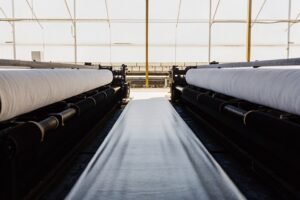
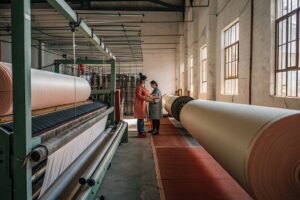
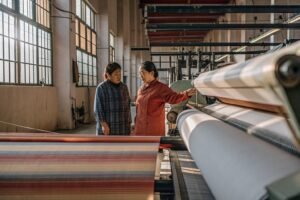
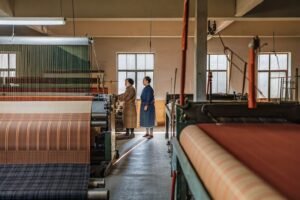
Then comes warping. For a high-density jacquard, we are carefully beaming up to 8,000 ends of individually colored threads onto a single beam, preserving a strict color sequence. If thread number 3,245 crosses over thread number 3,246, your pattern has a permanent visual flaw. This warping can take a full 48 hours for a 3,000-meter beam. Then the beam is knotted onto the loom, the jacquard harness is programmed, and the weaving begins. A complex 8-color weft jacquard weaves at roughly 150 picks per minute. For a 3,000-meter run, you’re looking at 7 to 10 days of non-stop weaving. Post-weaving, the fabric must be scoured, finished, inspected, and packed. Our end-to-end clock for a fresh yarn-dyed jacquard is 25 to 35 days. Last September, a European luxury menswear brand came to us in a panic after their Italian mill pushed their delivery by six weeks. We took a raw sketch of a geometric jacquard, dyed the yarn, and shipped the first 2,000 meters in exactly 28 days. They hit their Paris showroom appointment. That sprint was only possible because our dye house and looms run under one operational command.

What Is the Yarn-Dyeing Pre-Production Window for Multi-Color Weaves?
When a brand sends me a six-color geometric, the clock starts ticking long before the rapier moves. The yarn dye-to-weave window is the foundation, and if it’s compromised, the entire weaving quality suffers. For a multi-color weave, we’re often dealing with different fiber types in the same cloth—say, a mercerized cotton warp and a metallic lurex weft. Each fiber requires a completely different dyeing protocol.
The cotton warp might need a reactive dye cycle with a high-alkalinity fixation. The metallic weft isn’t dyed; it’s a film that requires a delicate handling and rewinding process to prevent metal fatigue. Our "window" is a parallel processing timetable. We don’t wait for the cotton to finish dyeing to start preparing the lurex. The day your PO is confirmed, two separate job tickets fire: one to the yarn dyeing vat for the cotton, and one to the metallic winding department. They run simultaneously. The critical path converges at the warping machine.
A common failure point in lesser mills is the "cold rest" time. Reactive dyed cotton needs a minimum of 12 hours of cold rest after drying for the dye molecule to fully penetrate the fiber’s core. If a rushed factory skips this and immediately warps the yarn, the color might measure correctly but will "bleed" on the wet scouring later, staining the cream weft and ruining the contrast. We enforce this cold rest period religiously in our scheduling software. In March 2024, a New York home-textile designer had a specific white-on-navy damask towel for a bridal registry. They needed the white weft to pop like fresh snow. The competitor’s sample had a blue-tinged white because of skip-rest staining. Our enforced 12-hour cold-rest window kept the white optical brightener pristine. The weave contrast was crisp. The window isn’t dead time; it’s a chemical curing step that separates a defined pattern from a watercolored mess.
How Does "Greige Mending" Add Hidden Days to a Rare Weave Timeline?
There is a secret time-bomb in rare weaving that no brand thinks about: greige mending. After a complex jacquard comes off the loom, it’s not a perfect roll. It’s a raw, dusty sheet containing hundreds of "weaving stops"—places where a warp thread snapped, the machine stopped automatically, and the weaver manually knotted a repair. Each knot is a potential defect.
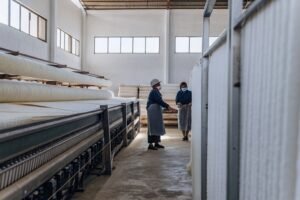
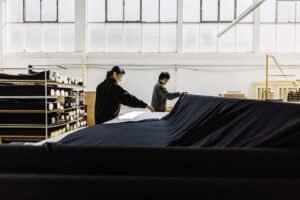
Before the fabric goes to the chemical-finishing hell—the scouring bath, the singeing flame, the stenter frame, which can all rip loose knots and create massive holes—it must be inspected and "mended." This is a manual process. A skilled worker sits at a table and uses a curved needle to thread the loose ends back into the weave structure exactly as the pattern dictates. For a solid fabric, this is fast. For an intricate jacquard with a specific, multi-float pattern, the mender must literally "read" the fabric and rebuild the missing motif stitch by stitch, using a magnifying loupe.
This is an artisanal step, not a machine one. A single 100-meter roll of a dense floral jacquard can have 50 or more minor warp stops that require 2 minutes of mending each. That’s 100 minutes of very careful, slow manual labor per roll. If a mill doesn’t schedule adequate mending capacity, the fabric sits in a queue for 4 extra days. We maintain a dedicated "Specialist Weave Mending" team of senior technicians who have been doing this for over a decade. Their eye for reconstructing a complex geometric pattern is uncanny. You can’t automate this easily. I caution every client: when I say 28 days for a rare jacquard, that includes 3 full days for inspection and mending. If your supplier quotes you 21 days, they are likely skipping the mending step and hoping the chemical finish glues the loose ends down. That’s how you get a roll of fabric that falls apart after the first wash cycle. It’s not a hidden delay; it’s a hidden investment in structural integrity. This detailed process of greige fabric inspection and mending is the unsung hero of a durable high-density textile.
How Can "Safety Warp" Holding Slash Bulk Re-Orders to 15 Days?
This is our secret weapon for long-term brand partnerships, and I’m going to explain it clearly because it’s how we turn a 35-day first order into a fast, 15-day follow-up cycle. A "Safety Warp" is a pre-wound, undyed or partially dyed warp beam that we hold in our conditioned storage vault specifically for you. We finance the raw material and the warping labor upfront, and we physically keep it off the production floor until your re-order email lands.
The logic is simple but powerful. The single longest serial delay in a bulk weave is warping. It can eat up 2 to 3 days just to creel the bobbins and beam the section. If you are a brand with a proven sell-through rate—say you’ve already done a first run of 1,500 meters of your signature stripe—we sit down and project your quarterly pull. We then pre-warp a second beam from the exact same dyed yarn lot, and seal it in a temperature-controlled, moth-proof vault. When your sales director calls on a Monday and says, "The stripe just got featured on a TikTok, we need another 800 meters yesterday," we don’t react with panic. We pull your beam from the vault, knot it onto the loom by Tuesday morning, and start weaving by Tuesday afternoon. The 3-day warping wait is completely removed from the critical path. What remains is weaving (5-7 days), finishing (3 days), and inspection (2 days). We run this "Vault-to-Loom" protocol for several established US contemporary brands, and their re-order lead time is a guaranteed 15 days. It changes their entire inventory management strategy from "risky stockpiling" to "confident agile response."

What Is the Capital Strategy Behind Holding Free Raw Yarn for Clients?
I know what a CFO reading this is thinking: "That sounds expensive. Who pays for the dead capital sitting in your vault?" We do. Shanghai Fumao carries the raw material cost of the safety warp on our balance sheet for up to 90 days for approved partner brands. We don’t charge a storage fee, and we don’t invoice the yarn cost until the beam is pulled and weaving actually commences.
How is that financially viable? It’s a partnership bet. We hold the yarn because we believe in your sell-through data. If you’re a brand re-ordering every 8 weeks with increasing quantities, the predictability of your pull-through justifies our interest in keeping that beam ready. Our cost for the raw yarn is fixed when we buy the bulk lot, so there’s no speculation. The alternative is financing a massive, risky inventory of finished fabric on your side, which costs you warehousing, insurance, and potential markdown losses. You’re a fashion brand, not a bank. By shifting the semi-finished raw material onto our balance sheet, we free up your cash to spend on marketing, influencers, and new design development.
A practical example: a Miami-based resort-wear label did this with us for a specific woven check in 2023. They had a "winner" fabric that sold out three drops in a row. Instead of them ordering 8,000 meters at once and praying they didn’t over-commit, we held a 2,500-meter safety warp for them. Every single month, they’d pull 600 meters exactly as needed. By January 2024, they had sold through the entire 8,000 meters in six separate drops without a single day of excess inventory. Their sell-through rate was 97%. That cash they didn’t tie up in excess fabric went directly into a Miami Swim Week activation that doubled their wholesale accounts. The safety warp strategy is a financial tool, not just a production trick.
How Does an Automatic Tying-In Machine Turn a Beam Change into a 30-Minute Task?
Once the safety warp beam is pulled from the vault, the traditional bottleneck was "drawing-in"—threading 8,000 individual yarns through the heddle eyes and reed dents. This is manual, precise, and took 4 to 6 hours for a complex Jacquard setup. Any speed gained in warping was partially lost here. But we’ve largely closed this gap by utilizing an automatic tying-in machine for repeat orders where the heddle pattern remains unchanged.
This is a brilliant piece of mechatronics. The machine takes the tail of the old warp (which exhausted on the previous run) and the leading yarns of the new safety warp. A needle system automatically selects a single yarn from the new beam and ties it to the exact corresponding yarn of the old beam with a precise, micro-weaver’s knot. It does this for thousands of threads in a continuous, automated sequence. The time is staggering: a fully automatic tie-in for a dense jacquard takes approximately 30 minutes of machine time, followed by a careful manual check of the knots as we slowly pull them through the harness. This replaces half a shift of meticulous manual labor.
I vividly recall a Friday afternoon distress call from a London streetwear brand. Their safety beam was pulled at 4:30 PM. Our technician ran the automatic tying-in machine immediately. By 5:15 PM, the new warp was fully tied and the loom was beating up the first weft picks of the re-order batch. We wove through the night shift and had 500 meters ready for the wet finisher by Saturday noon. The garment factory in Portugal received the fabric by the following Thursday. They shipped the re-stock hoodies ten days after the initial panicked call. Without that tying-in machine, the manual draw would have pushed the delivery past the weekend, missing a crucial London pop-up. That single piece of capital equipment is a significant reason a 15-day bulk re-order is a reality.
What Pre-Booked Finishing Slots Make the Difference During Peak Seasons?
Here is a scenario that kills brands every year between August and October: they approve a bulk quality, but it gets stuck in a "finishing queue." The weaving finished on time. The dyeing finished on time. But now your 2,500 meters are sitting on a greige trolley, wrapped in plastic, waiting for a gap on the stenter. And 20 other brands are also clamoring for that same heated hot-air machine to get their Christmas stock shipped. The delay isn’t a manufacturing defect; it’s a pure logistical capacity crunch. The factory’s eyes were bigger than its finishing belly.
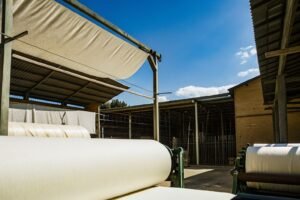
We solve this with a "Pre-Booked Finishing Slot" protocol for all bulk orders, particularly for rare styles. When our planning team confirms your 28-day lead time, we are not just assigning a loom slot. We are hard-reserving a specific 4-hour window on the stenter, the compactor, the sanforizer, and the inspection frame for 14 days in the future. This resource planning is visual. Our production manager uses a real-time scheduling dashboard. Your fabric doesn’t get a generic "finish this week" note; it gets a digital token that says "Stenter Line 2, October 15th, 0900 to 1300." If the weaving hits a snag and is an hour late, that window is already protected, and we shift the labor around. This methodology prevents the peak-season "black hole," where a fabric that exists physically simply cannot escape the factory because the dryers are running at 110% capacity. A Scandinavian outerwear brand specifically cited this reserved-slot practice as the reason they trusted us with their entire limited Vinter collection. They knew their heavyweight brushed coating would not be abandoned on a cold factory floor in October.

How Do We Manage a Stenter Frame’s Production Queue During Golden Week?
Golden Week in China (first week of October) is the single most dangerous week in the global textile calendar. The entire country stops. Most factories simply shut the gates, and when the workers return, they face a mountain of backed-up work, and the finishing queue becomes a week-long waiting list. Brands that haven’t pre-planned lose half of October.
We don’t treat Golden Week as a shutdown; we treat it as a "managed maintenance and skeleton-crew production window." Our stenter frames don’t all go cold. We schedule a planned, reduced-capacity running schedule months in advance. A small team of our most senior finishers, who live locally and don’t travel to distant provinces, voluntarily opts in to run just two of our six lines at a calculated speed, with a 3x overtime pay incentive. This is not a scramble; it’s a pre-agreed, expensive, but critical service.
The capacity is strictly limited and reserved specifically for "rare style, high-value bulk orders" that have a hard delivery date in the second week of October. If your bulk weave finishes on September 28th, we don’t wait until October 8th to process it. It’s inserted into the Golden Week skeleton-schedule and finishes on October 3rd. It lies packed and ready for the courier, while everyone else’s fabric is still naked greige in a queue. It’s a premium service. We charged a London-based label a slight peak surcharge for this last year for their luxury dress-weight wool coating. They paid the extra $0.15 per meter without blinking, because it meant their collection arrived in Selfridges two weeks before a key rival. The pre-booked slot plus skeleton-crew execution is the ultimate logistics weapon to weaponize a calendar that destroys less prepared vendors.
Why Do Post-Finishing Relaxation Hours Guarantee Selvage Stability?
This is a deeply technical detail that a purely sales-driven agent will gloss over. After a fabric is heat-set, stretched, and dried on the stenter at 160°C, the polymers inside the fibers are stressed. They are locked in a tense, "stretched" state. If you roll this hot fabric immediately onto a hard cardboard tube and shrink-wrap it for export, you are sealing in that stress. Two weeks later, when a cutter unrolls it in a factory, the fabric will have slowly, silently relaxed, causing a subtle shrinking of the width, and the selvages (the woven edges) will curl badly or even tear.
We enforce a mandatory "Resting Period" in our conditioned, climate-controlled staging room before packaging. For a rare, dense jacquard, we leave the batch to rest on a slack scray for a specific interval—a minimum of 8 hours—at a consistent 21°C and 65% relative humidity. This allows the yarns to reach their natural, relaxed moisture regain and the twist to "settle."
This physical settling prevents the dreaded "edge-curling" in cutting. A US denim brand from Texas learned this the hard way with a previous supplier. Their raw, heavy jacquard arrived in the US with the selvage curled into a hard, tight tube that couldn’t be spread flat on the cutter’s table, wasting 5% of the fabric’s yield. Our rest-and-relax protocol ensures the fabric arrives dimensionally stable and flat. It’s a risk that adds 12 hours to the "finished state" but saves thousands of dollars on the cutting room floor. I refuse to rush a 28-day rare weave into a box just to save a 12-hour settling cycle. That impatience is exactly what leads to a costly dispute after the container is unloaded. We manage the chemical anxiety of the polymer itself. Understanding the mechanisms behind fabric relaxation and shrinkage is key to grasping why this stage is non-negotiable for a dimensional guarantee.
Is Express Air-Freight Integration Reducing Total Lead Time by 7 Days?
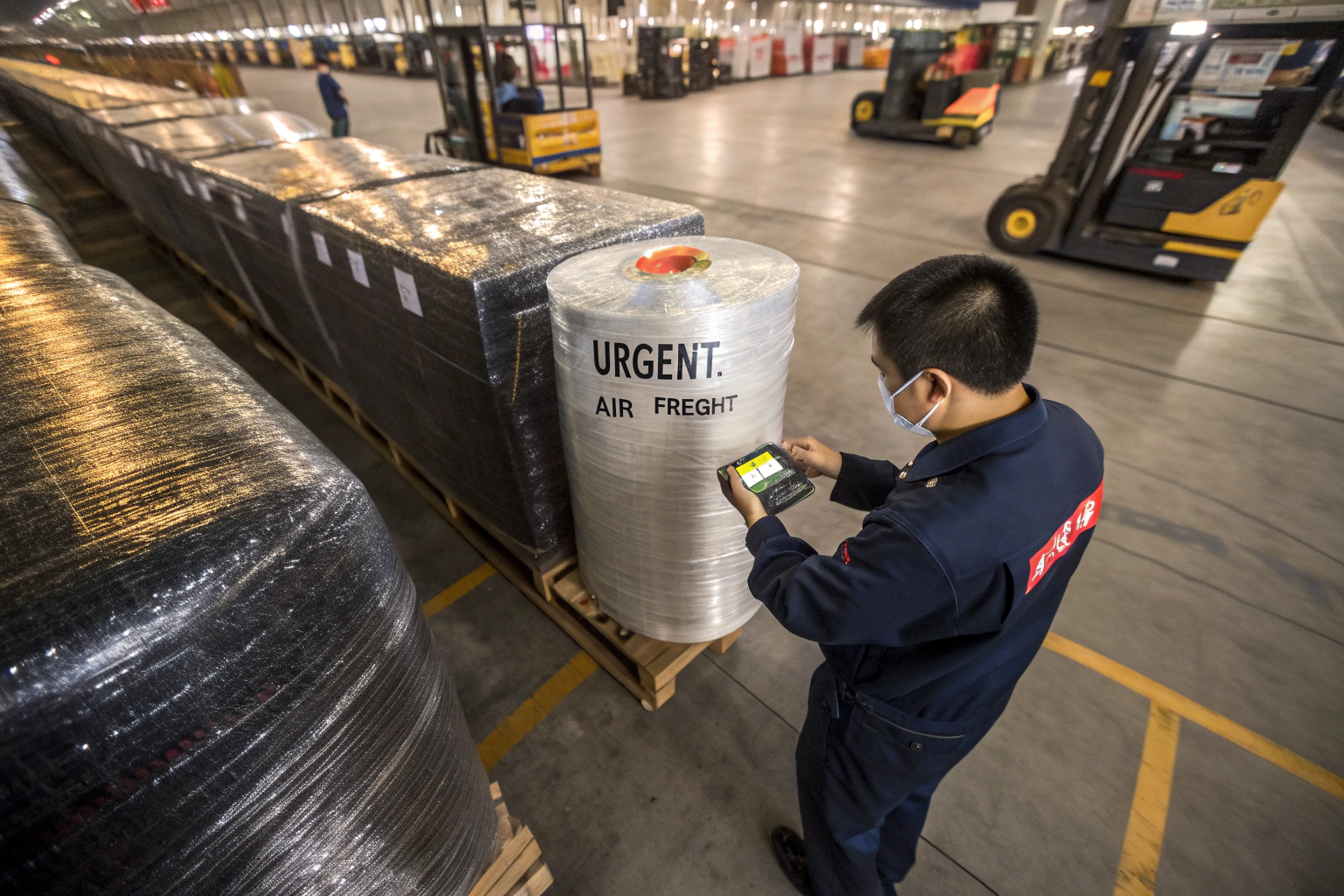
We can save you seven days on the ocean, and seven days can mean the difference between a full-price sell-out and a markdown disaster. I’m now telling fast-moving consumer brands that ocean freight is no longer the default "only option" for bulk fabric. By deeply integrating our export department with DHL and FedEx air-freight forwarding, and by using a consolidated "door-to-door" bonded service, we’ve reduced the total logistic lead time from Keqiao to a US warehouse from 22 days (sea) to just 6 days (air).
The economics have shifted. Yes, air freight is more expensive per kilo. But a 120-gram-per-square-meter fashion jacquard is lightweight. For a 500-meter specialty run for a capsule collection, the air freight surcharge might be $400. If that airlift gets the garments onto the rack two weeks earlier, capturing a full-price selling window, the brand’s margin increase massively outweighs the freight cost. We ran the numbers for an LA contemporary brand for a "cherry blossom" spring silk jacquard. The collection had a hard February 14th launch date. Sending the 700 meters via air cost an additional $680. Selling those blouses at full retail for an extra two weeks earned them an incremental $12,000 in gross profit, at zero markdown risk. That’s a 17x return on the freight investment. We now proactively propose an "Air-First Launch" strategy: we ship 30% of the bulk order via air to capture the urgent retail floor sets and key wholesale windows, and the remaining 70% via ocean to back-fill the stock. This blended logistics approach is what separates a strategic partner from a simple weaver.

Does a "Bonded Truck" Service Speed Up Customs Clearance for US Startups?
Customs clearance is a black box of anxiety for many US startups. They’ve heard horror stories of containers "randomly held" at the port of Long Beach for 10 days, incurring demurrage fees. When we ship via air, we use a consolidated "Air Express Customs Broker" with a pre-clearance protocol. The paperwork—the commercial invoice, the packing list, the mill certificate, the fiber content breakdown—is submitted electronically to US Customs and Border Protection while the pallet is still in the air over the Pacific.
This Triggers a "pre-clear" status. By the time the 747’s wheels touch the tarmac in Cincinnati (the DHL hub) or Memphis (FedEx), the fabric bundle is already conditionally released. A bonded truck simply drags the ULD (Unit Load Device) from the airport, through the customs virtual gate, and directly to a bonded warehouse for de-consolidation, or straight onto a local delivery van. There is no 3-day dwell time in a customs exam warehouse, unless a specific inspector physically flags the container.
A San Francisco-based athletic brand doing a tight holiday drop with us used this bonded truck express route. The fabric pallet landed at LAX on a Tuesday at 9 PM. It cleared customs via pre-clear at 10 PM. The bonded truck ran it up the I-5 directly to their cutting room in Oakland by 8 AM Wednesday morning. The cutters started work on the first shift. The total time from aircraft wheels-stop to factory floor was 11 hours. This frictionless flow is only possible with integrated express logistics that treat the fabric as a high-priority time-sensitive package, not a generic container on a slow boat. For a startup that needs to turn inventory into cash quickly, this is transformative.
How Does the "Container 48" Consolidation Reduce Vendor-to-Dock Time?
Many buyers think they need a full container load of fabric to get a good shipping rate. That’s a myth. We consolidate a service we call "Container 48." We combine multiple smaller bulk runs—your 300 meters of jacquard, another client’s 500 meters of dobby, yet another’s 200 meters of velvet—into a single, fast-tracked LCL (Less than Container Load) weekly sailing. The container is pre-booked to fill every Friday and sail on Sunday evening from Ningbo port, which is a 2-hour truck from our Keqiao factory.
This drastically reduces the "waiting-for-the-box" delay. Instead of your 30 rolls sitting in our warehouse for 12 days waiting for the next available booking spot in a bulk vessel, they catch the guaranteed weekly Friday slot. The ocean transit to the US West Coast is 12 days. The trucking to your door is 2 days. So the "Container 48" LCL service guarantees an 18-day dock-to-dock, compared to the 28-day average for disorganized LCL shipments that miss connections.
A New York contemporary womenswear brand used this for their entire Fall line. Their fabric was woven by the 2nd of the month, caught the Friday LCL ship, and was consistently unloaded at their New Jersey 3PL by the 20th. This predictable, rhythmic delivery transformed their production scheduling from chaos to a metronome. They could book their cutting room capacity three months in advance, confident that the fabric would arrive like clockwork. This oceanic reliability and the air-freight acceleration together form a complete, fast-track logistics arsenal. The advantages of consolidated shipping for smaller fashion brands are very real when your volumes aren’t full-container. It’s a systematic way to be fast and cost-effective, without the waste of half-empty containers.
Conclusion
Rare style bulk lead time is not a single number; it’s a meticulously engineered chain of critical events. The first, custom yarn-dyed jacquard sprint from sketch to a rolled, packed pallet takes 25 to 35 days. That accounts for the deep chemical cure of the dye, a specific cold-rest window, the precision of multi-color warp sequencing, and the artisanal greige mending that stitches the pattern back together. Our system shaves weeks off the standard by running parallel dye paths and removing idle queue time.
And the real game changes with your second order. The safety warp vault, the 30-minute automatic tying-in, the pre-booked finishing windows—even during the chaos of Golden Week—and the mandatory relaxation settling allow us to slash that re-order timeline to a rock-solid 15 to 20 days. Then the physical journey matters just as much. Our blended air-freight, pre-clear customs, and the "Container 48" rhythmic LCL push complete the loop, collapsing the transit from a nerve-wracking 3-week oceanic drift to a predictable 6-day airborne sprint. We accelerate not by rushing the machines, but by absolutely eliminating every moment of idle waiting.
Your buyer’s deadline doesn’t have to be a crisis. Let’s lock in your timeline now. Talk to our Business Director, Elaine, about the specific bulk lead time for your rare jacquard or dobby design, including a blended air-sea logistics proposal that gets the right stock to the right dock at the right speed. Your order doesn’t wait for a queue; it’s built to a schedule. Contact elaine@fumaoclothing.com to run a critical path analysis for your next drop. Let’s ship your fabric on time, every time.