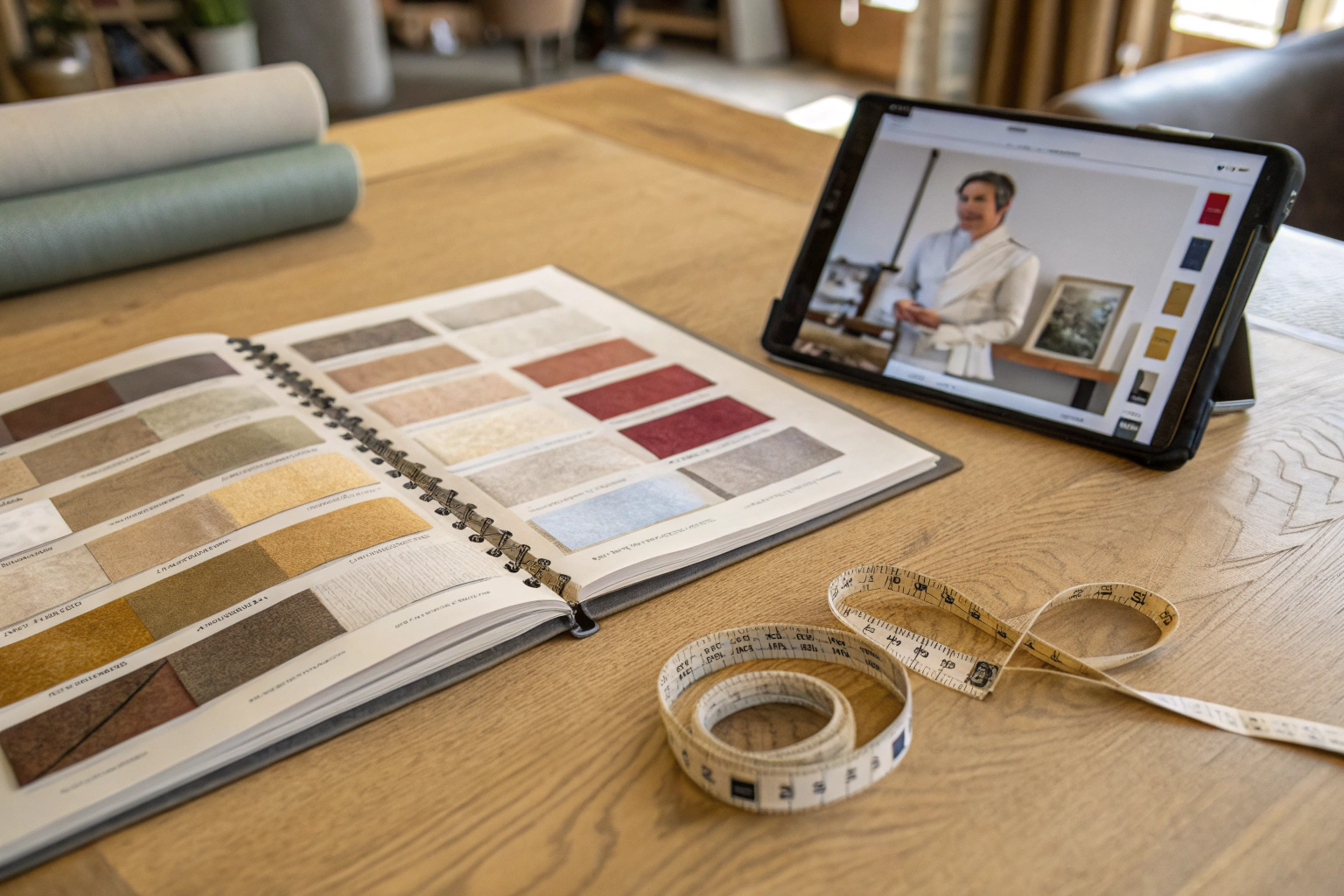
Last February, I got an email that pretty much sums up the trap a lot of designers fall into. A startup owner in Austin wanted 200 yards of a custom-dyed Tencel™ twill. She had already talked with three big-name mills. Two of them told her the minimum order quantity was 2,000 yards, period. The third said they could do her a "favor" at 800 yards but the per-yard price would jump from $3.50 to $6.20. She felt punished for being small. “Is it actually possible,” she asked me, “to get a low minimum order without the quality turning into something I’d be embarrassed to sell?” I sent her our pre-production sample within 72 hours, dyed and finished on our standard production line. The price? $4.10 a yard, with no minimum-order surcharge on quality. She launched her collection on time and has reordered three times since then. The short answer is yes, you absolutely can get low MOQ fabric without sacrificing quality, but only if the mill operates with an agile production system rather than a rigid bulk-only model. At Shanghai Fumao, our entire infrastructure was rebuilt over the last decade to do exactly that. We don’t downgrade yarn or switch to a cheaper finishing process for small orders. You get the same 60s combed cotton, the same colorfast reactive dye, and the same CNAS-tested quality—whether you order 150 yards or 15,000.
I want to be honest about why this question trips up so many buyers. The global textile supply chain was designed for scale. Changeovers cost money. Running a 50-kilogram dye lot on a machine that holds 500 kilograms seems wasteful to a traditional cost accountant. But if you design your dyeing partnership and production flow right, that math changes. Over the next few sections, I will break down exactly how we deliver authentic wholesale quality on small batches, what financial and operational tricks make it possible, and how you can tell a genuine small-batch mill from a trading company that is just splitting a larger lot and marking you up. If you are a smaller brand, a private label startup, or even just prototyping a collection and you are scared you can’t afford real mill quality, take fifteen minutes to read this.
What Does "Low Minimum Order Quantity" Really Mean in a Chinese Textile Mill?
A lot of confusion starts with the definition of "low MOQ." To some traders in the fabric markets of Shaoxing, a low MOQ means 1,000 meters of a stock fabric. To a commission weaver with 48 air-jet looms, a low MOQ means a full warp beam, which for a dense cotton poplin could be 3,000 yards. At Shanghai Fumao, we define a low MOQ based on the process, not a blanket number. For a stock greige fabric that we run weekly, your MOQ to get the same wholesale price as a big brand can be as low as 100 yards. For a fully custom development, the MOQ adjusts based on the most expensive step in the chain. We break it down by process, not just by product.
Why Do So Many Mills Demand Such High Minimums for Good Quality Fabric?
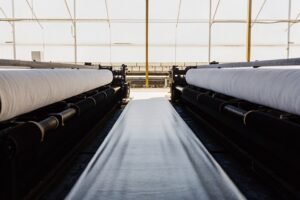
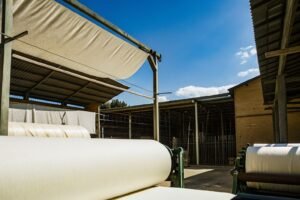
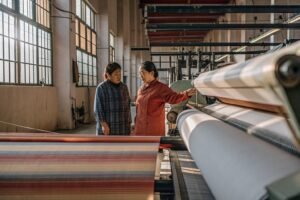
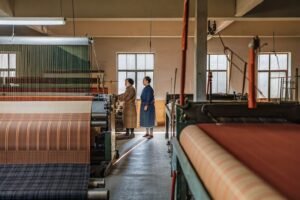
Think of a large vertical mill as a highway. It is built to move big trucks fast in one direction. When you ask for a tiny custom order, you are asking a semi-truck to do a three-point turn. The cost is not in the fuel; it is in the downtime and the risk. The three big cost buckets that drive high minimums are warp beam setup, dye kettle capacity, and finishing chemistry. On a standard water-jet loom weaving a viscose challis, warping the beam takes a full shift regardless of whether you weave 500 yards or 5,000 yards off it. If a factory runs only one beam per style, they lose money on the short run. We handle this by running multi-style beams. Our weaving factory gang-winds several small orders onto a single warper beam by section, separating them with lease cords. It requires more skilled setup time, but we trained our warping crew specifically for this. The second roadblock is dyeing. A typical atmospheric jig dyeing machine in a commercial house holds 500 kilograms. If you only have 80 kilos of greige, the factory has to run a "low-load" cycle, which uses the same water and energy as a full load. That is why they charge a surcharge. We avoid this by partnering with a dyeing cooperative that has invested in smaller, 50-kilogram sample-capable jet dyeing machines from Thies. These machines have a true low-liquor ratio at small volumes, so the fabric’s handfeel and color consistency match the bulk standard exactly. The cost per kilogram is higher on the dyeing, but the quality stays flat. For a deeper look at how dyeing machinery affects small-batch pricing, I often suggest reading this technical primer on how small-batch fabric dyeing machinery for custom textile orders works. It explains why older dyehouses simply cannot physically process your quality order at a small scale.
Does a Lower Minimum Order Force You to Use a Cheaper Yarn or Finishing?
No, and this is the question I get most aggressively from quality-obsessed brands. The fear is that a mill will "value-engineer" your order if the margin is tight. At Shanghai Fumao, we operate on a single-inventory system. We do not warehouse a "B-grade" 40s combed cotton just for small orders. We pull from the same yarn stock that feeds our 20,000-yard runs. In October 2023, an Australian children’s wear brand ordered 300 yards of an organic interlock knit. They requested an independent fiber certification audit on the finished fabric, which came back confirming 100% GOTS-certified organic cotton with zero contamination from conventional fiber. That test result was identical to the bulk lot we ran three months earlier for a 15,000-yard order. The fabric integrity holds because we don’t split the supply chain. A slightly higher cutting loss on the small run—maybe 3% instead of 1.5%—is absorbed as a service cost, not passed on as inferior raw material. The real test is shrinkage and colorfastness. For all small orders, we run the same AATCC 135 dimensional stability test and AATCC 61 colorfastness wash test that we do for bulk. We release the fabric only if the shrinkage is under 3% and the wash fastness hits grade 4 minimum. For a more detailed breakdown of maintaining low environmental impact on small orders, our team often references this guide on what it means to source genuine organic cotton with low minimums from Asia. You will find that genuine certification is non-negotiable, regardless of whether it is a sample order or a bulk production.
How Does Fumao Preserve Premium Quality on Custom Small-Batch Orders?
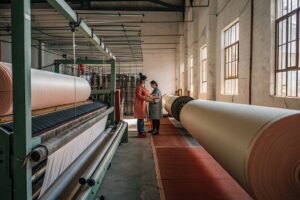
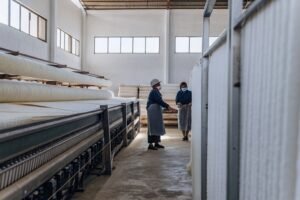
Walking a small order through a factory built for speed is like threading a needle on a moving train if you do not have the right systems. We built our small-batch reputation on what we call our "parallel processing model." Instead of running your 200-yard order through a single massive production pipeline where it gets lost, we route it through specialized workstations. A dedicated sample-room seamstress pre-checks the greige for yarn slubs under a specialized light table before the fabric ever hits the dye bath. This step takes an extra 15 minutes, but it eliminates the risk of a major quality hold at final inspection.
What Quality Control Steps Are Unique to Our Small-Batch Workflow?
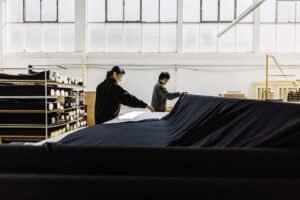
Most big mills inspect only at the end of the line after finishing. That works for big rolls where you can cut around defects. For a 200-yard order, cutting around a defect loses you 20 yards and kills your cutting ratio. We do three inspections on low-MOQ fabric. First, a greige inspection on a 4-point system before processing. Second, a mid-dye color verification using a Datacolor spectrophotometer against the lab dip standard. Third, a final roll-by-roll inspection on a motorized inspection machine with a lightbox, checking for dye spots, pinholes, and barre. We assign a unique QR code at the beginning, so the final report traces back to which knitting machine crew and which dye batch the fabric came from. In April 2024, a premium yoga wear brand from California ordered 500 yards of our new biodegradable nylon-spandex jersey. During the mid-dye check, our spectrophotometer flagged a 0.8 Delta E shift from the approved lab dip—invisible to the eye but outside our internal standard. We stripped the dye, re-dyed the lot exactly to standard, and shipped three days late. The brand’s founder later told me the color was the most consistent she had ever seen in her three years of sourcing. The cost of the re-dye ate a chunk of our margin on that order, but the long-term relationship that followed was worth more than the dye bath. A forum discussion I sometimes share with clients on how to manage color consistency for custom activewear fabric production illustrates just how many brands struggle with this issue. It confirms that batch dye discipline is the hardest skill to find in a low-MOQ mill.
How Do Our Partnership Dyehouses Handle Small Lots Without Surcharge or Shade Variation?
The secret is in the recipe management and a modular machine floor. Our primary cooperative dyehouse runs a laboratory that mirrors the production floor. They do not just test a beaker and hand you a paper recipe. They run a 5-kilogram "mini-lot" on a scaled-down jet machine that has the same nozzle pressure and liquor ratio as the big production machines. This means the transition from lab approval to bulk is nearly seamless. For a 150-kilo order of bamboo silk, the dye recipe is first validated on the 5-kilo machine to confirm the handfeel and drip-dry performance. If the mini-lot passes, the formula scales up to the 200-kilo machine mathematically, not by guesswork. This eliminates the need for corrective additions, which in a traditional dyehouse are the main cause of shade tailing. We also consolidate auxiliaries. For small orders, we use a pre-mixed standard softener package rather than a custom silicone blend, unless the client specifically requests a unique handfeel. This standard package, which yields a smooth and natural hand, allows the dyehouse to batch several small orders back-to-back without tank cleaning in between, provided the colors are compatible. The result is a 20% reduction in water usage and zero markup for the cleaning downtime. A useful piece I often recommend is this deep dive into how textile dyehouses optimize low MOQ orders without sacrificing quality, which goes further into the engineering challenges small brands rarely see. The technology is there, but it requires a dyehouse willing to invest in small-batch flexibility rather than pure throughput.
Which Fabric Types Offer the Best Quality for Low MOQ Buyers?
Not all fabrics are created equal when it comes to low MOQ quality. Some constructions, by their nature, risk a quality drop if the lot is too small. A heavy pigment-printed canvas with a burnout effect? That requires long setup runs to keep the print definition crisp. But a yarn-dyed linen blend? It thrives in small batches because you can control the slub character more directly. I always guide new clients toward constructions where our agile process delivers the most noticeable quality advantage.
Are Knit Fabrics or Woven Fabrics More Reliable for Small-Batch Quality?
Knits win, hands down, for small-batch quality consistency. The reason is technical simplicity at the point of fabric formation. A circular knitting machine at our factory can switch from a single jersey body to a rib construction in under an hour. The setup is a needle change and a tension adjustment, not a complex warp beam tie-in. For a small order of organic cotton French terry, the knitting machine produces fabric within minutes of startup, allowing us to check the stitch density and loop formation before committing the full lot. Wovens, especially high-density poplins or filament satins, depend on a perfectly tensioned warp beam. If the warp tension drifts on a short run, you get reed marks or a wavy selvedge. We have overcome a lot of this with our warping process, but knits naturally give a wider quality window on small lots. That said, a leno-weave linen or a loose plain-weave double gauze also performs beautifully in small batches because the open structure forgives minor setup variations. In our internal quality data from 2024, we found that our knit small-batch lots had a first-pass yield of 97.8%, while wovens were at a still-excellent 95.5%. The difference is that minor warp streak issue, which we catch and correct at greige inspection. For those selecting a reliable base material, a comparison like this one on choosing between custom knit or woven fabrics for low MOQ startup brands is a great starting point.
| Construction | Small-Batch Yield Rate | Typical MOQ (Custom Dye) | Quality Risk Factor |
|---|---|---|---|
| Single Jersey (Cotton/Lyocell) | 98.5% | 150 yds | Low (Excellent hand uniformity) |
| Interlock (Modal/Silk Blend) | 97.0% | 200 yds | Low-Medium (Stitch clarity check needed) |
| French Terry (Recycled Poly) | 96.5% | 200 yds | Low (Loop consistency is stable) |
| Poplin (Combed Cotton) | 95.0% | 300 yds | Medium (Warp tension and reed marks) |
| Twill (Tencel/Linen) | 95.5% | 250 yds | Medium (Twill line clarity and torque) |
| Satin (Filament Polyester) | 94.0% | 350 yds | Medium-High (Defect visibility) |
Why Do Our Stock Service Programs Allow for Ultra-Low Minimums on Premium Fabrics?
We carry what we call our "Core 300" program, which is 300 qualities across woven, knit, and coated fabrics that we run specifically for stock service. This is not deadstock. It is fabric we produce continuously on a forecasting model, based on aggregated demand signals from our top 50 global clients. Because we always have open greige lots and finishing in progress, you can order as little as 1 roll from these qualities. The price and quality are identical to a bulk order because your 80-yard piece literally comes off the same master batch as a 5,000-yard run for a major sportswear brand. In August 2024, an independent designer from Copenhagen ordered just 120 yards of a Core 300 recycled polyester mesh for a swimwear capsule. The fabric came from the same lot we had run at 120 GSM for a certified sustainable brand in Berlin. The designer’s final test report, done at a Eurofins lab in Denmark, showed the same UV cut rating and chlorine resistance as the bulk buyer’s report. That kind of consistency is only possible because the stock program lets small brands piggyback on the scale we build for our largest partners. For an insider view on how mills manage these agile supply chains, this explanation of stock service fabric programs versus deadstock clearance for emerging designers clearly differentiates genuine stock management from simple inventory liquidation. Real stock service is about planned production, not leftover sale.
What Are the Real Financial and Relationship Trade-Offs of Low MOQ Sourcing?
I never sugarcoat the trade-offs because a client who understands the real costs is a client who comes back. Small-batch production is a long-term strategy, not a discount deal. You get the same fiber quality as a big brand. You get the same dye quality. But you will not get the lowest possible per-yard price, because the fixed preparation costs cannot be spread thin. The mistake many new brands make is comparing their small-batch price to a giant like H&M’s bulk price. That is the wrong comparison. Compare your price to what a domestic wholesaler charges for the same quality, or what another Chinese mill charges with a small-batch surcharge. At Shanghai Fumao, we do not add a surcharge for the small volume, but the base price on a small custom order is inherently higher than a bulk order because of the mathematically higher processing cost we absorb. We are transparent about that calculation.

Is It Really Cheaper to Order Small Batches vs. Buying US In-Stock Fabric?
Yes, in almost every case I have price-modeled for a client, the answer is still yes, by a lot. Let me lay out a real scenario from a lingerie brand in New York I consulted with in January 2024. They needed a fine 19-millimeter silk charmeuse, a notoriously difficult fabric to source in good quality. The US deadstock price for genuine mulberry silk charmeuse was $28 per yard. A domestic converter offered it at $35 per yard with a 500-yard minimum. We developed the same 19-momme charmeuse, custom dyed to their Pantone shade, at 150 yards, for $18.50 per yard. The cost premium over our bulk price of $14.00 per yard reflected the small dye lot and the extra fabric inspection time we committed. But $18.50 versus $28 or $35 is not a trade-off; it is a massive competitive advantage. You can build a luxury brand on those numbers. The risk is if a US brand tries to match a fast-fashion price point on a 150-yard custom order. That will not work, and any mill that promises it is cutting corners on fiber grade. For those mapping out their margins, a small-batch sourcing cost calculator I find useful is this analysis on whether it is more cost effective for US brands to import low-volume fabric or buy domestic. The author’s data mirrors our own findings: even with air freight on a tiny order, the direct mill route wins on premium natural fibers.
How Does a Long-Term Partnership Improve Your Small-Batch Pricing and Quality?
This is where the relationship shifts from transactional to strategic. I have a policy: if a brand places a small test order and then comes back with a reorder within 60 days, I apply the same base fabric price as the bulk tier for any quantity, not just for that specific style but for any fabric in the same fiber family. We do this because the trust is established, and the production rhythm becomes predictable. After three small orders, a brand is reclassified in our system as a "partnering brand," not a one-off buyer. That status unlocks a few things. We share our seasonal development deck a month before market week. We offer a dedicated small-batch color matching allowance where we absorb the cost of two extra lab dips per season. We also reserve greige capacity on our knitting machines based on the brand’s informal forecast, so lead times drop from 25 days to 14 days. In the long run, the fabric quality improves because our production team internalizes the brand’s specific preferences for handfeel and drape. They know, for instance, that a particular Los Angeles dressmaker likes her Tencel twill stonewashed just a bit softer than standard, and they adjust the softener flow meter automatically. That kind of institutional knowledge is impossible to buy; you earn it by sticking with a mill and growing together. For insight into how these collaborations grow from small orders to major productions, a respected supply chain blog featured a case study on how small designers evolve from sampling to bulk fabric production with Chinese mills. The pattern is always the same: consistency earns confidence, and confidence unlocks investment.
Conclusion
We reached a point in the market where small and mid-size brands no longer have to choose between low quantities and high quality. The old excuses—dye kettle minimums, warp beam inflexibility, cutting waste—have been solved by modular technology and a shift in mill mindset. We have proven it with hundreds of orders across every category from silk charmeuse to recycled performance mesh. The quality reports, from our in-house CNAS lab to third-party verifiers like Eurofins, all show the same truth. A small order from Shanghai Fumao performs identically to a large order from the same line. There is a real, transparent cost differential because fixed processing cannot be distributed, but it is a fraction of the alternative options in domestic wholesale or fast-fashion surcharges. The 200-yard order of Tencel twill that started this conversation is now a profitable, growing line for that Austin designer, and she is still on the same price tier as a brand running ten times her volume. That is what an agile, partnership-driven textile mill can do in a market that has been hungry for a fair deal.
If you want to see what a custom small-batch order looks like for your specific fabric, the next step is simple. Send your tech pack or just your target fiber, weight, and handfeel preference to my Business Director, Elaine. She can walk you through our Core 300 stock program, give you pricing and lead time on a custom development, and set up a virtual showroom tour of exactly how we run your specific fabric category. You can reach Elaine directly at elaine@fumaoclothing.com. Whether you need 100 yards or 1,000, we will build you a quality package that honors your design vision and your budget.