
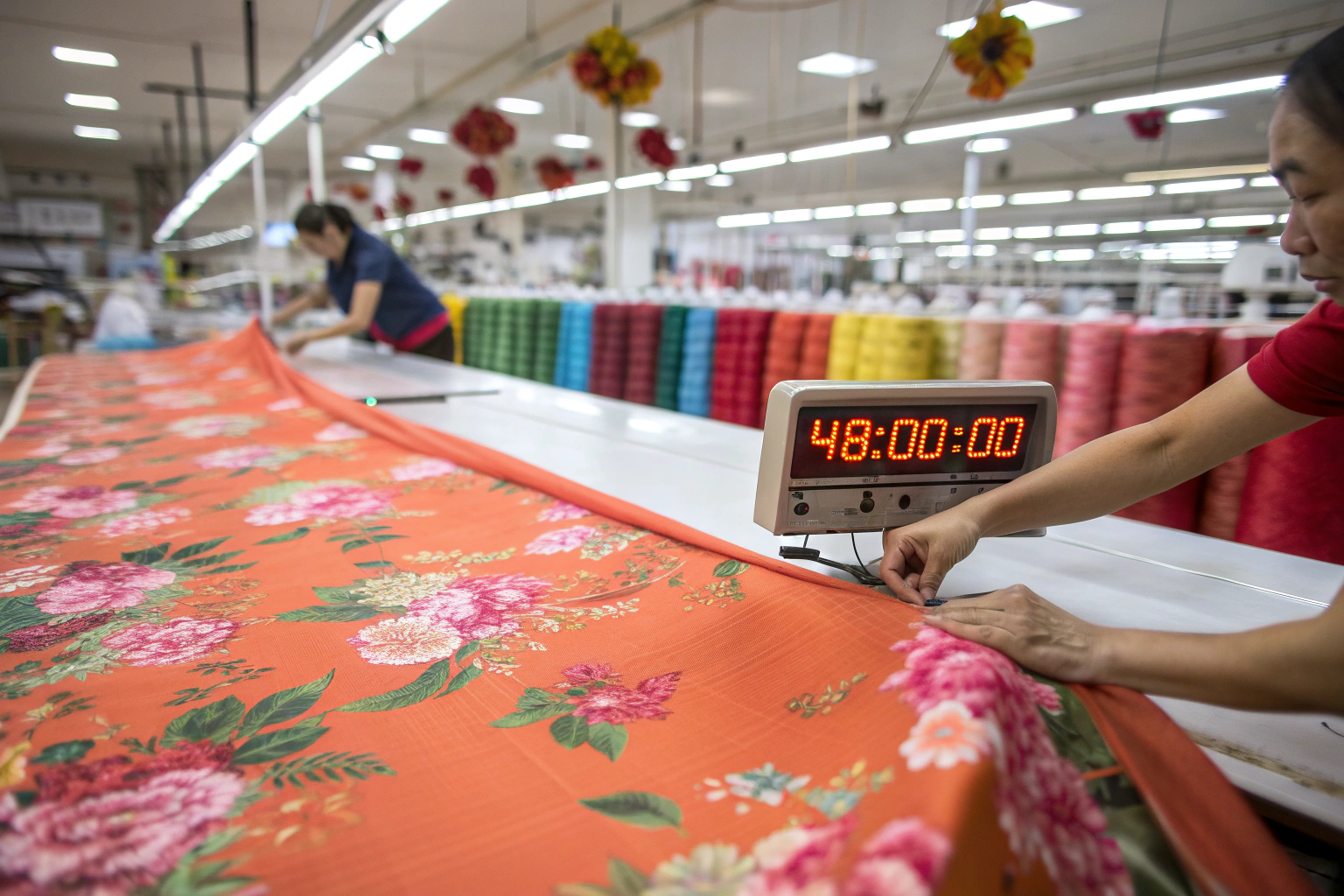
You have a sketch that’s burning a hole in your notebook. Maybe it’s a watercolor of a blurred floral, or a technical flat of a bomber jacket with a weird honeycomb texture. You’re dreaming about getting the perfect sample strike-off in your hands before a crucial buyer meeting in ten days. But every time you’ve asked a supplier for a custom sample, they’ve quoted you "two to three weeks, if we have the yarn." And then it arrives late, and the color is wrong. This isn’t just frustrating; it’s the difference between locking in a $50,000 purchase order and losing it to a competitor who moved faster.
Let me give you the real, no-fluff timeline we live by at Shanghai Fumao: 48 hours for a digital print strike-off, 72 hours for a solid lab dip, and 5 to 7 days for a finished jacquard or dobby loom state sample. I’m not talking about pulling a stock swatch off the shelf and calling it a "custom development." I’m talking about taking your Photoshop file or your physical Pantone chip, and engineering a brand-new textile from the yarn up, guided by a 48-hour rapid launch protocol that we’ve baked into our Keqiao operation. Here is exactly how we compress time without cutting corners, and how you can plug into this speed machine.
What Is Fumao’s 48-Hour Rapid Lab Dip Protocol?
When a new client hears "48-hour lab dip," they usually think we are cutting a dangerous corner. They assume we are rushing the dye cycle, skipping the fixation, or guessing the recipe. The truth is the exact opposite. We hit that speed because we have pre-eliminated 90% of the waiting time that a traditional mill builds into their process. In a standard dye-house, the chemist doesn’t start mixing until the morning meeting. The fabric doesn’t get scoured until the afternoon shift. The sample sits on a trolley waiting for the next available machine. That’s not dyeing; that’s a queue.
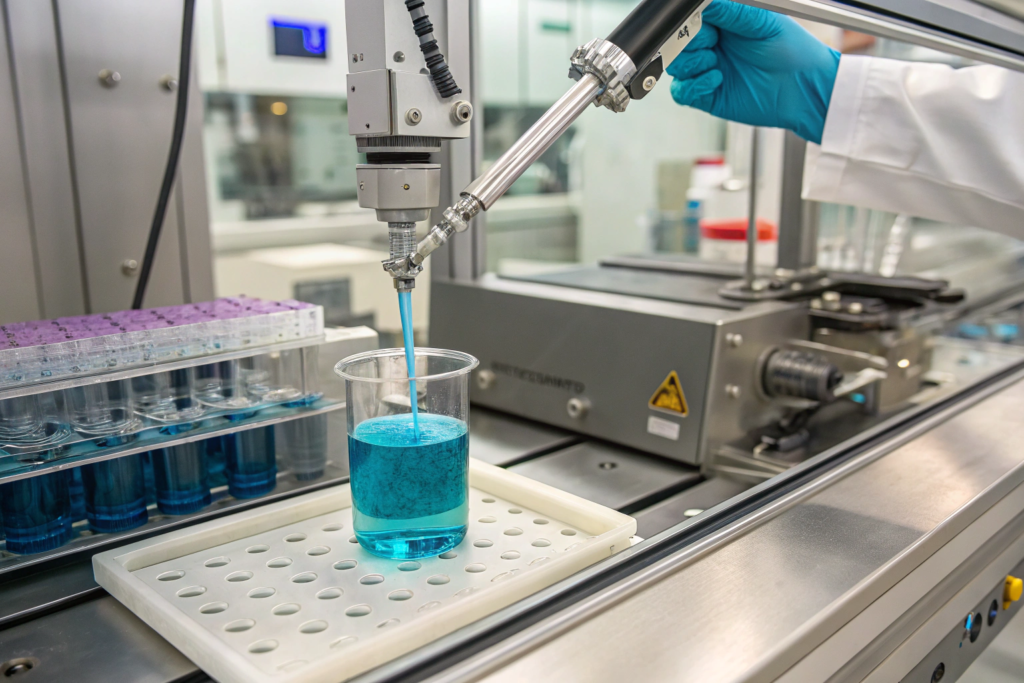
Our protocol is designed to treat a single sample request as a manufacturing emergency—a "hot-job" that bypasses the queue entirely. We have a dedicated miniaturized Rapid Lab that operates independently of our bulk production line. When your email hits my merchandiser’s inbox, it is instantly parsed. If it’s a Pantone code for a solid color on a standard base, the system generates a spectrophotometer reading. The automated dispensing system spits out the mother solution of the three base dyes. Simultaneously, our lab assistant grabs a pre-scoured weight of the fabric from our "Ready-to-Dye Stock Shelf." Within 45 minutes of your email, the fabric is in the pot machine. The IR dyeing cycle runs a 60-minute ramp profile to match bulk conditions. The fabric is then dried and hand-fed to our quality team. The entire physical processing takes about 4 hours. The rest of that 48-hour window is for the conditioning, the color assessment under D65 lighting, and the courier packaging. That speed comes from parallel processing, not a "quick and dirty" chemical cheat. A client from a major athleisure brand once told us our 48-hour promise was a "marketing myth," so they tested us with a tricky mint green on a recycled poly. We shipped the dip 42 hours after their PDF arrived. They’ve been a loyal partner ever since.
How Does the Pre-Scouring of Greige Stock Eliminate Standard Delays?
You might not realize this, but a huge chunk of sampling delay has nothing to do with color. It’s the "prep." Greige fabric, straight off the loom, is filthy. It’s covered in a waxy coating called sizing, along with natural oils and dirt from the factory floor. If you try to drop dye onto this raw fabric, it absorbs unevenly, giving you a patchy, pale, worthless match. Most mills include the scouring step in the sample timeline. That adds 2 to 3 days right there.
We eliminated this bottleneck by pre-scouring our most popular base fabrics in bulk. In our sampling warehouse, we keep rolls of "PFD" (Prepared for Dyeing) fabrics for our top 20 qualities: 40S cotton jersey, 75D polyester satin, Nylon 6.6 mechanical stretch, and our viscose twill. These fabrics have been bleached, scoured, and optically brightened (or not, depending on the target shade). They sit sealed in plastic on ready-racks. When your sample request comes in, the lab technician just walks over, unrolls a meter, cuts it, and throws it straight into the dye pot. We measure the residual moisture content with a hygrometer to ensure the pre-scour hasn’t left any alkaline residue that would throw the pH off. This pre-emptive action saves about 50 hours versus a traditional mill that has to stop a bulk jigger, load your small piece, scour, and rinse. That’s our speed secret: we moved the delay into the past, before you even called us. Shifting the importance of proper pre-treatment in textile processing from a sequential step to a parallel one is how we engineer speed.
Can We Run a "Hot-Job" Through Our Dedicated Sample Stenter Frame?
After the dye cycle comes the drying and finishing. In a standard factory, your tiny 10-gram sample has to wait for a gap in the massive 100-meter bulk stenter frame. That gap might not come until the next batch changeover, which could be 8 hours away. While the wet, dyed silk swatch is sitting in a plastic bin, it’s "bleeding"—the migrating water carries the dye particles around, creating a splotchy disaster.
We bypass this by installing a dedicated, bench-scale "lab stenter" right inside the color lab. This is a miniature pin frame that can handle a 40cm x 40cm swatch. It has a controlled hot-air flotation drying system with an independent PID temperature controller that can replicate the exact 140°C / 3-minute conditions of the bulk line. For a high-value request, we literally call a "Code Red" on the factory intercom. The lab technician carries the wet swatch in a sealed ziplock from the dye tube and walks it 10 meters to this dedicated lab stenter. The drying cycle starts within 60 seconds of the rinse ending. The dwell time, the air velocity, and the stenter width overfeed are all dialed in to match the bulk profile. This eliminates the variable of "air-dried" versus "stenter-dried" hand-feel. The sample you receive feels exactly like the future bulk fabric, not like a crinkly air-dried artifact. That’s the only way to guarantee bulk-to-lab correlation for the hand, not just the shade. Integrating Shanghai Fumao lab-scale finishing within our lab is an investment that pays off every time a client’s technical designer confirms the sample "drapes exactly like we expected."
Why Can Fumao Produce a Jacquard Loom Sample in Under 7 Days?
Jacquard sampling is the Mount Everest of textile deadlines. Big Italian mills quote eight to twelve weeks. They know you’re locked into their creative prestige, so they make you wait. For an independent brand, a 3-month sampling delay is a season killer. At Shanghai Fumao, a 7-day loom-state jacquard sample is not a myth; it’s a specific production discipline. The industry norm is slow because the warp preparation—threading 8,000 individual heddles in the correct order—is a tedious manual task. A mistake there, and the pattern looks like a broken television screen.
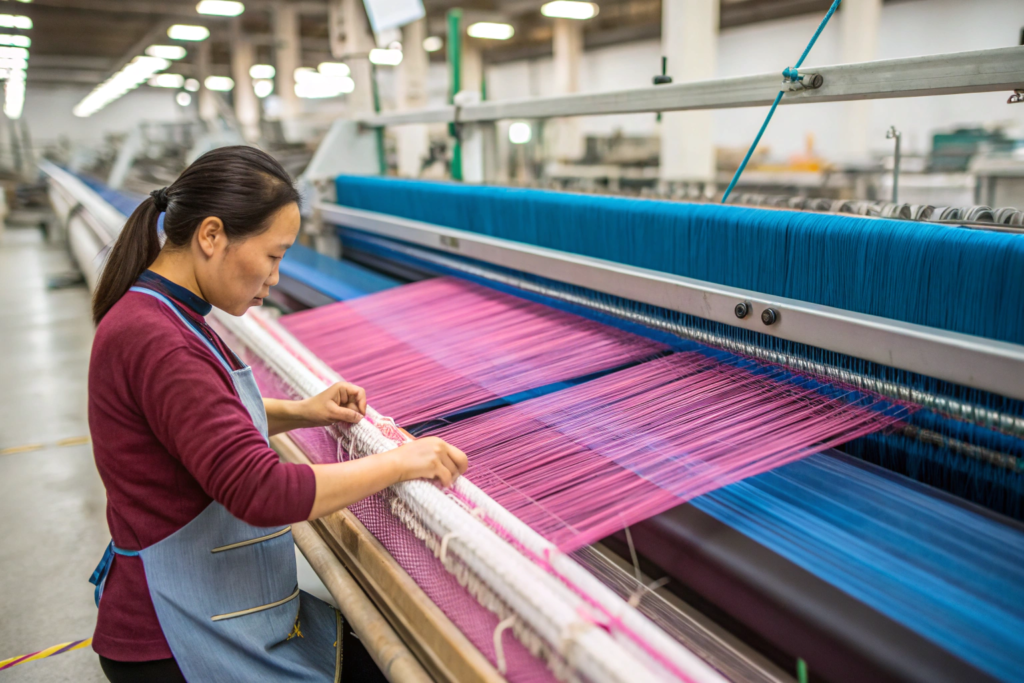
We beat this timeline through "warpless sampling" or ultra-fast sectional warping. For a physical loom-state strike-off, we don’t necessarily tie into a massive production warp. We use a dedicated sampling harness system with a rapid-thread automatic drawing-in machine. Our database of 30,000 weave files means we aren’t drawing the pattern from scratch; we are selecting, modifying, and casting the pick sequence. You send us a sketch of your abstract chevron jacquard. Our CAD designer digitizes the repeat in 2 hours. We load the file into the electronic jacquard head. Simultaneously, the warping department pulls a "sectional warp" from our stock of undyed viscose, cotton, or poly, on a miniature sample warper—a process taking 3 hours instead of a full day. The weaving run on a dedicated small-format sample loom takes about 4 to 6 hours for 5 meters of development fabric. We do not wash the fabric if it’s a dry-loom-state review; we just cut it, code it, and express it. That’s how a German avant-garde fashion student received a run of 3D metallic diamond-lattice jacquard swatches in exactly 6 days from approval. She used them in her graduation show, and it launched her label.
What Advantages Does a Dedicated Sample Loom Offer Over a Bulk Warp?
A bulk warp is like a freight train with 10,000 kilos of cargo. It’s incredibly efficient for long hauls, but it takes a mile to stop and start. Threading a custom design into a huge bulk beam for a 5-meter sample is financial suicide; the downtime costs thousands of dollars in lost production. A dedicated sample loom is built specifically for agility.
Our "mini-jacquard" sample machine is a 24-hook head with a 20-inch weaving width. It’s a stripped-down version of our giants, but the shedding mechanism (the lifting of the warp threads) is identical. The advantage is the "creel change." On a bulk loom, changing colors means pulling out and retying 8,000 bobbins. On our sample loom, we use a modular creel with snap-in colour packs. If your design needs to test three different weft colors, the weaver can switch the weft cone in under 5 minutes. We can run 3 versions of your pattern in a single morning.
A New York interior design firm sent us a complex geometric motif for a new hotel drapery. They were stuck between a matte gold and a burnished copper weft. On a bulk loom, evaluating those options would cost $3,000 in separate warps. On our sample loom, we wove a "sampler blanket"—a single 3-meter piece that contained 12 different layout variations and all three weft colors alternating in stripes. The designer held it up to the light in her Manhattan office, picked the copper/gold stripes instantly, and immediately signed the purchase order. That "test drive" capability saves brands from buying a $15,000 bulk lot that they’re unsure about. The visual and textural options are laid out in your hand, not on a screen.
How Does Our Component-Level "Knock-Down" Assembly Accelerate Novelty Yarn Sampling?
Exclusivity usually lies in the novelty yarns: a neon multi-colored slub or a thick, fuzzy bouclé accent stripe. Sourcing a custom fancy yarn usually takes 3 weeks from a spinner. That kills our 7-day deadline. We solve this by keeping a "component yarn library" of binders, effects, and core yarns. We don’t wait for a spinner; we assemble the novelty thread ourselves in our twisting facility, on-demand.
Think of it like a modular synth for sound, but for textiles. A bouclé yarn is just a binder thread wrapping an effect thread tightly around a core. We stock standard core yarns (like a 70D nylon) and then dozens of effect yarns (slubby cotton, nubby wool, metallic tape). When your design calls for a "random turquoise blue fleck in a black twill," we don’t call a spinner. Our technician programs a hollow-spindle fancy yarn twister right in our R&D room. The machine latches the binder, feeds the black core and the turquoise slub at unequal speeds, and creates the exact novelty yarn in 20 minutes. We then weave that fresh yarn directly onto the sample loom.
I’ve used this to save a pitch many times. In particular, a Japanese avant-garde label wanted a "paper yarn" accent that looked like crushed washi paper. We didn’t have an exact match, so we took a textured flat nylon tape from our component stock and manually crinkled it through a heated gear-crimping device we built ourselves. We made the first 50 meters of the "pseudo-paper" yarn in 2 hours. The designer flew in, saw the fabric sample on the table, and couldn’t tell if the yarn was genuinely imported from a Kyoto paper artisan. That component-level, DIY "knock-down" assembly of complex yarns is what separates a textile manufacturer from a simple fabric vendor.
How Do Digital Print Strike-Offs Go from File to Fabric in 48 Hours?
Digital printing is the reason the fashion cycle has gone from two seasons to 52 micro-seasons a year. You can create a million colors with zero screens. But speed without color accuracy is just expensive garbage. You have an RGB file on your screen, but the printer uses CMYK plus specific spot colors. If the RIP software (Raster Image Processor) isn’t calibrated to the exact fabric base, your "blush pink" comes out looking like a raw sausage.
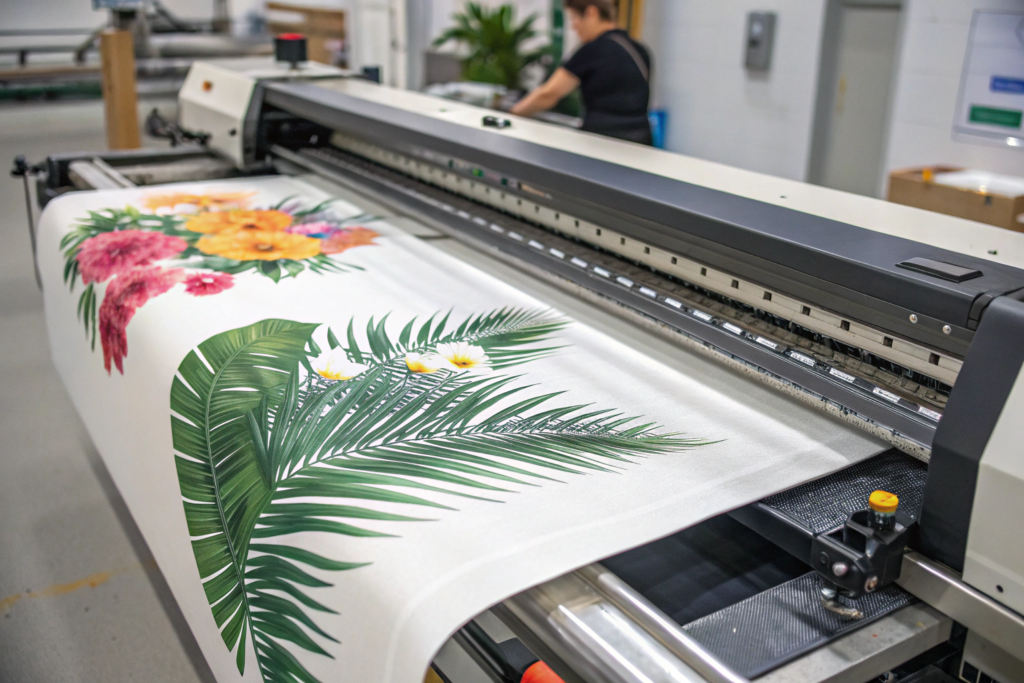
Our 48-hour digital strike-off promise runs like an IT server room, not a traditional print table. Your file, usually a TIFF or a layered PSD, arrives on our secure portal. Within the first hour, our CAD team separates the colors, establishes the ICC color profile specific to the fabric type (a polyester satin requires a totally different profile from a cotton poplin), and runs a "soft proof"—a calibrated digital representation that predicts how the ink will react. We then cast a physical "meterage swatch" on a single-head digital sample printer that uses the exact same Kyocera print heads and acid/pigment inks as our bulk machines. The total print time for 1 meter is about 20 minutes. The post-processing is the real time-eater: we have a dedicated high-frequency fixation unit for the sample room that can steam-fix a reactive print in 25 minutes, not the 90 minutes a bulk ager takes. The swatch is then washed and dried. We courier it the same evening, and our shipping agent scans it onto the DHL overnight network. A Brooklyn designer clicking "send" on a Monday can have a physical strike-off in her hand on Wednesday. That’s digital download speed, applied to physical cotton.
What Is ICC Profile Calibration and Why Does It Kill Sampling Time If Ignored?
This is critical to understand if you value your brand’s colors. A monitor uses light (RGB) to create color. A printer uses ink (CMYK). The color gamut—the range of possible colors—is completely different. Cyan ink can never be as bright as a screen’s cyan light. Your bright screen blue will print as a dull, purple-ish blue. When a printer tells you the test print isn’t ready, 90% of the time it’s because they are trying to visually match your screen expectation by manually tweaking the magenta down, running 4 test strips, and wasting 4 hours of ink and fabric. That’s guessing.
We scientifically map the gap using a spectrophotometer and ICC profiling. For every single fabric we stock, we have a pre-built ICC profile that tells the printer, "Fumao’s Poly Satin absorbs 58% more cyan than standard, so dial back the cyan head voltage by 12%." When your file comes in, our color management software automatically maps your RGB data into our specific CMYK+Spot profile. We print a linearization chart, measure it, and adjust the curve. A process that takes a sloppy operator 4 hours of trial-and-error takes our calibrated system 30 minutes.
A tragic example I saw with a competitor involved a Los Angeles swim brand that sent a "electric neon tangerine" file. No default profile can hit true neon; neons are out-of-gamut. Instead of making a custom spot profile, the competitor just printed it as a muddy orange and shipped it. The brand lost two months rejecting the dips. We do it differently. Our sampling CAD head sees a neon request and instantly pulls our "Fumao Neon Gamut Package"—a set of fluorescent pink and yellow spot inks that physically live in our printer for this exact demand. The ICC profile maps the target orange to those vivid tank colors, giving an accurate, blinding neon strike-off the first time. Scientific color management, using precison ICC profiles for digital textile printing, is the difference between 48 hours and a month of visual errors.
Can We Simulate Rotary Screen Textures Using a Digital Hybrid Application?
Digital prints are flat. That’s their one aesthetic weakness against traditional rotary screen printing, which can lay a thick, 3D layer of gold foil or a rubbery high-density ink. Gen Z brands want the raised "puff" or the glossy "gel" texture on a digital base. The solution is a "hybrid application" within the sample room.
This is something we pioneered for rapid sampling. We take the digital base print off the inkjet machine with perfect photographic registration. Then, instead of waiting a week to engrave a traditional rotary screen cylinder for the tactile element, we use a laser-cut "micro-screen" plate that fits a manual flat-bed sample press. Our technician laser-cuts a thin polyester film with the exact pattern of the raised gel or foil. This takes 30 minutes. The film is glued to a magnetic frame. We then hand-print the high-density clear puff ink or the adhesive for the metallic foil directly over the digitally printed base, using the registration marks.
The result is a 1-meter sample swatch that has the sharp, four-color process imagery of a digital print, combined with a 0.8mm thick, rubbery 3D surface that feels like a classic rotary screen finish. The time from concept to a finished hybrid sample is 72 hours, not 3 weeks. I recall a specific case from October 2023 when a Parisian streetwear brand demanded a "wet oil spill" texture on a digital all-over photo print of a cityscape at night. We printed the photo base digitally. Then we mixed a high-gloss, clear silicone PVC-free ink, laser-cut the trap pattern, and screen-printed the "oil slick" shapes on top. The hybrid sample looked like the fabric was covered in glossy, wet resin droplets. They used the sample to secure a €200,000 order from a Korean department store. They made the sales window because we didn’t split the process across two different factories. That hybrid agility is unique to a vertically integrated house.
Why Does Local Weft-Knit Development Beat Overseas Sampling for Activewear?
Nothing kills a fitness brand faster than a lengthy overseas knit development timeline. Activewear is a war of seconds—a 10-second 40-meter sprint fabric must arrive before the summer gym season. You can’t wait six weeks for a knit-down sample from a distant supplier who doesn’t understand your stitch requirements. Our localized weft-knit vertical setup operates on a simple mantra: "Develop on a Monday, ship on a Friday."
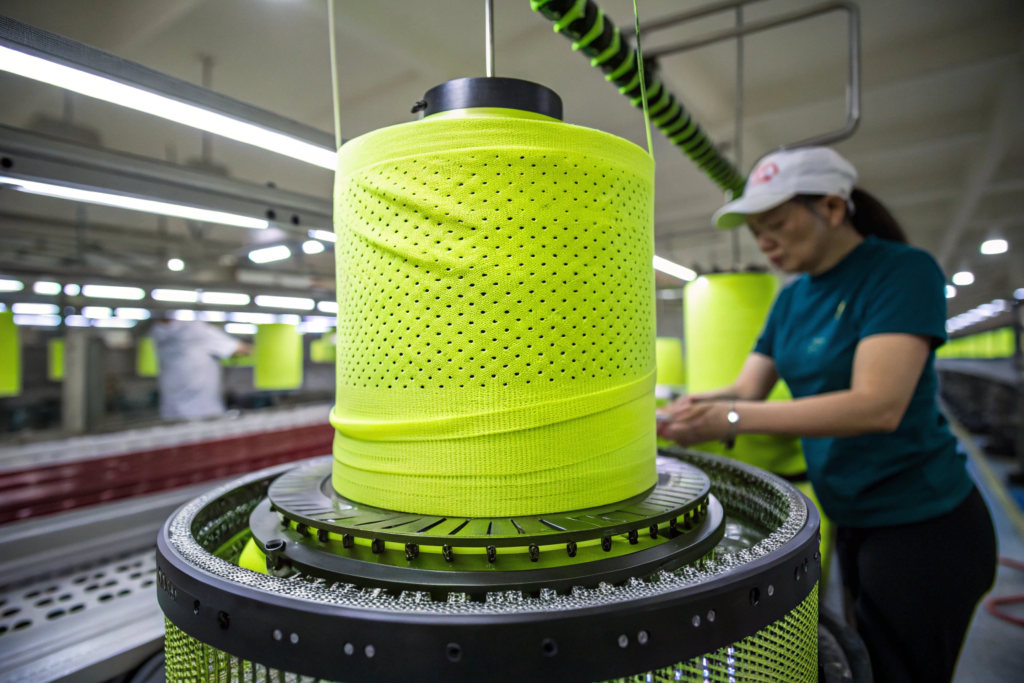
Knitting is a mechanical, structural act. A single jersey feels flimsy; a specific interlock feels firm and premium. When you send us a brief requesting a "buttery soft, four-way stretch rib for a yoga set," we don’t just pick a stock lot. We go to our sample bank of knitting machine cylinder gauges (from a fine 40-gauge for silk-touch tees to a coarse 12-gauge for heavy waffle thermals) and cast a "Knit-Down." This is a physical trial right on the machine, adjusting the yarn feed tension dials to hit the specific fabric weight (GSM) you need. The yarn feeders—which could be spandex, nylon, or cool-touch polyester—are placed on a dedicated small-diameter sample circular machine. The knitting takes hours, not days. The greige tube is then taken directly to our on-site wet-processing sampler, then to the drying and heat-setting table. Because we have a mini-scour and dye unit for knit tubes, we don’t batching with bulk orders; we run the single 5kg tube immediately. This allows a US fitness brand to test the compression, the opacity, and the stitch aesthetic within 7 calendar days. That rapid local feedback loop is why we’ve become the back-end for multiple DTC activewear giants.
What Is a Knit-Down and How Does It Allow for Immediate GSM and Stitch Adjustment?
A knit-down is the knitwear equivalent of a lab dip. It’s a small, controlled experiment to lock in the physical geometry of the stitch. The critical variables are the stitch length (how big the loop is) and the yarn tension. If the loop is too loose, the fabric is heavy and baggy. If it’s too tight, it’s a stiff board with zero stretch.
Our knit technician dials the stitch cams on the sample machine by increments of 0.1mm. We cast a "trial tube" of about 5 meters. From this tube, we immediately cut a precise 100cm² circle using a die cutter in the sample room. We weigh it on a digital scale—that’s the GSM (grams per square meter). You asked for a 220 GSM jersey with 120% crosswise stretch? If our first knit-down comes out at 240 GSM and only 90% stretch, we don’t guess. We change the cam setting and re-knit.
This is essential for performance sportswear where compression equals muscle support. For a specific "seamless rib" for a high-support sports bra, the yarn composition needed to be 48% Nylon, 52% spandex, but the feel needed to be "cool to the touch." We tried 3 micro-adjustments in 4 hours on our sample machine. The final adjustment involved feeding a Nylon 6.6 cool-touch filament at a slightly higher tension than the spandex core, forcing the nylon to sit on the fabric’s face and the spandex to burrow inside. At the end, the bra retained its powerful squeeze, but the surface felt like a cold, smooth ceramic tile. The brand’s designer actually whooped when she felt the finished pad sample. That process of creating a knit-down for fabric development on a local sample machine allows for a physical dialogue between the designer’s hand and the machine’s settings, which you absolutely lose if you outsource it to a faraway factory with a 3-week email lag.
How Do We Test for Elastane Burnout and Sagging Before Cutting a Sample Garment?
Spandex is a miracle until it dies. Elastane burnout happens when the heat setting is wrong, or the chlorine in a public pool attacks the fiber. A fabric looks amazing on the hanger, but after a customer wears it once on a sweaty summer day, the knees and elbows bag out into a permanent sag. By the time you get a return request, you’ve shipped 10,000 units of an expensive mistake.
We run destructive tests on the knit-down before we even send you the sample. We stretch the swatch to 100% elongation, clamp it in a "heat-ageing oven" at 70°C for 4 hours, simulating a boil-in-the-car trunk scenario. We then measure the recovery. If the fabric doesn’t snap back to within 5% of its original length, we reject the elastane quality or the heat-setting recipe right there.
We also do a chemical stress test for swimwear. Chlorine eats standard rubbery elastane for breakfast. We dip the sample in a bath of diluted sodium hypochlorite at a specific 5 ppm concentration for 24 hours, following a protocol modeled loosely on the AATCC 162 for colorfastness to chlorinated pool water. After this, we stretch it to failure. We destroyed a beautiful red rib knit last month this way—the elastane dissolved, and the fabric turned into a sad, limp noodle. We told the client, "This is going to fail in a resort pool." We switch to a high-chlorine-resistant spandex, which costs only 10% more but quadruples the lifespan. That’s the unglamorous, brutal testing that happens in that crucial 7-day development window, ensuring the sample you use for your photoshoot won’t betray you when it goes into mass consumer use. It stops a social-media-led return crisis before it starts. This internal durability screening is something you can only get with a hands-on, obsessed local knit team, not a distant mass factory. It’s Shanghai Fumao saving your reputation, one stretch test at a time.
Conclusion
Speed in custom sampling isn’t about rushing. It’s about removing friction. From the pre-scoured stock sitting in a sealed bin waiting for your dye command, to the dedicated miniature stenter that dries a swatch in minutes, to the rapid-thread jacquard head that casts a Spanish brocade file in 6 hours—every single step at Shanghai Fumao is engineered to collapse the dead time. You don’t wait for a queue, you don’t wait for a bulk warp, and you don’t wait for a color separator to manually tweak magenta levels for two days.
Your design sheet hits our portal, triggers a cascade of parallel actions, and culminates in a DHL envelope touching down at your studio in 48 to 72 hours. This isn’t a rush service for VIPs only. It’s our standard developmental doctrine. We believe your creativity shouldn’t be strangled by a three-week sampling gap. A fast, accurate sample means you can iterate faster, fail cheaply, and lock in orders before the season’s window slams shut.
Are you ready to touch your next swatch in days rather than months? Let’s break the speed barrier right now. Share your sketch or Pantone code with our Business Director, Elaine. She will immediately slot you into our rapid lab pipeline. The countdown to your physical strike-off begins the moment your email lands. Send your development brief to elaine@fumaoclothing.com. Let’s hold your imagination in your hands by Wednesday.








