Last November, a menswear brand owner in Chicago sent me a panicked WhatsApp message. He had budgeted $0.80 per yard for shipping and import costs on a 2,000-yard order of brushed cotton flannel. The actual total bill, once his forwarder’s invoice landed, was $1.65 per yard. Port congestion surcharges, customs broker fees, a trucking detention charge, and a last-mile residential delivery surcharge each took a bite. He was over budget by $1,700 on a single container. “I thought FOB meant I was covered until it hit the warehouse,” he told me. The reality is that FOB puts the logistical risk squarely on you, and unless you are moving multiple containers a month, those hidden costs can wreck your margin. After we talked, I had our logistics team quote him a Delivered Duty Paid (DDP) price for his reorder. The upfront unit cost looked higher. But the final landed cost was actually $0.35 per yard lower than his previous FOB mess because we absorbed the risk and consolidated the fees. That is the core of the question: how much does DDP shipping actually add to your fabric unit cost? The honest answer is that it adds visibility more than it adds cost. You pay a premium for the carrier’s assumption of risk, but you eliminate the unpredictable tail charges that make FOB dangerous for smaller importers.
I want to walk you through exactly what a DDP fabric quote from Shanghai Fumao includes, how the per-yard math breaks down against standard FOB, and where the value sits for a brand that values reliability over rock-bottom headline rates. If you have ever been burned by a customs exam hold, a surprise duty bill, or a trucker demanding a cash payment at the warehouse gate, this breakdown will show you why DDP might be the smartest logistics decision you make for your next purchase order.
What Exactly Is DDP Shipping for Fabric Importers?
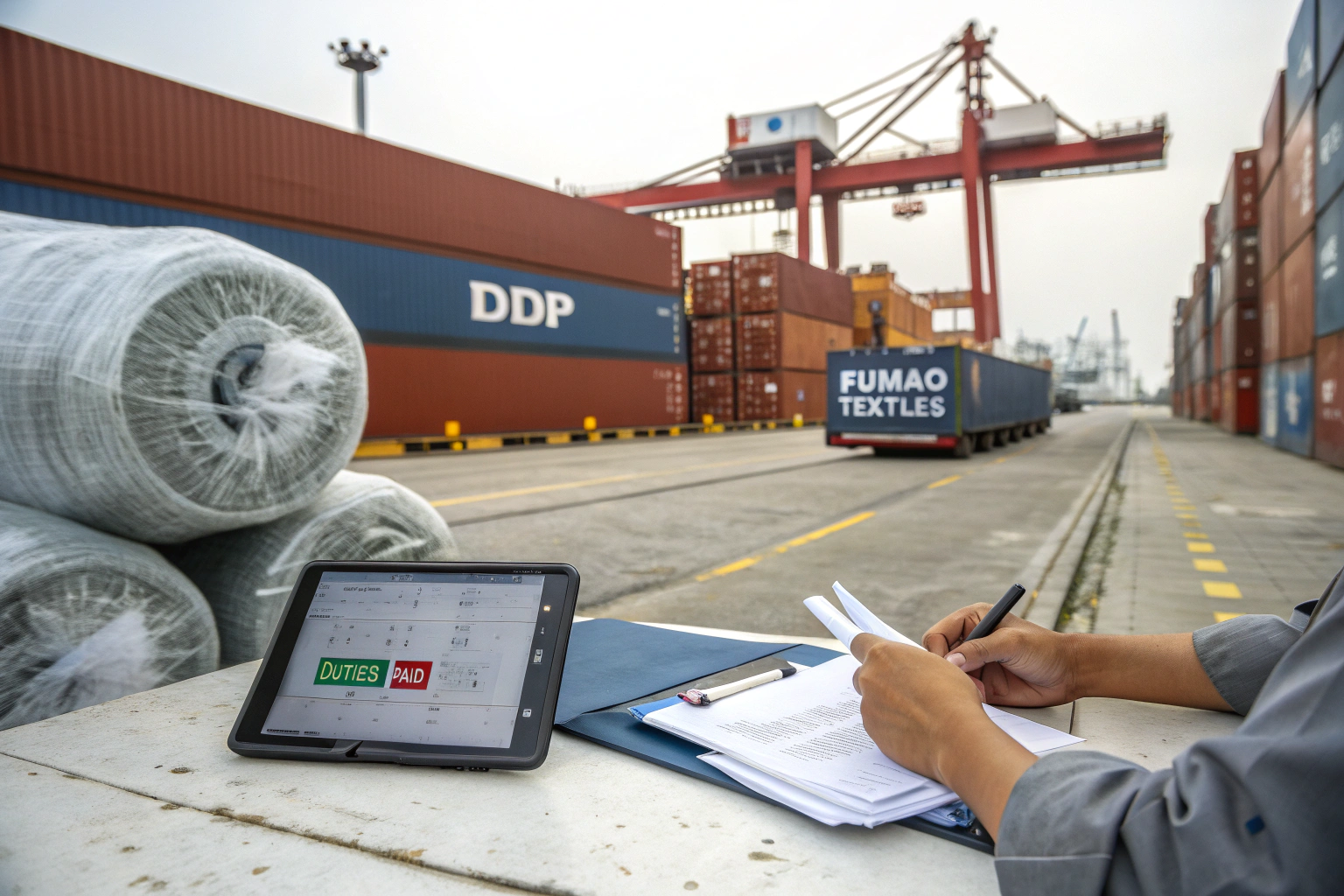
DDP stands for Delivered Duty Paid, one of the Incoterms 2020 rules defined by the International Chamber of Commerce. It means the seller—in this case, Shanghai Fumao—takes on the entire responsibility and cost of transporting the fabric from our Keqiao factory to your nominated destination address in the United States. This includes export clearance, ocean or air freight, import customs clearance, payment of US import duties and taxes, and final truck delivery to your door. When I explain DDP to first-time importers, I tell them it is like buying a plane ticket that includes your luggage, meals, and airport transfers, versus booking a bare fare and discovering each bag costs $85 at check-in. With DDP, the price I quote you per yard is the price you pay to have that fabric on your cutting table. There is no intermediary forwarder demanding a wire transfer before releasing the container. The carrier’s obligation is to us, and we settle all charges directly.

How Does the Incoterm DDP Shift Risk from Buyer to Seller?
Under FOB, the risk transfers from the seller to the buyer the moment the container crosses the ship’s rail at the port of loading. If the vessel runs into a storm, if the container gets flagged for a radiation scan at Long Beach, if the trucking company’s union goes on strike the day your fabric is supposed to move—those costs and delays hit you. Under DDP, the risk stays with us until the goods are physically at your specified location. This shift is enormous for a small to mid-size brand. Last March, a swimwear startup in Miami ordered 800 yards of recycled nylon spandex from us on DDP terms. The container was selected for a VACIS exam by US Customs. The exam fee was $450, and it added eight days to the transit time. Because the shipment was DDP, we paid the exam charge, and we arranged the bonded warehouse transfer. The client received her fabric intact, late but without a surprise bill. If she had been on FOB, that exam delay would have likely triggered demurrage charges of $180 per day starting on day four, turning an annoying delay into a $2,000-plus logistical penalty. Under DDP, the carrier’s network handles these routine disruptions silently. For importers who want a clear, legal breakdown of where liability sits, this Incoterms 2020 guide on DDP shipping terms for textile importers explains the risk transfer point more precisely.
What Is Included in the DDP Unit Cost vs. FOB?
When we issue a FOB quote, the price covers the fabric, local transport to the port, and Chinese export clearance. Your starting cost is the FOB unit price. When we issue a DDP quote, we build a completely different cost structure. The DDP unit cost includes the following line items, each of which is an estimate based on current market rates and your specific product’s HS code.
| Cost Component | FOB (Buyer’s Responsibility) | DDP (Fumao’s Responsibility) |
|---|---|---|
| Ocean Freight (Spot Rate) | Buyer pays to forwarder | Included in DDP unit price |
| Marine Insurance (0.3%-0.5% CIF) | Buyer arranges | Included |
| US Customs Clearance Fee | Buyer’s broker ($75-$150) | Included |
| US Import Duty (HTS Rate) | Buyer pays to broker | Included and pre-calculated |
| Merchandise Processing Fee (0.3464%) | Buyer pays | Included |
| Harbor Maintenance Fee (0.125%) | Buyer pays | Included |
| Single-entry Bond Fee | Buyer pays | Included (under our continuous bond) |
| Drayage & Last-Mile Delivery | Buyer arranges | Included |
The ocean freight is typically the largest variable. In August 2025, the spot rate for a 40-foot container from Ningbo to Los Angeles was hovering around $2,800. We secure contract rates that are typically 15% to 20% below spot, which gives us a buffer for short-term spikes. The import duty is calculated based on the fabric’s harmonized tariff schedule classification, which we confirm with a licensed US customs broker before quoting. For a typical polyester woven, the duty rate is 14.9% plus the Section 301 additional tariff if applicable. We include that exact duty in the DDP quote based on the commercial invoice value.
How Much Does DDP Shipping Add Per Yard Compared to Standard FOB?
The per-yard premium you pay for DDP shipping depends primarily on your order volume, the fabric weight and density, and the current freight market. But I can give you some working averages from our 2025 order book. For a typical mid-weight woven cotton fabric at 200 GSM, shipped in a consolidated 40-foot container with about 12,000 yards, the DDP add-on over FOB runs between $0.65 and $0.90 per yard when ocean freight rates are stable. For lighter-weight fabrics like a 90 GSM polyester chiffon, you fit more yardage into the container, so the fixed logistics costs spread thinner and the DDP add-on drops to $0.45 to $0.65 per yard. For heavier fabrics like a 400 GSM denim or a coated canvas, the add-on pushes up to $1.10 to $1.40 per yard because fewer yards per container drive up the per-unit freight and duty cost.

What Is the Real-World DDP Cost Breakdown for a Typical Fabric Order?
Let me walk you through a real costing sheet from a coat-weight wool-blend tweed order we shipped in January 2025. The order was 3,000 yards of 350 GSM wool-polyester tweed, shipped from Keqiao to a warehouse in New Jersey via ocean freight.
| Cost Element | Per-Yard Calculation | Total for 3,000 yds |
|---|---|---|
| FOB Fabric Cost | Base mill price | $18,600 ($6.20/yd) |
| Ocean Freight (Ningbo to NY) | $3,200 container / 3,000 yds | $1.07/yd |
| Marine Insurance | 0.4% of CIF value | $0.03/yd |
| US Customs Duty (HTS 5112.30) | 25% on woven wool blend | $1.63/yd |
| MPF + HMF Fees | 0.4714% combined | $0.03/yd |
| Customs Broker & Clearance | Flat fee $175 | $0.06/yd |
| Drayage to NJ Warehouse | $850 trucking | $0.28/yd |
| Total DDP Landed Cost | $9.30/yd |
In this case, the DDP premium over the FOB fabric price was $3.10 per yard. That is a significant percentage — about a 50% uplift on the base fabric price. But here is the crucial point. The brand owner had previously tried to manage FOB on a smaller order and ended up paying a spot duty rate that was incorrectly assessed at 32% instead of 25%, plus a $600 trucking detention fee because the warehouse appointment was missed. His actualized FOB landed cost on that mess was $9.85 per yard. Our DDP route saved him $0.55 per yard and a lot of headaches.
How Do Air Freight DDP and Small Parcel DDP Affect Unit Cost?
For smaller sample orders or urgent production gaps, we also offer air freight DDP and even express courier DDP through major integrators. The cost structure shifts dramatically. Air freight on a 100-kilogram shipment of 150 GSM silk charmeuse, about 350 yards, might run $4.50 per kilogram. That translates to roughly $1.30 per yard just for the air freight leg, compared to $0.25 per yard for ocean. But for a luxury fabric selling at a $40-per-yard retail equivalent, that $1.05 premium is often worth it to fill a stockout. The duty and clearance costs per yard remain the same as ocean. The big advantage of air freight DDP is speed and customs pre-clearance. The carrier files the electronic manifest before the plane lands, and clearance often happens within hours. I have seen a designer receive a DDP air shipment at her Los Angeles studio three days after the fabric left Shanghai. That kind of turnaround lets you accept last-minute orders from your own retail buyers and still deliver on time. For brands weighing the trade-offs, this practical guide on air freight DDP versus ocean DDP for fashion fabric replenishment breaks down the decision framework more fully with current rate comparisons that align closely with what we see in our own freight negotiations.
Why Does DDP Actually Save Money on Small to Medium Fabric Orders?
The counterintuitive truth about DDP is that it often works out cheaper for the importer who does not have an in-house logistics team. A large fashion group moving fifty containers a year has a dedicated logistics manager, a long-term contract with a forwarder, and a customs compliance officer on staff. For them, FOB makes sense because they can negotiate rates we cannot beat. But for a brand moving one to five containers a year, the logistics overhead is a drain. They pay retail freight rates, not wholesale. They miss consolidation opportunities. They get penalized for small-batch customs entries. DDP flips that math. We aggregate our clients’ volumes into our contract carrier lanes, so a small brand benefits from the same ocean freight rate as our highest-volume partners.

How Does Aggregated DDP Freight Lower Your Effective Shipping Cost?
Last year, we shipped DDP orders from seventeen different US-bound small brands through a single monthly consolidation container to a bonded warehouse in San Bernardino, managed by our freight partner. Each brand paid a DDP rate that included a portion of the container cost, calculated by volume weight. The effective ocean freight per cubic meter for the consolidation container was $65. If those seventeen brands had each booked their own loose cargo load through a forwarder, the market rate for that same volume would have been around $110 per cubic meter, perhaps higher with a small-shipper surcharge. The aggregated model saved each brand roughly 40% on the freight line item alone. And because the container was routed under our partner’s continuous customs bond, the bond fee was eliminated for the individual brands, saving another $85 minimum per shipment. For a micro-brand ordering 200 yards of organic interlock, the savings from the aggregated ocean freight and consolidated customs clearance are the difference between an unprofitable SKU and one with a healthy contribution margin. This logistics model is exactly how a DDP strategy combined with an intelligent fulfillment setup cuts hidden supply chain costs for boutique fashion lines.
Do Customs Brokerage Fees and Bond Costs Get Cheaper Through a DDP Program?
Yes, and the savings here are often overlooked. When you import on FOB, you hire your own customs broker. A standard single entry broker fee runs $75 to $150. On a 500-yard order of linen shirting with a total value of $2,000, that $150 brokerage fee alone adds $0.30 per yard to your cost. If your shipment is under $2,500 in total value, it qualifies for informal entry, which simplifies clearance and sometimes reduces the broker fee slightly. But the merchandise processing fee minimum still applies. Under our DDP program, we process a high volume of entries through a single broker, so our per-entry cost drops to under $40, and we pass that efficiency into the overall DDP quote. Similarly, a single-entry customs bond typically costs $50 to $75 minimum. Because we operate under a continuous annual bond that covers all the shipments of our DDP program, the bond cost per individual shipment is negligible. Over a year, a brand that imports six separate FOB orders will pay $300 to $450 in bond fees alone. Our DDP program absorbs that cost entirely.
What Are the Risks and Downsides of Choosing DDP for Fabric Imports?
I would lose credibility if I told you DDP is a perfect solution with no drawbacks. There are real scenarios where DDP is not the optimal choice, and I want to be transparent about them because I want you to make the right decision for your business, not just the one that makes my logistics easier. The two main downsides are reduced buyer control over the customs clearance process and a slightly higher upfront unit cost on paper. If your brand has an excellent relationship with a forwarder that consistently beats market rates, or if you are importing under a specific trade preference program that requires meticulous documentation only you control, FOB might still serve you better.

When Does DDP Reduce Your Control Over the Import Process?
Under DDP, we select the customs broker and the freight forwarder. You have no direct contractual relationship with the broker, which means if a clearance question arises—say, US Customs asks for additional fiber content verification or questions the valuation—you depend on our team to respond. In twelve years of running DDP shipments, we have had exactly two instances where a clearance query caused a delay because of slow communication between our broker and the client. Both were resolved within 48 hours, but I understand why some brands with sensitive launch dates or retailer compliance deadlines want direct control. There is also the question of duty drawback. If you are a US manufacturer who later exports finished garments and wants to claim a refund on the duties paid on the imported fabric, you need specific documentation. Under DDP, the duty payer of record is technically our appointed broker. The drawback process gets more complicated, though it is still possible to file with the correct paperwork. If your business model relies heavily on duty drawback claims, you should consult with a customs attorney before choosing DDP. For those who want to independently understand the compliance requirements, this resource on customs drawback eligibility for textiles imported from China provides a solid foundation.
Is There a Scenario Where FOB Ends Up Being a Smarter Choice?
Yes. If you are shipping a full container load every month and you have a dedicated forwarder who gives you an aggressive, negotiated ocean freight contract below market spot rates, FOB almost always wins on unit cost by a small margin. Let’s say you have locked in a rate of $1,800 per 40-foot container from Ningbo to Long Beach for the entire peak season, while our DDP container rate is based on a blended average of $2,400. On a 10,000-yard load, that $600 container difference equals $0.06 per yard. Add in your broker’s efficiency and your ability to self-file for certain bonded warehouse entries, and you might shave $0.10 to $0.15 per yard off the DDP quote. That is real money at scale. The trade-off is that you carry the demurrage and exam risk personally. For a sophisticated importer with a logistics department, carrying that risk is a rational financial decision. For a smaller brand without that infrastructure, the uncertainty of FOB is usually more expensive than the DDP premium. I always offer clients the choice, and I walk them through a side-by-side simulation using current rates. My goal is not to sell DDP; it is to provide the shipping model that generates the most predictable, lowest total cost for their specific volume and risk tolerance.
Conclusion
DDP shipping adds a transparent, predictable premium to your fabric unit cost, typically between $0.45 and $1.40 per yard depending on fabric weight, fiber composition, and order volume. That premium bundles ocean freight, insurance, US customs clearance, import duties and fees, and final mile delivery into a single, guaranteed price. For a small to medium brand importing less than a container per month, this model almost always delivers a lower total cost than FOB by eliminating the surprise demurrage charges, customs exam fees, retail freight markups, and bond inefficiencies that plague irregular importers. The case from our menswear client in Chicago proves the point: a DDP reorder came in $0.35 per yard below his previous FOB landed cost, and it arrived without the logistical chaos. The visibility and simplicity of DDP are not just a convenience; they are a measurable cost advantage for brands that value reliability and want to spend their energy on design and sales, not on arguing with a trucker at a warehouse gate.
To get a real DDP shipping quote tailored to your exact fabric specifications and delivery address, reach out to my Business Director, Elaine. Send her the fabric reference, target yardage, and the zip code of your final destination. She will run the numbers through our current freight contracts and customs duty database and return a per-yard DDP price within one business day. You can contact Elaine directly at elaine@fumaoclothing.com. With a single number, you will know exactly what it costs to land your fabric on your cutting table and can model your collection’s margin with full confidence.