You’re about to place a six-figure apparel order with a new factory. They’ve sent you an OEKO-TEX® certificate, assuring you the fabrics are safe and compliant. You feel relieved—but should you? In today’s market, a certificate is only as good as its authenticity and its direct link to your specific order. Relying on a fraudulent or misapplied certificate can lead to catastrophic outcomes: rejected shipments, massive fines, and irreversible brand damage. The question isn’t just if they have a certificate, but how you verify it’s valid, applicable, and backed by a real management system.
Verifying an OEKO-TEX® certificate isn’t about mistrust; it’s about due diligence. It’s a 5-minute process that can save you 5 months of headaches. At its core, genuine verification moves beyond a PDF file and involves checking three pillars: Database Validation, Product & Scope Match, and Supply Chain Traceability. Many factories, even honest ones, make critical mistakes—like using a mill’s certificate for their own garments or presenting an expired document. Your job is to catch these errors before production begins.
This guide will walk you through the exact, step-by-step process our team at Shanghai Fumao uses—and that we recommend to our own clients—to conduct a bulletproof verification. We’ll show you where to look, what questions to ask, and the red flags that should stop you in your tracks. Let’s turn that piece of paper into genuine peace of mind.
Step 1: The Instant Online Database Check
This is your non-negotiable first move. Every genuine OEKO-TEX® STANDARD 100 certificate has a unique, traceable number. The single source of truth is the official OEKO-TEX® certification database, publicly accessible online. Do not accept any excuse for skipping this step.
Go to the OEKO-TEX® website and find the “Check Your Certificate” or “Certificate Database” tool. Enter the certificate number provided by the factory. The valid result will show you the certified company’s exact legal name, the certification scope (what products are covered), the issue date, and the expiry date. Immediately, you can verify three things: 1) Is the certificate real? 2) Is it still valid? 3) Does the company name on the certificate match the factory you’re dealing with?
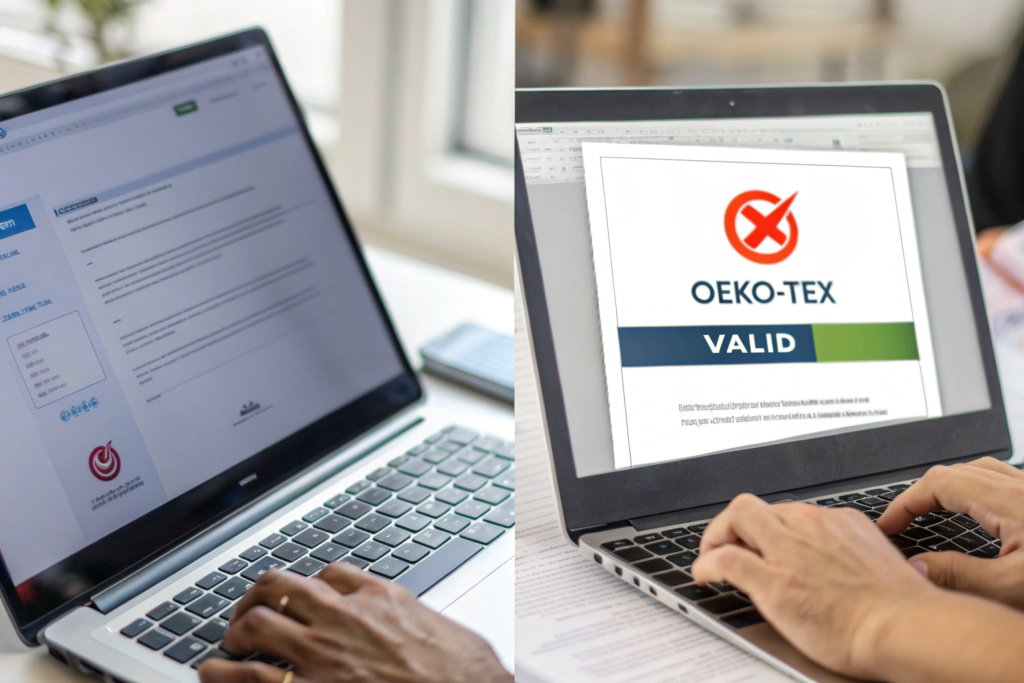
What specific details on the database listing are red flags?
Pay close attention to these elements in the database result:
- Company Name Mismatch: If the certificate is under "ABC Textile Co., Ltd." but you’re contracting with "XYZ Garment Factory Ltd.," this is a major red flag. The certificate belongs to a different legal entity.
- Expired Certificate: OEKO-TEX® certificates are valid for one year. An expired certificate is worthless. Ensure the "valid until" date covers your entire production and delivery timeline.
- Scope Discrepancy: The listed product scope (e.g., "woven fabrics of cotton") must match what you are ordering. A certificate for "knitted fabrics" does not cover your woven denim order.
- Missing STeP Details (if applicable): If the factory claims to have OEKO-TEX® STeP certification for sustainable production, this should also be listed in a separate section of the database. Verify it independently.
If any detail doesn’t match, stop. Politely ask the factory to clarify the discrepancy. Often, they may be using their fabric supplier’s certificate, which leads us to the next critical step. For a deeper understanding of the certification system itself, the OEKO-TEX® official guide for buyers is an essential resource.
Can a factory use their fabric supplier’s certificate?
This is the most common gray area—and a potential trap. A garment factory cannot legally use its fabric mill’s OEKO-TEX® certificate for the finished garments they produce. The certificate is issued to a specific legal entity for specific articles at a specific production stage. If the factory is only cutting and sewing, the certificate for the fabric belongs to the fabric mill.
The correct process is for the factory to either:
- Obtain their own certificate for the finished garment (which references the certified fabrics used), or
- Provide you with the fabric mill’s valid certificate PLUS a declaration of conformity stating that the certified fabric was used in your order without any subsequent chemical treatments that could invalidate it.
You must trace the certificate back to its source. This is why partnering with an integrated supplier like Shanghai Fumao simplifies this: as the fabric manufacturer, we provide our direct, verifiable certificate, eliminating the chain-of-custody ambiguity for our clients.
Step 2: Scrutinizing the Certificate Scope & Product Class
A valid certificate in the wrong hands or for the wrong product is invalid. Now you must ensure the document’s technical details align perfectly with your purchase order. This involves a line-by-line review of the certificate’s appendix or scope list.
Find the section that lists the certified articles. It should describe the fabric composition, construction, and importantly, the Product Class (I, II, III, or IV). Your order must fall within this described scope. For example, if you are ordering "100% Cotton Jersey, dyed, for T-shirts," the certificate should list an article that closely matches this description. A mismatch, like the certificate being for "100% Polyester Twill," means your product is not certified.
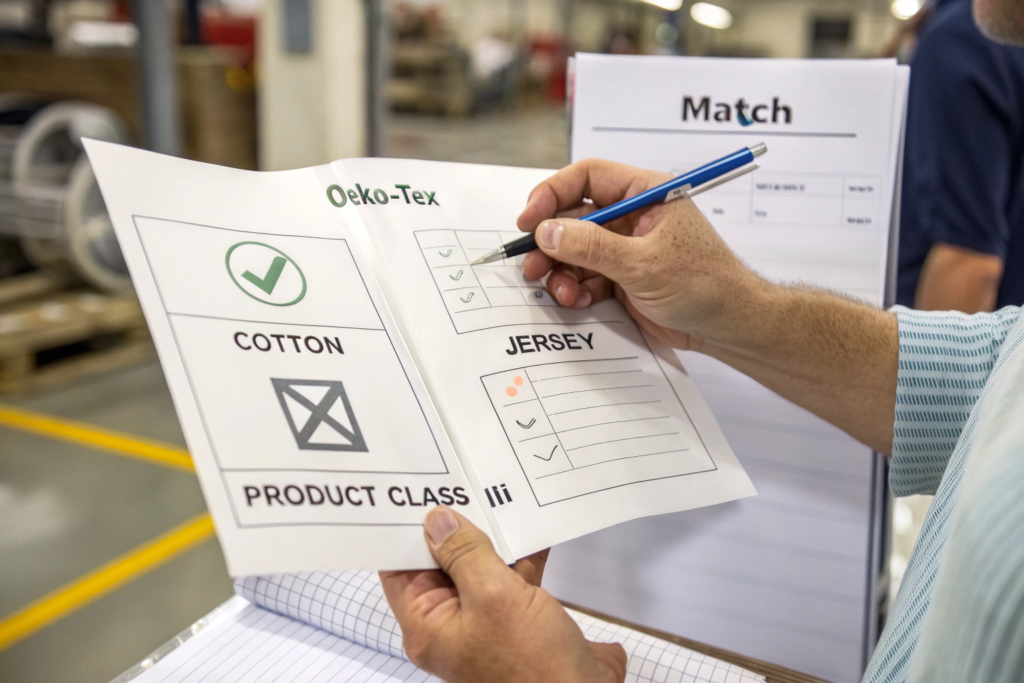
Why is the Product Class the most critical detail to verify?
The Product Class determines the strictness of the testing limits. Using the wrong class is a serious compliance failure.
- Class I: For babies (most strict).
- Class II: For direct skin contact (e.g., underwear, t-shirts).
- Class III: For no direct skin contact (e.g., jackets, linings).
- Class IV: For decoration (e.g., curtains).
The Scenarios You Must Catch:
- A factory certifies baby rompers (should be Class I) under Class II. This is a critical safety and legal violation.
- A factory uses a Class III certificate for loungewear (which is Class II). The product has not been tested for the stricter skin-contact limits.
Always ask: "What Product Class did you certify this article under, and why is that the correct class for my end-use?" The answer should be immediate and confident. This knowledge is vital, and forums like Textile Compliance Institute discussions often highlight real-world cases of Product Class misapplication.
What if my product uses multiple certified components?
A garment often involves more than just fabric: zippers, buttons, interlinings, prints, and embroidery threads. The OEKO-TEX® certificate for the final garment must cover all these components, or each component must have its own valid certificate. A common factory mistake is to certify only the main fabric.
Your verification question must be: "Does this certificate cover all components of the finished garment, including trims and accessories? If not, please provide certificates for the other components." If the factory applied a non-certified screen print or used non-certified elastic, the entire garment loses its certified status. This level of control is why our Shanghai Fumao team works with certified trim suppliers when managing full-package orders for clients.
Step 3: Auditing the Factory’s Internal Control System
A certificate is a snapshot of a past test. The real assurance comes from knowing the factory has a system to ensure every batch matches the certified sample. This is where you move from document verification to process verification. You need to assess their Internal Quality Control (IQC) system for chemical management.
Ask to see their procedure. A professional factory will have:
- A controlled chemical inventory list showing only OEKO-TEX® approved dyes and auxiliaries.
- Inspection records for incoming certified fabrics/trims (checking lot numbers against certificates).
- Production batch records that track certified materials through sewing.
- A clear policy that prohibits unauthorized chemical treatments (like spray-on softeners or stain guards) in the sewing facility.

What on-site audit questions should you ask?
During a virtual or physical site visit, ask these specific questions:
- "Can you show me where you store OEKO-TEX® certified fabrics, and how are they separated from non-certified materials?"
- "What is your process if a shipment of fabric arrives without the correct certification or lot number?"
- "Who is responsible for checking chemical compliance, and how are they trained?"
- "If you subcontract embroidery or printing, how do you ensure those partners use certified materials?"
Listen for vague answers. Competent factories will provide clear procedures and documentation. The absence of a system means the certificate you saw may represent a one-off test, not ongoing compliance. Resources like the Sustainable Apparel Coalition’s Higg Facility Tools outline the types of management systems leading brands look for.
How does OEKO-TEX® STeP certification add a layer of assurance?
If a factory also holds STeP (Sustainable Textile and Leather Production) certification, it’s a strong positive signal. STeP audits the factory’s environmental and social management systems, including a robust module on chemical management. A STeP-certified factory is far more likely to have the institutionalized processes needed to reliably maintain its STANDARD 100 certification. You can and should verify their STeP status in the same OEKO-TEX® database.
Step 4: Securing the Correct Documentation for Your Shipment
Verification doesn’t end at the audit. It concludes when you have the correct, legally valid documentation in hand for your specific shipment. This is your proof for customs, retailers, and consumers.
For each production lot, you must receive:
- The Correct OEKO-TEX® Certificate: The valid, matching certificate.
- A Test Report (Optional but valuable): Some certifiers provide a summary test report showing the actual results.
- A Declaration of Conformity / Transaction Document: This is crucial. It is a formal letter from the certificate holder (factory or mill) stating that the specific goods in your shipment (with referenced lot numbers, purchase order, etc.) are covered by the attached certificate. It links the generic certificate to your specific purchase.
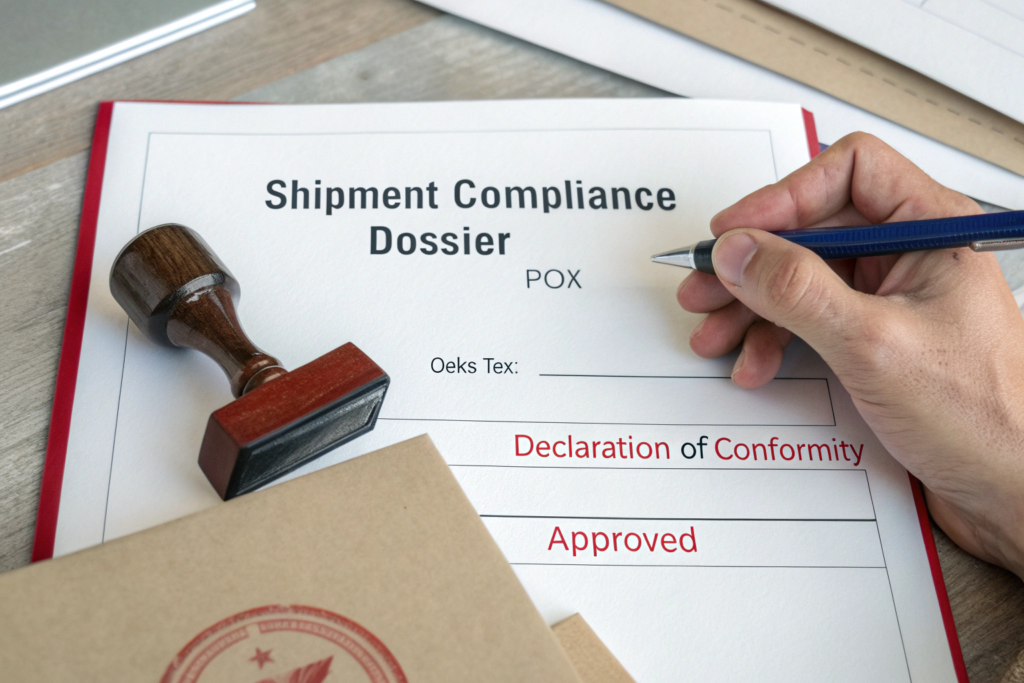
What are the consequences of inadequate documentation?
Without a clear, audit-ready paper trail, you are exposed:
- Retailer Rejection: Major EU retailers will reject shipments if the documentation doesn’t explicitly tie the certificate to the delivered goods.
- Customs Delays: Authorities may detain shipments for compliance verification.
- Legal Liability: In case of a dispute, you lack evidence of due diligence.
Instruct your factory explicitly: "Our shipment must include a Declaration of Conformity that references our PO #XXX and the lot numbers of the goods, stating they are covered by certificate #YYYY." Make this a contractual requirement. Learning about international trade compliance documentation helps understand the broader context.
When should you consider independent third-party testing?
As a final, optional but highly recommended step for high-risk or high-value orders, conduct independent lab testing. You can randomly select finished garments from the shipment and send them to an accredited lab (like SGS, ITS, or Bureau Veritas) for a targeted OEKO-TEX® parameter test.
This serves as the ultimate verification of the entire chain. If the test passes, it confirms the system works. If it fails, you have caught a potentially catastrophic failure before the goods hit your market. The cost of this test is minor insurance against monumental risk. At Shanghai Fumao, we are so confident in our integrated system that we support and facilitate such client-commissioned tests, viewing them as a partnership in quality assurance.
Conclusion
Verifying an OEKO-TEX® certificate is not a bureaucratic hurdle—it is the fundamental process of building a trustworthy supply chain. By following these four steps—Database Check, Scope Scrutiny, System Audit, and Documentation Securing—you transform a supplier’s claim into a verified fact. You move from hoping for compliance to knowing and documenting it.
This diligence protects your brand, satisfies regulators, and ultimately earns the trust of your consumers. It separates professional, long-term partners from opportunistic suppliers. Remember, a factory that is transparent and organized during verification is a factory that is likely to be reliable throughout production.
Don’t let a certificate be a point of anxiety; let it be a point of confidence. Start your next supplier relationship with these verification steps. If you seek a partner that makes this process transparent and effortless—where certificates are valid, traceable, and backed by a CNAS-accredited lab system—consider Shanghai Fumao. We provide full documentation packages and open-book quality audits as standard. To discuss how we can streamline your compliance verification, contact our Business Director, Elaine, at elaine@fumaoclothing.com.