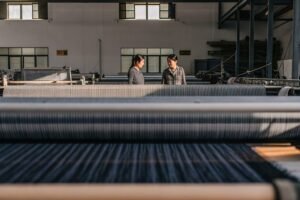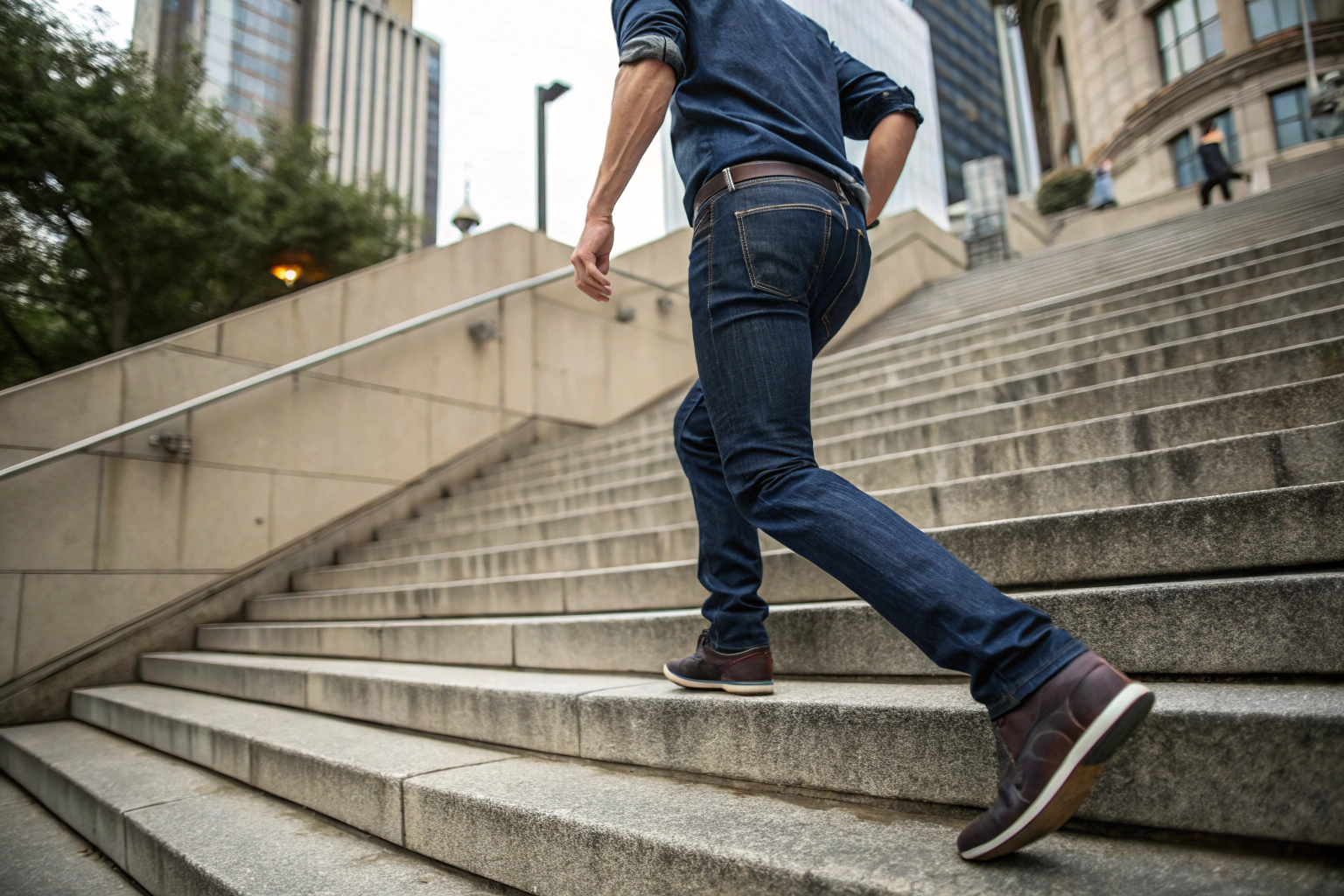
Let me tell you something I never thought I’d say back when I started in this business. Men care about stretch. For years we sold denim based on one thing only: Rigidity. The heavier the better. The stiffer the better. Raw selvedge denim that could stand up on its own was the holy grail. We talked about "break-in period" like it was a badge of honor. You suffered for six months until the jeans molded to your body. That was the deal.
That deal is dead. And I’m glad it’s dead.
Today the men walking into stores don’t want to suffer for fashion. They want to sit at a desk for eight hours get on a plane for a business trip chase their kids at the park and still look sharp when they walk into a dinner reservation. They want the look of raw heritage denim with the comfort of sweatpants. This is not a niche trend. This is the new baseline. And the textile industry has responded with a category of fabric we call Performance Stretch Denim. At Shanghai Fumao this category has grown from 10% of our denim production five years ago to over 65% today. That’s not a fad. That’s a revolution.
The risk for a brand that ignores this shift is simple. You become irrelevant. If your jeans don’t stretch men will try them on in the fitting room do one squat and put them back on the rack. They’ll walk across the mall to the brand that does have stretch. And they won’t come back. The pain of losing a customer over fit is permanent. My goal in this article is to break down the technology inside these fabrics why they perform better and how you can source them without falling into the trap of cheap spandex that bags out after two hours of wear.
This isn’t just about adding a little Lycra to cotton. It’s about a complete re-engineering of the yarn structure the weave density and the finishing chemistry. When you get it right you create a jean that a 45-year-old guy will wear on a 12-hour flight and still look crisp when he lands. That’s the magic. Let’s unpack how we do it.
What Is the Difference Between Stretch and Performance Denim
Alright let’s clear up the terminology because the industry uses these words loosely and it confuses buyers. Stretch Denim and Performance Denim are not the same thing even though people use them interchangeably.
Stretch Denim is the old school version. It’s usually a 98% Cotton 2% Spandex blend. You know this fabric. It stretches when you pull it but it doesn’t really snap back. After a day of wear the knees get baggy. The seat sags. You wash it and it tightens up again but by lunchtime it’s loose. That’s because the spandex content is low and the yarn structure is basic. It’s a one-trick pony. It provides initial comfort but fails on Recovery.
Performance Denim is the new generation. We’re talking about multi-component yarns with Dual-Core Technology or Specialty Polyesters. The composition might be 70% Cotton 28% Polyester 2% Elastane or even a Cotton/T400 blend. The goal of performance denim is not just stretch. It’s Stretch with Recovery. It’s Moisture Management. It’s Temperature Regulation. It’s a fabric that actively works to keep you comfortable and looking sharp.
The key difference is in the Yarn Core. In cheap stretch denim the spandex is exposed. When you wash it chlorine and detergent attack the spandex directly degrading it quickly. In performance denim the spandex or elastomultiester is Core-Spun. It’s wrapped tightly with a sheath of cotton or polyester. This sheath protects the elastic core from abrasion and chemicals. That’s why these jeans last longer and don’t bag out. The elastic is hidden inside a protective armor of cotton.
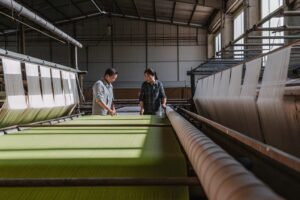
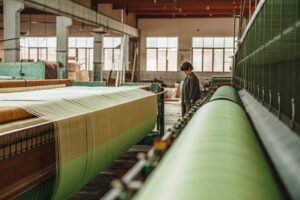
At Shanghai Fumao our weaving team has to adjust the loom tension significantly for these core-spun yarns. If you weave them too tight the fabric loses stretch. If you weave them too loose the fabric grows and the garment dimensions are off. It’s a balancing act that requires experience.

How Does Elastomultiester Compare to Traditional Spandex in Denim
This is a deep dive into fiber science but it’s crucial for understanding why some $80 jeans feel better than $200 raw denim after a month of wear.
Spandex (Elastane) is a polyurethane polymer. It’s a rubber band. It’s great at stretching up to 500% elongation. But its Power (the force it exerts to snap back) degrades over time especially with heat from the dryer. It also has poor UV Resistance. Leave a pair of spandex jeans in the sun and the elastic gets brittle.
Elastomultiester (e.g. Lycra T400 or Sorona) is a completely different animal. It’s a bicomponent polyester fiber made of two different polymers extruded side-by-side. When you heat it these two polymers shrink at different rates causing the fiber to curl up into a Crimp. This crimp acts like a mechanical spring. It’s not a chemical stretch like rubber. It’s a Mechanical Stretch. Because it’s polyester it’s immune to chlorine degradation. It has incredible recovery even when wet. It’s the secret weapon in premium men’s performance denim.
Here is a comparison table based on our lab testing of different elastic components in denim.
| Elastic Component | Stretch (%) | Recovery (%) | Heat Resistance | Chlorine Resistance | Cost Factor |
|---|---|---|---|---|---|
| Bare Spandex | 25-40% | 85-90% | Poor (Degrades) | Poor | Low |
| Core-Spun Spandex | 20-35% | 92-96% | Fair (Protected) | Fair | Medium |
| Dual-Core (Poly/Spandex) | 20-30% | 95-98% | Good | Good | High |
| Elastomultiester (T400) | 15-25% | 97-99% | Excellent | Excellent | High |
Why Is Recovery More Important Than Stretch Percentage for Men
Men move differently than women. Sorry for the generalization but it’s true in terms of garment stress. Women’s jeans often need high stretch for a tight skinny fit over curves. Men’s jeans especially in straight and slim-straight cuts need Hold. They need the fabric to resist the movement a little bit and then snap back into place.
If you give a guy a pair of jeans with 40% stretch he’s going to look like he’s wearing jeggings. Not the look most guys are going for. What they want is Comfort Stretch. This is typically in the 15-25% stretch range. Enough to eliminate the knee-pull when sitting and the waistband pinch after a big meal. But the real magic is the Recovery. After standing up from a two-hour meeting the knees should look like knees not like deflated balloons.
That’s why we obsess over Growth Testing in our lab. We take the denim stretch it by a fixed percentage for a set amount of time and then measure how much it doesn’t go back to its original size. A cheap stretch denim might show 6-8% Growth. That means your 32" waist jean becomes a 34" waist by the end of the day. A performance denim with T400 or dual-core spandex shows less than 3% Growth. That’s the difference between a jean that fits all day and one that looks sloppy by 3:00 PM.
How Are Men’s Denim Weaves Changing for Active Lifestyles
The fiber is only half the story. The Weave Structure is the other half. The classic denim is a 3/1 Twill. The weft yarn goes under one warp yarn and over three. This creates that diagonal ribbing we all recognize. It’s strong but it’s dense. It doesn’t breathe well. And it’s heavy.
For performance denim we’re moving away from the classic 3/1 to 2/1 Twill and even Plain Weave constructions. A 2/1 twill uses less yarn. The fabric is lighter and more pliable. It allows for better air flow. It also allows the stretch yarn to move more freely. If you trap a spandex yarn inside a super dense 3/1 twill it can’t stretch properly. It’s like putting a bodybuilder in a suit that’s two sizes too small. The fabric fights itself.
We’re also seeing a huge rise in Reverse Denim. This is where the face of the fabric is actually the weft side. It gives a flatter more uniform appearance that hides the stretch better. It looks less like "tech pants" and more like refined casual wear. This is popular for guys who want to wear their jeans to the office with a blazer.
Another innovation is the use of Fancy Yarns in the weft. Instead of a solid yarn we use a Slub Yarn or a Nep Yarn to give the surface texture of vintage denim. This is a visual trick. The surface looks like rugged 1940s workwear but the structure inside is 2020s performance technology. It’s the mullet of denim. Business on the outside party on the inside.

What Is the Role of Polyester Blends in Modern Denim Durability
I know what you’re thinking. "Polyester? In my premium denim? That’s a downgrade." I used to think that way too. But the new generation of High-Tenacity Polyester is changing my mind.
When we blend Coolmax or Thermolite polyester into the weft we’re not doing it just to save money on cotton. We’re doing it to solve specific performance problems. Cotton absorbs moisture. That’s great for a towel but it’s terrible for a jean on a humid day. Cotton jeans get heavy and clammy. Polyester is Hydrophobic. It repels water. A blend of 20-30% polyester in the weft acts like a wick. It pulls moisture away from the skin and spreads it out so it evaporates faster. The jean stays lighter and drier.
Polyester also adds Abrasion Resistance. The inner thigh of a man’s jean is a war zone. The friction from walking rubs the cotton fibers until they break and a hole forms. Polyester fibers are much stronger and more slippery. They reduce the friction coefficient. A cotton/poly blend denim will last significantly longer in the crotch area than 100% cotton.
The key is the Placement of the polyester. We usually put the performance poly in the Weft (the crosswise yarn) and keep the Warp (the lengthwise yarn) pure cotton indigo. This allows the jean to fade beautifully on the surface like a raw jean but perform technically on the inside. It’s the best of both worlds. For more technical data on this specific yarn placement strategy I often point designers to resources covering the mechanical properties of core-spun yarns and dual-core yarns in denim weaving and their impact on fabric handfeel and durability. It explains the engineering behind the comfort.
How Does Lower Tension Weaving Affect the Comfort of Denim
This is a factory floor secret. It’s not something you see on a spec sheet but you feel it the moment you put the jeans on.
In traditional rigid denim we weave with High Warp Tension. We crank the loom beam tight. This makes the fabric stiff and crisp. It’s great for raw denim purists who want sharp crease lines. But when you add stretch yarns to high-tension weaving you’re asking for trouble. The elastic yarns are under constant stress. They can’t relax.
In performance denim we use Low Tension Weaving. We back off the warp beam pressure. This allows the fabric to "bloom" after it comes off the loom. The yarns relax into a softer more natural state. This is why a good pair of stretch jeans feels broken-in right off the shelf. It’s not just the wash. It’s the way we set up the loom.
We also use a process called Overfeed in finishing. We actually feed the fabric into the stenter frame faster than the machine is pulling it. This forces the fabric to bunch up slightly and contract. This pre-shrinks the fabric and enhances the stretch and recovery properties. It’s like giving the fabric a yoga session before it leaves the factory.
How to Source Durable Stretch Denim That Won’t Bag Out
This is the million-dollar question for any brand owner reading this. "How do I make sure my customer doesn’t return the jeans because they stretched out?" Bagging is the number one complaint about stretch denim. It kills repeat business.
The answer lies in the Spec Sheet not the sales pitch. You need to demand specific test results from your mill. Don’t just ask "Does it stretch?" Ask for the ASTM D3107 Stretch and Growth Test results. This is the industry standard for measuring fabric stretch and recovery. The test involves hanging a specific weight on a fabric strip for a set time then measuring how much it recovers after the weight is removed.
At Shanghai Fumao we test every single batch of performance denim for growth. Our internal standard for men’s denim is Growth less than 3.5% after 1 hour of relaxation. That’s a strict standard. Cheap denim often tests at 6-8%. That 3% difference is the difference between a customer keeping the jeans and returning them.
Another critical factor is the Spandex Content Percentage. More spandex does not mean better stretch. In fact too much spandex often leads to worse bagging. The sweet spot for men’s denim is 1.5% to 2.5% Elastane . Anything over 3% and the fabric loses its memory. It becomes a wet noodle.
Finally look for Heat Setting in the finishing process. This is a non-negotiable step for performance denim. The fabric must be run through a stenter frame at a precise temperature (usually 180-190°C) to "set" the spandex. This locks the elastic into place. If a mill skips this step to save time or energy the jeans will grow like crazy. You can usually tell if heat setting was skipped because the fabric will shrink excessively in the first wash. That’s the spandex relaxing all at once.

What Tests Should I Request for Stretch and Recovery Validation
Don’t rely on the mill’s word. Ask for the Lab Report. Here is the specific data package I require from any new denim supplier before I approve a bulk order.
First Tensile Strength. Denim takes a beating. The warp yarns need to be strong. We look for a minimum of 60 lbs in the warp direction.
Second Tear Strength. This is different from tensile. It measures resistance to a rip propagating. For men’s jeans who kneel and squat this is crucial. We look for Elmendorf Tear Strength above 4,000 mN.
Third Seam Slippage. This is the nightmare where the fabric pulls away from the stitching at the crotch seam. We test this under a specific load and require less than 1mm of slippage.
Here is a quick reference guide to the key performance metrics we track internally.
| Test Method | Property Measured | Target for Men’s Performance Denim | Why It Matters |
|---|---|---|---|
| ASTM D3107 | Fabric Growth (%) | < 3.5% | Prevents knee bagging |
| ASTM D5034 | Tensile Strength (lbs) | > 60 lbs | Prevents ripping |
| ASTM D1424 | Tear Strength (mN) | > 4,000 mN | Prevents crotch blowout |
| AATCC 135 | Dimensional Stability (%) | < 2% Shrinkage | Consistent sizing wash after wash |
| AATCC 8 | Crocking Fastness | Grade 4 | Prevents indigo transfer |
Why Is Fabric Weight Still Important for Men’s Stretch Jeans
Just because the denim stretches doesn’t mean it should be flimsy. Men associate weight with quality. A jean that feels like tissue paper screams "cheap."
The sweet spot for men’s performance denim is between 10.5 oz and 12.5 oz per square yard. This is what we call Mid-Weight Denim. It’s heavy enough to have substance and drape like real denim but light enough to allow the stretch yarns to do their job. Anything under 9 oz starts to feel like a chino or a lightweight summer slack.
The challenge is maintaining that weight while incorporating stretch. The spandex core adds density. So a 12 oz stretch denim will actually feel heavier on the body than a 12 oz rigid denim because the yarns are more compact. We have to adjust the Picks Per Inch (PPI) in weaving to fine-tune the final weight.
For guys who still want the heft of a 14 oz raw jean but with comfort we use a technique called Mock Twist Yarn. This yarn has a high bulk but low weight. It creates an airy structure that looks thick but feels light. It’s a bit of textile engineering magic. You can find more discussion on this nuance in forums where denim enthusiasts and industry professionals discuss the impact of fabric weight on stretch denim performance and longevity. Real-world wear experience is invaluable.
What Are the Sustainable Options in Performance Denim
Here’s the tension in the market right now. Men want stretch comfort. But stretch usually means plastic. Spandex and polyester are synthetic fibers derived from petroleum. This is a problem for brands with strong sustainability commitments. You can’t claim to be an eco-warrior while selling jeans that are 30% virgin polyester.
But the industry is innovating fast. We now have access to Recycled Elastane and Bio-Based Elastane. Creora Regen for example is a spandex made from 100% recycled pre-consumer waste. It performs identically to virgin spandex. Sorona is a polymer made partially from corn glucose instead of petroleum. These fibers allow you to build a performance jean with a much lower carbon footprint.
The other big push is in Recycled Cotton. Denim production creates a massive amount of cutting waste. We can now shred that waste back into fiber and blend it with virgin cotton. The challenge is that recycled cotton fibers are shorter and weaker. You can’t make a 100% recycled cotton jean that will last. But a blend of 70% Virgin Cotton / 30% Recycled Cotton performs beautifully. When we combine that recycled cotton face with a recycled elastane core we get a jean that is both high-performance and circular.
At Shanghai Fumao we’ve invested in the GRS (Global Recycled Standard) certification for our denim line. This allows our clients to label their jeans with the exact percentage of recycled content. That’s a powerful marketing tool for the modern conscious consumer.

How Does Recycled Polyester Impact the Feel of Stretch Denim
Let’s be honest about the limitations. Virgin polyester is smoother and more uniform. Recycled Polyester (rPET) made from plastic bottles can have a slightly Harsher Handfeel and more Variation in Dye Uptake.
This means if we use rPET in the weft the fabric might feel a tiny bit less silky than virgin poly. Most consumers won’t notice the difference especially after the first wash. But the indigo dye might not strike the rPET fibers the same way it strikes cotton. You might get a slightly more "heathered" or "marl" appearance. That’s actually a cool aesthetic for casual denim. It looks vintage and broken-in.
The bigger challenge is Spinning Consistency. rPET staple fibers are shorter than virgin poly. They can be harder to spin into a fine consistent yarn. This is why rPET is often used in the Weft not the Warp. The warp takes the most tension during weaving. We keep the warp strong with cotton and a little virgin poly if needed. The weft takes less stress so the rPET works fine there.
For a deep dive into the technical specifications of these recycled materials I recommend checking out resources that track the advancements in textile-to-textile recycling and the performance characteristics of mechanically recycled cotton fibers. It gives a realistic view of where the technology stands today.
What Certifications Matter for Eco-Friendly Performance Denim
The alphabet soup of eco-labels is confusing. Here are the three that actually matter for performance denim.
GRS (Global Recycled Standard) : This verifies the recycled content. If you claim "20% Recycled Polyester" you need a GRS certificate to back it up. It also includes social and environmental processing requirements.
OEKO-TEX Standard 100 : This is critical for performance denim because of the chemicals used in finishing. You want Class I certification for baby-safe levels. It ensures the stretch jeans aren’t loaded with harmful residues.
Bluesign : This focuses on the Input Stream. It approves chemicals and processes before they enter the factory. It’s a preventative standard rather than a testing standard. It’s the gold standard for responsible chemical management in textile manufacturing.
Here is a quick guide to what each certification covers in the context of denim production.
| Certification | Primary Focus | What It Verifies for Denim |
|---|---|---|
| GRS | Recycled Content | % of recycled cotton/poly/spandex |
| OEKO-TEX | Chemical Safety | No harmful substances in finished jean |
| Bluesign | Sustainable Chemistry | Safe dyes and softeners used in mill |
| GOTS | Organic Fiber | Cotton grown without synthetic pesticides |
Conclusion
The dominance of performance stretch fabrics in men’s denim is not a passing trend. It’s a fundamental shift in consumer expectations. Men have tasted comfort and they’re not going back to the stiff restrictive jeans of the past. The technology has evolved to a point where we can deliver stretch recovery durability and sustainability in a single fabric without sacrificing the authentic denim look.
For brands the challenge is sourcing this fabric correctly. You need to move beyond basic stretch denim and into true performance engineering. You need to ask for growth test reports understand the difference between spandex and elastomultiester and consider the environmental footprint of the synthetics you’re using. The days of simply ordering "98/2 Stretch Denim" are over. The winners in this category will be the brands that understand the yarn structure inside the twill line.
At Shanghai Fumao we’ve spent years refining our denim program to meet this new reality. We work with both heritage selvedge purists and tech-driven performance brands. We know how to build a jean that looks like it was pulled from a 1950s mine but feels like it was designed for a 2020s commute.
If you’re ready to develop a men’s denim collection that actually fits and moves with the modern man reach out to our Business Director Elaine. She can walk you through our range of performance denim bases from lightweight summer twills to heavyweight T400 blends. We have the lab reports the certifications and the weaving capacity to bring your vision to life.
Email Elaine directly at: elaine@fumaoclothing.com