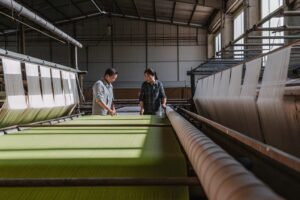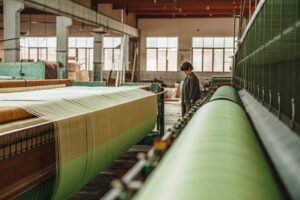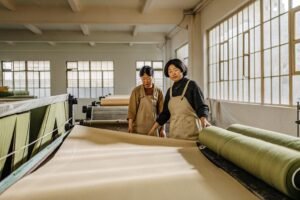
I’ll let you in on a secret that most sourcing agents don’t want you to know. The best fabric suppliers in China are not on the first page of Google when you search "China fabric manufacturer." They just aren’t. Those top spots are occupied by giant B2B platforms like Alibaba and Made-in-China. And look I’m not knocking those platforms they have their place. But the vendors there? They pay thousands of dollars a month in membership fees and PPC advertising. Guess who foots that bill in the end. You do through inflated fabric prices.
The real gems the factories that produce for Zara and H&M and the niche mills that specialize in that amazing bamboo silk you saw in a boutique in Paris those guys are buried on page 5 or page 7 of Google. Their websites look like they were built in 2008. Their English is broken. But their looms? State of the art. Their dye recipes? Perfected over 30 years. Finding them isn’t about luck. It’s about using Google like a detective not a shopper. I’m going to show you exactly how I would find my own factory if I were a buyer sitting in New York or London right now. No fluff just the real search strings and tactics we use in the industry.
The key difference between a "hidden gem" and a "cheap vendor" is capability versus visibility. A hidden gem has a modern factory a solid QC system and real technical knowledge but zero marketing budget. They rely on word-of-mouth and long-term relationships with a handful of big clients. They don’t need to advertise because they’re already running at 80% capacity. But they will take on new business if you approach them correctly and professionally. Using advanced Google search operators is your way to bypass the marketing noise and land directly on their doorstep. At Shanghai Fumao we sit somewhere in the middle we have the modern infrastructure and the global sales team but I respect the game. I want to show you how to find the specialists we sometimes even collaborate with.
But let’s be clear about one thing before we dive into the search tricks. Finding them is step one. Vetting them is step two. And that’s where most people fail. They find a great-looking website with pictures stolen from a trade show in Milan. They send an email that says "Hi send me price list for all fabrics." They get ignored or they get a fake quote. The goal of this post is to teach you not just the search operators but the mindset of how to communicate with these hidden manufacturers so they actually respond to you and treat you like a serious buyer not a tire-kicker.
How to Search Google for Niche Fabric Mills Not on Alibaba
Let’s get technical. The average buyer types "polyester spandex fabric supplier" into Google. That returns 50 million results. The first 30 are Alibaba pages or trade directories. It’s a waste of time. You need to think about how a small factory owner builds a website. They don’t have an SEO team. They have a nephew who took a computer class in 2010. That nephew built a simple HTML site with a title tag that probably says "Shaoxing ABC Textile Co. Ltd." and a meta description that’s just a list of machines. Your job is to search for the language of the factory floor not the language of the marketing department.
Here is the approach I would use if I were a buyer looking for a specific niche. Let’s say I want to find a mill that makes heavyweight brushed fleece for streetwear. Not the flimsy stuff you see everywhere. I want 400 GSM or higher. I would use search strings that look like programming code not English sentences. For example: "400gsm" "fleece" intitle:"about us" -alibaba -aliexpress -made-in-china. This tells Google: "Show me pages that have the exact phrase 400gsm and the word fleece where the page title contains ‘about us’ and exclude any site from Alibaba or its cousins." Boom. Suddenly you’re looking at the actual factory pages. These pages are often indexed under obscure subdomains or have URLs like factoryname.com/en/product-123.html. This is where the real information lives.

What Google Search Operators Uncover Obscure Textile Suppliers
You need to learn a few key commands. Treat them like tools in a toolbox. Once you master these you’ll never look at a Google search bar the same way again.
intitle:"factory tour": This is gold. A trading company never has a factory tour video page. Only a real manufacturer has a page showing dusty machines and workers in blue uniforms. Search forintitle:"factory tour" "circular knitting"and you’ll find small jersey specialists in Taiwan and mainland China who never appear on B2B sites.filetype:pdf: This is my personal favorite. Mills upload spec sheets and testing reports as PDFs. They don’t even know they’re searchable. Searchfiletype:pdf "AATCC 135" "shrinkage" "knit". This will pull up actual lab test results from specific mills. The PDF filename often contains the factory name. You can then Google that factory name directly.site:.tw OR site:.vn OR site:.jp: Don’t just search China. Taiwan has incredible functional textile mills specializing in high gauge seamless knitting technology for performance wear applications. Vietnam has denim and woven specialists who offer tariff advantages. Use the site operator to target specific country domains.
Here’s a quick reference table I use with my own junior sourcing staff. It breaks down the operator the logic behind it and what you should expect to find.
| Search Operator | Example Query | What It Finds | Why It’s Hidden |
|---|---|---|---|
| intitle:"index of" | intitle:"index of /images/fabric" |
Open directories of fabric images | No HTML page built just a server folder |
| inurl:product | inurl:product "modal" "lycra" -alibaba |
Individual product pages of small mills | Bypasses homepage SEO junk |
| allintext:… | allintext: "warp knit" "raschel" "email" |
Pages with specific technical terms & email | Niche blogs or old supplier lists |
| filetype:xls | filetype:xls "fabric inventory" "gsm" |
Stock lot spreadsheets uploaded by mills | They meant to email this to one client |
Why Are Experienced Fabric Buyers Using Image Reverse Search
This is a tactic that saves you from falling for the stolen photo trap. A lot of low-tier trading companies in China don’t even have a sample room. They just rip photos from high-end Korean or Italian mills and post them as their own. When you order that "Italian Wool Coating" you get a polyester felt disaster from a back alley in Jiangsu.
You need to use Google Image Search or TinEye. Right-click on the fabric image on their website. Select "Search Image with Google." If that exact same image appears on 15 different Alibaba stores and a Pinterest board called "Milan Trends 2024" then you know the supplier is a middleman. They do not possess that fabric physically. They will buy it on the spot market if you place an order and the quality will be a lottery.
On the flip side if you find a unique image of a specific jacquard loom setup with a blurry background of a factory floor and that image appears only on that one obscure website you might have just struck gold. That’s a real mill that took a photo of their own production. We do this at Shanghai Fumao with our in-house photography team every new development gets shot in our own studio with consistent lighting. You can spot the difference between a professional catalog shot and an iPhone photo from a real weaving shed. The iPhone photo is often the one attached to the better price and the more reliable delivery.
How to Verify a Chinese Fabric Mill Without Visiting China
Alright you found a website that looks promising. Shaoxing Hongyun Weaving Co. Ltd. It has a fuzzy photo of a loom and a Yahoo email address. Now what? Do you just wire them $5000 for a sample run? Absolutely not. You need to triangulate their existence using free online tools before you even send an introductory email.
The first thing I check is Baidu Maps not Google Maps. Google Maps is blocked in China and the satellite imagery for industrial parks in Zhejiang is often 3-5 years out of date. Baidu Maps is updated monthly. I take the Chinese address from their website. I paste it into Baidu Maps. If the pin drops on a rice paddy field or a residential apartment block you are looking at a PO Box scam. If the pin drops on a massive industrial complex with a blue roof and there are trucks visible in the street view? That’s a real operation. (Here I have to say I’ve seen some pretty elaborate fakes but satellite imagery doesn’t lie about the size of the shed).

How to Use Business License Lookups for Supplier Verification
Every legal business entity in China has a Unified Social Credit Code (USCC). It’s an 18-digit number. It’s public record. Legitimate factories often display this on their website or their WeChat official account. You can use this code to look up their registration details.
You want to check two things primarily: Registered Capital and Business Scope. A trading company might have a registered capital of 500,000 RMB ($70,000). That’s tiny. They can vanish overnight. A real weaving mill with 50 looms will have a registered capital of 10,000,000 RMB or more ($1.4M+). That’s a serious investment in fixed assets. Second look at the Business Scope. It should explicitly state "Manufacturing of Textiles" or "Printing and Dyeing Processing." If it only says "Wholesale and Retail of Textile Products" they don’t own a single machine.
There are third-party verification sites that aggregate this government data but they often charge fees. You can use the free government portal gsxt.gov.cn if you have a translator extension in your browser. But honestly the quickest way is to ask the supplier directly: "Please send me a copy of your Business License for our compliance department." If they refuse or send a blurry cropped photo that’s your sign to walk away. For a deeper understanding of corporate structures in the region you might find discussions on how to verify Chinese company registration documents and understand corporate structure risks helpful for background context.
What Red Flags Appear in Factory Audit Document Reviews
If the license checks out and the satellite map looks good you’re halfway there. The next step is the Document Audit. This is where you request their Supplier Questionnaire or Factory Profile.
A red flag that screams "middleman" is when they claim to have "100% export experience" and "ISO 9001 certified" but they can’t provide a Machine List. I always ask: "How many circular knitting machines do you have on your floor? What gauge? What brand?" A real mill owner knows this off the top of their head. "We have 30 Fukuhara machines 28 gauge." A trader will go silent or say "We have many factories we work with." That’s not what you asked.
Another trick is to ask for a Utility Bill from the last three months. Not for the dollar amount but for the address match. An electric bill for a dye house will be huge. An electric bill for an office will be tiny. If they give you a gas bill for a printing factory it proves they have steam boilers running. No steam boiler equals no real dyeing or finishing. Here is a simple checklist I use mentally when reviewing a new factory profile.
| Document Requested | What a Real Factory Provides | What a Trader Provides | Hidden Insight |
|---|---|---|---|
| Machine List | Specific brands model years quantities | "Various machines available" | Shows actual capacity & specialization |
| Floor Plan | Simple CAD drawing with machine layout | "We cannot share for security" | Proves physical layout & workflow exists |
| QC Manual | Internal 4-point system inspection criteria | Link to generic Wikipedia article | Shows commitment to standardized process |
| Staff Photos | Blurry group photos in uniform by looms | Stock photos of smiling models | Social proof of actual employment |
What Keywords Attract B2B Fabric Buyers to Niche Suppliers
This section is a little different. I’m putting on my marketing hat but for your benefit. To find a hidden gem you have to think about what a hidden gem calls themselves. They don’t use marketing buzzwords like "premium" or "luxury." They use technical jargon because that’s how they talk to other factory managers.
If you search for "comfortable stretchy fabric" you get consumer blogs. If you search for "spandex content 20% elastane blend" you get mills. The difference is night and day. The language of the mill is the language of the spec sheet. I’ve spent years optimizing our own site at Shanghai Fumao to bridge this gap we use both the consumer-friendly terms and the hardcore technical specs. But to find the true specialists who only speak "engineer" you need to modify your vocabulary.
A mill that specializes in brushed microfiber for outdoor gear might have a product page titled "75D/72F Semi-Dull Microfiber Peach Finish." That’s not a sexy title. But it’s exactly what a product developer at Patagonia types into Google. You need to learn the language of deniers (D) and filaments (F). Once you start using these terms in your searches the Alibaba listings drop away because they don’t bother to fill in those metadata fields. The small mill’s rudimentary website however might have those numbers hard-coded into the product description because that’s how the mill owner identifies the inventory in his own warehouse.

Which Technical Fabric Terms Yield Better Google Search Results
Let’s get specific. I’m going to give you a cheat sheet of "insider terms" that will bypass the consumer fluff and land you on B2B manufacturing pages.
Instead of searching "soft t-shirt fabric" search for "ring spun" "combed cotton" 40/1. That’s the yarn count and spinning method. A result with that string in the title is 100% a wholesale textile page.
Instead of searching "waterproof jacket material" search for "hydrostatic head" 10000mm "breathable membrane". This is the ISO 811 test standard. You’ll find technical white papers and PDF spec sheets from coating factories.
Instead of searching "shiny dress fabric" search for "twill weave" "filament polyester" "peach skin". You’ll find the mills that actually make the greige goods for evening wear.
I’ve compiled a small table of these translations. It’s a simple look-up for converting a design idea into a searchable manufacturing query.
| Design Description (Consumer) | Technical Search Term (B2B Factory) | Result Page Content |
|---|---|---|
| "Flowy summer dress" | "crepe de chine" "22mm" "mulberry silk" |
Silk mill product specs |
| "Thick hoodie material" | "fleece" "yarn count 20s" "3-thread" |
Knitting mill inventory list |
| "Stretchy workout leggings" | "nylon 6" "denier 40" "circular knit" |
Warp knit factory profiles |
| "Wrinkle-free shirt" | "easy care finish" "resin treatment" "poplin" |
Finishing plant capabilities |
Why Does Localized Search Language Matter in Textile Sourcing
English is only half the battle. Many small factory owners in Keqiao or Shengze don’t even have an English website. They have a Chinese site hosted on qcloud or aliyun and maybe one page of broken English. To find these guys you need to search in Chinese even if you don’t speak it.
This sounds harder than it is. You just need the right Pinyin or characters. Google Translate is your friend here but you need to use the specific regional term. For example "Fabric Market" in English is generic. But "Qingfang Cheng" (轻纺城) is the actual name of the China Textile City in Keqiao. Searching for "轻纺城" "针织" "工厂" will bring up Chinese directories and BBS forums where local buyers discuss which mill has the fastest delivery.
Another trick is to search for the local industry jargon. In the knitting industry in Guangdong they use the term "Da Jian" (大机) to refer to large circular knitting machines. Searching for "大机" "卫衣布" (fleece fabric) will bring you to the WeChat articles and QQ group posts of the actual factory floor managers. It’s a completely different internet and it’s where the real prices are discussed. If you are trying to understand the ecosystem better you can look at resources that cover the geographic distribution of China’s textile clusters including Keqiao and Shengze economic zones. This helps you narrow down your search radius by region before you even start typing keywords.
How to Approach a Hidden Gem Factory for the First Time
You’ve done the hard work. You found a mill in Shaoxing that has a terrible website but a great Baidu Maps location and a solid business license. Now the hardest part: Getting them to actually reply to you and take you seriously.
If you send an email that says "Dear Sir I am fashion designer from USA. I need price for cotton. Please send catalog." I promise you you will get deleted. These mill owners are busy. They are on the factory floor dealing with broken warping beams and dye lot emergencies. They don’t have time for vague inquiries. They sell to a handful of large domestic garment factories and that’s their bread and butter. You are a potential headache to them. A small order with complicated communication. You need to prove immediately that you are not a headache. You need to prove that you are a professional who understands the game.
The approach I recommend is what I call the "One Shot Email." You send one email. It is concise specific and includes an attachment. The subject line must look like an internal memo. Something like: "RFQ: Cotton Jersey 180GSM 34" Tubular / PO Potential Q4-2025" . That subject line tells them everything they need to know. They know the exact construction (Jersey) the weight (180GSM) the width (34 inches tubular) and that you are planning ahead (Q4). This is the language of the industry.

What Information Should a First Inquiry Email Include to Get a Reply
Here is the exact template I would use if I were a buyer cold-emailing a mill in China. And remember even if the factory owner doesn’t speak English his daughter or his export manager does. Use simple grammar. Bullet points are better than paragraphs.
- Specs First: Don’t say "I need a soft cotton." Say: "Spec: 100% Cotton Combed Jersey. Weight: 180-185 GSM. Width: 60" Cuttable. Construction: 30/1 Ne."
- Quantity Context: Tell them the scale. "Initial Order: 2,000 Yards. Repeat Potential: 10,000 Yards / Month."
- End Use: Tell them what you are making. "Garment Type: Women’s Basic T-Shirt. Destination: US Market." This tells them the level of quality expected. US market means they better watch out for shrinkage and colorfastness.
- Attachment: Attach a Fabric Reference Swatch photo with a ruler next to it to show the scale or a scan of a competitor’s swatch you want to match. Even better attach a simple Excel Tech Pack even if it’s just one page.
When they see this email they think: "This person is not a tourist. This person is a buyer. I can probably make money with minimal headache." That’s when you get the reply. And if you need guidance on what that tech pack should actually contain there are great resources on how to prepare a garment tech pack for overseas manufacturers including points of measure. This eliminates the back-and-forth emails that kill deals before they start.
How Does WeChat Communication Impact Supplier Relationships
Let’s talk about the elephant in the room. Once you make contact the conversation moves to WeChat. This is non-negotiable for Chinese factories. Email is for contracts and formal POs. WeChat is for daily life and solving problems.
You need to accept that the response time on WeChat will be erratic due to the time zone. They will message you at 9:00 PM your time which is 9:00 AM their time. You reply when you wake up. That’s the rhythm. But here is where the relationship building happens. On WeChat you see their "Moments" posts. You see photos of their kids eating dumplings. You see a video of the new stenter machine being installed. This is Social Proof. A fake trader can’t fake this. They don’t have a factory floor to post about.
(And let me be honest with you here if they send you a voice message in Chinese don’t panic. There’s a "Translate" feature right in WeChat. Just press and hold. It works decently well for basic instructions like "Color is ready" or "Need more time for sample.")
At Shanghai Fumao we operate in both worlds. We have the professional email CRM for tracking and the WeChat responsiveness for the immediate fire drills. When you find a hidden gem factory that is willing to communicate with you on WeChat you are building a direct line to the production floor. That is worth more than a 10% discount on the invoice price. It means when there is a problem they call you directly instead of hiding for three weeks. That’s the partnership.
Conclusion
Finding hidden gem fabric manufacturers using Google is not a one-click process. It’s a skill that combines digital forensics with old-school industrial knowledge. You have to dig past the sponsored ads and the polished Alibaba storefronts. You have to look for the factories that are too busy making fabric to build a pretty website. The search operators like intitle and filetype:pdf are your shovel. The satellite maps and business license checks are your metal detector. And the technical jargon of deniers and yarn counts is the language that tells the real manufacturers you belong in their inbox.
The reward for this effort is significant. You get direct access to production capacity at true factory-gate pricing. You cut out the layers of middlemen who add cost but no value. You build a relationship with the person who actually flips the switch on the dye machine. That relationship is your competitive advantage when supply chains get tight and inventory gets scarce.
If this all sounds like a lot of work well it is. But it’s work that pays off in better margins and fewer quality disasters. Or you can work with a partner who has already done this vetting for you. At Shanghai Fumao we’ve spent 20 years building the network the lab and the QC systems so you don’t have to spend 20 hours on Google Maps. Whether you find us through a deep search or through this article we’re here to be the transparent dependable mill that speaks your language.
If you have a project in mind and you want to skip the detective work reach out to our Business Director Elaine. She coordinates everything from lab dips to final shipping documentation. She knows the ins and outs of our production schedule and can give you a realistic timeline based on the current mill load. You can email her directly at: elaine@fumaoclothing.com. Let’s get your next collection made right.