Let me tell you about the most returned category in technical apparel. It’s not the fit. It’s not the zipper. It’s Fabric Failure . A customer buys a $400 "Technical Shell" for urban commuting. They wear it for a season. They rub against a brick wall waiting for the train. They scrape it on the edge of a desk. And the fabric Abrasions . It pills. It develops a shiny spot. It looks cheap. They return it or worse they post a photo on Reddit with the caption "Overpriced Hype."
Techwear is not a fashion trend. It’s a Performance Contract . The customer is buying the promise of Durability . They expect the garment to survive the urban jungle the way a mountaineering shell survives the alpine jungle. If you use fashion fabric you will fail.
At Shanghai Fumao we’ve been supplying technical fabrics to the outdoor industry for years and we’ve watched that technology trickle down into streetwear. The brands that get it right understand one thing: Denier is not a number. It’s a warranty.
In this article I’m going to break down the specific fabric specifications that define durable techwear. We’ll talk about nylon vs polyester woven construction and the critical importance of C6 vs C0 DWR finishes. This is the blueprint for building a product that earns customer loyalty instead of warranty claims.
What Is the Difference Between Cordura and Ballistic Nylon
This is the first question every techwear brand asks. And the answer is about Weave Structure not just fiber type.
Cordura is a Brand Name owned by Invista. It’s not a specific fiber. It’s a Certification of Abrasion Resistance . Cordura fabrics are typically made from High-Tenacity Nylon 6.6 . The magic is in the Air-Texturized Yarn .
Here’s what happens. The nylon filament is blasted with air jets. This creates Tiny Loops in the fiber. These loops act like Micro-Springs . When the fabric rubs against a rough surface the loops compress and bounce back. They don’t shear off. This gives Cordura its legendary Abrasion Resistance . The trade-off is a slightly Softer Handfeel and a bit of Surface Fuzz . It’s great for pants and backpacks.
Ballistic Nylon was invented for Flak Jackets in WWII. It uses a Very Tight 2×2 Basketweave . The yarns are Flat and Dense . The surface is Hard and Slick .
Ballistic Nylon has Extreme Tear Strength . It stops a puncture. It resists cutting. But it’s Stiff and Loud (that swish sound). It’s overkill for most apparel. It’s best for Reinforcement Panels on elbows and knees or for Extreme Bags .
For 90% of techwear pants and jackets Cordura Nylon is the better choice. It offers 90% of the durability with 200% more comfort.

How Does Denier Rating Translate to Real-World Abrasion Cycles
Denier (D) is the weight of the yarn. But for techwear Martindale Abrasion Cycles is the real metric.
- Standard Nylon (40D): Martindale Rating: 15,000 – 25,000 Rubs . Good for a windbreaker. Will show wear after one season of hard use.
- Cordura Nylon (160D): Martindale Rating: 50,000 – 80,000 Rubs . This is the sweet spot for pants. It will look new for years.
- Ballistic Nylon (500D+): Martindale Rating: 100,000+ Rubs . You cannot destroy this fabric. Your washing machine might break first.
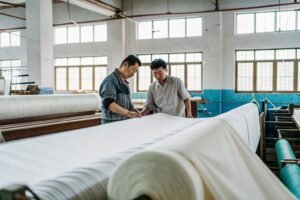
At Shanghai Fumao we stock 160D Cordura Ripstop as our core techwear base. It balances weight durability and drape. It’s heavy enough to feel substantial but light enough to not feel like armor.
Why Is High-Tenacity Nylon 6.6 Superior to Standard Nylon 6
This is the chemistry lesson that matters. There are two types of Nylon.
Nylon 6 : Made from one monomer (Caprolactam). Melting point: 215°C . Lower tenacity. Cheaper.
Nylon 6.6 : Made from two monomers (Hexamethylene diamine and Adipic acid). Melting point: 260°C . Higher tenacity. More expensive.
That 45°C difference in melting point is huge for techwear. It means Nylon 6.6 can withstand Higher Friction Heat . When you slide down a concrete embankment the friction generates heat. Nylon 6 will melt and glaze over. Nylon 6.6 will abrade cleanly without melting.
Also Nylon 6.6 has a Tighter Polymer Structure . It absorbs Less Water (4% vs 5.5%). This means it Dries Faster and Stays Lighter in the rain.
Always specify Nylon 6.6 for outer layers. Nylon 6 is fine for linings.
How to Evaluate Water Repellency and Breathability Ratings
Techwear lives and dies by two numbers: Hydrostatic Head (HH) and Moisture Vapor Transmission Rate (MVTR) .
Hydrostatic Head (HH) : This measures Waterproofness . It’s the height of a column of water the fabric can hold before leaking.
- 5,000mm HH: Shower resistant. Light rain for 30 mins.
- 10,000mm HH: Waterproof. Sustained rain. Minimum for a Techwear Jacket .
- 20,000mm HH: Extremely Waterproof. Monsoon conditions.
Moisture Vapor Transmission Rate (MVTR) : This measures Breathability . It’s how much sweat vapor can escape per 24 hours.
- 5,000 g/m²/24h: Low breathability. You will feel clammy.
- 10,000 g/m²/24h: Moderate breathability. Good for static commuting.
- 20,000+ g/m²/24h: High breathability. Good for active movement.
The Holy Grail is 20K/20K (20,000mm HH / 20,000g MVTR). This is the spec for high-end Gore-Tex and equivalent membranes.
For urban techwear a 10K/10K Laminate is often sufficient and much less expensive. The wearer is walking to the subway not climbing Everest.

What Is the Difference Between a Coating and a Laminate Membrane
This is where durability is won or lost.
Coating (PU Coating) : A liquid plastic is smeared on the back of the fabric. It’s Cheap . It’s Waterproof initially. But it Cracks and Delaminates over time especially at the fold points (elbows shoulders). After 2-3 years of wear and washing the coating fails. The jacket is trash.
Laminate (Membrane) : A thin film of ePTFE (Teflon) or Polyurethane is Glued to the fabric. This is Gore-Tex technology. It’s more expensive but it’s Flexible . It moves with the fabric. It lasts 10+ Years .
For a durable techwear piece Laminate is Non-Negotiable . Do not use PU-coated fabric for a $300 jacket. The customer will find out in year two and they will be furious.
At Shanghai Fumao we offer both 2-Layer and 3-Layer laminates. 3-Layer has the membrane bonded directly to the face fabric and a backer mesh. It’s the most durable and lightest option.
Why Does DWR Finish Choice Impact Long-Term Performance
DWR (Durable Water Repellent) is the Invisible Shield on the face of the fabric. It makes water bead up.
C8 DWR: The old standard. Long-Chain Fluorocarbons . Extremely effective. Banned in the EU and California because they are Forever Chemicals (PFAS) that accumulate in human blood. Do not use this.
C6 DWR: The current standard. Short-Chain Fluorocarbons . Less bioaccumulative but still a Fluorinated Chemistry . It’s being phased out.
C0 DWR (PFAS-Free) : The future. Made from Wax Silicone or Dendrimer Chemistry . It is Environmentally Safe .
The Durability Challenge : C0 DWR is Less Abrasion Resistant than C6. It wears off faster on the shoulders from backpack straps. The consumer will need to Re-Apply a spray-on treatment every season.
Be transparent about this. Include a care card that says "This jacket uses PFAS-Free Water Repellency. To maintain performance wash and tumble dry low regularly. Re-apply Nikwax TX.Direct annually." This sets realistic expectations and prevents returns.
What Are the Best Seam Construction Techniques for Techwear
The fabric can be bulletproof but if the Seams Fail the garment is worthless. Water will find the path of least resistance. It will find the needle holes.
Basic Seam (Mock Safety Stitch) : Cheap fast. Not Water Resistant . Water pours through the needle holes.
Taped Seams : A waterproof tape is Heat Pressed over the seam allowance on the inside of the garment. This seals the needle holes. This is Critical for Waterproof Jackets .
Welded Seams : No stitching at all. The fabric edges are melted together with Ultrasonic or RF Welding . This is the Most Waterproof and Most Futuristic look. It’s also Stiff and can be prone to peeling if not done perfectly.
For a durable techwear garment that bridges fashion and function Taped Seams are the standard. You must specify "Fully Taped Seams" on your tech pack. If you say "Waterproof Jacket" and only tape the shoulder seams (critical seams) you will get complaints.

How Does Bartacking Reinforce Stress Points on Cargo Pockets
Techwear loves Pockets . Lots of them. Cargo pockets utility pockets hidden pockets. Every pocket corner is a Failure Point .
A standard Back Tack (sewing forward and reversing) is weak. It will unravel under load.
Bartacking is a Dense Zig-Zag Stitch that covers the stress point with a Thick Woven Band of Thread . It distributes the force over a larger area.
You must specify Bartacking at:
- Pocket opening corners.
- Zipper fly bottom.
- Belt loop attachments.
- Sling hook attachment points.
This is a detail that consumers look for. They see a dense bartack and they think "Military Grade." They see a loose back tack and they think "Fashion Brand."
Why Is Bonded Thread Essential for High-Stress Seams
Standard sewing thread is Spun Polyester . It’s fuzzy. It creates friction. Under high tension it Snaps .
Bonded Thread is coated with a Resin or Lubricant . This reduces friction as it passes through the fabric and the needle. It increases Abrasion Resistance by 50% .
For any seam that will bear weight (shoulder straps pocket flaps) you must use Bonded Nylon or Bonded Polyester Thread (e.g., Coats Dabond). It’s a minor cost upgrade that prevents catastrophic seam failure.
How to Test Fabric for Pilling and Snagging Resistance
Techwear is worn in the city. It rubs against seatbelts messenger bags and rough concrete walls. Pilling is the enemy of the sleek technical aesthetic.
Pilling is when short fibers break and tangle into little balls. It makes a $400 jacket look like a $40 sweatshirt.
The ASTM D3512 (Random Tumble Pilling Test) is the standard. Fabric samples are placed in a cork-lined drum and tumbled for a set time. The results are rated 1 (Very Severe Pilling) to 5 (No Pilling) .
For techwear outerwear you want a Grade 4 or higher .
How to Achieve Grade 4:
- Filament Yarns Not Spun Yarns . Filament yarns are long continuous strands. They don’t have short fiber ends to break off.
- Tight Weave Structure . A dense weave locks the yarns in place.
- Anti-Pill Finish . A light resin coating can glue down surface fibers.
At Shanghai Fumao we run this test on every new technical fabric we develop. We don’t guess. We verify.

What Is the Wyzenbeek Test for Abrasion on Upholstery-Weight Tech Fabrics
If you’re making a techwear backpack or a panel that sees extreme friction you need to know about the Wyzenbeek Test .
It’s an Oscillating Cylinder covered in Wire Screen that rubs back and forth on the fabric. It’s much more aggressive than the Martindale.
Contract Upholstery Grade: 30,000 Double Rubs .
Heavy Duty Techwear: 50,000 – 100,000 Double Rubs .
Ballistic Nylon and 1000D Cordura score off the charts on this test. It’s why they are used for motorcycle gear and luggage.
How to Perform a Simple DIY Snag Test with a Key
You can do a quick field test in your studio. Take a Standard House Key . Drag the Serrated Edge lightly across the face of the fabric under moderate pressure.
- Good Fabric: The key slides. It might leave a temporary Polish Mark but no fibers pull up.
- Bad Fabric: The key Catches . It pulls up a Loop or a Fuzzball . This fabric will be destroyed by a seatbelt within a month.
This is the test I use at trade shows to embarrass lazy fabric suppliers. It takes 2 seconds.
Conclusion
Sourcing fabric for durable techwear requires a shift from fashion sourcing to performance sourcing. You must understand the difference between Cordura’s textured resilience and Ballistic Nylon’s hard density. You must demand laminate membranes over cheap coatings and specify bonded thread and bartacking in your construction. And you must verify these claims with standardized abrasion and pilling tests.
The techwear consumer is uniquely unforgiving. They are engineers and enthusiasts who inspect their gear with a critical eye. They share their findings on forums and Discord servers. If you cut corners on fabric they will expose you. If you deliver on the promise of durability they will become evangelists for your brand.
At Shanghai Fumao we bridge the gap between industrial textile manufacturing and independent design. We stock a curated range of techwear-ready fabrics including Cordura nylons laminate membranes and high-density ripstops. We provide the technical data sheets the Martindale reports and the seam sealing guidance to help you build a product that lasts.
If you’re developing a techwear collection and need a fabric partner who speaks the language of durability please reach out to our Business Director Elaine. She can provide swatch packs and technical specifications for our performance fabric range.
Contact Elaine at: elaine@fumaoclothing.com