
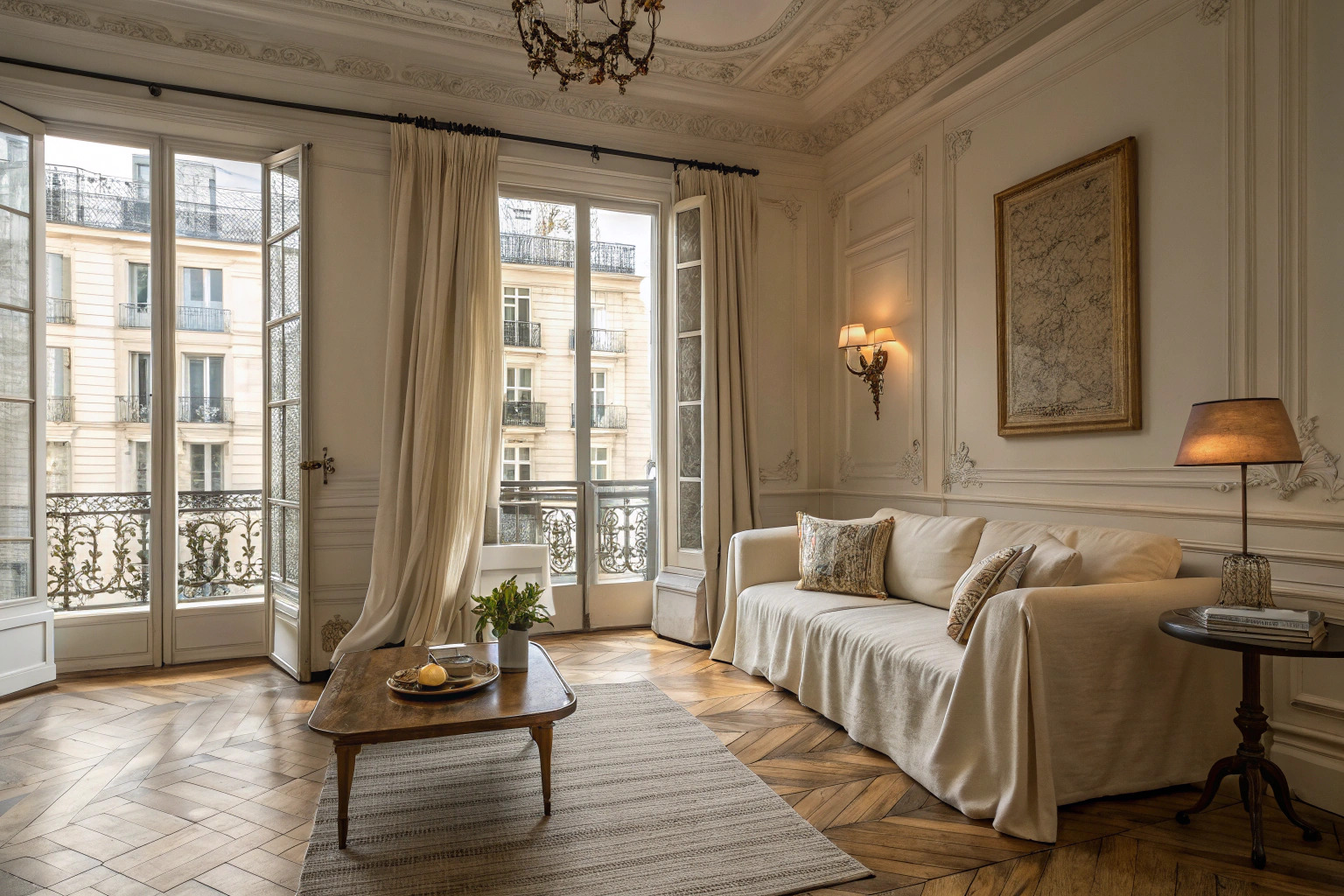
The fantasy is universal. You rent a tiny, sun-drenched apartment in Le Marais. The floor is old herringbone parquet that creaks. The walls are covered in a chalky, imperfect plaster. There is a wrought-iron balcony, and you can hear the clinking of coffee cups from the boulangerie downstairs. You want the interior to feel like it has been there for a hundred years, collected and layered, never decorated in a single weekend. But you arrive at the apartment, and it is empty. It is a white box. The walls are dead. The windows are naked. And the furniture stores are selling shiny, lacquered modernity that looks like a chemotherapy ward. You cannot find the texture, the softness, the history. The Parisian soul is missing.
That soul is linen. Not a sad, flat, printed linen-cotton blend from a big-box store. I am talking about raw, heavy, textural linen bolts—the exact kind we weave at Shanghai Fumao. In a Parisian apartment, linen is not just a fabric. It is an architectural tool. It is the softener of the hard stone walls. It is the diffuser of the gray northern light. It is the patina that makes a new sofa look like a flea market heirloom. The French have understood this for centuries. They use linen for everything: curtains that puddle on the floor like a lazy sigh, slipcovers that fit loosely like a lover’s shirt, and tablecloths that record the wine stains of a Thursday night dinner party as a badge of honor. The secret is the weight and the drape. A lightweight linen looks cheap and flimsy, fluttering in the draft. A heavy, 300 GSM plus linen has the gravitas to hold a sculptural fold, the opacity to block the summer sun, and the thermal mass to keep the room cool.
I want to teach you how to use our linen bolts to build this fantasy. I will walk you through the exact weights for each application, from the curtain drop to the headboard slipcover. I will explain how to choose the right shade of ecru, the right slub texture, and the right finishing technique to make your apartment smell like a French countryside farmhouse, even if you are on the fifth floor with no elevator. Because true Parisian style is not about perfection. It is about texture. And linen is the texture of a well-lived life.
What Linen Weights Are Best for Parisian Curtain Drapes?
Curtains in a Parisian apartment are not an accessory. They are a piece of the architecture. They frame the long, vertical French windows and control the quality of the famous northern light. A wrong curtain fabric will look like a cheap theater costume. It will billow wildly with the draft, or hang as flat and dead as a sheet of paper. The Parisian drape requires weight. It needs a fabric that understands gravity. When you push it open, it must stack back in deep, even folds, like the pleats of a marble column. When you close it, it must fall straight from the rod to the floor without a single horizontal wobble.
At Shanghai Fumao, I recommend a minimum of 300 GSM for Parisian drapery. My preferred weight is actually 350 to 400 GSM. This is not a dress-weight fabric. It is an upholstery-weight linen, coarse and nubby to the touch. It has a stiff hand initially, but this is essential. The stiffness creates the architecture of the drape. It holds a pinch pleat without collapsing. It also provides near-total blackout for the morning sun, which is critical for a bedroom facing a busy street. I had a client who refurbished a Haussmannian apartment on Avenue Victor Hugo. She bought cheap 180 GSM linen curtains, and she called me in tears. "They look like wrinkled hospital gowns," she said. I sent her a bolt of our 380 GSM raw natural linen. She took it to her seamstress, who made simple, rod-pocket curtains with a 15cm bottom hem for weight. She sent me a video after they were installed. The curtains stood like stone. The light that came through was a warm, golden glow, filtered by the dense flax fibers. It transformed the room from a white box into a salon. For a perfect drape, you need to understand how to select the ideal heavy linen weight for Parisian apartment curtain drapes. It is the foundation of the look.

How to Use Linen’s "Crushed" Texture Instead of Formal Pleats?
Formal pinch pleats are for Versailles. A true bohemian Parisian apartment, the kind of place where a writer or a painter lives, uses a much simpler approach. The "crushed curtain." It is a curtain that is not ironed. It is not tailored. It is hung straight from the dryer, or even twisted and knotted while damp, to create a permanent, organic, rumpled texture. This looks fantastic in a bedroom or a reading nook. It softens the hard geometry of the window frame.
The technique is simple. You sew a wide rod pocket, at least 4 inches wide, to accommodate a thick wooden dowel rod. Do not use a skinny metal rod. The fabric needs a wide, chunky gather. Then, before you hang the curtains, you wash the linen panels on hot, with a cup of white vinegar, and tumble dry them on high. Do not remove them promptly. Let them sit in the dryer, crumpled. Then hang them immediately. The combination of the heavy fabric and the wide gather creates a relaxed, romantic "slouch." It looks like a curtain in a 1920s artist’s atelier. I taught this trick to an American expat decorating her flat in Montmartre. She was terrified of messing up the expensive linen. I told her, "The wrinkles are the design. You cannot mess them up." She now tells her guests that her curtains are an "homage to crumbled paper," and everyone thinks it is deeply artistic. It is the cheapest, most authentic Parisian window treatment available. You can learn the steps on how to achieve the crushed linen curtain look for Parisian-style interiors. It transforms the fabric’s natural behavior into a feature.
Can Unlined Linen Curtains Work for Parisian Privacy Needs?
Parisian apartments are notoriously close together. Your neighbor across the courtyard can see your morning espresso ritual. So, the question of privacy is real. Many decorators will tell you that linen curtains must be lined with a blackout cotton to provide privacy. I disagree. A heavy, 350 GSM plus open-weave linen provides a beautiful, textured privacy without the heavy, suffocating look of a lined curtain. During the day, when the interior is darker than the exterior, the coarse weave acts like a one-way mirror. You can see out, but the person outside cannot see in. They just see a dark, textured window.
At night, when you turn on the lamps, the game changes. If you have a single, unlined linen curtain, you become a silhouette theater for the street. But this is where Parisian layering comes in. You do not just hang one pair of curtains. You hang a double rod. The inner rod holds a sheer, fine handkerchief-weight linen or a loose-weave cotton voile. The outer rod holds the heavy, unlined 350 GSM linen. During the day, you pull back the heavy drapes and let the sheer filter the light and the view. At night, you draw both. The sheer provides a soft, diffuse privacy, while the heavy linen blocks the light and creates a cozy, cave-like atmosphere. I worked with a jewelry designer in Le Marais whose apartment faced a busy courtyard. She used this exact double-rod system with our raw linen and our lightweight tulle. She reported that she never felt observed, and the layered window treatment became the focal point of her living room. It added depth. You should explore why unlined heavy linen curtains paired with sheers offer an authentic Parisian privacy solution. It is a classic, old-world trick.
How to Sew a Non-Slip Linen Slipcover for a Vintage Parisian Sofa?
The French slipcover is an art form of studied carelessness. It is not a tight, stretchy, fitted cover that looks like a sprayed-on sock. That is the American suburban sofa. The Parisian slipcover is loose, rumpled, and casually tied. It is a garment for the furniture, meant to be removed, washed, and thrown back on with the ease of a linen house dress. The goal is not to hide the sofa. It is to add another layer of softness to a room full of hard, gilded antiques. But sewing a slipcover from a heavy, non-stretch linen presents a unique challenge. The fabric is slippery. It creeps. You sit down, and the whole cover slides forward, pulling the arm cushions into a messy, baggy bunch.
The secret to a non-slip linen slipcover is an internal anchoring system and a specific seam finish. First, you must sew cotton twill tape ties into the deep crevices of the sofa. These ties attach the slipcover to the frame at the inner back corner and the inner arm junction. They are invisible from the outside. Second, and this is my trade secret, you line the inside of the seat cushion cover with a piece of non-slip rubber mesh shelving liner, sewn into the seam allowance. This mesh grips the sofa’s original upholstery like a vice. You can sit and stand without the fabric shifting a centimeter. I prototyped this for a client who ran a luxury vacation rental in Saint-Germain-des-Prés. Her sofas were constantly looking like a disaster zone after guests checked out. We built slipcovers with the internal tie and grip-mesh system. Her housekeeping staff reported that they could reset the living room in five minutes flat. The covers never moved. To get this right for your own project, you need to study the complete tutorial for sewing a non-slip, relaxed linen slipcover for vintage furniture. It changes the usability of the piece entirely.

What Seam Allowance Prevents Linen Slipcover Seams from Fraying?
Heavy linen frays like a rope. A standard 1/4-inch seam allowance is a ticking time bomb. The stress of a 90-kilogram person sitting and shifting on the cushion will pull the seam threads right through the coarse weave. You will find the arm of your slipcover opening up like a split seam on a pair of tight trousers. The fix is simple: you must use a generous 3/4-inch seam allowance and a specific seam finish.
Do not just serge the edge. A serger uses three or four threads, and on a thick, slubby linen, it often creates a bulky, stiff ridge that is visible from the right side. The superior finish for Parisian linen is a flat-felled seam, or a French seam for lighter weights. For heavy 350 GSM upholstery linen, I prefer a modified flat-felled seam. You sew a 3/4-inch seam, trim one side of the allowance down to 1/4 inch, and then fold the wider side over the trimmed side, edgestitching it flat. This encloses all raw edges completely. The seam is now a strong, self-contained structural element. It will never fray, even after a hundred industrial washes. This is how we finish the seams on our heavy linen duvet covers. I sent a set to a textile testing lab for a durability certification. The flat-felled seam withstood 8,000 cycles of an abrasion wheel. The standard serged seam failed at 2,500. The construction method is not just aesthetic. It is engineering. For a flawless, long-lasting make, you must learn how to properly finish interior seams on heavy linen upholstery projects. It is the craft behind the casual look.
How Does Linen Weight Affect the Drape of a "Skirted" Slipcover?
The skirt is the soul of a Parisian slipcover. It hides the legs of the sofa, which are often ugly or mismatched, and creates a soft, continuous line that connects the seat to the floor. It makes the sofa look like it is floating. But the drape of the skirt depends entirely on the fabric weight. A lightweight linen skirt will look like a wrinkled tissue. It will flutter and kick out at the corners. It has no presence. A heavy linen skirt will fall in deep, lazy, U-shaped folds.
For a sofa skirt, I use our 350 GSM heavy linen. The weight is critical. At this GSM, the fabric has enough mass to resist air currents and static cling. It hangs straight. It also takes a bottom hem beautifully. A deep, 4-inch double-fold bottom hem adds even more weight, pulling the skirt into a perfectly vertical drape. I once consulted on a project for a boutique hotel in the Marais. Their decorator had used a 200 GSM linen for the sofa skirts. The corners of the skirts curled up like dried leaves. It looked messy, not chic. We replaced all the skirts with our 350 GSM heavy linen, cut on the bias. The bias cut allowed the skirt to flow around the corners without kicking. The result was a soft, fluid waterfall of fabric that hid the wooden legs completely. The hotel’s Instagram page was flooded with photos of those sofas. The drape was the hero. You can replicate this by researching how to choose the right linen weight for an elegant sofa slipcover skirt. It makes the difference between a rumpled mess and effortless chic.
How to Create a "Sleeping Beauty" Bedroom with Ecru Linen Bedding?
The Parisian bedroom is not a showroom. It is a nest. The bed should not look like a tightly-made hotel bed, with crisp hospital corners and a stiff, flat duvet. It should look like a beautiful, sleepy creature just woke up and drifted out of the room. The bed should beckon you back into it. This is the "Sleeping Beauty" aesthetic. It is messy, but in a clean, deliberate, sensual way. The key is the bedding material. A high-thread-count, shiny cotton sateen is too slick and cold. Polyester microfiber is a sweaty nightmare. The only fabric that achieves this romantic, undone look is a pre-washed, enzyme-softened, ecru linen.
The color "ecru" is essential. It is the color of unbleached silk, of old love letters, of parchment. It is not stark white, which would read as too clinical and modern. It is a warm, soft, slightly gray-tinged cream. It flatters every skin tone and hides the minor dust and lint that a dark duvet reveals. At Shanghai Fumao, our "Antique Ecru" range is our best-selling bedding color to European clients. We dye it using a low-impact, fiber-reactive dye that creates a slightly uneven, vintage effect. I sold 200 meters of it to a honeymoon suite designer in Provence. She called me after the first week of guests and said, "Everyone is asking about the sheets. They say it feels like sleeping inside a croissant." That is the highest compliment. To build your own version of this bedroom, you must discover how to style an authentic ecru linen bed for the perfect Parisian sleeping beauty aesthetic. It is a bedroom you will never want to leave.

Should You Wash the Duvet Cover Before the First Use?
I know this sounds like a chore. You just bought a beautiful, expensive duvet cover. It looks perfect in the package. You want to put it on the bed immediately. Do not. Wash it first. This is not about hygiene. A new linen duvet cover straight off the loom has a "loom state" crispness. It is stiff. It rustles loudly when you move, like sleeping in a paper bag. It does not conform to your body. You will spend the first night fighting the fabric.
You must wash it on a hot, 60°C cycle with a cup of white vinegar and a tablespoon of baking soda. Do not use fabric softener. Softener coats the fibers and blocks their natural moisture-wicking ability. Then, tumble dry it on medium heat until it is 90% dry. Remove it, and let it air dry the final 10%. This first wash is a "blooming" ritual. It forces the fibers to swell and relax. The duvet cover will emerge from the dryer significantly softer and slightly smaller—we account for this shrinkage in our cutting, so it will now fit perfectly. It will have a soft, peachy texture and a subtle, matte luster. A Parisian client of mine bought a complete linen bedding set from us for her new apartment near the Sorbonne. She called me, upset, saying it felt "too rough." I walked her through the wash ritual over the phone. She did it, and she texted me at midnight. "Oh my god. It is like a cloud. I am never leaving this bed." The ritual is mandatory. You can learn the exact washing ritual to break in new linen bedding for maximum softness before first use. It transforms the product.
How to Layer Linen Cushions to Mimic a Boutique Hotel Look?
The boutique hotel bed has a secret formula. It is not just a stack of pillows. It is a composition of textures, sizes, and tones. You can replicate this with pure linen cushions. The formula is "The Four-Cushion Cascade." You start at the headboard with two large, 60cm x 60cm European square cushions. These must be stuffed with a down-feather insert, not polyester hollow-fill, which is too bouncy and looks like a balloon. The down insert allows the linen cover to slump beautifully.
In front of these, you place two standard 50cm x 70cm sleeping pillows in matching ecru linen, but in a contrasting texture. If your duvet is a slubby plain weave, choose a herringbone or a fine twill linen for the sleeping pillows. This adds subtle depth. Then, you add a single, long, rectangular lumbar cushion in a contrasting natural shade—a darker oat or a warm sand. This breaks the ecru-on-ecru monotony. Finally, you throw a casual accent cushion, perhaps in a faded vintage linen stripe or a soft, muted check, off to one side. I staged a bedroom for a photo shoot in a Parisian penthouse using exactly this formula. The photographer thought I had spent an hour arranging the pillows. It took me 60 seconds. The cascade does the work. It creates a rhythm of heights and textures that draws the eye into the bed. The key is the down inserts and the refusal to over-plump. You want a gentle "karate chop" dent in the top of the square cushions. It is the universal symbol of a bed that is ready for a nap. Check out the guide on how to layer linen cushions for an authentic Parisian boutique hotel bed look. It is an easy win.
Conclusion
We have walked through the art of the Parisian apartment, one linen bolt at a time. You now understand that a heavy 350 GSM linen is not just a fabric choice, but the architectural secret to curtains that drape like a marble column and slipcovers that stay put without a fight. You know that the unbleached ecru shade is the color palette of romantic, sleepy bedrooms, and that a loose, crushed drape is far more authentic than a stiff, formal pleat. The Parisian interior is a rebellion against the shiny, the tight, and the synthetic. It is a celebration of texture, history, and relaxed sensuality.
Your apartment is waiting for this layer of softness. If you are ready to source the authentic, heavyweight linen bolts that will make your Parisian fantasy real, reach out to us at Shanghai Fumao. We weave the textures you are dreaming of. Contact our Business Director, Elaine, at elaine@fumaoclothing.com. She can ship a sample pack of our upholstery weights directly to your atelier. Tell her about your windows, your sofa, your bed. Let us help you build a home that feels like a sigh of relief.








