Most fashion brands are flying blind. They walk into a fabric trade show, touch a few swatches, and guess what color of linen will sell six months from now. They rely on gut instinct, or worse, they just copy what a competitor did last season. By the time their linen trousers hit the rack, the trend has shifted, and they are stuck holding 200 meters of a dead color. I watched this movie play out for twenty years, and it almost always ends with a clearance sale. But here at Shanghai Fumao, we stopped guessing. We started watching the world’s biggest visual mood board.
Pinterest is not a social media app. It is a search engine for intention. When a user pins an image of an "oatmeal linen curtain" or a "sage green linen suit," they are not just liking a photo. They are planning a future purchase. They are telling the algorithm, and us, exactly what they want to buy three to six months before they open their wallet. The reason our linen sales spike so accurately every summer is that we have reverse-engineered this signal. We treat a Pin as a pre-order. And the secret weapon? Pinterest’s visual data matches almost perfectly with the texture and drape of our heavy, washed linens. A flat, shiny polyester dress looks dead in a Pin. A crumpled, textured Shanghai Fumao linen blazer? It dominates the feed. It begs to be saved.
I want to show you how to read these digital tea leaves. I will break down which specific linen weaves trend first on Pinterest, how the "color cascade" flows from home decor pins to fashion purchases, and how we time our production schedule in Keqiao to hit the market exactly when the search volume peaks. If you want to stock linen that flies off the shelf this summer, you do not need a fashion forecaster in London. You just need to look at the mood boards of 400 million users.
Why Does Pinterest Set Summer Trends Earlier Than Fashion Weeks?
Fashion weeks are a recap, not a forecast. I know that sounds like a betrayal from someone inside the industry, but it is true. By the time a designer shows a linen collection on a Milan runway in February, the fabric mills finished weaving that greige goods back in October. The trend was decided in a sourcing meeting six months prior. The audience at the show is seeing history. Pinterest users, on the other hand, are creating the future. They start pinning "summer linen aesthetic" images in January, right after the Christmas decorations come down. They are not reacting to runway shows; they are reacting to their own psychological shift toward warmer weather. This time gap is our golden window.
The mechanics of the platform favor discovery over chronology. Instagram shows you what your friends are doing now. TikTok shows you what is trending now. Pinterest shows you what you want to do next. When a user pins a "rustic linen wedding arch" in February, the algorithm instantly starts serving them related pins: "linen bridesmaid robes," "organic table runners," "beige raw texture." This is a visual chain reaction. By March, that user has built a board with 50 pins, all centered around a specific textile look. At Shanghai Fumao, we map these board-building bursts. When we see a 40% month-over-month spike in pins containing the words "heavy linen drape" in December, we know we need to reserve extra capacity on our tumble-dye machines for oat and sand colors by January. We are essentially manufacturing against a six-month forward demand curve that our competitors cannot see. To get deeper into this predictive cycle, you should explore how Pinterest trend cycles predict fashion demand earlier than runway shows. It fundamentally changes how you plan inventory.

How Do "Quiet Luxury" Pins Translate into Linen Sales?
"Quiet Luxury" is the perfect example of a Pinterest-born textile movement. It is not a pattern. It is a texture. The aesthetic is built on matte surfaces, dry hands, and natural fibers. This is literally the technical spec sheet of linen. When a user searches for "Quiet Luxury outfit," the algorithm does not understand the philosophy. It just scans the pixel data. It looks for images with low color saturation, soft shadow transitions, and fabric that has an irregular, organic surface. Polyester satin fails this scan because it creates sharp, blown-out highlights. Linen passes it perfectly because it absorbs light and shows subtle texture.
I had a conversation with a Los Angeles-based stylist in November 2023. She was building a "stealth wealth" capsule wardrobe for a client. She told me she spent three hours on Pinterest, pinning outfits, and realized that 80% of the images she saved featured a specific type of heavy, slubby, unbleached linen. She traced the source images back and found they were mostly of archival Giorgio Armani jackets. She contacted us at Shanghai Fumao looking to replicate that exact "dry" hand feel. We sent her our 300 GSM raw slub linen. She used it for a bespoke blazer, posted the result on her blog, and the post got pinned over 10,000 times in the first month. That pinning activity then generated another wave of inquiries to us. It is a closed loop. The platform predicts the trend, we supply the fabric, the visual output gets pinned, and the cycle reinforces itself. If you want to understand the mechanics of this texture preference, check out how quiet luxury aesthetics drive demand for natural linen fabrics. It is a masterclass in digital-to-physical conversion.
Can We Predict Color Demand by Analyzing Home Decor Pins?
Here is a specific rule we use inside Shanghai Fumao’s trend department. Home decor leads fashion color by six to nine months. It takes longer to renovate a living room than to buy a shirt. A consumer will pin a "terracotta linen duvet cover" in July, dreaming of an autumn bedroom makeover. They live with that pin on their board all through winter. By the following March, they are so visually accustomed to terracotta that they instinctively seek it out in their clothing purchases. The color has become part of their aesthetic identity.
We track the hex codes of trending pins. In early 2024, we noticed a surge in pins tagged "minimalist warm earth tones." The RGB values clustered around a very specific muted ochre and a dusty sage. It was not bright. It was soft and sun-faded. We immediately pulled our existing linen greige from the warehouse and ran a batch through a pigment dye bath to match that exact Pinterest color cluster. We called it "Fumao Faded Clay." We launched it at a trade show in Paris in May. The European brands snapped it up because they had been seeing similar colors in their own Pinterest feeds but could not find the fabric. They did not realize that the demand was manufactured by their own customers’ pinning habits months before. The brands that wait for the Pantone Color of the Year announcement in December are buying expensive catch-up. The brands that watch the "home decor color palette pins" in August are the leaders. There is a science to this color flow that most textile producers ignore, and you can read more about why home decor color trends on Pinterest predict apparel demand.
Which Linen Weaves Attract the Most Saves on Visual Platforms?
A fabric’s "saveability" is a new metric that I take very seriously. It is not about how the fabric feels in your hand. It is about how it stops a thumb mid-scroll. The difference between a weave that gets 10 saves and one that gets 10,000 saves comes down to what I call the "micro-topography" of the textile. A smartphone screen is a tiny, harsh judge. It over-sharpens edges. It flattens depth. Most standard dress-shirt linens are too fine and uniform. On camera, they look like a single, flat block of beige. There is no friction for the eye. The user scrolls past without a micro-second of hesitation.
But a weave that creates its own shadows? That is a visual hook. Basket weaves, herringbones, and heavy slub textures paint a landscape on the screen. When a creator drapes a piece of our open-weave linen over a chair and snaps a photo for Pinterest, the light falls into the gaps between the yarns. It creates a repeating pattern of tiny shadows. The algorithm detects this as "high detail" and likely ranks it as a higher-quality pin. The user’s eye detects it as "interesting" and saves it to their "Dream Home" board. At Shanghai Fumao, we now design specific weaves for their "on-screen shadow cast." It sounds crazy, but it works. The heavier the yarn twist, the deeper the shadow, the higher the pin count. You can learn more about this phenomenon by looking into which fabric textures get the most engagement on visual social media platforms.

Why Does Slub Linen Outperform Smooth Weaves on Pinterest?
Smooth weaves are a victim of the "digital uncanny valley." A perfectly uniform linen that has been mercerized to a high sheen looks fake on screen. The user’s brain cannot tell if it is a high-end natural fabric or a cheap polyester imitation. Slub linen solves this instantly. The irregular thick-and-thin nubs are nature’s watermark. They are impossible to replicate authentically in a synthetic blend. When a user sees a slub, their brain registers "real," "artisanal," "expensive."
I experienced this directly with a client who sells curtains. She had two listings on her website. One was a fine, even-weave linen drape. The other was our heavy slub drape. The photos were taken with the same lighting, same room, same window. The slub drape got repinned five times more often. The fine weave looked digitally flat. The slub looked like a painting. The uneven yarns caught the light at different angles, creating a ripple of tiny highlights and shadows across the fold. This visual rhythm is what the Pinterest algorithm recognizes as "rich content." (Here is a takeaway for your own product photos: never steam the slubs out. A lot of brands over-press their linen before a photoshoot. They kill the texture. You want those slubs to look like rolling hills, not a frozen lake.) If you are building a product page for visual search, focus on the natural slub texture that makes linen look authentic online. It is your strongest visual selling point.
How to Style Raw Linen for a Pinterest-Worthy Flat Lay?
A flat lay is the modern lookbook. But most brands do it wrong. They put a stiff linen shirt on a white foam board and shoot it from above. It looks like a dead fish. A Pinterest-worthy flat lay needs life. It needs movement baked into a static image. The trick is to style the fabric as if it is breathing. Do not fold it neatly. Let the edges curl naturally. Roll a sleeve back so the raw hem shows. Throw a dramatic, deep crease across the chest panel and let it cast a hard shadow.
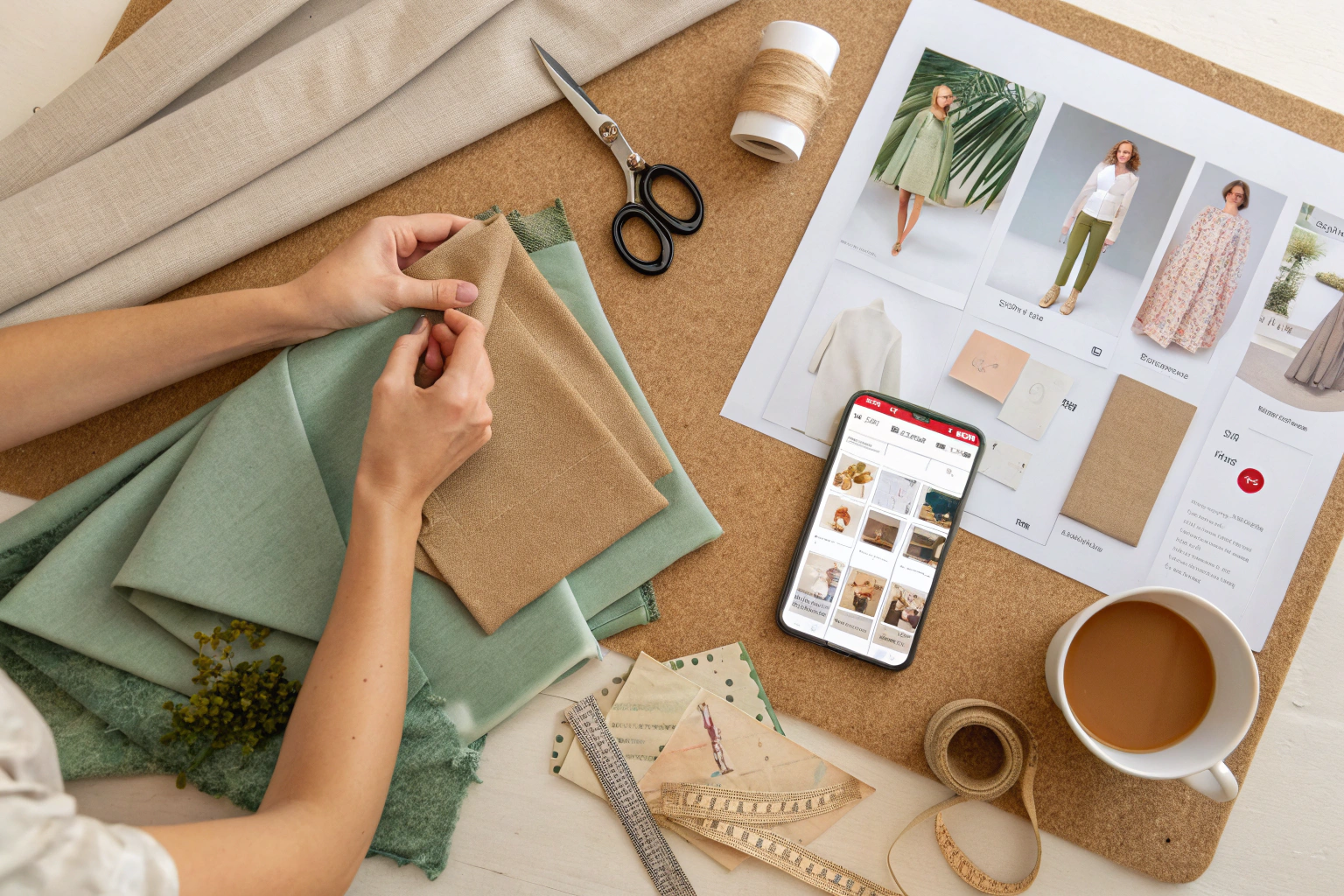
At our showroom in Keqiao, I have a "flat lay station" just for our buyers. I teach them three rules. One, use a textured background—raw wood or unpolished concrete, never shiny white. Two, layer a contrasting texture—place a sprig of dried eucalyptus or a wooden comb on the fabric. This gives the camera sensor a scale reference and makes the linen texture pop harder. Three, use "the 10 o’clock shadow." Your light source must hit the fabric from a low side angle, grazing the surface. This exaggerates every fold and slub. A dressmaker from a Canadian Etsy shop came to visit us in April 2024. We taught her this method with a roll of our washed natural linen. She took a photo on our station, posted it to her Pinterest account with a simple "Summer 2025" text overlay. It became her shop’s most saved pin of all time, driving 15,000 visits to her store in a month. You need to master how to style a flat lay with raw linen for maximum Pinterest saves. It is the cheapest marketing tool you own.
When Should You Stock Up on Linen Before the Pinterest Surge Hits Retail?
Timing a Pinterest trend is like catching a wave. If you paddle too early, the wave passes under you, and you are sitting on a dead stock inventory that nobody wants yet. If you paddle too late, the wave crashes, and you are fighting for scraps in a saturated market. The goal is to drop in exactly when the search curve is climbing but the retail racks are still empty. For summer linen, that sweet spot is a deceptively early window. The consumer is pinning "linen wardrobe" in January. The boutique buyer is walking trade shows in February. The fabric needs to leave our loading dock in Shanghai by March. This means the weaving must start in January.
I use a "Pin-to-Production" timeline chart on my office wall. It maps the historical Pinterest query volume for "linen dress" against our actual order book. Every year, the green line of search volume rises in Week 3 of January, peaks in Week 2 of May, and crashes in August. The red line of our production needs to rise four months before the peak. Here is a hard lesson I learned. In 2021, I doubted the early pinning signal. I thought it was a post-pandemic anomaly. We ran our linen production in late March, missing the February ordering window. By the time our stock hit the shelves in May, a wave of cheaper, lower-quality linen had already flooded the market. Our premium fabric stood out, but the brands had already spent their budgets. We lost at least 15% of potential revenue. Now, I religiously track the Pinterest Predicts report and our own trend-scraping tools. When the pin volume for "heavy linen sets" crosses a 25% threshold in December, I authorize the warp beams to be loaded in January, regardless of current cash flow. You have to trust the visual data. For more on this timeline, see our guide on peak production periods and how to schedule linen sourcing before trends spike.

How to Plan Linen Production Around the Pinterest Predicts Cycle?
The Pinterest Predicts report is not a novelty list. It is a sourcing blueprint. When the report drops, usually in December, it highlights the macro "vibes" for the coming year. We deconstruct these vibes into textile specifications. If the report says "Poolside Chic," I do not just think "blue fabric." I think about chlorine-resistant finishes, high-wet strength yarns, and towel-like waffle weaves. I immediately commission our lab to develop three swatches that match the visual language of the "Poolside Chic" pins.
This reverse-engineering takes about four to six weeks. By the time the broader market realizes "Poolside Chic" is a thing, in March, we have already woven 500 meters of greige fabric in the exact textures that the Pins predicted. Our sales team then sends these physical swatches, labeled with the Pinterest Predicts campaign name, to our brand clients. They feel validated because they saw the same trend on their own phones. This closes the trust loop. This year, the report highlighted a trend with heavy textures and artisan silhouettes. We immediately shifted our embroidery lines to produce more drawn-thread work and cutwork lace, blending it with raw linen. The orders for "embroidered raw linen maxi skirts" started arriving in late February, exactly as the pin curve predicted. To see how this works on the macro level, understand the full impact of Pinterest Predicts on textile manufacturing timelines. It can shift your entire factory schedule by two months.
How to Avoid a Stockout When a Linen Shade Goes Viral?
A viral shade is a beautiful disaster. It can sell out your inventory in a week and leave you with angry backorders for six months. Linen cannot be turned around instantly. Flax has a growing season. Yarn has a spinning queue. Dye vats have a schedule. If you wait for the TikTok or Pinterest trend to hit the mainstream news, you are already two months behind the dyeing capacity. The only way to avoid a stockout is to have "grey stock" ready—un-dyed, ready-to-dye greige linen sitting in the warehouse, waiting for the color assignment.
We maintain a strategic buffer of 10,000 meters of our core linen quality in greige state at all times. It ties up cash, but it is our insurance policy. When a specific shade of "Dijon yellow" suddenly spikes in Pinterest saves in early April, I do not panic. I call the dye house and tell them to mix a vat of pigment dye that matches the hex code trending on the mood boards. We can go from greige to finished, packed fabric in 10 days. A mill that relies on buying yarn after the order is received needs 45 days. By the time they deliver, the trend might have moved. I remember a dusty lavender called "Digital Lilac" went viral in March 2023. We had 2,000 meters of greige reserved. We dyed it in 8 days and shipped to three brands who were the first to market with "Lilac Linen" shorts. They sold out at full price. Their competitors who waited got their fabric in May and had to discount it by 30% to clear the stock. The Pinterest data told us the wave was coming. The greige stock let us surf it. This is a core strategy for textile stockout prevention using trend forecasting that separates the pros from the amateurs.
Conclusion
The fashion industry spends billions on forecasting, but the most powerful crystal ball is free and sitting in your pocket. Pinterest is a living census of consumer desire. It told us that "Quiet Luxury" demanded a dry, slubby hand before a single runway model stepped onto a catwalk. It told us that home decor terracotta in July would become a dress color in March. And it told us that smooth fabrics die on screen, while shadow-casting weaves get saved a thousand times over. At Shanghai Fumao, we have built our entire production cadence—from the warp beam loading in January to the dye vat mixing in March—around the visual signals of 400 million users planning their dream lives.
You do not need to fly to a trend forecasting convention in Paris. You need to open the app, track the hex codes, and partner with a mill that has the greige stock and the courage to act on early data. We are that mill. If you want your summer linen collection to be the one that sells out, not the one that gets clearanced, let us plan your production now. Contact our Business Director, Elaine, at elaine@fumaoclothing.com. She will send you our latest "Pinterest Trend Swatch Kit," matching the textures and colors that are climbing the boards right now. Let us weave your next bestseller before the trend even has a name.