
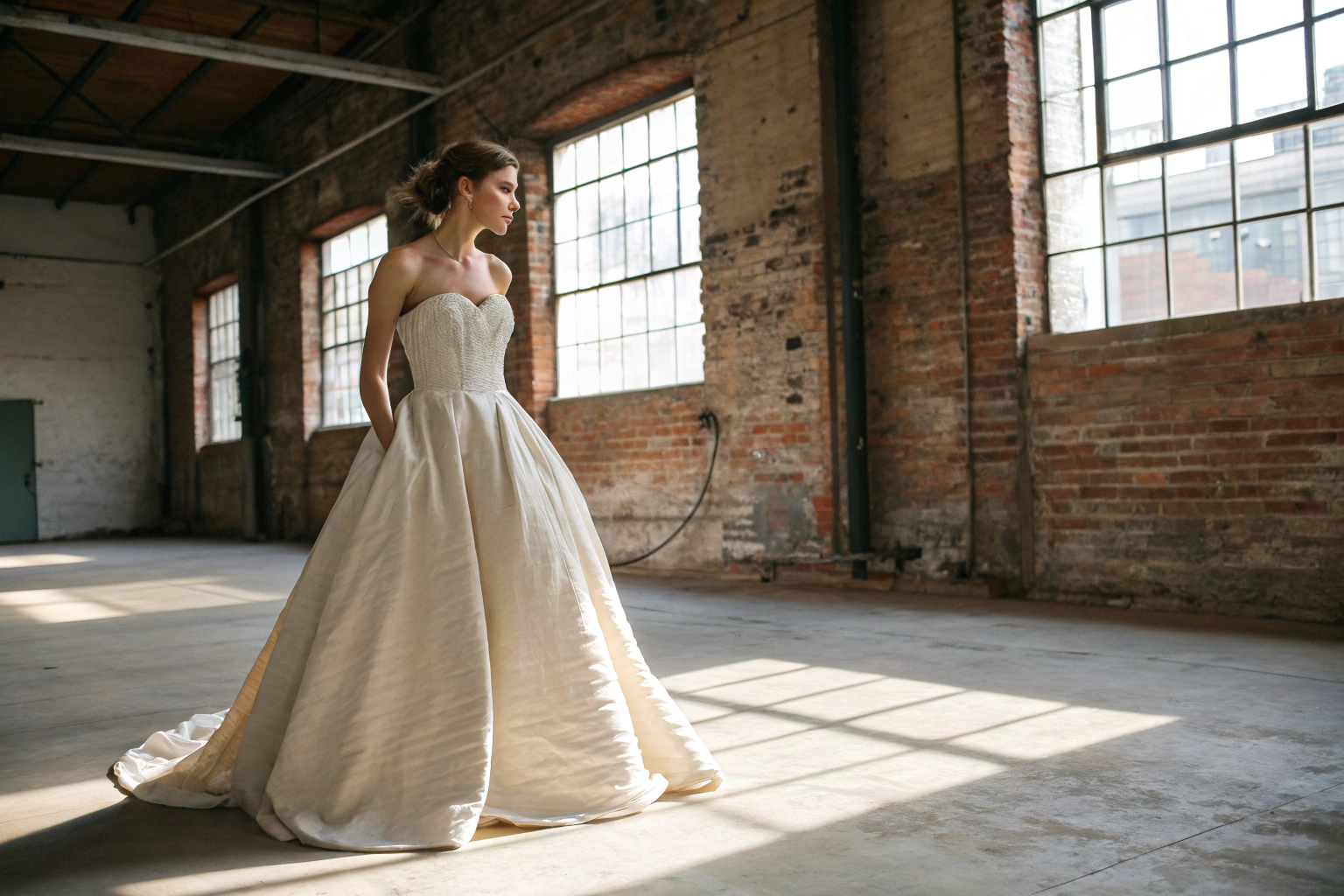
The phrase "cotton linen wedding dress" still makes most bridal consultants wince. I have seen it happen. A bride walks into a boutique, asks for something natural and breathable for her summer barn wedding, and the consultant steers her firmly back toward the polyester tulle and the heavy satin. "Linen wrinkles too much," they say. "Cotton is too casual," they say. "You will look like you slept in it." They are not wrong about the cheap stuff. A poorly woven, lightweight linen will crush the moment you sit down in the limousine. But they are dead wrong about what heavy cotton linen can become in the hands of a designer who understands structure. The real problem is not the fabric. The real problem is that the bridal industry has forgotten how to engineer with natural fibers.
You absolutely can make a wedding dress from our heavy cotton linen. In fact, at Shanghai Fumao, we believe it is the ultimate choice for the modern bride who wants to look like a sculpture, not a cupcake. Our 10-ounce and 12-ounce heavy cotton-linen blends have the structural integrity of a light denim but the drape of a softened canvas. They do not "wrinkle" in the chaotic way a cheap shirt wrinkles. They mold. They hold a shaped seam like memory foam. The key is treating the fabric as an architectural material. You cannot use a pattern designed for liquid silk. You need to design with darts, sculptural pleats, and raw-edged appliqués that leverage the fabric’s natural body. And the aesthetic? It is effortlessly cool. It is a dress that looks like it was made for a sun-drenched ceremony in Tuscany, not a stuffy hotel ballroom.
I want to walk you through how we do this. I will show you the structural linings that hold the shape, the seam finishes that celebrate the fray, and the pre-washing rituals that ensure the bride looks like a Grecian goddess, not a rumpled mess. Because the future of bridal wear is natural, textured, and honest. And heavy cotton linen is leading that charge.
How Do You Structure a Heavy Linen Wedding Dress for Support?
A fabric that has body does not need a separate corset. This is the first myth I have to shatter. Designers who are used to slinky charmeuse think every strapless bodice needs a hidden internal corset built from industrial nylon mesh and plastic boning. That internal cage is what makes most wedding dresses feel like a torture device by the end of the cocktail hour. Our heavy cotton linen allows a different approach. We build the structure into the skin of the dress itself, not into a separate cage. This is called a "self-supporting shell." It breathes because it is a single layer, reinforced only where the stress lines demand it.
The magic is in the interlining. We do not fuse a cheap, chemical-glued interfacing to the back of the linen. That would kill the drape and create ugly, bubbling delamination when the bride sweats. Instead, we use a cotton canvas interlining, hand-basted to the fashion fabric. (At Shanghai Fumao, we pre-wash our heavy cotton linen three times before we even think about cutting the interlining. We need the maximum shrinkage to happen on the table, not on the bride.) The canvas acts like a skeleton. In high-stress areas like the waistline and the bust apex, we insert spiral steel boning directly into channels sewn onto the canvas. The outer linen layer floats over this boning, completely smooth. The bride gets the sculptural silhouette of a corset with the breathability of a linen shirt. I built a prototype like this for a designer in Melbourne in March 2024. She was terrified the linen would buckle under the boning tension. We used a double-layer waist stay tape, anchored to the side seams. The dress held its shape for 14 hours of dancing. She called it "the invisible armor." To understand the technical nuances of this method, you should explore how to add internal structure to a heavy linen bodice for formalwear. It fundamentally changes the construction sequence.

What Interfacing Works Best with Raw Heavy Cotton Linen?
Interfacing is a silent dealbreaker in natural fiber garments. Use a standard fusible polyester interfacing on our raw cotton linen, and you have just created a fabric sandwich that will age at completely different rates. The linen layer wants to shrink and relax. The polyester glue wants to stay rigid. After one professional dry-cleaning, the bond breaks, and the dress looks like it has a skin disease—all bubbles and ripples. For a wedding dress that must last a lifetime, fusing is a short-term shortcut that leads to a long-term disaster.
I only use sew-in interfacing for bridal linen. My preferred material is a lightweight, organic cotton organdy. It is crisp, it is sheer, and it shares the exact same fiber memory as the cotton-linen shell. When the outer fabric shrinks, the organdy shrinks with it. They are a married couple, not a toxic relationship. For the front bodice panel, I often use a double layer of silk organza cut on the bias. This adds a subtle, invisible support that molds to the body’s curve without adding bulk. A client from Kyoto who makes bespoke linen wedding kimonos taught me a specific technique. She steams the cotton organdy over a wooden curved form before sewing it in. This pre-shapes the interfacing to match the bust curve. The final bodice does not just sit on the body; it floats around it. If you want to avoid the most common mistake in natural-fiber bridal sewing, research the best non-fusible interfacing options for cotton linen wedding gowns. It is a detail your bride will never see but will always feel.
How to Use Strategic Topstitching to Replace Decorative Beading?
Beading on a heavy cotton linen dress often looks like an afterthought. The fabric has such a strong, rustic character that shiny crystals can feel cheap and contradictory. We prefer a technique that celebrates the texture rather than covering it up: strategic topstitching. A double or triple row of contrast or tone-on-tone stitching can create a graphic, modern embellishment that weighs nothing and will never fall off. This is the "architectural embellishment" technique.
I use a heavy, 30-weight cotton thread and a longer stitch length, usually 3.5mm. A short stitch on a dense weave perforates the fabric like a postage stamp and weakens the seam. A long stitch sits on the surface, creating a bold, tactile line. For a wedding dress hem, I often suggest a triple parallel stitch in natural white on an oat-colored linen. From a distance, it looks like a subtle shadow. Up close, it is a distinct design detail. (This is a trick I learned from a vintage Japanese boro textile. The stitching is not just repair; it is the decoration.) I worked with a Canadian bride in June 2024 who wanted a "zero-plastic" dress. We eliminated all synthetic lace and beads. Instead, we used a graphic, geometric topstitch pattern on her heavy linen bodice, mimicking the lines of Art Deco architecture. The dress was photographed for a sustainable fashion magazine, and the close-up of the stitching got more attention than any beaded gown in the issue. It proved that stitch is a valid decoration. Look into how to use structural topstitching as a design feature on linen garments. It opens up a world of minimalist ornamentation.
Which Silhouettes Turn Heavy Cotton Linen into Bridal Gold?
The silhouette is a negotiation with the fabric. You cannot force a heavy cotton linen into a mermaid shape that demands four-way stretch. You cannot expect it to fall into a slinky bias-cut slip dress like a silk satin. When you fight the fabric’s nature, you get a stiff, unflattering drum. But when you listen to the fabric, when you let its body and drape dictate the shape, you unlock silhouettes that are impossible to replicate in synthetics. Heavy cotton linen loves volume, structure, and negative space. It wants to be cut into shapes that hold their form away from the body, creating a statuesque, Grecian aura.
At Shanghai Fumao, we have identified three "hero silhouettes" that convert skeptics into fanatics. The first is the sculptural A-line gown with an extended shoulder. The second is the minimalist column dress with a Watteau back. The third is the architectural two-piece with a corseted crop top and a ballroom skirt. These shapes do not require the fabric to stretch or cling. They require it to stand. The weight of the fabric pulls the skirt down into deep, vertical folds. The stiffness holds a sculptural sleeve in a perfect, curved bell shape. This is not a fabric that hides the body; it is a fabric that frames it. Designers who work with our linen often tell me they feel like sculptors, not seamstresses. The fabric becomes a medium for building volume. If you are designing a collection, you need to study the best bridal silhouettes for structured natural fiber fabrics to see how volume replaces stretch.

Why Does the A-Line Gown Work Perfectly with Heavy Linen?
An A-line gown is a geometric cheat code. Its shape—fitted at the shoulders and bust, flaring gently to the hem—relies entirely on the bias of the fabric or the volume of the cut. Heavy cotton linen has almost no bias stretch. If you cut a fitted hip block from it, the bride cannot walk. But an A-line bypasses the hip entirely. The skirt flares from the natural waist, creating a cone of fabric that never needs to stretch across the thighs.
The real magic is in the seams. A polyester A-line often collapses into a sad, flat triangle. The fabric has no memory, so it just hangs limp. Our heavy linen, with its high flexural rigidity, holds the angle of the flare. The seams become architectural lines that support the shape. I designed an A-line gown for a bride in New Zealand in January 2024. She wanted a dress with pockets that did not add bulk. We used our 12-ounce raw cotton linen. We cut the skirt panels with a 25-degree flare angle from the waist. The weight of the linen pulled the pockets flat against the skirt, making them completely invisible. She sent me a photo from her wedding day. The dress looked like a sculpture. The wind off the ocean caught the heavy linen, but instead of billowing up like a cheap fabric, the weight held the skirt down in a dramatic, rippling wave. It was cinematic. The principle behind this is understanding how the weight of heavy linen influences skirt structure and movement. It dictates everything from seam placement to hem circumference.
Can a Minimalist Slip Dress Shape Be Achieved with Cotton Linen?
A true slip dress, cut on the bias, clinging to every curve, is a technical impossibility for a heavy, rigid cotton linen. If you try, you will get a straight tube with diagonal wrinkles pulling from the hip, which is not flattering. But you can achieve the spirit of a slip dress—the simplicity, the clean lines, the minimalist sensuality—by cheating with a vertical dart structure. We call this the "Column Dress." It is a straight, narrow silhouette that skims the body without squeezing it, achieved through meticulous, vertically-oriented seam lines.
The trick is to transfer all the shaping to the princess seams and a center back seam. The front and back panels remain perfectly flat on the grain, showing off the beautiful raw texture. The shaping happens in the negative space of the seams. I once prototyped this for a bride who loved the idea of a Carolyn Bessette-Kennedy minimalist dress but wanted it in a matte, organic fabric. We cut the dress from our 9-ounce softened cotton linen. We added a deep inverted pleat at the center back instead of a walking slit. This gave her stride room without flashing any leg. The finished dress was a simple column of texture. It looked effortless. To keep the bodice from gaping, we cut the front facing on a slight bias, just 15 degrees off-grain. This gave the neckline a subtle, flexible hug without losing the overall straight-grain structure of the dress. It is a technique we developed specifically for this "faux-slip" look. You can learn more about the patterning workarounds for creating a faux bias-cut gown in stable woven fabrics. It is a clever bit of pattern manipulation.
How to Pre-Treat Fumao Fabric’s Linen for a Wrinkle-Soft Wedding Look?
The finish of a wedding dress is not created on the ironing board the morning of the ceremony. It is created in the pre-treatment process, weeks before the first cut is made. A raw heavy cotton linen straight off the roll has a crisp, papery hand. If you sew it in this state and press it perfectly flat, you are creating a ticking time bomb. The bride will wear it, her body heat and the ambient humidity will activate the fabric memory, and the dress will start to shrink and form chaotic, tight creases at every stress point. The perfect wedding linen is not "unwrinkled." It is "pre-crinkled." It has been stress-tested and relaxed before the big day.
At Shanghai Fumao, we call this the "Settling Ritual." We subject the yardage to a more aggressive version of the care it will receive over its lifetime. This means a series of hot washes, enzyme soaks, and mechanical tumble drying. The goal is to force the maximum possible shrinkage and to release all the loose, short fibers that cause surface fuzzing. After this ritual, the fabric emerges transformed. It has a softer drape, a more pronounced slub texture, and a "memory" that produces soft, rolling folds instead of sharp, chaotic creases. This is the state the fabric needs to be in for a wedding dress. A bride should not be the first person to wash her dress. The fabric should have already lived a little. For a deep dive into this process, look at how to pre-wash and soften heavy linen yardage before cutting a special occasion gown. It is a mandatory step, not an optional one.

Does Salt-Water Soaking Give a Softer "Beach Wedding" Texture?
Yes, and it is an old-world trick that we have scientifically validated. A salt-water soak is not just for creating a "beach vibe" aesthetic. Sodium chloride acts as a mild, natural fiber softener. It helps to break down the pectin and lignin that make the raw flax fibers stiff. It also slightly swells the cotton fibers in the blend, which mechanically disrupts the rigid bond between the warp and weft yarns. The result is a fabric that hangs with a more liquid, relaxed drape.
For a beach wedding dress, this treatment is poetic and practical. I recommend a soak for 12 to 24 hours in a solution of 1 cup of coarse sea salt per 5 gallons of cold water. You must agitate the fabric every few hours. Do not just let it sit. (This is a step where I have seen people ruin a whole roll. They leave the fabric folded in a bucket. The salt water only penetrates the outer folds, creating a streaky, uneven softness. You must open the fabric fully and submerge it in a clean plastic tub, like a kiddie pool.) After the soak, rinse it thoroughly. Salt residue left in the fibers will attract moisture and can cause a slightly clammy feel against the skin. I used this method for a bride in the Bahamas last year. Her dress was a simple, draped heavy linen sheath. We salt-soaked the yardage, then dried it in the sun on a clean grass lawn. The UV light added a subtle, natural bleaching to the high points of the slubs. The fabric looked like it had been washed by the sea for a hundred years. It was pure perfection against the white sand. You can find the exact ratios and timings by researching how to salt-water soak linen fabric for a natural soft drape. It is a classic technique.
How to Use Enzyme Washes to Create a Permanent "Lived-In" Hand?
Enzyme washing is the secret industrial process behind that impossibly soft, vintage-feel linen that sells for a premium in high-end boutiques. It uses a naturally occurring protein, cellulase, to eat away the micro-fibrils on the surface of the yarn. Think of it as a chemical exfoliation for fabric. It removes the fuzz, the pills, and the sharp edges of the flax nodes, leaving behind a perfectly smooth, polished yarn that feels like silk but looks like linen.
This is not a process you can easily do at home with a bottle of enzyme laundry detergent. It requires precise temperature control and a specific pH level. If the water is too hot, the enzyme dies. If the pH is off, the enzyme attacks the core of the fiber and weakens the tensile strength. At Shanghai Fumao, we use a neutral cellulase enzyme in a controlled industrial bath at 55°C for exactly 45 minutes. We then raise the temperature to 80°C to "kill" the enzyme instantly, stopping the reaction. I did a custom enzyme wash for a couture wedding dress designer in London in February 2024. She wanted the heavy linen to feel like a favorite old shirt but look like a cathedral train. We ran the yardage through our enzyme wash twice, at a lower concentration. The fabric lost 5% of its weight in micro-fuzz but gained a suede-like, powdery surface. She sent me a video of her cutting into it. She said it felt "morally wrong" to cut something so soft. This is a specialized finishing service that we offer to our bridal designer clients. To understand the science behind this, you should explore how enzyme washing permanently changes the hand feel of linen textiles. It is one of our most requested bespoke finishes.
Where Can Designers Source Heavyweight Bridal Cotton Linen by the Meter?
Finding a true heavyweight bridal linen is not like ordering a spool of all-purpose thread. You walk into a typical fabric store, and you find "linen look" polyesters or lightweight handkerchief linens that are 150 GSM at best. That weight is suitable for a summer blouse, not a wedding dress bodice that needs to support its own weight. Bridal construction demands a minimum of 300 GSM, preferably 400-450 GSM, which puts the fabric in the category of a light upholstery weight. Most retailers do not stock this because their core customer is making casual wear. You need to source from a mill that understands the crossover between fashion textiles and industrial textiles.
At Shanghai Fumao, we bridge this gap. Our "Heavy Canvas Linen" and "Architectural Cotton Linen" ranges are specifically woven for structure. We use a thicker warp yarn and a tighter pick count to increase the density without adding chemical stiffeners. The selvedge is reinforced with a tight plain weave to prevent fraying during the long construction process of a bridal gown. When a bridal designer contacts us, we do not just send a small swatch. We send a "Construction Kit": a half-meter cut of the heavyweight linen, plus a piece of our recommended cotton canvas interlining, and a sample of the spiral steel boning we recommend. We want the designer to build a test bodice, not just pet the fabric. This is the level of technical partnership required for a successful bridal line. If you are starting your sourcing journey, you need to know how to find wholesale heavyweight cotton linen suppliers for bridal fashion. It is a niche within a niche.

What Are the Key Specs for a Bridal-Grade Heavy Cotton Linen?
When you talk to a supplier, you cannot just say "heavy." You need to speak the technical language of weight, weave, and composition. A bridal-grade heavy cotton linen starts with the composition. I recommend a 55% linen, 45% cotton blend. 100% linen can be too rigid and prone to developing sharp creases at the inner elbow. The cotton adds a subtle, forgiving flex and reduces the dry-cleaning cost because it is less prone to cellulose fibrillation.
The crucial spec is GSM. For a structured bodice, demand 350 to 400 GSM. For a sculptural skirt that needs to hold a shape without a crinoline, you can go up to 450 GSM. Next, check the weave. A plain weave is fine, but a twill or a herringbone weave will have a richer texture and a slightly better drape. Finally, ask for the "shrinkage report." The supplier must provide a test certificate showing the residual shrinkage after washing. For bridal, I demand less than 2% residual shrinkage. We achieve this by mechanically compacting the fabric using a compactor machine before shipping. A designer from a sustainable bridal label in Vancouver once ordered 20 meters of linen from a broker who told her it was "pre-shrunk." She did a burn test, and the fabric melted—it was a linen-viscose blend with a heavy synthetic coating. The dress disintegrated during the first fitting. She now sends every roll to an independent lab before cutting. You can learn the exact verification tests by understanding the key specifications to demand for heavy bridal cotton linen fabric. It protects your labor and your reputation.
How Does Shanghai Fumao Support Small-Batch Bridal Designers?
The bridal industry is dominated by huge wholesale suppliers who want to sell entire rolls of polyester tulle. A small designer making 10 dresses a season is invisible to them. They cannot meet the 100-meter minimums. We built our service model specifically to empower these artisans. We do not treat a 15-meter order like an annoyance. We treat it like a collaboration. Because I know that today’s small-batch, zero-waste designer is building the aesthetic that the big brands will copy in three years. I want our fabric to be the original.
We offer a specific "Bridal Sample Pack" service. A designer can request up to 5 different heavy linen swatches, pre-washed, with matching interlining samples. We also do "Short End Bridal Rolls." If a big order leaves us with a 12-meter roll of a premium heavy slub linen, we list it in our private designer portal at a sample-sale price. We can also handle bespoke dyeing for very small yardages. A bridal designer from Barcelona needed exactly 8 meters of our heavy linen dyed to a specific dusty sage green. Our minimum dye lot for commercial orders is usually 50 meters. But because we had a similar color running that week for a larger client, we piggybacked her 8 meters into the vat. She paid a small custom fee and got the exact couture color she needed. That is the advantage of working directly with the mill, not a middleman. You get creative solutions. If you are an independent label, you need to find textile mills that actively support small batch bridal designers with low minimums. It is a game-changer for your cash flow and your creative range.
Conclusion
Making a wedding dress from heavy cotton linen is not a compromise; it is a statement. It is a rejection of the plastic, disposable glamour that has dominated the bridal industry for decades. We proved that with the right internal architecture—a canvas interlining and strategic boning—this fabric delivers a sculptural silhouette that breathes with the body. We explored how the A-line and the structural column dress transform the fabric’s natural stiffness into an asset, creating shapes that hold their form for 14 hours of dancing. And we went deep into the pre-treatment rituals, from salt-water soaks to enzyme washes, that ensure the bride wears a dress that is soft, relaxed, and pre-forgiven of any crease.
This is slow fashion for the most important garment of a lifetime. If you are a designer who wants to build a bridal collection around texture, authenticity, and architectural form, you do not need to compromise your ethics for structure. We can weave it for you. Reach out to us at Shanghai Fumao. Let us discuss your dream silhouette, the weight of the drape, and the exact shade of natural white that matches your vision. Contact our Business Director, Elaine, directly at elaine@fumaoclothing.com. She will prepare a bespoke Bridal Sample Kit for your collection. Let us make a dress that a bride can actually breathe in.








