
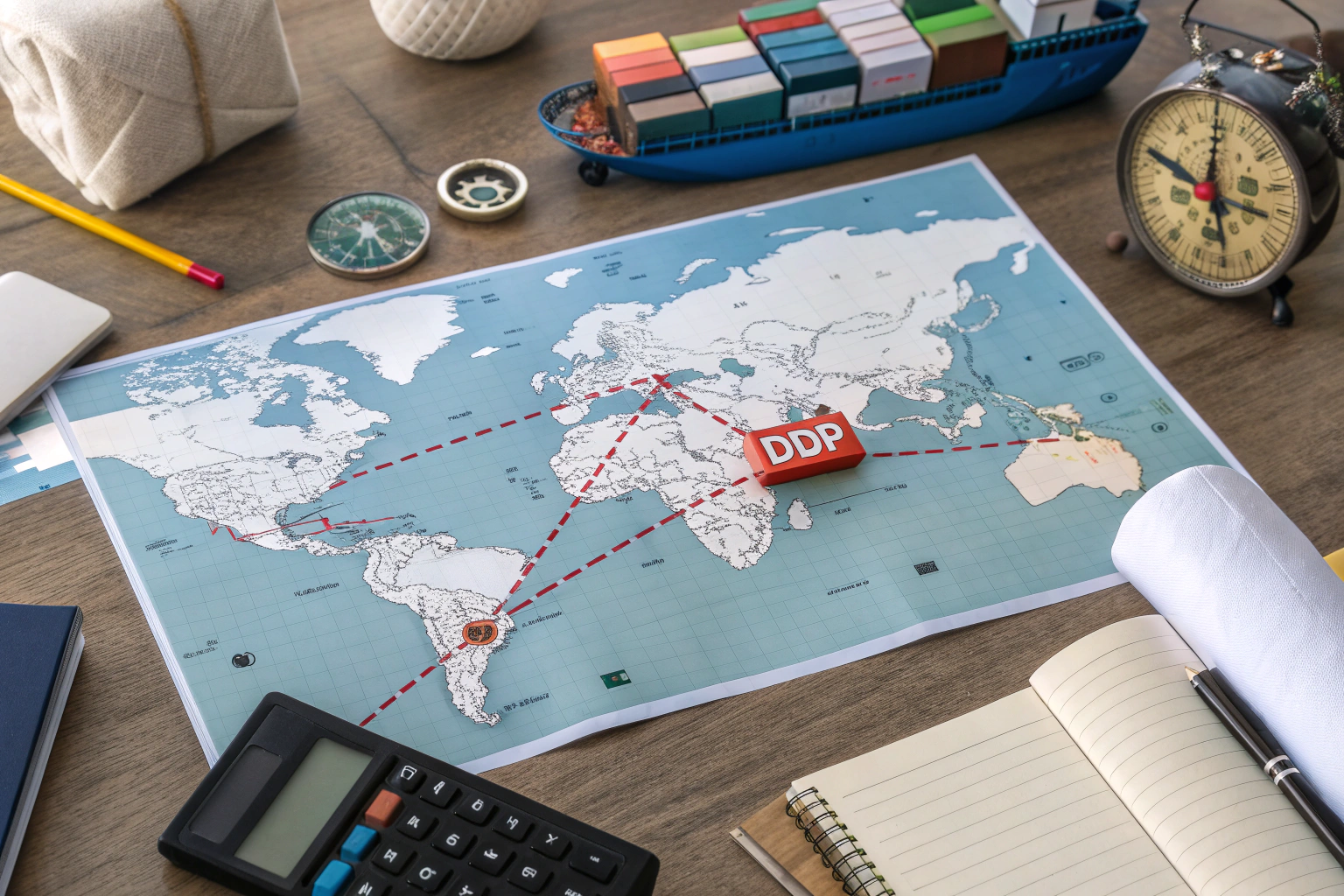
Waiting for fabric to arrive is like watching water boil. You’ve paid the invoice. The money has left your account. And now you are just… waiting. Days turn into weeks. Your production timeline shrinks. The landlord of your boutique is asking when the new collection drops, and your sewing team is sitting idle. The worst part? The anxiety of not knowing the real final cost. That’s the killer. You see one price online for sea freight, but then the courier slaps you with a $250 "customs brokerage fee" and a $180 "destination terminal handling charge" before they’ll release the pallet. That uncertainty is why DDP shipping exists, and why I want to unpack exactly what it means for your cotton linen orders.
DDP shipping for cotton linen textiles from our warehouse in Keqiao, China, to your door in California generally takes between 14 and 18 days by air express and between 22 and 28 days by sea freight. The "DDP" stands for Delivered Duty Paid, which is a game-changer for boutique owners and small brands. It means I, as the shipper, take on every single risk, cost, and bureaucratic headache until those rolls of fabric are physically placed inside your studio, warehouse, or even your garage. You don’t pay a single extra cent beyond the agreed invoice. No surprise tariffs, no holding fees, no complex customs broker forms. At Shanghai Fumao, we’ve moved heavily into offering DDP terms over the past three years, especially to the U.S. West Coast, precisely because our boutique clients told us the hidden import fees were killing their margins. We listened, and we fixed it.
Here is the reality: time in transit is only half the story. The clock doesn’t start when the ship sails; it starts when the fabric is ready to pack. I’m going to walk you through the two distinct timelines—air and sea—and then dig into the three biggest bottlenecks that eat up the days. I’ll share exactly how we shaved a full week off our standard California delivery schedule in 2025, and what you need to look out for on your end. If you’re tired of surprise costs, stick with me. This is how you take control of your supply chain.
What Are the Exact Air and Sea DDP Transit Times from China to California?
Let’s get the raw numbers on the table, because I hate it when logistics salesmen dance around the actual days with vague promises. You need to plan your launch events and your social media campaigns around exact dates, and I respect that. The air route from Shanghai Pudong International Airport to Los Angeles International is a mature, heavily trafficked lane. The flight itself is a 12-hour direct shot. But adding the ground handling, the security scanning, and the customs clearance on both ends, the total door-to-door timeline is consistently 3 to 5 business days for the express leg. We then tack on 1 to 2 days for the final mile delivery by truck to San Francisco, San Diego, or wherever you are in California. So, a realistic total is 5 to 7 business days for air DDP. I know that sounds fast, and it is, but you pay a heavy premium for that speed. I’ll get to the cost trade-offs in a moment.
For sea freight DDP, the standard lane we use is from Ningbo-Zhoushan Port to the Port of Los Angeles or Long Beach. The pure sailing time on a modern container vessel is around 12 to 14 days, depending on the carrier and whether they slow-steam to save fuel. Once the ship docks, the real work begins. You have to account for 3 to 5 days of terminal operations—unloading the vessel, getting the container through the chassis pool, and having U.S. Customs and Border Protection clear the shipment. After clearance, the trucking to your final California address usually adds 1 to 2 days. That puts the total sea DDP timeline at a solid 22 to 28 calendar days from the moment the container gates in at the port of origin. We tell our clients to bank on four weeks, and if it arrives in three and a half, you’re pleasantly surprised. This is real data from our 2024 and 2025 shipment logs, not marketing fluff.
Let’s dig deeper into the actual mechanics of these two modes because choosing between them isn’t just about how fast you want it. It’s about the physics of the cargo. Cotton linen fabric is heavy. A single roll of our 300gsm heavy linen can weigh 25 kilograms. Air freight charges on dimensional weight, which means they take the volume of the box and convert it into a "chargeable weight." If you have a large, lightweight shipment, you pay for the cube. But fabric is dense, so you pay for the actual gross weight. Right now, a typical air DDP rate from our door to California is roughly $4.50 to $6.00 per kilogram, depending on the fuel surcharge for that week. For a 50-kilogram sample run or a small batch order, that’s manageable. But for a 500-kilogram bulk order, you’re suddenly looking at $2,500 to $3,000 just in freight. That’s when the economics scream "sea freight," which typically costs around $1.20 to $1.80 per kilogram on a DDP basis for LCL (less than container load) shipments. I once calculated the exact break-even point for a client in Los Angeles last summer: if her fabric order was under 80 kilograms, air DDP was actually cheaper than sea DDP because the fixed customs brokerage fees on a sea shipment were too high for such a small parcel.

How Do Peak Seasons and Chinese Holidays Disrupt These Standard Timelines?
You absolutely cannot look at a calendar and just count forward 28 days. The shipping world has two massive bottlenecks that throw a wrench in the standard schedule. The first is the pre-Chinese New Year rush. Our factories and dye houses shut down for about three weeks, usually in late January or February. In the three weeks before that shutdown, every brand in the world rushes to get their containers out of China. The vessels fill up, the roll-over rates spike, and your container might sit at the port for an extra week waiting for a slot. I lived through this in January 2024 with a client in San Diego. We had her 300 meters of washed cotton-linen ready by the 15th, but the vessel was overbooked. Her container didn’t actually load until the 23rd, adding 8 days of pure waiting time to the schedule.
The second is the October Golden Week holiday, but also the back-to-school and pre-Christmas retail rushes in the U.S. shipping cycle. The peak shipping season from August to October sees a general rate increase, or GRI, from the carriers, and the ports get congested. During these times, I always advise my clients to add a "buffer week" to the transit time. Instead of promising your customers a 4-week delivery, quote 5 weeks. I also recommend you leverage our "Quiet Season" windows in June and July to ship. The ships are emptier, the customs lines are shorter, and we can often negotiate a lower DDP rate with our courier partners. A London-based client who sourced our bamboo linen blend shipped a full 40-foot container in June 2024. From gate-in at Ningbo to her receiving warehouse in Oakland, it took exactly 19 days—a full week faster than our standard estimate. That’s the kind of advantage you get by planning around the calendar, not fighting it.
What Are the Exact Customs Clearance Steps Under a DDP Incoterm for Textiles?
Under DDP, the customs clearance burden falls entirely on us, the seller. But as a buyer, understanding the steps helps you diagnose a delay if one happens. The process is a chain of specific documentation handoffs. First, our logistics team transmits the Importer Security Filing, or ISF, also known as the "10+2" filing, 48 hours before the vessel sails. This tells U.S. Customs who is shipping what. If we miss this, there’s a $5,000 fine, so we are religious about it. Second, we file the customs entry upon arrival. We classify your cotton-linen fabric under the correct HTS code, typically 5309.21.00 for blends with less than 50% flax or 5311.00 for pure linen. The tariff rate for pure flax is different from cotton blends. For DDP, we pre-calculate the exact duty rate. For example, a 55% linen 45% cotton blend currently carries a duty rate of roughly 3% to 8%, depending on the specific sub-classification. This is where my experience saves you money. If your blend is marginally different, the duty can jump to 14%. We use a certified customs broker in Los Angeles who pre-clears the entry while the ship is still in transit. This shaves off 2 to 3 days. Once cleared, the trucking is dispatched. I must emphasize this: DDP means our legal responsibility ends only when the truck driver physically hands you the bill of lading at your address. To understand how these responsibilities shift in other agreements, you can review a practical guide on comparing DDP versus FOB shipping terms for small US textile importers to see what best fits your risk profile.
How Do Fabric Production and Packaging Add to the Total Delivery Lead Time?
When a client emails me asking where their fabric is, and I pull up the tracking, nine times out of ten the delay isn’t on the boat or the plane. The delay happened before the goods even left the factory gate. The "transit time" clock you care about doesn’t start when the ship departs Ningbo. It starts the day you transfer the deposit. The manufacturing and packaging lead time is a hidden part of the DDP equation that many first-time importers completely forget to factor in. You might be counting on a 4-week ocean transit, but if the fabric takes an extra 3 weeks to weave and finish because you changed the weight at the last minute, your total timeline just became 7 weeks. That gap between expectation and reality is where the frustration and the frantic late-night WeChat messages happen.
The standard production lead time for our core cotton-linen stock is 10 to 15 working days for order quantities under 500 meters. This includes pulling the greige fabric from our shelves, sending it to the dye house, running the finishing wash you specified, drying it, and doing the final quality inspection. However, if you order a custom blend that we have to spin and weave from scratch, that lead time jumps to 25 to 30 working days. I always separate the timeline into two distinct phases for my clients: the "Manufacturing Phase" and the "Logistics Phase." I send a visual timeline in our proforma invoice confirmation email. It looks something like this: "Yarn Preparation (Day 1-5), Weaving (Day 5-10), Dyeing & Finishing (Day 12-18), QC & Packaging (Day 18-20), Handover to Forwarder (Day 20)." Only then does the actual DDP transit clock begin. An L.A. contemporary womenswear brand we partnered with in early 2025 ordered a custom enzyme-washed 200gsm linen-cotton. They assumed the 5-day air freight was the total wait. They were shocked when I explained the custom wash needed 7 days alone for the enzyme to react and the fabric to stabilize. We worked it out, but it was a wake-up call for them on what "lead time" really means.
Let’s dig into the packaging segment specifically because it directly impacts your DDP costs and the condition of your fabric upon arrival. You can’t just toss fabric into a box. If you do, you risk mold, crushing, and astronomical dimensional weight charges on air freight. We package cotton linen specifically for the California climate. I’ve shipped enough to the West Coast to know that the Port of Long Beach can be punishingly humid in August. We use a specific moisture barrier system. First, we wind the fabric on heavy-duty 3-inch diameter cardboard cores with a wall thickness of at least 10mm to prevent crushing. We then wrap the roll in a translucent polyethylene bag with a small silica gel desiccant packet inside to absorb residual moisture. We don’t use colored bags because the dye can leach onto the fabric if it gets hot in the container. Finally, for air shipments, we compress the rolls using a vacuum pump to reduce the volume by up to 15%, directly lowering your volumetric weight charge. For sea freight, we don’t vacuum as hard because the long voyage can cause permanent crease marks in the linen if it’s compressed too tightly for too long. This kind of specific knowledge only comes from doing this a thousand times.

How Do Quality Control Holds and Reweaving Affect Your Scheduled Shipping Date?
Here is a hard truth that I have to deliver to excited designers sometimes: your fabric might fail QC, and that will delay your ship date. But a delay to fix a problem is infinitely better than receiving a bad batch. Our CNAS-certified lab tests every dye lot before it clears for packing. The testing takes 24 to 48 hours. We check for shrinkage, colorfastness, and breaking strength. If a batch of your oatmeal linen shows a shrinkage rate of 4% in the warp, but your standard is a maximum of 3%, we put an automatic "QC Hold" on your order. The batch then goes back to the finishing department for a second compressive shrinking pass. This adds 2 to 3 days to the schedule. It’s inconvenient, but I refuse to ship fabric that I know will shrink unacceptably. I tell my production managers, "If it’s not good enough for my own sister’s brand, it’s not shipping."
Reweaving is the nuclear option. It’s rare, but it happens. In August 2024, we warped a custom 21s cotton-linen twill for a San Francisco client. The hand feel was beautiful, but our automated optical scanner found a recurring thick-thin defect every 30 centimeters, caused by a worn gear in the loom’s take-up mechanism. We could have ignored it and shipped it. She probably wouldn’t have noticed until after cutting. We didn’t. We scrapped the 200 meters, replaced the loom gear, and rewove the entire batch. That added 7 days. I called her personally, explained the situation, and she was upset but ultimately grateful because a defective batch would have ruined her "perfect fit" brand promise. Transparency in these moments builds trust. To see how other mills handle these setbacks, you might want to read about how textile mills manage production delays caused by quality control failures, which offers a broad perspective on industry standards.
Can You Expedite an Order If You Missed Your Original Timing Window?
Yes, we can expedite. But "expedite" isn’t a magic spell; it’s a sequence of specific, costly interventions that compress time. If you come to me in mid-October needing a fabric that was supposed to ship in September, we can usually recover some time, but not all. The first lever we pull is swapping the dyeing queue. We have long-standing relationships with our partner dye houses. I can sometimes bump a "repeat stock order" from a giant brand to run your smaller urgent lot first. This is a favor-based economy, and it works because we give them steady business. The second lever is shifting from sea to air freight. I’ve had many conversations that go, "I know the budget was for ocean, but to hit your pop-up store launch in Silver Lake, we need to put at least 200 meters on a plane." The cost jumps significantly, but saving a sales event is often worth the freight premium.
The third lever, which is the most extreme, is splitting the order. We ship the first 100 meters by air so you can start cutting and sewing immediately for your initial orders, while the remaining 300 meters follow by sea at the standard rate. This balances cash flow with speed. A contemporary resort wear client in Malibu did this successfully in April 2025. Her wholesale orders were due in early May. We air-freighted exactly enough fabric to sew the 50 units needed for the Nordstrom buy, and the rest of the stock replenishment arrived by sea three weeks later. I coordinated directly with our DHL account manager to ensure the air package had a special "Priority Clearance" tag assigned to it, and it cleared LAX in under 4 hours. So yes, we can expedite, but it requires a frank conversation about the trade-offs between time, money, and the physical limits of textile chemistry. You can’t make a bio-enzyme wash run faster than 8 hours; the fibers just won’t soften. For a deeper dive into these trade-offs, check out this guide on how to expedite urgent fabric orders from Asia using air freight and split shipments.
What Are the Hidden Cost Risks and How Does DDP Eliminate Them for California Buyers?
You think you’ve budgeted correctly. The fabric was $1,200. The shipping quote was $600. You tell yourself, "$1,800 landed. I’m within margin." Then the texts from your freight forwarder start coming. A "pier pass fee" for the terminal. A "chassis usage fee" for the truck. A "customs exam fee" because your container got flagged for an X-ray. By the time the pallet is in your hands, you’ve hemorrhaged an extra $300 to $500 you didn’t plan for. I’ve seen this exact scenario crush the profitability of a small California brand’s debut collection. The fear of these "gotcha" charges is what keeps boutique owners from ordering internationally. They feel like the system is rigged against them, and honestly, without DDP, it often is.
DDP eliminates these hidden cost risks by consolidating every single charge into one fixed, upfront price. When I quote you a DDP rate for your cotton linen shipment to California, that number includes the ocean or air freight, the origin trucking, the export clearance in China, the international transit, the U.S. import duty, the customs bond, the terminal handling charges at LAX or Long Beach, the customs brokerage fee, and the final mile delivery truck to your address. You pay that number, and you never open your wallet again. I know this because I take the risk on the fluctuations. If the carrier suddenly slaps a peak season surcharge of $150 per container after I’ve already quoted you, I eat that cost, not you. We have a dedicated financial team that monitors the shipping index and builds a small risk buffer into our long-term DDP pricing, but for our regular boutique clients, we keep the margins razor-thin because we want the repeat business on the fabric, not the freight. That’s where our value is.
Let’s break down the specific California-centric fees that DDP absorbs, because the Port of Los Angeles has some of the most complex surcharges in the country. The West Coast Marine Terminal Operator Agreement, or WCMTOA, charges a "Traffic Mitigation Fee" for containers picked up during peak daytime hours. That’s $35 to $75 per container. The Clean Truck Fund Rate is another $10 per TEU, added to fund low-emission trucks. Then you have the "Chassis Split Fee" if the trucker has to go to a separate depot to pick up the wheels for the container. In a traditional FOB or CIF shipment, all these nickels and dimes show up as line items on the freight forwarder’s final invoice, and you are contractually obligated to pay them to release your goods. Under our DDP terms, our broker in L.A. manages these payments directly and we don’t even mention them to you. It’s a silent, invisible shield. Another massive hidden cost is the "Customs Exam Fee." If CBP decides to do a tailgate exam or an intensive VACIS X-ray exam, the cost can be $300 to $1,000. Under DDP, we pay it. This is incredibly important for cotton-linen fabric because the fiber content can sometimes flag a mismatch with the declared HS code, leading to a lab test to verify the flax content. I budget for this. You don’t have to.

How Does the DDP Model Protect Your Cash Flow and Retail Pricing Strategy?
Cash flow is the lifeblood of a boutique. You’re likely operating on 30-day net terms with your own wholesale accounts, paying rent, and running marketing. You simply cannot afford a mystery deduction from your bank account three weeks after you thought the transaction was closed. DDP provides absolute financial predictability. You know your total landed cost down to the penny the moment you place the purchase order. This allows you to accurately calculate your Cost of Goods Sold, or COGS, and set your retail markup with confidence. A client in Venice Beach who runs a successful online linen clothing store told me that switching to our DDP model added exactly 2.8 percentage points to her net margin, not because the freight was cheaper, but because she eliminated the "miscellaneous logistics" line item from her P&L that had been bleeding her dry at an average of $420 per shipment.
This predictability also allows you to run pre-orders. If you know your "Sunset Stripe Linen Dress" will cost $34.50 landed, you can sell it on your website for $118 and have absolute confidence in your margin. Before DDP, she would use an estimated landed cost of $34.50, but sometimes it would balloon to $38, and she would quietly take the hit. You need that reliability to scale. I also suggest to my clients that they use our DDP invoices for their own bookkeeping. Our invoice lists the single unit price, which includes the fabric and the fully delivered service. This simplifies your import accounting and keeps your tax records clean. If you want to compare this against other cost-saving strategies, this practical breakdown of DDP versus DAP versus FOB for small US fashion labels might help you make a more informed decision for your specific situation.
Conclusion
Time in the textile trade is measured in more than just days on a calendar. It’s measured in missed opportunities if you ship too late, and in eroded margins if you guess wrong on the logistics. We’ve broken down the exact transit windows: a rapid 5 to 7 business days for air DDP and a steady 22 to 28 days for sea DDP to California. But we also peeled back the layers on what makes up that time. The production lead time, the potential for a QC hold that saves your brand’s reputation, the seasonal port congestion, and the packaging decisions that keep your cotton linen looking pristine when it arrives. The clock starts when you approve that lab dip, not just when the ship leaves port.
The real power of DDP, however, is the elimination of fear. Fear of the unknown bill, fear of the customs hold, fear of the fine print on a freight forwarder’s invoice. When I quote you a DDP price, I am giving you a promise. That roll of fabric will land at your California studio, and you will pay exactly what we agreed upon, not a cent more. At Shanghai Fumao, we’ve built our entire export model around this promise, because I believe that fabric suppliers should be partners in your growth, not sources of logistical anxiety. We handle the complex web of Ningbo port fees, CBP examinations, and last-mile trucking so you can focus purely on designing and selling.
If you have an upcoming collection that needs a reliable timeline, I encourage you to contact us directly to get a precise, all-inclusive DDP quote tailored to your specific fabric and your specific California zip code. We can map out the production schedule and the optimal shipping window together. Our Business Director, Elaine, handles all the logistics planning for our West Coast clients, and she can walk you through the current transit conditions and any seasonal factors that might affect your delivery. Reach out to her at elaine@fumaoclothing.com. Let’s get that beautiful cotton linen into your hands, on time and with zero hidden surprises.








