I remember sitting across from a buyer at a trade show in Las Vegas two years ago. She picked up a swatch of our softest washed linen, rubbed it between her fingers, and said, "This is beautiful. But my customer does yoga at 8 AM and brunch at 11. She’s not changing her outfit in between. Can your linen move with her, or does it just look pretty on a hanger?" She put her finger on the exact tension that’s reshaping the apparel industry right now. The boundary between fashion and performance has collapsed. The modern consumer wants the breathable, sustainable, natural aesthetic of linen, but she also wants to lunge, reach, and sit cross-legged without feeling like her clothes are fighting her. Traditional linen, for all its beauty, has a fatal flaw in this new world: it has almost zero stretch. A rigid 100% flax fabric resists movement, and if you push it too far, it doesn’t recover. It bags out at the knees and elbows and stays that way.
Yes, Shanghai Fumao offers cotton linen blends with mechanical and elastomeric stretch specifically engineered for the athleisure and active apparel market. We’ve developed a range of stretch-infused linen-cotton fabrics that combine the natural breathability and texture of flax with the recovery and freedom of movement that modern consumers demand. This isn’t just about throwing a bit of spandex into the yarn and calling it a day. It’s about a complete re-engineering of the yarn structure, the weave geometry, and the finishing process to create a fabric that moves with the body, recovers its shape, and still looks unmistakably like linen. We launched our first stretch linen-cotton range in 2023, and it’s now one of the fastest-growing segments of our product line, particularly with brands targeting the "athleisure naturalist"—a consumer who wants performance without petrochemicals, and comfort without compromising on aesthetics.
In this article, I’m going to walk you through exactly how we build stretch into cotton-linen fabrics, the two distinct technologies we use, the performance specifications you can expect, and how to choose the right construction for your specific garment type. Whether you’re designing a travel-friendly linen blazer, a yoga-to-brunch wide-leg pant, or a fitted polo that needs to hold its shape through a day of wear, I’ll give you the technical details and the honest trade-offs. Let’s get into the mechanics of how a 5,000-year-old fiber learned to stretch.
How Do You Engineer Stretch into Natural Cotton Linen Fabric?
When a designer first asks me for "stretch linen," they often imagine it’s as simple as adding spandex to the yarn, like pouring milk into coffee. The reality is much more complex. You’re trying to marry two materials with fundamentally incompatible personalities. Linen is rigid, inelastic, and has a memory that sets in whatever position it dries. Spandex is elastic, recoverable, and wants to snap back to its original length. If you combine them poorly, you get a fabric that fights itself—the linen fibers resist the stretch, the spandex pulls too hard, and after a few washes, the linen fibers break and the fabric loses all integrity. I’ve seen terrible "stretch linens" on the market that look great on the bolt and turn into a shapeless, pilled mess after three wears.
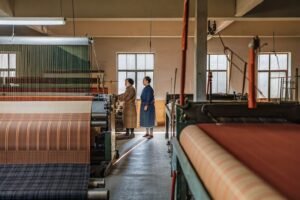
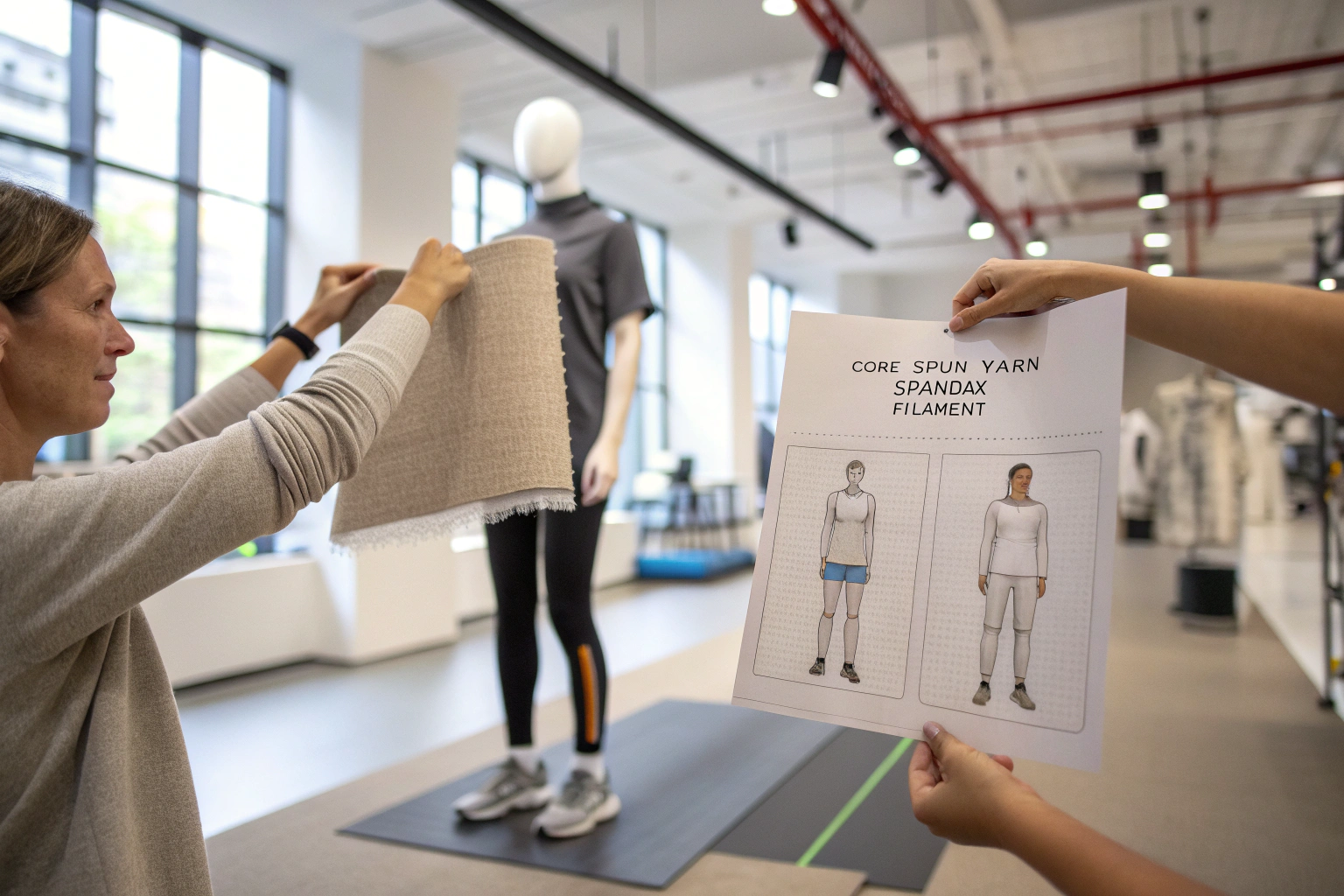
We engineer stretch into cotton linen using two distinct approaches at Shanghai Fumao. The first is core-spun elastomeric yarn technology. This is where we take a continuous filament of spandex—usually 20 to 40 denier—and wrap it completely with a sheath of linen and cotton fibers during the spinning process. The spandex sits at the core, invisible, while the natural fibers form the outer surface. The fabric looks and feels like linen because the spandex never touches your skin. The second approach is mechanical stretch, which uses no spandex at all. Instead, we engineer the stretch purely through yarn twist geometry and weave structure. By using an extremely high-twist yarn—what we call a "crepe twist" at around 28 to 32 twists per inch in the Z direction—and weaving it in a specific loose construction, the yarn acts like a tiny coiled spring. When you pull the fabric, the coils straighten out. When you release it, the yarn’s natural torque pulls it back into shape. Mechanical stretch gives you about 8% to 15% elongation, compared to 20% to 40% with core-spun spandex. It’s less dramatic, but it’s 100% natural fiber, which is increasingly important for brands with strict sustainability commitments.
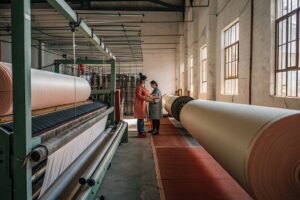
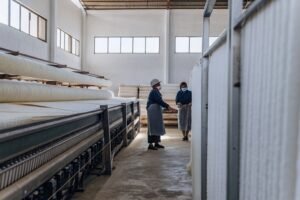
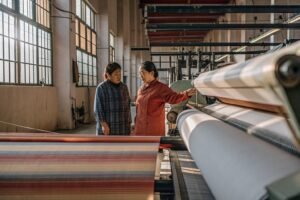
Let me take you deeper into the core-spun process because it’s the technology behind our bestselling stretch linen-cotton range. The spinning frame we use is a modified ring-spinning machine with a special attachment that feeds the spandex filament under controlled tension directly into the center of the yarn as the linen and cotton fibers are being twisted around it. The tension on the spandex during spinning is critical. Too little tension, and the spandex is loose inside the yarn—it won’t provide any recovery because it’s already extended to its relaxed length. Too much tension, and the finished yarn is permanently under strain, which will cause the fabric to shrink excessively and unpredictably the first time it hits water. We set the spandex draft ratio—the ratio of the spandex’s stretched length to its relaxed length—at precisely 3.0x to 3.5x for our linen-cotton blends. This took our R&D team about six months of trial and error to optimize. I remember the first batch we ran with a 4.0x draft ratio. The fabric came out of the dye bath looking beautiful, but then it shrank 8% in the warp direction during the first home laundry test. My QC manager walked into my office, dropped the test report on my desk, and said, "We’re not shipping this." He was right. We scrapped the batch, recalibrated the draft ratio, and haven’t had a shrinkage issue since.

What Is the Difference Between Core-Spun Elastomeric Stretch and Mechanical Stretch in Linen Blends?
The choice between these two technologies isn’t technical. It’s philosophical and commercial. Core-spun elastomeric stretch gives you significant, reliable stretch—typically 20% to 30% elongation with 95% or better recovery. This is what you need for a garment that has to move with the body through a full range of motion. Think fitted yoga pants, a tailored blazer that needs to accommodate shoulder movement, or a pull-on waistband that needs to stretch over hips and then recover to its original circumference. The spandex does the heavy lifting, and the linen-cotton sheath provides the natural look and feel. The trade-off is that spandex degrades over time. Chlorine, heat, and repeated high-temperature drying attack the polyurethane filaments, and after about 50 to 100 wash cycles, the recovery starts to decline. This isn’t a defect. It’s the physics of elastomeric polymers. I tell my athleisure clients to design with a 2% to 3% negative ease in their patterns to allow for this gradual relaxation over the garment’s life.
Mechanical stretch, by contrast, has no degradation issue because there’s no spandex to degrade. The stretch comes from the physical spring-like structure of the twisted yarns, and this structure is permanent. A mechanical stretch linen-cotton will have the same recovery on wash number 200 as it did on wash number one. But the total elongation is lower—typically 8% to 15%—and the recovery is slightly slower. When you stretch a mechanical stretch fabric and release it, it doesn’t snap back instantly like spandex. It eases back over a second or two. For a relaxed-fit garment where the stretch is about comfort and drape rather than performance, mechanical stretch is perfect. For a compressive, high-performance garment, core-spun is the better choice. We offer both because our clients design for different segments of the market. A Los Angeles brand making linen bike shorts for a studio-to-street capsule uses our core-spun 70% cotton 28% linen 2% spandex. A Parisian brand making fluid, oversized linen trousers for a slow-fashion label uses our mechanical stretch 55% linen 45% cotton. Same mill. Different technologies. Different garments. Understanding the distinction helps you specify the right fabric for your design intent, and you can explore more about the comparison between mechanical stretch and spandex-based elastic recovery in woven natural fiber fabrics for deeper technical background.
How Do You Maintain the Natural Linen Look and Feel When Adding Stretch?
This is the art of the sheath. In our core-spun yarns, the spandex filament is completely buried under a wrapper of linen and cotton fibers. The surface of the yarn is 100% natural fiber. When you look at the fabric under a microscope, you see flax fibrils and cotton fibers. You don’t see any synthetic filament. This means the fabric takes dye like a natural fiber—the spandex core doesn’t affect the color absorption—and it develops the same soft, lived-in patina over time that pure linen does. The hand feel is also dominated by the sheath. We can adjust the softness, the crispness, and the slub character by changing the ratio of linen to cotton in the sheath and by adjusting the finishing recipe.
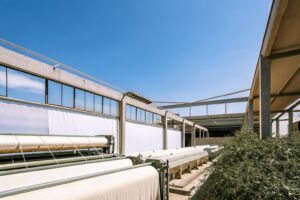
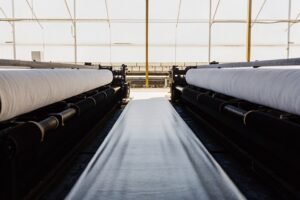
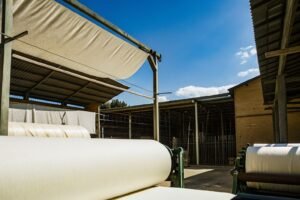
There’s a trick I want to share that many designers don’t realize. The finishing process for stretch linen is fundamentally different from rigid linen. With rigid linen, we often use a compressive shrinkage machine to pre-shrink the fabric. With stretch linen, compressive shrinkage can lock in the spandex in a partially extended state, which reduces the available stretch in the finished fabric. Instead, we use a relaxation drying process. The fabric is overfed onto a conveyor dryer, completely tensionless, and the spandex is allowed to relax fully. The fabric shrinks width-wise and length-wise as the spandex contracts, and the resulting finished fabric has maximum stretch available because the spandex is at its natural relaxed length. This relaxation drying takes longer and costs more than standard tenter frame drying, but it produces a superior stretch fabric. I had a client from Vancouver who had bought "stretch linen" from a competitor that came out stiff and with only 8% stretch instead of the claimed 20%. I explained the relaxation drying difference, and she realized her previous supplier had simply run the stretch fabric through a standard tenter, locking the spandex in a stretched state. She switched to our fabric, tested the stretch at 22%, and never looked back. For a deeper understanding of how finishing affects performance, reading about the role of relaxation drying and finishing processes on spandex-blended natural fiber fabrics will give you a solid technical foundation.
What Are the Specific Performance Specifications of Fumao’s Stretch Cotton Linen?
I believe in publishing real numbers, not marketing ranges that could mean anything. When you’re making a tech pack for a garment, "stretchy" isn’t a specification. "20% elongation in the weft direction with 95% recovery after 30 minutes" is a specification. At Shanghai Fumao, every stretch linen-cotton fabric we ship comes with a detailed test report that includes the exact elongation percentage, the recovery percentage, the growth percentage after cyclic loading, and the modulus—the amount of force required to stretch the fabric. These numbers aren’t just quality control metrics. They’re design tools. You use them to determine your pattern ease, your seam construction, and your fusible interfacing choices.
Our current stretch linen-cotton range includes four core constructions, each with different performance profiles optimized for different end uses. The Stretch Basic 70/28/2 is our workhorse. It’s a 70% cotton, 28% linen, 2% spandex plain weave with a finished weight of 180gsm. The weft-direction elongation is 22% with 96% recovery. The warp-direction elongation is limited—about 5%—because the warp yarns don’t contain spandex and are under tension during weaving. This fabric is ideal for casual pants, relaxed blazers, and structured dresses where you need cross-body stretch for comfort. The Stretch Active 55/40/5 is our high-performance variant. It’s a 55% linen, 40% cotton, 5% spandex twill at 220gsm. The weft elongation is 35% with 94% recovery. This fabric is designed for fitted activewear, yoga pants, and garments that need to stretch and recover through intense movement. The higher spandex content and the twill weave give it more give and a fluid drape.
The Mechanical Stretch Natural is our spandex-free option: 55% linen, 45% cotton plain weave at 165gsm, with 12% weft elongation and 90% recovery. The recovery is lower than the spandex versions, and the growth—the amount the fabric doesn’t recover after being stretched—is about 4% after cyclic loading. This means a knee area on a pant will bag out slightly after a day of sitting, but it will recover substantially with washing and drying. I’m completely upfront about this with clients because I’d rather they design around the material’s real behavior than be disappointed later. The fourth construction is the Stretch Light 80/17/3, an 80% cotton, 17% linen, 3% spandex voile at 130gsm, with 18% weft elongation and 97% recovery. This is our lightest, most drapey stretch linen-cotton, perfect for blouses, dresses, and travel garments that need to pack small and resist wrinkles.

What Is the Stretch-to-Recovery Ratio and Why Does It Matter More Than Just Elongation?
Elongation tells you how far the fabric stretches. Recovery tells you whether it snaps back or stays stretched out. These two metrics together determine whether a garment looks crisp and new after an hour of wear or looks like a wrinkled, baggy mess. A fabric with 40% elongation but only 70% recovery is essentially a disaster waiting to happen. It’ll stretch beautifully, but it won’t come back, and your customer will be left with sagging knees and a dropped waistband. The stretch-to-recovery ratio is the number I obsess over. For a premium athleisure fabric, I target at least 20% elongation with a minimum 95% recovery. Our Stretch Active hits 35% elongation with 94% recovery, which is a ratio that rivals many pure synthetic activewear fabrics, while still delivering the natural look and breathability of linen.
There’s a specific test protocol that produces these numbers, and you should know what it is so you can compare apples to apples when evaluating different suppliers. We use the ASTM D3107 standard for stretch and recovery testing. A 10cm by 5cm fabric strip is stretched to 85% of its known elongation limit—not to failure—and held there for 30 minutes. Then it’s released and measured after 60 seconds and again after 30 minutes of relaxation. The recovery percentage is how much of the original length has returned. The growth percentage is how much permanent deformation remains. A growth of 1% on a 10cm sample is 1mm of permanent stretching. On a garment knee that’s 40cm in circumference, that 1% growth translates to 4mm of bagging, which is invisible. At 5% growth, you’ve got 2cm of bagging, and the customer notices. Our standard for Stretch Active is less than 2% growth after 30 minutes. To understand how these testing standards apply in practice, you can learn more about the ASTM D3107 stretch and recovery test method for woven elastic fabrics and how to interpret the results.
How Do You Care for Stretch Cotton Linen Garments to Maintain Their Elasticity?
The care label you put in your garment directly determines how long the stretch lasts. Spandex degrades primarily from three things: heat, chlorine, and mechanical stress in wet conditions. Every wash cycle is a stress test. If your customer washes the garment in hot water and throws it in a high-heat dryer, the spandex filaments will start to lose their elastic recovery within 20 to 30 washes. If they wash in cold water and hang dry, the same garment will perform well for 80 to 100 washes or more. I provide two sets of care instructions to my clients: the "ideal care" instructions that maximize longevity, and the "real-world care" instructions that assume a typical consumer who occasionally makes mistakes.
The ideal care for our core-spun stretch linen-cotton is: machine wash cold on a gentle cycle, use a mild detergent without bleach or fabric softener—fabric softeners coat the fibers and can interfere with moisture wicking—and hang dry in the shade. No dryer. No iron. If the garment must be ironed, use a low heat setting and iron on the reverse side. The real-world care, acknowledging that some consumers will use a dryer, is: tumble dry on the lowest possible heat setting for the shortest possible time, and remove the garment while it’s still slightly damp. The residual moisture will allow the linen fibers to relax and the spandex to recover without heat damage. I always recommend my athleisure clients put a small "care matters" tag on their garments, explaining in friendly language that cold wash and hang dry will keep the stretch alive for years. Customers appreciate the education, and it reduces returns due to performance degradation. For a comprehensive guide on garment care, exploring best practices for washing and maintaining spandex-blended natural fiber garments to extend their lifespan is a resource you can share with your customers.
How Do You Choose the Right Stretch Linen Blend for Your Specific Athleisure Garment?
A stretch linen-cotton fabric that works beautifully for a relaxed wide-leg trouser will be a complete disaster for a fitted cycling jacket. The fabric weight, the stretch percentage, the recovery, the drape, and the opacity all interact with the garment’s silhouette and end-use in ways that aren’t obvious until you’ve made the wrong choice and seen the result. I’ve guided hundreds of brands through this selection process, and I’ve developed a matching framework that connects garment types directly to fabric specifications.
The key variables you need to match are: garment ease, body movement requirements, and structural support needs. A garment with significant negative ease—where the fabric is smaller than the body and stretches to fit, like a fitted yoga top—requires high elongation (25% minimum) and very high recovery (95% minimum). It also requires a fabric weight that won’t become transparent when stretched over curves. Our Stretch Active 55/40/5 at 220gsm is designed for exactly this application. The twill weave provides natural opacity even under tension, and the 5% spandex content delivers the necessary stretch and snap-back. A relaxed-fit garment with positive ease—like a wide-leg lounge pant—can work with lower elongation (12% to 18%) and slightly lower recovery because the fabric isn’t being stretched significantly during normal wear. The stretch in a relaxed garment is about comfort during movement, not about compression. Our Mechanical Stretch Natural or Stretch Basic 70/28/2 are both excellent choices here.
The structural support consideration is one that newer designers often overlook. If your garment has a tailored element—a collar, a waistband, a placket—you need a fabric with sufficient body and modulus to hold that structure. A lightweight, highly elastic fabric will collapse under the weight of a collar and interfacing, creating a puckered, unprofessional finish. For a commuter blazer or a structured shirt-jacket, I recommend a heavier fabric with moderate stretch rather than maximum stretch. Our Stretch Basic 70/28/2 at 180gsm is our most popular blazer fabric because the 22% weft elongation is enough to allow shoulder and elbow movement, but the fabric still has enough body to hold a lapel roll and a collar shape. I also recommend using a fusible knit interfacing rather than a woven interfacing on stretch fabrics. A woven interfacing has no stretch and will fight the shell fabric, causing delamination and bubbling. A knit interfacing stretches with the shell and maintains the bond through movement. This is the kind of detail that separates a garment that looks expensive from one that looks homemade, and you can explore more about selecting the right stretch woven fabric weight and composition for different apparel categories to build your technical knowledge base.

How Much Stretch Do You Really Need for Yoga and Low-Impact Movement Garments?
The athleisure market spans a huge range of activity levels. A garment designed for restorative yoga needs different stretch characteristics than one designed for a high-intensity interval training session. For low-impact activities—yin yoga, pilates, walking, casual cycling, and general daily wear—you don’t need compression-level stretch. What you need is freedom of movement without restriction. A fabric with 15% to 25% elongation in the direction of primary movement, typically the weft running horizontally around the body, is sufficient. Our Stretch Basic at 22% elongation handles these activities beautifully. The stretch is enough that a downward dog pose doesn’t pull the fabric tight across the back, but the recovery is strong enough that the knees don’t bag out when you stand up.
For moderate-impact activities—vinyasa yoga, barre, light jogging—the stretch requirement increases. The body moves through larger ranges of motion, and the fabric needs to accommodate those movements without restricting blood flow or creating pressure points. Our Stretch Active at 35% elongation is designed for this category. The higher spandex content provides the extra give needed for deep lunges and wide-legged poses. The twill weave also offers a slight natural give in the bias direction, which plain weaves don’t. When a body twists, the fabric experiences stretch along the diagonal, not just straight across the weft. A twill weave handles this diagonal stress better than a plain weave at the same thread count. This is one of those textile engineering details that most consumers never think about but that directly affects their comfort during a workout.
Can Stretch Cotton Linen Replace Synthetic Performance Fabrics in Your Brand’s Sustainability Story?
This is the conversation I’m having more and more frequently with brand founders. They’ve built their brand identity around natural fibers and sustainability, but their customers are asking for activewear. The easy answer is to launch a line of recycled polyester leggings and call it a day. But that answer doesn’t satisfy a brand whose core promise is "natural, biodegradable, plastic-free." Stretch cotton linen offers a partial bridge. It’s not going to match the compressive power of a 200gsm nylon-spandex performance knit. But for the vast majority of athleisure use cases—which are about lifestyle and comfort, not elite athletic performance—a well-engineered stretch linen-cotton can absolutely replace synthetics.
The sustainability story is compelling. A fabric that’s 95% to 98% natural fiber, with a tiny percentage of spandex for performance, is functionally biodegradable in a way that a pure synthetic never will be. When the garment eventually reaches the end of its life, the natural fibers decompose. The spandex fragment remains, but it’s a fraction of a percent of the total garment mass. Compare that to a 100% polyester legging that will sit in a landfill for 200 years. I’ve helped several brands build their sustainability marketing around this exact message, using our fiber content certificates and biodegradability test data as evidence. The key is honesty. Don’t claim the product is "100% biodegradable." Claim it’s "98% natural, biodegradable fibers with a trace elastane component for stretch." Customers respect that level of transparency, and it differentiates the brand in a market full of greenwashing. For more context on building a credible sustainability narrative, reading about how to market natural fiber activewear as a sustainable alternative to synthetic performance fabrics provides practical communication strategies.
Conclusion
The question "do you offer stretch linen?" opens a door into a much richer conversation about fabric engineering, garment design, and brand identity. The answer is yes—we offer core-spun elastomeric stretch linen-cotton blends that deliver 20% to 35% elongation with 95% recovery, and we offer spandex-free mechanical stretch options that give 8% to 15% elongation with permanent, wash-proof recovery. But the real value isn’t in any single fabric. It’s in the partnership that helps you choose the right one.
We’ve walked through the spinning technology that hides spandex inside a natural fiber sheath, the finishing process that relaxes rather than compresses, and the performance specifications that tell you exactly how the fabric will behave on a moving body. We’ve covered the garment-specific selection framework—high elongation for fitted activewear, moderate stretch for tailored blazers, mechanical stretch for relaxed sustainable collections. And we’ve talked honestly about the trade-offs: spandex degrades eventually, mechanical stretch recovers more slowly, and stretch linen will never match the compressive power of a synthetic knit. Knowing these trade-offs lets you design intelligently, set accurate customer expectations, and build a product that delivers on its promises.
If you’re developing an athleisure line and you want to explore how our stretch cotton-linen fabrics could fit into your collection, I invite you to reach out directly. At Shanghai Fumao, we don’t just send you a price list. We send you a curated set of swatches matched to your specific garment types, complete with the full performance test data, so you can make an informed technical decision. Our Business Director, Elaine, manages all stretch fabric development inquiries. She can walk you through the four core constructions, discuss custom blend ratios if you need something specific, and arrange lab dips in your brand colors. Send your requirements to elaine@fumaoclothing.com. Let’s build a fabric that moves with your customer.