
Let me tell you a horror story that I see happen to new boutique owners every single season. A designer in Chicago finds a fabric she loves on our website. She gets a price quote of $6.50 per meter. She does the math in her head: 200 meters times $6.50 equals $1,300. She budgets exactly $1,300 for fabric. Then the shipping invoice arrives. Then the customs broker calls with a $75 documentation fee. Then the trucking company demands $180 for the final mile delivery. Suddenly, her "$1,300 fabric" actually cost her $1,900. That $600 gap is the exact amount she had allocated for her swing tags and her social media ads. Now she’s scrambling. The fear of hidden costs like these keeps boutique owners stuck buying from expensive domestic middlemen instead of sourcing directly from the mill. They think they can’t predict the real cost. They think the system is rigged against small buyers.
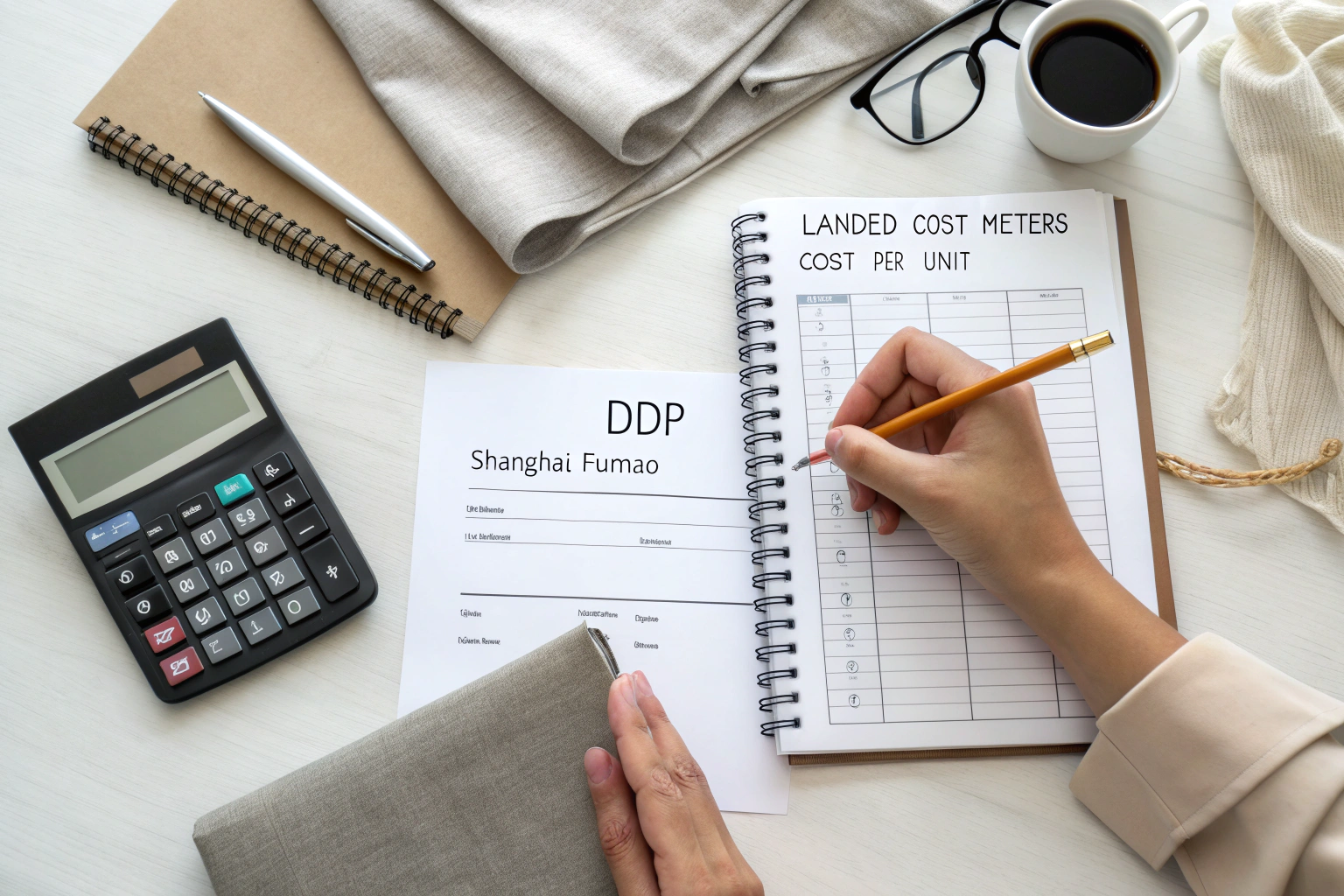
You calculate the landed cost for Fumao Fabric’s cotton linen under DDP terms by taking a single, all-inclusive number that we quote you, and simply dividing it by the total meters or yards you ordered. That’s it. No algebra. No guessing. No surprise invoices from a customs broker three weeks after delivery. Under DDP, which stands for Delivered Duty Paid, I give you one price that includes the fabric, the ocean or air freight, the U.S. import duties, the customs bond, the port fees, the trucking to your door, and every single administrative charge in between. When we agree on a DDP price of, say, $12.80 per meter for your custom-washed linen-cotton delivered to your studio in Los Angeles, that number is your total landed cost per meter. You pay that, and you never open your wallet again for that shipment.
Now, the real skill isn’t in doing the division. The real skill is understanding exactly what goes into that DDP number so you can negotiate intelligently, plan your retail pricing accurately, and spot when a competitor’s "cheaper" quote is actually a trap. In this article, I’m going to unpack every single component of the DDP landed cost formula as it applies specifically to our cotton linen fabrics shipping from Keqiao to the U.S. market. I’ll share the actual percentages and cost buckets, explain where fluctuations happen, and give you a framework for calculating your own retail markup with absolute confidence. Stick with me. By the end, you’ll be able to look at any fabric invoice and know exactly what your true cost per garment really is.
What Exactly Is Included in Fumao’s DDP Price for Cotton Linen Fabric?
You might be reading this and thinking, "Okay, but what’s actually inside that DDP quote? How do I know you’re not just padding it?" It’s a fair question. I’ve been in the textile export business for two decades, and I’ve seen freight forwarders bury so much junk into a line item that the client has no idea what they’re actually paying for. That’s why at Shanghai Fumao, I insist on breaking down the DDP price into transparent cost buckets for any client who asks. I don’t consider this confidential information. I consider it the foundation of a long-term partnership. When you understand exactly where your money is going, you trust the relationship, and you come back season after season.
A typical DDP price for our cotton linen fabric to the U.S. West Coast is built from five core components. First, the Fabric Cost itself—this is the ex-works price of the goods, representing about 55% to 65% of the total DDP figure. Second, the International Freight, which is the ocean or air shipping from China to the destination port, typically 20% to 30% of the total. Third, the U.S. Customs Duty and Fees, which includes the actual tariff percentage applied to the HTS code for your linen-cotton blend, plus the Merchandise Processing Fee, or MPF, and the customs bond premium. This bucket is usually 8% to 12%. Fourth, the Destination Handling Charges, which cover the terminal operations at the port, the trucking chassis, and the final mile delivery. Fifth, our Service and Risk Buffer—a small margin, usually 3% to 5%, that covers our logistics team’s time and absorbs any small currency exchange fluctuations or fuel surcharge spikes between the quote date and the ship date. This final bucket is what allows me to give you a fixed price and hold it firm for 30 days.
Let me dig deeper into the fabric cost component because this is where I can offer you real insight that a generic freight forwarder can’t. The fabric cost in a DDP quote isn’t just the price per meter off a rate card. For custom cotton linen, it includes the yarn cost, the weaving cost, the dyeing cost, the finishing cost, and our internal QC testing cost. If your fabric requires a specific enzyme wash to achieve a soft, peach-skin hand feel, that wash adds roughly $0.35 to $0.55 per meter to the fabric cost. If you require a water-repellent coating on the linen for outdoor cushion applications, that adds about $0.80 to $1.20 per meter. These finishing costs flow directly into the fabric cost line, which then gets multiplied by the freight and duty percentages. This is why choosing simpler finishes isn’t just about saving the finishing cost. It’s about saving the freight on that finishing cost and the duty on that finishing cost. A $0.50 per meter saving on finishing can translate to an $0.80 saving in the final DDP price after all the multipliers stack up.

How Are U.S. Import Duties Calculated Specifically for Cotton Linen Blends?
This is where the math gets specific and where a lot of importers leave money on the table by using the wrong tariff code. Cotton and linen are both plant-based fibers, but they fall under different chapters of the Harmonized Tariff Schedule of the United States, or HTSUS. Pure flax linen fabrics are generally classified under Chapter 53, while pure cotton woven fabrics fall under Chapter 52. But your fabric is a blend. How do you classify a 55% linen 45% cotton blend? The General Rules of Interpretation, or GRI, dictate that classification follows the fiber that imparts the "essential character." For textiles, there’s a specific hierarchy rule: if no single fiber constitutes the majority by weight, you classify based on the fiber that predominates. But for a 55% linen 45% cotton blend, the linen predominates, so the fabric is classified under the linen chapter, typically HTS code 5309.21.00 for unbleached or bleached blends.
The duty rate under this code is currently 3% to 8%, depending on the exact subheading and any trade preference programs in effect. A pure cotton woven under Chapter 52 might carry a higher rate. So a fabric labeled as "linen-rich" can actually be cheaper to import in terms of duty than a cotton-dominant blend. This is the kind of counter-intuitive detail that I help my clients navigate. We provide a full fiber content certificate with every shipment, tested in our CNAS lab using chemical dissolution testing according to AATCC 20A. This certificate is your legal defense if CBP questions the classification. A client importing our 70% flax 30% cotton heavyweight suiting was initially using a cotton code that carried an 8.5% duty. I caught the error during our documentation review, and switching to the correct linen code dropped her rate to 3%. On a $5,000 order, that’s a $275 saving just from getting the paperwork right. For a broader overview of these classification systems, understanding how HTS codes affect duty rates for imported natural fiber fabrics is essential knowledge for any serious importer.
What Freight and Logistics Costs Are Bundled into the DDP Quote?
The freight line in a DDP quote is never just the cost of moving a box across the ocean. It’s a cascade of smaller charges that, if you were shipping under FOB terms, would arrive as a dozen separate invoices from your freight forwarder. Under DDP, I bundle all of them. The first is the origin charges in China: the trucking from our Keqiao factory to the port of Ningbo, the export customs clearance fee, the bill of lading issuance fee, and the terminal handling charge at the Ningbo port. This origin leg typically runs $150 to $250 for an LCL shipment. The second is the ocean freight itself, which is the slot on the vessel. For LCL, this is charged per cubic meter or per 1,000 kilograms, whichever is higher—the freight industry calls this the "revenue ton." Cotton linen is dense, so you almost always pay by weight rather than volume.
The third bundle is the destination charges at the U.S. port. This is where the hidden costs lurk in a traditional FOB shipment. The L.A. or Long Beach terminal charges a handling fee. The trucker charges a chassis fee. There’s a Clean Truck Fund fee. There’s a Pier Pass traffic mitigation fee if the container moves during peak hours. There’s the customs brokerage fee—usually a flat $125 to $175 per entry—and the single-entry customs bond, which is typically $50 to $75 for a small shipment. And finally, there’s the last-mile trucking from the port to your specific California address. In a DDP quote, I’ve already negotiated all these rates with our contracted logistics partner in Los Angeles, and I’ve averaged them into a single, predictable cost bucket. If the Pier Pass fee goes up by $10 next month, you don’t see it. I eat it. If it goes down, I capture the saving and it helps offset the next client’s fluctuation. This is the value of working with a mill that does enough volume to have these relationships. For a detailed comparison of how these costs break down under different terms, you can explore how LCL sea freight destination charges work for California textile import shipments.
How Do You Calculate Your True Per-Unit Cost and Retail Markup from a DDP Price?
You’ve received my DDP quote. You see a single number: $2,560 for 200 meters of washed cotton-linen delivered to your door in San Francisco. You know your total landed cost is $2,560. But that number by itself doesn’t tell you anything about your individual garments. The next calculation is the one that actually matters for your business: the cost per garment. This is where I see designers make a critical error. They take the total DDP cost, divide it by the meters, and then multiply by the meters per garment. That works, but it ignores a crucial reality: fabric waste.
You must calculate your true per-unit cost by building in a cutting efficiency factor, or what the industry calls a "waste factor." No cutting table achieves 100% fabric utilization. Marker efficiency—how tightly the pattern pieces fit together on the spread fabric—typically runs between 80% and 90% for woven fabrics like linen-cotton. If your dress pattern theoretically requires 2.5 meters of fabric, you should budget 2.94 meters per dress at an 85% efficiency rate. Do the math with me. Your DDP cost is $12.80 per meter. Your theoretical fabric cost per dress is 2.5 × $12.80 = $32.00. But your actual fabric cost, with the 15% waste buffer, is 2.94 × $12.80 = $37.63. That extra $5.63 is not a mistake. It’s reality. If you ignore it across a production run of 200 dresses, you’ve just under-budgeted your fabric cost by $1,126. That’s a mortgage payment for a small studio. I always tell my clients to physically measure the actual marker efficiency with their pattern maker before finalizing their cost sheet. Don’t guess. Cut a sample marker on real fabric and measure the actual utilization.
Once you have the accurate fabric cost per garment, you add your trims, your labor, and your overhead to get your total Cost of Goods Sold, or COGS. This is where the DDP model’s predictability becomes your competitive weapon. Because your fabric cost is locked and fully delivered, your COGS doesn’t fluctuate. You can confidently set your wholesale and retail prices months in advance. The standard retail markup in the contemporary womenswear segment is 4x to 5x your total COGS. If your fully loaded COGS for that linen dress is $65, your retail price should land between $260 and $325. This isn’t greed. This margin covers your design time, your marketing spend, your unsold inventory risk, and your profit. A client I work with in Austin, Texas, switched to our DDP model for her linen resort line in early 2025. Before DDP, her landed cost per meter bounced between $11 and $14 depending on freight fluctuations, and she had to keep her retail price at $285 to cover the worst-case scenario. With our fixed DDP rate of $12.80, she dropped her retail price to $268. The lower price increased her sales volume by 18% in one season, and her margin actually improved because her cost was perfectly predictable. That’s the power of a stable landed cost.

How Do You Account for Tariff Variability in Your Long-Term Pricing Strategy?
Even under DDP, where I absorb the short-term tariff risk, you need to think about long-term tariff strategy for your brand’s pricing architecture. The political landscape shifts. A new administration could increase Section 301 tariffs on Chinese textiles from 7.5% to 25% with a stroke of a pen. Under DDP, your current order is protected. But your next season’s order will reflect the new reality. I can’t absorb a 17.5% permanent tariff increase indefinitely. So how do you plan for this? I recommend building a "tariff contingency" line in your own internal budget. A simple 5% buffer on your projected landed cost gives you flexibility. If tariffs stay flat, you pocket the buffer as extra margin. If they rise, you have room to adjust without shocking your retail customers.
The other strategy is to work with me on fabric weight and construction optimization. Tariffs on textiles are often assessed as a percentage of the declared customs value. If we can engineer a fabric that achieves the same visual and tactile effect at 180gsm instead of 220gsm, the per-meter cost drops, and the freight weight drops, and the duty amount drops. It’s a triple saving. I worked with a startup in Portland, Oregon, last year who wanted a very specific chunky, heavy linen look for a blazer. We achieved the exact same "chunky" aesthetic by using a slub yarn with a hollow core in a 190gsm fabric instead of the solid 240gsm she had originally sampled. The DDP price dropped by 22%, the duty was lower, and the blazer still looked exactly how she had envisioned it. This is the kind of engineering partnership that a transactional fabric seller won’t give you. For a wider perspective on navigating these trade uncertainties, reading about managing fabric import tariffs and trade policy risks for small fashion brands can help you build a resilient five-year pricing roadmap.
Why Does DDP Actually Simplify Your Bookkeeping and Tax Compliance?
This is the unsexy but incredibly valuable part of DDP that nobody talks about. When you import fabric under FOB terms, your bookkeeping looks like a paper explosion. You have a separate invoice from the mill, a separate invoice from the freight forwarder, a separate invoice from the customs broker, a separate receipt from the trucking company, and a separate bank statement showing the duty payment to CBP. At tax time, your accountant has to reconcile all these documents to establish your inventory cost basis. It’s a mess. It’s expensive. And if you get audited, you need to produce every single one of those documents.
Under DDP, you get one invoice from Shanghai Fumao. That single invoice is your total inventory cost. You record it in your accounting software as the cost of goods purchased. No need to allocate freight across multiple SKUs. No need to amortize duty payments across different fabric types. The transaction is as simple as buying from a domestic supplier, except you’re getting the mill-direct price with import duties baked in. A boutique owner in Nashville told me her accountant actually reduced her annual bookkeeping fee by $600 after she switched to our DDP model because the transaction complexity dropped so dramatically. That $600 saving is real money back in your pocket, and it’s a direct result of the DDP structure. Additionally, for sales tax purposes, your inventory cost basis is clean and defensible. If your state requires you to pay use tax on imported goods, you have a single document showing the total value of the imported merchandise. There’s no ambiguity. No missed receipts. This is particularly valuable for small businesses that don’t have a dedicated import compliance manager on staff. You can focus on designing and selling, and let my logistics team handle the customs complexity.
How Can You Verify That Your DDP Quote from Fumao Is Competitive and Fair?
I’ve just spent a lot of time explaining why DDP is transparent. But you might still be wondering, "How do I know if your quote is actually competitive? You could be padding the freight and I’d never know." That’s a healthy skepticism. I welcome it. In fact, I encourage my potential clients to test my quotes against the market. A fair DDP quote isn’t the cheapest quote. It’s the one that accurately reflects the real costs plus a reasonable service margin, without hiding risks that will explode later. The way to verify this is to reverse-engineer the quote using publicly available freight indices and tariff databases, and then to compare the service components.
The first verification step is the freight benchmark. The Shanghai Containerized Freight Index, or SCFI, publishes weekly spot rates for the Shanghai to Los Angeles lane. You can look it up online. Compare the per-cubic-meter or per-kilogram rate implied in my quote against the SCFI rate for the week I quoted. Keep in mind that my rate will be slightly higher because it includes the origin and destination handling, but it shouldn’t be wildly out of line. The second verification step is the duty calculation. Look up the HTS code I specified in your quote on the official USITC HTS website. Multiply the duty rate by the fabric value I declared. The number should match the duty line in my breakdown within a few dollars. If I’m quoting you a duty rate of 3% for a linen-cotton blend, and the public tariff database shows 8%, something is wrong and you should ask me to explain the discrepancy. It could be that I’m using a special tariff engineering provision, or it could be an error. Either way, the conversation is worth having.
The third and most important verification step is the hidden cost comparison. Ask a competing supplier for a CIF quote—Cost, Insurance, and Freight—which covers the fabric and the ocean shipping to the U.S. port, but nothing else. Then call a customs broker in Los Angeles and ask for a quote on handling the destination side: the bond, the entry, the exam, and the trucking to your specific zip code. Add the CIF quote and the broker’s quote together. Now compare that total to my DDP quote. If my DDP quote is within 5% to 10% of that combined number, it’s competitive, because you’re paying a small premium for the convenience of a single point of contact and the risk transfer. If my DDP quote is significantly lower than the combined total, I’m either getting volume discounts that the broker isn’t offering you, or I’ve made a mistake. I never make a mistake on a quote without catching it before you do. Our internal quoting software cross-references the latest freight rates automatically, and our logistics manager manually reviews every quote over $2,000 before it goes to the client.

How Do You Spot Incomplete Quotes That Look Cheaper but Will Cost More Later?
This is a trap I want to protect you from. A supplier sends you a quote for "CIF Los Angeles at $8.50 per meter" and you think, "Wow, that’s $2 cheaper than Fumao’s DDP quote." You place the order. The fabric arrives at the port. And then the invoices start rolling in. The terminal handling fee. The customs bond. The single-entry bond rider. The customs broker’s documentation fee. The exam fee because your container got flagged. The chassis split fee because the trucker couldn’t find a chassis at the same depot. The warehouse storage fee because you didn’t pick up the fabric on the free-time window. The final delivery fee. By the time the fabric is in your hands, your "$8.50 per meter" fabric actually cost $11.80 per meter—thirty cents more than my DDP quote—and you’ve spent three hours on the phone with a freight forwarder you’ve never met.
The tell-tale sign of an incomplete quote is the absence of destination line items. Look for these specific phrases: "subject to destination charges," "plus customs clearance," "excludes duties and taxes," or "pier pass and CTF additional." Every one of those phrases is a future invoice waiting to hit your bank account. I’ve seen small brands get completely blindsided by a $350 customs exam fee on a $2,000 shipment. That’s a 17.5% cost overrun on a line item they didn’t know existed. When I give you a DDP quote, it explicitly states "All destination charges, customs duties, and final delivery included." No exceptions. No fine print. If a competitor’s quote doesn’t say exactly that, you need to ask them to convert it to a full DDP quote for an apples-to-apples comparison. If they can’t or won’t, that’s a red flag. A legitimate supplier should know their logistics costs and should be willing to stand behind a door-to-door price. For help decoding these offers, learning how to compare international fabric supplier quotes and spot hidden destination fees is a skill that will save you thousands over your importing career.
Conclusion
Calculating the landed cost for Fumao Fabric’s cotton linen under DDP terms is, at its core, the simplest math you’ll ever do in your sourcing journey. You take our single, all-inclusive price per meter, you multiply it by your order quantity, and you divide by your actual fabric utilization to get your true cost per garment. No hidden fees. No surprise invoices. No anxious phone calls to a customs broker you’ve never met. That’s the promise of DDP, and it’s a promise I’ve built my export business around because I believe small brands deserve the same supply chain predictability that the big fashion houses enjoy.
We went deeper than just the division, though. We unpacked the five cost buckets inside every DDP quote—fabric, freight, duty, destination handling, and service buffer. We talked about how HTS code classification can save you real money on your linen-cotton blends, and why a 55% linen mix might cost less in duty than a pure cotton. We walked through the per-garment math that accounts for cutting waste and marker efficiency, and we built a framework for verifying that any DDP quote you receive is competitive and honest. Most importantly, I showed you how to spot the incomplete quotes that look cheaper on the surface but will bleed your budget dry with destination charges.
If you’re ready to stop guessing and start building your collection on a foundation of absolute cost certainty, I want to hear from you. At Shanghai Fumao, we don’t just ship fabric. We partner with you to engineer a product that hits your aesthetic, your timeline, and your margin targets. Our Business Director, Elaine, can prepare a detailed DDP quote for your specific cotton linen blend, weight, finish, and delivery address. She’ll include a full breakdown of the cost components so you can see exactly where every dollar goes. Reach out to her directly at elaine@fumaoclothing.com with your specifications, and she’ll get a quote back to you, typically within one business day. Let’s make your landed cost the simplest line in your P&L.








