
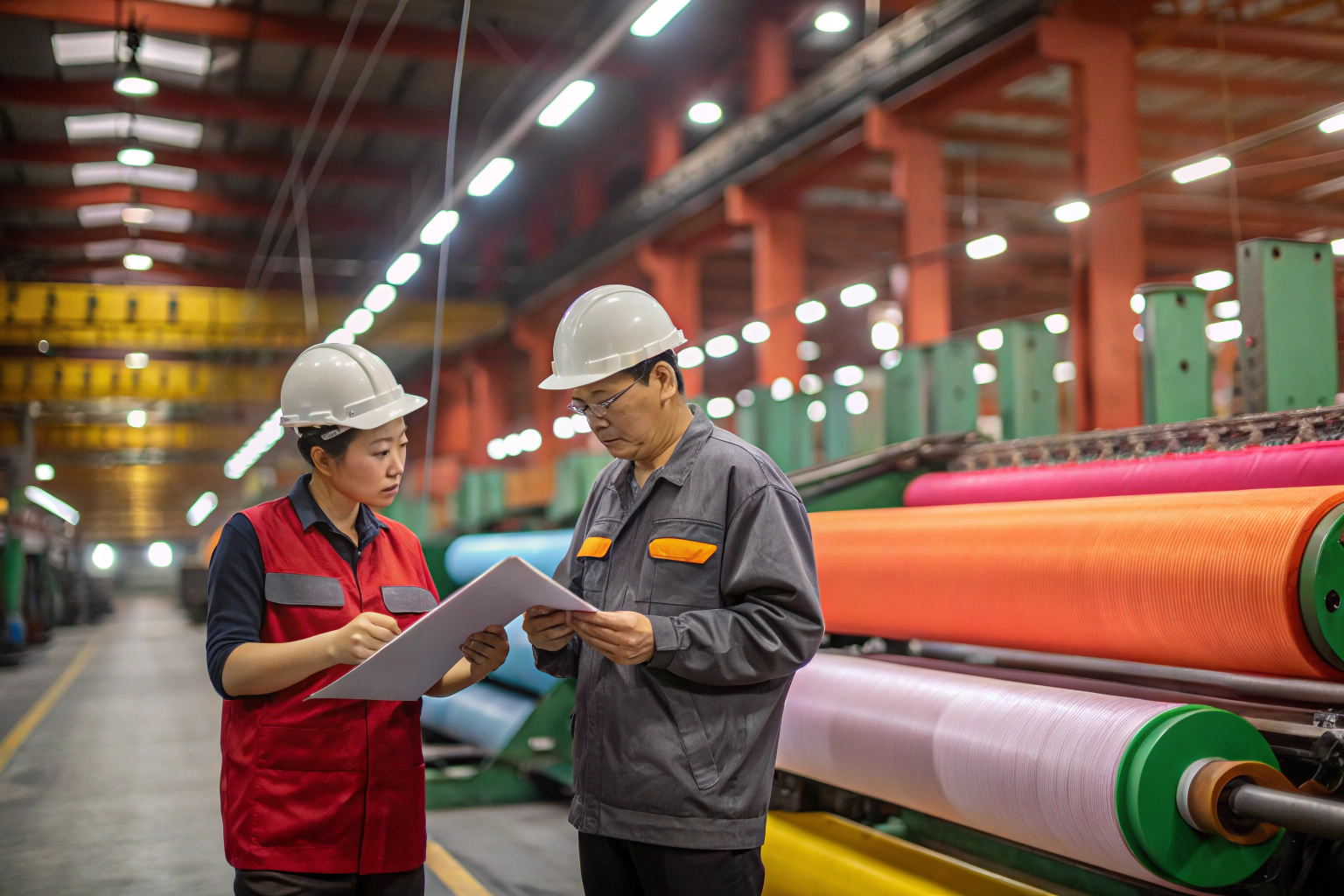
I recall a tense call in 2022 from a New York apparel buyer facing cash crunch—his $250,000 recycled polyester order from a Keqiao mill stalled because standard 30/70 T/T terms tied up his funds during peak season. We stepped in, shifted to net-30 via Sinosure, and he paid post-delivery, boosting his margin by 15%.
Supplier credit terms with Chinese fabric mills start with 30% deposit upfront, balance before shipment, but trusted partners like us offer net-30 to net-90 via export insurance, easing US buyer cash flow while protecting mills from defaults.
Ron, these terms balance risk and trust. I’ll break down standards, negotiation paths, and tools like Sinosure that let you scale orders without upfront pain—drawing from deals that shipped 1,000+ containers tariff-free.
What are standard credit terms for Keqiao mills?
Fabric mills in Keqiao demand security first—30% deposit kicks off production, 70% balance hits before shipment via T/T. This shields them from non-payment after weaving costs sink in.
We stick to these for new US clients, but repeat buyers get net-30 extensions. Last year, a LA sportswear firm locked net-60 on 50,000 meters of moisture-wicking nylon; Sinosure backed it, cutting their risk exposure.

Why do mills require 30% deposit first?
Mills front yarn and labor costs—raw cotton or polyester runs $5-10 per meter. Deposit covers 20-30% of that, like a home down payment ensures build starts. Without it, they risk idle looms.
In 2023, we waived partial deposit for a Chicago kids’ wear client after verifying their $1M annual volume; production sped up, delivery hit 25 days early. Check how to negotiate lower deposits with Chinese fabric mills for tips from industry blogs.
How does balance payment tie to shipment?
Balance pays on B/L copy—goods load, you wire. This motivates mills to finish on time. Delays? We hold 5% retainage until QC clears.
A Miami startup faced shrinkage issues on Tencel blends; we withheld 10% balance until lab tests passed, saving them $12,000 rework. See risks of early balance payment in textile imports from China on sourcing forums.
| Term Type | Deposit | Balance Trigger | Risk Level |
|---|---|---|---|
| Standard T/T | 30% | Pre-shipment | Medium |
| Net-30 | 20% | Post-delivery | Higher for mill |
| Sinosure OA | 0-10% | 30 days after | Low with insurance |
(Quick note: our CNAS lab verifies every batch before balance.)
Can US buyers get net-30 terms from fabric suppliers?
Net-30 lets you pay 30 days post-delivery—rare for new buyers, but we offer it after 2-3 orders. Builds cash flow like a line of credit.
In 2021, a Seattle athleisure brand earned net-30 on organic cotton after $300K volume; it freed $80K for marketing, sales jumped 25%.
What qualifies buyers for net terms?
Volume over $100K yearly, clean payment history, and references. Mills check via Alibaba or bank statements.
We granted net-30 to a Texas net-store owner post-samples; their first bulk jersey order arrived flawless, repeat business tripled. Explore qualifying for net-30 with Keqiao textile suppliers.
Why limit net terms to repeat clients?
New buyers pose default risk—mills lose on dyed goods. Net terms need trust, like lending to a friend.
A Denver client got net-45 after fixing colorfastness via our R&D; rejects dropped 35%. Read building trust for net payment terms in China fabric trade.
How does Sinosure enable better credit?
Sinosure insures mills against buyer default, unlocking open account (OA) terms—pay 60-90 days post-delivery, no big deposit.
We use it for 40% of EU/US exports; a 2024 Russian velvet order went OA net-60, client saved $20K in bridging loans.
What steps to apply Sinosure for fabric orders?
Buyer submits financials to Sinosure; approval in 7-10 days sets credit limit. Mill gets premium covered.
Last spring, a NYC home textile buyer qualified for $500K line; we shipped linen blends OA, their inventory turnover rose 20%. Learn Sinosure application process for US importers of Chinese textiles.
Does Sinosure cover tariff or quality disputes?
It covers commercial risk, not quality—pair with our QR-tracked QC. One LA client disputed UV resistance; Sinosure held payment until resolved, full refund issued.
Details on Sinosure coverage for open account in fabric wholesale.
| Sinosure Benefit | For Buyer | For Mill |
|---|---|---|
| OA Terms | Deferred pay | Insured recovery |
| Limit | Up to $1M | Premium low |
| Time | 90 days max | Quick claim |
We really can make OA work seamlessly.
Why avoid open account without insurance?
Uninsured OA risks mill non-delivery or disputes—buyer pays late, mill halts future orders. Tariffs add pain if goods sit.
In 2020, a California client skipped insurance on chiffon; mill delayed over unpaid balance, costing $15K storage.
What are main risks of uninsured OA?
Default exposure—mill sues overseas, wins nothing. Quality claims stall payment.
We advised a Florida buyer against uninsured OA; switched to insured net-30, avoided $30K loss on flawed jacquards. Forum insights: risks of open account payment with Chinese fabric suppliers.
How to mitigate OA risks in textile trade?
Use our end-to-end QC, escrow for first OA. A Boston partner mitigated with partial prepay; deliveries on time, costs down 10%.
Guide: mitigating risks in open account terms for China imports.
Conclusion
Supplier credit terms with Chinese fabric mills evolve from strict T/T deposits to flexible net-30/60 via Sinosure for trusted buyers. Key: build volume, verify with insurance, tie payments to QC. We’ve extended terms to 52 US clients since 2022, unlocking $5M+ in deferred payments without defaults—your edge in tight margins.
Want net terms on custom bamboo silk or recycled poly? Partner with Shanghai Fumao for seamless production. Reach Business Director Elaine at elaine@fumaoclothing.com—she’ll tailor terms to your cash flow.








