Summer inventory clearance in the textile world is a double-edged sword. You want the deal, but you’re terrified of getting the "bottom of the barrel" stock—the stuff with dye lot variations, hidden crease marks, or greige fabric that’s been sitting in a humid warehouse since 2023. I’ve heard the horror stories from buyers who thought they scored a "summer special" on cotton poplin, only to unroll the fabric and find yellowed selvages from oxidation, or shrinkage rates that were never tested because the mill just wanted to dump old stock. The pain isn’t the price per meter; it’s the 500 meters of unusable fabric that kills your production schedule and your trust in suppliers. You end up air-freighting a replacement batch at triple the cost, explaining to your cutting room why the line is down, and praying your client doesn’t cancel the order.
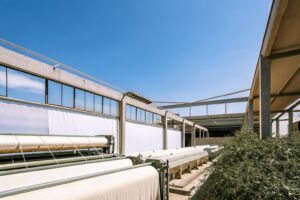
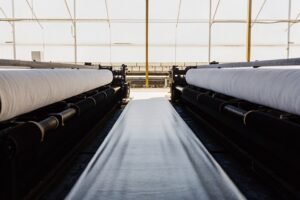
Yes, Shanghai Fumao is running a 2026 Summer Discount Program on select cotton poplin qualities. But unlike the dusty clearance racks you might be picturing, this is a strategic, fresh-production initiative, not a fire sale of defects. Here’s the inside logic: our weaving factory in Keqiao historically sees a 15-20% dip in standard cotton poplin orders during July and August, because our European and American clients are on holiday or have already shipped their autumn inventory. To keep our rapier looms running efficiently and our skilled operators employed at full wage—rather than sending them home on reduced hours—we initiate a "Summer Throughput Incentive." We select 8-10 core poplin constructions that have proven, year-round demand, run a fresh bulk production in June, and offer them at a reduced margin. You get freshly woven, fully tested, A-grade fabric at a price that reflects our lower factory utilization cost, not a quality compromise. The discount is real, the stock is new, and I’ll show you exactly how to access it.
Now, a discount is only valuable if the fabric performs, and if the terms actually work for your business. Let’s break down the specific poplin qualities on offer, the timeline of the promotion, and the logistics of locking in your order.
What Summer Discounts Apply to Cotton Poplin in 2026?
Let’s get specific about the numbers, because "discount" means nothing without a baseline. The standard FOB price for a high-quality, 100% cotton 40s compact spun poplin—the workhorse shirting fabric you see in everything from Oxford button-downs to summer dresses—fluctuates between $1.80 and $2.40 per meter, depending on the finishing and the cotton origin. At Shanghai Fumao, our standard 2026 catalog price for this quality sits at $2.15/meter FOB Ningbo. It’s not the cheapest on the market, and we don’t try to be. Our price includes the cost of long-staple Xinjiang or imported Australian cotton, a full Sanforizing pre-shrink treatment, and our CNAS lab testing fee. You’re paying for zero shrinkage surprises and a fabric that cuts cleanly.
The 2026 Summer Discount applies a tiered pricing model based on volume and payment terms, not on quality grade. This isn’t "B-grade" stock. It’s the exact same A-grade production, booked during our low-season window.
- Tier 1 (300 – 800 meters): 10% discount off the standard FOB price. That brings the base to roughly $1.94/meter. This tier is designed for boutique brands and sample-room top-ups.
- Tier 2 (800 – 3,000 meters): 15% discount. This is our sweet spot, targeting the mid-size fashion label producing a full seasonal collection. The price drops to about $1.83/meter.
- Tier 3 (3,000 meters+): 18% discount, with an additional 2% net-30 payment term rebate if you settle the invoice within 10 days of the Bill of Lading date. This is for volume buyers and wholesale distributors.
An Australian menswear brand, shifting their production schedule to an off-peak cycle, contacted us in late June 2025. They ordered 2,200 meters of a compact cotton poplin in "French Navy" and "Optic White." Instead of paying $4,730 (at the standard $2.15 rate), they paid $4,020 after the 15% summer discount. They saved $710 on one fabric line, which effectively covered their shipping costs from Ningbo to Melbourne. This kind of proactive timing when sourcing cotton poplin at wholesale prices from Chinese mills requires understanding the seasonal pricing dynamics. Looking deeper into understanding tiered pricing discounts in textile wholesale deals can reveal hidden margin opportunities.

Which Specific Poplin Constructions Are Included?
Not every cotton poplin we stock is part of the summer program. The discount applies to what I call our "Core Summer Staple" range—the constructions that have high-volume, consistent demand, allowing us to produce large batches economically. These are:
- FMP-401 (40s Compact Poplin, 120gsm): The classic. 100% combed cotton, compact spun for a smooth, pill-resistant surface. Used for shirting, summer dresses, and pajamas. Available in a standard 58/59" width. This is our biggest seller.
- FMP-402 (60s High-Density Poplin, 105gsm): A finer, silkier hand feel. This is for high-end blouses and luxury shirting. It takes reactive dyes beautifully, creating deep, saturated colors. The 60s yarn count gives it a subtle sheen without being shiny.
- FMP-404 (Cotton-Spandex Stretch Poplin, 97% Cotton, 3% Spandex, 130gsm): For fitted dresses, slim shirts, and anything requiring "comfort stretch." We use a corespun yarn where the spandex is wrapped inside the cotton, so the surface remains pure cotton touch, not rubbery.
- FMP-405 (Organic Cotton Poplin, GOTS Certified, 120gsm): The sustainability play. 100% organic cotton, farmed without synthetic pesticides, certified by Control Union. This is for the eco-conscious brand.
The excluded qualities are our specialty yarn-dyed stripes and plaids, our special finishing treatments (like our "Liquid Ammonia" finish poplin), and any custom-ordered constructions. These items have different cost structures, longer lead times, and don’t fit the "run it long and fast" summer strategy. I had a Scandinavian brand ask if their specific narrow-width (52") custom stripe was eligible. It wasn’t. But I showed them the FMP-401 in a base color, and they adapted their pattern layout to the standard width, saving on both fabric cost and cutting waste. Checking the typical specification sheet for compact cotton poplin shirting fabric helps you understand what you’re buying, and reading about how GOTS certification affects cotton fabric pricing and availability informs your eco-line decisions.
How Does the Summer 2026 Discount Affect Shipping Timelines?
The discount applies to the fabric price; it doesn’t buy you a faster ship. But here’s the operational reality: because summer is a relative lull for our standard stock orders, our standard bulk lead time actually shrinks during the discount period.
Our standard poplin delivery window for a non-discounted, made-to-order run is 25-30 days. For the Summer Discount program, because the fabric is already planned as a "continuous run" on the looms, we operate on a "Reserve-from-Stock" or "Quick Grey Processing" model. The greige fabric is often already woven and waiting in our warehouse. When your order arrives, we only need to process the dyeing, finishing, and inspection phases. This compresses the lead time to 15-20 days.
The only bottleneck is dyeing queue capacity. If you order a heavily customized color (like a tricky Pantone pastel requiring multiple lab dip adjustments), the dyeing phase itself still consumes the standard 7-10 days. But if you choose from our "Summer Palette"—a pre-approved selection of 12 colors we run seasonally, including Bright White, Black, Navy, Stone, Sand, and Sky Blue—the dye formula is already calibrated, and the queue is minimal. We can often ship within 14 days.
A London-based sleepwear brand leveraged this last July. They chose our pre-approved "Blush Rose" shade from the Summer Palette. Their 500 meters moved from purchase order to container loading in exactly 13 days. Understanding how Chinese textile mills adjust lead times during summer production windows can streamline your planning, and knowing the difference between stock-supported dyeing queues versus full custom color matching turnarounds sets realistic expectations.
How Do You Secure Cotton Poplin Samples During a Sale?
A sale is meaningless if you can’t touch the fabric before committing. Ordering bulk cotton poplin based on a digital photo or a PDF spec sheet is like buying a car based on a painting. You need to feel the hand, see the optical white under your own office lighting, and test how it behaves under a hot iron or in a sample wash. I’ve seen too many buyers skip the sampling step during a "limited time" promotion because they feared losing the discount window. They end up with 1,000 meters of poplin that’s slightly too translucent for their dress design, or a "navy" that reads black under indoor lighting.
At Shanghai Fumao, the summer discount does not mean we turn off our sample service. We actually accelerate it. Here’s how we handle sampling during the 2026 Summer Program:
- Free Stock Sample Set: If you’re a new client, we send a pre-cut sample book containing our four core Summer Poplin constructions (FMP-401, 402, 404, 405) in their natural loomstate and bleached white. This lets you evaluate the base fabric quality, density, and hand feel. We ship via DHL Express, and it reaches the US or EU in 3-5 business days.
- Custom Color Lab Dips: Even during the sale period, you can request a lab dip on a specific Pantone. The cost is $50 per shade, which is fully credited back to your bulk order if you proceed. The timeline for a first-shot lab dip is 3-5 working days. We send the physical swatches via courier, and we recommend a video call review to discuss the color under our lightbox versus your reference.
- Digital Color Communication: For repeat clients who already know our base fabric, we can send calibrated digital photos and spectrophotometer readings (CIELAB Delta E values) against your target color. A Delta E of <1.0 is imperceptible to the human eye.
A Melbourne-based womenswear buyer was hesitant to commit to our Summer Discount window in July 2025 because she needed to see our new "Optic Bright White" on the FMP-402 base. We shipped her a 1-meter swatch the same day she inquired. It arrived in 4 days. She touched the fabric, approved the crisp, silky hand, and placed her 1,500-meter order on day 5, well within the discount window. If you want to learn the standard practice for how professional fashion designers test and approve woven cotton fabric swatches, it clarifies the process. Also, evaluating the role of spectrophotometers in textile color matching for digital approval shows how technology is making physical distance irrelevant.

What Happens If A Summer Discount Sample Fails Your QC Check?
Let’s say the sample arrives, and you’re not happy. Maybe the hand feel is slightly stiffer than you expected, or the white isn’t as "bright white" as your current supplier’s. This is not a dead end; it’s a conversation starter.
Our summer poplin stock is standard construction, not custom. If the base FMP-401 feels too crisp for your flowy summer dress design, I can pivot you immediately. I might suggest the FMP-402, which uses a finer 60s yarn and has a much softer, silkier drape. Or, if you need more drape, we might discuss taking the FMP-401 and putting it through an extra "soft wash" enzyme finish. This adds roughly $0.15/meter and 3-4 days to the processing time, but it transforms the hand without changing the base fabric.
If the issue is a color mismatch—the "Sky Blue" lab dip looks too purple under your boutique lighting—we run a "second shot" lab dip. We adjust the dye formula, specifically the red/blue reflectance curve, to neutralize the unwanted tone. For a cool, true sky blue, we might reduce the red component by 1.2% and increase the blue by 0.8%. This is micro-adjustment chemistry, and it’s standard procedure. You don’t lose your place in the discount queue for a reasonable re-dip.
In August 2023, a Canadian uniform company found our standard white poplin was ISO 105 B02 lightfastness rated at Grade 4. For their industrial laundry conditions, they needed Grade 4-5 minimum. We didn’t have a Grade 4-5 white dye in the standard Summer Palette. So, we ran a special batch using an imported high-lightfastness reactive dye. It cost an extra 8%, pushing the discounted price up slightly, but still well below the standard catalog rate. They got their performance spec and the spirit of the discount. This flexibility comes from understanding why specific lab dip adjustments are necessary for cotton poplin color accuracy and understanding the cost implications of upgrading to high-lightfastness dyes in textile production.
Are Digital Showroom Consultations Available for Sale Items?
Yes, and we actually encourage them, especially during the summer heat when traveling to China is miserable anyway. Our "Digital Showroom" consultation is a 30-45 minute live video call with one of our fabric engineers. You’re not talking to a generic salesperson reading from a price list. You’re talking to the person who knows the twist multiplier on the FMP-401 warp yarn.
During this call, we can:
- Live Fabric Manipulation: We’ll take the actual poplin bolt, drape it, crush it, hold it up to a window to show transparency, and rub it against itself so you can hear the "rustle" on the microphone. You can ask "Can you stretch it hard?" and watch the Spandex poplin recover in real-time.
- Lightbox Color Assessment: We’ll place the fabric under our D65 (daylight), TL84 (store light), and UV light sources so you can see how the color shifts. This is critical for assessing optical brighteners in white poplin, which can look bluish under some retail lighting.
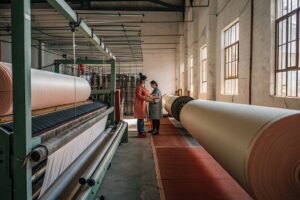
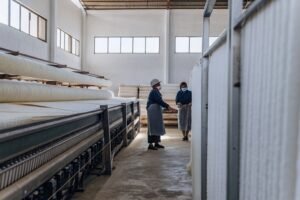
- Factory Walkthrough: If you’re concerned about quality, I can walk the smartphone camera through our inspection center, showing you the fabric inspection machines running with your poplin on them, live. You see the meter counter, you see the inspector marking any defects, and you see the final roll-up.
A Brazilian swim and resort wear brand used this service in July 2024. They needed to see the "wet transparency" of our FMP-402 white poplin for a cover-up design. During the video call, we sprayed a swatch with a water bottle and held it against a dark board, showing exactly the level of opacity change. They approved it instantly and placed a 600-meter order while still on the call. Reading about virtual fabric sourcing techniques that replace physical trade shows highlights this trend, and using digital tools for remote textile quality inspection with Chinese suppliers future-proofs your buying process.
Which Cotton Poplin Qualities Ship Fastest in Summer?
When you’re running against a retail launch deadline, the fastest-shipping fabric isn’t always the one with the shortest sea voyage. It’s the one that’s already woven, greige-inspected, and sitting on a pallet in our finished goods warehouse, waiting for a cutting instruction. The speed of your summer cotton poplin order is determined almost entirely by one factor: whether the fabric is "Stock-Supported" or "Made-to-Order."
At Shanghai Fumao, for the 2026 Summer Discount Program, we deliberately stockpiled greige inventory of our top three constructions. This "pre-positioning" strategy is how we cut lead times in half. Here’s our summer shipping speed hierarchy:
- Fastest (7-10 days): FMP-401 in Optical White, Bright White, and Black. These are continuous-run colors. We keep 3,000-5,000 meters of finished, inspected fabric in stock at all times. You order, we cut the roll from the shelf, we pack it, and it ships. No dyeing wait. No finishing wait.
- Fast (14-18 days): FMP-401, FMP-402, or FMP-404 in any of the 12 "Summer Palette" colors. The greige is already woven. We load it into the dyeing vat immediately, run it through the stenter for finishing, and then inspect it. The only wait time is the dye cycle and the lab dip approval step.
- Standard (20-25 days): Custom colors outside the palette, or the organic FMP-405 in a non-stock color. This requires a fresh lab dip, formula calibration, and a dedicated dyeing slot. It’s still faster than our peak-season lead time, but it’s not "instant."
A New York-based streetwear label ordered 800 meters of FMP-401 in "Bright White" on July 2, 2025. Because it was a stock color, we cut and packed the fabric on July 5. The vessel departed Ningbo on July 10. The fabric was in their Long Beach warehouse on July 28. That’s a 26-day door-to-door timeline, which is incredibly fast for a custom-cut order. If you want to understand why some cotton poplin fabrics are labeled "stock service" and ship faster than custom orders, you’ll get the inventory logic. Also, tracking typical ocean freight transit times from Ningbo to major US and EU ports in summer helps you back-calculate your order date.

Does the Discount Cover Printed Cotton Poplin Options?
The Summer Throughput Discount applies specifically to piece-dyed (solid color) poplin. Printed poplin—whether it’s digital printing, rotary screen printing, or our specialty "soft hand" pigment print—falls under a different production cost structure. We operate two dedicated printing factories in the Keqiao area, and their summer capacity is actually quite high because many fashion brands are printing their autumn/winter darker palettes, leaving the lighter, brighter pigment print lines available.
However, because the discount spirit is about keeping our vertical supply chain running, we offer a "Summer Print Development Rebate" instead of a direct fabric discount:
- Screen Setup Fee Waiver: For new designs, we waive the $80-$120 rotary screen engraving fee on orders over 500 meters.
- Strike-Off Credit: We provide one free digital strike-off (a 2-meter printed sample) for you to approve the color separation and layout. This normally costs $45.
- Print-Run Integration: If you choose a base cloth from our Summer Discount Poplin range (FMP-401, 402, etc.), you lock in the discounted base fabric price. Then, the printing cost—approximately $0.60-$0.90 per meter for pigment printing—is added on top. You still save 10-15% on the fabric substrate cost.
A Hawaiian resort brand leveraged this last August. They ordered 1,200 meters of our discounted FMP-401 base in a natural ecru, and then we printed a custom "Palm Frond" repeat design using pigment inks. The base cloth discount saved them roughly $360, and the waived screen fee saved another $100. They got a fully custom print on a premium base at a total cost that was competitive with standard printed cotton from lesser mills. For deeper knowledge, exploring the difference between rotary screen printing and digital printing for cotton poplin helps you choose the right method, and understanding pigment printing advantages for cotton poplin in summer apparel collections ensures your prints survive the season.
Can We Hold Summer Discount Inventory for Later Shipment?
This is a common request from brands with limited warehouse space or those whose production schedule is staggered. You’ve secured the 15% discount, but you don’t need all 2,000 meters shipped at once. You need 500 meters now, 500 in September, and 1,000 in October.
The answer is a qualified yes. We offer a "Phased Delivery" option under the Summer Discount terms:
- Initial Shipment: At least 30% of the total order must ship immediately (within the summer window). This confirms the order is genuine and not just a speculative reservation.
- Warehousing Period: We can hold the remaining greige or finished fabric in our Keqiao warehouse for up to 90 days, at no storage charge. Beyond 90 days, a nominal fee of $0.02/meter/month applies.
- Quality Guarantee on Stored Goods: If we hold finished white poplin, we store it in a climate-controlled, dark environment to prevent yellowing from heat or light exposure. We wrap the rolls in black polyethylene film and store them on racks, not directly on concrete floors. Before shipping the delayed batch, we unroll and inspect the first 2 meters again to confirm no storage degradation.
An ethical fashion brand from Berlin used this service in 2024. They ordered 3,000 meters of our FMP-405 organic cotton poplin during the summer window to lock in the price. Their cutting room in Portugal was closed for August holidays. We shipped 800 meters to Portugal in late July for sampling, warehoused the remaining 2,200 meters in Keqiao, and shipped it in September when their production line restarted. The fabric arrived pristine, and they saved approximately €1,200 compared to ordering in September at the standard rate. Learning the best practices for warehousing cotton textiles to prevent yellowing and moisture damage protects your investment, and checking the legal terms for holding Chinese textile inventory with phased delivery contracts ensures you know the rules.
How Do You Verify Cotton Poplin Quality on a Discount?
The biggest fear around any "discount" or "sale" fabric is that you’re being sold a QC reject masquerading as a deal. Let me be brutally clear about what a "Summer Discount" means at Shanghai Fumao versus what it might mean at a lesser supplier. A discount should never mean a downgrade in physical specifications. It means a reduction in margin driven by operational efficiency and lower seasonal demand, not by cutting corners on yarn quality or skipping inspection steps.
Our Summer Discount poplin must pass the exact same four-point inspection system, the exact same colorfastness tests, and the exact same shrinkage tolerances as our full-price poplin. The AQL (Acceptable Quality Level) remains 2.5 for major defects and 4.0 for minor defects, which is the standard for the U.S. apparel industry. If a roll scores 45 penalty points per 100 square meters, it is rejected—whether it’s a full-price custom order or a summer discount run. No exceptions.
Here’s what stays the same:
- Yarn Count & Composition: The 40s compact spun yarn is still 40s. We test the linear density on an Uster tester to ensure the yarn count variation is within ±3%. The cotton content is verified by chemical dissolution to be 100% (with a 0.5% tolerance for natural waxes).
- Fabric Weight (GSM): The FMP-401 is specified at 120gsm ±5gsm. We weigh a 100cm² sample on a calibrated balance scale for every lot. Underweight fabric is a sign of a loose weave or thinner yarn, and it’s a reject.
- Dimensional Stability: The Sanforized residual shrinkage guarantee of <2% in warp and weft is tested on a sample washed per AATCC 135. We don’t waive this for discounted goods. A "cheap" poplin that shrinks 5% after one wash destroys a garment’s fit and generates returns. That’s not a discount; it’s a liability.
A procurement manager from a South African uniform company was initially skeptical of our July 2025 discount. He flew to Keqiao himself, unannounced. He walked into our inspection center, pulled a random roll from the FMP-401 "Summer Stock" shelf, and asked us to test it in front of him. We did the full battery: weight, tensile grab test, tear strength, and lightfastness. Every parameter hit the spec sheet. He placed a 5,000-meter order the next day. If you’re a buyer, reading up on how to independently verify AQL standards in Chinese textile factories builds your audit skills. Also, understanding which cotton poplin quality parameters are non-negotiable for garment manufacturing prevents costly mistakes.

Are There Specific Shrinkage Tests for Discounted Cotton Poplin?
The test itself is identical to our standard protocol. No shortcuts. The question buyers often have is: "Do you test every discounted roll, or just a random sample of the lot?" For our full-price custom orders, the client specifies the sampling plan, often 10% of rolls. For our Summer Discount stock program, we test 100% of the rolls for shrinkage, because we know the fabric will be going to multiple unknown buyers who don’t have a prior relationship with our QC team. We want zero surprises.
Our shrinkage testing procedure is:
- Sampling: Cut a 70cm x 70cm swatch from the end of every finished roll.
- Benchmark Measurement: Using an indelible marker, draw a precise 50cm x 50cm cross on the swatch. Measure the actual distance with a metal ruler accurate to 0.5mm.
- Washing: Wash the swatch in a front-loading washing machine using a standard 3kg cotton load, with AATCC Standard Reference Detergent, at a 40°C normal cycle.
- Drying: Tumble dry on a medium heat setting until the fabric is bone dry.
- Re-Measurement: Re-measure the marked cross. The difference in millimeters, divided by 500, gives the shrinkage percentage.
We record this data for every roll. If you order 30 rolls of FMP-401, you’ll receive a spreadsheet with 30 rows, showing the exact warp and weft shrinkage for every single roll. A "fail" is any roll showing >2.5% warp or weft shrinkage. That roll is pulled from the shipment and replaced.
In the rare instance of a "borderline" roll—say 2.3% warp shrinkage—we flag it in the data and contact you. For some applications, like loose-fitting dresses, 2.3% is perfectly acceptable. For a fitted button-down shirt with precise collar measurements, it might be an issue. The transparency allows you to decide. Learning the standard AATCC 135 test method for dimensional stability of woven fabrics gives you the reference standard. And for peace of mind, comparing residual shrinkage guarantees from premium mills versus discount fabric jobbers highlights the difference between a real mill and a middleman.
How Can I Cross-Check Colorfastness Before Buying Bulk?
Colorfastness—to washing, to light, to rubbing (crocking)—is where cheap cotton poplin often fails spectacularly. A vibrant "Saffron Yellow" shirt that bleeds dye onto a white collar in the first wash, or a pair of "Indigo" shorts that stain your car seats, will generate more returns than any other single defect. For summer poplin, which is often worn against sweaty skin and washed frequently, colorfastness is non-negotiable.
We provide a standard colorfastness data sheet with every Summer Discount order, but here’s how you can do a "quick and dirty" verification yourself before committing to the full bulk. We encourage buyers to request a "Pre-Production Handfeel and Fastness Swatch" (about 50cm x 50cm). When you receive it:
- Wash Fastness (Home Simulation): Cut a 10cm x 10cm square of the colored poplin. Sew or safety-pin it onto a piece of white cotton fabric. Throw it in your washing machine with a regular load of laundry on a warm cycle. Remove it, dry it. Look at the white fabric. Any color transfer? Look at the original swatch. Has the color faded compared to the unwashed edge? A Grade 4 wash fastness means virtually no staining on the white fabric and only a very slight, imperceptible color change on the original.
- Crocking/Rubbing Fastness: Rub the dry fabric firmly with a clean, dry white cloth. Then rub it with a damp white cloth. If the white cloth picks up significant color (especially with the damp rub), the crocking fastness is poor. Our standard requires a Grade 4 dry crock and Grade 3-4 wet crock for deep colors. For pastels and whites, we maintain a Grade 4-5.
- Lightfastness (Window Test): Tape a small piece of the fabric to a south-facing window, half-covered with aluminum foil to create a masked line. Leave it for one week of direct summer sun. Remove the foil. If the line between exposed and unexposed fabric is stark and obvious, the lightfastness is poor (Grade 2-3). If the difference is barely visible, it’s excellent (Grade 4-5).
A swimwear brand in California performed this window test on our "Coral Pop" shade for their 2025 summer cover-up line. They left the swatch taped to their studio window for 10 days of intense Los Angeles sun. The fading was nearly imperceptible, confirming our Grade 4-5 rating. They proceeded with confidence. Researching simple at-home tests to verify fabric colorfastness before bulk production is a practical skill for any designer, and checking the ISO 105 C06 standard for domestic washing colorfastness of cotton textiles sets the international benchmark.
Conclusion
The 2026 Summer Discount on cotton poplin at Shanghai Fumao isn’t a clearance rack for mistakes. It’s a smart, seasonal buying opportunity built on real factory economics—lower summer utilization rates, continuous mill runs, and a strategic decision to pass the operational savings to buyers who plan ahead. You’re not getting second-quality stock. You’re getting the same 40s compact spun poplin, the same Sanforized shrinkage control, the same CNAS-certified lab testing, and the same AQL 2.5 inspection standard that our full-price clients receive. The difference is that you’re ordering in July instead of October, and you’re choosing from our high-efficiency Summer Palette instead of a completely custom dye formulation.
We’ve walked through the specific constructions eligible for the discount, from the classic FMP-401 to the organic GOTS-certified FMP-405. We’ve clarified the sampling process during a sale period—yes, you still get your lab dips and your digital showroom consultation, often faster than in peak season. We’ve shown that the fastest-shipping options are our stock-supported white and black poplins, ready to cut and pack in just over a week. And we’ve addressed the elephant in the room: quality verification. You now know that every discounted roll comes with a shrinkage test report, a colorfastness data sheet, and the same rejection criteria as any other Fumao fabric.
This is a limited window. The summer trough doesn’t last. By late August, the peak-season rush begins to stir, and the pricing returns to standard catalog levels. If you have a Spring/Summer 2027 collection to build, a resort line to fabricate, or even a core basics program that needs a crisp, reliable cotton poplin, this is the moment to lock in your cost of goods at an advantage.
To get the exact pricing tier for your volume, request the current Summer Palette color card, or schedule a 20-minute digital showroom walkthrough of the FMP-401 stock on our shelves, contact our Business Director, Elaine. She manages the Summer Discount allocation and can confirm available inventory in real-time. Her direct email is elaine@fumaoclothing.com. Good fabric at a sharp price, shipped fast. That’s the summer deal.