
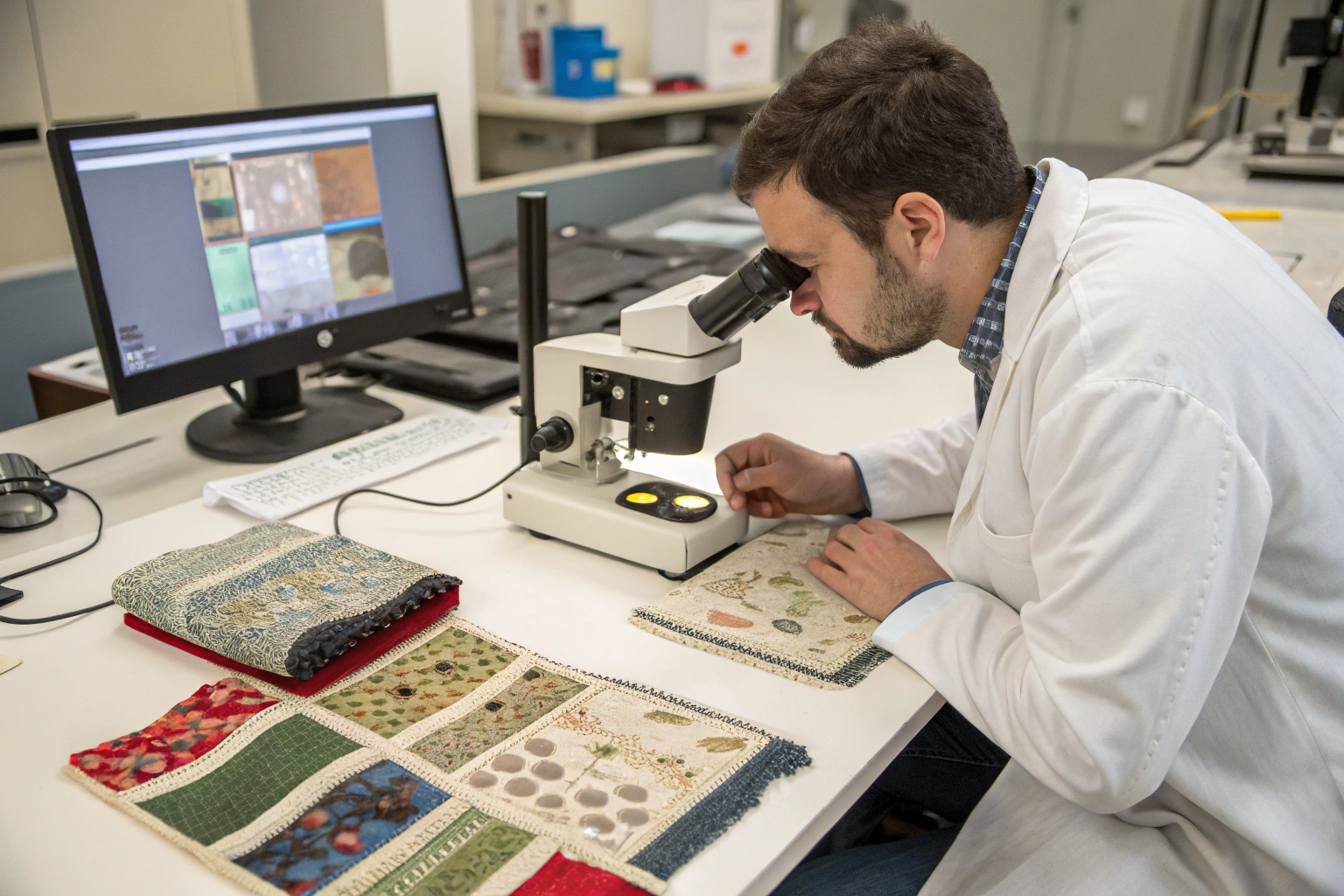
Let me tell you about a package I received in March 2025. It came from a designer in New York. Inside was a small, frayed piece of fabric wrapped in tissue paper. The note said: "I found this in a vintage store in Paris. It’s a wool-silk blend from a 1940s couture house. The mill that made it closed in 1962. I need 500 yards of this exact fabric for my Fall 2026 collection. Can you do it?"
I held that little scrap up to the light. It was beautiful. A shadow stripe with a dry, crispy hand but a fluid drape. The kind of fabric that has a soul. It was also impossible to buy anywhere on earth. This is the moment when most fabric suppliers say, "Sorry, that’s deadstock. Find something else." But that is not what we do at Shanghai Fumao. We are not just a fabric wholesaler. We are textile archaeologists. We reverse-engineer the past to build the future.
Replicating a rare or vintage fabric sample is one of the most challenging and rewarding things we do. It is not a simple "copy and paste." It is a forensic investigation. It requires analyzing the fiber content, deconstructing the weave structure, identifying the yarn twist, and matching the finishing chemistry. And sometimes, the answer is "No, we cannot replicate this 80-year-old silk that was woven on a loom that no longer exists." But more often than not, the answer is, "We can get 95% of the way there. And we can make it machine washable."
In this article, I am going to walk you through our Fabric Replication Process. I will show you how we take a 2-inch square of mystery cloth and turn it into a production-ready Custom Fumao SKU. If you have a swatch that haunts your dreams—something you found in a thrift store, a deadstock warehouse, or an old sample archive—this is the playbook for bringing it back to life.
What Is Fumao’s Step-by-Step Process for Fabric Reverse Engineering?
Alright, you have the sample. You have been guarding it like a dragon guards gold. You are ready to send it to us. What happens next? This is not magic. It is a methodical, scientific process that we have refined over 20 years of custom development.
Step 1: The Intake and NDA.
You ship us the sample (or a high-res scan if it is too fragile). Before we touch it, we sign a Non-Disclosure Agreement (NDA) . This is your intellectual property now. We do not share it with other clients. We do not post it on Instagram. It goes into a locked sample library under your account code.
Step 2: Visual and Tactile Analysis (The "Hand" Check).
Our Head of R&D—a woman with 30 years of experience who can identify a fiber blend by rubbing it against her lip—does a manual assessment. She notes the weight, drape, surface texture, luster, and "noise" (the sound it makes when crumpled). This gives us a target to aim for.
Step 3: The Burn Test and Chemical Solubility.
This is where we get scientific. We pull a few yarns from the warp and weft. We hold them over a flame. Does it melt (Synthetic)? Does it smell like burning hair (Wool/Silk)? Does it smell like burning paper (Cotton/Linen)? We then do a solubility test in different acids and solvents to isolate blend percentages. This tells us exactly if it is 70% Wool / 30% Silk or 60% Cotton / 40% Modal .
Step 4: Microscopic Cross-Section.
We slice the yarn and look at it under 400x magnification. This reveals the fiber morphology. Is it round Tencel or lobed Rayon? Is the wool fiber fine Merino or coarse Crossbred? This determines the grade of raw material we need to source.
Step 5: Deconstruction and Weave Draft.
This is the tedious part. Our technician takes a needle and unravels the weave. She counts the Warp Ends Per Inch (EPI) and Weft Picks Per Inch (PPI) . She measures the yarn denier. She maps the weave pattern on graph paper. Is it a Plain Weave? A 2×2 Twill? A 8-Harness Satin? A Dobby Lattice? This creates the "Weave Ticket" —the blueprint for the loom.
That package from New York with the 1940s wool-silk? The burn test revealed a 80/20 Wool/Silk blend. The microscope showed the wool was a fine 18.5 micron Merino. The deconstruction revealed a complex Crepe Weave with alternating S and Z twist yarns. That is why it had that dry, springy hand. Once we had the blueprint, we could start the sampling phase.

How Does Fumao Use Digital Microscopy to Analyze Unknown Yarn Counts?
Let’s geek out on the microscope for a minute. This is the tool that separates a "close enough" replica from an exact match. The human eye cannot tell the difference between a 40/1 yarn and a 45/1 yarn. But the fabric drape can. A 45/1 yarn is 10% finer. That means the fabric will be lighter and softer.
We use a Dino-Lite Digital Microscope connected to a computer with measurement software. We take a cross-section image of the fabric. The software counts the number of fibers in the bundle and measures the average fiber diameter in microns. For synthetic filament yarns, it measures the Denier Per Filament (DPF) .
Here is a real example. A client sent us a sample of a Japanese cotton shirting that was "the softest thing I’ve ever felt." He wanted to know why. We put it under the scope. The yarn was a 100/2 Combed Compact Cotton . That is a very fine, very long staple cotton spun with a special compacting process that removes all the short fibers and hairiness. A standard shirt uses 40/1 or 50/1. The 100/2 is almost twice as fine. That was the secret. We sourced Giza 86 Egyptian Cotton (one of the few cottons that can spin to 100/2) and ran it on our Compact Spinning Frame. The replica was perfect. The client was thrilled. He had assumed it was a chemical finish. It was just superior fiber and spinning.
If you want to understand how digital microscopy identifies cotton yarn count for fabric replication, the key metric is fiber density per cross-section. The microscope does not lie.
Can Burn Tests Accurately Differentiate Silk from Cupro in Vintage Blends?
This is a tricky one. Silk and Cupro are both protein-based regenerated fibers (Cupro is made from cotton linter, but it behaves chemically like silk). They both have a soft, luxurious hand. They both burn with a similar smell (slightly fishy/hair-like). A simple burn test can fool you.
Here is the Fumao lab trick: The Burn Rate and Residue.
- Silk: Burns slowly. It self-extinguishes when removed from the flame. The ash is a dark, brittle bead that crushes easily into a black powder.
- Cupro: Burns faster (like paper). It continues to glow after the flame is removed. The ash is light gray and fluffy, with very little hard bead.
But the definitive test is Chemical Solubility. We put the fiber in a 60% Sulfuric Acid solution at room temperature.
- Silk: Dissolves completely within 10 minutes.
- Cupro: Does not dissolve. (It needs a stronger acid like 75% Sulfuric Acid).
I had a client who thought she had found a deadstock Silk Charmeuse. It was priced like silk. It felt like silk. The burn test was ambiguous. We did the acid test. It was Cupro. She was disappointed, but also relieved she did not pay the silk premium. We replicated it for her in Fumao Cupro at 40% of the cost of silk, and it actually had better washability. That is the value of forensic analysis.
What Are the Minimum Yardage Requirements for Replicating Discontinued Textiles?
Okay, you have the analysis report. You know what the fabric is. Now we have to talk about the part that makes most small brands wince: The Minimum Order Quantity (MOQ). Replicating a fabric is not like buying stock fabric. You are not just coloring an existing greige cloth. You are building the greige cloth from scratch.
The MOQ depends entirely on where the uniqueness of the sample lies.
Scenario 1: The Weave is Standard, The Yarn is Special.
If the sample is a Plain Weave but uses a very specific Slub Linen Yarn that we do not stock, we can often use a "Sample Loom" approach. We can source a small batch of that specialty yarn (sometimes 50-100 kg minimum from the spinner) and weave it on a narrow Sample Loom. This is a smaller, slower loom designed for development.
- MOQ: 300 – 500 Yards.
- Cost: Higher per yard (maybe 30-40% premium) due to the inefficiency of the small loom and yarn sourcing.
Scenario 2: The Weave is Complex (Dobby/Jacquard).
This is where it gets expensive. A Dobby Loom uses a chain of wooden pegs or an electronic program to lift the warp yarns in a specific sequence. Setting up that sequence (the "pattern chain" ) takes a technician 4-8 hours of skilled labor. A Jacquard Loom is even more complex, requiring a custom digital file and harness tying.
- MOQ: 1,500 – 3,000 Yards. (We need enough volume to amortize the setup time).
- Setup Fee: $350 – $800 (This is the cost of the technician’s time to program the loom).
Scenario 3: The Finish is Unique.
This is the best-case scenario. If the base weave is something we already have in Greige Inventory, and the uniqueness is in the washing, coating, or brushing, the MOQ drops dramatically. We can take 500 yards off the greige shelf and run it through our Enzyme Wash or Calendering line.
- MOQ: 500 – 800 Yards.
I always tell my clients: "Before you fall in love with the sample, ask me where the uniqueness lives." If the uniqueness is in a finish we can apply to an existing base, it is easy. If it requires a custom jacquard loom setup, it is a major investment.

How Do Custom Yarn Spinning Minimums Affect Small-Batch Replication?
This is the silent killer of small-batch replication. The fabric mill can only weave the yarn that the Spinning Mill produces. And spinning mills have huge minimums for custom yarn.
Let’s say your vintage sample is a "Flame" yarn —a slub yarn with irregular thick and thin bumps. To replicate that, we need a spinner to set up a special slub attachment on their spinning frame. They have to stop production of their regular 50,000-pound orders to run our tiny 500-pound order. They will charge a "Changeover Fee" and a "Small Lot Premium."
Here is the reality of custom yarn MOQs:
- Standard Ring-Spun Cotton (No Slub): 500 lbs (approx 1,000 yards of fabric equivalent).
- Specialty Slub or Core-Spun Yarn: 2,000 – 5,000 lbs minimum.
- Solution-Dyed Nylon (Custom Color): 10,000 lbs minimum.
If your sample requires a custom-colored slub yarn, you are looking at a 5,000-yard fabric minimum. There is no way around it. The spinner sets the rule, not the weaver.
I had a client who wanted to replicate a 1970s Rainbow Slub Linen. It had 5 different colored slubs in the weft. It was gorgeous. To do it right, we needed to spin 5 separate custom slub yarns. The minimum from the spinner was 1,000 lbs per color. That is 5,000 lbs of yarn total. The fabric equivalent was nearly 8,000 yards. The project died at the quoting stage. It was just too much volume for a niche brand.
(Here is a workaround: We can sometimes use digital printing to simulate a slub yarn on a plain base. It is not the same texture, but it captures the visual spirit of the rainbow slub at a 500-yard MOQ. We offer this as a "Replica Alternative.")
When Is "Frame Loom" Sampling a Cost-Effective Alternative to Full Production?
For the 300-500 yard MOQ scenario, we use what is called a "Frame Loom" or "Sample Loom." This is a narrow-width loom (usually 20-24 inches wide) that is designed for R&D and sampling.
It is slower than a production loom. It requires more manual intervention. But it has almost zero setup cost. We can change the weft color in 30 seconds. We can adjust the picks per inch with a dial. It is the prototype shop of the weaving world.
We use the Frame Loom for "Proof of Concept" runs. You want 300 yards of that vintage plaid to make 50 sample jackets for a tradeshow? Frame Loom. You want to test the market with a small capsule before committing to 3,000 yards? Frame Loom.
The trade-off is Width. Frame Looms are narrow. We have to be creative with marker making (pattern layout). It works fine for scarves, narrow panels, or children’s wear. It is harder for wide-width adult womenswear because you waste more fabric in the cutting process.
I used the Frame Loom for the New York designer with the 1940s wool-silk. We ran a 350-yard sample order on the narrow loom. She made 40 blazers. They sold out at a trunk show in 90 minutes. That success gave her the confidence to commit to a 2,500-yard production run on the wide loom. That is the smart way to use sampling to de-risk replication.
Which Vintage Finishes Can Fumao Recreate on Modern Eco-Bases?
This is where the art of replication meets the science of modern sustainability. The original sample you love was probably finished with chemicals and processes that are banned, unsafe, or environmentally disastrous by today’s standards. Our job is to recreate the aesthetic of that vintage finish using modern, compliant, eco-friendly methods.
The Vintage Look: "Worn-In Softness."
The old way to make a shirt feel like it had been washed 50 times was to beat it with wooden hammers (literally, that is how early garment washing started) or soak it in caustic potash. Today, we use Cellulase Enzymes. These are proteins that gently "nibble" the surface fuzz off the cotton, creating that peach-skin softness without damaging the fiber strength. We can dial in the enzyme concentration and time to match the exact level of "vintage fade" you see in the sample.
The Vintage Look: "Crisp, Crinkled Crepe."
Old-school crepe was made by over-twisting yarns and then using harsh alkali to shrink them. This caused the fabric to pucker and crinkle. Today, we use mechanical compaction (Sanforizing with a special rubber blanket) and steam relaxation to achieve that permanent crinkle texture. It is a mechanical finish, not a chemical one. It lasts the life of the garment. And it is OEKO-TEX certified.
The Vintage Look: "Waxy, Oiled Cotton."
Think of a vintage Barbour jacket or a Filson tin cloth. That finish was originally paraffin wax and mineral oil. It was waterproof but heavy and non-breathable. We can replicate that look and function with a Bio-Based PU Coating that is matte and dry to the touch. It looks waxy. It beads water. But it weighs half as much and allows moisture vapor to escape.
I worked with a brand in October 2025 that wanted to replicate a deadstock "Cire" finish (a high-gloss, wet-look finish) for a raincoat. The original was a solvent-based polyurethane that is now banned under EU REACH regulations. We developed a water-based, high-gloss acrylic coating for them. It took 6 trials to get the gloss level (measured at 60 degrees on a gloss meter) to match the vintage sample. But we nailed it. The new version is PFAS-free, solvent-free, and biodegradable. It looks identical to the 1980s original.

Can "Peach Skin" Enzyme Washes Be Calibrated to Match a Specific Sample Hand?
Yes. And this is one of my favorite parts of the job. A client sends in a sample and says, "I love this hand. It’s not fuzzy. It’s not slick. It’s like a… peach." That is a specific surface friction.
We calibrate the Peach Skin Finish using three variables:
- Enzyme Concentration (% owf – on weight of fabric): More enzyme = more fuzz removal = smoother hand.
- Process Time: Longer time = deeper abrasion.
- Mechanical Action: We can use a "Soft Flow" machine (gentle) or an "Air Flow" machine (more aggressive beating).
We keep a "Hand Feel Library" in our finishing plant. We have swatches labeled: "Level 1 Bio-Polish," "Level 2 Peach Skin," "Level 3 Heavy Suede." When your sample comes in, our finishing manager rubs it between her fingers, compares it to the library, and says, "This is a Level 2, but with a softer Air Flow tumble."
I had a client who sent in a swatch of a Japanese cotton lawn that was "the softest thing I’ve ever touched." We tested it. It was a Level 2 Peach Skin with a silicone micro-emulsion softener. Silicone is what gives that "slimy-slick" feeling. We replicated it exactly. The client said, "This is witchcraft." No, it is just process control.
How Does Mechanical Crinkle Replication Differ from Chemical Crepe Effects?
This is an important distinction for longevity and sustainability. Chemical Crepe (using caustic soda) gives a sharp, irregular, "bark" texture. It is permanent, but it weakens the fabric significantly (up to 20% loss in tear strength). It also uses harsh chemicals.
Mechanical Crinkle (using a special stenter attachment or a "Tumbler" dryer) gives a softer, more uniform, "micro-pleat" texture. It does not weaken the fabric. In fact, because it compacts the yarns, it can actually improve tear strength.
If the vintage sample has a chemical crepe (you can tell by the irregular, jagged crinkles), we often recommend Mechanical Crinkle as the modern alternative. It captures the volume and texture without the toxicity and strength loss. It also looks better after washing. Chemical crepe can "fall out" and flatten over time. Mechanical crinkle is heat-set and stays crinkled forever.
How Long Does the Full Replication Process Take From Sample to Strike-Off?
Let’s talk about the clock. You have a launch date. You have a tradeshow. You need this fabric. How long does the magic take? Replicating a fabric is not a fast fashion process. It is couture-level development. You need to build in patience.
Here is the realistic Fumao Replication Timeline:
| Phase | Task | Duration |
|---|---|---|
| 1. Analysis | Burn test, scope, weave draft, yarn count. | 3-5 Business Days |
| 2. Sourcing | Finding the exact yarn or closest match. | 5-10 Business Days |
| 3. Sampling (Loom) | Setting up sample loom, weaving 20-50 yards. | 7-14 Business Days |
| 4. Finishing | Dyeing, washing, coating the sample yardage. | 5-7 Business Days |
| 5. Strike-Off Approval | Shipping the "First Shot" to you for approval. | 3-5 Days (Transit) |
Total Estimated Time: 4-6 Weeks (For a standard weave on a sample loom).
If the replication requires custom yarn spinning or a complex Jacquard setup, add another 3-4 weeks to the timeline.
I always tell my clients: "A true replica is a 2-month conversation." Do not come to me on March 1st expecting a perfect replica for a May 1st delivery. It will not happen. The development is the process. And that process cannot be rushed without sacrificing quality.

Why Does Yarn Sourcing Create the Longest Lead Time in Replication?
Of all the steps, Yarn Sourcing is the bottleneck. We do not stock every yarn on earth. We stock the Fumao Core Library of about 200 yarns (our "greatest hits"). If your vintage sample uses a yarn outside that library—and it almost certainly does—we have to go fishing in the global yarn market.
We contact our network of spinners in China, India, and Turkey. We send them a photo of the yarn under the microscope and a spec sheet: "Need 40/1 Combed Compact Cotton, Slub Type ‘Flame,’ Average Slub Length 40mm." They have to check their inventory. They might have something "close." They send us a sample cone. We knit a little tube on a circular knitter to check the hand. If it is not right, we go back and forth.
This back-and-forth with the spinner takes days for each iteration. They are running a factory, not a custom shop. We have to wait for them to fit our tiny sample request into their production schedule. This is why Yarn Sourcing is the long pole in the tent.
I had a client trying to replicate a hand-spun Indian Khadi cotton. The irregular, nubby texture was the whole point. Finding a mill that could replicate that "imperfect" look on modern machinery was a nightmare. We eventually found a small, family-run spinner in Tamil Nadu who still used vintage Ambar Charkha spinning frames. It took 4 weeks just to source the yarn. But the result was perfect. You cannot rush authenticity.
What Are the Milestone Checkpoints During the 4-6 Week Development Window?
To keep the project on track and to avoid surprises, we have three formal checkpoints where we require your sign-off before moving forward. This protects you and protects us.
Checkpoint 1: The Analysis Report (End of Week 1).
We send you a PDF with:
- Fiber Composition (confirmed by burn/solubility).
- Yarn Count (EPI x PPI).
- Weave Structure Diagram.
- Estimated MOQ and Target Price Range.
Your Decision: "Based on this info, do you want to proceed to sampling?" This is the Go/No-Go moment.
Checkpoint 2: The Loom State Swatch (End of Week 3).
We weave 5 yards of greige (un-dyed, unfinished) fabric and cut a swatch for you. This shows you the weave structure and weight. It feels like sandpaper and looks beige. That is normal. This checkpoint confirms: "Is the weave structure correct?"
Your Decision: "Yes, the stripe width is right. The drape is close. Proceed to finishing."
Checkpoint 3: The First Strike-Off (End of Week 5).
We dye and finish that 5-yard sample to match the color and hand of the original. This is the "Final Exam." We ship it to you via DHL.
Your Decision: "The color is 95% there. Please adjust the enzyme wash to make it slightly softer." OR "This is perfect. Proceed to bulk."
These checkpoints prevent us from spending 6 weeks and $2,000 in development costs only to find out at the end that the stripe was supposed to be 3mm wide, not 5mm. Measure twice, cut once.
Conclusion
Replicating a rare fabric sample is not a transaction. It is a collaboration. It is a journey into the past to extract a specific textile DNA sequence and bring it into the present. It requires forensic science to analyze the fiber, engineering skill to rebuild the weave, and artistic sensitivity to match the hand and drape.
At Shanghai Fumao, we have the CNAS-certified lab for the science, the modern and vintage looms for the engineering, and the 30-year veteran finishers for the art. We understand that this little scrap of fabric you found is not just cloth. It is the soul of your collection. It is the one thing your competitors cannot buy off a stock sheet.
The process takes time. It requires patience. It requires an MOQ commitment that reflects the complexity of the job. But the reward is a fabric that is exclusively yours—a modern reproduction of a forgotten masterpiece, built to today’s quality and sustainability standards.
If you have a sample that is burning a hole in your pocket, if you have been searching for that one fabric and come up empty, let’s talk. Do not just send the sample in the mail. First, email our Business Director, Elaine. Tell her the story of the fabric. Where did you find it? What do you love about it? What is the end use? She will send you the Fumao Replication Intake Form and the NDA. Then we can start the forensic process. Email her at elaine@fumaoclothing.com. Let’s see if we can bring that ghost fabric back to life.








