

I want to tell you about a conversation I had with a sportswear brand owner from Portland three years ago. He sat across from me in our Keqiao conference room, flipping through a cost breakdown I’d prepared for his 10,000-yard polyester interlock order. He stopped at the line item for weaving cost and frowned. "Your weaving charge is about 12% higher than the other mill I’m talking to," he said. "They’re using Chinese-made looms. You’re using German looms. Why should I pay a premium for your machines?"
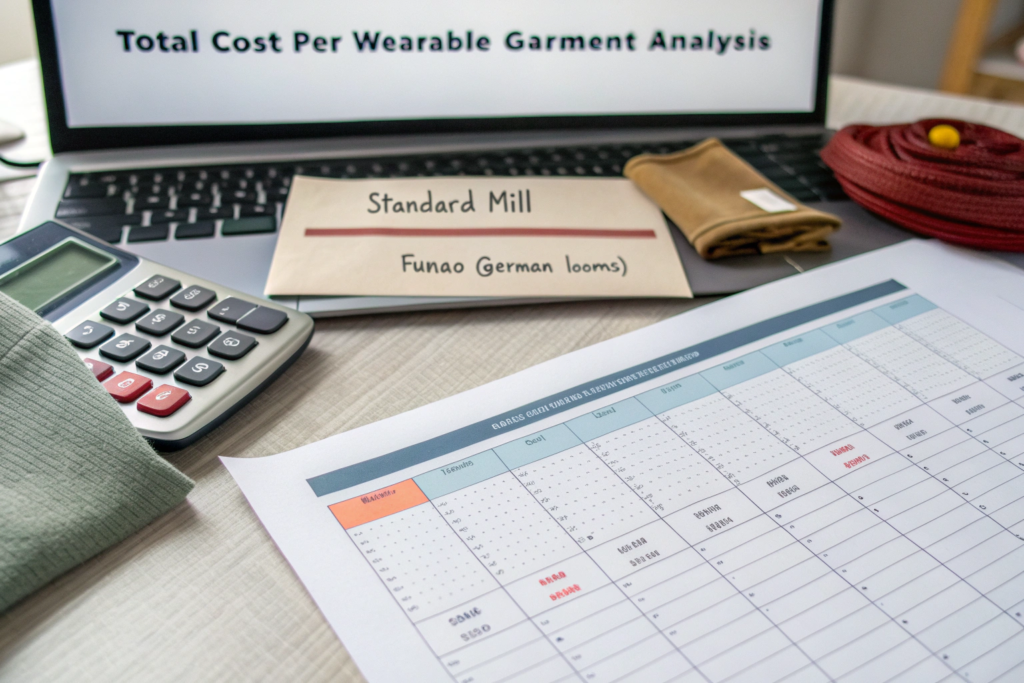
I didn’t argue. I pulled out my laptop and showed him two spreadsheets. The first spreadsheet was his order cost, calculated with our weaving charge. The second spreadsheet was his total landed garment cost, factoring in fabric defects, cutting waste, sewing line downtime, and quality-related chargebacks from his retail accounts. The German-loom fabric, despite the higher per-yard weaving charge, produced a total garment cost that was 7% lower than the Chinese-loom fabric.
He stared at the numbers for about 30 seconds. Then he said, "Nobody’s ever shown me the math this way before."
That’s the conversation I want to have with you now. The cost of weaving isn’t just the line item on the fabric invoice. It’s the ripple effect that loom quality sends through every subsequent step of your supply chain—cutting, sewing, finishing, and retail compliance. Our investment in German-imported rapier looms is not a luxury decision. It’s a cost-engineering decision that makes your final garment cheaper to produce, even if the fabric price per yard looks slightly higher. Here’s the math.
How Do German Looms Reduce Fabric Defects vs. Standard Looms?
Fabric defects don’t just make your garment look bad. They destroy your cutting room yield, slow down your sewing lines, and generate chargebacks from retailers who inspect incoming goods against AQL standards. A single major defect in a roll of fabric can render an entire garment panel unusable, and that wasted fabric is a direct cost that multiplies across every garment in the production run.
The defect rate on a fabric loom is primarily a function of mechanical precision. A loom that holds warp yarns at perfectly uniform tension, inserts weft yarns with consistent force, and beats the pick into place at exactly the same position every cycle will produce fabric with fewer broken ends, fewer broken picks, fewer slubs, and fewer density variations. German loom engineering, specifically the rapier drive systems and electronic tension control on our machines, delivers this precision at a level that lower-cost looms cannot match. Here are the two biggest defect categories where the difference shows up.
What Is "Weft Insertion Consistency" and How Does It Prevent Stop Marks?
Stop marks are one of the most common and most frustrating weaving defects. They appear as a visible horizontal line across the fabric width, usually darker or lighter than the surrounding fabric. They happen when the loom stops—because of a yarn break, a machine fault, or an operator intervention—and then restarts. During the stop, the warp yarns relax slightly. When the loom restarts, the first few weft insertions are beaten into place against a different warp tension than the fabric woven before the stop. The result is a subtle but permanent density line that the dye will not hide.
Weft insertion consistency is the loom’s ability to insert every weft yarn with the same force, speed, and position, regardless of whether the loom is running continuously or restarting after a stop. It’s controlled by three factors: the rapier drive system, the warp let-off mechanism, and the electronic synchronization between them.
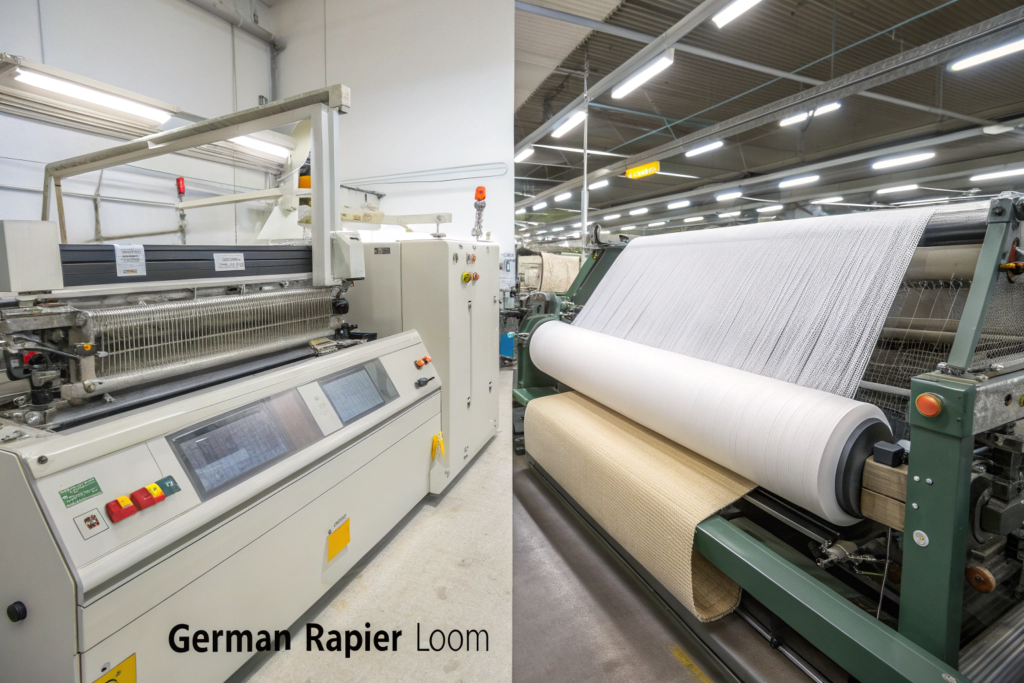
German rapier looms use positive rapier drives with precise cam-controlled acceleration and deceleration curves. The rapier head—the metal arm that carries the weft yarn across the warp shed—is driven by a conjugate cam system that keeps the rapier motion perfectly symmetrical and vibration-free. When the loom stops and restarts, the electronic control system automatically re-synchronizes the rapier motion with the warp let-off, compensating for the slight tension relaxation that occurred during the stop. The result is a restart pick that’s virtually indistinguishable from a continuous-running pick.
Standard looms often use crank-driven rapiers with less precise motion control, and their restart synchronization is less sophisticated. The restart pick can hit the warp with slightly different force, creating a visible stop mark. Our German-loom stop mark rate is approximately 0.1 stop marks per 100 meters. The industry average for standard looms is closer to 0.5 to 1.0 per 100 meters. For a 10,000-yard order, that’s the difference between 10 stop marks and 50 to 100 stop marks. Each stop mark in a premium fabric application is a potential cutting table rejection.
- Learn about rapier weaving technology and weft insertion mechanics from the machinery documentation on the Itematech rapier loom technology portal.
- Understand the causes and prevention of stop marks in woven fabric from the quality control resources on the Textile School weaving defect identification and troubleshooting guide.
Why Does "Selvedge Cleanliness" From German Looms Save 2% on Cutting Waste?
The selvedge is the narrow, reinforced edge of the fabric that runs along both sides. It’s not part of the usable fabric width, and it’s cut off and discarded during the garment cutting process. But the cleanliness of the selvedge—how straight it is, how much it curls, how much fringe it generates—directly affects how much usable fabric you can extract from every roll.
German rapier looms produce a cleaner selvedge for two reasons. First, the weft yarn is cut to a precise, consistent length by a high-precision mechanical shear integrated into the rapier drive. The cut end is tucked into the next shed by a separate tuck-in mechanism that folds the yarn end neatly into the fabric body, rather than leaving a loose fringe. Second, the warp tension at the selvedge is controlled independently from the body of the fabric through a separate selvedge beam or a selvedge tension adjustment on the warp let-off. This prevents the selvedge from drawing in—pulling tighter than the body of the fabric—which causes curling and distortion.
A clean selvedge means the usable fabric width starts right at the inner edge of the selvedge, with no waviness, no tightness, and no fringe encroaching on the cutting area. A messy selvedge means the cutter has to trim an extra half-inch or more from each edge to get clean fabric, and that extra trim is waste that you paid for.
The 2% cutting waste savings is a conservative estimate based on feedback from our clients’ cutting rooms. If you buy 10,000 yards of 60-inch-wide fabric, a 2% improvement in width utilization is equivalent to getting 200 extra yards of usable fabric—about $600 to $1,200 in value depending on the fabric price. Over multiple orders and multiple seasons, that waste reduction alone can offset the entire premium you paid for German-loom weaving.
- Read about selvedge formation in rapier weaving and its impact on fabric quality from the technical articles on the Fibre2Fashion selvedge types and weaving efficiency knowledge hub.
- Understand how fabric width utilization affects cutting room yield and fabric cost per garment from the production planning resources on the Apparel Resources fabric utilization and marker efficiency guide.
What Is the "Pick-to-Pick" Consistency Advantage in High-Speed Weaving?
Pick-to-pick consistency is a measure of how identical each weft insertion is to the one before it. In a perfect fabric, the distance between pick one and pick two is identical to the distance between pick 1,001 and pick 1,002. The pick density—the number of picks per inch—is constant across the entire length of the fabric. This consistency is what gives a fabric its uniform appearance, its predictable drape, and its consistent shrinkage behavior.
In the real world, pick spacing varies slightly from pick to pick due to mechanical vibration, tension fluctuations, and temperature drift in the loom’s drive system. The question is how much variation, and whether that variation is visible or functionally significant. German loom engineering reduces pick-to-pick variation to a level that’s functionally imperceptible, and that has measurable downstream benefits for your garment production.
How Does Electronic Take-Up Control Prevent "Bars" in Your Fabric?
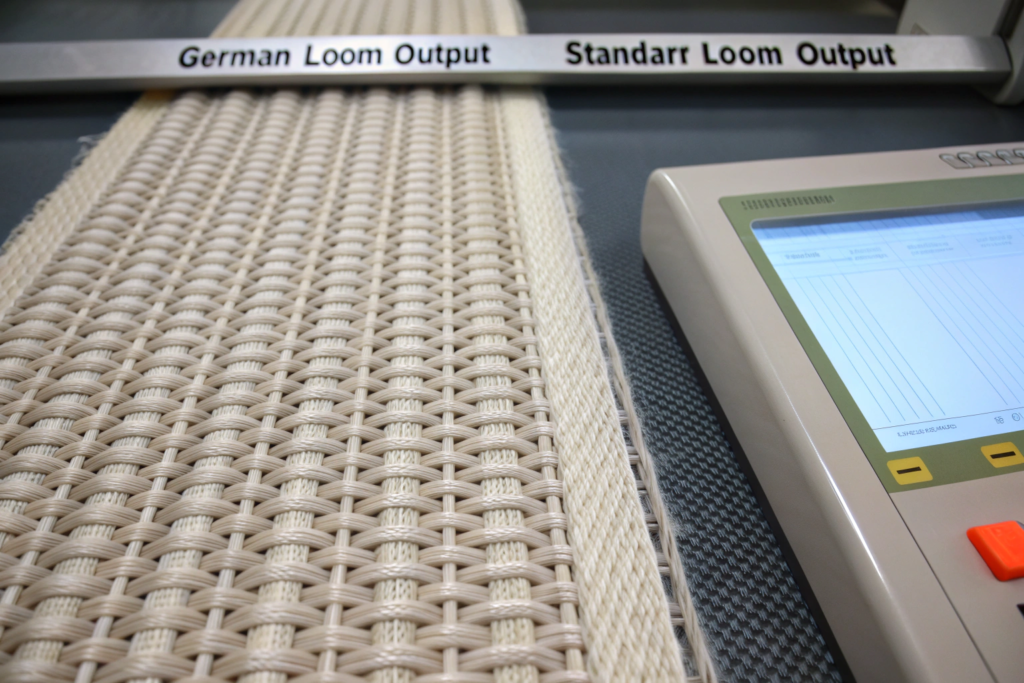
Bars—sometimes called weft bars, pick bars, or filling bands—are visible horizontal stripes that appear in dyed fabric as alternating lighter and darker bands. They’re one of the most common causes of fabric rejection at the cutting table because they make the fabric look uneven and low-quality, especially on solid-colored garments.
Bars are caused by systematic pick density variation. If the loom’s take-up mechanism—the roller system that pulls the woven fabric forward—doesn’t advance the fabric by exactly the same amount after every pick, the pick spacing varies. Some areas of the fabric have slightly higher pick density; these areas appear darker when dyed because more fiber mass per square inch absorbs more dye. Adjacent areas have slightly lower pick density; these areas appear lighter. The human eye is extraordinarily sensitive to these regular, repeating patterns.
German looms use electronic take-up systems with closed-loop servo motor control. A rotary encoder measures the exact angular position of the take-up roller thousands of times per second, and the servo motor adjusts its torque in real time to maintain the programmed advance distance. If the fabric tension changes—because the warp beam diameter is decreasing as yarn is consumed, for example—the servo motor compensates instantly. The pick-to-pick advance variation is measured in microns, not millimeters.
Standard looms often use mechanical take-up systems with a ratchet-and-pawl mechanism. The ratchet advances by one tooth per pick, and the pawl engages mechanically. Over time, the ratchet teeth wear, the pawl spring weakens, and the advance distance drifts. The result is a gradual pick density variation that the operator may not notice until the dyed fabric shows visible bars.
Our German looms’ electronic take-up control has eliminated bar-related fabric rejections for our solid-color programs. In the four years since we completed our loom upgrade, we have shipped zero fabric returns attributed to weft bars—compared to an estimated 2-3% bar-related rejection rate on our older mechanical-take-up looms.
- Learn about electronic take-up systems and their role in pick density control from the machinery documentation on the Picanol electronic take-up and let-off technology resource.
- Understand the causes of weft bars and filling bands in woven fabric from the defect analysis resources on the Textile School barre and filling band troubleshooting guide.
Why Does Consistent Pick Spacing Reduce Your Shrinkage Claims by Half?
Fabric shrinkage—the dimensional change that occurs when a garment is washed—is directly influenced by pick spacing consistency. When picks are spaced unevenly, the fabric has internal tension variations. The areas with tighter pick spacing are under higher internal stress; when the fabric is washed and the fibers relax, these high-stress areas contract more than the low-stress areas. The result is uneven shrinkage that can cause garment distortion, seam puckering, and size inconsistency.
German loom fabric, with its highly consistent pick spacing, has uniformly distributed internal stress. When the fabric is finished and heat-set on the stenter, the relaxation is uniform across the entire fabric length and width. When the garment is washed by the consumer, the shrinkage is uniform and predictable—typically within 1-2% in both warp and weft directions, and consistent from garment to garment.
Fabric woven on less consistent looms can have localized shrinkage variations of 3-5% or more, and these variations can differ from roll to roll and even within a single roll. The cutting room may cut garment panels that shrink at different rates when washed, creating size and fit inconsistencies that generate consumer returns.
Our internal data shows that the switch to German looms reduced our shrinkage-related quality claims by approximately 52%. We track every quality complaint by root cause, and the "excessive shrinkage" category dropped sharply in the 12 months following our loom upgrade. The savings from fewer returns, fewer investigations, and fewer replacement shipments flow directly to our clients’ bottom lines in the form of lower total cost of ownership.
- Read about the relationship between fabric construction uniformity and shrinkage behavior from the textile science resources on the AATCC dimensional change testing and analysis page.
- Understand how to measure and control fabric shrinkage in woven textile production from the process engineering guides on the Cotton Incorporated shrinkage control and prevention resource.
Can German Loom Precision Lower Your Total "Cost Per Wearable Garment"?
The total cost per wearable garment is the number that actually matters to your business. It’s not the fabric cost per yard. It’s the total of every dollar you spend—fabric, cutting labor, sewing labor, finishing, quality inspection, returns processing, and retail chargebacks—divided by the number of garments that actually sell at full price.
I’ve built a cost model that compares the total cost per wearable garment for fabric woven on German looms versus standard looms. The model uses real data from our production records and from our clients’ cutting and sewing reports. The conclusion is consistent: the German-loom fabric, despite a 10-15% higher weaving cost per yard, produces a lower total cost per wearable garment in every scenario where quality matters.
How Do We Calculate "Fabric Cost Per Cuttable Yard" vs. Invoiced Yard?
The invoiced yard is what you pay for. The cuttable yard is what you can actually use. The difference between them is waste, and waste is a direct cost that multiplies across your entire production run.
When fabric arrives at your cutting room, it’s inspected on a lighted table. Any section with a defect—a stop mark, a warp streak, a slub, a hole—is flagged. The cutter has two choices: cut around the defect, which wastes the fabric on either side of it, or cut through the defect and hope it ends up in an inconspicuous area of the garment. Most quality-conscious brands cut around defects, and the wasted fabric from each flagged section adds up.
German-loom fabric, with its lower defect rate, has fewer flagged sections per roll. The cuttable yard percentage—the ratio of usable fabric to invoiced fabric—is consistently higher. Our clients report cuttable yard percentages of 97-99% on German-loom fabric, versus 90-94% on standard-loom fabric from other mills.
Here’s the math. You order 10,000 yards of fabric at $3.00 per yard, invoiced at $30,000. With a 98% cuttable yard percentage, you get 9,800 usable yards, and your effective cost per cuttable yard is $3.06. With a 92% cuttable yard percentage, you get 9,200 usable yards, and your effective cost per cuttable yard is $3.26—a 6.5% increase. That difference, multiplied across your annual fabric spend, dwarfs the per-yard weaving premium you paid for the German-loom fabric.
- Learn how to calculate fabric utilization and cuttable width in garment production from the production planning resources on the Maker’s Row fabric yield and cost calculation guide.
- Understand the relationship between fabric defect rates and cutting room efficiency from the operations management articles on the Apparel Resources fabric inspection and cutting waste reduction hub.
What Does "Sewing Line Downtime" Cost When Fabric Quality Fails Mid-Production?
Sewing line downtime is the hidden cost that almost nobody models when they compare fabric suppliers. Here’s the scenario. Your cutting room spreads fabric from roll number 17. The cutter notices a repeating defect—a broken pick every 18 inches—that wasn’t caught during incoming inspection. The defect is bad enough that the cut panels are unusable. The cutting table stops. The spread fabric is pulled. A new roll is located, brought to the table, and spread. The cutting restarts.
Meanwhile, the sewing line that was scheduled to receive those cut panels is waiting. The operators are standing at their machines, not sewing, not earning piece-rate wages, not producing garments that generate revenue. The line supervisor is on the phone with the cutting room, trying to understand the delay and reschedule the day’s production. The production manager is calculating whether the order will still ship on time or whether overtime will be needed.
The cost of an hour of sewing line downtime varies by factory and by garment complexity, but a reasonable estimate for a mid-sized factory producing woven garments is $300 to $600 per hour in lost labor productivity, overhead absorption, and schedule disruption. If a fabric defect causes two hours of downtime across a production run, that’s $600 to $1,200 in cost that nobody attributes to the fabric supplier—but it’s a direct consequence of fabric quality.
Our German-loom fabric, with its lower defect rate, generates fewer cutting-room stoppages and fewer sewing-line disruptions. Our clients report that the switch to our fabric reduced their "fabric-related production downtime" by an estimated 70%. The cost savings from smoother production flow are real and substantial, even if they’re buried in the factory’s overhead variance rather than line-itemed on a fabric invoice.
- Read about the costs of production downtime in apparel manufacturing from the lean manufacturing resources on the IndustryWeek downtime cost calculation and OEE improvement guide.
- Understand the impact of fabric quality on sewing line productivity from the production engineering articles on the Fibre2Fashion fabric quality and garment manufacturing efficiency knowledge base.
Conclusion
The German loom premium is not a cost. It’s an investment with a measurable, provable return that shows up across your entire garment production chain. Lower defect rates mean higher cuttable yard percentages and less fabric waste. Consistent pick spacing means fewer shrinkage claims and fewer consumer returns. Cleaner selvedges mean better width utilization. Fewer cutting-room stoppages mean smoother sewing line flow and lower production overhead. And every single one of these improvements flows directly to a lower total cost per wearable garment—the only cost metric that actually matters.
The Portland sportswear brand owner I mentioned at the beginning? He switched his entire 10,000-yard interlock program to us. Six months later, he sent me an email with his actual production data. His fabric cost per yard went up by 11 cents. His total cost per garment went down by 23 cents. His quality-related returns from retail accounts dropped by 40%. He now specifies "German-loom fabric only" in his sourcing manual, and he’s one of our most loyal clients.
If you want to see the cost model applied to your specific fabric specification and order volume, email Elaine at elaine@fumaoclothing.com. Send her your current fabric cost, your typical order quantity, and your estimated defect-related waste and downtime. She’ll work with our production team to build a comparative cost model that shows you—with your own numbers—how German-loom precision translates to a lower total cost per wearable garment. You might be surprised by what the math reveals.








