
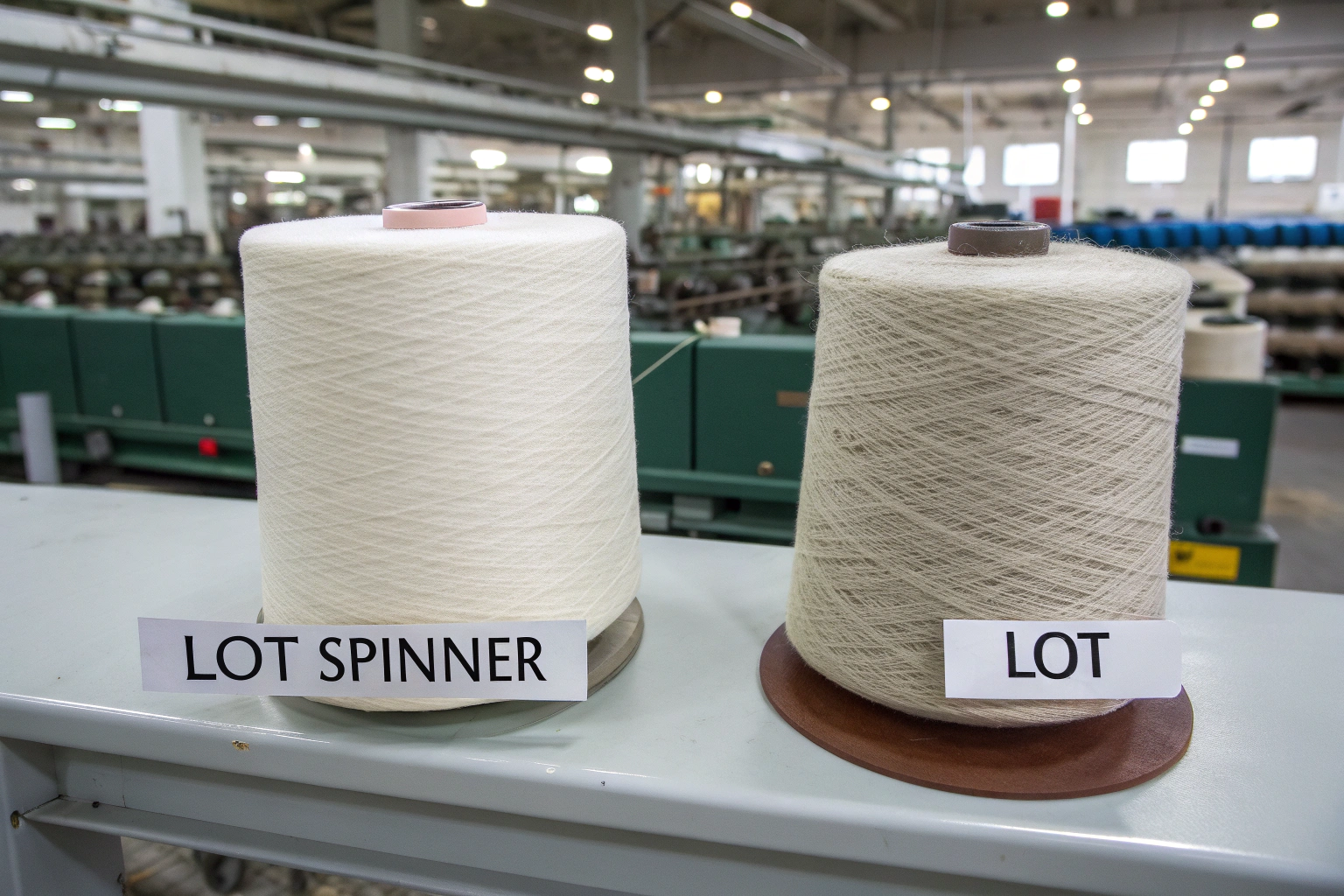
April 2022. A denim client from Amsterdam called me with a problem that almost ended our relationship. We had shipped them 5,000 yards of indigo-dyed cotton twill for their premium jeans line. They cut and sewed the first batch, washed the finished jeans, and everything was perfect. Two weeks later, they cut the second batch from a different roll. Same fabric, same dye lot, same wash recipe. The jeans came out a full shade lighter. Their production manager was furious. Their retail buyer was threatening cancellation. I flew our QC team lead to their laundry facility, and we spent three days tearing apart the production process to find the fault. It wasn’t the dye. It wasn’t the wash. It wasn’t the sewing. It was the yarn.
The two fabric rolls came from two different yarn lots, purchased from the same spinner but produced two months apart. The spinner had changed their cotton sourcing between the two lots—same grade, same staple length on paper, but the cotton came from different growing regions. The micronaire was slightly different. The fiber maturity was slightly different. The dye uptake was slightly different. We didn’t catch it because both yarn lots met the incoming specification, and we didn’t store them separately. That failure—a failure of storage and traceability, not a failure of weaving or dyeing—cost that client a production run and cost us a near-loss of trust that took 18 months to rebuild.
After that day, I made a decision that most of my peers in Keqiao thought was excessive. We built a climate-controlled, lot-tracked, barcode-scanned in-house yarn storage facility that costs us about $60,000 a year to operate. We don’t borrow yarn from nearby traders for rush orders. We don’t mix lots just because they have the same spec sheet. We treat yarn consistency as the foundation on which every other quality claim rests. Here’s why this matters for your fabric, and why most mills skip it.
What Happens When You Mix Yarn Lots Without a Storage Protocol?
Most fabric defects don’t start on the loom. They start months earlier, in a yarn trader’s unmarked warehouse, when a worker grabs 200 kilograms of 40S cotton from one pallet and 300 kilograms from another pallet because "it’s all the same spec." Technically, the spec sheet matches. The yarn count is 40S. The twist factor is 3.8. The evenness is within Uster 50% tolerance. But the cotton origin is different. The spinning date is three months apart. The storage conditions were completely different—one pallet sat in an air-conditioned room, the other in a humid corner near the loading dock.
When those two yarn lots are combined into a single warp, the fabric will have built-in shade variation before a single drop of dye touches it. Here’s the science of why that happens, and the testing protocol we use to prevent it.
Why Does Yarn From Different Harvests Absorb Dye Differently?
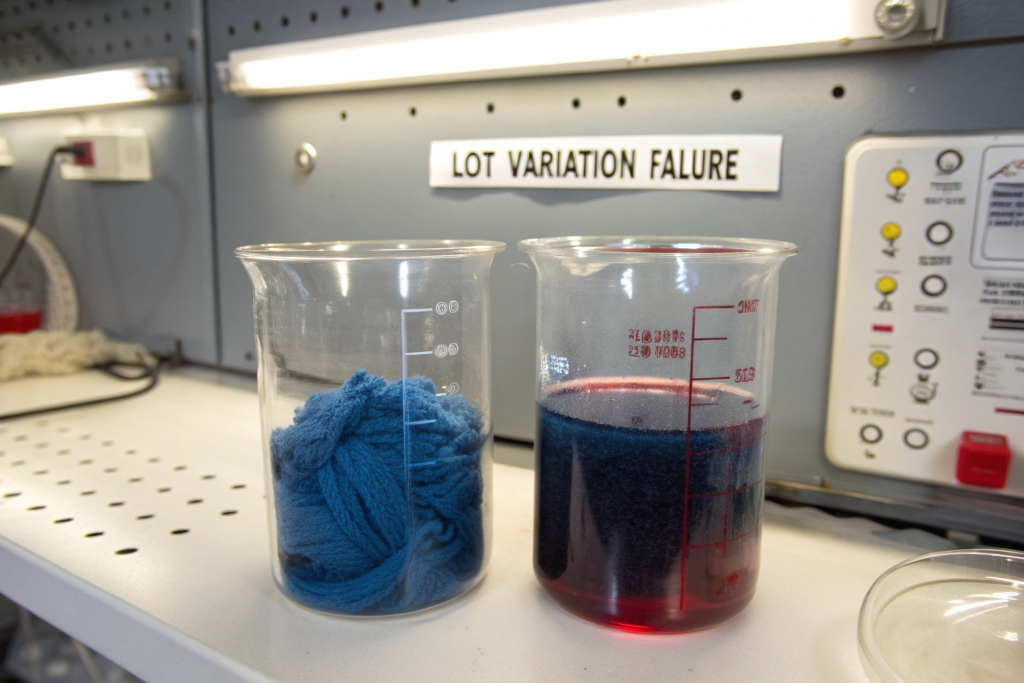
Cotton is an agricultural product. It’s not extruded from a petrochemical vat with identical molecular weight batch after batch. It grows in dirt, in sun, in rain, in specific soil chemistries, and the fiber it produces varies from harvest to harvest, region to region, even field to field on the same farm. Two bales of cotton that both grade as "Middling 1-1/8 inch" under the USDA cotton classification system can still differ in a property called micronaire—a measure of fiber fineness and maturity—and that difference is invisible to the naked eye but devastatingly visible to a reactive dye molecule.
When a cotton boll matures on the plant, the cellulose molecules inside each fiber cell wall develop in concentric layers. A fiber from a boll that matured in hot, dry weather has a thicker cell wall and a lower micronaire than a fiber from a boll that matured in cool, wet weather. The thicker-walled fiber has a smaller central lumen—the hollow channel inside the fiber—and a denser cellulose structure. When reactive dye is applied, the dye molecule must penetrate this cellulose structure to form a covalent bond. A denser cellulose structure takes up dye more slowly and may achieve a lower final saturation than a more open, higher-micronaire fiber.
If you mix a low-micronaire and a high-micronaire cotton in the same fabric, even if both are "Middling" grade, the dye will strike unevenly. The high-micronaire fibers drink up the dye faster and deeper. The low-micronaire fibers resist. Under a spectrophotometer, the average color might read within spec. Under the human eye, the fabric shows subtle cloudiness, shading, or a "frosty" appearance that consumers interpret as faded or cheap.
Our yarn storage protocol prevents this by isolating every incoming yarn lot by spinner, harvest date, and growing region. We don’t blend lots unless we’ve tested them for dye uptake consistency on a sample skein. The test involves knitting a small tube from each lot, dyeing them in the same bath, and measuring the reflectance curve difference. If the Delta E between lots exceeds 0.8, the lots are stored separately and assigned to different orders.
- Read about cotton fiber micronaire and its effect on dyeing consistency from the technical resources on the Cotton Incorporated fiber quality and processing guide.
- Understand the USDA cotton classification system and fiber property grading from the official standards on the USDA Agricultural Marketing Service cotton grading portal.
How Do We Test "Yarn Evenness" Before It Enters Our Warehouse?
Yarn evenness is a measure of how consistently the yarn’s diameter varies along its length. An uneven yarn has periodic thin spots and thick spots. On a woven fabric, those variations create visible stripes and a rough, irregular surface. On a knitted fabric, they create a "cloudy" appearance and inconsistent stretch. On a dyed fabric, thin spots take less dye and appear lighter; thick spots take more dye and appear darker. The overall effect is a fabric that looks like it has a permanent shadow.
Our incoming yarn inspection uses an Uster Tester to measure evenness automatically. The yarn is passed through a capacitive sensor at 400 meters per minute. The sensor measures the mass variation of the yarn cross-section and generates a spectrogram that shows the frequency and amplitude of any periodic irregularities. The key metric we look at is the CVm%—the coefficient of variation of mass. For a ring-spun 40S cotton yarn destined for premium shirting, we require a CVm% below 12.5. For a standard quality, below 14.0. If a yarn lot tests above 14.5, we reject it or downgrade it to a product category where the evenness tolerance is wider, like a brushed flannel where the nap will hide some of the variation.
But Uster testing can’t catch everything. We also do a manual "black board" test. A length of yarn is wound onto a black board in evenly spaced parallel rows. An inspector examines the board under standardized lighting and compares the visual evenness against a set of ASTM yarn appearance grade photographs. This manual check catches defects that the capacitive sensor misses—like a periodic thick-and-thin pattern that’s technically within the mass variation tolerance but visually obvious. The human eye is still the final judge of whether a yarn is "even enough" for a premium fabric.
- Learn about Uster evenness testing technology and its application in yarn quality control from the instrumentation resources on the Uster Technologies testing solutions portal.
- Understand the ASTM D2255 yarn appearance grading standards from the test method documentation on the ASTM International textile yarn standards page.
How Does Climate-Controlled Storage Prevent Fiber Brittleness?
Textile fibers are not inert. They are hygroscopic—they constantly absorb and release moisture in response to the ambient air. A cotton yarn stored in a dry, unheated Keqiao warehouse in January, when the outdoor humidity drops to 30%, will lose 3-4% of its moisture content in a week. The fibers become brittle, the twist liveliness changes, and the yarn breaks more frequently on the loom. Come July, the same warehouse at 85% humidity will swell the yarn with moisture, changing its diameter and making it sticky on the knitting needles.
Most mills in Keqiao store yarn in open-air warehouses without any climate control at all. It’s cheaper—you don’t pay for HVAC equipment or electricity to run it. But you pay in loom stops, warp breaks, and inconsistent fabric density. We calculated that the cost of climate control is about $0.03 per yard of finished fabric, and the cost of not having climate control—in rework, rejected fabric, and client disputes—is about $0.12 per yard. The math is simple. Here’s what our climate system controls and why.
What Is the Ideal Humidity Range for Storing Cotton vs. Spandex?
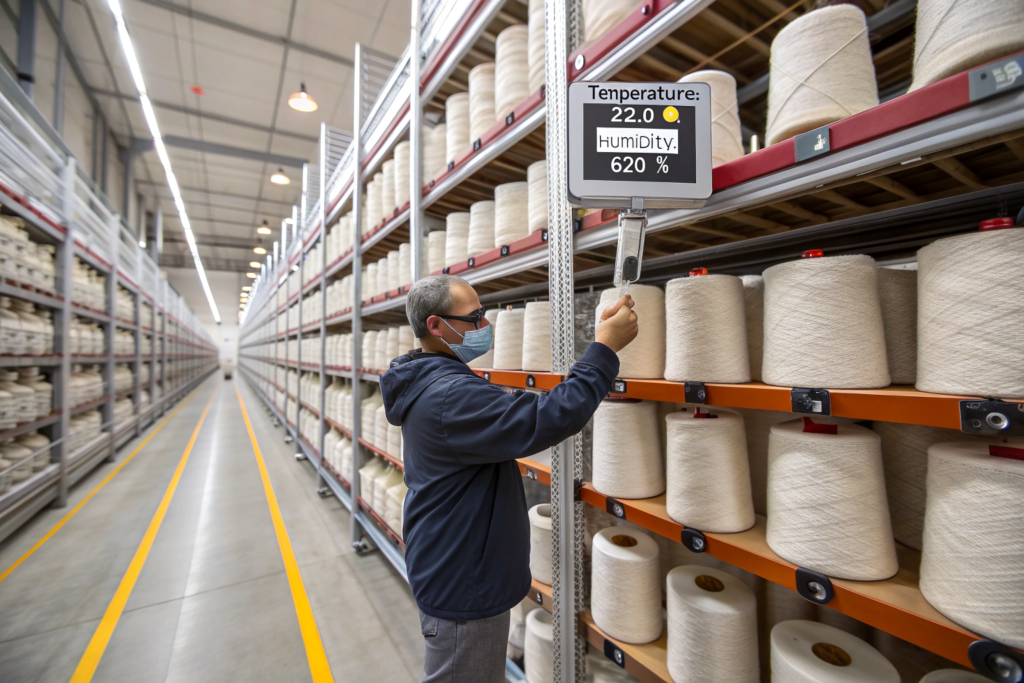
Cotton and spandex live in completely different climate worlds. Cotton is happiest at 55-65% relative humidity. At this level, the natural waxes on the cotton fiber surface remain pliable, the fiber is strong and elastic, and the spinning twist is stable. Drop below 50% and the cotton becomes brittle; the fibers snap during weaving rather than stretching, and the loom shed fills with fly—tiny broken fiber fragments that float in the air and settle on the fabric as white specks. Rise above 70% and the cotton becomes limp and weak; the fibers absorb so much moisture that they swell and lose their internal friction, making the yarn sloppy and prone to slippage during weaving.
Spandex is a different beast entirely. Spandex filament is a polyurethane polymer that is sensitive to hydrolysis—a chemical reaction where water molecules break the polymer chains. Store spandex at high humidity for an extended period, and the fiber permanently loses its elastic recovery. The fabric comes off the loom with good stretch, but after the first wash, the spandex has degraded and the garment bags out permanently. Spandex should be stored at 40-50% relative humidity, lower than cotton, and ideally in sealed polyethylene bags until it’s loaded onto the creel.
Our warehouse is divided into two climate zones. The main zone, for cotton, rayon, linen, and blended yarns, is maintained at 62% relative humidity and 22°C year-round. The elastane zone, for spandex, rubber thread, and any core-spun stretch yarns, is maintained at 45% relative humidity and 20°C. Yarn is moved directly from the spandex zone to the weaving floor only when it’s scheduled for production, minimizing its exposure to the higher-humidity production environment.
- Learn about the hygroscopic properties of textile fibers and optimal storage conditions from the materials science resources on the Textile School fiber moisture regain reference page.
- Understand spandex degradation mechanisms and proper storage protocols from the technical bulletins on the INVISTA Lycra fiber care and handling guide.
Why Do We "Condition" Yarn for 48 Hours Before Weaving?
Conditioning is the process of allowing yarn to equilibrate to the production environment before it’s loaded onto the loom or knitting machine. Yarn that arrives from a supplier has been stored in an unknown environment—maybe an air-conditioned spinning mill, maybe a hot shipping container, maybe a humid port warehouse. If you load that yarn directly onto the creel, it will change its properties during the first few hours of production as it adjusts to the new environment. The fabric produced at 8 AM will have different yarn tension than the fabric produced at 11 AM, even if the loom settings haven’t changed.
Our conditioning protocol is mandatory for every yarn lot that enters our warehouse. Each pallet of incoming yarn is unloaded into a dedicated conditioning bay—a section of the warehouse separated by plastic strip curtains, with independent temperature and humidity control. The bay is set to exactly match the production floor conditions: 60% relative humidity and 24°C. The yarn rests in this bay for a minimum of 48 hours. We log the arrival time and the conditioning start time for every pallet, and the warehouse management system will not release the pallet for production until the 48-hour timer has elapsed.
For spandex and core-spun stretch yarns, the conditioning protocol is even more critical. These yarns are packaged under tension on the spinning tube. If they’re unloaded from a cold truck in January and immediately placed on a knitting machine creel, the cold spandex will be stiffer and have a different stretch profile than warm spandex. The fabric knit at the start of the shift will have different stretch and recovery than fabric knit four hours later, after the spandex has warmed up. We pre-condition stretch yarns in the spandex storage zone for 72 hours—an extra 24 hours beyond standard conditioning—to ensure the spandex filament temperature and humidity are perfectly stable before production begins.
- Read about textile yarn conditioning and its effect on weaving performance from the production engineering resources on the Fibre2Fashion yarn preparation and conditioning knowledge hub.
- Understand the temperature sensitivity of elastane fibers in textile manufacturing from the technical documentation on the Hyosung Creora spandex processing best practices guide.
How Do We Trace a Single Yarn Lot to the Final Fabric Roll?
Traceability is the ability to answer the question: "Where did this specific roll of fabric come from, and what was done to it?" In a food recall, traceability can prevent illness and death. In textiles, the stakes are lower—nobody dies from a mismatched dye lot—but the business consequences of a quality failure without traceability can be existential. If a brand sells 10,000 units of a garment with a fabric defect, and they can’t trace the defect back to a specific production batch to isolate the affected inventory, they have to recall all 10,000 units. With traceability, they recall 200 units made from the defective roll and preserve the revenue from the other 9,800.
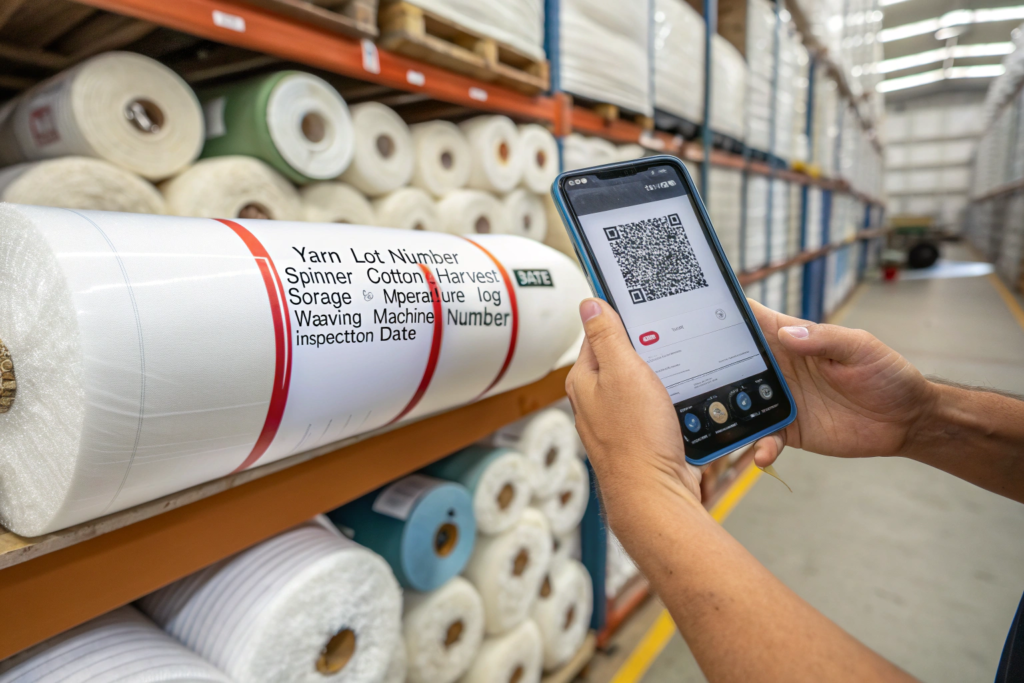
Our traceability system connects our yarn storage database, our production ERP, and our fabric roll labeling system into a single digital thread. Every yarn pallet enters with a barcode. Every production order is linked to a yarn lot. Every fabric roll is linked to a production order. Scan any roll’s QR code, and you see the entire history back to the yarn bale.
What Information Is Embedded in Our Yarn Lot Barcode System?
When a yarn delivery arrives at our warehouse dock, the receiving inspector scans the supplier’s delivery note and generates a unique barcode label for each pallet. This label contains a lot number that encodes the yarn specification and the receipt date. But the barcode links to much more data in our database than what’s printed on the label.
For every yarn lot, we record the spinner’s name and mill location, the yarn count and twist specification, the fiber composition (including the percentage of any recycled or organic content, with certification numbers), the cotton harvest region and ginning date (for cotton yarns), the spinning date as reported by the supplier, the date the yarn arrived at our warehouse, the temperature and humidity during its conditioning period, the Uster evenness test results from our incoming inspection, the single-end strength test results, and the dye uptake comparison Delta E against our reference standard.
This data serves two purposes. First, it enables rapid root-cause analysis when a quality issue arises. If a fabric roll shows unexpected shade variation during final inspection, our QC team can scan the roll’s QR code, identify the yarn lot, pull up the incoming inspection data, and determine within minutes whether the yarn lot was the source of the problem or whether the problem originated later in production.
Second, it enables predictive quality control. If we notice that yarn lots from a specific spinner have a gradual upward trend in CVm% over six months, we can flag that supplier for a quality audit before their yarn causes a production failure. If we see that yarn stored in a specific corner of the warehouse consistently shows slightly lower moisture content, we can adjust the HVAC baffles to balance the airflow. Data without a traceability system is just numbers. Data linked to physical lots is a quality management tool.
- Learn about barcode and RFID traceability systems in textile manufacturing from the technology resources on the GS1 global textile traceability standards page.
- Understand the principles of lot traceability and root-cause analysis in quality management from the ISO 9001 traceability requirements documentation on the ISO quality management portal.
How Does "Lot-to-Roll" Traceability Reduce Your Product Recall Risk?
If you’re an apparel brand, a fabric quality failure that reaches consumers is a recall event. You have to pull the defective garments from stores and e-commerce warehouses, process returns, issue refunds, and manage the PR damage. The cost of a full recall can wipe out the profit from an entire season. But if you can limit the recall to only the garments made from the defective fabric rolls, the cost drops by orders of magnitude.
Our lot-to-roll traceability system enables this targeted containment. When you receive your fabric shipment, every roll has a QR code. Your cutting room scans each roll as it’s loaded onto the spreading table. Your production management system records which rolls were used for each cutting lay and which cutting lays produced which finished garment lots. If our QC team later identifies a defect that originated from a specific yarn lot or a specific dye batch, we can send you a list of the specific roll numbers affected. You cross-reference that list against your cutting records and identify exactly which garment lots need to be quarantined.
This system was tested in a real-world incident last year. A batch of recycled polyester yarn from a new supplier exhibited an intermittent thick-and-thin defect that only became visible after the fabric was brushed for a fleece finish. Our final inspection caught the defect on 4 rolls out of an 80-roll order. We immediately traced the 4 rolls back to a specific yarn lot that had been used on a specific warping creel date. We identified 12 additional rolls in the order that used yarn from the same lot. All 16 rolls were isolated before the shipment left our dock. We replaced them from a different lot that had already passed our fleece brushing test. The client received a clean shipment with zero defective rolls and an explanatory report within 48 hours of our detection.
- Read about product recall management in the apparel and textile industry from the risk management resources on the American Apparel and Footwear Association product safety guide.
- Understand the role of digital traceability in supply chain risk mitigation from the transparency case studies on the Fashion Revolution transparency index methodology page.
Conclusion
In-house yarn storage with climate control and lot-level traceability is not a marketing feature. It’s an infrastructure investment that prevents the most insidious category of fabric defects: the ones that aren’t visible on the inspection table but emerge only after washing, after wearing, or after the garment sits on a retail rack under fluorescent lighting for three weeks. The Amsterdam denim incident taught me a hard lesson: you can have the best looms, the best dyehouse, and the best finishing line, and it all means nothing if the yarn sitting on your creel has an invisible inconsistency that only reveals itself downstream.
Our $60,000 annual investment in climate-controlled, lot-separated, fully traceable yarn storage is a cost that our competitors choose not to bear. They pass the hidden cost—the quality failures, the rejected shipments, the client disputes—on to their customers. We bear the cost internally because it’s cheaper than losing a client’s trust, and because it enables the kind of predictable, repeatable fabric quality that brands building a long-term reputation depend on.
If you want to see how your fabric order’s yarn would be stored, conditioned, and traced through our facility, email Elaine at elaine@fumaoclothing.com. She can arrange a live video walkthrough of our yarn warehouse, including a real-time look at the climate monitoring dashboard and the QR code traceability system in action. You’ll see exactly how we ensure that the yarn that goes into your first roll is identical to the yarn that goes into your last roll.








