
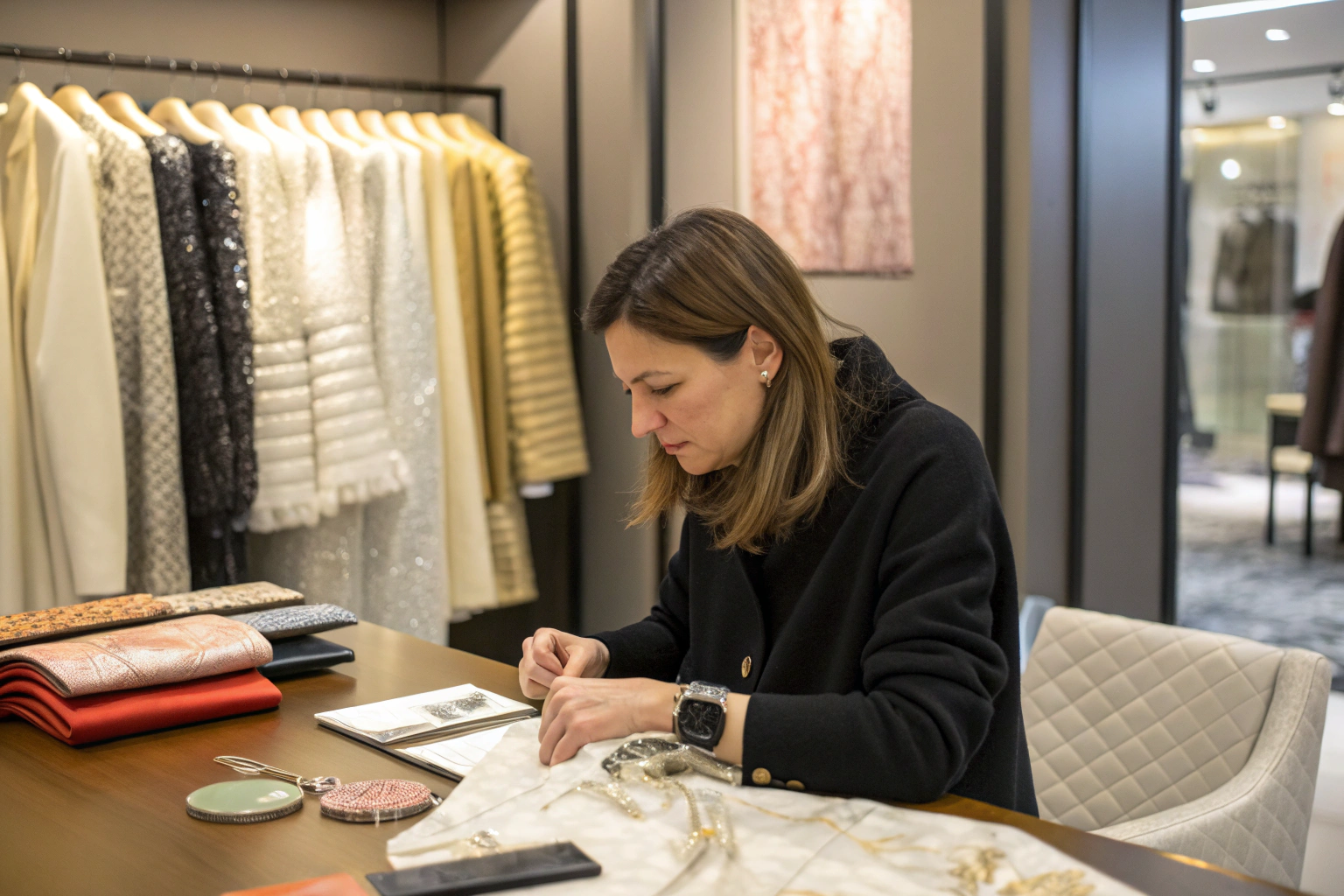
I remember a Wednesday afternoon in late February. A buyer from a Parisian contemporary womenswear brand sat in our Keqiao showroom, flipping through our latest texture swatches with a look I’ve learned to recognize over two decades. It’s the look of someone searching for something they can’t quite name. She paused at a sample—a crinkled nylon taffeta with a pearlescent coating—and said, "This is interesting, but it feels… last season. Where is the next thing? The texture that hasn’t been done yet?" She wasn’t being difficult. She was articulating the core pressure of European fashion: you lead the trend, or you’re irrelevant. Her competitors were already placing orders for autumn-winter. She needed a fabric that would stop a creative director mid-sentence at a design review.
That question—"where is the next thing?"—is the engine that drives our R&D department. We don’t wait for fabric trends to appear on the Première Vision runway. By the time a texture hits a trade show, it’s already six months old and every mill in Asia is rushing to copy it. We work upstream, closer to the source of trend creation: the fiber innovators, the chemical formulators, the archive libraries, and the collaborative dialogues with the design teams who are sketching next year’s collections right now. Here’s exactly how we turn a vague design intuition into a production-ready textured fabric that lands on European retail floors before the trend peaks.
How Does Our Trend Forecasting Feed Into Fabric Texture Development?
Trend forecasting in textiles is not about predicting the future. It’s about triangulating weak signals from multiple independent sources—yarn technology, chemical finishes, cultural aesthetics, and economic data—and synthesizing them into a physical fabric prototype that arrives at the right moment. Get the timing wrong, and you’re either too early (the market isn’t ready for your biodegradable sequin mesh) or too late (your crinkled nylon is already on a fast-fashion clearance rack).
Our R&D team operates on an 18-month development horizon. The texture that a European buyer orders in March 2026 for an autumn-winter 2027 collection began its life as a raw concept in our lab in September 2025. That sounds like a long lead time, but in textile innovation terms, it’s a sprint. Let me show you where the ideas come from and how we filter them.

What Role Do Italian Yarn Fairs Play in Our Texture Concepting?
Twice a year, our senior R&D textile designer flies to Florence for the Pitti Filati yarn fair. This is not a fabric show. It’s upstream of fabric—it’s where the world’s most innovative spinning mills present their new yarn developments to the knitting and weaving industry. The yarn you see at Pitti Filati in January will become the fabric samples at Milano Unica in July, which will become the garments on the runway in September, which will become the high-street interpretations 12 months after that.
At Pitti Filati, our designer isn’t looking for finished fabric concepts. She’s looking at raw material innovations: a new bio-based nylon with an irregular cross-section that creates unexpected light reflection; a core-spun linen with a soluble PVA filament that dissolves in dyeing to leave a hollow, ultra-light structure; a brushed mohair-nettle blend with a matte halo texture that hasn’t appeared in any commercial fabric yet.
She collects these yarn samples, brings them back to Keqiao, and our weave and knit technicians begin experimenting. A recent example: at the July 2024 Pitti Filati, she discovered a Japanese spinner showing a paper-nylon twisted yarn—washi paper fibers twisted around a recycled nylon core. The hand feel was unlike anything we’d seen: dry, crisp, with a faint rustling sound, but strong enough for garment construction. She brought back 5 kilograms of sample yarn. Our weave technician developed three constructions on our sample loom over the following two weeks—a plain weave with the paper-yarn in the weft, a basket weave with alternating paper-nylon and cotton, and a loose, gauze-like structure. We sent header samples to five European clients. By October, we had a confirmed order for 2,000 meters of the basket-weave version from a Berlin sustainable luxury brand. The fabric appeared in their spring 2026 collection, 18 months after the yarn was first shown in Florence.
- Explore the Pitti Filati yarn fair and its role in textile innovation from the event reports on the Pitti Immagine official exhibition portal.
- Understand the development process from specialty yarn to commercial fabric from the innovation articles on the Filo yarn fair trend forecasting resource hub.
How Do We Use "Archive Mining" to Revive 1990s Texture Trends for Gen Z?
Trends don’t emerge from a void. They cycle. Gen Z consumers are currently obsessed with 1990s and early 2000s aesthetics, and that obsession extends to fabric texture. The crinkle nylon, the seersucker, the burnout velvet, the shiny PVC coating—these are not new inventions. They’re revivals, and the original technical knowledge for producing them often died with the mills that made them 25 years ago.
We maintain a physical archive of over 800 vintage fabric samples dating from the 1960s through the 2000s. These aren’t museum pieces behind glass; they’re working reference samples that our technicians can touch, stretch, burn-test, and analyze on our microscopes. When a European buyer says, "I want the texture of a 1997 Prada Sport jacket, but in a sustainable fiber blend," we don’t have to guess what that means. We go to the archive.
Last spring, a Milan-based streetwear brand approached us with exactly this brief. They had a reference image from a vintage fashion editorial, but no physical sample. Our archive contained a nylon crinkle taffeta from a 1998 Japanese production that matched the visual texture. Our technician analyzed the original fabric under a digital microscope, mapped the crinkle pattern geometry, and reverse-engineered the heat-embossing roller profile that created it. We then applied the same mechanical crinkle process to a 100% recycled polyester taffeta, adjusted the temperature and pressure parameters because recycled polyester has a different melting point than virgin nylon, and produced a modernized version of the 1998 texture. The fabric was deadstock from an aesthetic standpoint, but it was made from certified recycled fiber with OEKO-TEX certification and a 50-meter minimum order quantity. The brand launched it as a "vintage revival" capsule, and the marketing story practically wrote itself.
- Read about the role of textile archives in contemporary fashion R&D from the curation resources on the Fashion and Textile Museum textile preservation and reference page.
- Understand mechanical crinkle finishing and its application to recycled synthetics from the technical articles on the Fibre2Fashion textile finishing and texturing knowledge hub.
What Mechanical Finishing Techniques Create Our Signature Textures?
Mechanical finishing is the art of physically altering a fabric’s surface without changing its chemical composition. Unlike chemical finishes that coat the fabric or bond with its molecular structure, mechanical finishes use heat, pressure, abrasion, and tension to reshape the yarn surface and the fabric plane. The advantage is durability: a mechanically embossed texture will survive wash cycles that would degrade a chemical coating. The disadvantage is precision: the process parameters—roller temperature, pressure, speed, fabric moisture content—must be dialed in to very tight tolerances, and small deviations produce visible defects.
Our mechanical finishing workshop houses several specialized machines that are uncommon in standard textile mills. We invested in them specifically to serve European buyers who demand textures that can’t be achieved with standard calendering or sanforizing. Here’s what these machines do and why they matter.

How Does Our "Peach Skin" Process Work on Recycled Polyester?
Peach skin is a surface texture, not a fiber. It describes a fabric with an incredibly fine, short, suede-like nap that feels soft and slightly grippy against the skin—like the fuzz on a ripe peach. Achieving this on virgin polyester is relatively straightforward; the fiber’s uniform surface responds predictably to mechanical buffing. Achieving it on recycled polyester is a completely different technical challenge.
Recycled polyester fibers are not physically identical to virgin polyester. They’re made from melted-down PET bottles and textile waste, and the polymer chain length is shorter and more variable than virgin PET. This means the fiber’s surface is microscopically rougher and more irregular. When you apply standard peach-skin finishing parameters to recycled polyester, the fibers don’t abrade evenly. Some areas over-abrade and develop pills. Other areas under-abrade and remain slick. The result is an inconsistent, blotchy texture that looks like a manufacturing defect.
Our R&D team spent over 120 development hours dialing in a peach-skin protocol specifically for recycled polyester. The key variables are the grit density of the emery rollers that buff the fabric surface, the fabric speed through the machine, the roller pressure, and the number of passes. We found that recycled polyester requires a finer grit (800-grit versus 600-grit for virgin polyester), a slower fabric speed (12 meters per minute versus 18), lower roller pressure to prevent fiber tear-out, and three passes through the machine instead of the standard two.
The protocol also includes a pre-treatment step: we run the fabric through a steam relaxation chamber before buffing. This opens up the fiber surface and relaxes the internal stresses from the recycled polymer’s inconsistent chain lengths, making the fibers more receptive to uniform abrasion. The finished fabric has a consistent, luxurious peach-skin hand that we’ve tested through 30 wash cycles with no pilling and no texture degradation. A Copenhagen-based minimalist brand switched their entire recycled polyester loungewear program to our peach-skin finish, and their product reviews specifically mention "the incredibly soft fabric" as a reason for repeat purchase.
- Learn about peach skin finishing technology and emery roller specifications from the technical documentation on the Caru textile finishing machinery resource portal.
- Understand the material property differences between virgin and recycled polyester from the polymer science resources on the Textile Exchange recycled polyester standards page.
What Is "Caustic Reduction" and Why Do Luxury Brands Request It?
Caustic reduction sounds like a chemical process, and it is—but I’m including it here because it’s a surface-texture technique that mimics the visual and tactile effect of filament silk. In the polyester textile world, it’s sometimes called "silk weight reduction" or simply "peeling."
The principle is counterintuitive: you deliberately destroy a portion of the fabric’s surface to make it feel more luxurious. Polyester filament yarns are smooth, round, and slightly glossy—they look and feel synthetic. Caustic reduction involves immersing the polyester fabric in a hot sodium hydroxide solution, which etches the surface of each filament. The caustic soda literally eats away the outer layer of the polyester polymer, reducing the fiber diameter and creating microscopic pits and channels on the surface. The fabric loses about 10-25% of its weight—hence "weight reduction"—but gains a soft, matte, dry hand that feels more like sand-washed silk than synthetic polyester.
The process is notoriously difficult to control. Too little etching, and the fabric still feels synthetic. Too much, and the fabric loses tensile strength and develops holes. The temperature, caustic concentration, dwell time, and fabric tension must be precisely managed, and the parameters change depending on the specific polyester yarn type, the fabric construction, and even the dye lot.
We run caustic reduction for a French luxury house that uses it on their polyester georgette blouse program. Their specification requires a 15% weight reduction with no more than an 8% loss in tear strength. Our lab monitors every batch by weighing a precisely measured fabric sample before and after the caustic bath, and testing tear strength on an Elmendorf tear tester. We’ve refined our process to hit the 15% target with a standard deviation of 1.2% across batches—tight enough that the luxury house’s quality auditor approved our process after a single audit visit.
- Read about caustic reduction chemistry and process control for polyester from the textile chemistry resources on the Textile School polyester weight reduction guide.
- Learn about tear strength testing and its importance in lightweight polyester fabrics from the test method descriptions on the AATCC Elmendorf tear strength standard page.
How Do We Collaborate With European Designers on Exclusive Textures?
The most interesting textures we develop never appear in our general catalog. They’re exclusive developments for a single brand, protected by a mutual non-disclosure agreement, and they represent a level of collaborative creativity that simply doesn’t exist in a transactional "pick from the swatch book" supplier relationship.
European designers approach us with texture briefs that range from the highly specific ("we need a crinkled taffeta with a crackled metallic foil that looks distressed but doesn’t shed") to the poetic and abstract ("we want a fabric that feels like the bark of an olive tree in a dry summer"). Translating these briefs into production-ready fabrics requires a structured collaboration process that bridges the gap between creative vision and textile engineering.

What Information Do We Need From a Designer’s "Texture Brief"?
A texture brief is the written and visual specification that a designer sends us to initiate a custom development. The quality of the brief directly determines the quality and speed of the development outcome. A vague brief—"something soft and textured"—produces a vague, slow development process with multiple rounds of rejected samples. A precise brief produces a first-round strike-off that often hits the target immediately.
We ask our European clients to submit texture briefs with six specific components. First, a physical reference swatch—an actual piece of fabric that has the target texture, even if the fiber content, weight, or color is completely wrong. The physical reference gives our technicians something to touch, stretch, and analyze under a microscope. Second, a Pantone TCX color reference for the development sample. Third, the intended garment type—a texture that works for structured outerwear may fail on a fluid dress because the drape requirements are completely different. Fourth, the target fiber composition, including any sustainability certifications required (GOTS, GRS, OEKO-TEX). Fifth, the target GSM weight range. Sixth, the care label aspiration—do they want machine-washable, or is dry-clean acceptable for a luxury texture?
We also ask for a "texture descriptor vocabulary" from the designer. Instead of "soft," we ask them to choose from more specific terms: plush, sueded, peached, sanded, brushed, felted, waxed, crinkled, embossed, cloqué, seersucker, hammered, crushed. Each of these words maps to a specific mechanical or chemical process in our production vocabulary, and using precise terminology accelerates the development path dramatically. A Helsinki-based designer who worked with us last season sent a brief that included a physical reference, a Pantone color, and the precise descriptor "dry, papery hand with micro-crinkle, 180 GSM, GRS certified, machine washable." We hit the target on the second development sample.
- Learn how to write an effective textile development brief from the design communication resources on the Maker’s Row product development specification guide.
- Understand the standard textile texture terminology and its production implications from the educational materials on the Textile School fabric finishing types reference page.
How Does Our "Sample Loom" Produce 50-Meter Exclusivity Runs for Catwalk Sampling?
European designers don’t need 2,000 meters of an experimental texture. They need 50 meters—enough to cut samples, show the collection to buyers, and gauge retail interest before committing to bulk production. But most mills won’t even quote an order under 500 meters, because the cost of warping a production loom for a tiny run exceeds the revenue from the order.
We solved this problem by building a dedicated sample loom capability. Our R&D center operates two small-scale sample looms—a 24-inch-wide rapier loom and a hand-operated dobby loom—that are specifically designed for short-run development and exclusivity sampling. These looms can warp in under 2 hours, compared to a full production warp that takes an entire shift. They can run as little as 20 meters of fabric economically, though our standard exclusivity minimum is 50 meters.
When a designer’s texture brief results in an approved development sample, we cut the 50-meter exclusivity run on the sample loom immediately. The fabric is finished on our lab-scale stenter and inspection table, so it never touches the bulk production line. The entire process from brief to 50-meter delivery can take as little as three weeks for a stock yarn, or five weeks for a specialty yarn that requires sourcing.
The 50-meter run serves a dual purpose. For the designer, it provides enough fabric to cut 20 to 30 garment samples for their collection presentation and buyer showings. For us, it proves the production concept at a small scale, identifying any issues that will need to be managed when the bulk order—often 2,000 to 5,000 meters if the samples are well-received—arrives. A London-based emerging designer used our sample loom service to produce 50 meters of a custom jacquard texture for her graduate collection; when Dover Street Market picked up the collection, we were ready to scale to 800 meters of commercial production within six weeks.
- Learn about sample loom technology and its role in textile product development from the equipment resources on the Itematech small-scale weaving machinery portal.
- Understand the economics of short-run textile production and exclusivity agreements from the business articles on the Apparel Resources small-batch manufacturing strategy hub.
What Is the "Trend-to-Delivery" Timeline for European Seasonal Orders?
The European fashion calendar is a relentless machine with fixed deadlines that cannot be negotiated. Paris Fashion Week happens when it happens. The buying appointments at Première Vision are immovable. The retail delivery windows for autumn-winter and spring-summer are inscribed in the contracts that brands sign with department stores. If your fabric misses the delivery window, it doesn’t matter how beautiful the texture is—the order is cancelled, and the relationship is damaged.
We manage our R&D-to-delivery pipeline against the European calendar with a level of calendar discipline that our clients consistently tell us is rare among Asian mills. Let me lay out the specific sequence for both major seasons, because understanding this timeline is critical for planning a custom development.

How Far in Advance Should Brands Engage Us for a Custom AW Texture?
The autumn-winter development calendar starts earlier than most brands expect. If you’re a European brand showing an AW 2027 collection at Paris Fashion Week in February 2027, the custom texture development needs to start on our R&D bench in late spring 2026—roughly 18 months before the garments hit the retail floor.
Here’s the month-by-month breakdown. April-May 2026: trend research and initial texture concepting, aligned with the spring yarn fairs and fiber innovation launches. June-July 2026: first-round texture development on our sample looms, using stock yarns where possible to accelerate the process. August-September 2026: header samples and texture strike-offs sent to the brand’s design team for review. October-November 2026: refinement rounds based on designer feedback; color lab dips initiated. December 2026-January 2027: final texture approved; bulk production warp preparation begins. February 2027: bulk weaving and finishing commences, aligned with the brand’s runway show timing. March-April 2027: fabric is shipped from Shanghai, delivered to the brand’s European manufacturing partners. May-June 2027: garments are cut, sewn, and finished. July-August 2027: garments are delivered to retailers for the AW floor set. September 2027: consumers buy the garments.
If a brand contacts us in September 2026 for an AW 2027 custom texture, we’re already six months behind the ideal timeline. We can still execute a fast-track development using our parallel sampling and contingency loom capacity, but the number of refinement rounds is reduced from three to one, and the risk of a suboptimal result increases. Brands that engage us in the April-May window get the full R&D process with multiple iterations and the highest probability of a perfect outcome.
- Understand the European fashion calendar and its implications for textile sourcing timelines from the scheduling resources on the Première Vision trade show calendar page.
- Learn about seasonal planning for fashion textile R&D from the industry guides on the WGSN fashion trend forecasting timeline resource.
What Is the Difference Between "Storyline" Sampling and Bulk-Ready Approval?
One of the most common miscommunications between European designers and Asian mills is the distinction between a "storyline sample" and a "bulk-ready approval." A storyline sample is a concept piece—it’s designed to excite a creative director, to communicate a mood, to earn a place in the collection narrative. It might use yarns that aren’t commercially available, a finishing process that worked once on a hand-operated machine, or a color that was mixed for that specific sample and can’t be replicated at scale.
A bulk-ready approval is a completely different thing. It’s a sample produced on the actual bulk production machinery, using commercially available yarns at a guaranteed supply volume, with a finishing process that is documented, repeatable, and within the cost parameters of the brand’s target FOB price. The difference between a storyline sample and a bulk-ready approval is the difference between a concept car at an auto show and a vehicle rolling off the assembly line.
We make this distinction explicit in our R&D communication. When we send a first-round texture sample, we label it clearly as "R&D Concept Sample—Not Bulk-Ready." We note which yarns are stock versus developmental, which finishing processes are scalable versus lab-only, and what the estimated MOQ and lead time would be if the concept moved to bulk. This transparency prevents the painful scenario where a designer falls in love with a sample, builds an entire collection around it, and then discovers six months later that the fabric can’t be produced in commercial quantities. We deliver dreams, but we also deliver the fine print that keeps those dreams from becoming nightmares.
- Read about the difference between prototype sampling and production-ready sampling in textile development from the product development resources on the Cotton Incorporated textile design and sampling standards page.
- Understand how to evaluate a fabric sample for scalability and commercial viability from the sourcing guides on the Common Objective sustainable fashion sourcing knowledge base.
Conclusion
Creating trending textures for European buyers is not a mysterious creative act. It’s a structured, disciplined process that combines upstream trend intelligence from Italian yarn fairs, physical reverse-engineering from our vintage archive, precise mechanical and chemical finishing capabilities, deep collaboration with designers through structured briefs, and an obsessive commitment to the European fashion calendar’s immovable deadlines. The magic—when it happens—comes from the intersection of all these elements, not from any one of them alone.
The Parisian buyer I mentioned at the beginning of this article? She left our showroom that February afternoon with a concept she hadn’t seen anywhere else: a bio-based nylon micro-crinkle with an enzyme-washed peach finish, developed on our sample loom in response to her description of "a fabric that feels like a second skin but has architectural volume." She took 50 meters back to Paris for her collection samples. Her creative director approved it. The bulk order arrived in our system 18 months later, and the fabric walked the runway in a show that Vogue described as "a masterclass in texture." That’s the outcome our R&D system is designed to deliver.
If your brand needs a texture that doesn’t exist yet—whether it’s for next season’s runway or next year’s commercial collection—send the brief to Elaine at elaine@fumaoclothing.com. Include a physical reference if you have one, your Pantone color, your target fiber composition, and your delivery window. We’ll assess the feasibility within three working days and let you know whether we can develop it in time for your calendar. You don’t need to know the technical name of the texture you’re chasing. You just need to know what you want the fabric to feel like. We’ll figure out the rest.








