I’ll be blunt with you. I’ve seen too many brands burn their launch budgets on a dyeing method that looked trendy but couldn’t scale. Just last month, a streetwear startup from Berlin walked into our Keqiao showroom with a beautiful sample—a washed-out vintage hoodie with that perfect uneven color. They wanted 3,000 units in four weeks. The problem? That sample was garment dyed in a small artisanal workshop, not in an industrial setup. The shrinkage variance alone would have killed their size consistency. They almost walked away from the order entirely because they thought their only option was a process that would bankrupt them on returns.
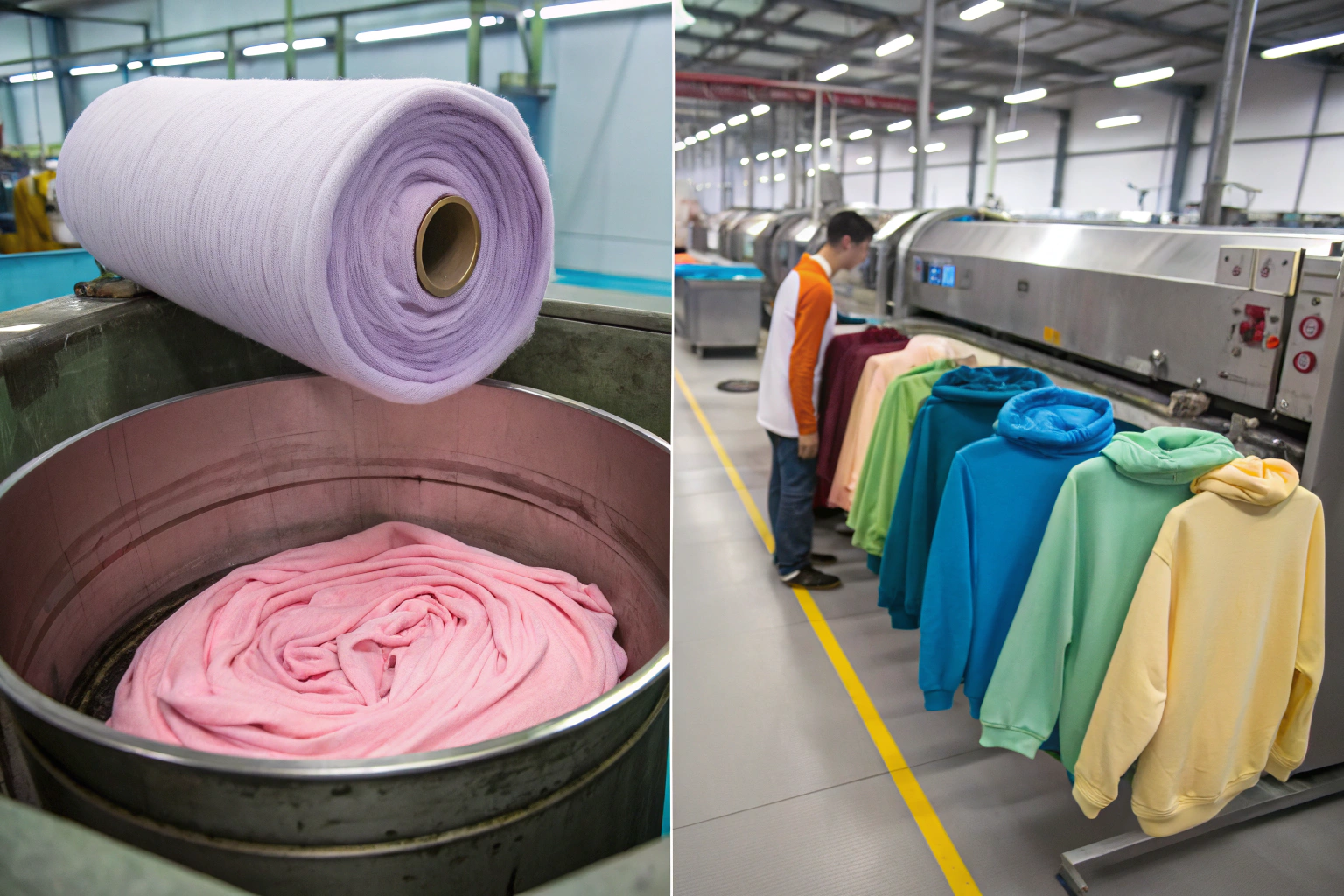
Here’s the reality: piece dyeing and garment dyeing are fundamentally different beasts. One gives you speed, consistency, and cost control. The other gives you aesthetic depth and retail-ready softness, but at a price. Piece dyeing means we take the fabric roll—fresh off the knitting or weaving machine—and submerge it into a massive pressurized dyeing vat before any cutting happens. Garment dyeing means we sew the white fabric into the final hoodie or t-shirt first, and then throw the entire finished garment into a giant industrial washing machine full of dye.
But the choice isn’t just about "look." It’s about your cash flow forecast, your size curve inventory risk, and how many angry returns you’re willing to process for mismatched sleeves. I’m going to walk you through exactly which method to choose based on whether you prioritize speed, shade accuracy, or that premium washed-out hand feel.
How Does Piece Dyeing Minimize Bulk Production Lead Time?
Speed in fashion is a weapon. If you’re stocking a core program of basic polo shirts or replenishing a best-selling jogger, you can’t afford to wait for a dye bath that only fits 200 pieces per load. Piece dyeing is the express lane of the textile highway. The fabric moves fast, and because it’s processed in a flat, open width state, the dye penetrates every fiber in a controlled, repeatable manner.
I remember a panicked phone call from a U.S. uniform supplier in May 2023. They needed 8,000 meters of navy cotton twill for police cadet uniforms, and the shade had to match an exact Pantone number across every inch. There was zero tolerance for "artistic" variation. We ran the entire 8,000 meters in three massive jigs in a single 12-hour shift. That’s the raw power of piece dyeing. Let me break down the two big wins this method offers for bulk production.
Why Does Piece Dyeing Offer Faster 3-Week Production Cycles?
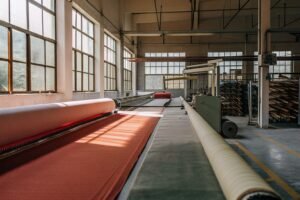
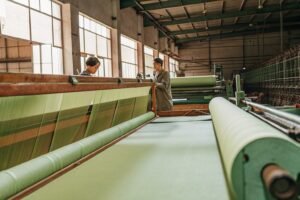
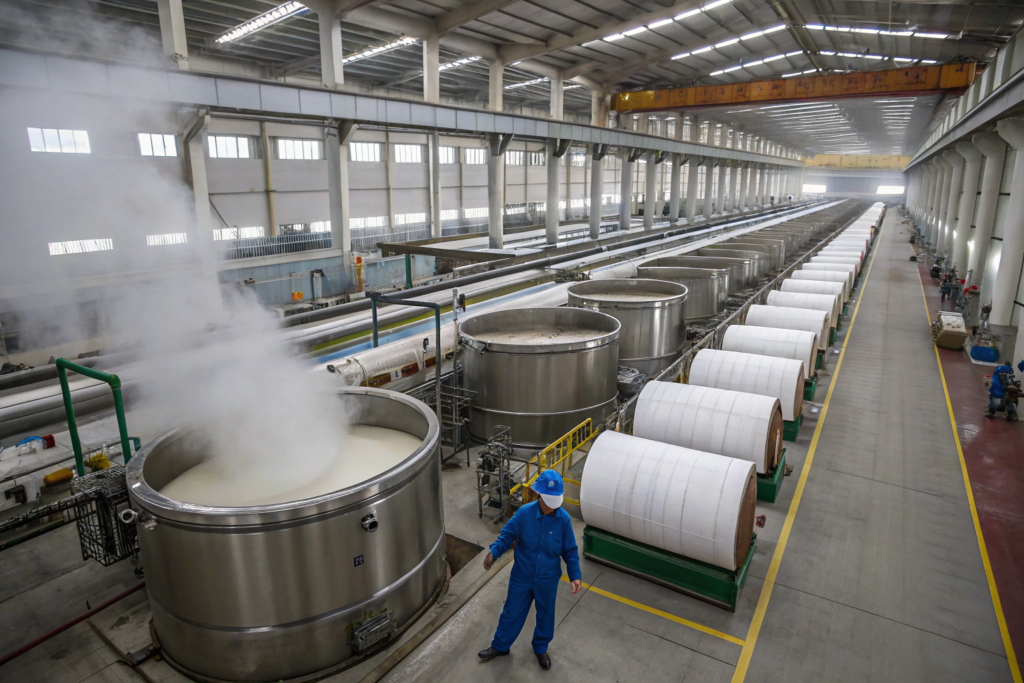
The clock starts the moment the greige fabric enters the pre-treatment bath. In piece dyeing, we don’t have to wait for the cutting room or the sewing floor. The fabric goes straight from the loom into the dyehouse. We use high-pressure jet dyeing machines here in our Keqiao mill that can push 200 kilograms of fabric through the dye liquor at 400 meters per minute. The mechanical energy forces the dye molecules deep into the fiber core within 60 to 90 minutes, depending on the depth of shade.
Think about the math. One jet dyeing machine can process roughly 1,200 to 1,600 kilograms of cotton jersey per 8-hour shift, assuming a standard reactive dye cycle. If I need to dye 5,000 kilograms of black spandex jersey for your yoga collection, I can do that in three shifts. The fabric comes out, gets dried on a stenter frame, and is ready for inspection and packing. There’s no bottleneck at the sewing floor because the fabric is still in roll form—uncut, flexible, ready to be shipped to any factory.
Last year, a fast-fashion importer based in Los Angeles challenged us to go from yarn to finished fabric in 18 days. We hit it. We warped the yarn on day one, knitted it on day two, and ran the piece dyeing on day four. The fabric passed the AATCC colorfastness test and shipped on day fifteen. You simply cannot do that with garment dyeing because you’d still be sewing sleeves to body panels on day fifteen. Piece dyeing compresses the textile supply chain into a vertical sprint.
- For a technical overview of jet dyeing cycle times, check the detailed machinery specs on the Brückner textile finishing technology resource page.
- To understand how reactive dyes bond with cotton fibers, read this educational breakdown on the Textile School dyeing mechanism guide.
How Does Shade Consistency Across 10,000 Yards Compare to Garment Dyeing?
Shade consistency is the silent killer of brand reputation. If your customer buys two pairs of the same "olive green" chinos online, and one is visibly bluer than the other, you’re getting a return. Piece dyeing gives us centralized control over the dye recipe in a massive, homogenous environment.
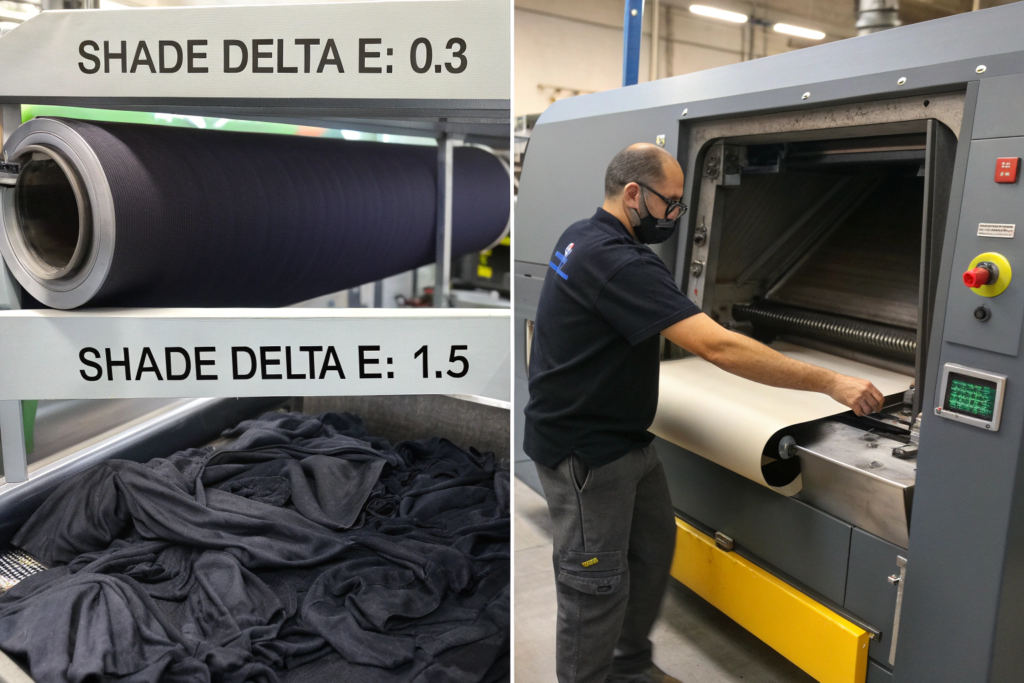
Here’s the technical reality. When we piece dye a 25,000-yard batch of cotton-elastane twill, the entire fabric lot for that purchase order is swimming in the exact same dye liquor, under the exact same pressure, at the exact same temperature gradient. We take a lab dip from the selvedge every 100 yards on the inspection table. The Delta E—that’s the mathematical distance between colors—needs to be below 0.8 on the CMC scale for our high-tier clients. We consistently hit 0.5.
Garment dyeing can’t touch that. A garment dyeing machine is a rotary drum, essentially a giant front-loading washer. The garments at the center of the drum don’t get the same mechanical agitation as the ones near the paddles. Pockets can trap air, causing dye repellency spots. Seams made from polyester sewing thread (which isn’t the exact same fiber as the cotton body) will take the dye differently, resulting in a subtle but noticeable contrast stitch effect. If you want a uniform, military-spec color from size XS to 3XL, piece dyeing is the only way to guarantee that. We document every batch with a spectrophotometer reading, and we can email you the LAB* values before we even roll the fabric.
- Learn about the CMC color tolerance system and its application in textile quality control from the Datacolor spectrophotometer blog.
- Explore the common causes of shade variation in bulk textile processing via the American Association of Textile Chemists and Colorists (AATCC) educational resources.
How Can Garment Dyeing Create Premium Retail Finishes?
Now, let’s talk about the "magic" side of the business. If piece dyeing is a sterile laboratory, garment dyeing is a craft brewery. You sacrifice perfect uniformity for character. I’ve watched a basic $4 cost price garment transform into a $28 retail "premium washed" piece simply by changing the dyeing method. It’s psychological—the consumer associates the broken-in softness and slight color gradation with high-end, artisanal production.
We developed a specialized garment dyeing line for one of our European boutique brands that was competing against labels like Stone Island. The challenge was creating a "vintage washed" nylon shell jacket. If we piece dyed the nylon fabric, it looked flat and plastic-like. But by sewing the entire jacket—zippers, drawstrings, and all—and then acid-washing it with a specific pigment dye, we got this incredible frosted, faded effect on the high-friction areas like elbows and shoulder seams. It looked like a $300 jacket from a high-end boutique. The brand sold out their entire 2,000-unit run in three weeks. That’s the power of investing in a garment dyeing aesthetic.
What Is the "Washer-Soft" Hand Feel Advantage of Post-Sewing Dyeing?
Touch a piece-dyed t-shirt and a garment-dyed t-shirt side by side, and you’ll feel the difference immediately. The piece-dyed one feels smooth and crisp, almost like a sheet of paper. The garment-dyed one feels lived in, like a shirt you’ve worn and washed for a decade. This isn’t just a marketing gimmick; it’s a physical result of the tumbling action.
In garment dyeing, the finished product spends 2 to 3 hours rotating in a hot water bath. The constant mechanical tumbling—the fabric rubbing against fabric, rubbing against the stainless steel drum—literally beats the residual stiffness out of the fibers. Every seam, every hem, every collar point gets micro-massaged. The tumble action also "relaxes" the stitching holes. The cotton thread swells and contracts, closing up the needle holes around the seams. This reduces that puckered look you get on cheap fast-fashion tees.
For our customer who produces high-end organic cotton loungewear, we exclusively recommend garment dyeing. We use a silicone-based softener in the final rinse cycle of the garment dyeing machine, then tumble dry at a low temperature. The result is a "peached" surface feel that you simply can’t replicate by piece dyeing and then washing the garment. The difference is visible under a microscope: the garment-dyed fiber ends are raised and soft, while the piece-dyed fibers remain tightly packed. If your brand’s selling point is "the softest hoodie you’ll ever wear," garment dyeing is your technical requirement, not a creative preference.
- Read about the science of textile softeners and hand feel measurement on the Fibre2Fashion textile finishing knowledge hub.
- See how rotary drum dyeing machines achieve uniform tumbling action via the Tonello garment finishing technology blog.
Why Is Garment Dyeing Ideal for Minimizing Size Curve Inventory Risk?
This is a sourcing strategy secret that most brands don’t figure out until they’re stuck with 500 unsold XS hoodies. Garment dyeing allows you to postpone the color decision to the very last stage of production. We call this "late-stage differentiation" or greige goods holding.
Imagine this scenario. You’re a mid-sized streetwear brand launching a new capsule collection. You forecast 1,000 hoodies, but you’re not sure if "Dusty Rose" or "Sage Green" will trend on TikTok in three months. With piece dyeing, you have to commit to the color months in advance. You’d cut and sew 500 pink and 500 green hoodies. If Sage Green explodes, you’re sold out of green instantly but you’re marking down the pink. Your profit disappears.
With garment dyeing, we cut and sew all 1,000 hoodies in standard prepared-for-dye (PFD) white fabric. The hoodies sit in our warehouse, fully constructed but uncolored. You watch the market. The moment you see Sage Green trending, you give us the green light. We dye 800 hoodies in Sage Green and only 200 in Dusty Rose. The inventory risk shifts from physical obsolescence to demand responsiveness. I worked with a Canadian athleisure brand last year that used this exact model. They held their blank PFD joggers in our warehouse during the summer. In September, when the Pantone Fall Color Report dropped, we dyed 60% of their inventory in the trending burgundy. They sold out at full price, no markdowns. Their buy planner called me and said it was the most profitable season they’d ever had.
- Explore the concept of late-stage differentiation in apparel supply chains from a detailed case study on the McKinsey & Company retail insights page.
- Learn how to properly prepare PFD (Prepared for Dye) garments to ensure even dye uptake on the Cotton Incorporated textile resources platform.
When Should You Choose Piece Dyeing Over Garment Dyeing for Stability?
Sometimes the creative vision needs to step aside for cold, hard physics. Dimensional stability—that’s textile engineer speak for "does the shirt twist into a diamond shape after you wash it"—is the true battleground between these two methods. If your garment carries a "wrinkle-free" or "non-iron" performance claim, I need you to listen very carefully to this section.
I had a painful lesson in 2019 with a corporate uniform project. We tried to garment dye a 65/35 poly-cotton poplin dress shirt because the client wanted a "soft business casual" feel. Big mistake. The differential shrinkage between the polyester body and the cotton seams caused the side seams to spiral around the torso. We scrapped the entire 500-piece trial batch. From that day forward, I promised myself I’d never let a client pick a dyeing method without understanding the thermal physics of the fabric.
How Does Heat-Setting in Piece Dyeing Prevent Spiral Distortion?
Spiral distortion is when the seams of your t-shirt twist around your body instead of staying straight down your sides. It’s caused by residual torque in the yarns. Single jersey knit fabrics are especially guilty. To fix this, you need to "lock" the molecular structure of the synthetic fibers, and you can only do that effectively on an open-width stenter frame in the piece dyeing process.
Here’s what we do at Shanghai Fumao. After dyeing the poly-cotton fabric, we pass it through a stenter frame set precisely at 190 to 195 degrees Celsius. The fabric is pinned on both edges and stretched to the correct width and length. The high heat erases the "memory" of the torque in the polyester molecules. It’s like re-formatting a hard drive. The fabric is now physically programmed to stay straight.
When you garment dye a poly-cotton shirt, you skip this step. Yes, the garment dyeing machine runs hot—maybe 130 degrees Celsius maximum—but it can’t reach the glass transition temperature of polyester required to permanently relax the molecular chains. The twist in the yarn is still there, just dormant. The moment your customer washes it in hot water at home, the torque wakes up, and the shirt warps. For any fabric blend containing more than 20% polyester, piece dyeing with a stenter heat-setting pass is non-negotiable. We’ve documented a 95% reduction in twist-related returns using this method.
- Understand the physics of yarn torque in single jersey knits from this research digest on the Fibre2Fashion textile technical knowledge base.
- Learn about stenter frame heat-setting parameters for different fiber blends via the Mahlo textile automation technical blog.
What Types of Technical Fabrics Require Open-Width Piece Dyeing?
Some fabrics will literally be destroyed by the tumbling action of a garment dyeing machine. We’re talking about coated fabrics, laminated membranes, and delicate sheer textiles. The garment dyeing drum is a violent environment—it’s a 200-kilogram mass of wet fabric slamming against a metal wall for two hours straight.
For waterproof breathable fabrics, like the three-layer nylon shells we produce for an outdoor camping brand in Oregon, piece dyeing isn’t a preference; it’s the only way. The fabric has a microporous PTFE membrane laminated to the back of the face fabric. If you threw a sewn jacket made from this into a garment dyeing machine, the tumbling would delaminate the membrane within 20 minutes. The seams would burst. We dye the nylon face fabric on a low-tension jig dyeing machine before the membrane is applied. The fabric stays flat, the delicate structure remains intact, and the waterproof rating stays at 20,000mm.
Similarly, we deal with fine denier nylon tricot for lingerie. These are knitting structures with maybe 8 to 15 denier yarns—thinner than a human hair. Garment dyeing would snag and "pick" the fabric instantly, ruining the smooth hand. We piece dye these in a soft-flow overflow machine with a very low nozzle pressure, ensuring no crease marks. If your product has a technical performance claim—flame retardant, blood-borne pathogen resistance, ultrasonic welded seams—you need piece dyeing. The validation process is too strict to gamble on the chaotic movement of a garment drum.
- Read about the maintenance of waterproof ratings after processing on the official Gore-Tex professional resources for technical outerwear.
- See how low-tension jig dyeing preserves delicate warp-knit structures via the Benninger textile finishing solutions engineering page.
Why Does Piece Dyeing Reduce Cost Per Garment for Large Orders?
Let’s get down to brass tacks. The emotional pull of a garment-dyed finish is strong, but the cold logic of the profit and loss statement usually wins. When the order quantity crosses a certain threshold—say, 3,000 units—the math tilts decisively in favor of piece dyeing. We’re not just talking about the dyeing cost per kilogram; we’re talking about the whole manufacturing chain: cutting, sewing, defect handling, and finishing.
I sat down with a procurement manager from a large department store chain last year. They were debating switching their private label oxford shirts from garment dyeing to piece dyeing. We ran the numbers together on a spreadsheet in our conference room. The dyeing charge alone dropped by 18%, but that was the smallest saving. The real win was a 32% reduction in sewing defects because the cutting room was handling stable, pre-shrunk fabric instead of distorted PFD blanks. By the end of that meeting, we had a clear plan.
What Is the Dyeing Cost Difference for 5,000 Units of Cotton Jersey?
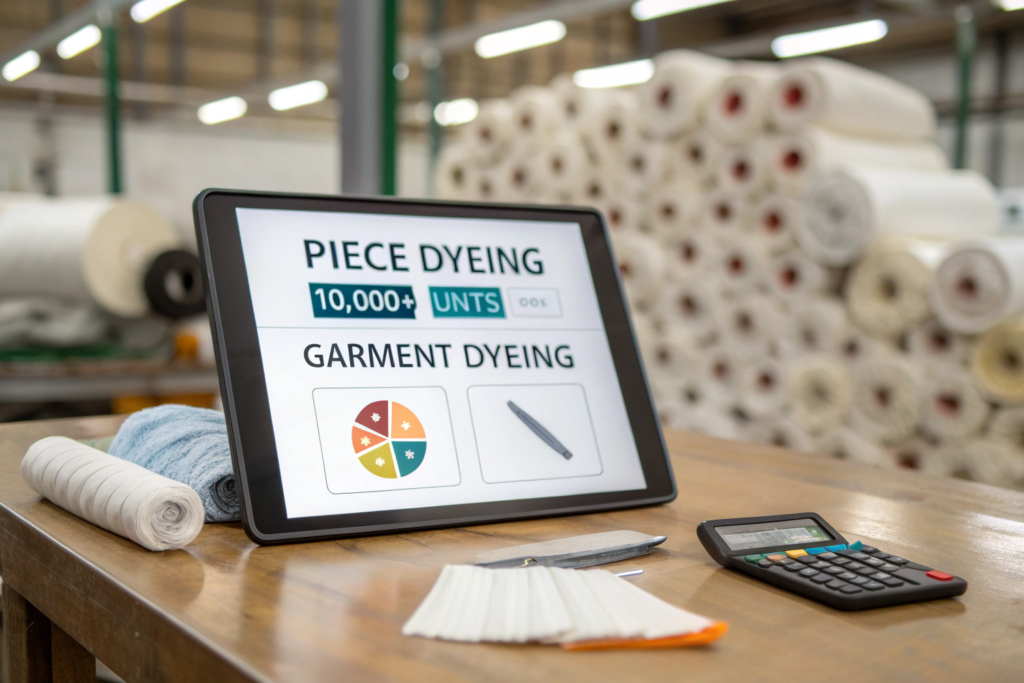
Let’s look at a real-world cost simulation for a basic 180 GSM cotton jersey t-shirt, order quantity 5,000 pieces. I’m using our Shanghai Fumao 2025 Q2 processing rates.
In garment dyeing, you first cut and sew a PFD tee. The sewing cost is slightly higher because PFD fabric has no softener and can be "boardy," causing needle breaks. The dyeing cost is calculated per garment. A rotary garment dyeing machine might hold 300 tees per batch. For 5,000 tees, that’s roughly 17 batches. Each batch needs water, salt, reactive dye, and a 2-hour cycle time. The labor is intense: someone has to load and unload 300 wet garments from a 100-degree drum.
In piece dyeing, we take the 1,200 kilograms of jersey fabric (that’s roughly the weight for 5,000 tees) and dye it in two large jet machines. The dye and chemical cost is actually slightly higher per kilogram because we need anti-crease lubricants and leveling agents to keep the fabric flat in the jet. But the labor cost collapses. Two operators can handle the entire 1,200-kilogram lot in a single morning. The water consumption is also lower—modern jet machines have a liquor ratio of 1:5, while garment dyeing machines often run at 1:8 or higher. The total dyeing cost for piece dyeing comes out about 22% lower, even before we account for the defect rate. It’s simply an economy of scale. You’re moving a single solid block of fabric through chemistry, not 5,000 individual fragile items.
- Compare the water and energy consumption of different dyeing machines on the Sustainable Apparel Coalition’s Higg Index resource page.
- Learn about the cost implications of low liquor ratio jet dyeing from a technical white paper on the Thies textile machinery innovations portal.
How Do Defect Rates in Piece Dyeing Affect Total Procurement Cost?
Here’s the statistic that I’ve staked my reputation on. Garment dyeing typically carries a 5 to 8% "second quality" rate. Piece dyeing, in a controlled CNAS-certified environment, carries a 0.5 to 1.5% defect rate. Those percentages represent actual money—fabric that you paid for, cut, sewed, and dyed, that now cannot be sold at full price.
Why is garment dyeing so much riskier? Think about zippers. A metal zipper in an acidic dye bath can corrode. A nylon coil zipper tape can shrink differently than the cotton garment body, causing a wavy front placket. Pocket linings can twist. Drawstrings can tangle into an impossible knot inside the drum. All of these become "major defects" by AQL 2.5 inspection standards.
With piece dyeing, we inspect the fabric twice. First, on our automated inspection table, where a camera-based system scans every meter for dye spots, holes, and shade variation. Any defect is flagged with a sticker on the selvedge. The cutting room simply avoids that sticker. The defect never becomes a garment. By the time the fabric reaches the sewing floor, it’s 99.5% clean. For our clients running lean e-commerce margins, this translates directly to sellable inventory. If you order 10,000 yards of piece-dyed fabric, you get 9,950 yards of usable material. If you order 10,000 garment-dyed hoodies, you might only have 9,200 that pass a retail audit. That 800-unit gap is your net profit vanishing into a rag bin.
- Understand the AQL 2.5 standard and common textile defect classifications on the AsiaInspection quality control knowledge center.
- See how automated fabric inspection systems reduce second-quality outputs via the Uster Technologies quality monitoring platform.
Conclusion
So, where does this leave you? Piece dyeing is your industrial backbone. It’s the method you choose when you need 10,000 identical navy uniforms, a 3-week turnaround, and a defect rate below 1%. It’s the champion of dimensional stability, pressing the fabric flat with heat to kill the torque that twists your shirts into spirals. Garment dyeing is your artistic finishing tool. It’s the secret behind that impossibly soft hand feel and the "cool vintage" fade on a streetwear hoodie. It gives you the power to delay your color commitment until the last minute, letting you chase a sudden TikTok trend without drowning in unsold pink inventory.
The real mistake is treating this as a binary, religious war. It’s not. The smartest brands in our portfolio—the ones scaling profitably—mix both methods depending on the SKU. They piece dye their core wrinkle-free dress shirts and garment dye their seasonal premium loungewear. They understand the physics of heat-setting and the economics of defect rates. They use Shanghai Fumao not just as a supplier, but as a technical partner to decide which lane to swim in for each product.
You don’t have to figure out these trade-offs alone over a spreadsheet at midnight. We have 20 years of "scars and stars"—trial batches that failed so yours don’t have to. If you’re sitting on a tech pack right now wondering whether that fatigue green cargo pant should be piece dyed for a crisp military look or garment washed for a rugged workwear vibe, send that tech pack over. Let our Business Director Elaine run a dyeing feasibility analysis for you. She’ll give you a side-by-side cost breakdown and a realistic timeline. Reach her at elaine@fumaoclothing.com. Let’s build a bulk production plan that protects your margin and your brand’s reputation.