
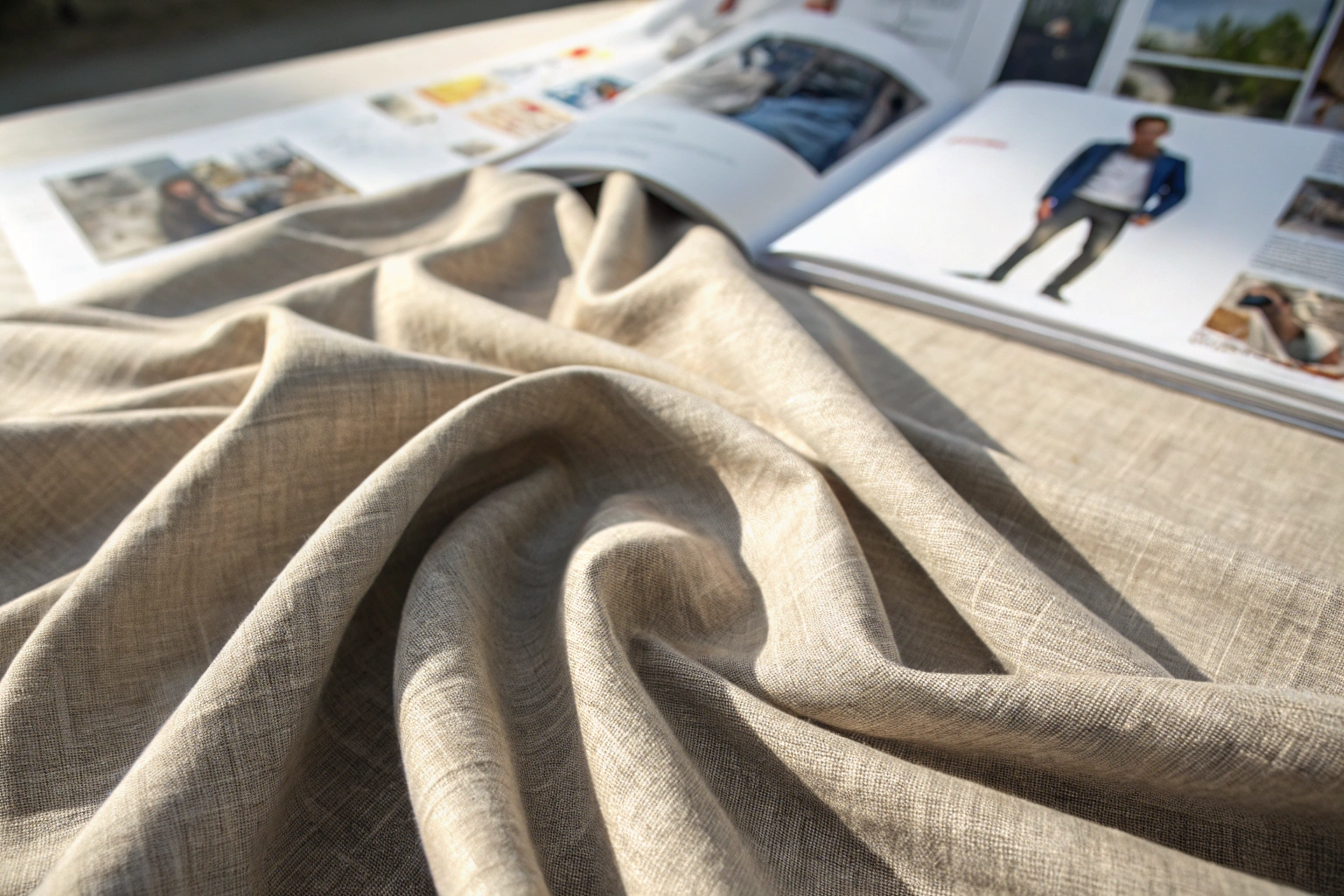
You are sourcing fabric for a Spring-Summer 2027 menswear collection. Every reference image your designer sends shows the same thing: shirts with visible grain, trousers with a dry, irregular surface, blazers that look like they were woven on a handloom. The fabrics are not flat. They are not smooth. They have slubs—those random thick-and-thin irregularities in the yarn that create a texture like handmade paper. Your current supplier’s stock program is all smooth poplins and twills. They tell you slub is a "novelty yarn" with a price premium and a quality risk. Your designer tells you slub is non-negotiable.
Slub texture is dominating menswear in 2026 because it satisfies three converging consumer demands simultaneously: a craving for authenticity and craft signaling in a market saturated with technical perfection, a desire for fabrics that look better with age and wear rather than worse, and a textile supply chain that has finally made high-quality slub yarns accessible at mid-tier price points. At Shanghai Fumao, slub fabric orders have grown year-over-year across every menswear category—shirting, suiting, trousers, and even lightweight outerwear. I am going to explain what a slub actually is at the yarn level, why it looks so good on the male form, the quality control checks that separate controlled slub from defective yarn, and how to specify a slub fabric that delivers the aesthetic without the durability risk.
What Is a Slub Yarn and How Is It Intentionally Made?
A slub is not a defect. It is a deliberately engineered irregularity in the yarn diameter. In standard yarn spinning, the drafting system attenuates the fiber strand to a uniform thickness, and any irregularity is a quality fault that is removed. In slub yarn spinning, the drafting system is programmed to vary the speed of the rollers at random or pseudo-random intervals, creating sections where the fiber strand is thicker and less twisted, interspersed with sections of normal thickness and normal twist. The thick sections are the slubs. The thin sections between them are the ground yarn. The result is a yarn with a controlled, repeatable irregularity that creates surface texture in the finished fabric.

How Does a "Slub Attachment" on a Spinning Frame Control Irregularity?
A slub attachment is a programmable device that controls the speed of the drafting rollers on a ring-spinning frame. The standard drafting system runs at a constant speed ratio between the back, middle, and front rollers, producing a uniform yarn. The slub attachment briefly slows the front roller or speeds the back roller, delivering more fiber mass into a short section of the yarn. The attachment is programmed with three parameters: the slub length, in millimeters or centimeters, which determines how long the thick section is; the slub thickness, as a multiplier of the base yarn diameter, typically 1.5 to 3 times the base thickness; and the slub spacing, or the distance between successive slubs, which can be random or follow a pattern.
A well-programmed slub attachment produces slubs that are intentional but natural-looking. The human eye is extremely sensitive to pattern recognition. If the slubs are spaced at exactly regular intervals, the fabric looks like a machine-made imitation of handmade. If the slubs are spaced with a controlled randomness—a minimum spacing, a maximum spacing, and a random distribution between them—the fabric looks authentically irregular, like hand-spun yarn. At Shanghai Fumao, I work with spinning mills that have the latest-generation slub attachments capable of true random spacing, and I specify the slub parameters based on the fabric’s end-use.
What Is the Difference Between a "Slub" and a "Nep" in Fabric?
A slub is an intentional thick place in the yarn. It is structural—the fiber mass is actually greater in that section. A nep is a small tangled knot of immature or short fibers. It is a defect, not a design feature. Slubs run along the yarn length and are integrated into the twist. Neps are discrete balls of tangled fiber that sit on the yarn surface or are trapped within the yarn.
Under a pick glass, the difference is obvious. A slub is a smooth, tapered thickening of the yarn. A nep is a rough, irregular knot. A fabric with controlled slubs looks textured and intentional. A fabric with excessive neps looks fuzzy, dirty, and poorly processed. The menswear consumer can distinguish them too. A slubby linen shirt reads as "crafted." A neppy cheap cotton shirt reads as "low quality." The difference is in the spinning control.
Why Does Slub Texture Appeal to the 2026 Menswear Consumer?
The menswear market has spent a decade in a technical performance cycle—stretch this, waterproof that, wrinkle-free everything. The consumer has technical fatigue. Every shirt feels like it came out of a lab. Every trouser looks like it was extruded by a machine. Slub texture is the aesthetic antidote to technical perfection. It signals that a human hand was involved in the making of the fabric, even if that hand was programming a slub attachment on a computerized spinning frame. The consumer is buying the story of craft, not necessarily the reality of it.

How Does Slub Signal "Authenticity" in a Mass-Produced Market?
Authenticity is a perception, not a fact. A slubby cotton-linen shirt from a mid-tier brand is produced in a factory with the same level of automation as a smooth poplin shirt. But the visual irregularity of the slubs creates a perceptual link to handloom weaving, artisanal production, and pre-industrial textile traditions. The consumer sees the texture and thinks "handmade," "small batch," "craft."
This perception is reinforced by the luxury menswear market, where Italian and Japanese mills have been producing high-end slub fabrics for decades. Brands like Loro Piana and Brunello Cucinelli have trained the consumer to associate slub texture with expensive, artisanal quality. The trickle-down is now reaching mid-tier and contemporary menswear, where slub fabrics are being produced at lower price points using the same spinning technology but less expensive base fibers. The consumer buys the aesthetic and the story, even if the price is accessible.
Why Does Slub Look "Better with Age" Than Smooth Fabric?
Smooth, uniform fabrics show every sign of wear immediately. A flat poplin shirt develops a shine at the collar and cuffs. A smooth worsted trouser bags at the knee and shows a defined wear line. The fabric looks worse with age. A slub fabric ages in reverse. The initial texture already looks slightly worn, slightly relaxed, slightly imperfect. The wrinkles, the slight color variation along the slubs, and the irregular surface all camouflage the signs of wear that would be conspicuous on a smooth fabric. A slubby blazer that is three years old looks like it has developed character. A smooth blazer that is three years old looks like it needs to be retired. This is the "vintage curve" that slub fabrics ride, and it is highly attractive to a menswear consumer who wants to invest in garments that last.
What Are the Quality Risks of Slub Yarn in Bulk Production?
Slub yarn is inherently weaker than uniform yarn because the thick sections have less twist than the thin sections. Twist is what binds the fibers together and gives yarn its strength. In a slub yarn, the drafting variation that creates the thick section also reduces the twist insertion in that section. The slub is softer, bulkier, and mechanically weaker than the ground yarn. This weakness creates specific quality risks that must be managed during spinning, weaving or knitting, and finishing.

Why Does Slub Yarn Have Lower Tensile Strength at the Thick Points?
Twist binds fibers together through transverse pressure. The more twist, the tighter the fibers are compressed, and the more friction resists fiber slippage when the yarn is under tension. In a slub yarn, the thick section has less twist per unit length than the thin section because the twisting mechanism applies a constant number of twists per unit of yarn delivered, and the thick section is delivered faster. The result is that the thick section has fewer twists per inch.
When the fabric is stretched, the weak points at the thick slubs are the first to fail. In weaving, this manifests as warp yarn breakage on the loom, reducing weaving efficiency. In a finished garment, this manifests as premature wear at stress points—elbows, knees, seat seams—where the slubby yarns fail earlier than uniform yarns would. I mitigate this risk by specifying a minimum twist level in the ground yarn sections and limiting the maximum slub thickness to 2.5 times the base yarn diameter for apparel applications. Beyond 2.5 times, the strength loss becomes unacceptable for all but the most delicate, decorative fabrics.
How Does Uneven Dye Uptake Create "Shading" Along the Slub?
The thick sections of a slub yarn have a different fiber density than the thin sections. When the fabric is dyed, the dye liquor penetrates the thick sections differently. The surface of the thick slub may dye normally, but the interior may receive less dye because the fiber packing is looser and the dye molecules have a longer path to travel to reach the center. The result is a subtle color variation along the slub—lighter at the thickest point, darker at the transition zones. This is called "slub shading" or "slub halo."
Slub shading is, for many designers, a desirable aesthetic effect. It enhances the handcrafted, vintage look. But it must be consistent across the fabric and between dye lots. If the shading is too pronounced, or if it varies between the left and right sides of the fabric, the garment pieces will not match at the seams. I test slub fabrics for dye consistency across the full width and between dye lots, and I provide a shade band reference to the buyer so they can approve the acceptable range of slub shading.
How to Specify a Slub Fabric That Balances Aesthetics and Durability?
Specifying a slub fabric is not like specifying a standard poplin. You are specifying not just the fiber, the count, and the construction, but the character of the irregularity itself. The slub parameters—thickness, length, spacing, and twist—determine the visual texture, the hand feel, and the durability. A specification that omits these parameters leaves the mill to guess, and the mill’s guess may produce a fabric that is too wild or too tame for your design.

What Are the Key Slub Parameters: Thickness, Length, and Spacing?
The three parameters that define a slub yarn are thickness, length, and spacing. Thickness is the ratio of the slub diameter to the base yarn diameter. A 1.5x slub is subtle—visible on close inspection but not dominant. A 2.5x slub is pronounced—a major design feature. For shirting, 1.5x to 2.0x is typical. For suiting and trousers, 1.8x to 2.5x creates a stronger texture. For lightweight outerwear, 2.0x to 3.0x can work if the base yarn is strong enough.
Length is the distance along the yarn that the slub extends, typically 20 to 80 millimeters. Short slubs—20 to 40mm—create a speckled, granular texture. Long slubs—50 to 80mm—create a streaky, linear texture. The combination of slub length and thickness determines the visual character. A 2.5x slub at 80mm length is a dominant, bold texture. A 1.5x slub at 25mm length is a subtle background texture.
Spacing is the distance between slubs, which can be random within a range. Tight spacing—50 to 150mm average—creates a densely textured fabric. Wide spacing—300 to 600mm average—creates an occasional slub fabric where the slubs are isolated highlights. For most menswear applications, I recommend a random spacing with a 150 to 350mm average, which produces a natural, non-repeating texture.
How to Approve a Slub Strike-Off Before Bulk Production?
A slub strike-off is a sample length of the fabric, typically 5 to 10 meters, produced on the actual bulk loom or knitting machine with the intended slub yarn. The strike-off is not just a color approval. It is a texture approval. You must evaluate the slub character—the thickness, the frequency, the randomness—and compare it against your design reference.
Lay the strike-off flat on a large table. Walk around it. Look at it from a distance of two meters—the distance a passerby sees the garment. Look at it from thirty centimeters—the distance the wearer sees the cuff. The slub texture should be visible and interesting from both distances, not overwhelming up close and invisible from afar. Mark any areas where the slubs cluster too densely or are absent. A good slub strike-off has consistent slub distribution across the full width and length. If the distribution is patchy, the spinning attachment was not programmed correctly, and the bulk will have the same problem. Reject it.
Conclusion
Slub texture is dominating menswear in 2026 because it offers the visual signal of craft and authenticity in a market that has grown tired of technical perfection. The irregular thick-and-thin yarn creates a fabric that looks handmade, ages gracefully, and stands out against the flat uniformity of standard poplins and twills. The slub is created by a programmable attachment on the spinning frame that varies the drafting speed, producing controlled thick sections at random intervals. Quality risks include reduced yarn strength at the thick points and uneven dye uptake that creates slub shading—both manageable with proper specification and quality control. Specifying a slub fabric means defining the slub thickness, length, spacing, and acceptable shading range, and approving a strike-off that captures the intended character.
At Shanghai Fumao, I develop slub fabrics across the menswear spectrum—linen-cotton slub shirting, wool-Tencel slub suiting, and cotton slub jersey for polo and tee-shirt applications. If you are planning a menswear collection that needs slub texture, please contact our Business Director, Elaine. She can send you a slub swatch pack with different parameter combinations so you can specify the exact character you want. Email her at elaine@fumaoclothing.com. Let us put some texture into your next line.








