You designed the perfect summer blazer. The sample in the workroom looked incredible—textured, breathable, with that effortless, slightly rumpled elegance that linen is famous for. The bulk production arrived, you steamed a piece, hung it on a rack, and went to lunch. When you came back, the blazer looked like you had slept in it for a week. Deep, jagged creases ran across the back and sleeves. The fabric did not whisper "relaxed luxury." It screamed "cheap and neglected." You are not sure what went wrong. The supplier’s spec said "linen blend." The price was good. The hand feel at the sample stage was acceptable. But the wrinkle behavior is a customer service disaster waiting to happen.
Cheap linen blends wrinkle excessively because the linen component uses short, low-quality flax fibers, and the blend partner is often chosen for cost rather than compatibility. Linen naturally wrinkles—that is part of its character and its charm. But quality linen wrinkles in soft, even waves that relax with body heat and look intentional. Cheap linen wrinkles in sharp, random creases that look messy, feel rough, and refuse to relax even with steaming. At Shanghai Fumao, I have developed linen blends for brands across the price spectrum, and I know exactly where the cost-cutting happens and how it ruins the wrinkle behavior. I am going to teach you how to spot short-fiber linen with a simple twist test, how to identify blend partners that make wrinkling worse, and how to write a linen specification that guarantees the relaxed, luxurious wrinkle profile your customer expects.
Why Does Short-Staple Linen Wrinkle More Aggressively Than Long-Staple?
Linen is extracted from the stalks of the flax plant. The valuable part is the long bast fiber that runs the length of the stalk. But flax stalks are not infinite. When flax is processed, the long fibers are combed out for high-quality linen yarn. The short fibers—the tow, the tangled bits, and the broken ends—are left behind. These short fibers are not waste in the garbage sense. They are sold cheaply to spinning mills that produce low-cost linen yarn. The problem is that short flax fibers do not behave like long flax fibers. They do not bend gracefully. They snap, kink, and resist recovery. A fabric made from short-staple linen is fundamentally prone to sharp, aggressive wrinkling because the fibers themselves are stiff, brittle, and poorly aligned.

How Does "Fiber Length" Determine the Wrinkle Recovery of Linen?
Linen wrinkles when the fibers are bent beyond their elastic limit. A long, high-quality flax fiber—typically 50 to 80 centimeters in the raw state, cut to 15 to 25 centimeters for spinning—is naturally stiff but has a degree of flexibility along its length. When the fabric is crumpled, the long fiber bends in a gentle arc, distributing the stress along its entire span. When the pressure is released, the fiber springs back toward its original shape. The crease is broad, soft, and temporary.
A short flax fiber—5 to 10 centimeters or less—cannot bend in a gentle arc. It is too short to form a smooth curve. When the fabric is crumpled, the short fiber kinks at a sharp angle, concentrating all the stress at a single point. The fiber’s internal structure fractures at that point, creating a permanent micro-crease. Multiply this by thousands of short fibers across the fabric surface, and the result is a field of sharp, chaotic, permanent wrinkles. The fiber length is the physical root cause. If you want to understand the full quality spectrum, looking into how staple length affects linen fabric performance will give you a deeper technical foundation.
What Does the "Twist Test" Reveal About Linen Fiber Quality?
The twist test is a simple, destructive field test that reveals the fiber length distribution in a linen yarn. Pull a single yarn from the fabric. Hold it between your thumbs and forefingers, about two inches apart. Twist it firmly in one direction until it breaks.
A yarn made from long-staple linen will resist twisting for several revolutions before it snaps. The break will be clean, and the broken ends will show long, individual fibers protruding. A yarn made from short-staple linen will break almost immediately, with very little twist resistance. The broken ends will be blunt and fuzzy, with no long fibers visible. The short fibers cannot grip each other effectively, so the yarn has minimal twist strength. This test takes ten seconds per yarn and requires zero equipment. I use it when I visit a new linen supplier. I pull a yarn from their sample fabric, twist it, and watch how it breaks. The twist behavior tells me the fiber length before I ever send a sample to the lab.
Which Blend Partners Actually Make Linen Wrinkle Worse?
Blending linen with another fiber is supposed to improve the wrinkle behavior. A well-chosen blend partner adds elasticity, softness, and recovery. But some blend partners actually make the wrinkling worse. They introduce a fiber that is itself prone to creasing, or that creates internal friction points that lock the linen fibers into their bent position. The result is a fabric that wrinkles more, not less, than 100% linen. The worst offenders are low-quality viscose and regular polyester.

Why Does Adding Viscose to Linen Often Create "Sharp" Creases?
Viscose rayon is a regenerated cellulose fiber. It is soft, absorbent, and drapes beautifully. On paper, adding viscose to linen should improve softness and drape while reducing the stiffness that causes wrinkling. But low-quality viscose has very low wet strength and very low elastic recovery. When a linen-viscose blend is crumpled, the viscose fibers absorb moisture from the air and lose what little strength they had. They collapse into the bent position and stay there. The linen fibers try to spring back, but they are held in place by the collapsed viscose fibers that are now acting like tiny anchors.
The creases that form in a linen-viscose blend are characteristically sharp and narrow. They look like knife-edge folds rather than soft rolls. The fabric also becomes progressively more wrinkled in humid conditions because the viscose is absorbing atmospheric moisture and weakening continuously throughout the day. I have seen a 70/30 linen-viscose blazer look pristine at 10 AM and look like crumpled tissue paper by 3 PM on a humid summer day. A high-quality modal or lyocell, which have better wet strength than generic viscose, can actually improve the wrinkle profile. The problem is not the cellulosic category. It is the quality grade.
How Does Regular Polyester "Lock In" Creases That Won’t Steam Out?
Polyester is a thermoplastic. It softens when heated and hardens when cooled. When a linen-polyester blend fabric is crumpled and left in a crumpled state—folded on a shelf, packed in a suitcase, stacked in a warehouse—the polyester fibers are bent. If the fabric is then exposed to heat—a hot shipping container, a warm stockroom, the trunk of a car on a summer day—the polyester fibers soften while in the bent position. When they cool, they re-harden in the bent position. The crease is now physically set into the polyester component, and no amount of steaming or hanging will remove it. The linen component might relax, but the polyester holds the crease like a plastic hinge.
This is why cheap linen-polyester blend trousers develop permanent crease lines at the crotch and behind the knees. The body heat from the wearer, combined with the pressure of sitting, literally heat-sets the polyester into the creased position. I have tested linen-polyester blends in our lab by creasing a fabric, placing it in an oven at 40°C (104°F)—simulating a hot shipping container—and then attempting to steam out the crease. A 100% linen fabric recovers fully. A 70/30 linen-polyester blend shows a permanent ghost crease that lightens but never disappears. If you are producing garments that will be folded, packed, and shipped, avoid linen blends with standard polyester. A small percentage of an elastic polyester like PBT or spandex can help recovery, but rigid polyester is a wrinkle trap.
How to Test Linen Wrinkle Recovery Before You Buy?
You do not need to trust a supplier’s claim that their linen blend is "wrinkle-resistant." You can test it yourself with a simple, repeatable protocol that simulates the real-world wrinkling your garment will experience. The "Crumple Test" is free, takes five minutes, and gives you a direct visual comparison between different linen fabrics. I use this test in my own QC lab at Shanghai Fumao when I am evaluating a new linen yarn or a new blend composition.

What Is the "Crumple Test" and How Does It Simulate a Day of Wear?
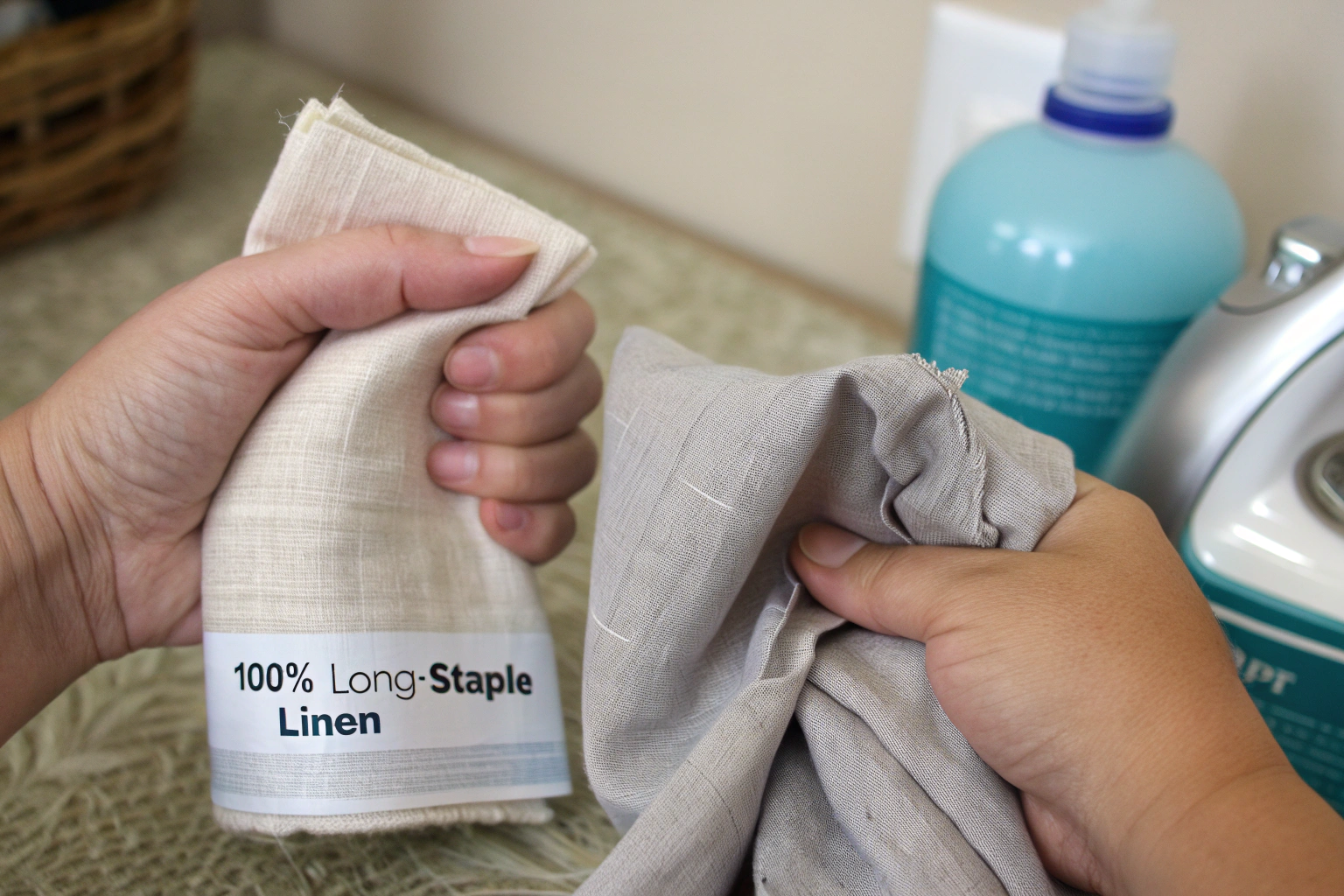
Take a 20cm by 20cm swatch of the fabric. Crumple it tightly in your fist. Squeeze it hard for 30 seconds. This simulates the compression forces the fabric experiences when a wearer sits down, bends an elbow, or leans against a chair back. Release the swatch and lay it flat on a table. Observe the wrinkle pattern.
A high-quality, long-staple linen or a well-designed linen blend will show broad, soft, evenly distributed wrinkles that begin to relax and flatten out within a few minutes of resting. The fabric surface will look textured and lived-in, not messy. A cheap, short-staple linen or a poorly chosen blend will show sharp, narrow, chaotic creases that do not relax. The fabric surface will look crushed and disheveled. Take a photo of both swatches side by side after five minutes of relaxation. The difference is stark and undeniable. I use this test with buyers when they visit our showroom. I hand them two swatches—one premium, one budget—and ask them to crumple both. After five minutes, they never choose the budget option.
How to Use a Spray Bottle to Test "Humidity Wrinkle Recovery"?
Linen wrinkles worse in humidity because the fibers absorb moisture, swell, and lose stiffness. A fabric that looks acceptable in an air-conditioned office might be a disaster on a humid summer afternoon. You can simulate this by lightly misting the crumpled swatch with a spray bottle of water before releasing it.
After the 30-second crumple, give the still-crumpled swatch a single light mist of water. Then release and lay it flat. The moisture accelerates the wrinkling behavior that will occur over hours of wear on a humid day. A premium linen will still show soft, relaxed wrinkles. A cheap linen-viscose blend will show dramatically worse creasing with the moisture than without it, because the viscose component loses its strength when wet. This mist test is the single most revealing diagnostic for linen blend quality. I have rejected linen-viscose supplier samples that looked beautiful in the dry crumple test but failed catastrophically after a single mist of water.
How to Write a Linen Specification That Prevents Wrinkling Disasters?
You cannot fix a cheap linen blend after the fabric is woven. The wrinkle behavior is baked into the fiber quality, the yarn structure, and the blend partner choice. You must specify the quality parameters in the purchase order before production begins. A vague spec for "linen blend" will get you the cheapest short-fiber linen the mill can source, blended with the cheapest compatible fiber available that day. A precise spec will get you the fabric your designer intended.

What Fiber Specifications Guarantee Long-Staple Linen?
Do not write "linen." Write "Long-staple linen, minimum average fiber length 50mm, preferably European flax (French or Belgian origin)." The geographic origin matters because European flax, particularly from the Normandy and Flanders regions, is grown and processed specifically for long-staple textile applications. The retting, scutching, and hackling processes are optimized for fiber length preservation. Chinese flax can be excellent, but the quality range is wider, and you must verify the staple length rather than relying on origin alone.
If you are specifying a linen blend, name the blend partner precisely and require a minimum quality grade. For a linen-Tencel blend, write "Linen/Lyocell (Tencel brand) blend, 80/20 or 70/30." Do not accept "linen/viscose" without a specific brand name. Standard viscose has too wide a quality range. Tencel, a branded lyocell from Lenzing, has guaranteed wet strength and fiber uniformity that improve the wrinkle profile rather than degrading it.
What Finishing Processes Reduce Wrinkling Without Losing the Linen Texture?
A bio-wash, also called an enzyme wash, uses cellulase enzymes to gently etch the surface of the linen fibers. This removes the shortest, most protruding fiber ends that contribute to surface roughness and sharp creasing. The enzyme treatment softens the linen hand feel and reduces the severity of wrinkling without destroying the characteristic linen texture. A silicone softener applied in the final rinse adds a microscopic lubricating film to the fiber surface, reducing friction between fibers and allowing them to slide past each other during bending, which reduces crease sharpness.
I recommend specifying "Bio-wash with silicone softener" for any linen or linen-blend fabric intended for apparel. The combination can improve the AATCC wrinkle recovery rating by half a grade to a full grade. The cost is modest—$0.15 to $0.30 per meter—and the improvement in consumer satisfaction is dramatic. At Shanghai Fumao, I run this finishing combination on every linen apparel fabric unless the buyer specifically requests a raw, unwashed hand.
Conclusion
Cheap linen blends wrinkle excessively because they use short-staple flax fibers that kink instead of bending, blended with fibers like low-quality viscose that collapse when wet or rigid polyester that heat-sets creases permanently. You can identify short-staple linen with a simple twist test—the yarn breaks almost immediately with a blunt, fuzzy end. You can predict wrinkle behavior with a crumple test and a mist test—cheap blends show sharp, chaotic creases that refuse to relax. And you can prevent wrinkling disasters by writing a specification that demands long-staple European flax, a compatible blend partner like Tencel rather than generic viscose, and a bio-wash finish with silicone softener.
At Shanghai Fumao, I source long-staple linen from trusted European and Chinese suppliers, blend it with premium lyocell or organic cotton, and finish it with enzyme wash and softener to achieve the relaxed, luxurious wrinkle profile that premium brands demand. If you are developing a linen garment and want to ensure the wrinkle behavior matches your brand’s quality promise, please contact our Business Director, Elaine. She can send you a linen swatch pack with different staple lengths and blend options, so you can crumple them yourself and see the difference. Email her at elaine@fumaoclothing.com. Let us make sure your linen wrinkles in all the right ways.