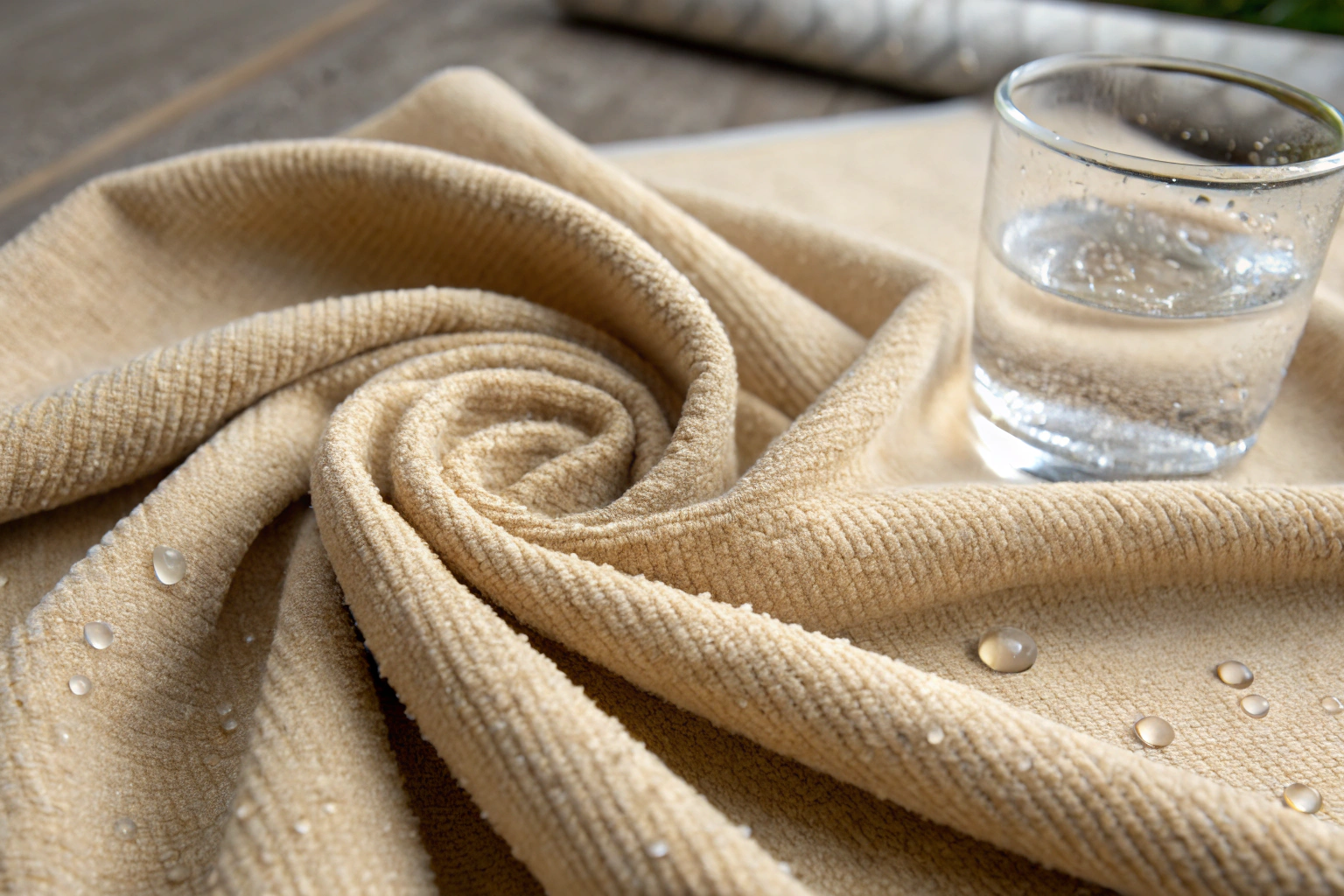
You are sourcing fabric for your new athleisure line. The designer keeps asking for "french terry" for the hoodies and joggers. You nod along, but honestly, you are not entirely sure what makes it "french" or why it costs more than the basic fleece your last supplier offered. Is it just a marketing name for an overpriced sweatshirt fabric? Or is there something structurally different that your customer will actually feel? You order a sample cut from a mill, and when it arrives, you rub the backside with your thumb. The loops are neat and defined. The face is smooth. It feels expensive. But you still cannot articulate why this fabric deserves a premium price tag on your retail hangtag.
French terry is not a marketing term. It is a specific knit construction with a smooth face and a looped back, produced on a circular knitting machine with a particular arrangement of ground yarn and loop yarn. It is called "french" terry because of its historical association with French textile manufacturing in the early 20th century, but the name now refers to the construction method, not the geographic origin. At Shanghai Fumao, I produce french terry in weights from 220 GSM to 450 GSM, in 100% cotton, cotton-poly blends, and recycled fiber compositions, for brands ranging from luxury loungewear to high-performance activewear. I am going to explain the knitting mechanics behind the loop structure, the performance properties that brands love, and how to specify a french terry that hits your exact hand feel, weight, and price targets.
How Is the Signature "Loop Back" Structure Knitted?
French terry is not a weave. It is a weft knit, produced on a circular knitting machine. The magic is in the two-yarn system. A ground yarn forms the smooth face of the fabric, knitting in a standard single jersey stitch. Simultaneously, a second yarn—the loop yarn—is fed into the machine and laid into the structure without being formed into stitches. The loop yarn floats between the knitted stitches on the back side, creating the characteristic unknitted loops. The loop yarn is held in place by being trapped between the ground yarn stitches, but it does not pass through the needle hook itself. This is fundamentally different from fleece, where the back yarn is knitted in and then mechanically broken and brushed to create fuzz.

What Is the Difference Between "Two-Thread" and "Three-Thread" French Terry?
Two-thread french terry uses exactly two yarns: one ground yarn that forms the face stitches, and one loop yarn that forms the back loops. The face yarn determines the appearance and the color of the face side. The loop yarn determines the softness, the absorbency, and the color of the back side. The fabric is relatively lightweight, typically 200 to 280 GSM. Two-thread french terry drapes beautifully and is the standard for premium spring and summer loungewear.
Three-thread french terry adds a third yarn—a binding yarn—that ties the ground yarn and the loop yarn more securely together. The three-yarn structure is heavier, typically 300 to 450 GSM, and the fabric has more body, more structure, and better shape retention. The binding yarn prevents the loop yarn from pulling out or snagging, which is a common failure point in cheap two-thread terry. Three-thread french terry is the standard for premium hoodies and sweatpants that need to hold their shape through dozens of wash cycles. When a streetwear brand asks me for a "heavyweight hoodie fabric," I point them to three-thread french terry at 400 GSM. The weight, the structure, and the loop security are all driven by that third binding yarn.
Why Does the Loop Yarn Not Unravel When You Pull It?
The loop yarn is mechanically trapped, not chemically bonded. On the knitting machine, the ground yarn forms a complete stitch loop that passes through the previous stitch. The loop yarn is laid into the space between the ground yarn stitches, running horizontally across the fabric. When the next course of ground yarn is knitted, the stitches of the new course capture the loop yarn and hold it in place against the back of the fabric.
The security of the trap depends on the stitch density. A tight, high-density french terry has short ground yarn stitches that squeeze the loop yarn firmly. A loose, low-density french terry has longer stitches with more space, and the loop yarn can be pulled out more easily. This is why cheap french terry loses its loops after a few washes—the stitch density was too low, and the loops snagged and pulled out. At Shanghai Fumao, I specify a minimum stitch density for every french terry weight to ensure the loop yarn stays locked in place through the garment’s useful life. I test loop security by rubbing a sample against a velcro strip ten times and counting the pulled loops. More than two pulled loops per square inch is a fail.
What Performance Properties Make French Terry Irreplaceable for Athleisure?
French terry occupies a unique performance niche between basic single jersey and heavy brushed fleece. The smooth face looks polished enough for public wear. The looped back creates an air gap that insulates without overheating. The unknitted loops are free to move, wick moisture, and breathe. This combination of properties is why every athleisure brand, from Lululemon to Fear of God Essentials, builds collections around french terry. The fabric performs during a workout and looks acceptable in a coffee shop afterward.

How Do the Loops Create Insulation Without Overheating?
The loops on the back of french terry create a layer of trapped air between the fabric and the skin. Air is a poor conductor of heat, so the trapped air layer provides insulation—the body’s heat is retained rather than conducted away. This is the same principle that makes double-glazed windows energy-efficient.
But unlike a heavily brushed fleece, where the brushed fibers create a dense, compact insulating layer, the french terry loops are open and separated. Air can circulate between the loops. Heat can escape when the body temperature rises. The fabric insulates when the wearer is at rest and vents when the wearer is active. This thermoregulation is the defining performance characteristic of french terry. A brushed fleece hoodie is for static warmth—sitting on a cold bleacher. A french terry hoodie is for active warmth—walking, stretching, moving. Brands love french terry because it works across a wider range of body temperatures and activity levels, which means the consumer wears it more often.
Why Does French Terry Wick Moisture Better Than Brushed Fleece?
Moisture wicking is the capillary movement of liquid water through the spaces between fibers. For wicking to work, the fibers must be wettable—hydrophilic cotton works well, hydrophobic polyester works if the fiber surface has been chemically modified—and there must be continuous capillary channels for the water to travel through. The loops of french terry create ideal capillary channels. The loop yarn fibers are aligned along the loop length, creating continuous pathways. The open loop structure allows water to spread laterally across the fabric back, increasing the surface area for evaporation.
Brushed fleece interrupts these capillary channels. The brushing process mechanically tears the fibers, creating a chaotic, tangled surface of broken fiber ends. The capillary pathways are disrupted. Water pools in the thickest areas of the brushed nap and evaporates slowly. The fabric feels damp against the skin for longer. This is why french terry is the preferred fabric for premium activewear and performance loungewear. The moisture management is a structural property of the loop construction, not a chemical finish that washes out after twenty cycles.
How to Specify French Terry Weight, Blend, and Finish for Your Brand?
Not all french terry is created equal. The weight determines the drape and the season. The fiber blend determines the hand feel, the moisture performance, and the price. The finishing—whether the fabric is bio-washed, silicone-softened, or left with a natural hand—determines the final tactile experience and the shrinkage performance. Specifying french terry for your brand means choosing the right combination of these three variables for your specific end-use and price point. A generic "french terry" PO will get you whatever the mill has in stock. A proper specification gets you the fabric your designer actually wants.

What GSM Range Fits Summer vs. Winter Loungewear?
The weight is the single most important variable, and it is measured in GSM—grams per square meter. For summer loungewear, I recommend the 200 to 260 GSM range. This weight drapes fluidly, breathes easily, and feels cool against the skin even in warm weather. A 240 GSM two-thread cotton french terry is the fabric of the lightweight summer hoodie—the piece you throw on for a cool evening beach walk.
For winter loungewear, I recommend the 320 to 450 GSM range. This weight has body, structure, and thermal mass. A 400 GSM three-thread cotton-poly french terry holds its shape beautifully, insulates effectively, and feels substantial and expensive. The winter weight is what the consumer expects from a premium sweatpant or a hoodie that retails above $100. The midweight 280 to 320 GSM range is the year-round workhorse. It is heavy enough for a spring jacket and light enough for an air-conditioned summer office. I produce the midweight more than any other category because it spans the widest range of end-uses.
How Does Fiber Blend Change the Hand Feel and Performance?
A 100% cotton french terry has the softest natural hand feel and the best moisture absorption. But it also has the worst shape retention and the highest shrinkage. A 100% cotton hoodie will lose its shape over time, bagging at the elbows and stretching at the hem. A cotton-polyester blend, typically 80/20 or 60/40 cotton-poly, adds dimensional stability and durability. The polyester fibers are stronger and more elastic than cotton, so the fabric recovers better from stretching, resists abrasion, and shrinks less in the wash.
For performance activewear, I often recommend a 55/45 cotton-poly or even a poly-rich 40/60 blend. The higher poly content increases wicking speed, reduces drying time, and adds durability for high-abrasion activities. The trade-off is that the hand feel becomes progressively less natural and more synthetic. For premium loungewear where the tactile experience is the primary selling point, I steer brands toward 100% long-staple cotton or a 90/10 cotton-poly blend with the poly buried in the ground yarn so the loop yarn against the skin remains 100% cotton. The consumer’s skin feels the loop yarn. The face yarn is what they see. You can optimize the blend to put the premium fiber where the consumer perceives it and the performance fiber where the consumer needs it.
How Does French Terry Compare to Fleece, Jersey, and Ponte?
French terry is often confused with brushed fleece, single jersey, and ponte roma because they are all knit fabrics used in casual apparel. But their physical structures, performance properties, and appropriate end-uses are fundamentally different. Understanding the distinctions allows you to choose the right fabric for each garment in your collection and to explain to your customer why a french terry hoodie costs more than a jersey hoodie.

Why Is French Terry "Cleaner" Looking Than Brushed Fleece?
Brushed fleece has a napped, fuzzy back created by mechanically tearing the fibers of the back yarn. The brushing process creates a soft, cozy feel, but it also creates a slightly irregular, "messy" surface. Lint and pilling are inherent to brushed fleece because the torn fiber ends are free to tangle and form pills.
French terry has clean, defined loops that are knitted, not torn. The surface is orderly, uniform, and neat. It looks more polished and more expensive. A french terry hoodie reads as "elevated casual." A brushed fleece hoodie reads as "weekend comfort." The visual difference matters when a brand is positioning a garment as a premium piece rather than a basic commodity. I produce both, and I guide brands toward french terry when the retail price point justifies the higher perceived quality.
How Does French Terry Drape Differently from Jersey and Ponte?
Single jersey is a one-yarn knit with a smooth face and a slightly textured back. It is the thinnest, drapiest, and least structured of the knit family. A jersey hoodie will drape like a heavy tee shirt—clinging, flowing, with no architectural shape. It is suitable for lightweight summer layering pieces but not for structured hoodies or sweatpants.
Ponte roma is a double-knit fabric made on a machine with two sets of needles. It is thick, heavy, and very structured, with almost no drape. Ponte is used for tailored knit blazers, structured dresses, and formal leggings. It does not breathe well and feels rigid compared to french terry.
French terry occupies the middle ground. It has more structure and body than jersey, so a hoodie holds its silhouette. But it has more drape and breathability than ponte, so it moves with the body and does not feel stiff. This balanced hand is what makes french terry the default fabric for premium athleisure. It is structured enough to look intentional and relaxed enough to feel effortless.
Conclusion
French terry is not a fancy name for sweatshirt fabric. It is a specific two-yarn or three-yarn knit construction that creates a smooth face and a looped back, delivering a unique combination of structure, breathability, moisture management, and polished appearance. The loops trap air for insulation without overheating. The unknitted loop structure wicks moisture better than brushed fleece. The clean, defined back surface looks more expensive and stays neater through washing. Brands love it because it performs across a wide range of activity levels and temperature conditions, and because it photographs beautifully on an e-commerce model.
At Shanghai Fumao, I produce french terry in weights from 220 GSM to 450 GSM, in 100% cotton, cotton-poly blends, and recycled fiber compositions, with finishes ranging from natural hand to bio-washed and silicone-softened. If you are developing a loungewear or athleisure collection and want to explore the french terry options that fit your price point and performance requirements, please contact our Business Director, Elaine. She can send you a french terry swatch pack with the full weight range and the most popular blend options, so you can feel the difference in your own hands. Email her at elaine@fumaoclothing.com. Let us build the fabric that your customer will live in.