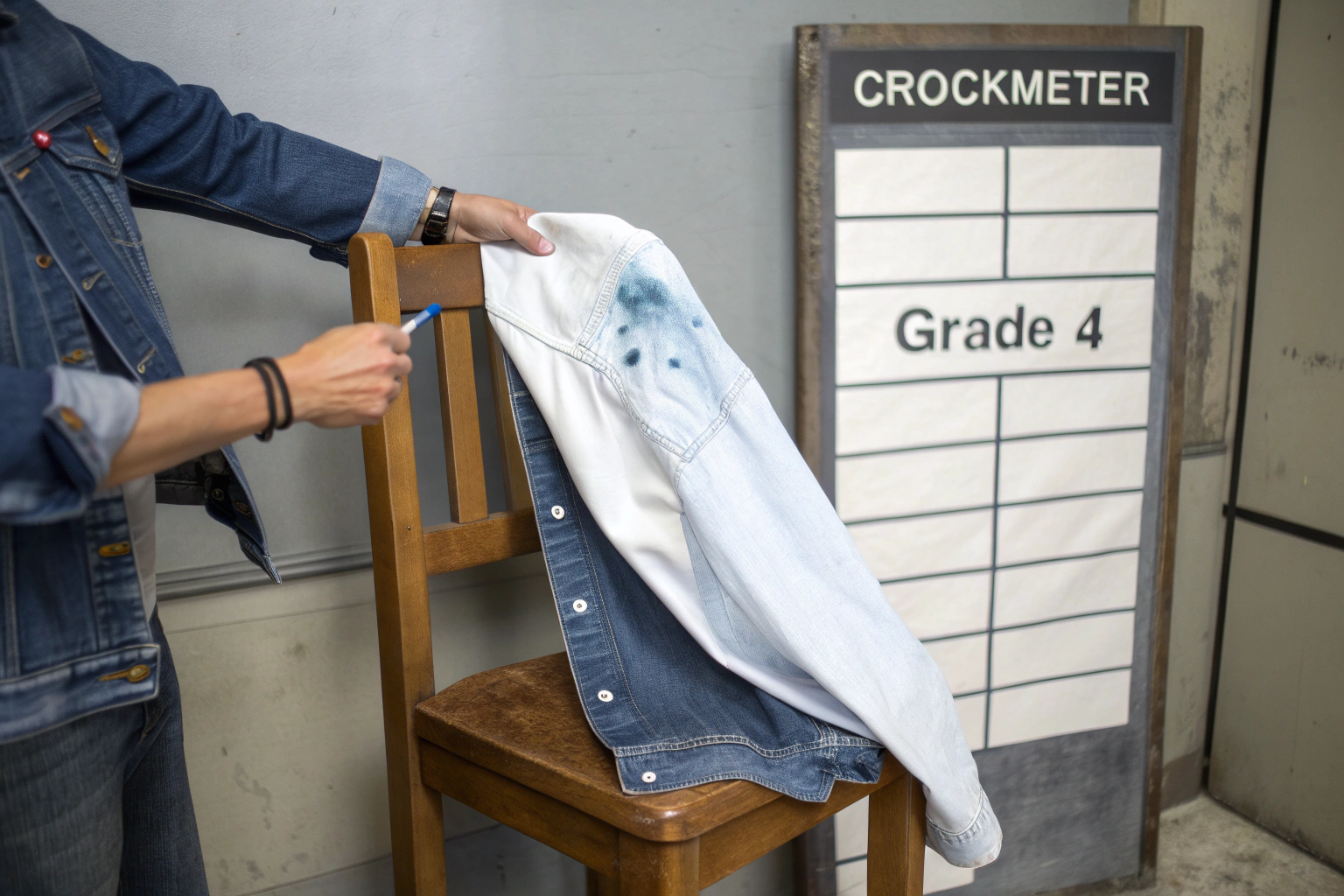
You open the test report from your denim mill. Under "Color Fastness to Crocking," it reads "Dry: Grade 4, Wet: Grade 3." You pause. Grade 4 sounds good—like a B-plus or an A-minus. You ship the bulk, cut the jeans, and sell them to a boutique that places them on a white leather couch for a display photo. The next morning, the couch has a faint blue shadow where the jeans were sitting. The store owner calls, furious. You pull up the test report. Grade 4. It passed. So why did it fail in the real world?
Color fastness Grade 4 is a laboratory rating, not a consumer experience guarantee. It means the fabric transferred a specific, measurable amount of color under controlled test conditions. It does not mean zero color transfer. It means the transfer is limited, and for many garments, that limit is perfectly acceptable. But denim—especially dark, rigid, or unwashed denim—has a unique relationship with color transfer that the standard Grade 4 scale does not fully capture. At Shanghai Fumao, I produce denim for brands ranging from raw selvedge specialists to washed-down fast fashion, and I have learned exactly where Grade 4 is safe, where it is a return-generating liability, and how to upgrade a fabric to Grade 4-5 or 5 when the application demands it. I want to explain the testing method behind the number, the specific risk scenarios for denim, and how to write a fastness spec that matches your actual end-use.
How Is Color Fastness Grade 4 Actually Tested?
Color fastness grading is not an opinion. It is a physical test performed with a Crockmeter—a mechanical device that rubs a standard white cotton cloth against your fabric under a fixed pressure for a fixed number of cycles. The resulting stain on the white cloth is visually compared against the AATCC Grey Scale for Staining, a set of nine pairs of grey and white chips that represent increasing levels of color transfer, from Grade 1 (severe, heavy staining) to Grade 5 (zero visible staining). The human eye judges which grey scale pair most closely matches the contrast between the clean white cloth and the stained area. The test is standardized under AATCC TM8 for crocking, with a dry rub and a wet rub performed separately. The wet rub is always worse because water lubricates the dye molecules and makes transfer easier.

What Does the Grey Scale Actually Measure and What Doesn’t It?
The Grey Scale for Staining measures contrast, not absolute color quantity. It does not care that the stain is blue. It only cares how different the stained white looks from the clean white. A Grade 4 staining means the contrast is just barely perceptible to a trained eye—a faint trace of color that most untrained observers would struggle to see against the white background. A Grade 3 means the stain is clearly visible. A Grade 2 means it is obvious and heavy.
But here is the problem for denim. The Grey Scale measures how much color transferred to a white cloth, which is a laboratory proxy. It does not measure how much color transfers to a leather car seat, a beige suede sofa, or a white cotton t-shirt layered under a denim jacket. Those real-world surfaces have different textures, different fiber compositions, and different affinities for indigo dye. A Grade 4 on the white cotton crocking cloth can still produce a visible blue stain on a textured, absorbent surface like suede or uncoated leather. The lab test is a standardized simulation, not a replica of every real-world contact scenario. I have seen Grade 4 denim stain a white leather handbag strap in humid weather because the moisture and the leather’s porosity amplified the dye transfer beyond what the lab’s dry cotton cloth predicted.
Why Is the Wet Rub Always One Grade Worse Than the Dry Rub?
Water is a lubricant and a solvent. When you wet the rubbing cloth, the water film reduces the mechanical friction between the cloth and the denim surface, which might seem like it would reduce transfer. But the water also penetrates the denim yarns, swells the cotton fibers, and mobilizes loosely bound indigo molecules that were physically trapped on the fiber surface but not chemically bonded. These mobilized molecules dissolve into the water film and transfer to the white cloth.
The wet rub test is therefore a more aggressive simulation of real-world conditions: a customer wearing dark jeans on a humid day, a spill on the fabric, or a gentle wash cycle where wet denim rubs against wet lining fabric. A fabric that scores Grade 4 dry and Grade 3 wet is normal for dark indigo denim. A fabric that scores Grade 4 dry and Grade 4 wet is exceptional and has been heavily washed or treated to remove surface indigo. If your denim application involves any moisture exposure—rainwear, activewear, or garments that will be worn against light-colored fabrics in sweaty conditions—you must evaluate the wet rub grade, not just the dry. The dry grade alone is misleading.
Is Grade 4 Fastness Safe for Your Specific Denim Application?
Grade 4 is safe for some denim products and a customer service disaster for others. The determining factors are the wash level, the contact scenario, and the consumer expectation. A Grade 4 raw denim sold with a "will bleed" warning is perfectly safe because the consumer expects the transfer and treats it as a feature. A Grade 4 washed denim sold as a pair of "no-fade, no-transfer" chinos is a return waiting to happen because the consumer expects color stability and the Grade 4 guarantee does not meet that expectation.

When Does Grade 4 Pass for Raw and Unwashed Denim?
Raw, unwashed, or "dry" denim is saturated with unfixed indigo. The indigo dye sits on the surface of the cotton fibers as a physical layer, not a chemical bond. It is designed to crock, to fade, and to transfer color onto everything it touches for the first several months of wear. A raw denim that scores Grade 4 dry and Grade 3 wet is actually very good for the category. Many raw denims score Grade 2 or Grade 3 dry, and the brands market this as "high crocking, high contrast fading."
The consumer of raw denim is educated. They know not to sit on a white sofa. They know to size for shrinkage and to expect blue transfer onto their white sneakers. The Grade 4 result, in this context, is a sign of a slightly cleaner, more refined raw denim that will still fade beautifully but will transfer less color onto car seats and shirt hems. I produce a 15-ounce raw selvedge denim for a heritage menswear brand that consistently scores Grade 3-4 dry and Grade 2-3 wet. The brand prints this on the hangtag: "This denim bleeds. That’s how it fades." Zero returns for crocking. The consumer expectation is correctly set.
Why Is Grade 4 Not Enough for Washed and "No-Fade" Denim?
Washed denim—whether it is a light enzyme wash, a medium stone wash, or a heavy vintage wash—has gone through a wet processing step designed to remove surface indigo and soften the fabric. The consumer buying a pair of medium-wash jeans expects them to be color-stable. They will throw them in the washing machine with white t-shirts. They will sit on a light grey couch without a second thought. If those jeans transfer color onto the white t-shirts or the couch, the consumer will return them.
For washed denim, the acceptable fastness standard is higher. Dry crocking should be Grade 4-5 or Grade 5—virtually no visible transfer. Wet crocking should be Grade 4 minimum. Achieving this requires thorough washing, effective soaping to remove hydrolyzed indigo, and sometimes a cationic fixing agent applied in the final rinse to lock residual dye onto the fiber. At Shanghai Fumao, I run washed denim through multiple soaping cycles and test the crocking after each cycle until the Grade stabilizes at 4-5 dry and 4 wet. If the grade does not reach this threshold, the wash is not done. I send it back for re-processing. A washed denim that only achieves Grade 4 dry is under-washed, and the customer will find the blue transfer.
How to Upgrade Denim Fastness from Grade 3-4 to Grade 4-5?
A denim that tests at Grade 3-4 dry is not defective. It is unfinished. The indigo on the surface has not been adequately removed or locked down. Upgrading from Grade 3-4 to Grade 4-5 is a process of removing the loose surface dye through mechanical washing and chemical soaping, then applying a fixing agent to bind any remaining accessible dye. The upgrade is achievable on standard denim production equipment, but it takes time, water, and chemistry that a low-cost mill might skip.

What Is a "Cationic Fixing Agent" and How Does It Lock Indigo?
Indigo is an anionic dye—it carries a negative charge in solution. A cationic fixing agent is a positively charged polymer that is applied in the final rinse bath. The positive charges on the fixing agent attract the negative charges on the indigo molecules, forming an insoluble complex that physically locks the dye onto the fiber surface. The dye is not chemically bonded—indigo never truly bonds to cotton—but it is mechanically trapped inside a polymer film that resists rubbing.
The fixing agent can improve crock fastness by half a grade to a full grade, moving a fabric from Grade 3-4 to Grade 4 or 4-5. The downside is a potential slight change in hand feel—the fabric can feel marginally stiffer or less breathable—and a potential slight shift in hue, because the fixing agent can cause a slight reddening or dulling of the indigo shade. I use a non-formaldehyde, silicone-modified cationic fixer for premium denim. It provides the fastness upgrade with minimal hand feel impact. The cost is about $0.05 to $0.10 per meter. For a denim that will be sold as "no-transfer," it is the best money spent in the finishing process.
How Do "Soaping Cycles" Mechanically Remove Loose Indigo?
Soaping is the industrial equivalent of washing your dark jeans five times before you wear them. The denim fabric is run through a series of hot water baths with a detergent specifically formulated to disperse indigo. The mechanical action of the wash wheel, combined with the chemical action of the detergent, lifts loosely bound indigo off the fiber surface and suspends it in the water. The soaping water turns dark blue. The fabric gets lighter and cleaner.
The number of soaping cycles is the critical variable. One cycle removes the most accessible surface indigo. Two cycles remove indigo from deeper within the yarn structure. Three cycles start to attack the core indigo that gives the denim its depth of color, and the shade begins to noticeably lighten. The art is to stop soaping at the exact point where the crocking grade is acceptable and the color depth is still commercially attractive. I run the Crockmeter after each soaping cycle and plot the Grade against the color strength. The curve shows diminishing returns: the first two cycles improve the Grade by a full point, the third cycle adds half a point, the fourth adds nothing. I stop at the economic optimum.
How to Write a Color Fastness Specification for Denim?
A color fastness specification that says "good color fastness" is worthless. You must specify the test method, the specific fastness property, the minimum acceptable grade for both dry and wet conditions, and the exceptions for specialty denim like raw or sulfur-dyed blacks. The specification must be in the purchase order before production begins. A post-production argument about fastness is unwinnable without an agreed standard.

What Is the Exact AATCC TM8 Specification Line You Need in Your PO?
Write this line in your denim purchase order under a section titled "Color Fastness Requirements": "Color Fastness to Crocking per AATCC TM8: Dry crocking minimum Grade 4. Wet crocking minimum Grade 3. For washed denim, wet crocking minimum Grade 4. Grading per AATCC Grey Scale for Staining." If your denim is raw or unwashed, add: "Exception: Raw denim may achieve Dry Grade 3-4 and Wet Grade 2-3, provided consumer warning label is applied."
This specification is specific, measurable, and enforceable. A third-party lab can execute AATCC TM8 and assign a Grade. There is no ambiguity. There is no "but it looked fine to me." The number on the lab report is the binding evidence. I include this specification line in every denim contract at Shanghai Fumao, and I provide the corresponding lab report from our CNAS-accredited lab for every bulk lot.
Why Should You Also Test "Accelerated Laundering Fastness" for Denim?
Crocking measures rub-off onto other surfaces. Accelerated laundering fastness, tested under AATCC 61-2A, measures color loss from the denim itself during washing. A dark wash denim that crocks at Grade 4 but loses 20% of its color depth after five home washes will generate returns for "fading too fast," even if it never stains the customer’s other clothes.
The laundering fastness test subjects the denim to a simulated five home launderings in a single accelerated cycle, using steel balls for abrasion and a standardized detergent. The color change of the denim itself is graded on the AATCC Grey Scale for Color Change, from Grade 1 (severe fading) to Grade 5 (no change). A good dark wash denim should achieve Grade 4 for color change—slight, barely perceptible fading. A raw denim will score Grade 2 or 3 for color change, and that is acceptable because the consumer expects it to fade. If you are developing denim and want a comprehensive view, understanding how to interpret AATCC 61 accelerated laundering test reports for denim is essential. I include laundering fastness in my standard denim test package. The two tests together—crocking and laundering—give the full picture of the denim’s color behavior.
Conclusion
Color fastness Grade 4 is a solid, commercially acceptable rating for the dry crocking of most denim fabrics, but it is not a universal guarantee of zero color transfer. It means the transfer is minimal under laboratory conditions—barely visible to a trained eye. For raw, unwashed denim, Grade 4 dry is excellent, and the consumer expects and accepts some transfer. For washed, "no-fade" denim, Grade 4 dry is the bare minimum, and Grade 4-5 or 5 should be the target, especially if the denim will be worn against light-colored fabrics or upholstery. The wet rub is always the more demanding test, and the Grade drops by one point for most denims. Upgrading fastness is a process of thorough soaping to remove loose surface indigo, followed by a cationic fixing agent to lock down the remainder. And the specification must be written into the purchase order with the exact AATCC TM8 method and minimum grades, so that a failed test is a clear, enforceable quality defect.
At Shanghai Fumao, I produce denim across the full fastness spectrum, from high-crocking raw selvedge to zero-transfer washed blacks. I test every lot for both crocking and laundering fastness, and I provide the full lab report so my buyers know exactly what they are getting before the container ships. If you are developing a denim product and need help setting the right fastness specification for your wash level and target consumer, please contact our Business Director, Elaine. She can send you our denim fastness test package sample and a swatch card showing the visual difference between Grade 3, Grade 4, and Grade 5 crocking results. Email her at elaine@fumaoclothing.com. Let us make sure your denim crocks the right amount—no more, no less.