
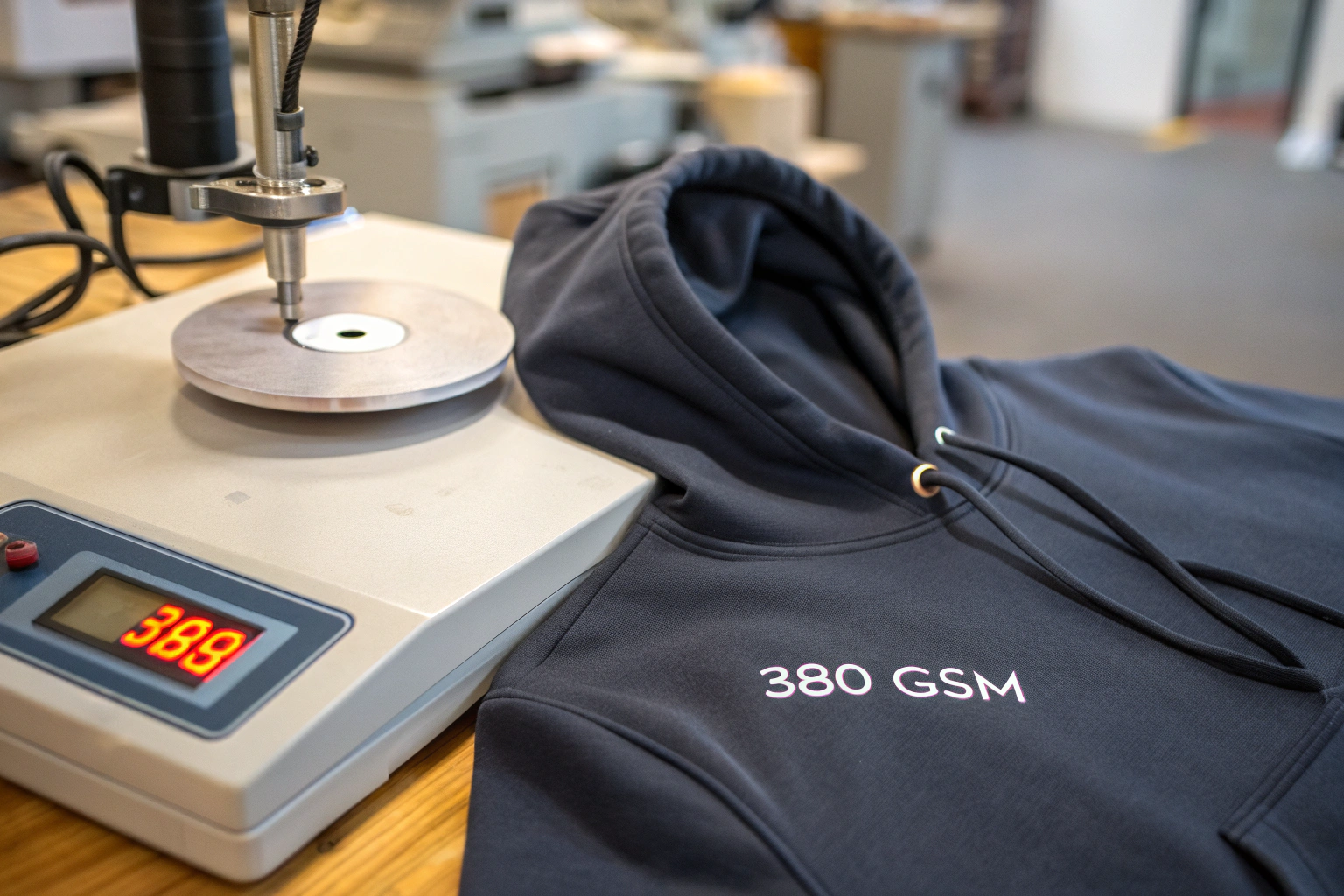
You found the perfect hoodie sample. The fit is impeccable, the drape is exactly what you wanted, and the color is a rich, dusty oatmeal that photographs beautifully. You send the sample to your supplier and say, "Match this." Two months later, the bulk production arrives. You open the first carton, pull out a hoodie, and your heart stops. It is thin. It is flimsy. It hangs on the body like a limp dishrag. The shape is the same, the color is close, but the soul of the hoodie—its weight, its warmth, its structure—is gone. Your supplier used a 240 GSM fleece when your sample was a 380 GSM fleece. You did not specify the GSM in your purchase order because you did not know what GSM was. Now you have 500 unsellable hoodies.
GSM stands for Grams per Square Meter. It is the single most important number in a knit fabric specification, and it is the number that separates a premium, structured hoodie that retails for $120 from a cheap, fast-fashion hoodie that bags out at the elbows after three wears. GSM quantifies fabric weight in a way that "heavy" and "light" cannot. At Shanghai Fumao, we test the GSM of every single roll of fleece before it leaves our facility, because a 20-GSM deviation can change the entire garment silhouette. I want to show you what GSM actually measures, how to choose the right GSM for your specific hoodie application, and how to enforce a GSM tolerance in your contract so you never receive a lightweight ghost of your sample again.
How Is GSM Actually Measured and Calculated in a Textile Lab?
GSM is not an opinion. It is not a hand-feel assessment. It is a physical measurement using a calibrated circular cutter and a precision digital scale. The test is standardized under ASTM D3776 for woven fabrics and ASTM D3887 for knits. The principle is brutally simple: you cut a known area of fabric, you weigh it on a scale accurate to 0.01 grams, and you multiply the weight by a factor that converts the sample area into one square meter. There is no guesswork. The number on the scale is the GSM. If your supplier cannot show you a photo of this test being performed on your bulk lot, they are probably not measuring it at all.

What is the Difference Between a "GSM Cutter" and a "Hand Cut" Measurement?
A proper GSM cutter is a pneumatic or manual press that drives a circular blade through the fabric. The blade cuts a precise disc with an area of exactly 100 square centimeters. That is one one-hundredth of a square meter. The scale reads the weight of that disc in grams, and you multiply by 100 to get the GSM. The precision comes from the cutter. The area is fixed and repeatable.
A hand-cut measurement using scissors and a ruler is nearly worthless for specification enforcement. A slight wobble of the scissors, a one-millimeter error in the ruler marking, and your "100 square centimeter" sample is actually 95 or 105 square centimeters. A 5% error in area translates to a 5% error in GSM. On a 300 GSM target, that is a 15 GSM deviation created by your measuring tool, not by the fabric. If you are verifying a supplier’s GSM claim at home, buy a proper GSM cutter. It costs about $30 and eliminates the measurement error. I have watched buyers reject perfectly good fabric because their hand-cut "GSM test" showed a deviation that did not actually exist in the fabric.
Why Must You Test GSM from Multiple Points Across the Fabric Width?
Fabric is not perfectly uniform. The left selvedge, the center, and the right selvedge of a roll can have different weights due to tension variations during knitting and finishing. A mill that only tests the center of the roll might report a perfect 300 GSM, while the edges are 280 GSM and 315 GSM. Your hoodie panels cut from the center will feel right, and the panels cut from the edges will feel wrong.
The standard protocol, which I enforce at Shanghai Fumao, is to cut three GSM samples: one from the left edge, one from the exact center, and one from the right edge. The three values are averaged to get the reported GSM, and the range between the highest and lowest is recorded as the "GSM variation." A variation of less than 3% is acceptable for commercial quality. A variation greater than 5% indicates a knitting or finishing problem that will cause inconsistent garment quality. If you are learning how to verify fabric GSM claims from a supplier, always ask for the individual left-center-right values, not just the average. An average can hide a variation problem that will bite you on the cutting table.
What GSM Range Defines a "Lightweight" vs. "Heavyweight" Hoodie?
The hoodie market segments itself by GSM, and the consumer knows the difference even if they cannot name the number. A lightweight hoodie feels like a long-sleeve tee shirt with a hood. A heavyweight hoodie feels like armor against the cold. The GSM number determines not just the warmth, but the drape, the stitch definition, the shrinkage behavior, and the price point the market will accept. Choosing the wrong GSM for your brand positioning is like choosing the wrong genre of music for a film soundtrack. Everything else can be perfect, but the emotional impact will be off.

When Should You Choose a 220-280 GSM French Terry for a Spring Layer?
The 220 to 280 GSM range is the lightweight category. This fabric is usually a french terry with a flat back or a lightly brushed back. It is not designed for warmth. It is designed for drape, breathability, and a soft hand feel that works against the skin in mild weather. A 240 GSM cotton french terry is the fabric of the "spring hoodie"—the piece you throw on for a cool evening walk or an air-conditioned office.
Lightweight hoodies drape close to the body. They do not hold a structured shape. The hood will not stand up on its own; it will flop. The cuffs and hem will stretch out faster because there is less material to provide recovery. This is not a defect. It is the design intent of the weight class. I produce a 260 GSM organic cotton french terry for a sustainable loungewear brand in California. They market it as a "cloudweight hoodie" and sell it for $88. The low GSM is a feature, not a flaw, because the brand position is about effortless drape and summer layering. If they used a 400 GSM fleece, the garment would look completely wrong for their aesthetic.
What Makes a 380-450 GSM Brushed Fleece a Premium Streetwear Staple?
The 380 to 450 GSM range is the heavyweight, premium streetwear category. This fabric is a three-thread fleece with a heavily brushed back. The brushing process mechanically raises the fibers on the inside of the fabric, creating a dense, insulating pile that traps air. The result is a hoodie that feels substantial, warm, and expensive. The weight gives the garment architectural structure. The hood stands up. The body holds a clean silhouette. The cuffs snap back into shape.
This GSM range commands the highest retail price points, typically $100 to $200 for a cut-and-sew hoodie from a recognized streetwear brand. The fabric cost is higher—more cotton per meter—and the knitting and brushing processes are slower. But the consumer perception of quality is directly proportional to the GSM in this segment. A 420 GSM hoodie communicates "luxury" and "durability" before the customer even reads the label. I produce a 400 GSM recycled cotton-polyester brushed fleece for a Canadian streetwear label. They sell out every drop. The GSM is the unspoken hero of their product photography because the weight makes the garment hang perfectly on the model.
Why Does the Wrong GSM Destroy Your Hoodie’s Shape and Durability?
A hoodie that is 50 GSM under specification will look acceptable on day one. It might even feel softer and drapier, which a buyer could mistake for an improvement. The disaster unfolds over the first five to ten wash-and-wear cycles. The fabric lacks the fiber density to resist mechanical stress, and it progressively deforms. The elbows bag out. The hem loses its grip. The hood collapses. The garment looks three years old after three months. Your customer, who paid $120 for what they thought was a premium piece, posts a one-star review with a photo of their sad, misshapen hoodie.

How Does Low GSM Cause "Elbow Bagging" and "Knee Sag"?
Knit fabrics are viscoelastic. They stretch under load and partially recover. The recovery depends on the density of the fiber network. A high-GSM fleece has more fibers per square centimeter. When the wearer bends their elbow, the fibers stretch, but the dense network has enough elastic memory to pull the fabric back to its original shape. A low-GSM fleece has fewer fibers. The same elbow bend stretches the individual fibers beyond their elastic limit, and the network cannot pull back. The fabric remains permanently deformed. This is elbow bagging.
The mechanism is the same for the knee area of sweatpants and the seat area of hoodies that are worn while driving. I have a US workwear brand client who specifies a minimum 360 GSM for their hoodies specifically to prevent elbow bagging in their construction-worker customer base. They learned this lesson the hard way with a 280 GSM batch that generated a wave of returns. The GSM was the variable that changed. Nothing else. Understanding how fabric weight correlates to garment durability over wash cycles is critical knowledge for any brand that offers a warranty or stands behind product quality.
Why Does Underweight Fabric Kill Embroidery and Print Registration?
Embroidery needles and screen-printing screens apply concentrated stress to a small area of fabric. A heavyweight fleece has enough fiber density to absorb the needle penetration without puckering and to hold the printed ink layer without distortion. A lightweight fleece puckers around every embroidery stitch, creating a wrinkled halo around your logo. The screen print pulls the fabric slightly during the squeegee pass, misaligning the design. After one wash, the print on a low-GSM fabric can crack because the fabric underneath is stretching and recovering more than the ink film can tolerate.
I produce a lot of hoodies destined for heavy puff-print and multi-head embroidery. For these applications, I strongly recommend a minimum of 340 GSM. The fabric weight provides a stable platform for the decoration. If you are building a brand that relies on bold graphic placement, do not let your decorator blame the ink or the thread for what is actually a substrate problem. The GSM is the foundation the decoration sits on.
How to Enforce a GSM Tolerance in Your Fabric Purchase Agreement?
A GSM number without a tolerance is a wish, not a specification. Every industrial process has variation. The question is not whether the fabric will deviate from the target GSM; it is how much deviation you are willing to accept and what happens if the deviation exceeds that limit. Your purchase agreement must state the target GSM, the acceptable tolerance range, the test method, and the remedy for a failed test. Without these four elements, you have no legal standing to reject a batch that is 30 GSM underweight.

What Percentage Tolerance Is Realistic for Knit Fleece?
A tolerance of plus or minus 5% is the industry standard for knit fleece fabrics in the 250 to 450 GSM range. A 400 GSM target with a 5% tolerance means the acceptable range is 380 to 420 GSM. A roll that measures 379 GSM is technically rejectable. A roll that measures 381 GSM is acceptable. The line is sharp and mathematical.
A 3% tolerance is achievable by high-quality mills with excellent process control, but it will cost more because the mill must discard or re-process more borderline fabric. A 7% tolerance is too loose for apparel; at that range, a 400 GSM fabric could be 372 GSM, and the customer will feel the difference. I recommend 5% for most commercial applications. At Shanghai Fumao, our internal QC standard is 5%, and our first-pass yield within that tolerance is consistently above 98%. If you want to understand the industry norms, looking into standard GSM tolerances for knit fabric purchase agreements is a good starting point.
What Is the Agreed Remedy if the Bulk Lot Fails the GSM Test?
The remedy ladder must be written into the contract before the order is placed. A fair ladder has three rungs. Rung one: if the bulk GSM is outside the agreed tolerance but within 7% of the target, the buyer accepts the fabric at a pre-agreed discount, typically 5% to 10% off the invoice price. Rung two: if the bulk GSM is between 7% and 10% off target, the supplier must re-process or replace the fabric at their own cost, including all freight. Rung three: if the bulk GSM is more than 10% off target, the buyer may reject the entire lot for a full refund, including all shipping and duty costs incurred.
I sign contracts with this ladder every week. It protects the buyer from a bait-and-switch where the sample was 400 GSM and the bulk is 330 GSM. It also protects the mill from a buyer who tries to reject a lot for a 2% deviation that is within industry tolerance. The third-party inspection report, with GSM measurements taken according to the specified ASTM method, is the binding evidence. No argument. No negotiation. The number on the scale is the judge.
Conclusion
GSM is the hidden architecture of your hoodie. It determines the weight, the warmth, the drape, the durability, and the price point. A 240 GSM french terry is a spring layering piece. A 420 GSM brushed fleece is a streetwear statement. The difference is not subjective. It is measurable with a $30 GSM cutter and a digital scale, and it must be tested across the full width of the fabric roll, not just at the center. When the GSM is wrong, the hoodie bags at the elbows, the hood collapses, the embroidery puckers, and your customer posts a one-star review. When the GSM is right, the hoodie holds its shape for years, the print stays crisp, and the customer buys the next color.
At Shanghai Fumao, GSM is not an afterthought. We test it on every roll, record the left-center-right values, and print the average on the roll label with a QR code that links to the full inspection report. We specify a 5% tolerance in our contracts and honor a three-rung remedy ladder if the bulk fails. If you are developing a hoodie and want to lock in the exact fabric weight that matches your brand positioning, please reach out to our Business Director, Elaine. She can send you our fleece GSM swatch pack with physical samples from 200 to 450 GSM so you can feel the difference in your own hands before you place the order. Email her at elaine@fumaoclothing.com. Let us make sure your hoodie has the weight it deserves.








