
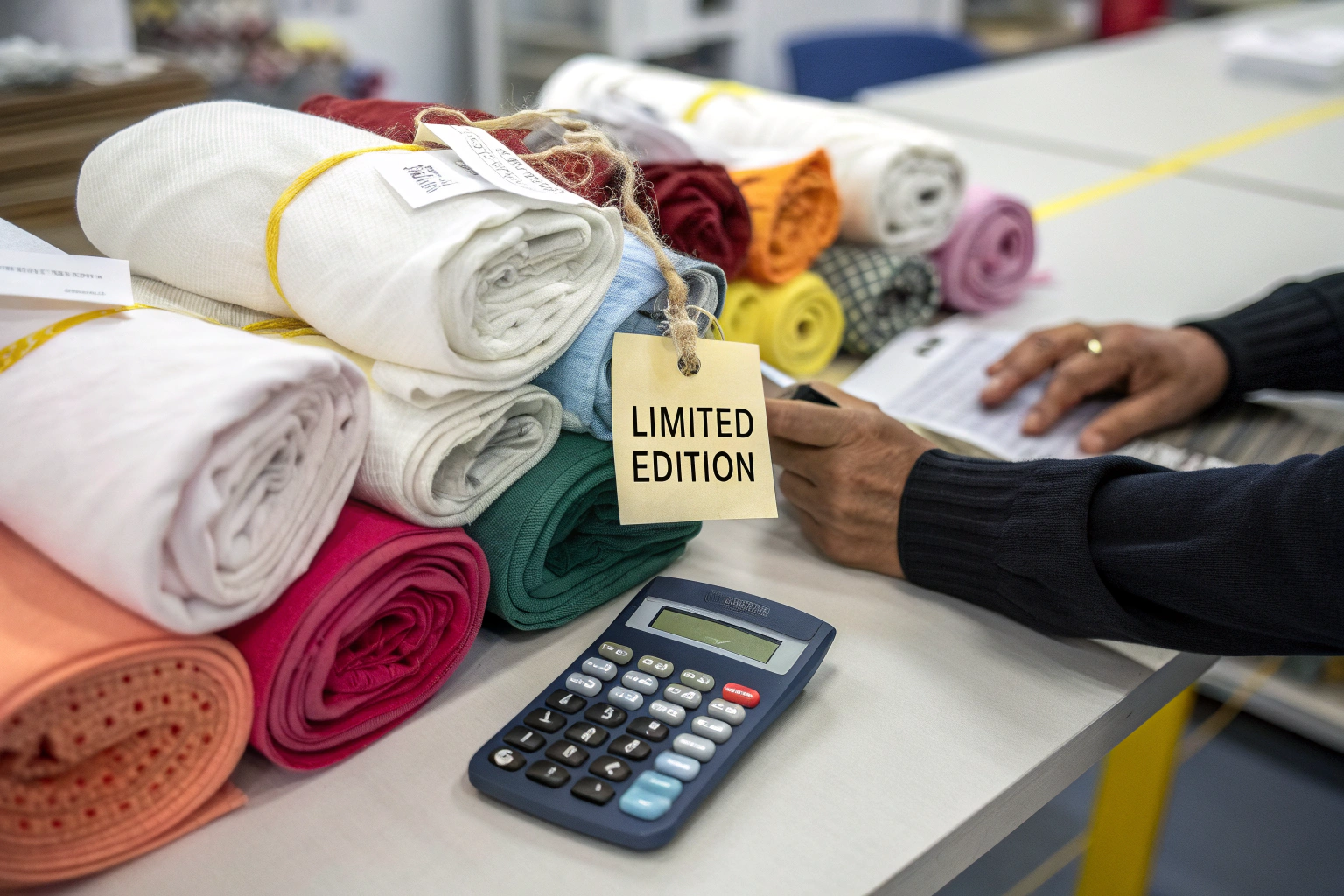
You are scrolling through a deadstock fabric marketplace at midnight. You find it: a breathtaking Italian jacquard remnant, 150 meters exactly, in a deep emerald green that matches your upcoming collection’s mood board perfectly. The price is 60% below wholesale. Your heart races. This is the find that could define your season and save your margin. You click "Add to Cart." And then the doubts flood in. What if the fabric has a hidden defect? What if those 150 meters are all that exist in the world, and you cannot reorder when your bestseller takes off? What if the color fades after three washes because it has been sitting in a warehouse for five years? You are caught between the thrill of a creative bargain and the fear of building your brand on a foundation of other people’s leftovers.
Deadstock fabric is not inherently good or bad. It is a tool, and like any tool, its value depends entirely on your brand strategy and your willingness to verify what you are buying. I run a large-scale weaving and finishing operation at Shanghai Fumao, and I produce the kind of custom fabric that sometimes generates deadstock—the overruns, the canceled orders, the slightly off-shade lots that never shipped. I also occasionally buy deadstock from other mills for my own stock service program. I know exactly where the risks hide, and I know how to inspect a deadstock lot so thoroughly that the risk becomes a calculated bet rather than a blind gamble. I want to walk you through the real math behind that bargain price, the inspection protocol that catches hidden disasters, and the specific business models where deadstock makes strategic sense.
What Are the Hidden Quality Defects in Deadstock Inventory?
Deadstock fabric is not unsold because it was unloved. It is unsold because something went wrong. The original buyer canceled, over-ordered, or rejected the lot. Or the mill over-produced to cover shrinkage and had a few rolls left over. Or the color was slightly off-spec and the brand refused it. The quality spectrum of deadstock ranges from absolutely perfect, first-quality overrun to catastrophically defective third-quality scrap. The price difference between a perfect overrun and a hidden defect lot is often zero because the deadstock seller either does not know or does not disclose the difference. You are the quality control department now.

How Does "Warehouse Aging" Degrade Spandex and Coated Finishes?
Fabric is not wine. It does not improve with age. Some fibers and finishes degrade silently on the shelf, and the fabric will look perfect when you buy it and fall apart after the first wash. Spandex is the most dangerous aging risk. The elastic filaments inside a stretch denim or a cotton-spandex jersey slowly lose their recovery power over time. A two-year-old deadstock roll of stretch woven might have 80% of its original stretch. You cut it, sew it, the customer wears it once, and the knees bag out permanently.
Coated and laminated fabrics are equally dangerous. A polyurethane coating on a waterproof rain jacket fabric can hydrolyze in a humid warehouse. The coating becomes sticky, then brittle, then it delaminates from the base fabric entirely. I once inspected a deadstock lot of coated nylon taffeta that was offered at a 70% discount. The surface looked fine. I bent the fabric sharply, and the coating cracked like an eggshell. The entire 800-meter lot was unusable. Polyurethane coatings have a shelf life of roughly three to five years under ideal conditions, and most deadstock warehouses are not climate-controlled. Ask the seller for the original production date. If the fabric is more than two years old and contains spandex or PU coating, either test it yourself or walk away. Learning about the shelf life of spandex in stored textiles is something most brands ignore until a customer complaint lands in their inbox.
What Does "Shade Band Variation" Mean on a Deadstock Label?
Shade band variation is the polite industry term for "this roll does not match the other rolls." In a custom dye lot, the dyer aims for a single, uniform shade across all rolls. But small variations happen. A professional QC team grades rolls into "shade bands"—A, B, C—where A is the target, B is slightly lighter or darker, and C is noticeably different. An apparel brand orders 2,000 meters, accepts the A and B bands, and rejects the C band. The C band becomes deadstock.
When you buy that deadstock C band roll, you are buying a color that the original brand said "no" to. The difference might be subtle enough that your customer never notices, or it might be visible enough that a sleeve looks like it came from a different garment than the body. You will not know until you unroll the entire lot and compare the beginning to the end under a D65 daylight lamp. I always ask deadstock sellers: "Is this a shade band reject, an overrun, or a canceled order?" A canceled order is the safest. A shade band reject requires you to inspect every single roll under a light box and sort them yourself.
How to Verify Deadstock Fabric Condition Before You Pay?
The deadstock market operates on a "sold as seen" basis. There is no mill test report. There is no supplier guarantee. There is no refund for a lot that pills after one wash. Your only protection is your own inspection before you commit. You need to get a sample, and you need to do more than feel it and hold it up to the light. You need to run the same basic tests a professional QC lab would run, using tools that cost under a hundred dollars total. If the seller refuses to send a sample, do not buy the fabric. It is that simple.

How to Run a "Burn Test" to Confirm Fiber Content Claims?
A deadstock label might say "100% silk." Your burn test will tell you if it is actually silk or if it is a polyester impersonator. You need a small tuft of yarn pulled from the fabric, a pair of tweezers, a lighter, and a ceramic plate. Hold the tuft with the tweezers, bring the flame close, and observe three things: how it burns, what it smells like, and what remains.
Silk and wool are protein fibers. They burn slowly, smell like burning hair, and leave a black, crushable bead of ash. Cotton and linen are cellulose fibers. They burn quickly, smell like burning paper, and leave a fine, grey, powdery ash. Polyester and nylon are synthetic thermoplastics. They shrink away from the flame, melt, drip like hot plastic, smell like chemical burning plastic, and leave a hard, shiny bead that you cannot crush between your fingers. I have caught "deadstock silk" that was actually polyester with a silky finish using nothing but a Bic lighter. The burn test takes thirty seconds and requires zero training. It is not quantitative—it will not tell you the blend percentage—but it will catch a total fiber content lie.
What is a "GSM Punch Test" and Why Does It Expose Weight Lies?
A deadstock seller might claim the fabric is a heavy 300 GSM french terry. It feels thick in the photo. When it arrives, it is a flimsy 220 GSM. You cannot judge fabric weight by feel or by eye. You need a GSM cutter, which is a handheld circular knife that cuts a precise 100-square-centimeter disc of fabric. You can buy one for about thirty dollars. You cut the disc, place it on a digital scale that measures to 0.1 grams, and multiply the reading by 100. That number is your actual GSM.
I recommend cutting three discs: one from the left selvedge, one from the center, and one from the right selvedge. If the three GSM readings vary by more than 5%, the fabric has an uneven weight distribution, and your garments will have inconsistent drape and warmth. This is a common problem in deadstock that came from a mill with poor tension control. A uniform 300 GSM fabric with a 2% variation is good. A fabric that ranges from 260 GSM to 320 GSM across the width is a headache waiting to happen on your cutting table.
When Does Deadstock Make Strategic Sense for Your Brand Model?
Deadstock is not a sourcing strategy. It is a sourcing tactic, and it fits some business models beautifully while actively harming others. The key variable is reorderability. If your brand model requires the ability to reorder the exact same fabric season after season, deadstock is a trap. If your brand model thrives on scarcity, limited drops, and one-of-a-kind pieces, deadstock is a treasure hunt. You need to match the fabric source to the business model, not the other way around.

Why Is Deadstock a Perfect Fit for "Capsule Drop" Business Models?
A capsule drop model is built on scarcity. You release a limited run of 50 pieces in a unique fabric, market them as "once it is gone, it is gone," and sell out within 48 hours. You do not need reorderability. In fact, un-reorderability is the marketing message. Deadstock fabric, with its inherently limited and unknowable supply, is the ideal raw material for this model.
The math works beautifully. You buy 100 meters of a premium deadstock jacquard at $4 per meter. The wholesale price for an equivalent custom-woven jacquard would be $12 per meter. You produce 30 jackets, sell them at a premium price point because of the "limited edition" story, and your fabric cost is a third of what your competitor pays. The key discipline is that you must design the garment after you buy the fabric, not before. You cannot design a collection around a deadstock fabric that you might not be able to source. You buy the deadstock lot, then design the capsule around what you physically own. This is the reverse of the traditional design-sourcing-manufacture sequence, and it requires a flexible, reactive design process.
When Does Deadstock Become a Liability for a "Core Program" Brand?
A core program brand sells the same five styles, in the same fabric, season after season. Their customer comes back for the "perfect tee" in the same soft modal jersey they bought last year. If that modal jersey is a deadstock lot that runs out after 500 units, the brand has a customer service crisis. They either disappoint their loyal customers by discontinuing the bestseller, or they scramble to find a matching replacement fabric that is never quite identical.
I have seen this disaster happen to a US menswear brand that built their signature oxford shirt on a deadstock cotton lot. The fabric was beautiful, the price was right, and the first production run sold out in three weeks. They tried to reorder. The deadstock was gone. They spent six months and thousands of dollars trying to replicate the fabric with a custom mill, and the result was never exactly the same. The customer reviews turned from five stars to three, with comments like "The new fabric is stiffer than the old one." Core programs need guaranteed supply continuity. Deadstock is definitionally discontinuous.
How to Find Reliable Deadstock Sources Without Getting Burned?
The deadstock market is unregulated, fragmented, and full of sellers who do not know fabric. A garment factory clearing out their warehouse might not know the difference between a woven and a knit. A liquidator selling a bankrupt mill’s inventory might not know the fiber content of the rolls they are auctioning. Your sourcing channel determines your risk level more than the fabric itself. You need to build relationships with sellers who have skin in the game and a reputation to protect, not anonymous liquidators on B2B platforms.

What Questions Reveal a Deadstock Seller’s Real Knowledge?
A knowledgeable deadstock seller can tell you the fabric’s origin story. An ignorant seller shrugs and says "it is fabric." Ask these five questions before you buy:
- "Which mill produced this fabric, and why was it not shipped to the original buyer?" A good seller knows the mill name and the reason: overrun, canceled PO, or shade rejection.
- "What is the original production date or lot number?" This reveals the age and allows you to check for spandex degradation.
- "Do you have the original mill test report or any QC documentation?" Even a partial report gives you GSM, composition, and shrinkage data.
- "How many meters are available in total, and is this the entire lot or are there more rolls?" This tells you whether you can scale the design or if this is truly a one-off.
- "Can you send a 1-meter cutting from the actual roll you will ship?" A seller who refuses samples is hiding something.
I buy deadstock for my own stock service program from a network of mills I know personally. I visit their warehouses, I inspect the rolls with my own QC team, and I know exactly why the fabric was not shipped. That level of trust took years to build, but you can start by filtering out sellers who cannot answer the basic origin questions.
How Do Physical Deadstock Warehouses Differ from Online Marketplaces?
Online deadstock marketplaces are convenient but high-risk. The listing photos are often color-corrected. The descriptions are often generic. The seller might be a middleman who has never unrolled the fabric. You are buying a digital representation of a physical object, and the gap between the photo and the reality can be a mile wide.
A physical deadstock warehouse, especially one attached to a mill or a large garment factory, is a completely different experience. You can walk the aisles. You can pull rolls off the shelf. You can unroll a few meters under a light box right there in the warehouse. The fabric is physically present, touchable, and inspectable. If you are sourcing from overseas and cannot visit, find a deadstock seller who offers live video call inspections. Ask them to walk the phone camera down the roll while you watch, showing the selvedge, the surface under light, and the reverse side. I do this for my remote deadstock buyers. It is not as good as being there in person, but it is a hundred times better than trusting a website photo. The best deadstock relationships are with sellers who treat transparency as their competitive advantage.
Conclusion
Deadstock fabric is a calculated risk, not a blind gamble. The bargain price is real, but so are the hidden costs: the spandex that lost its stretch in a humid warehouse, the shade band variation that the original buyer rejected, the burn test that reveals polyester where the label promised silk. You mitigate these risks not by avoiding deadstock entirely, but by treating every lot as guilty until proven innocent. You inspect before you pay. You run the GSM punch test, the burn test, and the light box shade check. You buy deadstock for scarcity-based capsule drops and sample rooms, not for core programs that need guaranteed reorderability. And you build relationships with sellers who can tell you the fabric’s origin story, not just its price.
At Shanghai Fumao, we generate deadstock from our own overruns and canceled orders—first-quality fabric that simply had no original buyer. We also stock select deadstock from partner mills in our stock service program, fully inspected and labeled with accurate composition and weight data. If you are looking for premium deadstock with the transparency and inspection data that most liquidators will not provide, please contact our Business Director, Elaine. She can show you our current deadstock inventory, including the original production dates and the QC reports that accompany each lot. Email her at elaine@fumaoclothing.com. Let us turn a canceled order into your brand’s next sold-out capsule.








