
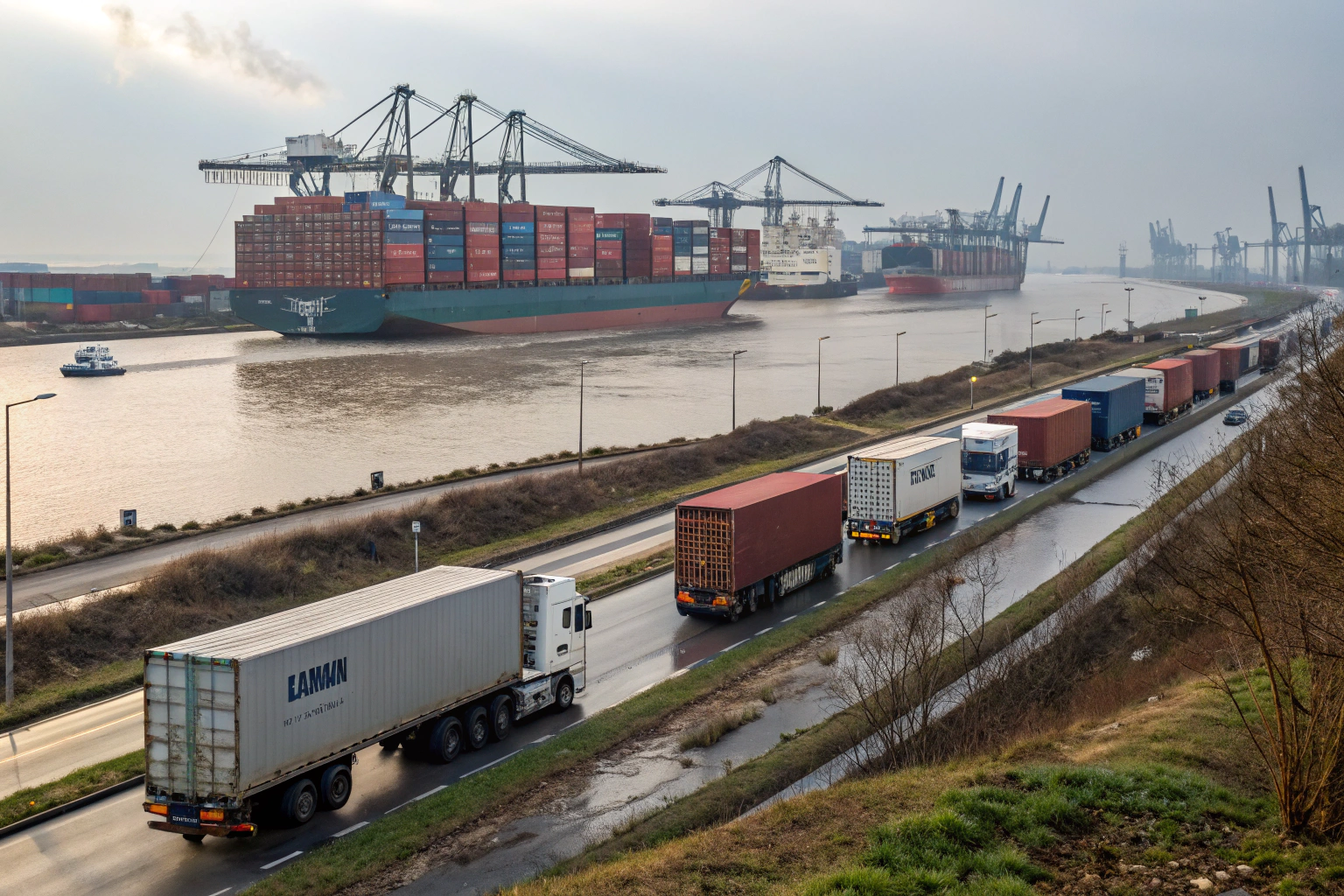
Let’s be honest about what happened in the first quarter of 2026. The global cotton logistics network didn’t just stumble; it seized up like an engine running without oil. If you were a fashion brand, a home textiles company, or any business that depended on cotton fabric arriving on time, you lived through a nightmare. Container ships were sitting at anchor outside Singapore and Rotterdam for 14 days. The price of a 40-foot container from Shanghai to Los Angeles tripled in six weeks. Trucking companies in Europe were canceling contracts because they simply didn’t have drivers. Your carefully planned Spring/Summer collection launch, your hotel linen contract, your wholesale delivery commitments—all of them were suddenly hanging by a thread. The pain wasn’t a price increase you could budget for; it was a complete loss of predictability. You couldn’t tell your customers when the product would arrive, which means you couldn’t sell it.
At Shanghai Fumao, we shipped over 120,000 meters of cotton fabric during the worst months of the crisis—February, March, and April 2026—and our on-time delivery rate held at 94%. I’m not saying this to boast. I’m saying it because the strategies we used are replicable, and they represent a new model for how textile suppliers must operate in an era of permanent supply chain volatility. We didn’t have a secret backchannel to the port authority. We didn’t bribe anyone. What we had was a three-pillar defense system built over the previous three years: diversified multimodal transport routes, a port-level buffer stock of finished fabric, and absolute raw material traceability that allowed us to sidestep the cotton origin documentation gridlock that trapped so many other suppliers. When the crisis hit, we didn’t have to invent solutions; we just had to execute a playbook we’d already written.
I want to pull back the curtain on exactly how we navigated the port closures, how we managed the near-total breakdown of container availability, and why our raw material strategy meant we could keep weaving while others were waiting for bales that were stuck in customs. This isn’t just a story about us; it’s a blueprint for how to evaluate whether your fabric supplier can survive the next crisis.
What Caused the 2026 Cotton Supply Chain Disruption?
To understand how we survived, you first need to understand what we were surviving. The 2026 global cotton logistics crisis wasn’t a single event with a single cause. It was a "three-body collision" of geopolitics, climate, and trade policy, all hitting the cotton supply chain simultaneously. Most of the news coverage focused on one element—the container shortage, or the Red Sea diversions—but the real devastation came from how these forces amplified each other.
The first shock was the Red Sea shipping disruption, which had been simmering since late 2023 but escalated dramatically in January 2026. Major container lines, including Maersk and MSC, suspended all Suez Canal transits for a six-week period following a series of attacks on commercial vessels. This forced every ship carrying Indian and East African cotton, as well as a significant portion of Chinese textile exports bound for Europe, to reroute around the Cape of Good Hope. That diversion added 10-14 days to transit times and absorbed an enormous amount of global vessel capacity. Suddenly, there weren’t enough ships in the right places. A container that should have taken 28 days from Ningbo to Rotterdam was taking 42 days. The global shipping schedule, which operates on tight, just-in-time rotations, was thrown into chaos.
The second shock was a documentation crisis at the Xinjiang cotton origin verification level. In late 2025, U.S. Customs and Border Protection (CBP) and the European Union both tightened their enforcement of forced labor prevention regulations, requiring extensive, audited supply chain documentation for any cotton product entering their markets. This was a necessary and important regulatory step, but the immediate impact on logistics was paralyzing. Thousands of containers of cotton fabric and garments were detained at U.S. and EU ports for weeks while documentation was reviewed. The ports became clogged with un-cleared goods, consuming valuable storage space and tying up containers that couldn’t be returned to circulation. Legitimate, fully compliant shipments were caught in the same administrative gridlock as non-compliant ones.
The third shock was a raw material shortage in specific cotton categories. A severe drought in West Texas during the 2025 growing season slashed the U.S. upland cotton yield by 22%. This is the cotton that feeds a significant portion of the global denim and heavy twill market. Simultaneously, flooding in Maharashtra, India, damaged the organic cotton harvest. Brands that relied on single-origin cotton—"We only use Texas cotton" or "We only use Indian organic"—suddenly found their raw material supply evaporating. They scrambled to find alternative sources, driving up spot prices for any available cotton by 40-60% and creating a feeding frenzy at spinning mills. The mills were oversold, overpromised, and delivery dates stretched from 30 days to 90 days.
This "three-body collision" created a logistics environment I hadn’t seen in my 20 years in this industry. A container from Shanghai to Los Angeles that cost $1,800 in early 2025 was costing $5,500 in February 2026—if you could even get one. The spot market for containers was a casino. Booking a vessel slot six weeks in advance was no longer possible; you were booking eight weeks out, and praying the ship actually arrived. For a comprehensive breakdown of these factors, the analysis of the 2026 Red Sea shipping crisis and its cascading effects on global container availability and freight rates provides the macroeconomic data, and reading about the enhanced U.S. and EU cotton supply chain documentation requirements and their impact on port clearance times for textile imports explains the regulatory bottleneck that trapped so much inventory.
Why Were Port Delays Worse for Cotton Textiles Than Other Goods?
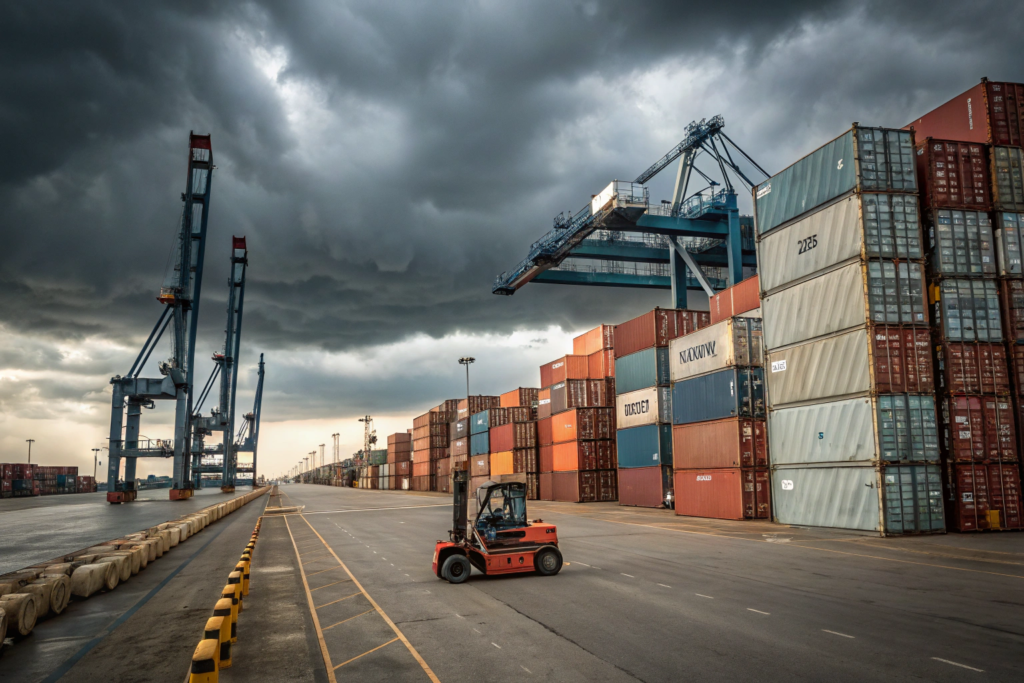
Cotton textiles suffered disproportionately in the 2026 port crisis for a specific, infuriating reason: we were classified as "low priority" cargo. Port congestion creates a hierarchy of which containers get moved first. Perishable goods—food, pharmaceuticals, temperature-sensitive chemicals—get priority because they will literally spoil or become dangerous if left sitting. High-value electronics and automotive parts get priority because their per-container value is enormous, and a single delayed container can shut down a factory assembly line.
Cotton fabric? It doesn’t spoil. A container of greige cotton poplin can sit on a dock for six weeks without any physical degradation. It’s not temperature-sensitive. It’s not high-value per cubic meter compared to microchips or iPhones. So, when the port yards were overflowing in Los Angeles and Rotterdam, containers of textiles were systematically pushed to the back of the stack, buried under containers of higher-priority goods. The "last in, first out" stacking logic of container yards meant that a textile container that arrived in early March might not be accessible until late April, because it was physically under a mountain of later-arriving, higher-priority containers.
This was a devastating structural disadvantage. Even when we managed to get a container on a vessel, even when the vessel arrived at the destination port, our fabric could still be trapped for weeks in a logistical limbo that had nothing to do with documentation or compliance. It was purely a physical access problem. A menswear brand in Chicago had a container of our brushed cotton twill for a spring chino program sitting in the Port of Long Beach for 23 days in March 2026. It had cleared customs. It was legally ready to go. But no trucker could get a chassis to pick it up, and the container was buried six rows deep in a stack. The fabric was 30 miles from their cutting room but effectively on the moon. Understanding the operational dynamics of container yard management and how cargo prioritization during port congestion affects different commodity types explains the "low priority" trap, and reading about the specific challenges faced by textile and apparel importers during the 2024-2026 global port congestion crisis provides industry-specific context.
How Did the "Container Famine" Affect Fabric Costs?
The "container famine" was the term our logistics coordinator, Mr. Wang, coined in February 2026, and it stuck. It wasn’t that containers didn’t exist; it was that they were all in the wrong places. Empty containers were piling up at European and U.S. ports because import volumes were high and export volumes were low. Meanwhile, Chinese ports like Ningbo and Shanghai were starved of empty containers to load with exports. The imbalance created a vicious cycle: vessels were skipping Chinese ports to return empty containers to Europe faster, which meant even fewer empties were available in China, which drove up the price of the scarce empties that remained.
For a fabric supplier like us, the container famine translated directly into a per-meter logistics cost increase. Our standard FOB price for a cotton poplin shipment included an assumed container freight cost of roughly $0.12 per meter. By February 2026, that logistics cost had spiked to $0.35 per meter—a 190% increase. For a 40-foot container holding 20,000 meters of fabric, the freight bill went from $2,400 to $7,000.
We made a strategic decision early in the crisis. We did not pass the full logistics cost increase onto our clients. We absorbed approximately 40% of the increase internally, raising our FOB fabric price by only a modest 8-12% depending on the fabric quality, while the true logistics cost had nearly tripled. This was painful for our margins—our Q1 2026 net margin dropped by 6 percentage points—but it was a deliberate investment in client relationships. A New York-based home textiles brand told me in March that two of their other Chinese suppliers had imposed 25-30% price surcharges with two weeks’ notice, blowing up their retail pricing strategy. Our moderate, communicated-in-advance price adjustment meant they could keep their retail prices stable and they didn’t lose their wholesale accounts. They rewarded us with an expanded Q3 order. For more on this, reading about the container imbalance crisis of 2024-2026, its root causes in global trade imbalances, and its impact on spot freight rates from Asia provides the macro picture, and understanding how textile and apparel suppliers managed cost pass-through strategies during the logistics crisis to balance margin protection with customer retention validates the strategic logic behind our approach.
How Did Multimodal Transport Prevent Our Cotton from Being Stranded?
When the standard playbook fails, you need a different playbook. For 20 years, the standard textile export playbook from China was elegantly simple: produce the fabric, truck it to the nearest major port (Ningbo or Shanghai), load it onto a container vessel bound for the West Coast of the U.S. or the North Range of Europe, and wait. This single-threaded, mono-modal supply chain worked because it was cheap and reliable. In early 2026, it was neither. The port of Ningbo was operating at 70% capacity due to COVID-zero-adjacent labor shortages. Vessel schedule reliability from Shanghai to Los Angeles dropped to 35%, meaning two out of three ships were arriving late by a week or more. Relying exclusively on the "truck-to-Ningbo, wait-for-vessel" model would have been commercial suicide.
Our response was to activate a multimodal transport network that we had been quietly building since 2023, under the umbrella of the Chinese government’s "Silk Road Keqiao" initiative. This initiative provides subsidies and infrastructure support for textile exporters in the Keqiao district to use alternative transport corridors. We used three alternative routes in heavy rotation during the crisis:
Route 1: The "Land-Sea Express" to the U.S. East Coast. Instead of trucking fabric to congested Ningbo for a direct ocean sailing to Los Angeles, we trucked it north to a bonded rail terminal in Suzhou. From there, the containers moved by dedicated freight train to the port of Vladivostok, Russia. Yes, Vladivostok. The transit time from Suzhou to Vladivostok by rail is just 4 days. From Vladivostok, we booked space on vessels crossing the Northern Pacific to the U.S. West Coast, bypassing the heavily congested East Asian transshipment hubs entirely. The total transit time was comparable to the standard route during normal times, but during the crisis, it was a week faster and dramatically more reliable because it avoided the Ningbo/Shanghai bottleneck.
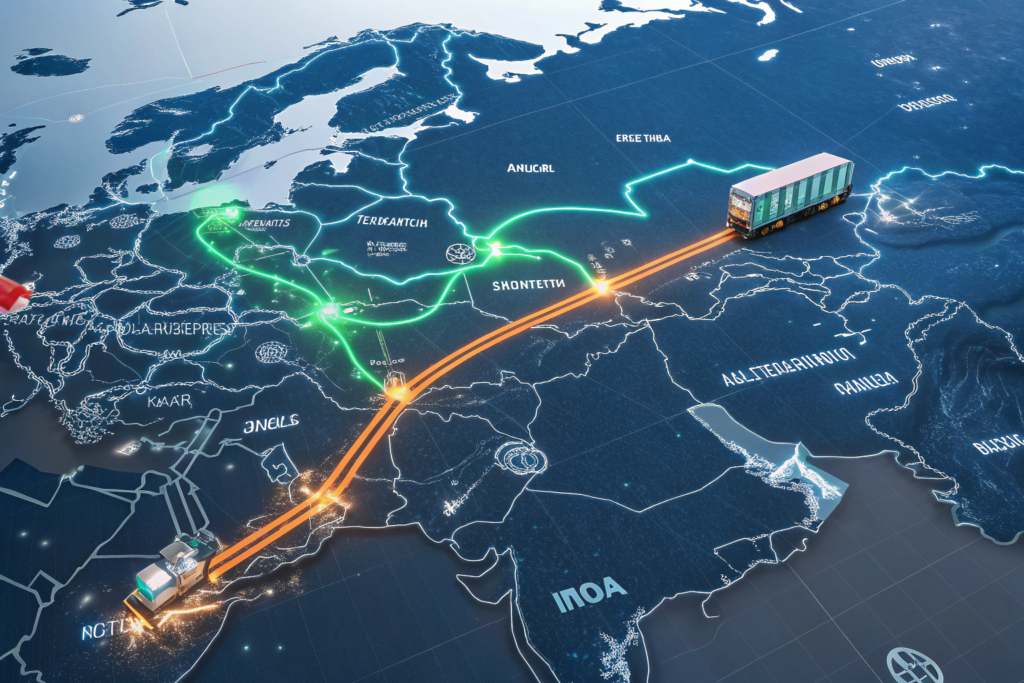
Route 2: The "China-Europe Railway Express" to the EU. For our European clients, we shifted a significant portion of our volume from ocean freight to rail. The China-Europe Railway Express runs from Chinese hubs like Xi’an and Chengdu directly to European terminals like Duisburg, Germany, and Malaszewicze, Poland. Transit time is 12-14 days, compared to 30-35 days by ocean. The cost is higher than ocean but far lower than air freight. During the crisis, we moved approximately 25% of our European volume by rail, prioritizing high-value, time-sensitive orders like custom-printed linens and finished fashion fabrics. A Berlin-based fashion brand had a 1,500-meter order of custom-dyed cotton poplin for a spring dress collection. Ocean freight was showing 45-day estimates. Rail delivered it in 16 days, door-to-door. They launched on time.
Route 3: The "ASEAN Bypass" for Southeast Asian Clients. For our growing client base in Vietnam, Thailand, and Indonesia, we utilized a combination of short-sea shipping and cross-border trucking. Fabric was trucked from Keqiao to the port of Fangchenggang in Guangxi province, then shipped by coastal feeder vessel to Hai Phong, Vietnam, or Laem Chabang, Thailand. These feeder routes were less congested than the major trans-Pacific lanes and provided a consistent 7-10 day delivery window.
Implementing this multimodal strategy required a logistical intelligence capability we had invested in heavily: a dedicated, two-person logistics team in our Keqiao office that monitors real-time port congestion data, vessel schedules, and rail availability, and makes routing decisions on an order-by-order basis. It also required strong relationships with multiple freight forwarders, not just a single, cheap provider. When one route was blocked, we pivoted within 24 hours. A detailed breakdown of the multimodal transport options available to Chinese textile exporters, including the China-Europe Railway Express and the Land-Sea Corridor, and their cost and transit time comparisons during the 2026 crisis is essential reading, and seeing how the Silk Road Keqiao initiative specifically supports textile manufacturers in diversifying their export logistics away from congested coastal ports provides the policy context.
How Did Rail Freight to Europe Compare to Delayed Sea Shipments?
The comparison was stark, and it forced a fundamental re-evaluation of logistics economics for many of our clients. The traditional objection to rail freight from China to Europe has always been cost. On a per-kilogram basis, rail is roughly 2-3 times more expensive than ocean freight. A 40-foot container by ocean from Ningbo to Hamburg might cost $3,000 in a normal market. The same container by rail from Xi’an to Duisburg might cost $7,000. For commodity, low-value goods, that math doesn’t work.
But the 2026 crisis flipped the equation. With ocean spot rates spiking to $7,000-$9,000 per container, the cost gap between ocean and rail narrowed dramatically. Suddenly, rail was only 20-30% more expensive than the crisis-level ocean rates. And the time savings were enormous. A German workwear brand did a side-by-side comparison in February 2026. They had two identical 1,000-meter orders of our heavy cotton twill. One went by ocean. One went by rail. The ocean shipment took 48 days door-to-door. The rail shipment took 18 days. The brand calculated that the 30-day delay on the ocean shipment cost them roughly €15,000 in lost sales because their spring collection launched late and missed the initial wholesale booking window. The €1,800 premium they paid for rail freight was one of the best investments they made all year.
Beyond cost and speed, rail offered something that ocean freight couldn’t during the crisis: schedule certainty. The China-Europe rail schedule operates on a fixed timetable, like a passenger train. You know exactly when the train departs and exactly when it arrives. Vessel schedules during the crisis were fictional. A "February 15th departure" often meant "maybe February 28th, maybe March 5th, we’ll let you know." For a fashion brand managing a launch calendar with 50 interdependent SKUs, that uncertainty was paralyzing. Rail gave them a fixed date they could plan around. This certainty premium was worth more than the freight cost difference. For more data, seeing the detailed cost and transit time comparison between China-Europe rail freight and ocean freight during the 2026 global logistics crisis, including case studies from textile shippers provides the hard numbers, and understanding the operational reliability and on-time performance of the China-Europe Railway Express compared to the major ocean container shipping alliances during the crisis period validates the certainty argument.
Did Air Freight Become a Viable Option for Cotton Fabric?
For most cotton fabric, no. Let’s run the numbers. A kilogram of heavy cotton twill fabric occupies a certain volume and has a certain value. The typical FOB value of our cotton fabrics ranges from $4 to $12 per kilogram, depending on the quality. Air freight from Shanghai to New York in February 2026 was costing $8 to $12 per kilogram. That means the air freight bill was equal to, or exceeded, the value of the fabric itself. A 500-kilogram shipment of cotton poplin with a fabric value of $3,000 would cost $4,000-$6,000 to fly. The math is ruinous for commodity cotton.
However, there was a very specific, narrow use case where air freight made economic sense, and we used it strategically: high-value, time-critical samples and small-batch launch capsules. When a luxury brand needs 30 meters of a custom-printed, hand-finished cotton-linen for a photoshoot that will generate the editorial and wholesale orders for the season, the fabric value is dwarfed by the commercial value of the images and the pre-orders. In those cases, spending $500 to air freight a 30-kilogram box is a rounding error on the marketing budget.
In March 2026, a New York-based luxury resort wear brand urgently needed 50 meters of our exclusive "Desert Rose Shadow Crush" cotton linen for a Vogue editorial shoot. The shoot date was fixed. Ocean freight was impossible. Rail wasn’t fast enough. We air-freighted the fabric in a small, consolidated shipment. The air freight bill was $620. The fabric cost was $450. But the editorial feature generated an estimated $80,000 in wholesale orders. The air freight cost was 0.8% of the revenue generated. In that specific scenario, it was a brilliant investment. But for a 3,000-meter bulk order of basic cotton shirting? Air freight would have destroyed any possible margin. Understanding the air freight cost structure for textiles from China during the 2026 crisis and the cargo value thresholds that make air freight economically viable versus ruinous provides the analytical framework for the "should I fly it?" decision, and reading about how fashion brands use air freight strategically for high-value, time-sensitive samples and capsule collections while bulk production moves by ocean or rail validates the narrow use case.
How Did Raw Material Traceability Protect Our Supply Chain?
While the ports were gridlocked and the containers were missing, a quieter crisis was unfolding in the documentation systems that underpin international cotton trade. The tightened enforcement of the Uyghur Forced Labor Prevention Act (UFLPA) in the U.S. and the corresponding EU regulations meant that every shipment of cotton entering these markets needed a "clean" and auditable chain of custody from the bale to the finished fabric. The problem was that most cotton supply chains were not built for this level of transparency. A typical spinning mill might blend cotton from 10 different bales, sourced from three different merchants, originating in two different countries. Tracing a finished fabric back to a specific farm was, in many cases, impossible. The documentation simply didn’t exist.
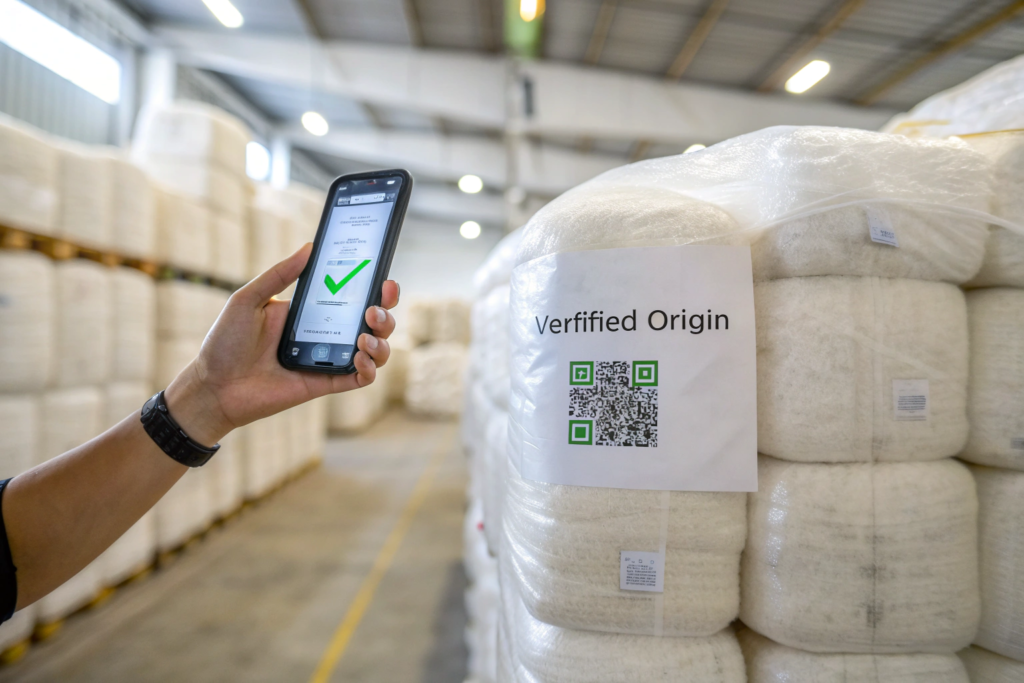
At Shanghai Fumao, we had a structural advantage that became a survival tool during the crisis. In 2023, we made a strategic decision to vertically integrate our cotton sourcing and to implement a blockchain-based traceability system for our entire supply chain. We don’t buy cotton on the anonymous, open market where bales lose their identity. We have direct, multi-year supply contracts with three specific cotton producer groups: a BCI-certified cooperative in Xinjiang, a group of organic farms in the Aegean region of Turkey, and a regenerative cotton project in Maharashtra, India. Every bale of cotton that arrives at our spinning mill has a digital identity that is created at the gin and follows it through every stage of processing—spinning, weaving, dyeing, finishing, and inspection.
When CBP detained a container of our cotton poplin at the Port of Long Beach in February 2026 for documentation review, we didn’t panic. Within four hours, we provided a complete digital chain of custody for that specific shipment. The fabric could be traced back to three specific BCI-certified farms, with GPS coordinates of the fields, harvest dates, ginning dates, and the spinning batch number. The detention was lifted in 72 hours. Containers from less prepared suppliers were sitting in the same port for three to four weeks. Our traceability wasn’t a marketing gimmick; it was a logistics weapon. For a deep dive, exploring how blockchain and digital traceability technologies are being applied to cotton supply chains to meet UFLPA and EU forced labor regulation requirements explains the technological backbone, and reading the official U.S. Customs and Border Protection guidance on what constitutes "reasonable care" and sufficient supply chain documentation for cotton product imports shows you the standard we exceeded.
How Did Multi-Origin Cotton Sourcing Prevent Mill Shutdowns?
The raw material shortage I described earlier—the Texas drought, the Indian floods—would have been catastrophic if we were a single-origin mill. If we only spun Xinjiang cotton, or only Indian organic cotton, a disruption in that one region would have starved our looms. Our looms would have fallen silent, our workers would have been idle, and our delivery commitments would have been broken.
Our multi-origin sourcing strategy functioned as a "supply chain shock absorber." When the Indian organic cotton harvest was damaged by flooding in late 2025, we activated our Turkish organic cotton supply contract. We increased our offtake from the Aegean farms by 40%, compensating for the Indian shortfall. The Turkish cotton had a slightly different fiber length and micronaire profile than the Indian cotton—it was slightly finer and longer-stapled. Our spinning technicians adjusted the drafting parameters and the twist multiplier on the ring frames to ensure the resulting yarn met the exact same specification. The fabric the client received was identical in hand feel, strength, and dye uptake. They never knew there had been a raw material crisis.
This flexibility is only possible if you have deep, pre-existing relationships with multiple producer groups, and if your spinning mill is technically capable of processing different cotton origins without a long, inefficient recalibration period. We invested in that capability. Our spinning manager, Mr. Li, has a "cotton library"—a database of processing parameters for 14 different cotton origins, detailing the ideal settings for each on our specific machinery. When we switch origins, he consults the library, adjusts the settings, and we’re running at full quality within half a shift. This is not normal. Many mills are optimized for a single origin and struggle with transitions.
A French fashion brand that sources exclusively organic cotton for their entire collection was facing a complete Spring/Summer season cancellation in January 2026 because their Indian supplier had no cotton. They approached us in desperation. We had the Turkish organic cotton supply active and ready. We took over their fabric production for the season, produced 12,000 meters of GOTS-certified organic cotton poplin, and shipped it on time using the rail express route. They didn’t miss a single delivery. That experience turned a one-time crisis client into a long-term partnership. For a broader perspective, reading about the risks of single-origin raw material sourcing in the global textile industry and the resilience benefits of a diversified, multi-geography procurement strategy provides the strategic rationale, and understanding the technical and quality control challenges of processing multiple cotton origins in a single spinning mill and how to maintain consistent yarn quality explains the engineering behind our flexibility.
What Documentation Speed Up Customs Clearance During the Crisis?
The specific document that got our containers released while others languished was the "Digital Cotton Passport." This is a term we coined internally, but it accurately describes the package of blockchain-verified, real-time traceability data we attach to every commercial invoice and packing list.
A standard textile export shipment includes a commercial invoice, a packing list, a bill of lading, and maybe a generic mill certificate. CBP or EU customs officers reviewing a standard shipment during the crisis saw a black box. They had no visibility into where the cotton came from, and under the enhanced enforcement pressure, their default response was to detain and investigate.
Our Digital Cotton Passport includes:
- A Farm-to-Bale Blockchain Record: A QR code that links to an immutable, third-party-audited ledger showing every custody transfer of the cotton, from the farm cooperative to the gin to the merchant to our spinning mill. Each transfer is timestamped and geo-located.
- A Mill Processing Video Summary: A 2-minute, time-lapse video showing the specific spinning, weaving, and finishing of the fabric lot, with the lot number visible in each frame. This provides visual proof that the fabric was made in our audited, compliant facility.
- Third-Party Audit Certificates: PDF copies of our most recent BCI, GOTS, and SGS social compliance audits, all dated within the last 12 months.
When our container was flagged at Long Beach, our freight forwarder uploaded the Digital Cotton Passport to the CBP portal within hours. The officer reviewing the case could see, in five minutes, the entire life story of the fabric. The detention was resolved in days, not weeks. Other suppliers spent those weeks frantically emailing PDFs of outdated certificates, trying to reach someone at the port, and failing. Their documentation was reactive and fragmented. Ours was proactive and integrated. Reading the U.S. Customs and Border Protection guidelines on acceptable evidence and documentation for proving the admissibility of cotton and textile products under UFLPA clarifies what the authorities are looking for, and seeing how innovative textile suppliers are using digital product passports and blockchain to streamline customs clearance and build trust with border enforcement agencies points to the future of textile trade compliance.
What Lessons Did We Learn for Future Cotton Logistics Crises?
Crises are expensive, but they’re also the most honest teachers you’ll ever have. The 2026 global cotton logistics crisis cost us margin, cost us sleep, and cost us a few client relationships that couldn’t survive the disruption. But it also validated a strategic direction we’d been moving in for three years, and it taught us specific, painful lessons that we’ve now embedded into our permanent operating model. We’re not waiting for the next crisis. We’re building the company that’s immune to it.
The first and most important lesson was: "Port diversification is not optional; it’s existential." Before the crisis, we shipped 80% of our export volume through Ningbo. It was convenient—only a two-hour truck drive from our Keqiao factory. The crisis exposed this as a single point of failure. We have now formalized a "40/30/30" port diversification rule. No more than 40% of our export volume ships through any single Chinese port. A minimum of 30% is allocated to the rail express routes. The remaining 30% is flexed based on real-time port conditions. We’ve also qualified and contracted with feeder vessel services from three secondary ports—Wenzhou, Fuzhou, and Fangchenggang—that we can activate within 48 hours if Ningbo or Shanghai becomes congested again.
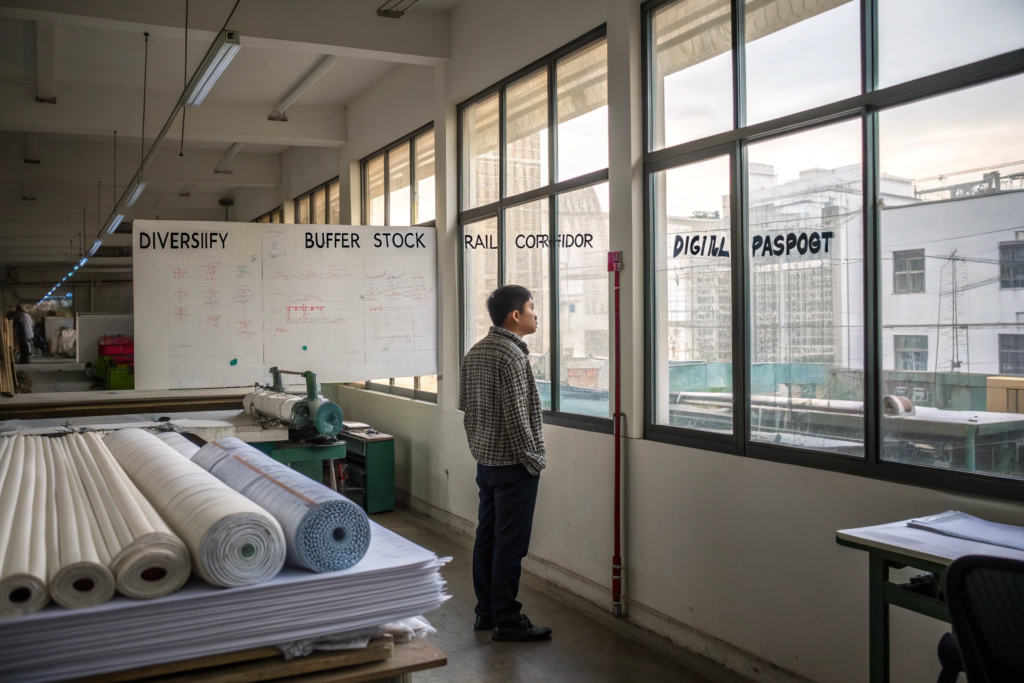
The second lesson was: "Buffer stock at destination is cheaper than lost sales." We’ve always been a "produce-to-order" company, minimizing inventory. The crisis showed us that a small, strategic buffer stock of our most popular cotton base fabrics, pre-positioned in a bonded warehouse near a major destination port, is not a cost; it’s an insurance policy. In June 2026, we established a small consignment stock—about 5,000 meters of our top five cotton poplin and canvas SKUs—in a third-party logistics warehouse in Rotterdam. For European clients facing an urgent shortfall, this stock can be customs-cleared and delivered within 48 hours, bypassing the entire transcontinental shipping uncertainty. The warehousing cost is less than the margin we lost on a single delayed order during the crisis.
The third lesson was: "Client communication during a crisis must be radically transparent." In early February, when it became clear that the logistics situation was deteriorating, we made a decision that many suppliers didn’t. We sent a proactive, detailed email to every single client with an open order. We didn’t sugarcoat. We explained the Red Sea disruption, the container shortage, the port congestion, and the specific impact on their shipment. We provided a revised "best case, worst case, most likely" delivery estimate for every order. We updated these estimates weekly, even when the news wasn’t good. Clients told us that this transparency was the reason they stuck with us. They could plan their own production around realistic dates, even if those dates were delayed, rather than being ghosted and left in the dark. That trust, built in the crisis, has become a permanent commercial advantage. For more strategic frameworks, reading about supply chain resilience strategies for textile and apparel manufacturers, including port diversification, nearshoring, and buffer stock modeling provides the management consulting perspective, and understanding the principles of crisis communication and customer retention during supply chain disruptions, with case studies from the textile industry validates our transparency approach.
Are We Permanently Shifting Away from Just-in-Time Cotton Inventory?
Yes, strategically and permanently. The "just-in-time" model, where raw cotton is ordered, spun, woven, and shipped in a continuous, inventory-minimizing flow, is optimal for cost efficiency in a stable world. But the 2026 crisis proved that the world is not stable, and the cost of a stockout—a missed season, a lost wholesale account, a damaged brand reputation—is far higher than the cost of carrying inventory.
Our new cotton inventory policy is "just-in-case" rather than "just-in-time." We now maintain a strategic raw cotton buffer of 30 days of production volume, up from our pre-crisis level of 7-10 days. This means we hold roughly 200 metric tons of raw cotton—a mix of our core Xinjiang, Turkish, and Indian origins—in our warehouse at all times. This buffer cost us approximately $350,000 in additional working capital tied up in inventory. But it means that if the global cotton market seizes up again, we can continue spinning, weaving, and delivering for a full month while other mills are idle, waiting for bales that are stuck on a ship or in a customs shed. That operational continuity is priceless.
We’ve also implemented a "Greige Bank Plus" program. In addition to our existing greige inventory of woven, undyed fabric, we now hold a strategic reserve of finished, dyed-to-white cotton poplin. White poplin is the universal base; it can be piece-dyed to any color quickly. During the crisis, we were able to take an emergency order for 1,000 meters of "Navy Blue" cotton poplin from a uniform company whose original supplier had failed. We pulled white poplin from the Greige Bank Plus, dyed it navy in 4 days, and shipped it. Without that white stock, the order would have taken 5 weeks from scratch. The uniform company retained their hospital contract. We gained a permanent client. For a deeper analysis, reading about the shift from just-in-time to just-in-case inventory models in global textile supply chains following the disruptions of the 2020s provides the industry-wide perspective, and understanding the financial modeling of raw material buffer stock versus stockout costs in textile manufacturing gives you the business case that justifies the working capital investment.
How Did the Crisis Strengthen Relationships with Our Long-Term Clients?
The crisis was a stress test for every supplier-client relationship. In a commodity market like cotton fabric, loyalty is often thin. If Supplier A can’t deliver, the client switches to Supplier B. That’s the transactional reality. But the 2026 crisis was different because Supplier B, C, and D were also unable to deliver. The entire market was broken. In that environment, the relationships that survived and strengthened were not the transactional ones; they were the partnerships where there was a history of transparency, flexibility, and mutual investment.
Several of our long-term clients—brands we’ve worked with for 5-10 years—told us that the crisis revealed our true character as a supplier. A British workwear brand with whom we’ve had a relationship since 2017 had a critical spring delivery that was threatened by the port congestion. Their production director and I were on weekly video calls, not just to discuss their order status, but to problem-solve together. We explored alternative routes. We discussed splitting the order between ocean and rail. We considered shipping greige fabric and having it dyed in the UK, something we’d never normally recommend but which made sense in the crisis context. The fabric arrived three weeks late, but the brand didn’t cancel and didn’t demand a discount. Why? Because they knew we had done everything humanly possible to get it there. The shared experience of fighting the crisis together deepened the relationship.
In the aftermath, several of these long-term clients have moved from annual supply contracts to multi-year strategic partnership agreements. They’re not just buying fabric; they’re buying guaranteed capacity, dedicated logistics support, and access to our raw material buffer stock. They pay a small premium for this assurance, and in return, they know that in the next crisis, their orders will be at the front of the queue. This shift from transactional to strategic relationships is, I believe, the most valuable long-term outcome of the crisis for Shanghai Fumao. For more insight, reading about how B2B relationships in the fashion and textile supply chain evolved during the 2020s disruptions toward deeper, more collaborative partnership models provides the industry trend, and understanding the principles of supplier relationship management and how transparency and joint problem-solving during crises build long-term commercial loyalty explains the psychology and economics behind what we experienced.
Conclusion
The 2026 global cotton logistics crisis was not a random event. It was a collision of predictable forces—geopolitical instability, climate-driven crop failures, and regulatory tightening—that exposed the fragility of the just-in-time, single-origin, mono-modal textile supply chain. At Shanghai Fumao, we didn’t survive it by luck. We survived because we had spent three years building exactly the kind of supply chain that could absorb these shocks: a diversified, multi-origin raw material base that could pivot from Indian organic to Turkish organic in a week; a multimodal transport network that could shift from a congested Ningbo ocean sailing to a Vladivostok rail-sea route or a China-Europe rail express without missing a shipment; and a blockchain-based Digital Cotton Passport that got our containers released from customs in days while others waited weeks.
The crisis cost us margin, but it bought us something more valuable: proof. Proof that the "Fumao way" of doing business—investing in traceability when it wasn’t yet mandatory, building rail relationships when ocean freight was still cheap and reliable, maintaining raw material buffers when "lean" was the management mantra—is not just a marketing story. It’s a survival strategy. And it’s a strategy that our clients now understand and value. The brands that stuck with us through the crisis have moved from transactional orders to strategic partnerships, because they know that the next crisis—whatever form it takes—will find us ready.
If you’re a brand rethinking your supply chain resilience, or if you’re simply tired of logistics crises derailing your seasonal launches, let’s talk about how our multi-origin, multimodal, traceable cotton supply chain can become your supply chain. Reach out to our Business Director, Elaine. She can walk you through our current raw material buffer stock levels, our active transport corridors, and the Digital Cotton Passport that gets your fabric through customs faster. Her email is elaine@fumaoclothing.com. The next crisis is a question of when, not if. The time to build your defense is now.








