
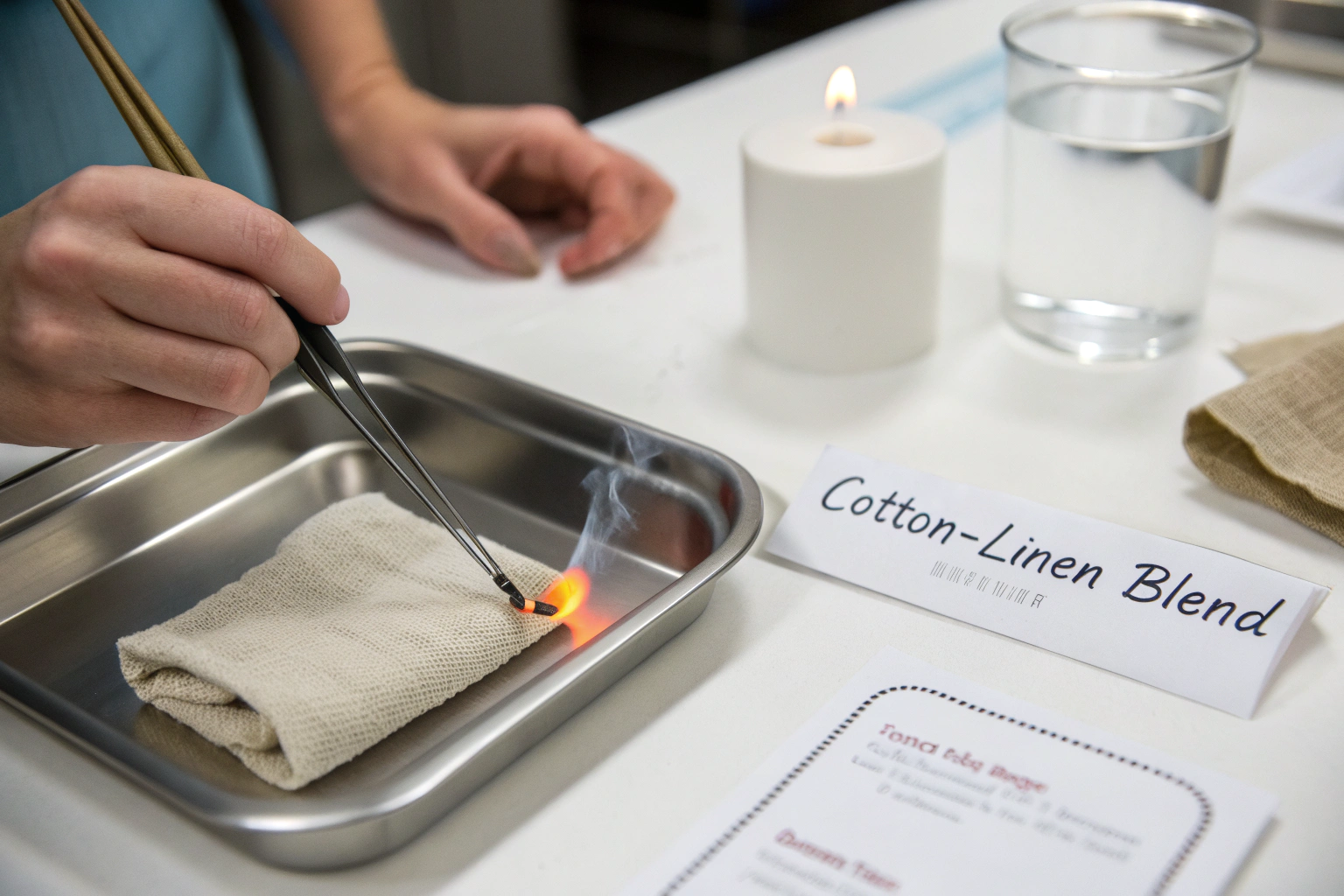
You just received a beautiful swatch of what you paid for as "70% cotton, 30% linen." It has the right slubby texture, the right matte look. But something in your gut says it feels too slick, too heavy, or maybe it wrinkles just a little too perfectly. You suspect you have been sold a poly-blend disguised as a natural fiber. There is only one way to know for sure without sending it to a lab. You need to set it on fire. But here is the cold truth. Most people do a burn test wrong. They hold a lighter to the edge for two seconds, see some black smoke, and panic. They mistake the natural smell of burning cellulose for burning plastic. They confuse the natural ash of a plant fiber with a synthetic bead. A bad burn test is worse than no test at all because it creates false confidence or unnecessary fear.
A proper burn test is a four-sense diagnostic. You are not just watching for a flame. You are observing the speed of the burn, the color of the smoke, the shape of the ash, and most importantly, the smell. Natural plant fibers like cotton and linen burn like dry leaves. Animal fibers like wool burn like burning hair. Synthetics melt like burning plastic and drip. At Shanghai Fumao, our QC team uses a burn test as a quick, field-level check before we even send a sample to the CNAS lab for spectroscopy. It is not a replacement for a certified fiber composition test, but it is a 90% accurate tool that tells you immediately if you are dealing with a pure natural, a pure synthetic, or a blend. And for a cotton-linen blend specifically, the interplay of the two cellulose burn characteristics tells you a lot about the ratio.
I want to teach you the exact protocol we use in our inspection room. I will walk you through the setup, the safety steps, the specific "burn ladder" for different fiber types, and how to interpret the tricky gray areas where a cotton-heavy blend behaves differently from a linen-heavy one. Because when you know how to read fire, nobody can sell you a synthetic ghost.
What Equipment Do You Need for a Professional-Grade Fiber Burn Test?
A professional burn test is a controlled experiment, not a campfire trick. The difference between a reliable result and a dangerous guess starts with your choice of tools. I have seen designers try to do a burn test holding a fabric strip with their bare fingers over a shag carpet. This is stupid and dangerous. You need a setup that isolates the fabric, contains the flame, and allows you to observe without panicking. The core principle is that you are the scientist, and the flame is your data. You control the variables.
The non-negotiable starting point is your heat source. Do not use a cigarette lighter. A lighter produces soot, and the flickering orange flame makes it hard to see the fabric’s true reaction. You need a clean, blue flame. I recommend a small butane kitchen torch or a chef’s crème brûlée torch. The blue flame has a consistent temperature and no carbon residue. Your grip must be stainless steel tweezers with a long handle, at least 8 inches. You want your hand as far from the flame as possible. The burn platform must be fireproof and heat-resistant. A ceramic petri dish or a stainless steel tray is perfect. Never use a plastic plate. Finally, have a safety kit ready: a small spray bottle of water and a natural-fiber fire blanket, like a folded cotton towel. Synthetic blankets melt. At Shanghai Fumao, our inspection desk has a dedicated "Burn Station" with a fume extractor hood, exactly like a mini science lab. We do this multiple times a day. Discipline in the setup prevents a trip to the emergency room. To get a full understanding of the right gear, you should review the essential tools for conducting a safe and accurate fabric burn test at home. It is the foundation of the whole procedure.

Why Is a Ceramic Dish Better Than a Sink for Burning Swatches?
A sink seems logical. It is metal, it is water-adjacent. But a stainless steel sink is thermally conductive. When a melting synthetic drip falls onto the thin steel, it can superheat the spot instantly, burning through any residue and making a permanent scar on your sink. A ceramic dish is an insulator. It absorbs the heat slowly and contains the drip. It also provides a pure white background. This white background is critical for observing the color of the smoke and the ash. Against a dark or reflective surface, you might miss the subtle gray-to-black transition that distinguishes cotton from linen.
I learned the hard way about the importance of a dedicated burn vessel. A junior inspector in our Keqiao lab in 2022 was testing a small poly-spandex blend directly over the edge of the cutting table on a scrap of cardboard. The synthetic melted, dripped onto the cardboard, and ignited a small secondary fire that scorched the table. Nobody was hurt, but the sample was destroyed, and the test was invalid. After that, I mandated that every burn test must happen inside a standard, white, glazed ceramic evaporating dish. The dish is the boundary of the experiment. If the flame leaves the dish, the test stops. If the fabric sample piece you test is too large—more than a 1-inch square—it generates too much heat for the dish to contain. I cut a swatch about the size of my thumbnail. It burns completely in 10-15 seconds and leaves a perfect, readable ash inside the dish. This small sample size also prevents the heavy, acrid smoke from overwhelming the room. The discipline of the dish is the discipline of control. Find out more about how to set up a safe burn test station with ceramic and metal tools. It is a basic but essential protocol.
How Does the Shape of the Flame Reveal Fiber Content Before the Ash Does?
Forget the ash for the first five seconds. The flame itself is a diagnostic screen. Different fiber types interact with oxygen in completely distinct ways. Cotton and linen are cellulose. They do not shrink away from the flame. They ignite immediately and burn with a vigorous, bright yellow-orange flame, like a tiny bonfire. They want to burn. The flame dances and spreads quickly across the edge. Wool and silk are protein. They are difficult to ignite. They shrink back from the flame, curl up into a tight ball, and burn with a sputtering, low, orange flame that often self-extinguishes the moment you remove the external heat source. It is a reluctant, fighting burn.
Polyester and nylon are the liars. They shrink violently away from the flame. They melt into a hard, shiny bead even before the flame touches them. When they finally ignite, they burn with a dull, lazy, sooty yellow flame, sometimes with a greenish-blue core. They drip molten plastic, and the moment you remove the heat source, they often self-extinguish and leave a hard, crystalline black bead. I was training a new sales rep last month. I put a mystery swatch in the tweezers and hit it with the torch. It shrank back and melted into a hard drop before the flame even caught. "That’s a synthetic," I said. "Don’t even need to smell it." The flame-shape test is instantaneous. It takes one second. If the fabric retreats from the heat, you are dealing with a significant percentage of thermoplastic fiber. Cotton-linen, being pure cellulose, leans into the flame. This immediate reaction is your first and fastest QC checkpoint. To master this quick-check method, understand how flame behavior differs between plant-based and synthetic textile fibers. It will make you a faster diagnostician.
How Do Cotton and Linen Burn Differently in a Blend?
Here is the challenge that trips up even experienced sewists. Cotton and linen are botanical twins. They are both cellulose. They both ignite easily. They both leave a fine, gray, feather-light ash. The burn test differences between them are not a clash of opposites; they are a whisper. You have to become a connoisseur of nuance. When you burn a pure cotton swatch and a pure linen swatch side-by-side, the differences appear in the speed of the burn, the color of the smoke, and the integrity of the residual ash. Missing these cues is the reason so many buyers believe their 100% linen is actually a cotton blend, or vice versa.
At Shanghai Fumao, we produce both 100% cotton and 100% linen fabrics, and our QC team has a calibrated nose for this specific distinction. A pure cotton flame is slightly more violent and eager. Cotton has a shorter fiber length and more surface fuzz, so the oxygen penetrates the yarn faster. The flame crackles softly. The smoke is white with a faint gray tint. The ash is soft, fluffy, and disintegrates at the touch. Linen, with its longer, denser bast fibers, burns a fraction slower. The flame is calmer and slightly brighter, almost a clean yellow. The critical differentiator is the smoke. Linen smoke is a darker gray, almost a charcoal hue. And the ash is unique. Linen ash retains a ghostly skeleton structure of the original yarn. It does not collapse into a powder instantly like cotton ash. It holds its shape like a burnt scroll. You can literally see the twist of the yarn in the linen ash. If you burn a blend swatch and see a mix of fluffy powder and structured skeletal fragments, you have a cotton-linen blend. The ratio is roughly proportional to the ash structure. More powder means more cotton. More skeleton means more linen. Dive deeper into the subtle burn test signs that distinguish cotton from flax fibers in home textiles. It is a skill that grows with practice.

What Does the Smell of Burning Cellulose Tell You About the Ratio?
Your nose is a gas chromatograph. It is not as precise as the lab machine, but it is instantly available. Burning pure cotton smells like burning paper, a campfire, or a dry leaf pile. It is a clean, slightly sweet, familiar smoke. Burning pure linen smells like burning rope, a twig, or straw. It has a sharper, more acrid, almost grassy edge. The difference is in the lignin. Linen contains more natural plant gum and lignin than cotton. When this burns, it releases a distinct, pungent, "heavy" note.
In a cotton-linen blend, the smell is a harmonic of the two. A 70-30 cotton-heavy blend will smell mostly like paper, with just a faint, back-end hint of rope. A 50-50 blend will have an equal presence. A 30-70 linen-heavy blend will smell strongly of a rope fire, masking the softer cotton note. I have a routine at the factory. When a new batch of greige yarn arrives, I do not even look at the label first. I take a lighter to a tuft of fiber, close my eyes, and inhale. My nose can tell me if the ratio is off before the burn test even finishes. A shipment once arrived labeled as our standard 70-30. I burned it blind. The smell hit my nose heavy with lignin—too sharp, too grassy. It smelled like a 55-45 linen-heavy blend. I sent it to the lab for a chemical dissolution test. My nose was right. The supplier had sent the wrong lot. We caught it before we wove 500 meters of mis-labeled fabric. You can train your own nose by burning known swatches and building a mental library of scents. To understand more about this sensory diagnostic, explore how to identify fiber blends by smell during a controlled textile burn test. It is a lost art.
How to Read the Ash Skeleton to Verify a 70/30 Cotton-Linen Blend?
The ash is the final signature. After the flame dies, wait for the ember glow to stop completely. Do not blow on the ash to speed it up. You will scatter the evidence. You need the ash to cool and settle naturally. Now, use your tweezers to gently prod the residue. The structural integrity of the ash is your ratio indicator. A pure cotton ash has zero structure. It is a soft, fluffy, amorphous gray dust. It collapses at the faintest touch. A pure linen ash is a perfect, dark gray fossil of the original yarn. You can pick it up in one piece.
A 70% cotton, 30% linen blend—our most popular at Shanghai Fumao—produces an ash that is mostly fluffy, but embedded within the powder are distinct, thin, fragile skeletal fragments. The linen fibers act as rebar inside the concrete of the cotton ash. You should be able to see tiny, thread-like structures running through the dust pile. If you can count several thin, connected segments, your linen content is likely above 20%. If the whole pile collapses into a uniform, shapeless mound, your cotton content is likely above 85%, or the fabric is pure cotton. I showed this to a design student who visited our booth at a trade show. She was skeptical. I burned a certified 70-30 swatch we keep as a control sample. The ash was a dust pile with delicate, tiny skeleton traces. I then burned a swatch she had brought from another supplier, labeled as "70-30." The ash was almost entirely a dense, structured lattice. It was more like a 50-50 blend. She had been overpaying for linen content that was not there. The ash skeleton does not lie. To validate your own ratios, learn how to interpret ash residue to estimate fiber blend ratios in natural textiles. It is an empirical method you can trust.
What Are the Most Common Burn Test Errors That Fool Buyers?
The burn test is a perfect little lie detector, but only if you do not fall for its common traps. I have seen smart, experienced fashion professionals completely misdiagnose a fiber because they ignored a finish, or they misinterpreted a blended melt. The fire never lies, but the fabric can be deceptive. Chemical finishes, blended melts, and the presence of sewing thread can all create false positives that lead you to reject a perfectly good natural fabric, or worse, accept a clever synthetic mimic. The most dangerous words in a burn test are "I think it might be…"
At Shanghai Fumao, we catalog these errors as "Burn Test Artifacts." We train our new QC staff by deliberately burning treated fabrics and misleading blends, so they learn to spot the traps. One of the biggest traps is the "Resin Ghost." Some fabric mills apply a heavy resin finish to linen to give it a crisp, anti-wrinkle hand. When you burn this linen, the resin melts into a tiny, temporary bead before the cellulose fire consumes it. An untrained eye sees that micro-bead and screams "polyester," when in fact the underlying fiber is pure flax. The resin is just a surface coating. Another trap is the "Sewing Thread Contaminant." If you cut your swatch from the seam allowance, you are burning the polyester thread along with the fabric. The fabric burns to ash, but the thread melts into a hard bead. You might reject the fabric based on the thread residue. I always cut my test swatch from the center of the swatch card, well away from any serged edges. Discipline in sample preparation is as important as the test itself. You need to be aware of these pitfalls, so research the most common fabric burn test misinterpretations and how to avoid them. It saves you from making expensive sourcing mistakes.

Can Chemical Finishes Make Natural Fibers Melt Like Synthetics?
Yes, and this is the number one error I see in online burn test videos. A creator burns a piece of our enzyme-washed linen, sees a tiny curl on the edge, and immediately posts, "Fumao Fabric sold me a blend, it’s melting!" They are wrong, and they are damaging our reputation because they do not understand the chemistry of finishing. Mechanical finishes, like our beetle calendaring, leave no residue and do not affect the burn. But chemical finishes, even natural ones, can alter the initial flame reaction.
For example, a starch or a heavy silicone softener coating will melt and bubble for a split second on contact with the flame. It forms a tiny, transparent blister at the very edge of the fabric. If you blink, you miss it. A paranoid buyer sees that blister and stops the test. "Aha, plastic!" they declare. But a silicone blister is soft and shatters into a fine, white silica powder when you touch it. A polyester bead is hard, black, and shatter-proof. The correct protocol is to let the flame run for a full five seconds. The surface finish will vaporize within two seconds. The core fiber’s true nature then reveals itself. If the flame then continues to burn like paper and leaves a gray ash, the fiber is natural, and the blister was just the softener. I had a client from a luxury bedding brand accuse us of mixing nylon into our organic cotton sateen because of this exact blister. I asked him to pull a fresh swatch from the center of the roll, wash it in hot water, dry it, and then burn the washed swatch. The blister vanished. The finish had washed away. He apologized and doubled his order. The lesson here is to look deeper into how chemical textile finishes interfere with accurate fiber identification burn tests. Pre-wash your sample if you suspect a heavy finish.
Why Should You Never Trust a Burn Test on a Single Thread?
A fabric is a conspiracy of yarns. The warp might be pure cotton. The weft might be a cotton-poly core-spun blend. If you pull out a single yarn from the selvedge and burn it, you are testing one witness in a complex trial. You will get a partial verdict. A professional burn test does not test a thread. It tests a small, intact square of the fabric that contains both the warp and weft systems in their correct proportions. This is the only way to see the integrated burn behavior.
I investigated a complaint from a sportswear client in 2021. He had received our heavy cotton-linen canvas and claimed it was laced with nylon. He sent me a video of a single yarn melting into a hard bead. I asked him to show me the fabric. He had pulled the yarn from the edge of the cut, where the factory had used a fusible selvedge glue to prevent fraying during transit. That glue thread was a thermoplastic. The rest of the fabric was pure cellulose. I made him cut a 1-inch square from the body of the fabric and burn the whole piece. It burned to a clean, gray ash with zero melting. His entire batch was actually perfect, but he had spent a week in rage over a selvedge glue thread. Single-thread tests are a recipe for panic. You must burn a composite sample. The warp and weft yarns burn together, and the interaction of their ashes tells you the truth. A single yarn test is only useful for identifying a pure, unknown yarn from a cone, but not for verifying finished fabric. To avoid this trap, understand the differences between testing fabric swatches versus individual yarn threads for fiber content. It is a fundamental principle of textile analysis.
How to Document a Burn Test for Supplier Negotiation?
A burn test that lives only in your memory is useless in a negotiation. You cannot email a supplier and say, "I remember it smelling like plastic." They will deny it, and you have no leverage. You need to turn your sensory observations into an objective, shareable evidence package. A properly documented burn test is a powerful psychological tool. When you send a supplier a clear video of their "100% linen" melting into a hard black bead, alongside a video of a certified control sample burning to ash, the conversation changes instantly. It shifts from "trust me" to "explain this."
I have used documented burn tests at Shanghai Fumao to win chargebacks against yarn suppliers, and I have also had clients use them against us when they suspected a finishing issue. Fairness demands evidence. The documentation must include four elements: a visual comparison, a verbal narration, a timestamped control sample, and a physical residue archive. First, do not just film the suspect fabric. Film a split-screen, or a sequential burn, where you first burn a known pure control sample, then burn the suspect sample under identical conditions. Second, narrate the video live. Say what you are seeing: "The edge is shrinking back. I see a black bead forming. The smoke is black and acrid." Do not add music. This is a forensic document, not a TikTok aesthetic. Third, show a close-up of the fabric label and the lot number before you burn it. Prove the chain of custody. Fourth, after the test, tape the cooled ash residue onto a piece of white paper, label it, and store it in a plastic zip-lock bag. This is your physical evidence. If the supplier still disputes it, you can mail them the ash. I once resolved a $15,000 dispute with a European client by sending a photo of our burned ash next to her burned ash. The color difference proved her batch had a different dye lot contamination. We traced it back to a mislabeled drum at the dye house. The documented test saved the partnership. To build your own case, learn how to document a textile burn test properly for international supplier disputes. It is your quality control insurance policy.

How to Set Up a Control Burn Comparison Video for Maximum Impact?
A single burn video is hearsay. A comparison video is a verdict. The control sample is your scientific baseline. It must be a certified piece of fabric whose composition you know with 100% certainty. At Shanghai Fumao, we keep a library of "Known Standard Swatches" in a fireproof cabinet. We have a pure cotton control, a pure linen control, a 70-30 cotton-linen control, and a pure polyester control. When a client disputes a lot, we do not just burn the disputed lot. We burn the disputed lot next to the matching standard control.
The setup is critical. Your camera must be on a tripod. No shaky handheld footage. The lighting must be bright, diffused daylight, not a yellow desk lamp that skews the color of the flame. Place the control swatch and the suspect swatch on a white piece of paper, labeled "Control: 100% Linen" and "Suspect: Lot #247." Burn the control first. Let the video roll continuously. Narrate the entire process. Then burn the suspect swatch in the same frame. The visual contrast is often stark and undeniable. I had a client who was convinced our organic cotton was actually viscose. We set up the comparison burn. The control cotton and our cotton burned identically. A viscose control we added as a third burn burned differently—faster, with a bright white flash. The visual evidence proved our cotton was authentic. He withdrew the complaint immediately. The side-by-side format eliminates any argument about "test conditions." The conditions are literally identical. To make your own evidentiary video, master how to shoot a split-screen control burn test for textile quality verification. It is the most persuasive document in a sourcing dispute.
What Should You Do If the Burn Test Reveals a Synthetic Lie?
You have the video. You have the melted black bead sitting in a ceramic dish. The label says 100% linen, but the fire says polyester. You have been defrauded. The immediate emotional reaction is rage. You want to send a furious email and demand a full refund. Do not do this. A professional response is a staged escalation that protects your legal and financial position. The first step is to isolate the batch. Do not cut into it. Do not sew a single garment. The more you alter the evidence, the weaker your claim.
Your next move is a formal "Notice of Non-Conformity" email to the supplier. Attach the comparison video and a clear still photo of the melted bead next to the fabric label. State that the fabric fails the stated fiber composition warranty. Specify the exact purchase order number and the lot number. Demand a formal explanation and a proposal for remedy—either a full refund, a return at their cost, or a re-production with the correct fiber content. Copy your bank and your sourcing agent. If the supplier is legitimate, they will investigate and likely settle. If they are a bad actor, they will ghost you. This is why you always buy with a payment method that allows a chargeback, like a credit card or PayPal for sample yardage. I have walked several Ron-type clients through this process. One of them bought "100% silk" from a random Alibaba seller. The burn test showed a hard, black, plastic bead. He sent the notice. The seller tried to claim it was a "special silk blend." My client escalated to Alibaba Trade Assurance with the burn video as evidence. He won a full refund within 72 hours. The burn test video was the deciding factor. The platform’s arbitrator could see the undeniable physical evidence. For a full walkthrough, explore the steps to take when a burn test proves your fabric composition has been misrepresented. It is a procedural battle that requires cold, hard documentation.
Conclusion
The burn test is the great equalizer in the textile trade. It gives a tiny designer with a pair of tweezers and a kitchen torch the same diagnostic power as a million-dollar brand with a spectroscopy lab. We have walked through the precise setup that separates a reliable test from a dangerous guess, and why a ceramic dish and a butane torch are your non-negotiable tools. We decoded the subtle whisper between cotton and linen—the darker smoke, the sharper scent of lignin, and the skeletal ash structure that reveals the true blend ratio. We exposed the traps that fool most buyers, from the softener blister that mimics a melt to the single-thread selvedge glue that starts a panic.
You now have a portable laboratory in your pocket. You can verify a fiber before you commit a single dollar to bulk production. Use this power every time a new shipment lands on your cutting table. If you want to start your next project with a swatch that will pass the burn test with flying colors—clean ash, zero melt, true blend—then reach out to us. At Shanghai Fumao, we will send you a certified swatch card with our actual cotton-linen blends, and you can burn them yourself. Contact our Business Director, Elaine, at elaine@fumaoclothing.com. Ask for the "Burn Test Starter Kit." We will include our control samples and a data sheet. Set them on fire. We are confident you will like what you see in the ash.








