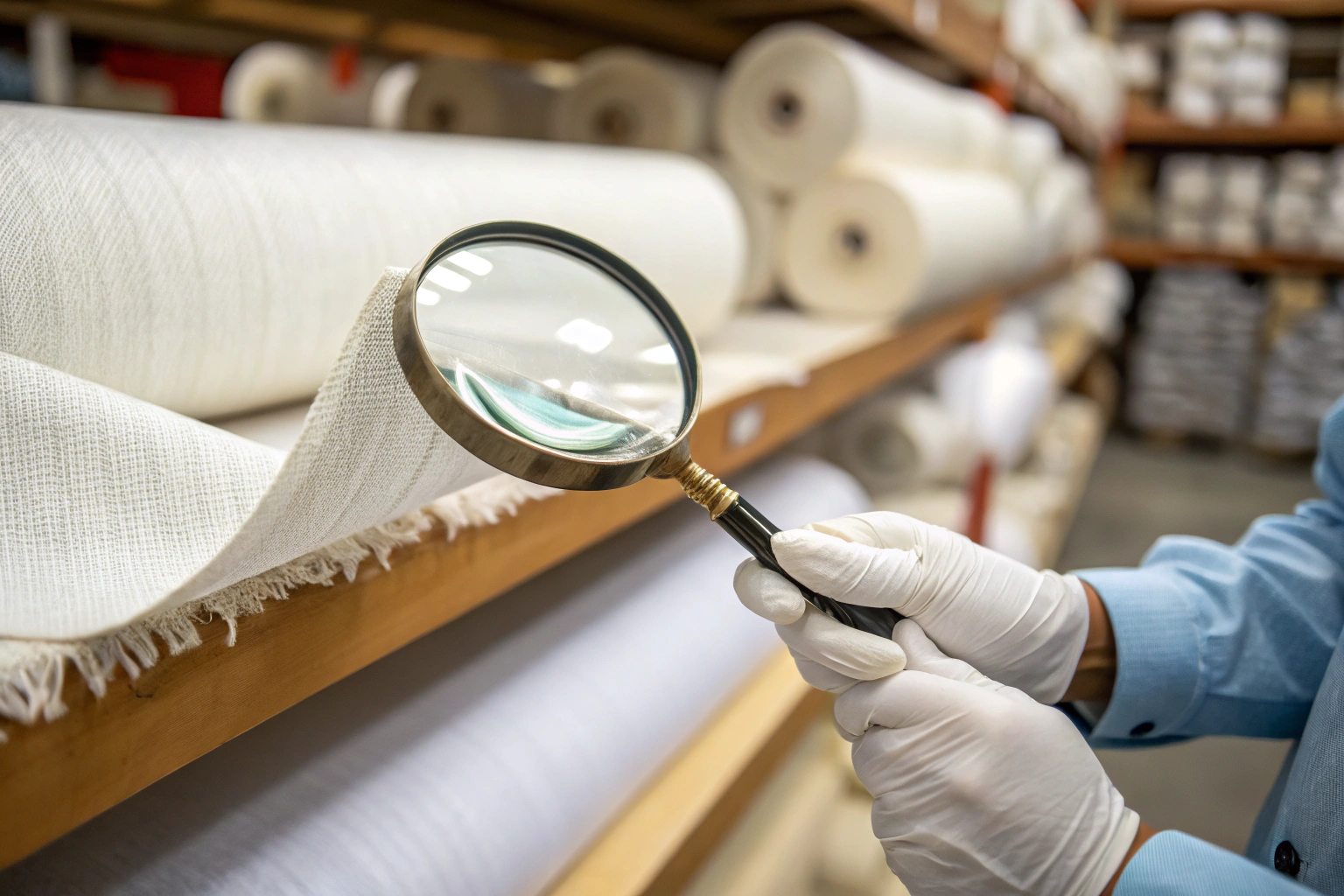
I once had a client from San Francisco call me, absolutely furious. She had received a shipment of our premium linen shirting, cut it into a beautiful button-down, and then tossed it in the wash. When it came out, she said the fabric felt "thinner than a cheap hotel sheet." I asked her a single question: "What thread count were you expecting?" She paused. "I don’t know. A high one? It says premium, so like, 600?" And right there, I realized the problem. She was judging linen by cotton rules. The thread count race—that marketing war where 800 is better than 400 and 1,000 is somehow luxurious—has completely warped how we evaluate fabric quality. Linen doesn’t play that game. A "high thread count" linen is often a stiff, boardy, over-engineered disaster that defeats the entire purpose of wearing flax in the summer.
The thread count of Fumao Fabric’s premium linen shirtings typically ranges from 40 to 80 threads per inch in the warp direction, with a total thread count between 80 and 150 when you add the weft. That’s it. Those numbers sound low because you’re used to hearing about cotton sheets with 300, 400, or 600 thread count. But linen yarns are inherently thicker, stronger, and more irregular than the ultra-fine, mercerized cotton yarns that achieve those inflated counts. A premium linen shirting doesn’t need microscopic threads packed like sardines. It needs a balanced, open weave with enough space between the fibers to breathe, to wick moisture, and to drape softly against the skin. The quality of a linen shirting isn’t measured by how many threads we can cram into an inch. It’s measured by the yarn quality, the weave precision, and the finishing. If you’ve been shopping for linen using cotton metrics, you’ve been shopping blind. Let me fix that.
Here’s what I want to do in this article. I’m going to break down exactly how thread count works—and doesn’t work—for linen shirting. I’ll explain the real quality markers you should be looking at, from the Lea count of the flax yarn to the picks per inch in the weave. I’ll share the specific specifications of our bestselling premium linen shirtings, and I’ll give you the tools to evaluate any linen fabric like a textile engineer, not a department store consumer. This isn’t just about numbers. It’s about understanding the material so you can design better garments and sell them with confidence.
Why Does Thread Count Matter Differently for Linen Than for Cotton?
The thread count confusion in linen comes from a fundamental mismatch between how cotton and flax fibers behave. Cotton fibers are flat, ribbon-like, and naturally twist around each other when spun into yarn. You can spin cotton extremely fine—up to 100s or 120s Ne in high-end shirtings—and when you pack those fine yarns tightly together, you get a smooth, lustrous, high-thread-count fabric that feels luxurious. Linen fibers are completely different. They’re cylindrical, rigid, and have a natural gum called pectin that holds the fiber bundles together. You simply cannot spin flax as fine as cotton without breaking the fibers or losing the characteristic texture that makes linen desirable. The finest linen yarns, even in premium Italian-spun qualities, top out around 60s Lea. For context, a 60s Lea linen yarn is roughly equivalent in diameter to a 40s Ne cotton yarn. The numbering systems themselves are different—linen uses the Lea system, cotton uses the English cotton count, and they don’t convert one-to-one.
When a fabric marketer tries to sell you "high thread count linen," they’re either using the term loosely, they’re blending polyester or cotton into the yarn to make it finer, or they’re counting plies as separate threads—a deceptive practice the Federal Trade Commission has warned against since the 1990s. A genuine 100% flax linen shirting with a claimed thread count above 200 is almost certainly using a multi-ply counting method or is blended with synthetics. I tell my clients to reset their expectations entirely. A beautiful, high-quality linen shirting from a mill that knows what it’s doing will have a total thread count in the 80 to 150 range, and that’s not a compromise. That’s the material’s natural sweet spot.
Let me dig into the actual physics of why a lower thread count linen can feel better than a higher thread count one. Thread count measures density—how many yarns are packed into a square inch. But density is only one variable. The diameter of the yarn is the other. If I use a thick, coarse yarn and pack it tightly, I get a high thread count number, but the fabric is heavy, stiff, and doesn’t breathe. If I use a fine, long-staple flax yarn and weave it at a moderate density, the thread count is lower, but the fabric is lighter, softer, and far more comfortable against the skin. This is the classic trap of using a single metric to judge a multi-variable product. You wouldn’t judge a car’s performance by its tire pressure alone. The same logic applies here. The key to a premium linen shirting is the balance between yarn fineness and weave density. Our bestselling 60s Lea premium linen shirting uses a 48×40 construction—48 warp yarns per inch, 40 weft yarns per inch. That’s a total thread count of 88. And it’s the most breathable, elegant, drapey linen shirting our clients have ever handled. A competitor’s "200 thread count" linen, using a coarser 24s Lea yarn packed at 100×100, feels like a canvas tote bag. Higher thread count. Much worse shirt.

What Is the Lea System and How Does It Measure Linen Yarn Quality?
The cotton world uses the English cotton count, abbreviated as Ne, which measures how many 840-yard hanks of yarn weigh one pound. A 40s Ne cotton yarn means 40 hanks, each 840 yards long, weigh one pound. The higher the number, the finer the yarn. Linen uses the Lea system, which measures how many 300-yard hanks weigh one pound. A 40s Lea linen yarn means 40 hanks of 300 yards weigh one pound. Right away, you can see why the numbers don’t match. A 40s Lea linen is a completely different thickness than a 40s Ne cotton. In fact, to convert Lea to an approximate Ne equivalent, you multiply the Lea number by about 1.6. So a 60s Lea linen—our premium shirting yarn—is roughly equivalent in diameter to a 37s Ne cotton yarn. That’s a fine shirting-weight yarn, but it’s nowhere near the 80s or 100s cotton used in luxury dress shirts.
The Lea number also tells you about the fiber quality. To spin a 60s Lea linen yarn, you need long-staple flax fibers, typically from European sources like France or Belgium, where the climate and soil produce plants with long, uniform stalks. Short fibers, or tow, can’t hold together at those fine counts. So when I specify a 60s Lea linen for your shirting, I’m implicitly specifying a premium fiber source. I’m also telling you that the yarn will have fewer slubs and a smoother, more consistent surface. A 24s Lea linen, used in our heavier casual shirting, will have more visible slubs and a more rustic texture. Neither is better in an absolute sense. They’re different tools for different garment aesthetics. But understanding the Lea system lets you decode the true quality level of a linen fabric without relying on the misleading thread count number. For a deeper technical dive, you can explore how the Lea linen yarn numbering system works and what it means for fabric quality assessment.
How Do Weave Structure and Picks Per Inch Affect Linen Shirt Quality More Than Thread Count?
Thread count treats warp and weft as equals. They’re not. The warp yarns run the length of the fabric and are under tension on the loom. They need to be stronger, more uniform, and more tightly twisted. The weft yarns run across the width, and they can be softer, more textural, and slightly less twisted because they don’t bear the same mechanical stress. In our premium 60s Lea linen shirting, we use a construction we call "60×54"—60 warp yarns per inch, 54 weft yarns per inch, total thread count of 114. But the magic isn’t in the total. It’s in the ratio. The warp-dominant construction, with slightly more warp than weft, creates a subtle vertical grain that elongates the body visually when the shirt is worn. This is the kind of detail that pattern makers and designers obsess over, and it’s completely invisible if you only look at the total thread count.
The weave structure also changes the hand feel at the same thread count. A plain weave linen shirting at 60×54 will feel crisp and cool. A twill weave with the exact same yarn count and density will feel softer, drape more fluidly, and wrinkle slightly less because the floats—the sections where the weft skips over multiple warp yarns—allow the fibers to relax. We offer our premium linen in both plain weave and a 2/2 twill, and I always send clients swatches of both because they behave so differently in a finished garment. The plain weave is perfect for a structured, architectural shirt. The twill is better for a relaxed, fluid silhouette. Same thread count. Same yarn. Completely different garment expression. This is why I encourage every client to specify the weave structure in their tech pack, not just the thread count. To understand how these construction choices translate into finished product performance, reading about the relationship between woven fabric structure, picks per inch, and garment drape behavior is essential knowledge for any serious shirt maker.
What Are the Actual Specifications of Fumao’s Premium Linen Shirting Range?
Let me give you the actual numbers, straight from our production specification sheets. I believe in radical transparency with fabric specs because I’ve seen too many buyers make expensive assumptions based on vague marketing language like "premium" or "luxury." At Shanghai Fumao, "premium linen shirting" isn’t a marketing term. It’s a specific tier of products with defined technical parameters. If you order our premium linen shirting, you know exactly what you’re getting, down to the yarn supplier and the finishing recipe. This level of detail is what separates a mill that understands garment construction from a commodity fabric trader.
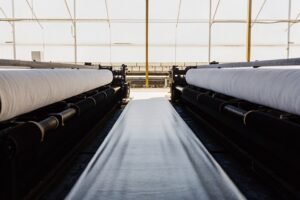
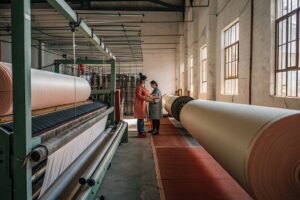
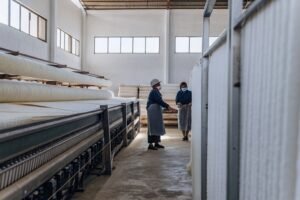
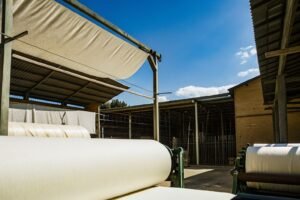
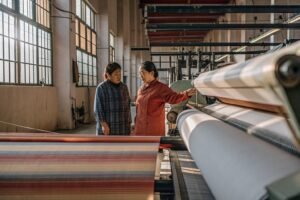
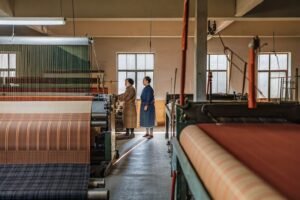
Our premium linen shirting range currently consists of three core constructions, all using European-origin long-staple flax and all woven in our Keqiao facility. The first is the Classico 60s, our flagship fine shirting. It uses a 60s Lea warp and weft in a plain weave with a 60×54 construction, giving it a total thread count of 114 and a finished weight of 130gsm. This is the fabric you choose for a refined, breathable button-down that wears cool in high summer and softens beautifully with every wash. The second is the Twill Drappo 45s, a 45s Lea linen in a 2/2 twill weave with a 68×48 construction, total thread count of 116, and a finished weight of 165gsm. The twill structure and slightly coarser yarn give it a fluid, almost silky drape that works beautifully for relaxed overshirts and shirtdresses. The third is the Rustico 36s, a 36s Lea linen in a plain weave with a 44×36 construction, total thread count of 80, and a finished weight of 200gsm. This is a heavier, more textured shirting with visible slubs and a dry, matte hand feel, perfect for workwear-inspired shirts and lightweight summer jackets.
Let me walk you through why each of these constructions exists and what they’re optimized for. The Classico 60s took our development team eight months to perfect. The challenge wasn’t the weaving. It was the finishing. A 60s Lea linen yarn is so fine that it’s vulnerable to fibrillation during wet processing—that’s when the individual fibrils that make up the flax fiber start to peel apart, creating a fuzzy, hairy surface on the fabric. To prevent this, we use a gentle bio-enzyme polish followed by a soft-flow tumble dry at precisely controlled temperatures. The result is a fabric with a thread count of only 114 that feels smoother and more refined than competitors’ coarser fabrics with higher thread counts. I remember presenting this fabric to a buying team from a major European brand at a trade show in Paris in 2024. They kept rubbing the swatch between their fingers, looking at the spec sheet, and looking back at the swatch. The senior buyer finally said, "This can’t be only 114. It feels like 200." I replied, "That’s because you’ve been conditioned to equate smoothness with density. They’re not the same thing."

What Is the Weight Range and Opacity of Each Premium Shirting Construction?
The thread count tells you about density, but the weight—measured in grams per square meter, or GSM—tells you about substance. These two metrics interact in ways that directly affect how the fabric performs in a garment. The Classico 60s at 130gsm is our lightest shirting. At this weight, white and natural shades have a slight translucency when held up to direct light. This is not a defect. It’s a characteristic of fine linen, and many high-end brands exploit it by designing shirts that reveal a subtle silhouette line, adding depth and sensuality to the garment. If you need full opacity, a double-layer yoke or a front placket in a self-fabric double layer solves the issue without changing the fabric.
The Twill Drappo 45s at 165gsm hits the sweet spot for most ready-to-wear applications. The twill weave naturally packs more yarn into the structure because the floats allow the weft to beat in tighter. This increased density, combined with the heavier yarn, makes the fabric fully opaque even in white. It’s also more forgiving to sew because the twill structure has more give and doesn’t fray as aggressively at the cut edges as a plain weave. The Rustico 36s at 200gsm is fully opaque and almost behaves like a lightweight jacketing fabric. Some of our clients use it for unstructured blazers as well as shirts. The heavier weight gives it excellent wrinkle recovery—the fabric has enough mass that gravity pulls out lighter creases when the garment is hung overnight. For more information on choosing the right weight for your specific end-use, understanding how linen fabric weight and opacity affect garment design and end-use applications is a valuable skill.
How Do Our Finishing Treatments Affect the Thread Count and Final Hand Feel?
The thread count I specify on our data sheets is the finished thread count—the count after all wet processing, drying, and dimensional stabilization. This is important because the greige fabric straight off the loom has a different count than the finished fabric. During wet finishing, linen fabric shrinks. The warp yarns swell and contract, pulling the weft yarns closer together. A greige construction of 56×50 might finish at 60×54 after the wash and dry cycle. I always report the finished count because that’s what you’re actually sewing with.
Our standard finishing for premium linen shirting includes an enzyme wash to remove surface fuzz, a softener application to achieve the specific hand feel the client requests, and a compressive shrinkage treatment to stabilize the dimensions. The enzyme wash is particularly critical for the Classico 60s. Without it, the fine yarns fibrillate and the fabric feels rough. With it, the surface is clean and smooth. The softener is customized. Some clients want a dry, crisp "paper" hand. Others want a soft, peach-skin hand. We can achieve either by adjusting the softener chemistry—a silicone-based softener gives a slick, slippery feel, while a fatty acid-based softener gives a waxy, plush feel. Neither affects the thread count, but both dramatically affect how the fabric feels to the wearer. I always send clients a "finishing menu" with three hand-feel options for each shirting base, along with physical swatches, so they can make an informed choice. The spec sheet might say "60×54, 114 TC" on all three, but the finished fabrics will feel completely different. This is the art of textile finishing, and it’s what makes a custom-developed fabric worth the investment.
How Should You Evaluate Linen Shirting Quality Beyond the Thread Count Number?
You’ve got a thread count number now—maybe 114 for our Classico, maybe 80 for our Rustico. But a number on a spec sheet doesn’t tell you if the fabric will make a great shirt. You need a different set of evaluation criteria, ones that actually correlate with garment performance and customer satisfaction. I’ve been inspecting linen fabric for twenty years, and I’ve developed a simple, five-factor evaluation framework that I teach to all my buying office clients. It doesn’t require a lab. It requires your eyes, your hands, and a little bit of water.
The five factors I evaluate on every linen shirting sample are: yarn evenness, weave consistency, hand feel and drape, wrinkle recovery, and wash performance. Yarn evenness is the first thing I check. Hold the fabric up to a window or a lightbox. Look at the warp yarns running vertically. Are they consistent in thickness, or do you see thin spots that will break under tension? In linen, some slub variation is natural and desirable. But a "thin place" in the yarn—where the diameter suddenly drops by 30% or more—is a defect that will cause a hole in the garment after repeated washing. Weave consistency is the second check. Look at the overall surface. Are there any missing picks, where a weft yarn didn’t insert properly, leaving a horizontal gap? Are there any reed marks, which are vertical lines caused by a damaged reed dent? These defects are rare in our production because our inspection tables catch them before packing, but if you’re evaluating a sample from any supplier, you need to know what to look for.
Hand feel and drape are subjective but critical. I evaluate hand feel by rubbing the fabric against my inner wrist, not my fingertips. The skin on your inner wrist is more sensitive and more similar to the skin on a wearer’s torso or neck. A fabric that feels soft to your calloused fingertips might still irritate a sensitive neck. I evaluate drape by draping the fabric over my fist and letting it cascade down. A good linen shirting should form soft, rounded folds, not stiff, angular peaks. If the fabric stands up in sharp points, it’s over-starched or the yarn is too coarse for the construction. Wrinkle recovery I test by balling the fabric up in my fist for thirty seconds, then releasing it and laying it flat. Linen will wrinkle—that’s part of its identity—but a premium linen should relax its wrinkles somewhat over the next ten minutes as the fibers reabsorb ambient moisture. A fabric that stays as crumpled as a piece of aluminum foil after ten minutes has poor recovery and will look terrible by lunchtime.

How Do You Test a Linen Swatch for Shrinkage and Colorfastness at Home?
You don’t need a lab coat to run meaningful textile tests. For shrinkage testing, I teach my clients a simple home method. Cut a 20cm by 20cm square from your linen swatch. Mark the exact center with a ballpoint pen—draw a 10cm line in the warp direction and a 10cm line in the weft direction, forming a cross. Measure the lines precisely with a ruler and write down the numbers. Then wash the swatch in your home machine on the cycle you’d recommend to your customers—typically a gentle cold cycle for linen. Hang it to dry. Don’t put it in the dryer; linen and dryers are not friends. Once dry, measure the lines again. The difference divided by the original length gives you the shrinkage percentage. Our premium linen shirtings are guaranteed to shrink less than 2% in both directions because of our compressive finishing, but you should verify this yourself on every sample. I once caught a finishing error where a batch of Classico 60s came out of the tenter frame with 3.5% residual warp shrinkage because a technician had set the overfeed rate incorrectly. That batch never shipped to the client. We re-finished it. That’s what testing catches.
For colorfastness, take a clean white cotton cloth—an old white t-shirt works perfectly—and rub it firmly against the dyed linen swatch twenty times. Then wet the white cloth and rub again. If color transfers to the white cloth, the dye is crocking, and it will stain your customer’s white leather bag or light-colored pants. A small amount of color transfer on the wet rub is common with deep, saturated colors like navy or black, but it shouldn’t be heavy. For a more precise test, cut a small piece of your white test cloth, sew it to the linen swatch along all four edges, and throw the whole assembly in the wash. If the white fabric comes out tinted, the dye is bleeding, and you need to talk to your supplier about fixing the dye recipe. Our standard is an AATCC Grade 4 for dry crocking and Grade 3.5 for wet crocking. For a step-by-step visual guide on these procedures, you can learn how to perform home textile quality tests including shrinkage and crocking assessments on fabric swatches.
Why Does the Origin and Staple Length of the Flax Fiber Matter for Long-Term Durability?
The thread count, the weave, the finish—all of that sits on top of the foundational variable, which is the raw fiber itself. Flax is grown in several regions globally, but the premium shirting market overwhelmingly relies on European flax, primarily from the coastal belt stretching from Normandy in France through Belgium and into the Netherlands. This region has a specific combination of cool maritime climate, rich soil, and long summer daylight hours that produces flax plants with tall, uniform stalks and long individual fibers. The staple length of these fibers—the average length of a single flax fiber cell—ranges from 60mm to 90mm in top-grade scutched flax. Longer fibers mean fewer fiber ends in the yarn. Fewer fiber ends mean less surface fuzz, less pilling, and a smoother, stronger yarn.
Short-staple flax, or tow, is a byproduct of the long-staple production process. It’s cheaper, and it’s often used in coarser fabrics like upholstery or canvas where a rustic texture is acceptable. But for a premium shirting, short fibers are the enemy. They create weak points in the yarn where the short fibers can’t transfer load effectively to their neighbors. Under the repeated stress of wearing and washing, those weak points fail, and the yarn breaks. The garment develops small holes, often at stress points like the elbow or the collar fold. I’ve seen this happen with "cheap premium" linen shirts that were marketed as high-quality but used short-staple tow from non-European sources. The shirts looked beautiful on the hanger. They fell apart after three washes. At Shanghai Fumao, we specify long-staple European flax for all our premium shirting yarns, and we require our spinners to provide a fiber analysis certificate with every lot. That certificate includes the average staple length, the short fiber content percentage, and the fiber strength in centinewtons per tex. If the short fiber content exceeds 5%, we reject the lot. This is the level of sourcing discipline that produces a linen shirting that lasts for years, not months.
Conclusion
If you take one thing away from this article, I hope it’s this: stop asking about thread count on linen. It’s the wrong question, and it leads you to the wrong fabric. A premium linen shirting like our Classico 60s, with its modest total thread count of 114, will out-perform, out-drape, and out-last a coarser, over-dense "high thread count" linen every single time. The metrics that actually matter—the yarn Lea count, the construction balance, the fiber origin, the finishing precision—are the metrics I obsess over in our Keqiao mill every day. They’re the metrics that determine whether a shirt feels like a second skin or a potato sack.
We’ve covered the Lea system and why a 60s Lea linen is a premium yarn. We’ve walked through our three core shirting constructions—the Classico, the Twill Drappo, and the Rustico—with their specific thread counts, weights, and end-use recommendations. I’ve shared my personal five-factor evaluation framework and shown you how to run simple shrinkage and crocking tests on your own studio table. The overarching lesson is this: linen is not cotton. It has its own quality language, its own performance characteristics, and its own standards of excellence. Learning that language puts you in control of your fabric sourcing decisions.
If you’re ready to feel the difference that properly specified linen shirting can make in your collection, I want to send you the swatches. At Shanghai Fumao, we offer a comprehensive shirting sample pack that includes all three premium constructions in both plain weave and twill, with our three standard finishing options. You can touch the difference between a 60s Lea plain weave and a 45s Lea twill. You can wash them, crumple them, and test them yourself. Our Business Director, Elaine, handles all sample requests and can put together a package tailored to your specific shirting project. Reach out to her at elaine@fumaoclothing.com with your requirements, and she’ll get the swatches moving within 24 hours. Let’s move past the thread count myth and into real fabric quality.