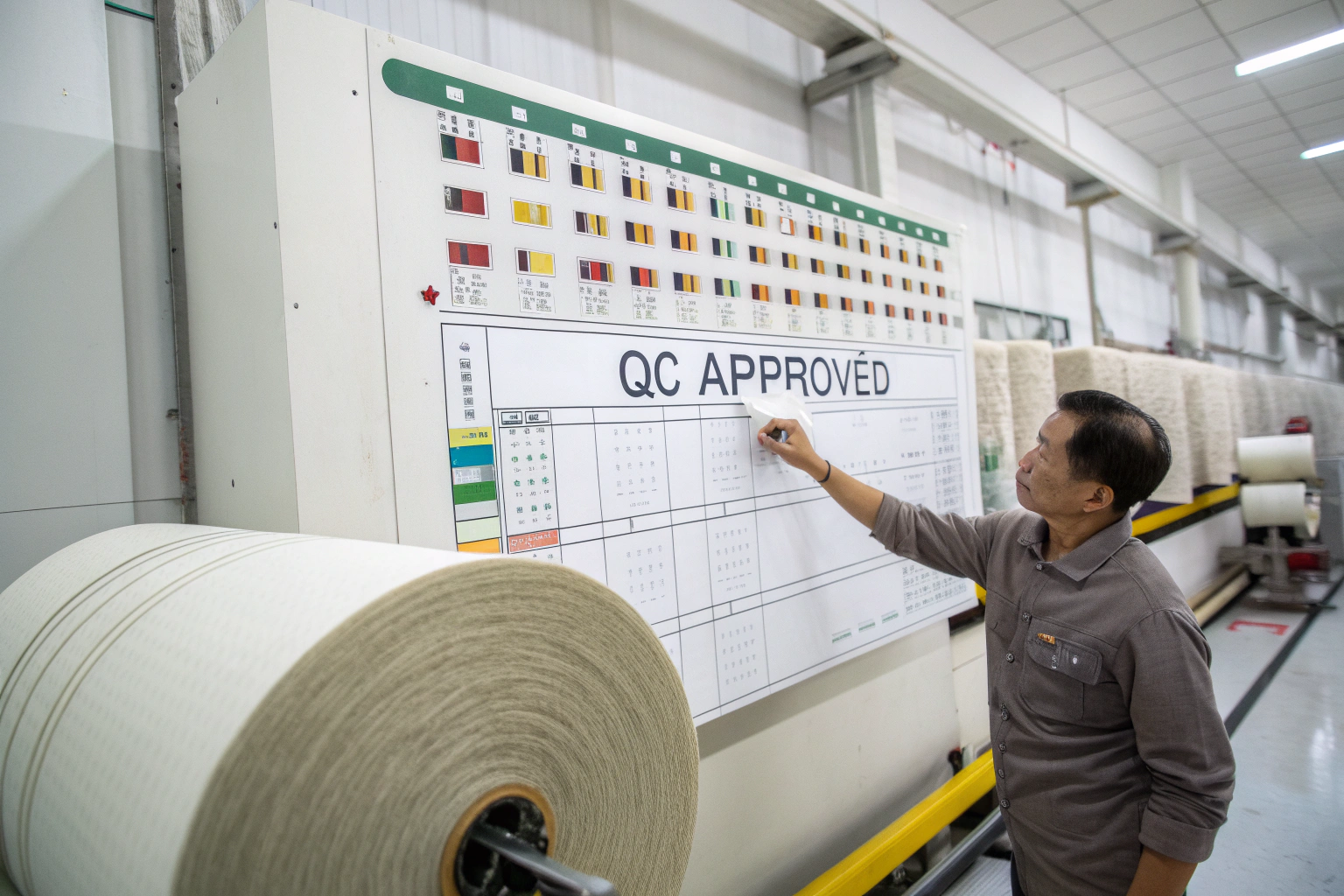
I’ve been in this mill for twenty years, and there’s one question that makes or breaks a brand’s launch. It’s not about price. It’s not about weight. It’s "When will it arrive?" You have a trade show booth booked for February. You have a pre-order campaign going live in March. And now you’re staring at a spec sheet for a fabric that doesn’t even exist yet. A custom blend of linen and cotton that needs to be spun, woven, dyed, and finished to your exact specifications. The anxiety here isn’t just about waiting. It’s about the terrifying gap between your brand’s promise to your customers and a factory’s reality on the ground. If we miss your window, you miss your season. That’s not drama. That’s just math.
The lead time for custom linen cotton fabric at Shanghai Fumao’s factory runs between 25 and 40 working days from deposit confirmation to shipment readiness, depending on the complexity of your specifications. A simple custom weight adjustment on an existing construction takes about 25 days. A fully custom yarn-dyed jacquard with multiple finishing stages pushes closer to 40 days. I’m not going to give you a vague range and walk away. I’m going to walk you through exactly where every single day goes, from the yarn spinning mill to the final inspection table, so you can plan your collection calendar with surgical precision. This isn’t just about our factory speed. It’s about giving you the tools to never miss a delivery deadline again.
Here’s the thing most mills won’t tell you: the physical weaving of your fabric only takes about 15% of the total lead time. The rest is preparation, waiting, testing, and finishing. Understanding this breakdown is what separates experienced importers from anxious first-timers. I’ve shipped custom fabric to over 100 countries from our base in Keqiao, and the brands that succeed are the ones who build this timeline into their development calendar from day one. Let me show you exactly how the clock ticks, where the bottlenecks hide, and how we compress timelines without cutting corners on quality.
What Factors Most Influence the Lead Time for Custom Fabric Development?
You might assume that a "simple" custom fabric should be fast. "It’s just linen and cotton blended together, right? How complicated can it be?" I hear this from startup founders all the time. They think custom means "pick a color and go." The reality is that every single custom parameter you specify triggers a chain reaction of setup time. The real source of delay isn’t laziness on the mill’s part. It’s the physics of fiber behavior and the queuing system of a busy factory. When you understand what actually eats up the calendar days, you can make smarter design decisions that naturally shorten your lead time without sacrificing the uniqueness of your collection.
The three biggest factors that influence custom lead time are yarn availability and sourcing, the complexity of your color application, and the number of finishing stages you require. Let me break these down from the factory floor perspective. Yarn availability is the silent schedule killer. If your design calls for a specific 14s flax yarn with a particular twist level, and we don’t have it on the shelf, we have to order it from the spinner. That alone can add 7 to 10 days. We keep a massive inventory of standard yarn counts in our Keqiao warehouse, but "custom" often means exactly that—a yarn that nobody stocks. The second factor is color. A solid piece-dyed fabric is relatively quick because we can dye the entire roll in one bath. But if you want yarn-dyed stripes or checks, we have to dye the individual yarn cones before warping the loom. That step adds 4 to 6 days of dyeing and drying time before weaving even begins. The third factor is finishing. Every wash, every coating, every enzyme treatment adds a processing day and a drying day. A triple-finish fabric with bio-polishing, a softener wash, and a dimensional stability treatment doesn’t just take three extra days. It takes five because of the quality control checks between each stage.
Let me get into the weeds on this, because I want you to have the same mental model I use when I quote a lead time to a new client. I think of the factory as a hospital emergency room. The standard stock fabrics are like a patient with a sore throat. They go through triage quickly and leave in a few hours. A custom fabric is like a patient needing multiple surgeries from different specialists. The yarn specialist, the dye specialist, and the finishing specialist all have their own schedules, and the patient has to wait between operations. Our production planning department uses a digital scheduling system called an ERP to track every order’s "critical path." The critical path is the longest chain of dependent tasks. If your yarn is late from the spinner, everything else shifts. No amount of rushing the weaver will pull back that lost week.
Another factor that surprises newcomers is the minimum processing quantity at our partner dye houses. A lab dip uses one liter of water and dyes a tiny swatch. The bulk dyeing uses a 500-kilogram capacity jet dyeing machine. The dye house won’t load your 80-kilogram order into that machine until they have a full batch or until you pay a surcharge for a partial load. The scheduling of these batch runs is a weekly affair, not a daily one. If you miss the Wednesday dye batch cut-off by one day, your fabric waits until the following Wednesday. That’s seven calendar days gone, just from the rhythm of industrial scheduling. I’ve learned to communicate these rhythms transparently.

How Does Yarn Sourcing and Custom Spinning Extend Your Production Calendar?
When you tell me you want a custom linen-cotton blend with a specific slub texture or an unusual ratio like 70% flax and 30% organic cotton, the clock starts ticking on the yarn level. We don’t just pull that off a shelf. We work with a network of spinning mills here in Zhejiang province that specialize in long-staple fibers. The first step is sourcing the raw fiber bales. For European flax, which commands a premium and a longer lead time, the fiber often comes from France or Belgium, processed into sliver, and then shipped to our spinners. The shipping of the flax sliver alone can take two weeks if it’s not already in China. For the cotton component, if you require a specific origin like Supima or GOTS-certified organic, the lead time extends further because the documentation chain for certification must be verified before the yarn is even spun.
Once the fibers are in the spinner’s warehouse, the real work begins. The spinner has to blend the fibers precisely to your ratio in a blow room, card them into a uniform web, and then draw and twist them into the exact yarn count you specified. If you want a Ne 10.5 slub yarn with a specific slub pattern—meaning the thick and thin variations happen at a deliberate rhythm—the spinner has to reprogram the ring frame machine. That programming and testing loop takes about 2 to 3 days. They spin a small sample cone, we test the tensile strength and the twist per inch in our lab, and we send you a photo for visual approval. I recall a specific project in March 2025 for a San Francisco designer who wanted a "cloud" texture on a 45% linen 55% cotton base. The spinner ran four trials adjusting the slub length from 40mm to 65mm before we nailed the look. That yarn development added 12 days to the project, but the resulting fabric was the hero of her collection. You can learn more about these preliminary steps by reading about how to specify custom yarn spinning parameters for small-batch woven fabric production.
How Do Dyeing Method Choices Accelerate or Delay Your Order?
The moment you move beyond "natural unbleached," you step into a world of scheduling complexity. There are essentially three dyeing routes for custom linen-cotton, and each has a radically different timeline. Route one is piece dyeing, where we weave the fabric in its natural greige state and then dye the entire roll in one bath. This is the fastest route. From greige to finished dyed fabric, the process takes about 5 to 7 days, including the dye cycle, washing, and drying. Route two is yarn dyeing, where we dye the individual yarn cones before weaving. This is how you get woven-in stripes, plaids, or a heathered effect where the warp is one color and the weft is another. Yarn dyeing adds 5 to 7 days of dye house time before the warping and weaving can even begin. Route three is garment dyeing, which isn’t our direct responsibility as a fabric mill, but we have to build the fabric to withstand that process, meaning we adjust the shrinkage allowance.
The real hidden time sink in dyeing is the color approval loop. We send you a lab dip. You review it under your studio lights. You ask for it to be "a touch warmer." Our colorist adjusts the reactive dye recipe, re-dips, and re-sends. Each iteration of this loop consumes 2 to 3 days. If we go through three rounds of color approval, you’ve added over a week to the calendar. I always advise my clients to send a physical Pantone chip or a snipping of existing fabric from their previous collection as the target. Digital photos on WhatsApp are the enemy of accurate color. I learned this the hard way in 2022 when a client approved a sage green based on a phone photo, and the bulk came out looking like mint toothpaste. Since then, we require physical approval on all custom colors. The extra three days of courier time for the physical swatch is cheap insurance against a six-week re-dye disaster. To see how professionals manage this delicate phase, explore this guide on managing the lab dip color approval process for textile manufacturing efficiently.
How Long Does the Weaving and Finishing Process Take at Our Keqiao Factory?
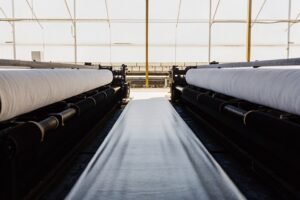
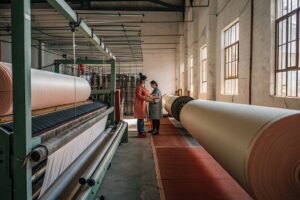
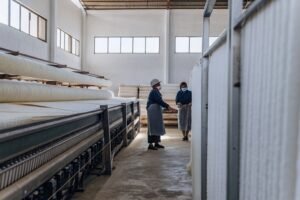
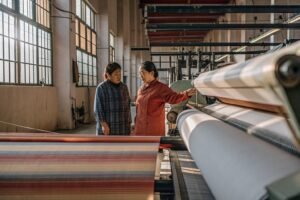
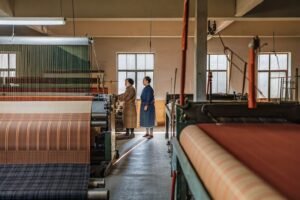
Let’s assume the yarn is finally sitting in our warehouse, correctly spun and approved. Now the real industrial ballet begins. The weaving and finishing phase is where I have the most direct control, because this happens right here in our facility and our immediate partner network within the Keqiao textile cluster. This is a 30-kilometer radius of specialized factories, and it’s the reason we can offer timelines that mills in other regions can’t match. But "control" doesn’t mean "instant." The machinery demands setup time, and the physics of wet processing can’t be rushed without destroying the fabric. I’m going to walk you through the exact sequence of operations on the floor, from the warping creel to the final inspection table.
The core weaving and finishing phase for a custom linen-cotton fabric spans roughly 12 to 16 working days. This breaks down into 2 to 3 days for warping and loom setup, 3 to 5 days for the actual weaving (depending on the meterage and the pick density), and 7 to 8 days for the wet finishing, drying, and dimensional stabilization. The weaving speed is surprisingly fast on our modern rapier looms—we can run about 300 to 400 picks per minute on a standard plain weave. But the setup before the loom runs is meticulous. A single error in the warp beam preparation, like a crossed end, will create a streak down the entire length of the fabric. My warping supervisor, who has been doing this for 18 years, checks every beam with a magnifying glass before it goes to the loom. That’s not a delay. That’s quality.
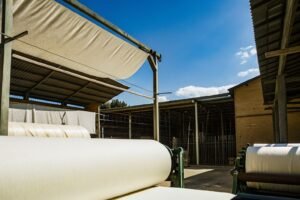
Let me explain the rhythm of the finishing department because it operates on a completely different clock than the weaving floor. The weaving department is about mechanical speed and shift schedules. The finishing department is about chemical reactions, water temperature, and drying time. You cannot speed up an enzyme wash. The cellulase enzymes need exactly 45 to 60 minutes at precisely 55 degrees Celsius to eat the micro-fuzz off the linen fibers. If you pull the fabric out ten minutes early, the hand feel is scratchy and inconsistent. Similarly, the tenter frame dryer runs at a specific speed because the fabric needs a certain dwell time in the heated chamber to reach its target moisture regain of 8% to 10%. If you crank the speed and the fabric comes out at 4% regain, the yardage will be artificially light and you’ll pay for water weight you aren’t getting. I test the regain of every batch with a halogen moisture analyzer. It takes 90 seconds per test, and I do it three times per batch. That’s the level of nerdiness that keeps your fabric dimensionally stable.

How Does the Warping and Loom Setup Time Impact Small Custom Orders?
This is the part of the process that small-batch buyers often misunderstand. They see a loom running at 350 picks per minute and think, "My 200 meters can be done in a few hours." The weaving is fast. The preparation is not. Warping is the process of taking hundreds of individual yarn cones and winding them side-by-side onto a massive beam under perfectly equal tension. For a custom order, we have to creel the yarn, which means loading each cone onto a frame. A typical warp beam for a 60-inch wide linen-cotton fabric might have 3,600 individual ends. Each end has to be threaded through a heddle eye and a reed dent. This threading process, called drawing-in, is done by hand by skilled technicians. For a complex pattern like a custom dobby weave, drawing-in can take two skilled workers a full day.
The loom setup also includes a critical "first meter" inspection. We weave about five meters of your fabric, cut it off the loom, and rush it to the lab for a full analysis. We check the picks per inch against your specification. We check the width—greige fabric is always woven wider to allow for shrinkage in the finishing stage, a calculation we call the "finishing allowance." If the picks per inch are off by more than 2%, we adjust the loom’s take-up gearing and re-run another first meter. This calibration loop is non-negotiable. I remember an order from a Melbourne designer in August 2024 for a very specific 120gsm open-weave linen-cotton for resort kaftans. The first meter came out at 115gsm—too light, would have been transparent. We adjusted the beat-up mechanism to pack in slightly more weft, and the second trial hit 122gsm. That calibration consumed four hours. But without it, the entire 300-meter roll would have been useless to her. For more context on these operational steps, you can read up on how warping and loom setup times affect minimum order quantities for custom woven textiles.
What Quality Control and Testing Gates Add Necessary Time Before Shipment?
I’ve mentioned QC checks throughout this article, but I want to consolidate them into a single timeline sequence so you understand why we don’t just weave it, fold it, and ship it. Our standard QC gate process for custom fabric adds a hard 3 to 4 days to the schedule after the fabric is finished. This is not optional. This is the "insurance policy" phase. The sequence goes like this. Day one after finishing: conditioning. The fabric rests in a controlled environment at 65% relative humidity and 20 degrees Celsius for at least 24 hours. This allows the fibers to relax to their natural equilibrium moisture content. Testing fabric straight off a hot dryer gives false shrinkage readings.
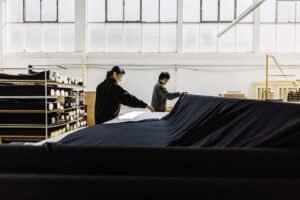
Day two: physical testing. We cut samples from the beginning, middle, and end of the production roll. These samples go to our CNAS-accredited lab for a battery of tests. Shrinkage is tested according to AATCC 135, usually a 40-degree Celsius home laundry simulation. Colorfastness to crocking is tested under AATCC 8. Tensile strength is tested on a universal testing machine—for a 200gsm linen-cotton, we want to see at least 350 newtons in the warp direction. Seam slippage is tested by pulling a stitched seam apart under a fixed load. Each test has a standard time to run, and the lab report generation takes a few hours. Day three: visual inspection. Every single meter of your custom fabric passes over our backlit inspection table. Our inspectors scan for weaving defects, dye spots, and finish inconsistencies at a speed of about 15 meters per minute. They mark defects with small stickers and record the type and location in our digital system. If the defect points exceed our agreed standard—usually a 4-point system where a major defect is worth four points per linear meter—we flag the roll for review. Sometimes the roll passes. Sometimes it needs rework. Sometimes we scrap it and pull from the overage we always weave. To understand these standards in depth, examining how to interpret a 4-point fabric inspection report for custom textile orders will give you the vocabulary to discuss quality with any mill.
How Can You Strategically Reduce Your Custom Fabric Lead Time Without Sacrificing Quality?
I’ve just spent a lot of time explaining why custom fabric takes a month or more. But I’m not in the business of telling you "that’s just how it is." I’m in the business of finding you a competitive edge. Over the years, I’ve developed several strategies with my regular clients that legitimately shave 7 to 10 days off the standard lead time without touching the quality. These aren’t tricks. They are operational maneuvers that require a bit of trust and a willingness to plan differently than the rest of the industry. The brands that work with me for years, season after season, don’t just accept the standard calendar. They manipulate it.
You can strategically reduce your custom lead time by decoupling the greige weaving from the dyeing decision, booking loom slots in advance during slow seasons, and standardizing your finishing recipe across multiple fabric weights. Let me explain each of these with concrete examples from our factory. Decoupling means you order the greige fabric—the raw, unbleached, unfinished cloth—before you have finalized your seasonal color palette. Greige weaving is the slowest and most machinery-constrained part of the process. If we weave 300 meters of your custom 60% linen 40% cotton twill in June, during our quiet season, it takes the standard two weeks. It then sits in our humidity-controlled warehouse, labeled with your company name. In July, when you’ve finalized your four Pantone colors, we send the already-woven rolls to the dye house. The dye house only takes a week. Your total felt lead time is seven days instead of thirty. A New York-based client of mine has been doing this for three seasons now with her linen blazer line. She places her greige order in November, stores it in our warehouse, and then drip-feeds dye instructions in January. She consistently gets her fabric before her competitors even receive their first lab dips.
The second powerful lever is what I call "recipe standardization." Many designers ask for slightly different finishing softeners on every fabric in their collection. One fabric gets a silicone wash, another gets a cationic softener, a third gets a bio-polish. Each of these finishes requires a separate bath, a separate machine setup, and a separate QC test. If you standardize your finishing across your entire collection, you save about 2 to 3 days in the finishing department because we can run all your batches through the same machine setup consecutively. I often tell my clients, "Pick one hand feel for your brand." Maybe your brand DNA is a soft, peach-skin touch. Let’s apply that exact enzyme-and-softener recipe to your 150gsm blouse weight, your 220gsm dress weight, and your 300gsm jacket weight. The fabrics behave differently, but the process is identical, and they share a cohesive tactile identity that your customers recognize as "your brand feel." This isn’t just efficient. It’s brilliant branding.

How Can Pre-Booking Loom Slots During Quiet Seasons Accelerate Your Order?
The factory calendar has a heartbeat. The peak periods—March through May and August through October—are when the massive fast-fashion and ready-to-wear brands run their bulk. If your small custom order enters the queue during these months, it’s competing with 50,000-meter runs for the same looms. But in the quieter months of June to July and November to December, the looms are hungry. I actively encourage my boutique and startup clients to align their development calendars with these windows. If you can place your custom weaving order in early June for a Fall collection or in early November for a Spring collection, you benefit from the "Quiet Season Effect." The looms are available immediately. The dye houses are less congested. The finishing technicians have more time to focus on your specific requirements rather than rushing through a backlog.
Pre-booking is the formal version of this strategy. You give us a 30% deposit to reserve a specific loom on a specific week, six months in advance. This is what the big brands do. There’s no reason a small brand can’t do it too. We draft a "Loom Reservation Agreement" that specifies the loom type, the dates, and the yarn specifications. This locks in your production slot contractually. A small womenswear label from Vancouver did this with us for the first time in 2025. They booked a dobby loom for the first week of July for their custom waffle-weave linen-cotton. In May, they finalized the exact yarn dyed stripe pattern. When July arrived, their yarn was already creeled and the loom was waiting. We wove 400 meters in four days and shipped it by July 20th. Total development time felt like two weeks, even though the planning had started months earlier. This is supply chain mastery, and it’s available to anyone willing to plan ahead.
Why Does Simplifying Your Color and Finish Specs Speed Up the Entire Pipeline?
I’ve hinted at this, but I want to make it explicit because it’s the most immediate action you can take today to get your fabric faster. Every additional colorway in your custom order adds a separate dye lot. Each dye lot requires its own lab dip, its own bulk dye recipe, its own machine cleaning cycle, and its own post-dye QC testing. If you order five colorways, you’re not just multiplying the dyeing time by five. You’re adding in the time for the dye machine to be drained, cleaned, and re-filled between each lot. That’s roughly 2 to 3 hours per changeover. A five-color order might eat up an entire extra day just in transition time compared to a single-color order.
The same applies to finishes. A fabric that has to go through a bio-polish enzyme bath, then a softener bath, then a stenter frame for dimensional stability, and finally a sanforizing compressive shrinkage machine is a fabric that has to be physically moved, wet out, dried, and tested between stages. If you can choose either enzyme softness or dimensional stability as your priority—rather than both—you save days. I often have a frank conversation with designers about their "must-haves" versus their "nice-to-haves." Is a slightly softer hand feel really worth an extra five days of lead time if it means missing the Paris trade show? Sometimes the answer is yes. But very often, once the designer understands the time cost, they choose the simpler route and are thrilled with the result. The fabric is already linen-cotton. It’s naturally beautiful. Sometimes we over-engineer things out of anxiety, and a simpler spec sheet is faster, cheaper, and often better for the garment’s drape. For more insights on streamlining your design specs, you might find value in exploring how to balance custom fabric specifications with realistic production lead times.
Conclusion
Custom lead time is never just a single number. It’s a story of a thousand small decisions made on the factory floor, from the spinner’s twist settings to the dye house’s batch scheduling to the QC inspector’s sticker roll. We’ve walked the entire length of that timeline together. We started with the 25 to 40 working day baseline and then dissected it into its component parts: the 7 to 10 days for custom yarn sourcing, the 4 to 6 days for color approval loops, the 3 to 5 days for warping and weaving, the 7 to 8 days for finishing, and the non-negotiable 3 to 4 days for quality control testing. I’ve tried to give you the same mental model I use every morning when I review the production schedule on my desk—a model that respects the physics of fibers and the realities of factory scheduling, not just the promises of a sales pitch.
But more importantly, I’ve shared the strategies that the smartest brands I work with use to bend time in their favor. Decoupling greige from color. Pre-booking quiet season loom slots. Standardizing a signature hand feel across an entire collection. These aren’t theoretical concepts. They’re working tactics used right now by designers in New York, Melbourne, and Vancouver who refuse to be victims of the standard calendar. The ultimate lesson is this: lead time is negotiable. Not in the sense that you can demand the impossible, but in the sense that you can architect your development process around the realities of the supply chain rather than fighting against them. The brands that win are the ones who treat the factory not as a black box that spits out fabric on a mysterious schedule, but as a partner whose rhythms they understand and whose capabilities they strategically leverage.
If you’re ready to start the conversation about your own custom linen-cotton fabric—and you want a realistic, detailed timeline that you can actually build your launch calendar around—I want to hear from you. At Shanghai Fumao, we don’t just quote you a number. We walk you through a draft production schedule that maps every stage against specific calendar dates, so you know exactly when the yarn order goes out, when the loom starts running, and when the QC report lands in your inbox. This is the level of transparency I believe every brand deserves. Reach out to our Business Director, Elaine, and she’ll put together an initial timeline estimate based on your specific fiber blend, weight, and finishing requirements. Just send your tech pack, your mood board, or even just a description of what you’re dreaming up to elaine@fumaoclothing.com. Let’s build something beautiful, on time.