
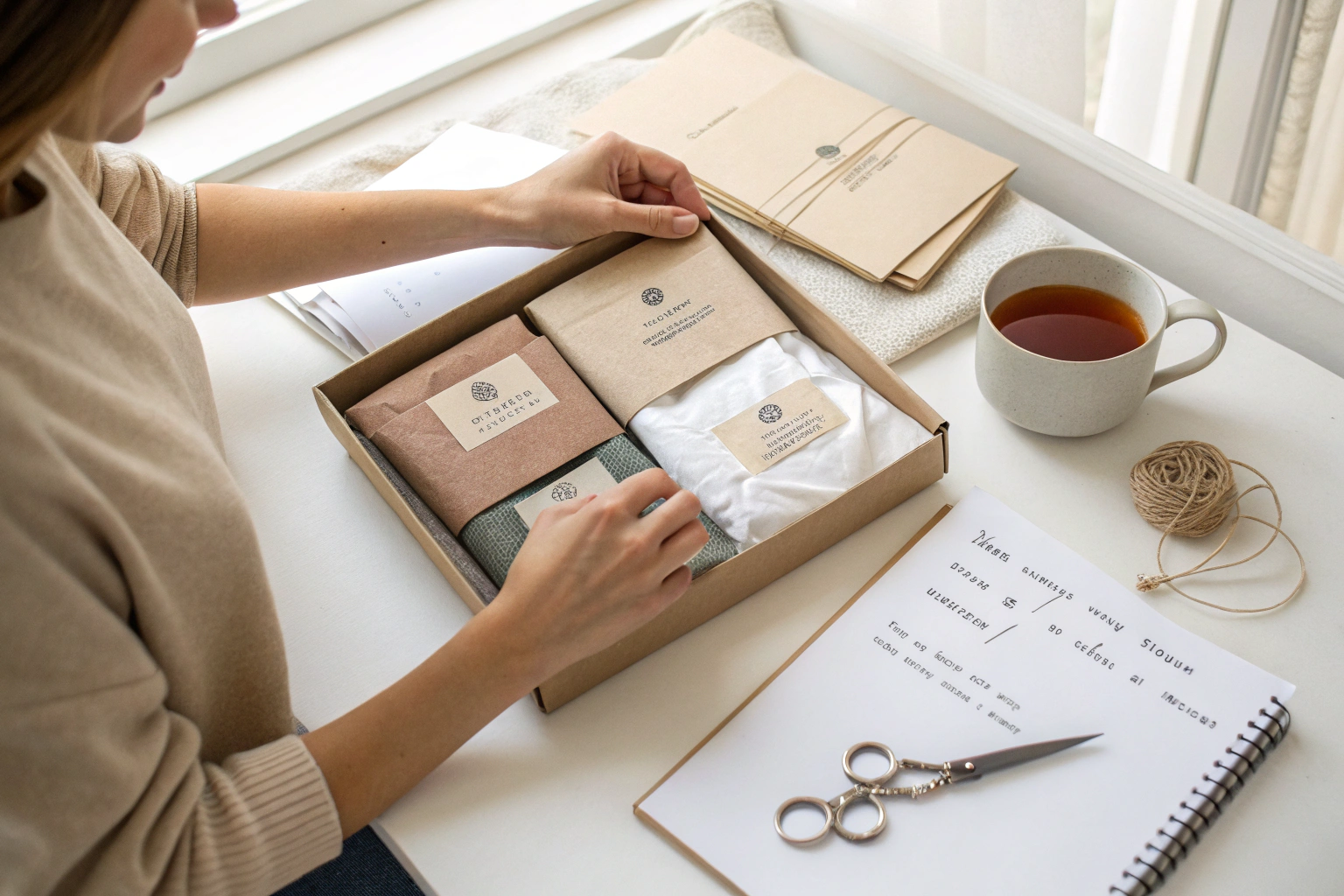
I get it. You’ve fallen in love with a fabric online—maybe you’ve been scrolling through our catalog at Shanghai Fumao for hours—but clicking that "order" button for a bulk roll worth thousands of dollars feels like jumping off a cliff blindfolded. What if the color is slightly off? What if the hand feel doesn’t match the drape you imagined for your spring dress collection? The anxiety is real. You are a boutique owner, not a giant corporation. You can’t afford to eat the cost of 200 meters of fabric that doesn’t work. The fear of wasting capital on an unseen product is the single biggest reason small brands hesitate to source from overseas suppliers like us. That hesitation can stall your entire creative process.
Yes, we absolutely ship small cotton linen samples for your boutique, and we have optimized the entire process to be fast, nearly free, and incredibly informative. We don’t treat samples as an afterthought; we treat them as the first step of our partnership. Whether you need a few standard hanger swatches to check the color against your mood board, or you need custom-developed lab dips on our proprietary bamboo-cotton slub, we can get them to your door. At Shanghai Fumao, we keep an active library of over 30,000 seasonal designs in stock, and we can cut a set of A4-sized samples for you within 24 hours. For custom developments, I usually quote 3 to 5 days to produce a handloom. This isn’t just about sending you a piece of cloth; it’s about sending you a physical data sheet that you can touch, wash, and test before you commit a single dollar to bulk production.
Here’s the thing—samples are more than just color references. They are your insurance policy against supply chain disasters. Let me tell you why our sampling process is different, and why so many boutique owners from Brooklyn to Melbourne trust us to start small before they scale up. We’ve shipped fabric to over 100 countries, and we know the little details that make a sample package helpful versus useless. I’ll walk you through exactly how to request them, what to look for when they arrive, and how to use them to negotiate with your own customers. Stick with me.
What Types of Cotton Linen Samples Can You Actually Request from Our Catalog?
Let’s be real here. When I talk to boutique owners at trade shows, a lot of them assume that requesting a "sample" just means getting a tiny, crumpled piece of fabric in a crumpled envelope. That might be true if you are buying from a discounter, but not if you are sourcing from a mill that actually cares about your design process. The problem you face is that a standard hanger swatch shows you the color, but it doesn’t tell you how the fabric behaves when you cut it on the bias or wash it at home. You need different types of samples for different stages of your development, and you need a supplier who understands that nuance.
We categorize our samples into three distinct tiers to match exactly where you are in your buying journey. First, we have the Standard Stock Swatches—these are pre-cut A5 or A4 pieces from our inventory of classic cotton-linen blends. They ship almost immediately because they are already sitting on our shelf. Second, we offer Custom Development Handlooms. If you want to tweak a yarn count—say, making a 21s plain weave a bit more open by dropping to a 14s—we create a small woven sample specifically for you on our sampling looms. These take about 5 to 7 days. Third, and this is the most critical for boutique brands, we offer Full Finishing Sample Books, which include a swatch in three states: greige (unfinished), prepared for dyeing, and the final finished piece. This lets you see the shrinkage and the color shift before you even place a production order.
Let’s dig a little deeper into the actual terminology here because I know it can be confusing if you are new to sourcing directly from a mill in China. When we say "hanger swatch," we mean a small piece of fabric, usually about 8cm by 8cm, stapled or glued onto a thick card with a die-cut hole so you can hang it on a rack. This is the standard for sales reps. But for an actual boutique designer, I always recommend you ask for a "draping cut." This is a larger piece, maybe 25cm by 25cm, that you can actually pin onto a mannequin or a dress form. You’d be surprised how a fabric that looks stiff on the card flows beautifully when you gather it in your hand. I remember a client from Seattle who was designing a prairie dress in early 2024. The hanger swatch of our 55% linen, 45% cotton blend felt dead and heavy to her. We immediately expressed her a 50cm drape sample of the same batch. She hung it vertically, and the weight of the linen created a beautiful, cascading waterfall effect that the small swatch completely missed. She ordered 500 meters within the week. That’s the kind of insight you can only get from the right sample size.

How Do Custom Lab Dips and Strike-Offs Work for Small Boutique Orders?
Okay, so you need a very specific shade of dusty rose to match your upcoming autumn capsule. You can’t find it in our stock list. Here’s where the custom lab dip process begins. A lab dip is a small sample of fabric dyed in a beaker in our laboratory to try to match a target color. You send us a Pantone number, or even better, a physical swatch of the color you want. Our colorist then mixes a recipe of dyestuffs—for cotton-linen, we usually use reactive dyes because they bond well with cellulose—and dips a small piece of your chosen base fabric. The first dip is often close, but not perfect. We typically run three to five "shots" or trials, adjusting the concentration by 0.1% to 0.5% each time to nail the shade.
Here is a detail that trips up many first-time boutique buyers: the lab dip is always done on a specific base. If you change the base fabric later—even from a 14s linen to a 21s linen—the color will look slightly different because the fiber absorbs the dye differently. I always tell my clients to lock the base fabric first before paying for lab dips. Our standard practice at Shanghai Fumao is to send you a digital photo of the dip under D65 lighting first for approval, and then we courier the physical dip directly to your boutique. You must check the physical dip under your own lighting, because a phone screen lies. I once had a client who approved a "sage green" digital photo, but when the actual dip arrived, she realized her phone’s night mode had warmed the tone, and it looked too minty in real life. Since then, we always insist on physical approval for final colors. This process typically takes 5 to 8 days and costs a nominal fee that we fully credit back against your bulk order. This is standard practice, but if you want to read more about how to request custom fabric lab dip sampling from Asian textile mills, there are good resources out there to prepare you for the terminology.
How Can Digital Print Strike-Offs Expand Your Linen Collection’s Possibilities?
Maybe your boutique brand isn’t about solids at all. Maybe you’ve built your following on intricate, hand-drawn prints on natural backgrounds. We can absolutely do digital print strike-offs on our cotton-linen bases. A strike-off is essentially a test print, usually about one meter, of your artwork to verify color accuracy and sharpness before committing to bulk production. We use high-resolution digital printers that operate at 2400 DPI, which means even the finest watercolor brush strokes come out crisp on the fabric surface. The process starts with you sending us an AI or PSD file. Our pre-press team separates the colors and prepares a proof. You approve the proof, and we print a small run—typically 1 to 3 meters—right here in our Shaoxing printing factory.
The critical thing to consider with natural fiber bases is the pretreatment. Cotton and linen absorb ink differently than polyester. We apply a specific coating called a "pre-coat" to the fabric before printing to prevent the ink from bleeding into the fibers, which would make the print look blurry. After printing, we steam the fabric to set the reactive inks, and then wash it to remove any excess dye. This wash changes the hand feel significantly—it softens the fabric and gives it that "lived-in" look. I always send the strike-off in its final, washed state so you know exactly what the bulk will feel like. A boutique owner from Copenhagen worked with us last September on a custom botanical print for a linen blend duvet set. She almost rejected the strike-off based on a photo, but the physical fabric felt so buttery soft after our post-treatment wash that she doubled the order. You can also explore how to utilize digital fabric strike-off services for low MOQ boutique brands to see if this fits your creative vision.
How Fast Does Fumao Deliver Samples Internationally, and What Does It Cost?
Speed kills in the fashion game. You’ve booked a trunk show, you have customers coming in three weeks, and you need to touch that fabric now. I hear this urgency in emails every single day. The biggest frustration I see boutique owners experience with sampling is the "black hole" phenomenon—you fill out an online form requesting a swatch, you get an automated thank-you email, and then… nothing. Weeks pass, your designs stall, and the momentum is lost. At Shanghai Fumao, we operate on a strict clock because I know that a sample that arrives two days late might as well not arrive at all if you’ve already missed your buying decision window.
We deliver standard stock samples internationally typically within 5 to 8 business days using express couriers like DHL or FedEx. Custom handlooms and lab dips take a bit longer because of the production time—budget about 12 to 15 days total from the day you confirm the specifications to the moment the package lands on your doorstep. The cost is actually the most surprising part for most new clients. We offer free stock swatches; you just cover the express shipping fee, which usually runs between $25 to $40 depending on where you are in the U.S. or Europe. For custom developments, we charge a small development fee—usually $50 to $80—which covers the lab time, the dyes, and the courier. As I mentioned, we deduct that full amount from your first bulk order. I don’t make a profit on samples; I make a profit when you love the sample and return to order a full container. That’s the straight truth.
Let’s dig deeper into the timeline logistics because this is where the supply chain can either be your secret weapon or your nightmare. The clock starts the moment you confirm exactly what you need. A vague email like "send me some white linen samples" actually delays the process because our team has to go back and forth asking: What weight? What weave? What finish? I always recommend that you specify the exact reference code from our website. Each SKU in our digital catalog has a unique code, like "FM-CL-210-OW" (which indicates a 210gsm cotton-linen in oatmeal white). When you quote that code, our sample team can pull the fabric from the shelf in less than ten minutes. Another timing tip: the express courier cut-off is 4 PM China Standard Time. If we finalize your sample set at 4:30 PM, it won’t move until the next business day. We try to beat that cut-off daily, but being aware of time zones—we’re 12 hours ahead of New York—helps you set realistic internal timelines. I also encourage clients to take advantage of our summer "slow" period in June to July to get complex sampling done. The dye labs are less busy, and your custom requests get turned around in 3 days instead of 5.

What Shipping Carriers and Customs Paperwork Do We Handle for You?
Shipping fabric samples isn’t as simple as dropping a letter in the mailbox. Because we are shipping a commercial product across borders, even a small swatch technically requires a customs declaration. If the paperwork is wrong, your sample sits in a warehouse in Memphis or Leipzig for days, and you get hit with unexpected duties. We handle the commercial invoice for you. We declare the samples at a nominal value, typically $10 to $20, specifically for customs purposes only, and we clearly mark the package as "Commercial Samples of No Resale Value." This designation is crucial because it usually exempts you from import duties. We use HS code 5516.93.0090 for our mixed cotton-linen blends. This specific code signals to customs officers that these are small swatches, not ready-to-sell garments.
We also laminate a "Sample Certification Letter" on the outside of the package in a clear sleeve. This letter, printed on Shanghai Fumao letterhead, explains that the enclosed textiles are samples for evaluation only. It includes the weight, the square meterage, and a statement that the goods are not intended for resale. I can’t tell you how many clearance delays this simple letter has prevented. We usually ship via DHL for U.S. and European addresses because their online tracking portal is transparent. For Middle Eastern clients, we occasionally use Aramex, which has better local network coverage. If you have your own FedEx or UPS account number, we can ship on your account and just charge you for the internal labor and packaging. To get a broader view of the standard practices, you might want to read about how to manage DHL express sample shipping and customs clearance for textile importers, which covers the nuances of cross-border fabric logistics.
How Can You Track the Development Progress of Your Custom Samples?
This is a question I love getting because it shows the buyer is serious and detail-oriented. You don’t want to send an email and pray. You want to know if the yarn has been spun, if the loom is warped, if the dye bath is cooking. We provide a specific timeline breakdown when you commission a custom sample. For instance, if you order a custom handloom of a new cotton-linen jacquard, here’s the schedule: Day 1-2, yarn sourcing and twisting. Day 3, warping the sample loom. Day 4, weaving. Day 5, finishing wash. Day 6, QC check and label printing. Day 7, dispatch. At each stage, your assigned sales rep—usually Elaine or someone from her team—can send you a brief WeChat, WhatsApp, or email update, often with a photo of the fabric on the loom. I’m serious. If you want to see the yarn, we can send you a photo of the yarn cones. We have nothing to hide.
We also offer a digital tracking sheet for larger development orders. This is a live Google Sheet or a shared Excel file that lists every SKU, the expected completion date, and the actual completion date. If a lab dip comes back from the lab with a Delta E of 1.5 (which is too high for our standard of 0.8), the tracking sheet will note "Re-dip required, +2 days." This transparency prevents those uncomfortable emails where you’re chasing us for an update. I built this system after a near-disaster in 2021 when a client in Texas missed a trade show deadline because our old sample department had lost her order in a paper filing system. Now, everything is digitized, and you have a direct line. For more insight into how mills manage this back-and-forth, check out this discussion on streamlining custom fabric sample tracking and lead time communication with suppliers.
How Do You Evaluate a Cotton Linen Sample to Make a Smart Bulk Purchase?
Alright, the package from China has arrived. You tear it open, and you’re holding a beautiful piece of fabric. It feels nice. It looks nice. But "nice" isn’t a technical spec. The real fear now is trusting that this small, lovely swatch will translate into a bulk roll that looks and behaves identically when it arrives months later. I’ve seen too many boutique owners get burned because they judged a fabric by its cover—meaning they looked at the color, felt the softness, and called it a day. Then they washed the prototype, and the seams puckered, or the color bled onto the trim. The pain of a failed prototype is worse than the pain of a slow sample, because you’ve already invested in cutting and sewing.
When you receive a sample from Shanghai Fumao, or honestly from any supplier, you need to run it through a specific sequence of tests in your own studio. First, do a visual check under multiple light sources—sunlight, your boutique’s track lighting, and standard indoor LED. Second, perform a hand crush test: ball the fabric up tightly in your fist for 30 seconds and then release it. You’re checking the wrinkle recovery, which is critical for a boutique setting where the garments will hang on a rack. Linen wrinkles, but high-quality long-staple flax with a good finish should relax its wrinkles somewhat. Third, and this is non-negotiable, do a wash test. Cut the swatch in half. Throw one half into a standard home washing machine on a gentle cold cycle and hang it to dry. Compare the washed half to the unwashed half. Measure the shrinkage. Look for shade changes. If the fabric pills, fades, or shrinks more than 2% in width or length, you need to call us and ask for a pre-shrunk or stabilized version before you order the bulk.
Let’s go even deeper into the specific testing protocols I teach to new boutique clients during our video calls. Grab a small notebook and record everything. For the hand feel test, don’t just rub the fabric between your fingers. Rub it against your neck or your inner arm. A fabric that feels soft to the hand might still be too scratchy on sensitive skin. The micronaire value of the cotton component matters here; we typically use a cotton with a micronaire between 3.8 and 4.2 for our blouse-weight blends, which guarantees that soft, cashmere-like touch. Another test—the "snap test"—tells you about the finish. Hold the fabric up to your ear and snap it like you’re shaking out a tablecloth. A crisp linen should have a sharp crackling sound; a heavily treated linen with too much softener will sound dull and dead. Finally, check the selvedge. The selvedge, or the factory edge, should be clean and straight, not pulling or wavy. A wavy selvedge on the sample is a huge red flag that the tension during finishing was uneven, and that problem will only magnify across a full 50-meter roll.

What Burn and Bleed Tests Can Teach You About Fiber Content and Dye Quality?
You might have ordered a "100% linen" sample, but how do you know for sure? A burn test is a fast, crude, but effective way to verify the fiber content of your swatch. I don’t recommend doing this to the entire sample—just snip off a tiny corner, maybe 2cm by 2cm. Hold it with tweezers over a fireproof sink or a metal tray and ignite it with a lighter. Cotton and linen are both plant-based and will burn quickly with a yellow flame, produce a soft grey smoke that smells exactly like burning paper, and leave behind a fine, feathery grey ash. If your sample shrinks away from the flame, melts into a hard plastic bead, and smells like burning chemicals, it contains synthetic fibers like polyester. I once caught a rogue batch of "linen blend" this way. The mill had mistakenly mixed a polyester warp with the linen weft, and the burn test revealed the hard black bead immediately.
For the dye quality, run a simple "crocking test," which is a fancy term for checking if the color rubs off. Take a clean, dry, white cotton cloth and rub it vigorously against the printed or dyed surface of the sample about 20 times. Then, wet another white cloth and do the same. If color transfers to either cloth significantly, the fabric has poor wet or dry crockfastness. This means that denim-blue linen dress will ruin your customer’s white leather handbag. Our standard at Shanghai Fumao is a Grade 4 or higher on the AATCC crockmeter test for dry rubbing and Grade 3.5 or higher for wet rubbing. If the sample you received fails your home test, do not proceed to order. It’s as simple as that. For a deeper dive into the chemistry behind this, you might want to explore how to perform a fiber burn test and crocking test on natural fabric blends to verify quality.
How Should You Measure Your Sample Against Your Technical Design Pack?
Your tech pack is your blueprint. The sample in your hand must conform to the specs you sent us, or the garment won’t sew correctly. You need to measure the weight. If your tech pack calls for a 180gsm fabric and the sample arrives at 200gsm, your flowy summer dress just became a heavier structured shift. How do you check this at home? If you don’t have a GSM cutter (which is a small round knife), you can use a ruler and a digital scale. Cut a 10cm by 10cm square from the sample (exactly). Weigh it on a gram scale. Multiply that number by 100. That gives you the grams per square meter. I remember a client in Vancouver who designed a stunning bias-cut slip dress. Her tech pack specified a maximum of 120gsm to achieve the slinky drape. Our sample lab sent her a 135gsm swatch by mistake during a busy week. She caught the discrepancy using exactly this scale method, and we re-wove the sample to the correct spec within a week.
You also need to check the thickness using a standard micrometer or even a stack of coins as a rough gauge if you’re desperate. More important than thickness, though, is the bow and skew. Lay the sample flat on a cutting mat. Look at the weft yarns. They should run perfectly perpendicular to the warp. If they curve (bow) or slant (skew) by more than 3%, your bias-cut skirts will twist around the body during wearing. We check every sample on a light table before packing it, but rough transport can sometimes distort the fabric. If you see a bow, steam the fabric and try to straighten it. If the yarns won’t straighten, the fabric has a "heat-set" memory issue from a rushed finishing process, and that’s a reject. Always cross-reference your findings with the data sheet we include. Our data sheets list the specific ASTM D3776 mass per unit area, and you should match your home measurement within a 5% tolerance. To see how professionals set up these specifications, learning to read and verify technical fabric data sheets for apparel design is a valuable skill to develop.
What Happens After You Approve a Sample and Place Your First Bulk Order?
You’ve done the hard work. You’ve tested the swatches, wrestled with the shrinkage percentages, and finally, you’ve signed off on the perfect cotton linen blend. Now comes the mental leap: transferring this tiny, perfect rectangle into 500 meters of identical quality. A wave of anxiety can hit here. You might think, "What if the bulk doesn’t match the sample? What if the mill cuts corners to save money on the large run?" These are legitimate fears. An unethical supplier can show you a golden sample and then ship you rubbish because they know a small boutique likely doesn’t have a third-party inspection budget. This is precisely why the approval process at Shanghai Fumao is so meticulous.
We lock the approved sample in a sealed bag, signed and dated by you and us, and we put it in our vault. That sample becomes the legal standard for the contract. Before we ship the bulk, our independent QC team cuts a "shipment sample" and a "pre-production sample" (PP sample) and cross-references them against the sealed approval swatch. The PP sample is usually a full 2-meter cut, and we send it to you via express before we even dye the entire batch. You check that the hand feel, the drape, and the construction match exactly. Only after you approve the PP sample do we release the bulk dye lot. I developed this two-step lock system after a 2020 incident where a rogue finishing factory swapped our softener for a cheaper silicone that changed the absorbency of the linen. We caught the error on the PP sample, quarantined the bulk, and rewrote the finishing protocols. Without that step, a container of sub-par fabric would have landed at a client’s door in Miami, and that relationship would have died.
Let’s break down the production pipeline so you understand exactly what happens after you say "yes." The first stage is yarn reservation. Your sample was made from a specific batch of yarn. We have to check if that batch has enough stock for your bulk meterage. If your 300-meter order needs 120 kilograms of 21s linen-cotton yarn, we physically hold those cones in our warehouse and label them with your company code. The second stage is the dye lot preparation. If your fabric is solid-dyed, we mix the dye recipe based on the lab dip formula you approved, but we have to scale it from a 1-liter beaker to a 1,000-liter industrial dyeing vessel. The physics of the dye bath change at scale, which is why the PP sample is absolutely critical. The third stage is the weaving or knitting, and the fourth is the finishing. A real-world scheduling tip: if your order goes through our partner dye house during the August to October peak, it might queue behind massive fast-fashion orders. To avoid this, I often advise my boutique clients to schedule their bulk finishing in the November window if they can wait, as the lines are shorter and the attention to detail is higher.

How Do We Maintain Shade Continuity from a Small Swatch to a Full Bulk Production Roll?
This is the hardest technical challenge in textile manufacturing. A small sample swatch dyed in a lab beaker absorbs dye differently than a 50-kilogram roll of fabric in a large jet dyeing machine. The liquor ratio—meaning the amount of water relative to the weight of the fabric—changes, and that affects the depth of the shade. Our color matching team doesn’t just guess. We use a spectrophotometer reading that measures the reflectance curve of the approved lab dip and stores it as a digital fingerprint. When the bulk batch comes out of the machine, we take a sample, condition it, and read it again. We calculate the Delta E (DE CMC). For a neutral, we accept nothing above a 0.8 DE. If the fabric comes out too yellow, we can add a tiny amount of blue dye to the finishing bath to "knock back" the warmth—we call this a shade correction.
We also consider the selvage of the bulk roll. If you examine the approved sample’s selvedge against the bulk pre-production sample, you can often spot weaving tension issues. A tight selvedge in the bulk that wasn’t in the sample will cause cracking in the center of the fabric when it’s on the cutting table. I worked with a new brand from Berlin in early 2024 that had exactly this problem. Their approved sample had a loose, open selvedge, but the bulk arrived with a pin-tight selvedge that warped the entire roll. We took the claim seriously, re-inspected the remaining greige in our warehouse, and found that the loom’s take-up roller pressure had been set 15% higher by a night-shift operator. We reprinted the entire batch at our cost and deducted the loss from the weaver’s account. That’s the standard we hold ourselves to. To understand how suppliers standardize this, you might want to look at how to maintain strict color continuity from lab dip to bulk textile production.
What Shipping and Logistics Support Ensures Your Bulk Order Lands Smoothly?
Approving the bulk fabric is just half the battle. You still need to get it into your country without it costing a fortune or arriving damaged. We have a dedicated logistics team here in Keqiao that handles the entire export documentation package for your boutique. We generate the packing list, which details every roll’s width, net weight, and gross weight. We provide a Certificate of Origin, usually Form A for generalized system of preferences, if your country has a duty reduction agreement. For the actual shipping, we present you with at least three options: sea freight, air freight, or express consolidation for smaller orders. If your order is under 200 kilograms, express air shipment via FedEx or DHL might actually be cheaper than LCL (Less than Container Load) sea freight once you factor in the destination port charges and customs broker fees. I usually walk my small clients through this calculation on a video call.
We also invest heavily in packaging. I mentioned earlier about the pH-neutral tubes and vacuum packing. For bulk, we take it a step further. We use a heavy-duty polyethylene bag, about 0.05mm thick, to wrap the rolls, and we place them in a reinforced corrugated carton with edge protectors inside. This prevents the freight forwarder’s forklifts from puncturing the fabric. All our export cartons are palletized and wrapped with a weather-proof shrink film. In the past year, we’ve shipped about 150 small-bulk orders to boutiques worldwide, and our damage claim rate is under 0.3%. If you need to connect your own freight forwarder, we seamlessly hand over the goods to them at our dock with a complete equipment interchange receipt. And if you happen to be in the U.S., it’s wise to check out tips on arranging reliable freight forwarding and bulk fabric import from Chinese textile mills to avoid last-minute port headaches.
Conclusion
So, can Shanghai Fumao ship small cotton linen samples for your boutique? The answer is a resounding yes, but I hope you now see that it’s about so much more than just "sending a swatch." It’s about engaging in a full-scale development partnership that starts with a tiny piece of cloth. We’ve walked through the different types of samples—from standard hanger swatches to custom handlooms and strike-offs—and we’ve dissected the delivery timelines that get them from our factory floor in Keqiao to your studio in under two weeks. We got technical about the lab dip process, the importance of Delta E values, and how a simple burn test or crock test in your own kitchen can protect your brand’s reputation. We also tackled the terrifying but crucial transition from a perfect sample to a flawless bulk roll, discussing shade continuity, selvedge tension, and the logistics of getting your fabric safely across the ocean.
The truth is, a sample is a contract written in thread. It embodies a promise of quality, consistency, and partnership. I’ve dedicated over two decades to making sure that promise is never broken for the designers and boutique owners who trust our mill. From a quick stock swatch to a complex custom development involving bio-enzyme washes and digital print matching, we handle the details so you can focus on the creative side of your brand. The fabric you choose is the soul of your collection, and getting it right in the sampling phase saves you countless headaches and dollars down the line.
If you’re ready to feel the quality for yourself, I invite you to take the next step. Don’t just imagine the perfect fabric for your upcoming capsule collection; hold it in your hands, crumple it, wash it, and see how it drapes on your mannequin. Reach out to us directly to start the conversation. Our Business Director, Elaine, manages all sample dispatch and development projects. She can assemble a tailored sampling package based on your specific aesthetic and technical needs, and she will guide you through the simple approval chain to get those swatches in the mail immediately. You can send your Pantone references, your mood boards, and your tech pack details directly to her at elaine@fumaoclothing.com. Let’s turn that vision into a sample, and that sample into your best-selling collection yet.








