
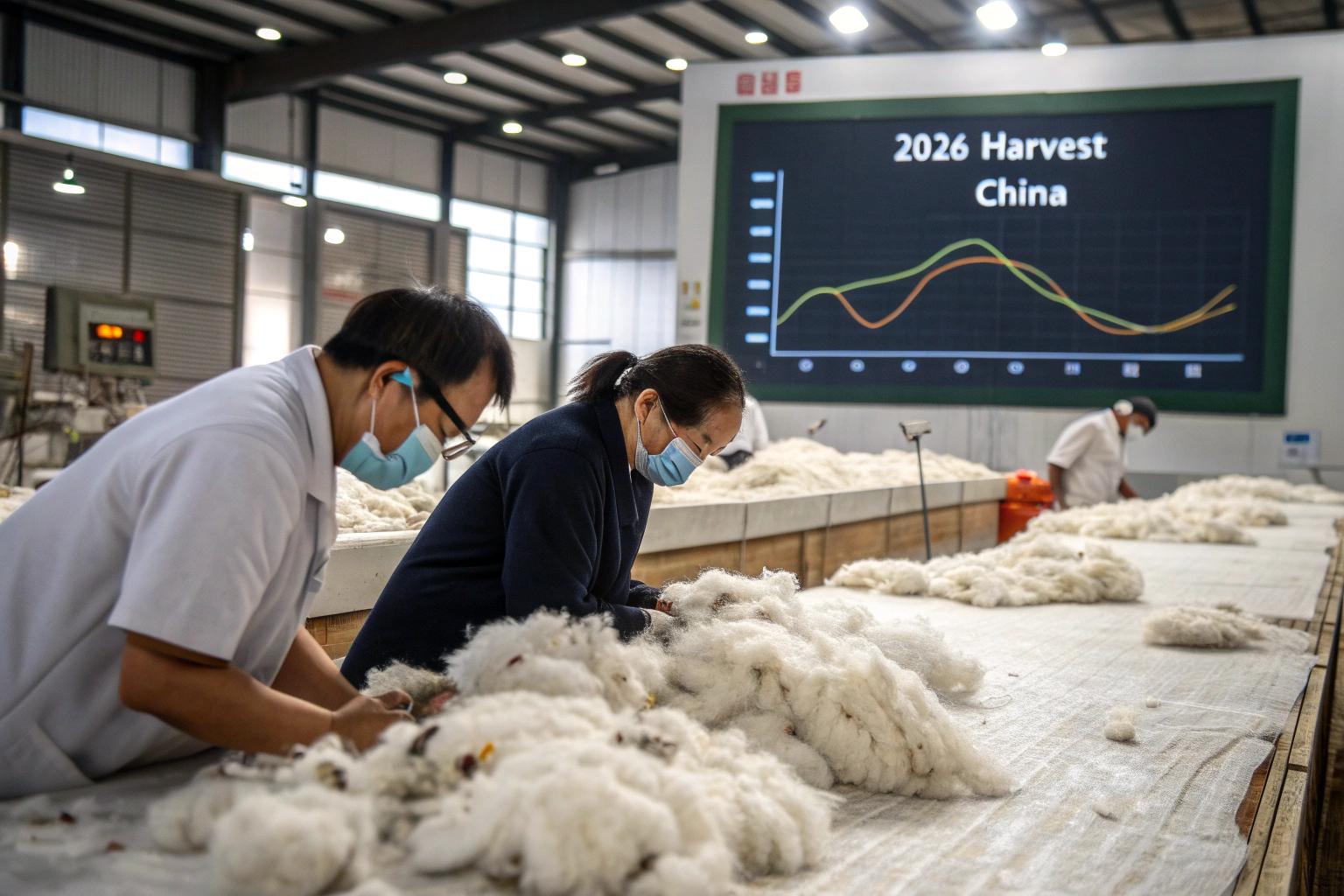
I got a panicked phone call from our raw materials buyer in Heilongjiang province this past August. He was standing in the middle of what should have been a chest-high flax field ready for harvest. Instead, the plants were stunted at knee height, the roots were sitting in stagnant, muddy water from an unseasonal typhoon that dumped three months of rain in four days, and half the field was already showing signs of fungal rot. He estimated a 35% yield loss on that plot alone. A week later, I got a different call from our cotton liaison in Xinjiang, reporting a blistering heatwave that pushed daytime temperatures past 42 degrees Celsius for ten consecutive days, stressing the cotton bolls right at the peak of fiber development. The fibers were short, weak, and would never survive our high-speed spinning process.
Climate change is no longer a distant, academic graph for the textile industry. It’s a weekly operational crisis that rewrites our fiber cost, our quality control parameters, and our delivery timelines. The 2026 harvest for cotton and linen in China is one of the most volatile we have ever tracked. And I want to be brutally transparent with you about what’s happening on the ground, because the price you pay for your cotton-linen shirting next season will be directly determined by the weather events I’m describing right now. Understanding this reality isn’t just a supply chain curiosity; it’s a margin-protection strategy.
But here’s what the sensationalist headlines miss: a bad weather event doesn’t automatically mean bad fabric. It means the mill’s engineering team has to work ten times harder to correct for nature’s inconsistency, and I’m going to explain exactly how we do that.
How Are Extreme Rain Patterns Delaying China’s Flax Harvest?
Flax is a crop that demands precision in its final weeks. It needs a "dry down" period—warm, rain-free days that allow the plant to mature and the fiber bundles inside the stalk to lignify properly. In a normal year, the flax fields in Heilongjiang and Inner Mongolia are pulled in late July and left to rett on the ground for two to three weeks, where dew and natural fungi gently separate the valuable bast fibers from the woody core. This year, a series of stalled low-pressure systems parked over Northeast China in late July and simply refused to move. The rain fell on the flattened flax swaths for days, turning the field retting into a rotting event.
The result is a dual disaster. First, the physical yield drops because the over-retted fibers rot and snap. Second, the visual quality of the linen degrades. Instead of the pale, silvery-grey "dew-retted" color that luxury brands prize, the waterlogged flax turns a mottled, dark grey-brown with black fungal staining. The fiber loses its natural luster and takes on a harsh, brittle hand. At Shanghai Fumao, we’ve had to reject two entire truckloads of water-damaged flax this season because the tensile strength was 30% below our minimum threshold for weaving a stable fabric. This quality rejection creates a supply bottleneck. The available pool of premium-grade Chinese flax has shrunk, and the price for the surviving high-quality bales has spiked by about 18% compared to last year.
We’ve partially mitigated this by increasing our allocation of European-origin flax from our contracted farms in Normandy, which experienced a relatively stable dew-retting season this year. However, European flax carries a transportation carbon cost and a longer shipping lead time. For brands that built their cost structure around Chinese-origin flax, this shift is a budget conversation that needs to happen now, not after the line is already priced.

What is the difference between "dew retting" and "water retting" in a wet season?
Dew retting is the traditional, climate-dependent method where flax stalks are spread thinly on the field, and the natural moisture from dew, rain, and sun activates soil-borne fungi that slowly eat the pectin glue holding the fiber bundles together. It takes two to six weeks and produces a silvery, warm-toned fiber. Water retting submerges the flax stalks in rivers, ponds, or tanks. In an excessively wet year, field retting essentially becomes uncontrolled, stagnant water retting. The stalks sit in puddles for days, the bacterial population explodes, and the fermentation becomes anaerobic—it rots, rather than rets. This over-retting produces a weak, dark, and inconsistent fiber with a coarse, woody hand. The luxury linen market specifically demands dew-retted fiber for its color and softness. When rain forces a water-retted result, that entire harvest year gets downgraded to industrial-grade use—sacks, ropes, insulation—and is lost to the apparel supply chain entirely.
How are mills adapting to the increased "slub irregularity" caused by climate stress?
Climate stress makes flax stems grow unevenly. A heat-stressed plant produces thick, woody sections alternating with thin, weak sections along the same stem. When these irregular stems are processed, the yarn comes out with unpredictable, extreme slubs—long, lumpy variations that can look like defects rather than intentional design. In a normal year, a premium linen yarn has a slub roughly every 8 to 15 centimeters, with a thickness variation of about 30%. This year’s climate-stressed Chinese flax is producing slubs every 3 to 5 centimeters, with a thickness variation exceeding 60%. This is not a luxury texture; it’s a weaving nightmare that causes warp breaks on the loom and weak points in the finished fabric. Our spinning team has adjusted by increasing the twist per inch by 8% to bind the irregular fibers more tightly and by blending in 20% more of the stable European-origin fiber to normalize the irregularity. It’s a material cost increase, but it preserves the weaveability and the aesthetic consistency that a retail buyer expects.
Why Is the 2026 Cotton Yield Threatened by Heatwaves in Key Chinese Regions?
Cotton is a heat-loving plant, but it has a physiological limit. Once the ambient temperature exceeds 40 degrees Celsius, the plant’s stomata—the tiny pores on the leaves—close to preserve water. When the stomata close, photosynthesis stops. The plant stops sending sugar to the developing cotton bolls. The fibers, which are single cells elongating from the seed coat, need a constant flow of sugars to build their cellulose walls. A heatwave during the "peak bloom" period, which hit Xinjiang hard in late July 2026, causes the plant to abort the youngest bolls entirely. The bolls that survive develop shorter, weaker fibers with lower "micronaire"—a measure of fiber fineness and maturity.
A mature, premium cotton fiber for a fine-count yarn should have a micronaire between 3.8 and 4.2. The heat-stressed Xinjiang cotton we’ve tested this September is showing micronaire values as low as 2.8, with a significant percentage of "dead" fibers that are flat, collapsed, and transparent. These dead fibers don’t take up dye. They create a speckled, uneven color in the finished fabric, a defect called "white specks" that ruins a solid dyed poplin. The yield per acre is also down. Our ginning partners are reporting roughly a 15% to 20% reduction in lint yield compared to the five-year average. The economic ripple effect is immediate: less available cotton, lower average quality, and a frenzied competition among spinning mills for the limited supply of high-grade bales.
This quality degradation affects the cotton-linen blend directly. The cotton component, which we rely on for softness and drape, is now shorter and weaker. We’ve had to adjust our blending ratio this season. Where we normally use a 55% cotton, 45% linen for a soft shirting, we’ve shifted to a 50/50 blend in some batches and compensated for the loss of softness with an extra enzyme wash cycle. The fabric cost goes up by about $0.40 per meter, but the hand feel remains consistent. The alternative—using the heat-stressed cotton without adjustment—would result in a fabric that pills after three washes and feels scratchy against the skin.

What is "micronaire" and why does a low value ruin a cotton-linen blend?
Micronaire is a measure of air permeability through a compressed plug of cotton fibers. It’s a combined indicator of fiber fineness and maturity. A low micronaire, below 3.5, means the fibers are either very fine (which can be good for softness) or, more commonly, immature (which is terrible for fabric quality). Immature fibers are flat, ribbon-like tubes without the strong, springy cellulose wall that gives cotton its resilience. In a cotton-linen blend, the immature cotton fibers entangle loosely around the rigid linen cores. When the fabric is woven and then undergoes mechanical stress—in the tumbler, on the stenter, in the washing machine—those immature fibers snap and break away from the yarn surface. This is the primary mechanism of pilling. A fabric woven with low-micronaire cotton will look fuzzy and tired before the customer has even worn it twice. It’s the invisible quality flaw that causes a garment to fail the "10-wash test" and triggers a wave of returns.
How are climate-resilient cotton seed varieties changing the fiber’s spinning quality?
The seed breeders are fighting back. New climate-resilient varieties, like the drought-tolerant "Xin Nong 36" being trialed in northern Xinjiang, are showing a 25% higher water-use efficiency. The plant produces a deeper root system and a waxy leaf coating that reflects heat. The fiber quality from these new varieties is surprisingly good—micronaire values holding steady at 4.0 even under 38-degree heat stress, and staple length maintaining at 29mm. However, there is a trade-off. The yield per acre of these climate-resilient varieties is about 8% lower than the conventional high-yield hybrids in a normal year. So the farmer sacrifices volume for quality stability. The spinning behavior of these new varieties is also different. The fibers have a slightly higher nepping tendency because the heat stress thickens the primary cell wall unevenly. We have to slow down the carding machine speed by 5% to give the cleaning elements more time to remove the neps. This slows production, but it preserves the yarn quality. The takeaway for a brand is that the 2026 cotton you want exists, but it comes from a specific, climate-adapted seed variety grown by a specific co-op, and that traceability matters more than ever.
Can Smart Irrigation in China Offset the 2026 Water Shortage for Cotton?
Water is the silent variable in the 2026 harvest equation. Xinjiang, which produces over 85% of China’s cotton, relies heavily on glacier-fed rivers and groundwater. The Tianshan mountain glaciers that feed the Tarim Basin irrigation canals are retreating at an accelerating rate. A 2025 study from the Chinese Academy of Sciences reported a 22% reduction in glacial mass over the last two decades. Less glacier ice means less summer meltwater flowing into the irrigation canals precisely when the cotton plants hit their peak water demand during the July boll-filling stage.
Smart irrigation is the countermeasure. The Xinjiang Production and Construction Corps has rolled out a massive deployment of soil moisture sensors, satellite-linked weather stations, and drip irrigation tape across millions of acres. Instead of the old flood irrigation method, where fields were drowned under a sheet of water and 50% evaporated, the new systems deliver water directly to the root zone, one drop at a time. The efficiency is stunning. Drip irrigation achieves a water-use efficiency of 85% to 90%, compared to 40% for flood irrigation. The soil moisture sensor feeds real-time data to a control room, which adjusts the drip rate per acre based on the exact evapotranspiration rate calculated from the satellite’s thermal imagery.
The water shortage is still real—the glaciers are still melting—but the smart irrigation system has cushioned the blow. The 2026 cotton yield would have been a catastrophic 40% drop without the drip infrastructure. Instead, it’s a manageable 15% to 20% reduction. For a garment brand sourcing cotton-linen from our mill, this means the fiber is available, but the water cost of production is embedded in a higher raw material price. The story you can tell your customer, however, is that the cotton in their shirt was grown with 50% less water than conventional methods, backed by the actual sensor data we can access through our supply chain partners.

How does "drip irrigation" directly improve fiber length uniformity?
Flood irrigation creates cycles of stress and plenty. The soil goes from waterlogged to bone-dry between flooding intervals. The cotton plant experiences this as a series of mini-droughts, which interrupts the steady, continuous elongation of the fiber cells inside the boll. The result is a fiber with variable length along its axis—long sections alternating with short, pinched sections. When spun into yarn, this length variability creates weak points and thin places. Drip irrigation eliminates the feast-or-famine cycle. The plant receives a constant, low-volume water supply that matches its daily transpiration demand. The fiber cells elongate smoothly, evenly, and continuously from the seed coat. The length uniformity index, measured by High Volume Instrument (HVI) testing, is typically 82% to 84% for flood-irrigated cotton, but regularly hits 86% to 88% for drip-irrigated cotton. This 4-percentage-point difference translates directly into a stronger, smoother yarn with 30% fewer thin places and weak spots. The fabric wears evenly, dyes evenly, and lasts longer. The water story is also the quality story.
What is the long-term groundwater depletion risk for China’s textile cotton belt?
Drip irrigation solves surface efficiency, but it does not solve the aquifer deficit. Xinjiang’s deep groundwater reserves, the fossil water trapped in the Tarim Basin aquifer for millennia, are being pumped out faster than any modern rainfall can replenish them. The groundwater table in some cotton-growing counties has been dropping by 1 to 2 meters per year for the past decade. This is an unsustainable trajectory. Within the next 20 to 30 years, some of the deep wells will hit the bedrock or become too saline for agricultural use. This long-term risk is pushing the Chinese government and the textile industry to look beyond Xinjiang for future cotton security. Some spinning mills are already diversifying their fiber sourcing, increasing imports of Brazilian and West African cotton to reduce pressure on the local aquifer. For a brand planning a 5-to-10-year cotton-linen program, this groundwater reality is a strategic signal: the future of cotton will likely be a global blend, not a single-origin story, and you should build your brand’s sourcing narrative around water-smart agriculture, not a specific romanticized location.
How Should Fashion Brands Hedge Against 2027 Cotton Linen Price Spikes?
I sat with the finance director of a major European fashion group in June 2026, and he showed me their cotton futures position. They were entirely unhedged for their Spring 2027 linen program, assuming that "natural fibers don’t swing like oil." That assumption is dangerously outdated. Cotton and linen prices have become weather derivatives, and the volatility is structural, not temporary. A single heatwave in Xinjiang or a single stalled storm front in Heilongjiang can move the spot price of cotton-linen greige fabric by 15% in a week.
The first hedging strategy is the "Greige Reserve" model I’ve been advocating to all my brand clients. You don’t buy finished, dyed fabric in advance, because color trends change too fast and dead stock is a balance sheet poison. You buy the loomstate, unbleached, undyed cotton-linen greige fabric at today’s price and hold it in a bonded warehouse in Keqiao. Greige is a flexible asset. It can become any color, any finish, for any season. By reserving 70% of your projected fabric volume in greige form during the 2026 harvest window, you lock in the fiber cost before the 2027 weather events drive it higher. At Shanghai Fumao, we offer a "Greige Reservation Agreement" where you pay a 30% deposit now, the fabric sits in our climate-controlled warehouse, and you call it off in dyed, finished batches as your 2027 production demands. The price is fixed. The supply is guaranteed. The risk of a weather-driven price spike is transferred from your P&L to our inventory.
The second strategy is contract farming, which goes one step upstream. A brand can directly contract a specific acreage of flax in Heilongjiang or a specific drip-irrigated cotton plot in Xinjiang, paying a fixed price per kilo before the seed even goes in the ground. The farmer gets income security, and the brand gets a legally-binding fiber supply at a pre-agreed price, regardless of what the spot market does. We facilitate these contracts for larger clients, and we include a force majeure clause that protects against a total crop failure, but not against a mere quality downgrade. The brand accepts the quality risk, but eliminates the price risk.

What is a "Greige Reservation Agreement" and how does it fix fabric costs?
A Greige Reservation Agreement is a forward contract on unfinished fabric. You sign an agreement specifying the exact fabric construction, weight, blend ratio, and total meterage. You pay a deposit—typically 30% of the total value—and we produce the greige fabric and store it under your name. The per-meter price is calculated based on today’s fiber costs, weaving charges, and a small storage fee. If raw flax or cotton spikes 20% in six months, your fabric price does not change. You have already bought the fiber, you have already paid for the weaving, and you are merely paying the storage and the delayed finishing charges. When you are ready to produce your collection, you issue a "call-off" instruction. We take the greige from the warehouse, dye it to your lab dip, finish it, inspect it, and ship it. The lead time for a call-off is about three to four weeks, compared to eight to ten weeks for a full production start from scratch. This strategy reduces your upfront cash outflow compared to buying finished fabric outright, eliminates the risk of dead color stock, and provides an ironclad hedge against fiber price volatility.
Why is "contract farming" the next frontier for secure premium linen sourcing?
Contract farming is the ultimate level of supply chain integration. You are not buying fabric. You are buying the output of a specific field. You visit the farm, you meet the farmer, you walk the rows of flax, and you sign a contract that says: "I will purchase 100% of the Grade A dew-retted fiber from these specific 50 hectares at a fixed price per metric ton." This arrangement removes the middleman, the gin speculator, and the commodity exchange entirely. The relationship is direct. For the farmer, the security of a guaranteed buyer at a known price allows them to invest in better retting equipment, irrigation upgrades, or organic certification. For the brand, the story is unbeatable: "We grow our own linen." The quality is also more consistent because you have visibility into the agricultural practices from day one. The challenge is the risk. If the crop fails, you have no fiber and no refund; that’s what the force majeure clause covers. But if the crop is merely slightly lower quality, you take it anyway, and your textile mill must be skilled enough to adapt the finishing process to compensate. It’s a deep commitment, but for a heritage brand building a decade-long linen identity, it’s the only sourcing model that provides true independence from global commodity markets.
Conclusion
The 2026 cotton and linen harvest in China is a real-time lesson in the cost of climate volatility. Flooded flax fields, heat-stressed cotton bolls, and retreating glaciers are not future scenarios; they are the current invoice line items making your fabric more expensive and harder to source. The brands that treat these harvest disruptions as random, unpredictable shocks will get whipsawed on price and quality every single year. The brands that engineer resilience—through greige reservations, contract farming, and a willingness to blend fiber origins to stabilize quality—will not just survive the climate era; they will lock in a cost advantage that their reactive competitors cannot match.
This is the moment to stop hoping for a calm weather year and start planning for permanent turbulence. Your fabric cost is a climate hedge, and the window to lock in the 2026 harvest base price is open right now.
If you want to discuss a Greige Reservation Agreement for your 2027 cotton-linen collections, or if you need a detailed breakdown of which specific blends and weights are best protected against this year’s quality variability, I have the harvest data and the cost models ready. Our Business Director Elaine can walk you through the available greige inventory and the contract farming options for the 2027 planting season. Don’t wait for the weather report to tell you what your margins will be. Email her at elaine@fumaoclothing.com and put "Harvest Hedge Strategy" in the subject line. Let’s lock in your supply before the next storm hits.








