
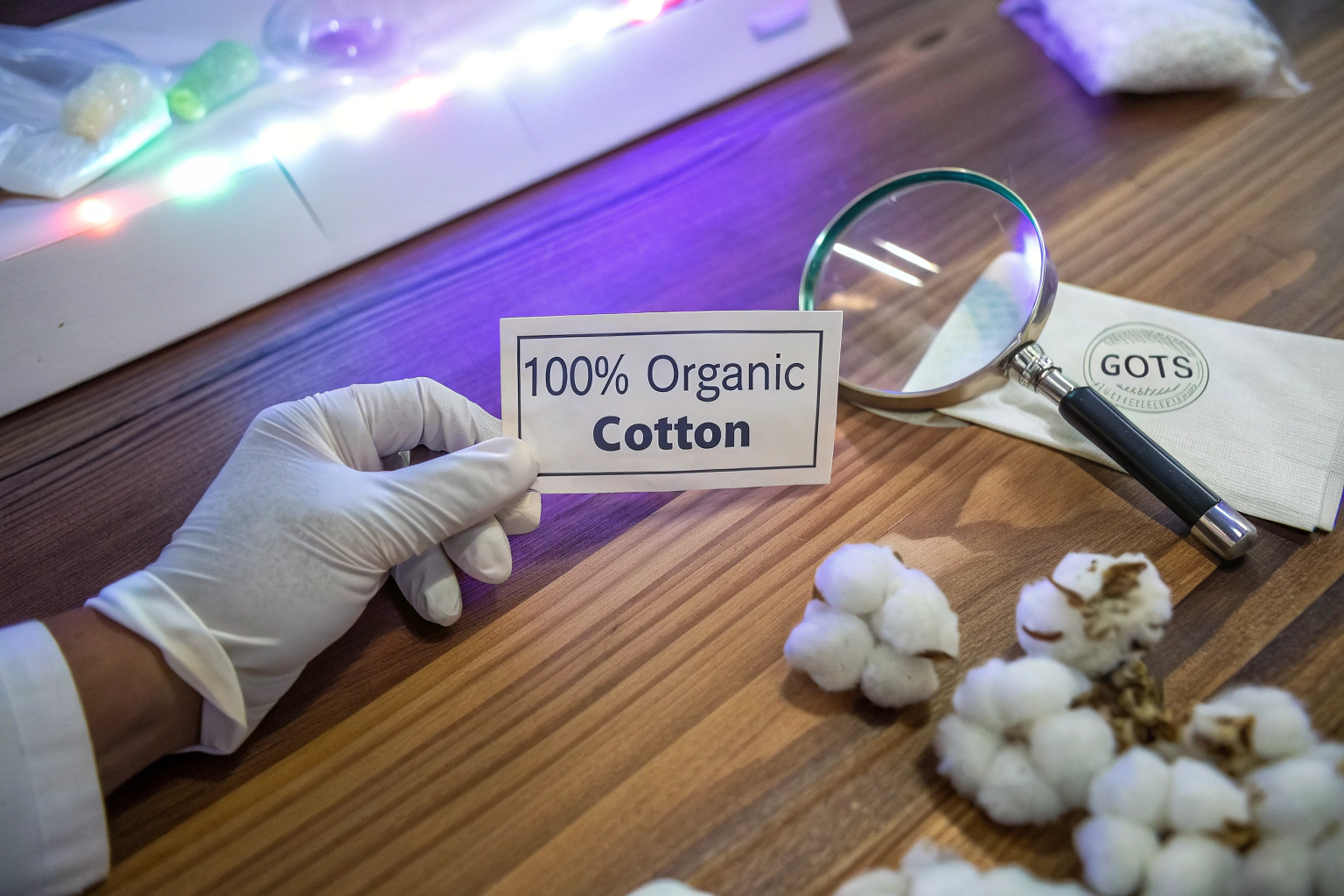
I received a desperate WhatsApp message from a buyer in Berlin last month. She had just placed a $40,000 order for "GOTS-certified organic cotton" poplin from a new mill she found on a B2B platform. The price was 30% below market, and the certificate looked real. When the shipment arrived at Hamburg port, the German customs lab pulled a random sample. It tested positive for glyphosate residue and contained 15% polyester contamination. The certificate was a Photoshop job, and the fabric was seized and destroyed. She lost her entire investment and her launch window because she trusted a PDF instead of verifying a supply chain.
Fake organic cotton labels are the most profitable scam in the textile industry in 2026. The global demand for sustainable fashion has created a gold rush, and counterfeiters have gotten terrifyingly sophisticated. They know that a Western buyer rarely audits the factory. They know the buyer wants to believe the story. And they exploit that trust with fake transaction certificates, doctored lab reports, and "organic" logos they invented in Canva last Tuesday. At Shanghai Fumao, we see the fake certificates circulating in Keqiao, and I’m going to show you exactly how the forgers operate so you never fund their operation.
But first, you have to understand one chilling truth: the fiber itself cannot tell you if it’s organic once it’s spun into yarn and woven into cloth. The DNA of the cotton doesn’t change whether it was sprayed with pesticides or not. The proof is not in the fiber; it’s in the chain of custody documents that tracked it from the seed to the loom. If that paper trail has a single gap, the "organic" claim collapses.
Why Are Fake "Organic Cotton" Certificates Flooding B2B Platforms in 2026?
The economics of the scam are brutally simple. Organic cotton commands a 25% to 40% premium over conventional cotton on the wholesale fabric market. A mill can buy conventional cotton at $2.80 per kilogram, print a fake GOTS certificate, and sell it as "organic" for $4.20 per kilogram. On a 10,000-meter order, that’s an extra $5,000 to $8,000 in pure, fraudulent profit. The risk of getting caught is low because most buyers never test the fabric, and even fewer audit the farm. The forgers have also discovered that B2B platforms like Alibaba and Global Sources have automated verification systems that check if a certificate exists, but not if it belongs to that specific mill. They take a legitimate certificate from a certified mill in India, alter the company name and address in Adobe Illustrator, and upload it. The platform’s algorithm sees a valid certificate number and approves the listing.
I’ve personally seen a "GOTS Transaction Certificate" in a Keqiao trading office that listed a certification body that had gone bankrupt three years earlier. The buyer didn’t check the accreditation status of the certifier. The certificate was a zombie—dead but still walking. Another common tactic is the "expired scope" scam. A mill was genuinely certified in 2022, let it lapse in 2023 due to failing the chemical audit, but continues to use the expired certificate number on all their 2026 sales documents. The certificate number is technically "real," but the certification is dead. You can’t just look at the logo; you have to verify it in real-time against the certification body’s live database.
The situation has gotten so bad that the Global Organic Textile Standard organization released a fraud alert in early 2026 specifically naming several common forgery patterns in the Asian textile supply chain. But the scammers evolve faster than the alerts. They now use AI-generated company websites with fake team photos, fake factory videos, and even fake LinkedIn profiles of "compliance managers" who are actually stock photos from a free image website. The illusion is complete, and it’s designed to fool busy sourcing managers who spend ten minutes on due diligence before placing a six-figure order.

How can a "scope certificate" be verified in under 60 seconds?
A scope certificate is the document that lists exactly which processes a factory is certified for—spinning, weaving, dyeing, printing—and which fiber categories are covered. The scam version changes the company name. The verification takes under a minute. Go to the GOTS public database at global-standard.org. Enter the certificate number exactly as it appears on the document. Do not trust the copy-paste the supplier gives you; ask for a photo of the original certificate. The database will show the registered company name, address, and valid date range. If the name on the certificate doesn’t match the database EXACTLY—including punctuation, spacing, and the legal suffix like "Co., Ltd."—it’s a forgery. Also, check the "certified processes" field. If your supplier claims to sell "GOTS-certified organic dyed fabric," but their scope certificate only lists "weaving" and not "dyeing," they are buying greige organic cloth and dyeing it in an uncertified, conventional chemical bath. The final fabric is no longer organic, regardless of the fiber origin.
What are the "grey market" organic cotton loopholes that mills exploit?
The "grey market" is the sale of organic cotton fiber that is grown organically, but sold outside the certification system. A farmer might grow organic cotton but sell the harvest to a conventional gin because the organic buyer canceled the order. The gin mixes it with conventional cotton, and the organic identity is lost forever. However, some mills buy this mixed, undocumented fiber at a discount, spin it into yarn, and then retroactively apply for a fraudulent transaction certificate claiming the entire batch is organic. This is called "certificate washing." You can spot this by checking the "Mass Balance" on the transaction certificate. The certificate should account for every kilogram of organic fiber that entered the facility and every kilogram of organic product that left. If the numbers don’t balance—if the mill supposedly shipped more organic fabric than they purchased organic fiber—they are injecting conventional cotton into the stream. You can dig deeper into the forensic accounting of this by learning how to audit GOTS transaction certificates for mass balance discrepancies. It’s the financial sleuthing that catches the smartest scammers.
What Laboratory Tests Can Detect Pesticide Residue in Finished Cotton Fabric?
I had a menswear client from Stockholm call me in March 2026. He had a "GOTS certified" organic cotton twill from a new supplier in South Asia. The price was great, the hand feel was soft, and the certificate checked out visually. But his gut told him something was off. He sent a fabric swatch to an independent ISO 17025 accredited lab in Germany and ran a GC-MS (Gas Chromatography-Mass Spectrometry) pesticide residue scan. The report came back with detectable levels of Glyphosate, Chlorpyrifos, and Endosulfan—three pesticides that are strictly prohibited in organic agriculture. The certificate was a complete fake, and the fabric was conventional cotton sprayed heavily before harvest. The lab test cost him $350. It saved him a $60,000 brand reputation disaster.
Laboratory testing is the ultimate backstop against sophisticated document fraud. A piece of paper can lie; a mass spectrometer cannot. The standard test panel for organic cotton verification is the "GOTS Restricted Substances List" screen, which tests for approximately 300 individual chemical residues, including organochlorine pesticides, organophosphorus pesticides, and pyrethroids. You don’t need to test every shipment; you need to test the first shipment, and then conduct random "spot checks" on subsequent shipments to ensure the mill isn’t bait-and-switching you with a good first batch and dirty later batches. The test requires a small swatch—roughly 20 grams—and takes about 5 to 7 business days for the full panel.
The specific test method matters. A simple "heavy metals test" is not enough. You must request the "Pesticide Residue Screen by LC-MS/MS and GC-MS/MS." This is the gold standard. The reporting limit should be 0.05 mg/kg or lower for most prohibited pesticides. If the lab’s detection limit is too high, the test might return a "clean" result simply because the equipment isn’t sensitive enough to find the residue, not because the residue isn’t there. You want a lab with ISO 17025 accreditation specifically for pesticide residue analysis in textiles. We use SGS and Bureau Veritas for our internal verification, but we also encourage our clients to independently test our fabric through a lab they choose. A mill that resists independent testing is confessing guilt.

What is the "GC-MS pesticide screen" and why is it the gold standard?
GC-MS stands for Gas Chromatography-Mass Spectrometry. It’s a machine that vaporizes the fabric extract, pushes the gas through a long, thin column that separates the different chemical compounds based on their size and polarity, and then blasts each compound with electrons to shatter it into a unique fragment pattern. This fragment pattern is a chemical fingerprint. The machine compares the fingerprint against a library of thousands of known pesticides and identifies the exact chemical, down to the parts-per-billion level. It doesn’t just say "pesticide detected." It says "Glyphosate, CAS #1071-83-6, concentration 0.18 mg/kg." This specificity is what gives you the evidence to confront the supplier and demand a full refund. Without a GC-MS report, you have only a suspicion. With it, you have a legal case.
How can you perform a cheap "at-home" flame test to spot synthetic blends?
The lab test is the definitive proof, but a simple flame test gives you immediate, directional data at zero cost. Cut a small 2×2 cm swatch from the fabric. Hold it with tweezers over a ceramic dish or a metal sink. Touch a lighter flame to the edge. Organic cotton (and any natural cellulose fiber) will ignite easily, burn quickly with a bright yellow flame, and produce smoke that smells exactly like burning paper or dry leaves. The ash will be fine, soft, and grey—it crumbles to powder when you rub it between your fingers. A synthetic fake will shrink away from the flame, melt into a hard, black, molten ball, drip like hot plastic, and produce thick, black, acrid smoke that smells like burning tires or chemicals. If your "100% organic cotton" fabric melts and beads, it contains polyester or nylon, and the organic claim is a lie regardless of what the certificate says. This test takes ten seconds and has caught more frauds than I can count.
Why Are "Transaction Certificates" Easier to Fake Than "Scope Certificates"?
A scope certificate is the factory’s annual operating license for organic production. It’s a single document that stays relatively static. A transaction certificate (TC) is issued for every single shipment, and a large mill might generate hundreds of TCs per year. This volume creates the forgery opportunity. The scammers know that buyers rarely verify the TC individually; they just file it away as part of the shipment paperwork. A fake TC is usually a copy-paste of a previous legitimate TC with the dates, quantities, and product descriptions altered.
The critical vulnerability in the TC system is the "input-output balance." A legitimate TC lists the specific input lot numbers of the organic yarn that entered the weaving process, and the output lot numbers of the finished fabric that resulted. These numbers must be traceable backward. If you ask the supplier, "Show me the input TC for the yarn used in this fabric’s output TC," you are asking them to bridge a gap that forgers rarely close. A fake TC chain collapses at this point because the forger only faked the final document; they didn’t fake the entire upstream history. I always recommend that brands request the full chain of TCs—from the gin to the spinner, spinner to the weaver, weaver to the finisher—for the specific batch they are buying. A mill that is genuinely certified can produce this chain within hours because their certification body requires them to maintain these records for at least five years.
Another telltale sign of a fake TC is the issuing certification body. The GOTS system accredits specific certifiers, like Control Union, Ecocert, and ICEA. A fake TC might list "Global Organic Certification Services" or some similar-sounding but completely unrecognized certifier that has no GOTS accreditation. Always cross-reference the certifier’s name against the official GOTS list of approved certification bodies. If the certifier isn’t on that list, the certificate is toilet paper.

What is the "chain of custody" and how do you request a complete audit trail?
Chain of custody is the documented path that the organic fiber traveled from the farm to the finished fabric. It includes the farm certificate, the ginning TC, the spinning TC, the weaving/knitting TC, and the finishing TC. Requesting this complete audit trail is not a sign of mistrust; it’s standard due diligence. A legitimate supplier will provide a digital folder with PDF scans of every TC in the chain, all linked by the same organic fiber batch ID. You can then spot-check the links. Pick one TC in the middle—say, the spinning TC. Call the spinner listed on the document. Verify they exist and that they recognize the lot number. If the spinner says "We never wove that lot," the chain is broken. Most scammers never fake the middle documents because they assume you won’t check.
How can you "stress test" a supplier’s organic claim with a single technical question?
The fastest way to expose a fake is to ask a question that a genuine organic production manager can answer instantly, but a salesperson selling fakes cannot. My favorite stress test question is: "What is your segregation protocol for organic and conventional cotton during carding?" A real organic mill has a physical separation—a wall, a dedicated machine, a specific shift schedule, or a deep-cleaning logbook—to prevent conventional fiber from mixing with organic fiber. They will answer immediately with a specific procedure: "We deep-clean the carding machine for 4 hours between conventional and organic runs, and we have a signed cleaning log for every batch." A fake will pause, confused, and say something vague like "We clean the machine." Ask for a photo of the cleaning log for your specific batch. The silence that follows is your answer.
How to Use Digital Traceability Tools to Verify Organic Cotton Origin?
The paper certificate system is broken because paper can be forged. In 2026, the only credible proof of organic origin is a digital, real-time traceability platform that tracks the fiber from the farm to the fabric using geolocation, blockchain, or isotopic analysis. We implemented a QR-code-based traceability system at Shanghai Fumao specifically because our clients were tired of getting burned by paper fraud. Every bolt of our organic cotton fabric leaves our facility with a unique QR code that links to a digital dashboard showing the gin location, the spinning date, the weaving timestamp, and the lab test results for that specific bolt.
Digital traceability doesn’t just prevent fraud; it creates marketing value. The end consumer scans the QR code on their shirt’s hangtag and sees the cotton field, the farmer, and the factory floor. This transparency builds a bond that a paper certificate in a filing cabinet never can. The technology exists, and it’s affordable. The fact that a mill refuses to provide digital traceability in 2026 is itself a red flag. If they can’t show you a digital link to the farm, they are either hiding something or they don’t actually know where their fiber came from—both of which disqualify an "organic" claim.
There are also third-party platforms like Oritain and Haelixa that use forensic science, not just documents. Oritain measures the stable isotope ratios of the cotton fibers. Cotton grown in different regions has a unique chemical signature based on the local soil and rainfall. This signature is impossible to fake. Haelixa embeds a unique, invisible DNA marker into the raw organic cotton at the gin. This marker survives spinning, weaving, dyeing, and finishing, and can be verified at any point in the supply chain with a simple test kit. These tools are the future, and the brands that adopt them now will be the ones that survive the coming consumer trust crisis. To see how this integrates from a consumer-facing perspective, explore how to build a consumer-facing QR code traceability story for ethically sourced cotton menswear. It turns a compliance cost into a brand asset.

How does blockchain-based traceability prevent "double-spending" of organic certificates?
Blockchain is a decentralized ledger. When an organic cotton bale is registered on a blockchain platform, that registration is a permanent, time-stamped, unalterable record. If a forger tries to copy the certificate number and apply it to a different shipment, the blockchain instantly flags the "double-spend" because the original certificate has already been assigned to a specific batch. The system prevents the same digital asset from being claimed twice. This is particularly powerful for transaction certificates. Instead of issuing a PDF that can be duplicated, the certifier issues a token on the blockchain. The token transfers from the farm to the gin to the spinner to the weaver, mirroring the physical movement of the fiber. You can view the entire token transfer history in real-time. If the mill can’t provide access to the token for your specific batch, the physical fabric in front of you is not linked to the digital chain.
What are isotopic fingerprinting and DNA markers, and how are they changing the game?
Isotopic fingerprinting is based on the science of "you are what you eat." Cotton plants absorb water and nutrients from the local soil, and the ratio of heavy to light isotopes of elements like Carbon, Nitrogen, and Oxygen varies geographically. A cotton plant grown in Xinjiang has a measurably different isotopic signature than a cotton plant grown in West Texas or Gujarat. This signature is embedded in the cellulose molecule itself. Oritain analyzes the fiber and compares it to a global reference database. If the supplier claims the cotton is "organic Egyptian," but the isotopic signature matches the Xinjiang profile, the fraud is scientifically proven. DNA markers are synthetic DNA sequences sprayed onto the raw cotton at the gin. This DNA is inert, food-grade, and invisible. It acts like a biological barcode. At any subsequent processing stage, a simple swab test can detect the marker. If the marker is present, the cotton is genuine. If it’s absent, the cotton has been swapped. These technologies are finally becoming accessible to mid-sized brands. You can learn more about the forensic side from detailed breakdowns on how to use isotopic origin testing to verify organic cotton claims in apparel. It’s the CSI of textile sourcing.
How to Educate Your Retail Buyers on the "Fake Organic" Problem?
The final link in the chain is the retail buyer who stocks your product. If they don’t understand the organic fraud problem, they won’t value the premium you’re charging for genuine certified fabric. I presented to a group of department store buyers in Paris in January 2026, and I started the talk by holding up two identical white T-shirts. I asked, "Which one is organic?" Nobody could tell. I then passed around two certificates—one real, one fake. Only one buyer spotted the forgery. The room went silent. They realized their entire "sustainable" section could be filled with fakes, and they had no ability to detect them.
Educating the retail buyer starts with this terrifying truth: you cannot see, feel, or smell "organic." You can only verify it forensically. Give the buyer a simple, one-page "Organic Cotton Verification Checklist" they can use to audit any brand that pitches them. The checklist has three questions: "Show me the live GOTS scope certificate link," "Show me the digital traceability platform for this specific batch," and "What independent lab tested this fabric for pesticide residue?" If a brand cannot answer all three immediately, the buyer should reject the product. This simple tool empowers the buyer and positions your brand as the honest, transparent partner in a sea of fakes.
Also, share the fraud stories. Tell them about the Berlin buyer who lost $40,000. Tell them about the fake certificates on B2B platforms. Fear is a powerful educational tool. When the buyer realizes that stocking a fake organic product exposes their store to lawsuits, reputational damage, and social media cancellation, the price premium you charge for genuine Shanghai Fumao organic cotton becomes the cheapest insurance policy they ever bought. You’re not just selling fabric; you’re selling legal safety and brand integrity.

What one-page "Buyer Audit Sheet" can you give your retail partners?
The Buyer Audit Sheet is a single laminated page they keep in their buying office. It contains the three non-negotiable checks:
- Live Certificate Verification: Go to global-standard.org. Enter the certificate number. Match the name and scope. If any detail is different, reject.
- Independent Lab Test: Demand a recent GC-MS pesticide residue report from an ISO 17025 accredited lab. Check the test date—must be within 12 months. Check the reporting limit—must be below 0.05 mg/kg for prohibited pesticides.
- Digital Traceability: Scan the QR code on the fabric bolt or hangtag. Does it show the farm, the gin, and the factory? If it goes to a generic "About Us" page, reject.
This sheet takes three minutes to use. It saves a lifetime of brand damage.
How can you turn the "fraud problem" into a marketing advantage for your own brand?
Your competitor is likely selling fake or uncertified "organic" cotton, even unknowingly. You can position your brand as the "Proof Keeper." Publish your GOTS scope certificate number directly on your product page. Embed the live link. Post a video of the farm or the isotope testing process. Publicly challenge your competitors to do the same. When a customer asks "How do I know your organic cotton is real?" you don’t get defensive. You say, "Here is the QR code. Scan it. Watch the farmer in Gujarat talk about his soil. See the lab report from last month’s batch. We’re an open book." This radical transparency becomes your brand’s entire identity. In a market flooded with green lies, the honest brand doesn’t just survive; it becomes the category leader.
Conclusion
The fake organic cotton epidemic in 2026 is the inevitable result of an industry that outsourced trust to a PDF document. Forgers thrive in opacity. They crumble in the light of live database verification, mass spectrometer scans, and digital blockchain trails. The tools to spot these fakes are not secret CIA technology; they are publicly available databases, $350 lab tests, and a $15 UV flashlight. The missing ingredient is the will to spend ten minutes verifying what a supplier claims, rather than just filing the certificate and hoping for the best.
At Shanghai Fumao, we treat every organic claim as a legal deposition, not a marketing slogan. We expect our clients to test us, audit us, and scan us. A supplier who resists verification is a supplier who has something to hide.
If you’re currently sourcing "organic cotton" and you have a nagging feeling the price was too good to be true, don’t ignore that feeling. Verify it. Send the swatch to a lab. Check the certificate database. Or, start with a mill that has already done the homework and is willing to show the receipts.
Our Business Director Elaine can send you our complete "Organic Integrity Packet" for any fabric in our line. It includes the live GOTS scope link, the latest GC-MS pesticide residue report from an independent ISO 17025 lab, and the QR code traceability demo. Stop betting your brand on a piece of paper. Email her at elaine@fumaoclothing.com and put "Organic Verification" in the subject line. Let’s build a supply chain that survives scrutiny.








