I had a startup client from Austin message me in a panic just last month. He had sold out his entire first run of 200 custom cotton-linen resort shirts in under a week, but his accountant told him he actually lost $3.50 on every single unit. He didn’t factor in the import duties, the warehousing fees, and the hidden cost of the care labels. He had priced his shirt based on a "keystone markup" formula he read in a blog post from 2015, and it almost bankrupted his brand before the second restock. He made the classic mistake of confusing revenue with profit.
Reselling custom cotton apparel made with Shanghai Fumao fabric isn’t a guessing game. It’s a mathematical puzzle where you control the cost levers before you even sketch the silhouette. The margin isn’t found at the retail register; it’s locked in during the sourcing conversation. When you bypass the trading companies, negotiate the greige reservation, and engineer your tech pack to optimize cutting efficiency, you can realistically land a gross profit margin between 65% and 78% on a premium custom cotton garment. And I’m going to show you exactly how the numbers stack up, from the mill floor in Keqiao to the customer’s doorstep in Chicago.
But here’s the uncomfortable truth that most brand owners don’t want to hear. Your margin doesn’t come from marking up a cheap fabric. It comes from reducing the hidden friction costs that bleed your bank account while you sleep. Let’s break down a real, working cost sheet.
How to Calculate the True Landed Cost of Custom Cotton Apparel?
Most new brands calculate cost like this: Fabric price per meter x meters used + sewing cost = Total. That formula is dangerously incomplete. I received a tearful phone call from a designer in Miami in February 2026 who had used that exact formula. She forgot the air freight surcharge during the peak season, the customs bond fee, and the cost of the hangtag pins. Those "minor" oversights devoured 22% of her expected margin. She broke even on a product that should have made her $45 a unit.
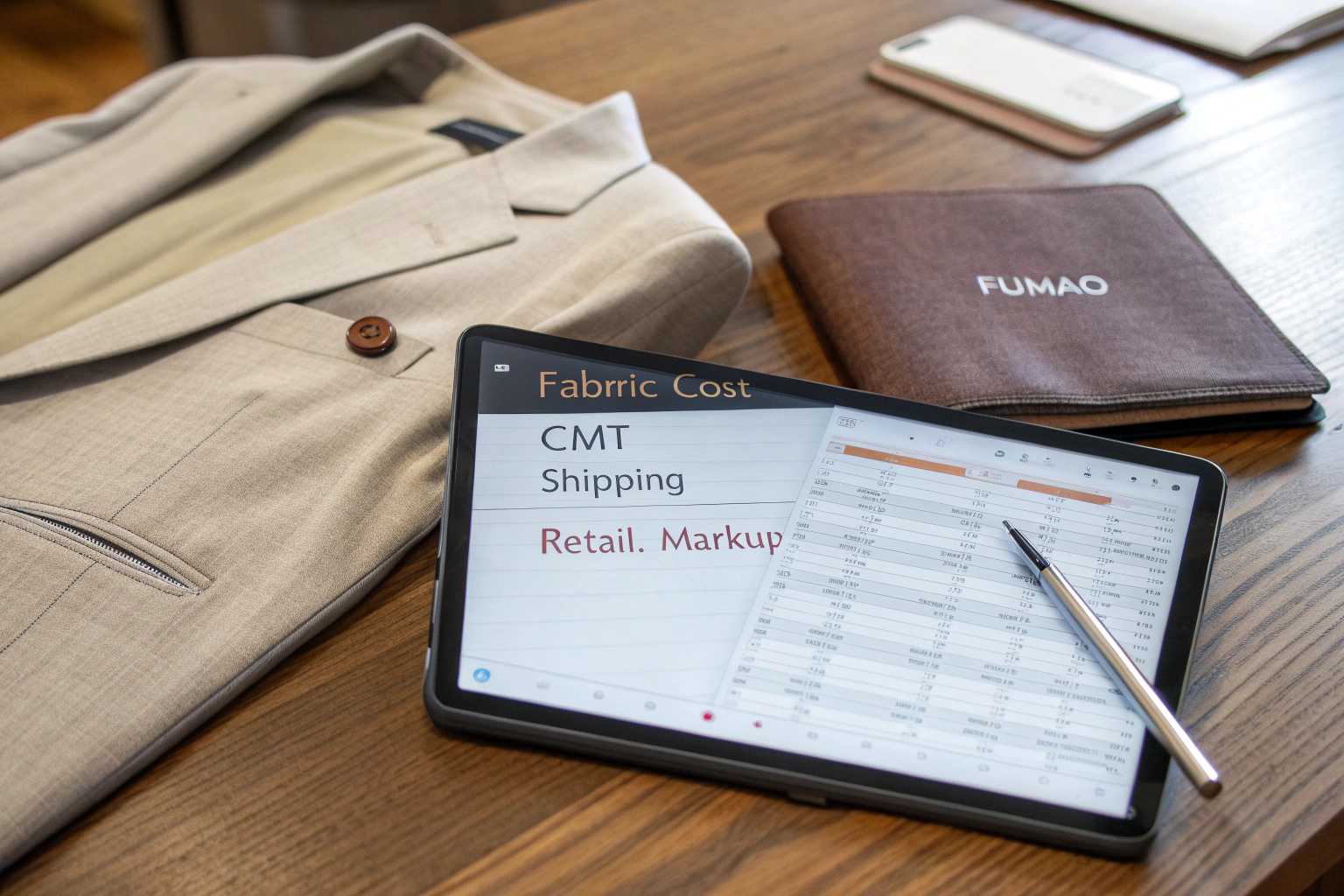
True landed cost is the total cash outlay required to get a finished, packaged, and ready-to-sell garment into your warehouse or 3PL facility. It includes six categories that most sourcing guides conveniently ignore. First, the Fabric Cost: not just the meter price, but including the 3% shrinkage buffer you must order extra to account for cutting waste. Second, the Trim Cost: buttons, zippers, labels, hangtags, and the poly bags. Trims are the silent margin killers; they often add $2.50 to $4.00 per unit. Third, the CMT Cost (Cut, Make, Trim): the labor to cut the fabric and sew the garment. Fourth, the Logistics Cost: freight forwarding, customs clearance, port handling, and last-mile delivery to your warehouse. Fifth, the Duties and Taxes: calculated on the CIF value (Cost, Insurance, Freight) of the goods. Sixth, the Quality Control and Compliance Cost: the third-party inspection fee and the lab testing cost for fiber content verification. If you ignore any one of these, your spreadsheet is a work of fiction.
I always tell my clients to create a "Ghost Line Item" of 5% of the total projected cost, labeled "Gremlins." This covers the inevitable random expense—the port congestion surcharge, the label reprint because the font was wrong, the extra shipping sample to a celebrity stylist. This buffer prevents your margin from turning negative the moment something real happens.

What hidden "trim costs" do first-time importers always overlook?
Trims are the small, physical components that attach to the garment. They seem cheap individually, but they compound fast. A typical custom cotton shirt requires: a main label, a care label, a size label, a hangtag, a hangtag string, buttons, a collar stay, a poly bag, and a carton marker. Sourcing these from different vendors means ten separate shipping fees and ten chances for a delay. We help our Fumao Fabric clients consolidate trims through our network of Keqiao accessory suppliers. The most overlooked trim cost is the "swing ticket" or hangtag. A die-cut, premium textured paper hangtag with a cotton string costs around $0.40 to $0.80 per unit. If you’re doing a run of 1,000 units, that’s $800 just for the cardboard sign that most customers throw away. I advise brands to invest in a high-quality woven label instead and kill the hangtag. The label stays on the garment and builds brand equity with every wear. The hangtag dies in the landfill.
How can you negotiate CMT costs by understanding the "minute value" system?
Garment factories don’t price by the piece; they price by the "Standard Allowed Minute" (SAM). This is the calculated time in minutes a trained operator needs to sew a specific seam. A simple cotton poplin shirt with a standard collar might have a SAM of 25 minutes. A complex safari jacket with four pockets and a convertible collar might have a SAM of 65 minutes. The factory multiplies the SAM by their "Minute Value" (their internal cost per minute of labor, which includes operator wage, electricity, and machine depreciation). If you walk into a negotiation knowing the approximate SAM of your garment, the factory owner recognizes you as a professional. You can ask: "What’s your current minute value for a woven cotton top?" If they say $0.08, you know your 25-minute shirt should cost around $2.00 in direct labor. This data lets you negotiate from fact, not from hope. You can also reduce the SAM by simplifying your design. Removing one unnecessary seam line can slash the SAM by 2 minutes, saving $0.16 per unit, which across 5,000 units is $800 in pure net margin.
What Is the Wholesale vs. DTC Margin Split on Cotton Linen Collections?
A brand owner in London told me he was "killing it" because he was selling his cotton-linen jackets wholesale at $85 with a 55% margin on his landed cost. But he was comparing himself to the wrong benchmark. He wasn’t factoring in the cost of the showroom commission he paid to the sales agent, the marketing contribution fee the department store charged, or the chargebacks for late shipments that the retailer deducted from his invoice. His actual net-net on wholesale was closer to 18%. Direct-to-consumer, on that same jacket, was netting him 62% after platform fees and fulfillment costs.
The channel you choose dictates your margin reality. Wholesale offers volume and cash flow predictability. A typical boutique order might be 30 to 50 units per style, and the invoice is paid on delivery or net-30 terms. The margin appears thinner on paper—you sell at 50% to 60% of the suggested retail price—but you outsource the customer acquisition cost and the individual packing and shipping labor. DTC, through your own Shopify store, keeps 85% to 92% of the retail price in your pocket (after credit card fees and platform costs), but you pay for every single Facebook ad click and every single poly mailer. The most profitable brands in our client roster run a hybrid model: they use wholesale to cover their fixed overhead (salaries, rent, software) and DTC to generate the actual profit and build the brand’s direct relationship with the end consumer.
A custom cotton-linen resort shirt built with our Fumao fabric, with a landed cost of $22, can wholesale at $55 (60% margin) and retail DTC at $128 (83% margin before marketing spend). The hybrid model is the safety net. If the Instagram algorithm crashes your DTC traffic one month, the wholesale invoices keep the lights on. If a big retailer cancels their order, the DTC engine fills the gap. You aren’t betting your entire business on one fragile sales channel.

Why are DTC brands achieving 70%+ gross margins with custom cotton?
DTC brands skip the middleman, but that’s not the real secret. The real secret is perceived value through storytelling. A cotton-linen shirt sold wholesale to a boutique is just a shirt among hundreds on a rack. A cotton-linen shirt sold DTC through a beautifully shot email campaign, with a founder’s note about the flax field in Normandy and the QR trace to the Keqiao mill, is an experience. The customer pays for the story, not just the stitching. Our Fumao Fabric clients who succeed in DTC use our digital spec sheets and harvest photos directly in their product pages. They don’t just say "55% Cotton, 45% Linen." They say "Woven on a Picanol rapier loom in Shaoxing, from rain-fed European flax, enzyme-washed for a vintage hand." That narrative justifies a $128 price point on a garment that cost $22 to land, yielding a 70% gross margin before ad spend. The margin is in the meaning.
How can a hybrid sales model protect your margin from sudden tariff changes?
Tariffs are a political weapon, and they change without warning. A hybrid model lets you surgically adjust. If US tariffs on Chinese textile imports spike, you can route your wholesale orders through a bonded warehouse in a third country, slightly increasing your landed cost but preserving the retail relationship. Meanwhile, you can adjust your DTC pricing by 5% overnight on your website to absorb the hit without losing wholesale accounts. The flexibility of DTC pricing also allows you to run "Tariff Sale" events, turning a political headache into a marketing urgency event. Wholesale can’t do that because retail partners lock in pricing months in advance. For a much deeper dive into this strategy, you can review the updated strategies for mitigating US tariff risk on Chinese cotton apparel imports. It saves you from getting blindsided by a policy tweet.
How to Build a "Pricing Story" That Justifies Premium Cotton Markups?
A buyer from a New York concept store once told me, "I don’t buy a $95 shirt. I buy the reason it’s $95." If the reason is "it’s high quality," you lose. That’s a generic, meaningless claim. A pricing story is a logical, sensory sequence that walks the customer from a reasonable base price to a premium final price through layered, undeniable value additions. I teach my brand clients a technique called "The Four Anchors."
Anchor One: The Fiber Origin. Start the story with the raw material. "This shirt begins as a rain-fed flax stalk in Northern France, grown without a single drop of irrigation." The customer mentally accepts a base price of $40 for this agricultural authenticity. Anchor Two: The Manufacturing Ethics. Add the human layer. "Cut and sewn in a GOTS-certified facility where the seamstress has been with the factory for 12 years." This adds $30 in perceived value. Anchor Three: The Mechanical Finish. Describe the unique touch. "Tumbled for 40 minutes with volcanic stones and bio-polished with enzymes for a hand-feel that usually takes 50 washes to achieve." Add another $30. Anchor Four: The Traceable Impact. Provide the digital proof. "Scan the QR code on your care label and watch the exact loom that wove your specific garment’s fabric." Add the final $25. The customer now sees a $125 story, not a $22 cost sheet. They feel proud of the price, not suspicious of it.
This pricing story transforms the garment from a commodity competing on cost into an artifact competing on meaning. You aren’t asking the customer to pay more because you’re greedy; you’re asking them to invest in a documented chain of value that they can verify with their smartphone. When a competitor tries to undercut you on price, they aren’t just selling a cheaper shirt; they’re selling a story with missing chapters.

How does "cost transparency" marketing affect consumer purchase behavior?
Cost transparency is dangerous if done wrong. If you simply post "This shirt cost me $22 to make," the customer mentally locks onto that number and feels any markup is a rip-off. Effective cost transparency explains why the cost is $22 and what the markup funds. Break down the $22: $9 fabric, $5 labor, $3 trims, $3 logistics, $2 testing and compliance. Then explain the markup: "We multiply by 5.8x so we can pay for the website, the customer service team, the free returns, and a fair living wage for our designer." This framing shifts the psychology from "they are profiting off me" to "they are allocating my money responsibly." Brands like Everlane pioneered this, but a custom Fumao Fabric brand can do it deeper because we provide the granular data—the actual yarn batch cost, the actual dye vat energy consumption—that makes the transparency authentic, not a marketing gimmick.
What is "value stacking" and how do you apply it to a cotton linen blazer?
Value stacking is the process of adding visible, tangible features that individually justify small price increments, but collectively justify a massive price jump. A basic unlined cotton-linen blazer might sell for $150. You stack these value-adds:
- Horn buttons instead of plastic: +$15 perceived value.
- Hand-stitched armhole for flexibility: +$25.
- Internal Bemberg cupro pocketing instead of polyester: +$20.
- Double-stitched, taped shoulder seams that won’t tear: +$20.
- Garment-dyed post-construction for an heirloom patina: +$30.
None of these cost the earth, but together they build a $260 jacket story in the customer’s mind. They see the horn buttons glint differently from plastic. They feel the armhole move without binding. They read the words "garment-dyed" and imagine a vintage piece discovered in a Parisian flea market. The price becomes a bargain for the perceived heritage.
How to Reduce Customs and Logistics Costs on Fumao Cotton Shipments?
A logistics manager at a fast-growing brand in Toronto told me his shipping costs on a container of cotton shirts had jumped 40% in 2026 because he was still using the Incoterms his first sourcing agent set up in 2021. He was paying for "Air Freight Door-to-Door" from Shanghai to Toronto on a shipment that could have gone LCL sea freight, saving him $3,200. He just didn’t know the other options existed because the freight forwarder never offered them.
Logistics cost reduction starts with choosing the right Incoterm. If you’re a small brand ordering under 500 units, don’t order FOB (Free on Board). You’ll get crushed by hidden port fees because you don’t have the volume to negotiate with the freight forwarder. Instead, ask for DAP (Delivered at Place) or DDP (Delivered Duty Paid) with Shanghai Fumao’s recommended logistics partners. We consolidate dozens of small brand shipments into shared containers, giving you the freight rate of a much larger company. You pay slightly more for the product ex-factory, but the all-in landed cost is often 15% lower because the consolidation eliminates the minimum handling fees at the port.
The second big cost leak is the HTS code misclassification. A cotton-linen shirt is Chapter 6205. A cotton-linen jacket is Chapter 6203. The duty rate can differ by 8% between these chapters. I’ve seen brands incorrectly classify a "shacket" (shirt-jacket) and pay the higher coat duty for three years before an audit caught it. They didn’t get a refund. We provide the recommended HTS code with every shipment, verified by a trade attorney, not a freight forwarder’s guess. This single piece of data protects your margin from a customs clawback.

What is the "shared container" strategy for brands ordering small-batch custom cotton?
Small brands can’t fill a 20-foot container. They pay exorbitant "Less than Container Load" (LCL) rates, where the freight forwarder charges for the cubic meter, plus a minimum handling fee, plus a destination terminal fee. The "shared container" or "Buyer’s Consolidation" strategy bundles ten different small brands into one container. Each brand pays only for their cubic meters, but the container itself is treated as a Full Container Load (FCL), slashing the rate per cubic meter by roughly 35%. The container moves faster because it doesn’t sit at a consolidation warehouse waiting to be stuffed. At Shanghai Fumao, we coordinate these shared loads for our clients, especially during peak season when LCL space disappears. You don’t need to know the other nine brands; we handle the consolidation and split the documentation so your goods clear customs independently.
How can duty drawback programs reclaim costs on returned cotton garments?
Returns are a profit margin black hole. But if you imported the fabric, sewed the garment in China, and then a US customer returns it, you might be eligible for a "Duty Drawback." This is a refund of 99% of the duties you paid on the imported fabric that was ultimately exported back out of the US (as a return). Most small brands don’t know this exists, or they think it’s too complicated. It requires filing a specific claim with CBP, but the dollar amount can be significant. If you paid $2,500 in duties on a shipment and your return rate was 8%, $200 of that duty is potentially recoverable. It adds up fast. We advise our brands to work with a customs broker who actively offers drawback filing services. If your current broker just clears the shipment and sends you a bill, they are leaving money on the table. For the specific procedures, you should study the up-to-date guide on how to file for customs duty drawback on returned Chinese textile apparel. It’s free money the government owes you.
Conclusion
The profit margin on reselling custom Fumao Fabric cotton apparel is not a fixed number you look up in a textbook. It’s a dynamic, engineered outcome that starts the moment you choose the fiber blend and ends the moment you choose the shipping Incoterm. The brands that earn 70% gross margins are not luckier than the ones breaking even. They are simply more forensic about the hidden costs that leak through the holes in a generic cost sheet. They tell a pricing story that makes the customer feel smart, not squeezed. They use shared logistics and correct tariff codes to keep the government from taking an unfair bite.
Your margin is a measure of your supply chain intelligence, and your fabric partner should be your best source of that intelligence.
If you are ready to see a live cost breakdown for a specific silhouette—say a 7oz cotton-linen overshirt with horn buttons and a garment wash—and want to model your margin before you commit to production, I’ll share our internal cost calculator with you.
Stop guessing and start engineering your profit. Contact our Business Director Elaine for a "Margin Modeling Session." She will pull actual fabric costs, CMT estimates, and current freight rates for your specific US or EU port. Email her at elaine@fumaoclothing.com and put "Margin Analysis Request" in the subject line. Let’s turn your collection into a cash-flow machine, not a storage unit problem.