You are staring at your fabric budget for Spring/Summer 2026, and the numbers do not work. Cotton prices are volatile. Custom development minimums are too high for your small batch production model. You need 200 yards of a beautiful cotton-linen for a limited run of blazers, and the mills you contacted quoted you a 1,000-yard minimum with a six-week lead time and a price that eats your entire margin. You feel trapped between the economics of bulk production and the reality of your boutique scale. I hear this frustration from independent designers every week. The traditional fabric sourcing model was built for brands ordering container loads, not for brands ordering 20 rolls.
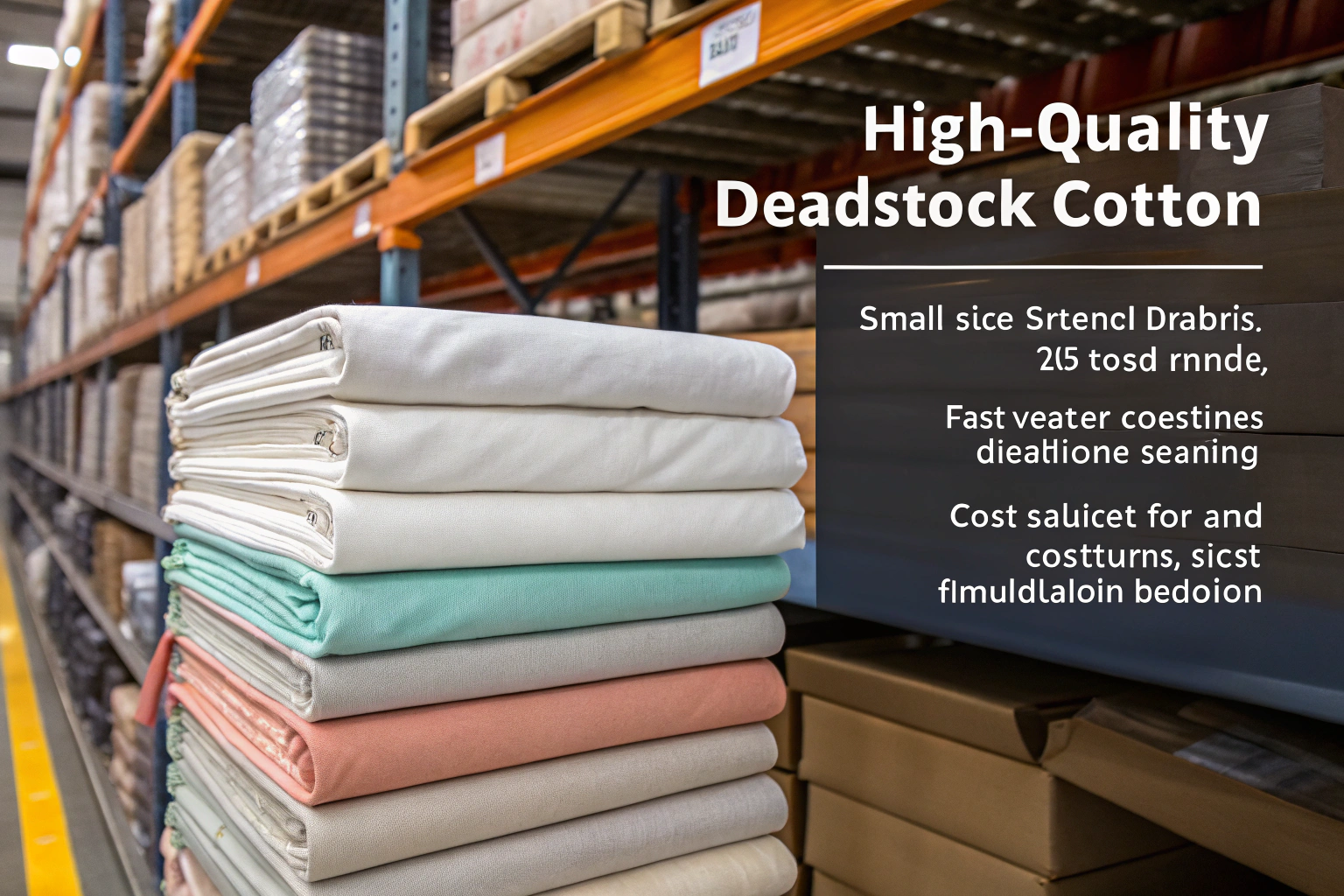
Deadstock cotton-linen is the smartest sourcing strategy for small to mid-size brands in 2026 because it solves the three problems that make traditional custom production uneconomical at low volumes: high minimum order quantities, long lead times, and full-price development costs. Deadstock fabric is already woven, already finished, and already sitting in a warehouse ready to ship. You can buy as little as 50 yards, receive it in a week, and pay 25% to 50% less than the custom bulk price. In a year of cotton price volatility and supply chain uncertainty, deadstock converts those risks into a known, available, affordable inventory.
This is not a clearance strategy for desperate brands. It is a deliberate sourcing model that aligns with the realities of modern fashion: smaller batches, faster turnarounds, and a consumer who values uniqueness over uniformity. Let me walk you through why deadstock makes more sense in 2026 than ever before, how the economics compare to custom production, and how to build a reliable deadstock supply chain.
Why Is Deadstock Fabric A Strategic Sourcing Choice For 2026
Sourcing strategy is about aligning your material supply with your business model. If your business model is high-volume, low-margin basics, custom bulk production is the right fit. If your business model is limited-edition drops, capsule collections, or made-to-order, deadstock is not just a fallback option. It is the superior strategic choice. The economics of small-batch production simply do not work with the cost structure of custom weaving.

How Does Deadstock Align With The Shift To Small-Batch Fashion?
The fashion industry is fragmenting. The era of the 50,000-unit department store order is giving way to the era of the 500-unit direct-to-consumer drop. This shift is driven by consumer demand for exclusivity, by the economics of inventory risk, and by the rise of platforms like Shopify that enable brands to sell directly without wholesale commitments. Small-batch production reduces inventory risk—you only produce what you can sell—but it requires a fabric supply that matches the batch size.
Deadstock aligns perfectly with this model. The fabric already exists. You can buy exactly the yardage you need for one production run, sell through that run, and then move on to a different deadstock fabric for the next drop. You are never sitting on 800 yards of leftover fabric that you ordered to meet a minimum. Your inventory risk is near zero. Your cash flow is healthier because you are not tying up capital in raw material inventory. The small-batch model and deadstock sourcing are two sides of the same coin. For a broader perspective on this shift, you can read about the shift toward small-batch and limited-edition fashion production and how deadstock fabric sourcing supports this business model. The trend is structural, not cyclical.
Why Is Deadstock More Reliable In A Volatile Cotton Market?
Custom production exposes you to the cotton market at the moment you place your order. If cotton prices have spiked since you built your budget, your fabric cost is higher than planned, and you either absorb the hit or raise your retail price. Deadstock fabric was produced at some point in the past when the raw material cost was different, usually lower. The deadstock price you pay today is based on what the mill needs to clear the inventory, not on the current cotton spot price.
This time disconnect is a form of free hedging. The deadstock roll on our shelf was woven six months ago, or twelve months ago, when cotton prices were at a different level. The price we charge for that roll is not indexed to today’s commodity market. It is indexed to our need to turn inventory into cash and free up shelf space. In a rising cotton market, deadstock prices remain stable or even decline as we make room for new production. This makes deadstock a counter-cyclical sourcing strategy. When custom production costs are rising, deadstock becomes relatively more attractive. For more on this dynamic, you can explore how deadstock fabric pricing relates to commodity cotton price movements and why it offers a hedge against raw material volatility. The time lag is your financial friend.
What Are The Economic Advantages Of Buying Deadstock Cotton Linen
The economic case for deadstock rests on three numbers: the price per yard, the minimum order quantity, and the carrying cost of inventory. When you compare deadstock to custom production on these three metrics, deadstock wins on all three for any order under 500 yards. Let me walk through the math.

How Much Can I Save Per Yard With Deadstock Versus Custom?
Deadstock cotton-linen typically sells for 25% to 50% below the equivalent custom bulk price. A fabric that would cost $8.00 per yard to develop and weave as a custom order might be available as deadstock for $4.50 to $6.00 per yard. The savings come from two sources. First, the development costs—yarn sourcing, lab dips, sample weaving—were already paid by the original client who commissioned the custom production. You are not paying for that development overhead. Second, the mill’s carrying cost for the deadstock inventory is a sunk cost. The fabric is taking up shelf space. Selling it at any positive margin generates cash that can be reinvested.
The savings are not theoretical. They are visible on every deadstock invoice. A brand that buys 200 yards of deadstock at $5.50 per yard spends $1,100. The same brand buying 200 yards of custom-woven fabric at $8.00 per yard, assuming the mill even accepts a 200-yard order, spends $1,600. The $500 difference might be the entire marketing budget for the collection launch. For a breakdown of the cost structure, you can read about the cost comparison between deadstock and custom-woven cotton-linen fabric for small-batch orders under 500 yards. The math is straightforward and compelling.
How Does The Lower MOQ Reduce My Inventory Risk?
Custom production minimums force you to buy more fabric than you need. If your production run requires 200 yards and the mill’s minimum is 500 yards, you buy 500 yards and hope to use the remaining 300 yards in a future collection. Sometimes you do. Often, the extra fabric sits on your shelf for two years, occupying space, tying up cash, and eventually getting sold to a jobber for pennies on the dollar or thrown away.
Deadstock has no minimum order quantity beyond the length of the roll. If a roll has 85 yards and you need 85 yards, you buy the roll. If you need 200 yards and we have two rolls totaling 210 yards, you buy both and have 10 yards left over for samples. The match between your production need and your fabric purchase is nearly exact. Your inventory of leftover fabric after production is minimal. The cash that would have been tied up in 300 yards of surplus fabric stays in your bank account, funding marketing, hiring, or your next collection. The lower MOQ reduces your working capital requirement and your inventory holding cost. For a deeper look at the working capital impact, you can explore how minimum order quantity constraints in custom textile production drive excess inventory and how deadstock sourcing reduces working capital requirements for small fashion brands. The balance sheet impact is significant.
How Do I Build A Reliable Deadstock Supply Chain
Deadstock sourcing is only as reliable as the supplier you source from. A random roll of deadstock from an unknown seller on Alibaba is a gamble. A deadstock program from a reputable mill with documented quality standards and consistent inventory flow is a supply chain. The difference is the difference between a treasure hunt and a procurement strategy. Building a reliable deadstock supply chain means finding a supplier who treats deadstock as a product line, not an afterthought.

What Should I Look For In A Deadstock Supplier?
The supplier should provide three things with every deadstock listing: a technical specification sheet, a quality inspection report, and an accurate available yardage. The spec sheet tells you the fiber content, the weight, the width, and the finish. The inspection report tells you whether the fabric has any defects and grades the roll on the 4-point system. The yardage tells you exactly how much fabric you are buying and whether it is sufficient for your production run.
A supplier who cannot or will not provide these three pieces of information is not a reliable deadstock partner. They are a liquidator selling mystery fabric. The fabric might be first-quality surplus from a premium mill, or it might be water-damaged stock from a bankrupt factory. You cannot tell from a photo. You need the data. We provide all three for every deadstock roll we list because we want deadstock buyers to become repeat buyers, and repeat buyers need consistency. For a checklist of what to evaluate, you can read about the criteria for evaluating deadstock fabric suppliers and building a reliable supply of quality surplus textiles. The spec sheet is the minimum requirement.
How Do I Get Priority Access To The Best Deadstock Inventory?
The best deadstock does not sit on a public website waiting to be discovered. It moves through private channels to buyers who have an established relationship with the mill. A beautiful washed cotton-linen in a trending color might be listed and sold within 48 hours to buyers on the mill’s deadstock notification list. The general public never sees it.
If you are serious about sourcing deadstock as a core part of your strategy, you need to be on the mill’s priority notification list. This typically requires opening a trade account, placing at least one initial order to establish the relationship, and specifying your ongoing fabric preferences so the mill’s sales team knows what to alert you about. We offer a deadstock notification list that gives subscribers 48-hour priority access before new inventory is released to our general website. Subscribers receive an email with photos, specs, available yardage, and pricing. The best rolls sell within that 48-hour window. For guidance on building this access, you can explore strategies for gaining priority access to mill deadstock inventory through trade accounts and notification lists. The early access is the competitive advantage.
What Are The Limitations Of A Deadstock-Only Sourcing Strategy
Deadstock is a powerful sourcing tool, but it is not a complete fabric strategy for every brand. It has specific limitations that you need to understand before you commit to it as your primary sourcing method. The most significant limitation is that deadstock is, by definition, non-repeatable. When a roll is gone, it is gone. If you build a bestselling product around a deadstock fabric and sell out, you cannot order more of the same fabric. This is both a strength—it creates genuine scarcity—and a limitation—it caps your sales volume.

What Happens When My Bestseller Sells Out And I Cannot Reorder?
You have three options, none of them perfect. Option one: find a similar deadstock fabric and produce a second edition of the garment with a note that the fabric has changed. This maintains the product category but resets the customer expectation on color and texture. Option two: take the deadstock fabric to a mill for custom reproduction. This is expensive at low volumes and defeats the cost advantage of deadstock in the first place. Option three: retire the style and introduce a new product. This aligns with a limited-edition brand strategy but limits your ability to build a permanent core collection.
The inability to reorder is the fundamental trade-off of deadstock sourcing. You trade repeatability for uniqueness, cost, and speed. If your brand strategy is built around permanent core styles that you expect to sell season after season, deadstock is not the right primary sourcing method for those styles. You need custom production. Deadstock works best for seasonal capsule collections, limited drops, and experimental styles where the scarcity is part of the appeal. For a decision framework, you can read about how to balance deadstock and custom fabric sourcing strategies for fashion brands that need both unique seasonal pieces and repeatable core styles. The right mix is usually a blend of both approaches.
How Do I Build A Cohesive Collection From Available Deadstock?
This requires a mindset shift from "I design a collection, then I source the fabric" to "I source the fabric, then I design the collection around it." In a traditional design process, the designer starts with a concept, sketches silhouettes, selects colors, and then finds fabric that matches the vision. In a deadstock-led design process, the designer starts with the available deadstock fabric, and the color, texture, and drape of that fabric inspire the design.
This is not a limitation. It is a different creative process, and many designers find it liberating. The fabric constraints actually focus the creative decision-making. If the available deadstock is a dusty olive and a washed terracotta, the collection palette is built around those two colors, and the silhouettes are chosen to suit the weight and drape of those specific fabrics. The collection ends up more cohesive because the materials dictate the design, not the other way around. Designers who are comfortable with this process thrive with deadstock. Designers who need to start with a Pantone chip and a sketch may find it frustrating. For practical guidance, you can explore how to design apparel collections around available deadstock fabric inventory using a material-first creative process. The fabric leads the design.
Conclusion
Deadstock cotton-linen is the smartest sourcing strategy for 2026 if your brand operates on a small-batch, limited-edition, or capsule collection model. It solves the minimum order quantity problem that makes custom production uneconomical below 500 yards. It provides a natural hedge against cotton price volatility because deadstock prices are based on inventory clearance, not current commodity markets. It offers per-yard savings of 25% to 50% compared to custom production. And it aligns with the structural shift toward smaller, faster, more unique fashion that consumers increasingly demand. The trade-off is that deadstock is non-repeatable—when a fabric sells out, it is gone—which makes it ideal for seasonal capsules and limited drops but challenging for permanent core styles. The brands that win with deadstock are the brands that embrace the material-first design process and build the scarcity into their brand story.
If you want to test deadstock as a sourcing strategy, email Elaine and ask to be added to our deadstock notification list. You will receive our next drop before it goes public, and you can see for yourself the quality, the pricing, and the selection of cotton-linen fabrics available. Pick one fabric, order enough for a small run, and experience the economics firsthand. Email elaine@fumaoclothing.com with the subject line "Deadstock Notification List." Let us show you what fast, affordable, low-risk fabric sourcing actually feels like.