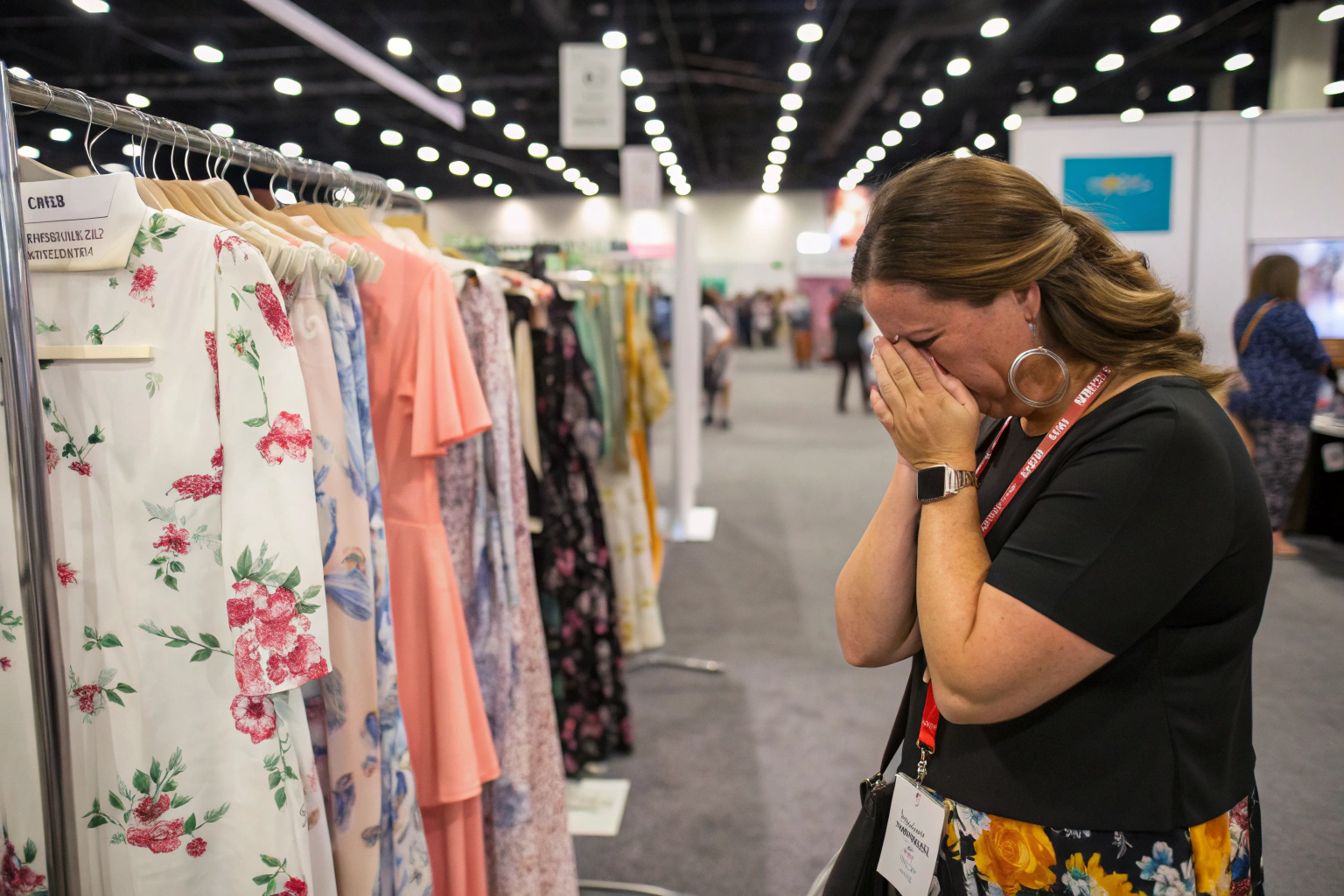
You spent months developing a signature print for your brand. It is a hand-painted watercolor floral, converted to a digital file, perfectly scaled for a bias-cut midi dress. You send it to a mill for sampling. The sample is beautiful. You place a bulk order. Three months later, you are scrolling through a trade show in Las Vegas and you see your print on a competitor’s rack. The mill sold your exclusive design to another brand. You never signed an exclusivity agreement. You have no legal recourse. Your signature print is now a commodity, and your brand differentiation evaporated overnight. I have watched this exact scenario destroy a small brand’s identity. A print designer from Los Angeles told me she cried in the middle of the trade show aisle.
Yes, Shanghai Fumao can provide contractual exclusivity on a custom cotton-linen print that you develop with us. We offer three tiers of exclusivity protection: time-limited exclusivity for a specific season, territory-based exclusivity for a defined geographic market, and full perpetual exclusivity where the print belongs to you and we never sell it to any other client. The terms are documented in a formal Exclusivity Agreement that is signed before we begin production. We also retain your print file in an encrypted, access-controlled digital archive so that no internal team member can accidentally or deliberately share it with another client.
Exclusivity is a legal and operational commitment, not a verbal promise. Let me walk you through the different tiers, how we protect your digital files, and what you need to do to secure your intellectual property before you send us your first artwork.
What Are The Different Tiers Of Print Exclusivity We Offer
Exclusivity is not a single yes or no question. It is a spectrum of protection levels, each with different commercial terms. The right tier for your brand depends on how central the print is to your brand identity and what budget you have available for exclusivity. I will explain each tier plainly so you can choose the one that matches your business need.

What Is Seasonal Exclusivity And How Does It Work?
Seasonal exclusivity grants you the exclusive right to use the print for a defined time period, typically 12 months from the date of first production. During that period, we will not sell the print to any other client. You have a one-season head start on the market. When the exclusivity period expires, the print may be released to our general archive or sold to other clients, unless we agree to renew the exclusivity for another term.
This tier is designed for brands that operate on a seasonal collection calendar and need to ensure their summer print is not on a competitor’s rack during the same selling season. It is the most affordable exclusivity option because we retain the right to monetize the print after the season ends. The cost is typically a modest surcharge on the bulk fabric price, or a minimum order quantity commitment that guarantees us a certain volume of business in exchange for the seasonal protection. This tier works well for trend-driven prints that have a short market life. A watercolor floral that is hot for Spring/Summer 2026 may not be relevant by Spring/Summer 2027. Seasonal exclusivity protects your window of peak value without locking up the print permanently. For more on the structure, you can read about the terms and conditions of seasonal print exclusivity agreements in textile manufacturing. The time limit is the defining feature.
How Does Territorial Exclusivity Protect My Market?
Territorial exclusivity grants you the exclusive right to use the print within a defined geographic market, such as North America, the European Union, or Australia and New Zealand. We can sell the same print to other brands operating in other territories, but not to any brand selling into your protected territory.
This tier is designed for brands that have a strong presence in a specific region and need to prevent direct competitors in the same department stores and boutiques from accessing the same fabric. A brand selling to Nordstrom in the US does not want a competitor also selling to Nordstrom in the US using the identical print. Territorial exclusivity solves this problem at a moderate cost. The complication is enforcement. We must verify that any other client purchasing the same print is genuinely selling into a different territory. This requires trust and, in some cases, contractual commitments from the other buyer regarding their distribution channels. We manage this by maintaining detailed records of which prints are sold to which clients for which territories, and we are transparent with all parties about the territorial restrictions. For the details of how this works in practice, you can explore how territorial exclusivity agreements for printed textiles are structured and enforced across different geographic markets. The map defines the right.
What Does Full Perpetual Exclusivity Cost?
Full perpetual exclusivity means the print belongs to you, permanently. We will never sell it to any other client, in any territory, for any purpose, ever. The print file is treated as your intellectual property, licensed to us solely for the purpose of producing fabric for your orders. When you stop ordering the print, the screens or digital cylinders are archived or destroyed, and the file remains in our encrypted archive accessible only to you.
This is the highest level of protection and it carries the highest cost. We charge a one-time exclusivity buyout fee, which is calculated based on the estimated lost revenue from not selling the print to other clients over its commercial lifespan. The fee varies depending on the complexity and appeal of the print, but it typically ranges from $1,500 to $5,000. This fee is in addition to the standard development costs for the print sampling and screen or cylinder engraving. For brands where a signature print is a core part of the brand identity—think of the iconic prints that define a brand’s visual language—the perpetual exclusivity fee is an investment in brand protection. For brands where the print is a seasonal novelty, seasonal exclusivity is usually the smarter commercial choice. For a thorough comparison, you can read about the cost structure and terms of perpetual versus seasonal print exclusivity agreements in custom textile manufacturing. The permanent protection comes at a permanent price.
How Do You Protect My Digital Print Files From Theft
Print exclusivity is only as strong as the security of the digital file. A signed agreement means nothing if a rogue employee can email the print file to a competitor from their personal account. Digital file security is the operational backbone of any credible exclusivity promise. We invested in access-controlled storage and file transfer protocols specifically because we work with brands whose print artwork is their most valuable intellectual property.

Who Has Access To My Print File Inside Your Company?
Your print file is stored on an encrypted server with role-based access control. Only three people in the company have the credentials to access the client print file directory: the head of the printing department, the production manager assigned to your account, and me, the owner. No other employee—not the sales team, not the sampling department, not the finishing department—can open the folder where client print files are stored.
Every access event is logged with a timestamp and the user ID. The log is reviewed monthly. If anyone outside the authorized list attempts to access the directory, the attempt is denied and flagged for investigation. This system eliminates the risk of casual file theft—a curious employee browsing through interesting prints and forwarding one to a friend who works at another mill. It also means that if a print ever does leak, the access log tells us exactly who accessed the file and when, which creates accountability. For a technical explanation of these systems, you can read about how textile mills use encrypted servers and role-based access control to protect client digital print files from internal theft. The security is as much about deterrence as prevention.
How Do You Transfer Print Files Securely?
We never ask you to send a high-resolution print file as an unencrypted email attachment. Email is not secure. Attachments pass through multiple servers and can be intercepted or stored indefinitely in inboxes with weak password protection. Instead, we use a secure file transfer service with end-to-end encryption. You upload the file to a password-protected portal. We download it, transfer it to the encrypted internal server, and delete it from the portal.
For ongoing communication about the print—color separations, scale adjustments, strike-off approvals—we use the same secure portal. We never discuss proprietary print details over unencrypted channels like standard WeChat or unsecured email, because those platforms do not provide the level of confidentiality that a proprietary print deserves. We also sign a Non-Disclosure Agreement specific to the print development before you send us any files. This NDA is separate from the exclusivity agreement and covers the pre-production phase where the print is being sampled and approved. For a guide to best practices, you can explore secure file transfer protocols for sharing proprietary textile print designs with manufacturing partners. The security begins before the file reaches our server.
What Are The Minimums For An Exclusive Cotton Linen Print
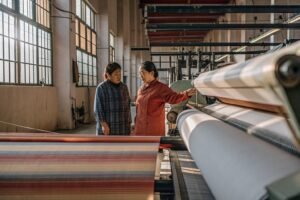
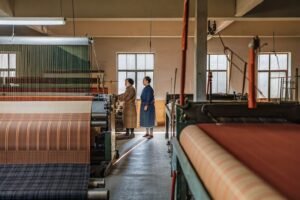
An exclusive print is a custom development. It requires engraving screens or cylinders, mixing custom dye colors, and running print trials to match the strike-off to your approved artwork. These setup steps have fixed costs that do not vary with the order quantity. The minimum order quantity for an exclusive cotton-linen print is driven by the need to amortize these setup costs across a commercially viable yardage.

What Is The Minimum Yardage For A Custom Screen Print?
The minimum order quantity for a custom rotary screen print on cotton-linen is 500 yards per colorway. This minimum covers the cost of engraving the nickel screen, formulating the dye paste, setting up the printing machine, and running the print. Producing less than 500 yards is possible but the per-yard cost increases sharply because the fixed setup costs are spread across a smaller yardage.
For digital printing, the minimum is lower, starting at 100 yards per colorway. Digital printing does not require engraved screens. The print file is sent directly to the printer, and the ink is applied by print heads, similar to a high-end inkjet printer but for fabric. The per-yard cost of digital printing is higher than rotary screen printing at larger volumes, but the setup cost is near zero, making it the better choice for small-batch exclusives and sample yardage. Many brands start with a digital print for their first season, test the market response, and then transition to rotary screen printing for the second season if the volumes justify the screen engraving investment. For a comparison of these two methods, you can read about the minimum order quantities and cost trade-offs between rotary screen printing and digital printing for custom cotton-linen fabrics. The printing method determines the minimum.
Can I Order Samples Before Committing To A Bulk Order?
Yes, and this is a standard part of the development process. We produce strike-off samples—short lengths of printed fabric, typically 2 to 5 yards—using the actual production method that will be used for the bulk order. For rotary screen printing, a sample screen is engraved and used to print the strike-off. For digital printing, the strike-off is printed on the same digital printer that will run the bulk. You receive the strike-off, evaluate the color accuracy, the print definition, and the hand feel, and you approve it before we proceed to bulk production.
The strike-off development has a separate cost, typically $100 to $300 per colorway depending on the print complexity and the printing method. This cost is credited against your bulk order if you proceed. If you choose not to proceed, the cost covers our time and materials. The strike-off stage is your opportunity to verify that the print on the actual production fabric matches your digital artwork. Colors render differently on a monitor than on physical fabric. A navy blue on your screen may print as a dark teal on cotton-linen. The strike-off catches these discrepancies before you commit to 500 yards. For the procedural details, you can explore the sample development process for custom printed textiles from digital artwork to strike-off approval to bulk production. The sample is your safety net.
Who Owns The Print Artwork And Screens After Production
Ownership of the physical tools—the screens or cylinders used to print your fabric—is a separate question from ownership of the artwork file. Both should be addressed in the exclusivity agreement. I have seen disputes arise where a brand assumed they owned the screens because they paid for the engraving, but the mill’s standard terms stated that the screens remained mill property. Clarifying this upfront prevents a conflict when you eventually want to move production.

Do I Own The Screens If I Paid For The Engraving?
Under our standard terms, you own the screens if you paid the engraving fee in full. We will state this explicitly in the Exclusivity Agreement. If you decide to move production to another mill, we will release the screens to you or to your designated carrier. You pay the shipping cost. The screens are your physical property.
If you choose not to pay a separate engraving fee, and instead the engraving cost is amortized into the fabric price over a minimum order quantity, the screens remain our property until the amortization is complete. After that point, ownership transfers to you upon request. This structure is common when brands prefer to pay a higher per-yard price rather than an upfront engraving fee. Both structures are legitimate, but the choice must be documented. A brand that does not understand which structure they are operating under may be surprised when they try to take their screens to another mill and find they do not legally own them. For guidance on these terms, you can read about the ownership and release terms for custom rotary print screens in textile manufacturing agreements. The screens are assets. Know who owns them.
What Happens To My Print When I Stop Ordering?
Under a perpetual exclusivity agreement, the print file remains in our encrypted archive, and the screens are stored or returned to you at your direction. We will never produce the print for any other client. Under a seasonal or territorial exclusivity agreement, the print file may be released to our general archive after the exclusivity period expires, unless we agree to renew. We will notify you before the expiration and give you the right of first refusal to renew or to upgrade to perpetual exclusivity.
If you choose not to renew and the print is released, we may offer it to other clients. We will not offer the print to a direct competitor in your primary market during the first season after release, as a professional courtesy, but this is not a contractual obligation unless specified in the agreement. The safest course is to decide your long-term intentions for the print at the start of the relationship and choose the exclusivity tier that matches those intentions. A print you intend to use for one season can be seasonal. A print you intend to build your brand identity around should be perpetual. For more on planning the lifecycle of a print, you can explore strategies for managing the lifecycle of an exclusive custom textile print from development to archive. The end of production should be planned at the beginning.
Conclusion
Exclusivity on a cotton-linen print is a contractual right, not a verbal assurance. We offer three tiers of protection—seasonal, territorial, and perpetual—so you can choose the level that matches your budget and your brand’s reliance on the print. We protect your digital files with encrypted servers and role-based access controls so that no unauthorized employee can access your artwork. We produce strike-off samples for your approval before bulk production so that the printed fabric matches your vision. And we document the ownership of the screens in the Exclusivity Agreement so that there is no ambiguity about who controls the physical printing tools. Your print is your intellectual property. We treat it with the respect that a creative asset deserves.
If you have a print design ready for development, email Elaine. She will send you our standard Non-Disclosure Agreement and our Exclusivity Agreement template for your review. You can discuss the appropriate tier for your project—seasonal, territorial, or perpetual—and we will provide a development proposal with timelines, minimums, and costs. Email elaine@fumaoclothing.com with the subject line "Custom Print Exclusivity Inquiry." Let us protect your print as carefully as you designed it.