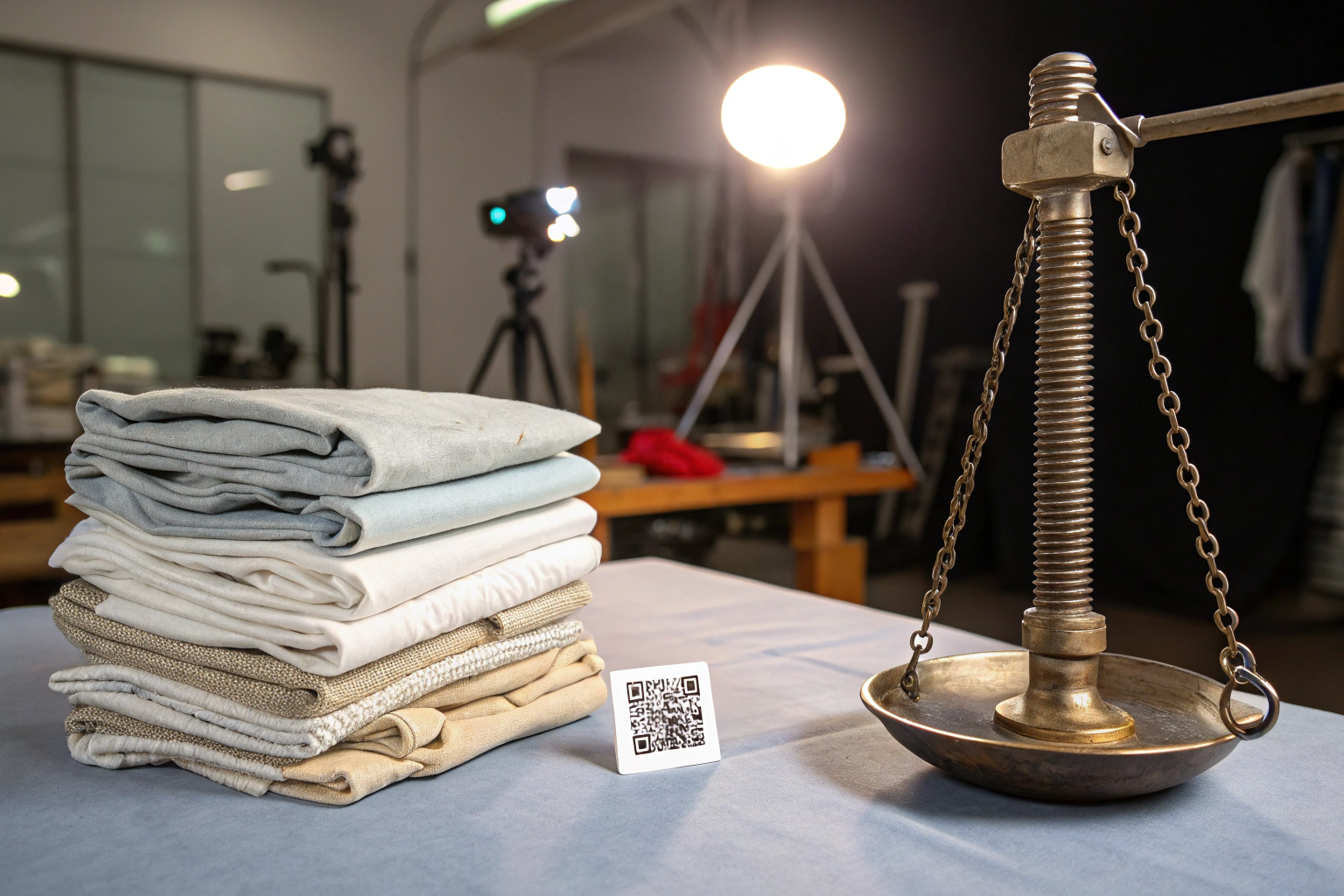
Last quarter, a procurement manager from a European fast-fashion buying office challenged me directly at a trade show in Paris. He held up his phone showing a price of $1.60 per yard for a printed polyester georgette on Alibaba. “Why would I pay you $2.20 for what looks like the same fabric?” he asked. I pulled out a 50-gram weight scale, a lighter, and a swatch of our fabric. We weighed the competitor’s 90 GSM claimed weight against ours. Theirs was 78 GSM, underweight. I burned a thread sample. Ours melted cleanly into a hard bead; his burned with black smoke and a sharp chemical smell, indicating a heavy filler content. The print registration on his sample drifted by 0.5 millimeters; ours held at 0.2. He went quiet. I told him, “You are not paying $0.60 more for the same fabric. You are paying for the real fabric you thought you were buying in the first place.” That exchange captures the whole story. Shanghai Fumao does not compete with low-end wholesalers on price because we do not produce the same product. We engineer fabric to a quantifiable standard, and that standard carries an unavoidable but transparent cost. The price difference is not a markup; it is the sum of fiber integrity, process control, compliance testing, and reliability.
I want to walk you through exactly where those extra dollars—or dimes per yard—actually go. Because if you are a serious brand, you know one return, one chargeback, or one failed lab test from a substandard lot erases any savings from a cheap invoice. Over the next few sections, I will break down the engineering, the hidden shortcuts, and the long-term value that define our pricing structure. You will see the specifics, not just general promises. If you are weighing a quote from us against an aggressively priced competitor, this breakdown will give you the data you need to make a confident decision.
What Hidden Technical Differences Justify a Higher Fabric Price Per Yard?
The biggest difference between us and an average wholesaler lives in the places you cannot see with your naked eye on a showroom table. A fabric can feel soft off the sample card and still fall apart after five home washes because the yarn twist is too low, or the finishing resin washes out. At Shanghai Fumao, we build fabric from the yarn specification upward, and we refuse to compromise on the structural elements that determine a garment’s life. An average wholesaler buys greige goods from a commission mill based on the lowest bid. We specify the yarn count, twist multiplier, and even the intermingling points on a filament yarn. That upfront engineering adds cost, but it prevents failure.

Why Does Yarn Quality and Fiber Blend Accuracy Affect Your Final Price?
In October 2023, we sourced a batch of 40s compact spun cotton for a jersey order. The market price for standard carded 40s cotton was around $3.20 per kilogram at the time. The compact spun with a higher twist for pilling resistance cost us $3.85 per kilogram. A wholesaler using the carded yarn would save $0.65 per kilo immediately. But on a 180 GSM jersey, that yarn substitution drops the fabric’s Martindale pilling rating from a grade 4 to a grade 2 after 2,000 rubs. For a premium children’s wear brand, that would trigger a recall risk. We do not play that game. The same goes for blends. A genuine 70/30 bamboo-cotton fleece with properly processed bamboo viscose has a specific thermal and moisture profile. An average wholesaler often substitutes a cheaper modal or mixes in regular viscose to hit the price point. Our incoming yarn inspection uses a chemical solubility test on every lot to verify the exact fiber blend. If a yarn lot fails the test, we reject it before it ever touches our knitting machine. This level of material screening costs about $120 per incoming inspection, but it guarantees that the fabric composition label you sew into your garment is legally accurate.
How Do Coating and Finishing Chemistry Costs Separate Premium from Budget Mills?
Here is an example where pennies per liter of chemistry translate into dollars of value. We coat a water-resistant utility fabric for outdoor gear using a solvent-free polyurethane membrane sourced from a Taiwanese supplier with a proven hydrolytic stability rating of 5 years. An average wholesaler coating a “waterproof” polyester might use a cheap solvent-based PU paste from a local trader. The initial handfeel might be slightly stiffer but acceptable. However, after six months of storage or exposure to humidity, the cheap coating begins to delaminate and peel. We have seen this failure in our own lab when we tested competitor samples for an American workwear client. Our formula costs approximately 30% more per coated meter, but the bond strength tested on an Instron machine shows a 50% higher peel resistance. For finishing, we use a wrinkle-free resin on cotton shirting that complies with the EU REACH regulation on formaldehyde release, registering under 75 ppm. A budget wholesaler using a standard DMDHEU resin might hit a 200 ppm reading, which is above the threshold for many European and California-based buyers. These chemical choices are invisible to the designer at the sourcing table, but they dictate whether the garment meets legal standards at the point of sale. For a more commercial overview of this exact comparison, this guide on premium fabric finishing costs versus stock market alternatives explains the price and performance gap clearly from a technical buyer’s perspective.
Is Fumao’s Higher Price Actually a Reflection of True Quality Assurance?
Pricing is not only about what goes into the fabric. It is also about what we pull out before it ships. A low-cost wholesaler typically ships 90% to 95% of what they make, with a generous allowance for defects. We ship 100% of what passes our standard, and we reject a lot if it doesn’t. The cost of that rejection is built into our margin, and it is what saves our clients from catastrophic production delays in their own cutting rooms. Last year, an average Chinese fabric wholesaler’s internal defect rate on knits might be accepted at 8 points per 100 square meters. Our internal standard is 4 points, and our target is way under that. Your price per yard with us includes the fact that we absorb the loss on the 5% of fabric that never leaves our lot because it had a dye streak or a splice mark.

Why Is Our In-House CNAS Lab a Costly Investment That Pays Off for You?
Running a CNAS-accredited lab is not cheap. It costs us over $200,000 annually in calibration, staffing, proficiency testing, and equipment maintenance. An average wholesaler outsources testing to a third-party lab once a year, if at all, to get a “passing” certificate they can show you. We test every production lot against ASTM or ISO standards before we release the packing list. During a 2024 spring order for a French loungewear brand, 12,000 yards of modal-cashmere jersey ran through our lab. We caught a 1.5% variance in the pilling score on one dye lot, traced it to a slightly shorter tumbling time in finishing, and corrected it before the fabric left Keqiao. The brand’s QA manager later told us that our pre-shipment report was more thorough than the audit they performed on a European supplier. The cost of maintaining this capability is embedded in your per-yard price. But consider the alternative. If a wholesaler’s fabric fails at your distribution center, you are looking at a chargeback, air freight for replacement, and lost sales on a stockout. That $0.30 per yard you saved on the invoice can easily turn into a $3.00 per yard real cost. For brands building a risk mitigation strategy, this comprehensive overview of the cost benefits of in-house textile laboratory testing for fashion brands lays out the math better than I can in a blog post. It shows exactly why skipping on testing is the most expensive shortcut in sourcing.
How Does Our 4-Point Inspection System Prevent Defective Yardage from Shipping?
A lot of wholesalers talk about inspection, but they do it on a table with a pair of fluorescent tubes. We use a motorized inspection machine with a backlit panel that runs at 25 meters per minute, which exposes pinholes, thick places, and dye spots that a static check misses. Our system uses the ANSI 4-point method, where defects are scored based on their length. A defect under 3 inches gets 1 point; over 9 inches gets 4 points. We allow a maximum of 40 points per 100 linear meters for individual rolls. If a roll exceeds that, our inspection team downgrades it to seconds quality, and the client is immediately notified. We also track "defect repeatability"—if the same defect, like a periodic thick place warp yarn, appears every 5 meters, our weaving technician is called to the floor immediately to trace its source. This real-time feedback loop costs us in staffing. We pay our inspectors 15% above the local average and train them for six months. But this system caught a crease mark issue on a 250-yard Tencel twill order for a designer in Tokyo last December. We identified it, replaced the fabric, and salvaged their capsule collection launch. An average low-price wholesaler would have shipped that with a hope and a prayer.
How Do Certifications and Real Compliance Impact the Total Cost?
Certifications are not just wall decorations. They are auditable production costs that hit your fabric price directly and indirectly. An average wholesaler who does not hold valid certifications can price a fabric 10% to 15% lower simply because they do not carry the compliance overhead. But that lower price comes with zero traceability. When a European or Californian regulation changes—like the new EU Digital Product Passport or extended EPR rules—that uncertified fabric can be blocked at customs. In 2023, a buyer from a UK retailer told me about a container of printed viscose from an uncertified vendor that was held at Felixstowe for three weeks pending a certificate of origin and chemical safety. The demurrage bill was £4,500. The cheap fabric turned into a financial disaster.

What Do Global Recycled and Organic Certifications Actually Cost Us Per Yard?
Maintaining GOTS and GRS certification costs us roughly $15,000 to $20,000 annually in audit fees and chain-of-custody management. We also pay an organic premium of about 20% to 25% on certified organic cotton yarn versus conventional. This premium is a direct pass-through in the raw material cost. If an average wholesaler offers a “organic” cotton poplin at $2.80 per yard, and our GOTS-certified version is $3.40, the difference is almost entirely the fiber cost and the audit trail. I tested this myself last year. I bought a “organic” swatch from an uncertified AliExpress vendor for a comparison. We ran an isotope test through our lab, and the fiber profile showed a mix of conventional and organic, with trace pesticides detected. It was a fraud. At Shanghai Fumao, we use a transaction certificate system for every GOTS lot, so you can trace your fabric’s fiber back to the specific organic ginning cooperative in Xinjiang or India. For a deeper dive into what makes organic fabric genuinely cost more, this breakdown of what the GOTS organic certification process really means for textile pricing is a resource I share with clients who are skeptical about the premium price.
Why Is Sustainable Production an Investment That Raises Unit Prices?
Sustainability costs real money in energy, water treatment, and chemistry. Our dyehouse partnership invested in a membrane bioreactor wastewater system that recycles 60% of dye water back into production. The system cost over ¥4 million. An average dyehouse dumping untreated or partially treated effluent into the municipal pipe saves that capital cost entirely and undercuts our dyeing price by $0.15 to $0.20 per yard. We choose to run the MBR system because it meets the Bluesign and ZDHC wastewater guidelines that major European sports brands demand. Similarly, our recycled polyester yarns come from a supplier who mechanically processes post-consumer PET bottles under a chain-of-custody that complies with the Global Recycled Standard. The cost is roughly 10% to 12% higher than virgin polyester chip, which fluctuated around $1.10 per kilo last year. An uncertified wholesaler might simply re-label virgin polyester as "eco-friendly" without any verification. We refuse to do that. The result is a higher invoice price for our sustainable fabrics, but it is a truthful price that carries no legal or reputational risk for you.
What Is the Long-Term Value of Paying a Premium Price to Fumao?
A cheap invoice gives you a moment of relief. A premium invoice gives you years of predictable performance. The true cost of fabric is not what you pay per yard; it is what that fabric costs your brand over the life of the garment and the customer relationship. I often tell new designers to model their sourcing decisions on a total cost of ownership basis, not just a landed cost per meter. When you choose Shanghai Fumao, you are paying upfront for a fabric that preserves your brand’s reputation, reduces your operational chaos, and ultimately improves your margin stability.

How Does Fabric Consistency Reduce Chargebacks and Returns for Your Brand?
Returns are the silent killer of fashion profitability. The industry average return rate for online apparel sits around 25% to 30%, and a huge slice of that is quality-driven: color not matching the screen, fabric pilling after one wear, shrinkage beyond tolerance. In 2022, a Southern California direct-to-consumer brand switched to us after a season of 18% return rates due to fabric complaints on a cotton-modal sweater knits sourced from a price-driven wholesaler. We replicated their construction with a tighter yarn twist and a controlled tumble-dry preshrinking process. The direct cost increased $0.45 a yard. But their quality-related return rate dropped to 4% in the next season. That single change added an estimated $120,000 to their bottom line from saved return shipping, restocking, and lost customer acquisition costs. When you calculate it, the extra fabric cost represented less than 1% of their retail price, but it preserved 14% of their revenue. A well-made fabric resists pilling, fades gracefully, and meets the customer’s expectation of "what I saw online." That translates directly into a higher Net Promoter Score, more organic repeat purchases, and a lower customer service cost. I recommend every brand read this classic piece from a retail analytics company on how fabric quality directly impacts fashion brand return rates and profitability. The data backs up what we see daily: better raw materials correlate with better financial outcomes.
Why Does Our Relentless Development Process Create Exclusivity for Your Brand?
You are not just buying fabric from us. You are buying a development engine that gives you access to fabrics your competitors cannot get at any price. Our 20-person R&D team tracks trend forecasts and innovates on new biodegradable membranes, self-cleaning nanocoatings, and zero-water pigment printing techniques. For a premium activewear brand launching this season, we developed a proprietary jacquard knit that maps compression zones seamlessly into the fabric structure without sewing separate panels. The development took four iterations and cost us $2,500 in lab work and sampling before we even sold a single yard. We absorbed that development cost as a partnership investment. If you source from an average wholesaler, you are limited to their open stock catalog, which fifty other brands are buying at the same time. Our premium pricing allows us to invest in these exclusive developments. Over a three-year partnership, a brand working with our R&D team can bring to market innovations that define their niche—whether that is a bio-based spandex alternative or a modal denim with a zero-cotton water footprint. This is not a purchase; it is a competitive barrier. For a strategic perspective on how mills like ours foster this type of growth, this business article on how strategic mill-driven textile innovation helps smaller brands compete is essential reading. It frames research and development as the ultimate pricing lever, and we have structured our entire company around that truth.
Conclusion
The price tag on a Fumao fabric is higher than an average Chinese wholesaler’s price because it measures a fundamentally different product and a fundamentally different promise. The average price includes the risk of underweight fabric, filler chemicals, uncertified fiber, and no post-shipment accountability. Our price includes compact-spun yarn, certified organic raw materials, a CNAS-accredited test report for every lot, a 4-point inspection system that rejects marginal fabric, and an R&D team that works on your next season’s exclusivity. When you spread that cost across a garment that sells at a 4x to 8x markup, the per-unit impact is negligible, but the protection it gives your brand is enormous. The sourcing decision that looks expensive in the spreadsheet is often the cheapest option in a P&L statement after returns, legal exposure, and lost repeat customers are factored in.
If you are ready to experience a transparently priced fabric development process that treats your brand like a partner, not a transaction, let’s talk numbers. My Business Director, Elaine, can line up a cost comparison for you directly. Send her your current base fabric specification and your target price range. She will return a detailed costing sheet that shows exactly where the money goes—from yarn grade and dye chemistry to inspection and shipping. You can reach Elaine at elaine@fumaoclothing.com. I guarantee the clarity of that conversation will be a refreshing change from the opaque pricing you see elsewhere.