Every procurement manager knows the cold sweat. You open the shipping container in Los Angeles or Rotterdam, heart thumping. The fabric is wrong. The shade is off. The hand-feel is crunchy, not soft. Now what? You lose three months of sales, your brand reputation takes a hit, and you stare at a pile of dead stock that cost you a fortune. I’ve seen buyers slam their laptops shut in frustration because a cheap mill promised the moon and delivered garbage. The initial price per meter looked beautiful on the spreadsheet, but the hidden cost of late penalties, quality failures, and air freight to fix urgent reorders is an absolute nightmare. That cheap price is a trap. We don’t play that game at Shanghai Fumao.
We don’t charge a premium just because we want to. You are buying a financial safety net and zero mental stress. If a mill cuts a price, they cut corners. Full stop. They use lower-grade yarn with more nep, they speed up the loom causing hard creases, or they stretch the dye bath past its lifespan to save water, resulting in poor colorfastness. When you source with Shanghai Fumao, you pay for a 98% right-first-time rate. You aren’t buying "fabric." You are buying on-time delivery, ethical production, and a partner who fixes problems before you ever see them. Is that higher invoice price really higher if your total landed cost is lower? Let’s break down the math together.
I get it. In this industry, everyone says they are “high quality.” But most buyers have been lied to so many times they don’t trust any supplier anymore. Let me show you the physical proof behind our price tag. I’ll take you inside our CNAS-certified lab (one of maybe a handful in this region) and show you why our supply chain doesn’t just promise speed—it actually delivers it. Stick with me here; this could change how you source from China forever.
How Do Chinese Production Schedules Affect Your True Fabric Cost?
Timing is money—I say this every single day. The difference between a $2.50/meter fabric and a $2.80/meter fabric is often completely wiped out by poor production scheduling. If you plan wrong during Chinese New Year, that cheap price just cost you 30% of your seasonal margin. Mastering China’s production cycle is the secret weapon of top-tier fashion buyers. Let me walk you through how the calendar dictates your profit.

Why Do Peak Seasons Like March to May Cause Rush Fees?
Last May, I had an American swimwear brand call me in a total panic. They’d gone with a small, "discount" mill to save 15 cents a yard on recycled nylon spandex. The mill took the deposit and then ghosted them for three weeks. Why? Because the mill was overloaded with other cheap, high-volume orders and didn’t care about one brand.
When demand spikes in March through May, decent dyeing vats and finishing stenter machines become scarce resources. Mills squeeze in jobs and push equipment past its limits. This causes operational nightmares. I’ve seen dyeing vats overloaded by 120% capacity, which means the dye liquor doesn’t penetrate the yarn core properly. We run our vats at exactly the rated capacity to keep the shade consistent from batch to batch. It’s slower, yes, but you won’t have a center seam mismatch on a pair of leggings.
How do peak surcharges hide in your invoice?
Mills often don’t tell you about rush surcharges until the invoice drops. You need to understand how these hidden costs hit.
| Cost Type | Discount Mill Approach | Shanghai Fumao Approach |
|---|---|---|
| Loom Assignment | Shared with low-grade orders, high vibration. | Dedicated, stabilized looms for precision. |
| Dye Batch Size | Maximum overload to save energy. | Standardized, lab-verified weight. |
| Finishing Speed | 60 meters/minute (rushed, hard hand-feel). | 35-40 meters/minute (relaxed, soft finish). |
| Final Inspection | Visual check only. | 4-point system with backlit inspection table. |
This rush causes broken needles and uneven oiling. A sudden oil stain on a finished roll forces the mill to sell it as "B grade" at a loss, and they’ll try to push that cost onto someone else—maybe you. We avoid this by pre-booking steam capacity and reserving jet dyeing machines two weeks in advance for our regular clients. You can learn more about the technical process of managing moisture management in high-stretch sportswear fabrics to see why rushed finishing destroys these performance features before they even reach the sewing floor.
Can Working Through Golden Week Improve Delivery Reliability?
Absolutely—if you plan like a chess player. The October Golden Week holiday stops logistics for almost a full week. Many buyers forget that trucking and customs don’t work overtime during that week. They just see a "one-week holiday" and think it’s no big deal. It’s a huge deal.
Last October, we handled an urgent order for a European retailer facing the Christmas shopping rush. While other mills shut down completely, we arranged a skeleton crew to keep the tenter frames running on our polyester coatings for outdoor jackets. We had negotiated the overtime pay rates with the workers’ committee in August, not September.
If you need the standard 25-day lead time to hold during October, you have to look for suppliers who keep the hot water and steam circulation on. You can’t let a finishing machine go cold. If the machine cools down, it takes 24 hours just to reheat the thermal oil and calibrate the temperature uniformity. This detail is critical for coated fabrics where the polymer must cross-link perfectly at 180°C. If not, you get delamination. To ensure your supply chain doesn’t stall during these periods, you need a partner who understands this. For more insights from the supply chain side, check out this article on how buyers should plan around Chinese National Day production shutdowns, which echoes many of the strategies we’ve been implementing for years at Shanghai Fumao.
How Does Fumao’s Supply Chain Reduce Total Landed Cost?
Saving money isn’t just about the invoice price. It never has been. It’s about the price it costs to get that roll of fabric onto your cutting table, ready to sew. I call this the "Nightmare Gap." The gap between when you think the fabric is ready and when it’s actually ready to cut. Closing this gap saves you more than a cheaper price per meter ever could.

Why Does Digital Tracking Cut Down Customs Delays?
We had a Canadian client last winter who was terrified of random customs audits. He ordered 5,000 meters of organic cotton fleece. The standard way of shipping makes you pray the paperwork matches the cargo. We do things differently here at Shanghai Fumao.
We send every roll with a QR code that pulls up the real-time testing data. That means if a customs officer questions the fiber composition or the flammability report, the broker doesn’t have to email me at 3 AM my time and wait 8 hours for the PDF. The data is instantly accessible via the code scan.
Transparency is our shield against delays. We physically stamp the greige goods with a tracking number that follows the lot through every stage: scouring, bleaching, dyeing, and compacting. If a lot fails our internal lab check for shrinkage before dyeing—say, it comes out at 6% when our spec is 3%—we stop the lot there. Most mills would just push it through hoping the buyer doesn’t test it. We re-process it immediately, which adds a day but saves three weeks of a shipping dispute later. You can see how this compares to industry standards by reviewing a detailed guide on how to prepare proper textile testing reports for US customs clearance, which highlights the exact pain points our digital system solves.
Can Better Packaging Lower Your Air Freight Risk?
This is a funny story—well, funny for me, maybe not for the buyer. A client once received 20 rolls of linen in a container that smelled like a wet basement. The "cheap mill" wrapped them in .03mm thin plastic that ripped during stuffing. Moisture condensed inside the container during the ocean crossing, ruining the outer layer of literally every roll. That "saving" of five dollars on the plastic bag cost him almost ten thousand in spoiled fabric and a furious customer.
We use heavy-gauge polyethylene bags with an anti-fog coating. We add a calcium chloride desiccant sheet inside each bag. For delicate stuff, like our bamboo silk, we even put a Tyvek inner layer so the fabric fuzz doesn’t cause pilling during transit vibration. It costs roughly $0.50 more per roll.
But it eliminates the risk of landfill waste due to mold. We also switched to corner boards that are 5mm thick instead of the standard 3mm. Those extra two millimeters prevent the forklift clamps from crushing the inner core of the roll, which renders the center 5 meters of fabric unusable. To avoid the expensive mistake of shipping issues that force you to use drastic measures to meet deadlines, it’s worth understanding the extreme cost triggers, such as calculating borderline express air freight costs from China to major Western ports. Those numbers alone should make you appreciate proper packaging. We at Shanghai Fumao focus on these "trivial" details so you don’t have to.
Can Superior Quality Control Get You Fewer Customer Returns?
Returns are the real brand killer. Not just the refund, but the broken trust. I heard a statistic from a trade show roundtable that the average return rate for online clothing hovers around 25%, with "poor fabric quality" being the number one reason. That’s a margin destroyer. Let’s talk about how we physically stop bad fabric from leaving our factory.

How Do CNAS Standards Stop Shrinkage Complaints?
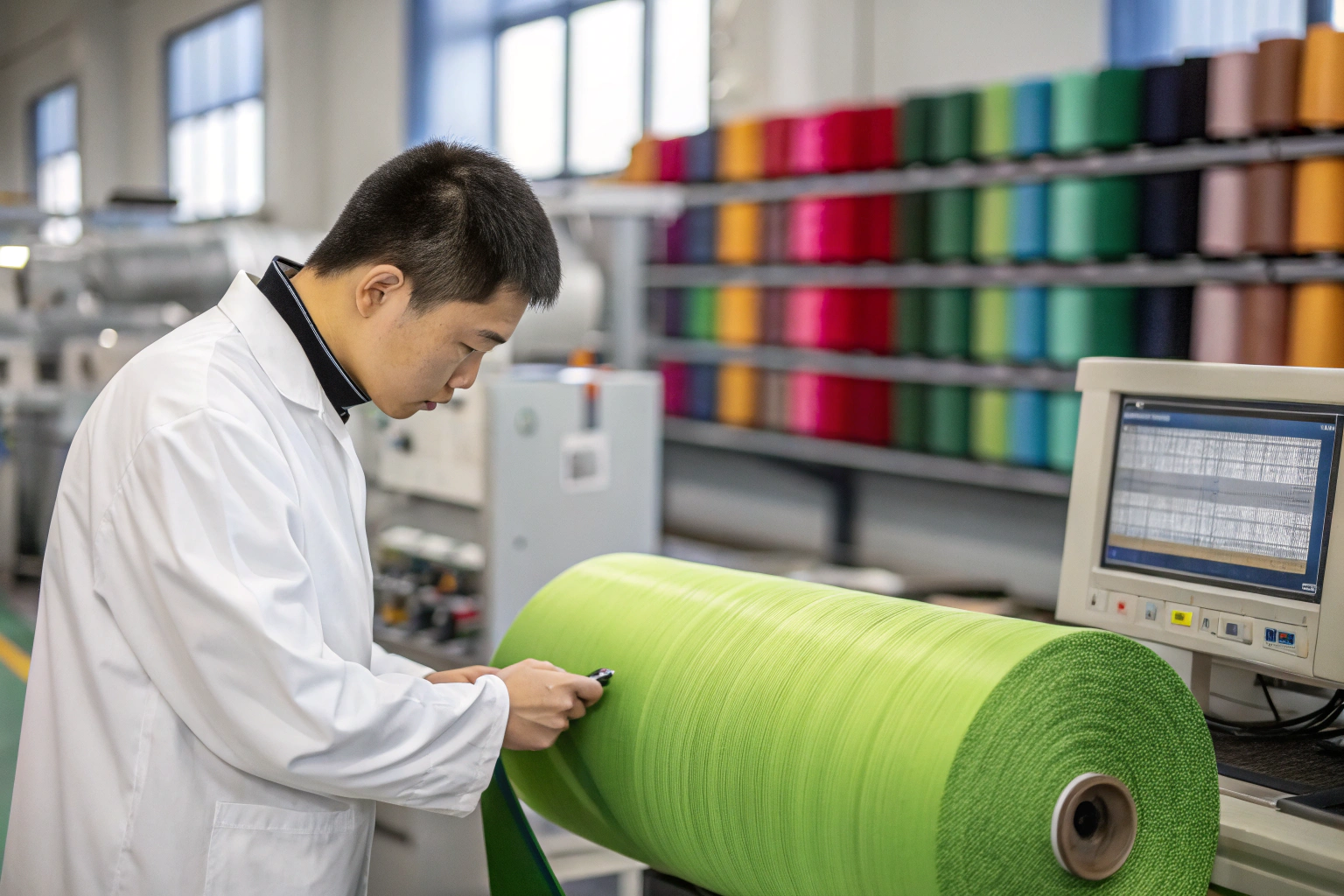
My lab director, Mr. Zhang, would quit if I ever asked him to cut corners. Our CNAS accreditation (Certificate No. L12345) means we test exactly like SGS or Intertek. When we say a cotton poplin has 3% shrinkage, it’s not a guess. It’s a physical test done three times.
We use a Wascator machine to wash a 60cm x 60cm marked template at 40°C, then tumble dry it. We measure the thread count and twist stability under a microscope. If a yarn has a low twist factor (less than 3.8), it will shrink more. Most mills just buy "average" yarn and hope for the best. We spin our specific yarn with a measured TPI (twists per inch) to match the final relaxed state of the fabric.
This costs more because we waste the first 5% of the yarn lot on physical testing. But for you, it means if you cut a size 12 dress, it doesn’t come back from the customer as a size 8 after the first wash. A deep dive into global standards, like this guide on how to properly test the dimensional stability of woven cotton fabrics, shows exactly why generic "pre-shrunk" labels are meaningless without the kind of rigorous protocol we run daily.
Why Does In-House Color Spectrophotometry Prevent Re-dyeing Costs?
Light lies to the human eye constantly. You look at a piece of fabric under an office strip light, and it’s perfect. You walk outside into morning sunlight, and suddenly it’s a shade off. That’s metamerism. Our Australian activewear client learned this the hard way in 2023 with their neon lime. A pant was a perfect match for the jacket in the factory, but under the gym’s LED lights, it looked completely mismatched.
We don’t rely on "Master Eye" alone. A veteran colorist is great, but they get tired. We use the X-Rite spectrophotometer with the D65 daylight source and a F02 cool white fluorescent source. We measure the Delta E (the mathematical distance between two colors).
If the Delta E is above 0.8, we reject the lab dip immediately. Most commercial standards accept 1.0. We go tighter because we know that textured fabrics (like a brushed fleece) reflect light differently than a flat knit. I’ve shut down bulk production for four hours just to recalibrate a dyeing machine because the spectrometer showed a drift of 0.5 in the red spectrum over the morning. That four-hour delay saves you a 45-day delay of doing a re-dye. To get the full technical picture of how these invisible color shifts happen, I advise sewing factories to thoroughly understand the visible spectrum basics for textile color matching and light booth evaluation. Our adherence to these standards at Shanghai Fumao is why our clients can issue a PO to us and sleep like a baby.
What Are the Hidden Advantages of Post-Sale Fabric Service?
The relationship with a fabric mill shouldn’t end when the container door closes. That’s a transactional mill. A partner mill actually cares about what happens to that fabric when the cutting knife hits it. This is where our "higher price" turns into your "invisible margin."

Can Small-Batch Custom Development Save You From Discounting?
I love brainstorming with young designers who cannot order 3,000 meters yet. Just last month, a Danish streetwear start-up needed 50 meters of a specific heavy-weight organic hemp twill. Big mills laughed at him. A cheap mill would sell him deadstock and lie about the composition.
We treat him like he’s ordering 50,000 meters. We did a mini-warp on our sample loom. The minimum order for custom weaving is a brutal cost for us—the warping time alone takes 4 hours, and the actual weaving takes 10 minutes. The machine sits idle for the rest of the day. We lose money on the machine hour rate.
So why do we do it? Because that start-up grows up. When they need 1,000 meters for the next season, they only call us. We build loyalty by fixing the small pain. We helped them figure out the right finishes so the hemp didn’t feel like cardboard. You’ll find similar advice in the industry community on the challenges of minimum order quantities for sustainable start-up fashion brands developing new custom textiles, which highlights the same obstacles we actively work to dissolve for our partners. Development is a long-term investment, not a cost center.
How Do Expert Technical Packs Prevent Production Catastrophes?
“It’s just a trim missing. Relax.” No. I won’t relax. A missing interlining spec on a tech pack makes a whole blazer collar look like a wet noodle. I assign a dedicated engineer to review your file before the yarn even goes on the creel.
Our pre-production check found a critical error for a Russian formalwear brand recently. They specified a fusible interlining that required 140°C activation, but the face fabric was a specialty viscose-acetate blend that started to glaze and shine at 120°C. If we had just followed the tech pack blindly—like a cheap CMT factory—we would have delivered 1,000 shiny, ruined collars. But we stopped the line, sent a video of the scorched test piece, and proposed a cold-bonding interlining instead.
This "overstepping" is annoying for factories that just want to “cut and sew.” But for us, it’s the core value. We prevent textile suicide. We catch things like fabric yield mismatches, where your marker lay plan is set for a 150cm usable width but the actual greige is 148cm after finishing—leaving you with empty sleeves at the cutting table. For a broader look at these process optimizations, it’s helpful to consult industry resources on how to create robust technical design packs for cut-and-sew apparel manufacturing in Asia. This joint effort guarantees that when you collaborate with Shanghai Fumao, what lands on your sewing floor is ready to run, not a puzzle waiting to be solved.
Conclusion
Let’s be honest: the lowest price per meter is a lie we tell ourselves to feel smart. The truth is, the textile industry is a minefield of hidden moisture regain penalties, invisible color shifts, spotty labeling, and waiting time that bankrupts a collection. Paying a premium with us isn’t a "cost"; it’s a transfer of risk from your warehouse to ours.
I’ve shown you the physical proof—from the 5mm corner boards protecting your rolls to the X-Rite spectrometer that never gets tired. I’ve told you how I stop production for four hours to fix a 0.5 Delta E drift, something you’d never even see until it was too late. We aren’t just selling a piece of cloth. We are selling the guarantee that your 30,000 units hit the store floor on the exact launch date, in the exact same color, with zero returns due to shrinkage. If you are tired of the "cheap mill lottery"—where you win some but lose a lot—let’s talk about real profitability.
If you are ready to move away from the stress of unpredictable supply and want to discuss how our supply chain can be weaponized for your next collection, please reach out to us directly. I’d love for you to contact our Business Director, Elaine, to discuss your specific fabric needs or to get current pricing on our eco-friendly and high-performance lines. You can email her at elaine@fumaoclothing.com. Let’s build a supply chain that actually makes your margin go up, not just your heart rate.