
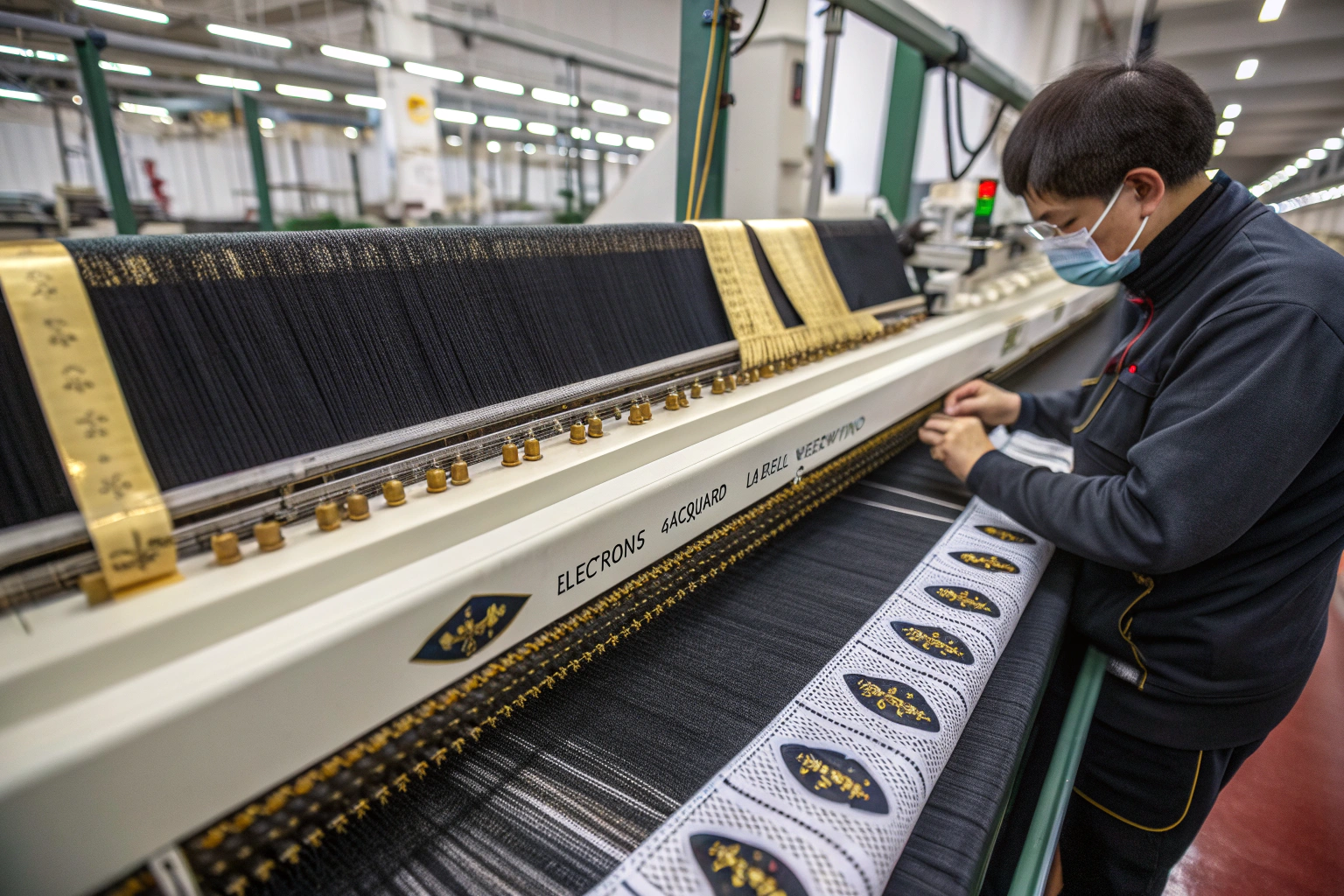
I see it all the time. A US startup founder has designed an incredible hoodie. The fit is perfect, the fabric is custom-milled, and the packaging is eco-friendly. Then I look at the back neck. A scratchy, poorly printed satin tag that looks like it came from a 1990s tourist t-shirt. Or worse, a generic laser-printed label that disintegrates in the first wash. The founder doesn’t realize that a cheap label is a silent brand killer. It whispers "amateur" to a customer who just paid $120 for a premium garment. That tiny strip of fabric is the last thing your customer touches before they commit to the purchase, and it’s the first thing that irritates their neck if it’s bad.
At Shanghai Fumao, we treat woven labels not as an afterthought, but as a core branding asset. We replicate the density, color-fastness, and soft hand-feel of a premium Italian woven label, but we deliver it in 7 days with zero minimum order quantity surcharges. For a startup, this isn’t just a supplier upgrade; it’s a strategic repositioning of the product’s perceived value. I’m going to walk you through exactly why our labels have changed the launch trajectory for dozens of indie brands, how the technical weaving process works, and how you can design a label that makes your garment look like a hero product from a far more established house.
How Does Fumao’s Weaving Density Elevate a Startup’s Brand Perception?
Perception is a physical sensation before it’s a rational judgment. When a customer picks up your t-shirt, their fingers brush the inside back neck. If that label feels like a dense, silky ribbon with a crisp, engraved-like texture, their brain instantly codes the entire garment as "luxury." If it feels like a flimsy, fuzzy piece of rough polyester that bends like paper, their brain codes it as "fast fashion." You cannot escape this unconscious bias. The weaving density of the label is the single biggest physical differentiator.
Most low-cost label suppliers use standard 50-denier threads and a loose plain weave on outdated needle looms. They pump these out at high speed, and the result is a label with low thread count, blurry text, and a rough, sandpapery back. At Shanghai Fumao, we exclusively produce our premium startup labels on electronic jacquard label looms using a high-density 30-denier fine polyester or a mercerized cotton yarn. We pack more picks per inch into the weave, often doubling the thread count of a generic label. This creates an ultra-smooth, high-definition surface. Small serif fonts and intricate logo vectors that turn into a muddy blob on a cheap loom come out razor-sharp on ours. A Chicago-based minimalist streetwear label sent me their raw, complex monogram logo file. Their previous supplier’s sample made the initials "C" and "G" look like a solid grey dot. Our high-density sample revealed the exact chiseled detail of the typeface, with a clear, open counter-space. The founder messaged me, "This label alone just moved my hoodie into a different price bracket." That’s the immediate perceptual shift.

What Is the Difference Between Damask and Satin Label Weaving Styles?
You have two primary choices for a premium woven label: damask and satin. They aren’t just aesthetic preferences; they are structural opposites that dictate how fine your text can be. A damask weave uses a single warp and a single weft, tightly interlaced in a 1/1 or 1/2 ratio. It creates a flat, matte surface that’s physically thinner and more drapeable than any other type. A satin weave uses long warp floats over multiple wefts to create a glossy, lustrous surface.
I usually tell my startup clients this: if your logo is a graphic icon or a simple, bold sans-serif wordmark, satin is stunning. The long floats reflect light like a mirror, making a solid gold or white thread pop dramatically against a dark background. It looks expensive and shiny. But if your logo has tiny, intricate text—like a website URL, a care instruction line, or a detailed illustrated crest—you need a damask. Satin’s long floats lack the structural interlocking to hold a clean, sharp edge on a tiny 4-point font. The thread drifts slightly, and the letter becomes fuzzy. Damask’s tight interlacing acts like a pixel grid, locking every micro-detail in place. The back of the label is also a key differentiator. Satin has floating threads on the back, which can feel slightly rough and snaggy. We apply a thin, non-toxic water-based back-coat to smooth it. Damask’s tight weave has an inherently clean back that’s skin-friendly right off the loom. We wove the legal text for a New York wellness patch brand entirely in 4-point Helvetica in damask. The text was perfectly legible under a linen tester. It passed their lawyer’s review. On a satin base, that text would have been a glossy, illegible smear. Choosing the right weave style is an engineering decision, not just a visual one.
How Does Recycled Polyester Thread Affect Label Durability and Softness?
Startups in 2024 are terrified of being called out for greenwashing. They want every component, down to the thread holding the label on, to have a sustainability story. But "eco" thread has a nasty reputation for being brittle, dull, and rough against the skin. That’s old technology. The new generation of mechanically recycled polyester staple fiber has changed the game entirely, and we use it as standard.
We source a specific high-tenacity recycled polyester (rPET) filament that’s spun from post-consumer bottle flakes. In its raw state, rPET can have a slightly coarser hand-feel because the polymer chains are shorter and less uniform than virgin poly. We solve this with a two-step texturing process. First, we air-interlace the filament at high pressure to create micro-loops that trap air and give bulk and softness. Second, we apply a proprietary silicone-free softener that isn’t a surface coating, but rather a molecular-level polymer reorganization that etches the fiber surface slightly to reduce friction.
The result is a label thread that is indistinguishable from virgin polyester in softness, but just as strong. Woven into a damask label, it creates the same crisp, tight surface. The critical test is the "neck rub." I have a stack of labels that I literally tape to my own t-shirt collars to test for 12 hours. Our recycled thread labels passed the "no-itch" test every time. A Los Angeles sustainable basics brand switched their entire label program to our rPET damask. Their previous labels used organic cotton, which shrunk and wrinkled horribly after the first home wash, curling into a stiff tube. Our rPET labels emerged from 20 laundry cycles completely dimensionally stable, flat, and soft. The brand now proudly states "Label made from recycled water bottles" on their hangtag. It’s a micro-story that closes the sustainability loop and delights a customer who examines the details. That’s using Shanghai Fumao’s material science to turn a legal requirement into a marketing asset.
Can a 7-Day Woven Label Sample Help You Pivot Before a Launch?
I have watched startups die on the launchpad because they locked in a label design based on a digital mockup, waited three weeks for a sample from a slow supplier, and by the time the sample arrived, their garment production had already started. The label was wrong. The text was too small. The gold thread looked brassy. And they were stuck with 5,000 pieces of a compromised brand identity. In the startup world, a seven-day turnaround isn’t a convenience; it’s a survival mechanism.
At Shanghai Fumao, our "Rapid Label Strike-Off" program is designed specifically for this entrepreneurial reality. You send us your vector file by Monday. Our CAD team weaves a physical damask or satin sample, including any requested color variations and back-coating options. We photograph the sample against a color-checker card and email you a high-res macro shot by Wednesday for immediate remote approval. Simultaneously, we courier the physical sample. It lands in San Francisco, Austin, or Brooklyn by Monday morning. This gives you a full week to physically handle the label, stick it to the actual garment fabric with a piece of double-sided tape, photograph it for your e-commerce product page detail shot, and feel the hand against your neck. You can still change the thread color from "champagne" to "antique brass" because the bulk order hasn’t begun. I’ve facilitated this exact pivot for a Denver outdoor startup. They saw the physical sample of their brand name in a metallic silver on a moss green ground and realized it was illegible against their dark green jacket lining. We switched the thread to a matte beige in 24 hours. The bulk run was perfect. Without that rapid, tactile prototype, they would have spent $2,000 on labels that vanished against the shell fabric. Speed gives you the right to change your mind.

How Does a Visual Strike-Off Batch Let Startups Test Market Feedback Cheaply?
Before you buy 10,000 labels, you should test your branding on real humans, not just your co-founders. A visual strike-off batch of woven labels is the most cost-effective physical branding focus group you can run. We weave a sampling "blanket" that contains multiple iterations of your logo, on multiple base colors, and with multiple thread finishes.
I tell founders to take this physical batch of 20 different label variations and lay them out on a table at their next pop-up shop or sample sale. Don’t tell people they are labels. Just say, "Which of these patches feels the most premium?" or "Which catches your eye first?" You will get brutally honest, unsolicited feedback. I saw a Phoenix-based streetwear entrepreneur do this with a batch I sent him. He was dead-set on a high-contrast white thread on a black aggressive gothic font. His test customers at a weekend market unanimously pointed to a tonal black-on-black subtle gloss label as "looking way more expensive." He changed his entire brand identity that night based on the physical evidence in his hand. The learning cost him $35 in strike-off development, not a $1,800 mistake on a bulk badly designed logo. That’s the lean startup methodology, applied to textile trims. The strike-off enables a pivot validated by your actual paying customers, not a screen mockup.
What Registration Accuracy Can Fumao Guarantee for Laser-Cut Butterfly and 3D Labels?
Startups, especially in the womenswear and couture-lite space, are moving beyond the standard folded rectangular label. They want a die-cut shape that’s integral to their creative direction: a butterfly, a skull, a geometric zigzag, or a raw, fringed edge. This immediately introduces a technical nightmare: registration. Registration is the alignment of the weave pattern with the physical cutting laser. If the weave shifts by even 0.5mm, your perfectly centered golden bee motif is suddenly missing a wing.
Our weaving machines use optical sensors that read a specific "registration thread" woven into the label. This thread is a black reactive filament that’s perfectly opaque to the laser’s guide beam. The laser cutting system locks onto this black thread with sub-millimeter precision. We guarantee a ±0.3mm cutting tolerance on our laser-cut labels. For a small, 30mm wing-shaped label, this means the intricate woven border perfectly follows the laser-cut edge without drifting into the heat-seal zone.
A case in point: a Nashville-based lingerie startup wanted a delicate, branded lace wing label that was an integral part of the bra strap design. The shape was an organic, flowing curve, not a rectangle. We wove a soft, silky micro-satin label with their script logo in a metallic rose gold, and then our laser deftly cut the complex wing outline. The registration was flawless; the laser never breached the internal lettering by more than 0.1mm. The founder sent the samples to a high-end boutique, who immediately doubled their wholesale order because the label read as part of the bespoke garment architecture, not a cheap add-on. The precision of label registration techniques is what separates a crisp, branded accessory like that from a cheaply die-cut, blurry-edged patch that looks like a craft project.
Why Do Fumao’s OEKO-TEX Labels Align with the Clean Branding Trend?
The "clean" branding aesthetic isn’t just a beige color palette. It’s a promise of low toxicity and ethical production. The label physically touching the consumer’s skin must materialize the entire ethos of your brand. If you market a "clean, organic, allergy-safe" baby onesie, but the brand label is a polyester satin dip-dyed with cheap, heavy-metal laden azo dyes, you’ve created a direct skin-contact liability. An educated, conscious Gen Z parent or a wellness-obsessed Millennial will question that contradiction instantly.
We produce fully certifiable OEKO-TEX Standard 100, Class I labels. This is the strictest certification, approved for baby articles. It means every component—the thread, the dye lot, the back-coating adhesive—has been tested and verified to be free from formaldehyde, heavy metals, and allergenic disperse dyes. Our label facility uses a sealed dyeing system for any colored threads, with a closed-loop water filtration, and we can provide a digital scan of the scope certificate that matches the specific lot number of your label order. For brands, this means you can legally and honestly stamp your garment as having "every single component" certified, right down to the brand identification. This is incredibly powerful. A San Francisco online maternity brand was stuck in a legal review for weeks because their previous label supplier in another country couldn’t provide a traceable certificate for the red dye in their logo. Our included batch-level certification unlocked their e-commerce launch overnight. We removed a compliance barrier, which is worth more than any thread count.

What Is the Difference Between Heat-Transfer and Woven OEKO-TEX Labels?
Many startups default to a heat-transfer label—a sticker-like graphic ironed onto the neck tape—because they think it’s the cheapest way to print detailed instructions. But a heat transfer is a film. It’s plastic. It cracks, it sweats, and it creates an impermeable, non-breathable patch on sensitive neck skin. A woven OEKO-TEX label is a breathable textile.
There is also a profound difference in the certification scope. A heat transfer label requires a PU or PVC adhesive film. This film has plasticizers (phthalates) that are strictly regulated and extremely hard to certify for baby-wear. We can do it, but the testing cost is high. A woven label uses a simple, stitchable fabric body. Our OEKO-TEX certification covers the entire textile matrix, and the adhesive we use for a light back-coat is a water-based, formaldehyde-free polymer that passes the "saliva test" for baby articles without breaking a sweat.
The lifespan is also a differentiator. I’ve done a "boil wash" durability test on both types. After 30 home laundry cycles in 60°C water, the heat transfer label was peeling at the corners, and the print had faded to a pale ghost. The woven label was exactly the same color and fully attached. For a premium startup that wants their garment to be resold on a platform like Depop or Poshmark, the label must survive the entire lifecycle of the garment. A shredded label on a second-hand piece looks terrible and diminishes resale value. A perfect woven label on a two-year-old garment silently says "this was built well." For a brand, that’s free, passive marketing. Understanding the specific criteria for achieving OEKO-TEX Standard 100 for every component is not just a regulatory move; it’s a design choice that aligns with the circular fashion economy.
Can We Embed Security Features to Stop Counterfeit Garage Brand Labels?
Once your startup pops off and gets traction, the copycats follow. They will buy your product, scan the label, and send the jpeg to a cheap label factory to produce an identical knockoff for their inferior garage-brand version. You need an anti-counterfeit feature that’s woven directly into the label’s DNA, not just a printed hologram sticker that falls off.
We embed forensic-level identifiers. The most effective is a micro-woven "taggent" thread—a specialized yarn that’s indistinguishable from the standard white weft in normal light, but fluoresces a specific, unique glow pattern under a precise 365nm UV wavelength. We use a dual-layer code: a visible, ultra-fine micro-text smaller than 1.5pt that a scanner can read, and a hidden UV thread. The copycat’s factory will scan and replicate the visible text, maybe, but they won’t have access to the specific proprietary fluorescing thread.
A premium LA-based streetwear brand that we supply was suffering a massive counterfeiting problem in Asian markets. The fakes were visually perfect, right down to the hem stitching. But they couldn’t source our exact Fumao UV thread. The brand’s legal team simply walked through the counterfeit bazaars with a tiny UV pen; if the hidden thread didn’t glow a specific electric magenta pattern, the item was immediately impounded. This isn’t James Bond fantasy; it’s a very pragmatic, low-cost method to protect your brand equity. I always remind founders that woven label costs are tiny—perhaps $0.08 to $0.25 per piece—but protecting a $120 product and its entire brand reputation is infinite. We’re weaving a security detail right alongside your name. For any brand looking to build a supply chain in China, a comprehensive guide to anti-counterfeiting for brands emphasizes the power of starting this security at the component level.
How Does the Fumao "Label Builder" Tool Simplify the Design Process?
I get it. Most founders are not technical textile engineers. They’re creative designers or business hustlers who find the specification of a "fold type" or a "warp thread denier" utterly alien. And frankly, it shouldn’t be their job. Sending a raw vector file to a generic sales agent and asking for a "nice label" is far too ambiguous. It results in endless email threads, lost in translation errors, and physical samples that miss the mark completely. We built our digital "Label Builder" specifically to eliminate this communication fog.
This is a web-based configuration tool where you drag and drop your logo vector, select your base material from a menu of visual swatches (Matte Damask, Gloss Satin, Organic Cotton), and visually pick your thread colors from a calibrated Pantone Textile Spectrum. The critical module is the "Fold Simulator." You select the physical construction of your label from 12 distinct models—End Fold, Center Fold, Manhattan Fold, Mitered Loop, etc.—and the tool instantly generates a 3D digital twin of how your woven, folded label will look and drape in reality. This allows a non-technical founder to "self-serve" the structural spec correctly the first time. They don’t need to learn mill jargon. The tool outputs a tech pack PDF attached automatically to the RFQ. A Brooklyn accessory designer I mentor used this tool to build a complex, flangeless loop-fold for a tote bag label in under 15 minutes. He told me it was the first time he’d ever configured a trim piece without feeling stupid. That’s a massive workflow unlock for the non-industrial designer, putting the sampled result within a 7-day striking distance.

Can We Instantly Preview a "Manhattan Fold" Versus an "End Fold" Before Ordering?
The fold is the architecture of the label. An "End Fold" creates a flat seam allowance; it lies completely flush and hidden inside a neck seam. It’s the cleanest modern look. A "Manhattan Fold," conversely, is a vertical loop with a gentle, raised 3D crest at the center. It looks like a tiny, sculpted book spine. The decision between these two drastically changes the garment’s neck feel and luxury signal.
Previously, a textile designer would have to sketch this in Illustrator, or you’d need to physically mail a proto folded label to the client for approval, adding 8 days and a round of international shipping. Our Label Builder’s "Live 3D Viewer" renders the fold in real-time in WebGL. You click "Manhattan Fold," and the digital label instantly folds up vertically, and you see the soft shadow the raised crest casts. You click "End Fold," and it flattens out, showing the reverse side of the sew allowance.
This visual preview let a Vancouver tech-wear brand instantly catch a major design flaw. Their logo had a central vertical stripe. In the "Manhattan Fold" preview, the central fold line literally split their logo emblem in half, creating a visually broken, distorted graphic. They saw this in the real-time 3D preview, immediately switched to an "End Fold" to keep the surface flat, and ordered the physical sample. Without the simulation, they would have ordered 5,000 labels and discovered the bisected logo only upon unboxing. That preview saved them $900 in dead, misprinted stock, and endless frustration. It’s a stark example of how a little bit of interactive tech reduces the risk inherent in the analog world of custom trims.
How Do We Ensure Your Digital Mock-Up Color Matches the Physical Woven Thread?
The single greatest anxiety in custom labels is the color gap. The RGB thread color on a computer screen is illuminated, bright, and glowing. The physical dyed polyester thread is subtractive, matte, and deeply affected by the texture of the weave it sits within. A gold that looks bright on-screen can look a dull, muddy mustard on a physical damask background. This is the "screen-to-thread" gap, and it’s the number one reason for sample rejection.
We bridge this using a calibrated "Thread Real" Library. Our design team has physically woven a comprehensive color atlas of every single stock thread we carry, photographed them under D65 lab lighting with a calibrated camera against a standard GretagMacbeth ColorChecker, and assigned an Lab* color space coordinate to each. When you select "Antique Gold" in the Label Builder, you are not seeing a generic hex code #CFB53B. You are seeing a high-res, datacolor-calibrated image of an actual woven thread swatch from our physical library.
When the client receives their physical strike-off, the delta-E between the screen preview and the real thread is typically below 1.2, which is a very tight perceptual match. A high-end Scottish cashmere startup was incredibly anxious about matching the label gold to a specific heritage crest detail on their knitwear. They used our calibrated swatch library, selected a "Burnished Brass" thread specifically from the visual swatch (not from a generic color picker), and when the DHL package arrived, they emailed me, "The gold thread is literally perfect. It matches the woven crest exactly." That’s the quiet technical confidence that lets a brand founder sleep at night. No guessing, no praying, just a physical thread library matched digitally to a real-world production standard. That color-trust is the bedrock of our Shanghai Fumao label partnership.
Conclusion
We’ve traced the journey from a flimsy, generic brand-killer to a high-density, custom-woven brand accelerator. A Fumao label isn’t just a legal requirement or a generic trim. It’s a strategic tool that physically signals luxury, durability, and obsessive attention to detail from the very first touch. For a US startup, this tiny textile component can justify a higher retail price, survive the punishing resale market, and even embed a legally defensible anti-counterfeit fingerprint.
Our 7-day rapid strike-off program means you can iterate your brand identity in a week, not a month. Our OEKO-TEX Class I certification means you can sell to a baby’s delicate skin without a compliance headache. And our Label Builder tool means you don’t need a textile degree to specify an intricate Manhattan Fold with calibrated gold thread. You just need your logo and your vision. We handle the rest, turning a sketch into a physical statement piece that makes your garment feel complete. This is what separates a polished, investable brand from a side-hustle that gets ignored on the rack.
Ready to feel the difference a true woven label makes? Don’t settle for a cheap, scrappy finish that betrays the quality of your design. Let’s build your brand’s signature identity right now. Contact our Business Director, Elaine, to kick off your 7-day label strike-off. Email her your logo vector, and she’ll guide you through the Label Builder to select your fold, thread, and texture. The first sample is waiting to be woven. Reach out to elaine@fumaoclothing.com and put the finishing touch on your next drop.








