
I still remember a frantic email I received back in 2018. A buyer from a premium London-based childrenswear label was trying to track down her production order. She had been emailing someone who called himself a "Sales Manager" for six days with no reply. When she finally found my personal contact through a mutual connection at a trade show, I discovered the "manager" was a third-party trading agent who had never even visited our factory floor. The actual production hadn’t started. The trader ghosted her. That moment crystallized something I now treat as a core value: direct communication between a buyer and the factory boss is not a luxury—it is risk management. It is the only way to guarantee that the person promising you a delivery date actually controls the machines that will meet it.
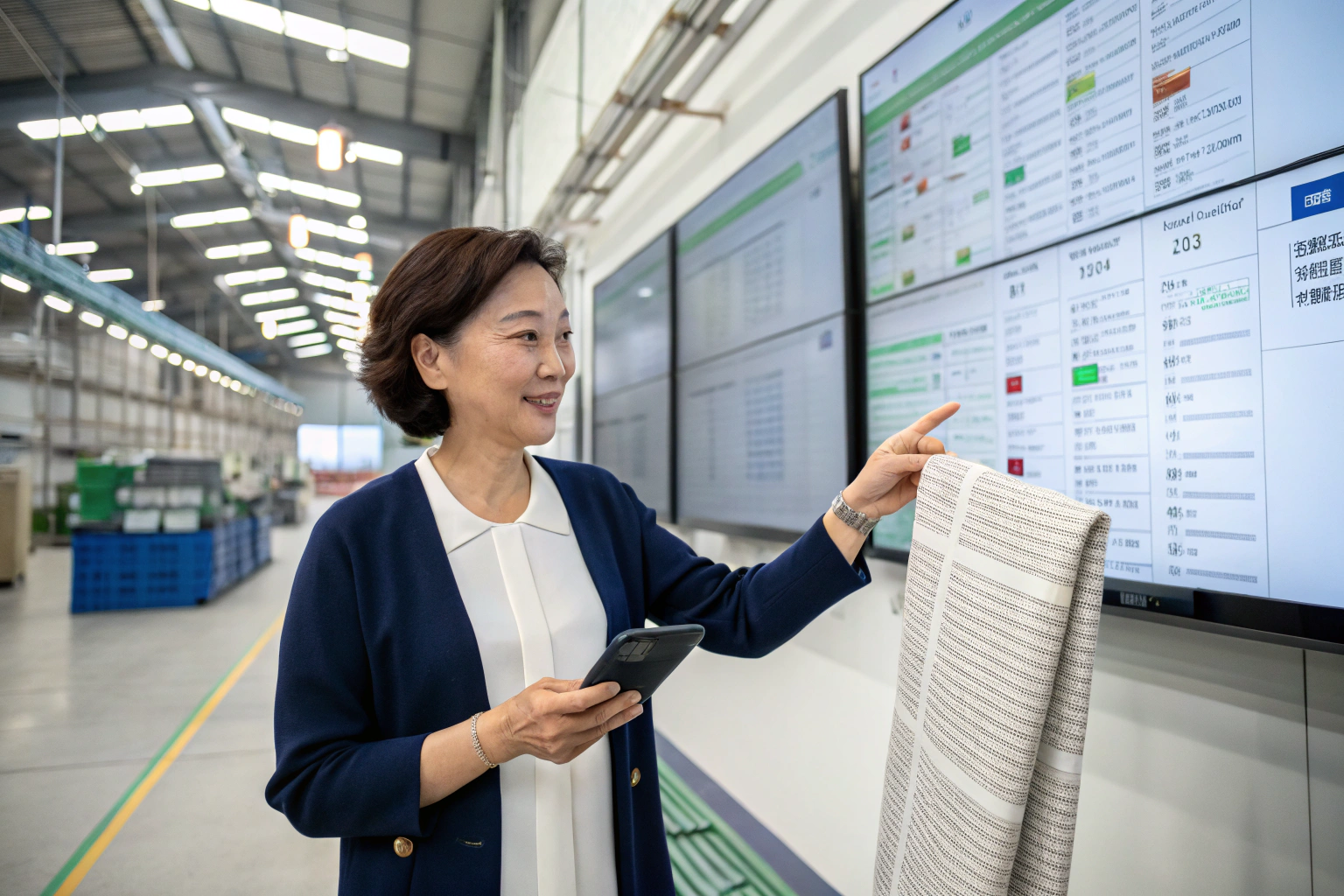
At Shanghai Fumao, my name is Elaine, and I am the Business Director and the person who makes the final call on every significant production decision. I do not hide behind a generic "info@" email address or a chatbot. When you work with us, you communicate directly with me and my core management team. This is not a marketing gimmick. It is how we guarantee that the downstream promises made by sales representatives actually match the upstream reality inside the weaving shed, the dyeing facility, the coating line, and the inspection room. My phone number and messaging channels are shared early in the relationship because I have learned that the cost of a missed message is not measured in minutes—it is measured in thousands of dollars of wasted inventory or dead freight.
But I know what you are likely thinking. "If I talk to the boss, will I get real answers or just sales talk?" "What is the preferred non-email channel for quick updates given the time zone gap?" And "Is there a protocol for contacting senior leadership without alienating the day-to-day contact person?" These are the right questions. Let me walk you through exactly how direct access works, what a typical boss-level interaction resolves that a standard rep cannot, and why a factory owner in Keqiao will respond to you on a Sunday morning.
Why Is Direct Boss Access a Game-Changer for American Importers?
I once watched a buyer lose a season because a junior sales rep at another factory told him, "Don’t worry, the greige fabric is ready," when in reality it was still sitting on a truck at a dyeing subcontractor’s loading bay. The rep did not lie out of malice. He lied because he was trained to protect his commission and because he had no actual visibility into the subcontractor’s production floor. He relayed what he hoped was true. The buyer planned a launch campaign around that hope. The fabric arrived five weeks late, the launch fizzled, and the brand’s cash flow cratered.
Direct boss access eliminates that layer of institutionalized optimism. As the boss, I do not need to protect a commission. I need to protect a 20-year reputation. When you text me and ask, "Elaine, is Lot 4210 actually on the stenter frame right now?" I can turn around from my desk, walk 40 meters across the factory yard, and physically put my hand on the roll. I will send you a photo of the fabric moving through the machine with a timestamp. That level of verification is impossible for a remote sales representative operating from an office in a different city.
But this goes beyond crisis resolution. Direct access also compresses the negotiation cycle for complex custom orders. A standard development dialogue involves the buyer talking to a sales rep, the sales rep emailing the factory manager, the factory manager checking with the dyeing department, the answer flowing back up the chain over three days, and the buyer getting a response so distorted by a game of telephone that it barely resembles the original question. When you talk to me directly, the chain is one link. You describe a problem with a polyester spandex recovery. I walk into the lab, consult with our textile engineer, and give you a technical fix within hours, not days.

What specific decisions can only the factory boss, not a sales rep, make?
Certain commercial and technical decisions sit exclusively at my desk because they involve risk allocation that a commissioned salesperson simply cannot authorize. Rescheduling a production slot to prioritize an urgent reorder from a long-term partner, for instance, means I am personally delaying another order. A sales rep cannot make that trade-off. Waiving a surcharge for a rush service, approving an out-of-spec yield tolerance of three percent to save a critical delivery window, or authorizing an immediate credit note for a quality claim before the formal insurance investigation concludes—these are all boss-level decisions.
When a shipment of high-end wool coating fabric to a Boston client arrived with subtle surface abrasion marks in December 2024, the sales rep could only offer a standard "we’ll investigate" response. I called the client directly within two hours of the claim. I authorized a full 70 percent credit against a future order and absorbed the loss while we traced the root cause to a misaligned guide roller on the decating machine. The sales rep could not have committed to a five-figure credit. I could, and I did, because the long-term relationship matters more than the margin on one container. For [what types of dispute resolution and rush-order approval require direct factory boss authorization in Chinese textile manufacturing], the universal answer is: anything involving unbudgeted money, significant schedule disruption, or reputational exposure.
How does "floor-level" knowledge differentiate a boss from a trading agent?
A trading agent knows what a fabric datasheet says. A factory boss knows what the loom sounds like when the warp tension is two centinewtons too high. I can hear a problem before I see it. This sensory, experiential knowledge is what enables me to make promises I can physically keep.
When a client asks whether a complex jacquard pattern will look sharp on a brushed-back fleece, an agent looks at a theoretical simulation. I walk to the jacquard loom, pull a sample off the back beam, and check the "float" length of the pattern threads. If the floats are too long, they will snag during the brushing process and pill. I know this not from a textbook but from 20 years of solving exactly that problem. If you’re interested in [how to verify that your Chinese fabric supplier has hands-on factory floor production knowledge rather than third-party trading experience], you should ask one specific test question: "Can you describe the exact machine model and the cylinder temperature used for my heat-setting process?" A factory boss can answer that in a single sentence.
Real boss access means you speak to the person who controls both the commercial and the physical reality of your order. But speaking to that person requires navigating a different communication stack than the one a typical American buyer uses for domestic vendors.
What Communication Platforms Streamline U.S.-China Fabric Sourcing Talks?
Western buyers default to email. I understand why. Email creates a paper trail. It is asynchronous. It respects the time zone gap. But it is also catastrophically slow when a container is being loaded wrong on a Friday evening in China and your East Coast office is just opening for the day. By the time you read the email and reply, the container door is already welded shut.
We use a hybrid communication model. Email remains the primary channel for formal transmission of purchase orders, technical data sheets, test reports, contracts, and invoices. These documents require a permanent, searchable archive and are often attached to letters of credit or audit trails. But for operational execution—production status updates, quality issue resolution, urgent schedule changes, video walkthroughs of your fabric on the inspection table—we use WeChat. This combination gives you both legal formality and operational velocity.
I know some American buyers hesitate to use WeChat. There are security concerns, and the app is less familiar in the US market. I respect that entirely. For clients who cannot or will not install WeChat, we use WhatsApp or Telegram as a secondary real-time channel. The specific app matters less than the communication posture: comfortable with rapid, informal, voice-memo exchanges during critical windows.

Should Western buyers switch to WeChat for faster manufacturer responses?
Honestly, the answer is yes, and here is why. The Chinese textile industry runs on WeChat. Not partially. Almost completely. A factory manager at one of our dyeing subcontractors will ignore an email for 24 hours but will respond to a WeChat message in 90 seconds. This is not rudeness. This is a platform ecosystem reality. WeChat integrates text, voice calls, video calls, document sharing, and mobile payments into a single app that the entire supply chain carries in their pocket at all times.
When you need a video of the fabric being inspected under our D65 light booth, I can make a WeChat video call and show you live. The grey scale appears on your screen in real time. You can ask me to zoom in on a selvedge. You can approve or reject on the spot. This capability cuts days out of the approval cycle. For [a practical guide for American importers on using WeChat to communicate effectively with Chinese fabric factory owners], the key is to understand the cultural norms: short messages, frequent appropriate emojis to soften directness, and an expectation that you might receive a message at an unusual hour because the sender wants to resolve something before they sleep.
How do Shanghai Fumao’s team bridge the time zone communication gap?
We operate on a "follow the sun" principle. I and my senior production managers start our day at 7 a.m. China Standard Time, which is roughly 7 p.m. Eastern Time or 4 p.m. Pacific Time. This overlap window allows for real-time conversations during the US business afternoon. We schedule technical reviews, video walkthroughs, and urgent negotiations during this period.
For critical status updates that must reach you before your morning coffee, we send a formatted "Daily Flash" message via email or WeChat at the end of our business day. It contains the exact production stage of every active lot, a list of decisions needed from you that day, and any photos or test results generated overnight. You wake up to a complete situation report. You reply during your morning. We process your reply at the start of our next day. The loop closes in under 24 hours with only one exchange cycle. This system reduces the back-and-forth email volleyball that can stretch a simple yes-or-no question across three days.
Direct access is not a free pass to bypass process. In fact, knowing how to initiate a relationship at the boss level without creating internal friction is a skill that protects the relationship long-term.
How Should You Initiate a Direct Relationship with the Fumao Team?
The first contact with a factory shapes the entire relationship. If you open with a generic "Send me your catalog and lowest price," you will likely be routed to a junior sales administrator, not the boss. That is not gatekeeping. That is triage. A factory boss receives dozens of unsolicited inquiries every day, most of which are from people who will never place an order. The ones that break through are those that demonstrate serious intent, specific technical requirements, and a clear understanding of the industry.
I personally read every inquiry that references a specific product category, a previous trade show meeting, or a referral from an existing client. These signals tell me you are not a mass emailer scraping Alibaba contacts. You are a professional doing targeted sourcing. Mention that you saw us at Première Vision Paris or MAGIC Las Vegas. Mention a fabric spec you are struggling to source—for example, "I need a GRS-certified recycled polyester taffeta with a down-proof calendered finish and a C0 durable water repellent treatment for an outerwear collection." That sentence tells me you know your technical requirements, you understand the eco-certification landscape, and you are working on a real project with a defined deadline.
Once the conversation is opened, I personally handle the discovery call. I do not hand it off. I ask about your brand, your end consumer, your price architecture, and your past sourcing headaches. The purpose is not to extract data. The purpose is to diagnose whether we can genuinely serve you better than your current setup.

Should you ask for the boss by name on the first inquiry?
You do not need to demand the boss. A demand can sound adversarial. But mentioning that you would appreciate a direct line to senior management to discuss a technically complex project is entirely reasonable and usually effective.
A better approach is to address your inquiry to a named individual based on your research. Our website, LinkedIn presence, and trade show collateral all feature my name. When an inquiry arrives addressed to "Elaine," it signals that you have done your homework. It implies that you are specifically interested in Shanghai Fumao, not any random supplier. When you’re learning [a step-by-step method for initiating direct communication with a Chinese textile factory owner for custom development projects], begin by establishing your credibility in the first two sentences: who you are, what you are building, and what specific technical challenge you face.
What information should you prepare before the first boss-level call?
Do not call without a technical brief. A successful first conversation can build a production timeline, budget estimate, and material recommendation. A vague first conversation wastes everyone’s time and signals that you are not ready to buy.
Prepare your target fabric composition—not just "cotton," but "100 percent combed cotton, ring-spun, single jersey, 180 GSM, 68-inch width." Know your required certifications: Oeko-Tex, GOTS, GRS, BCI. Share your target FOB or DDP price per yard, even if approximate. Disclose your annual volume estimate, even if you are a startup. The more information you give me, the more precise my guidance becomes. If you are evaluating [what technical specifications and business information to prepare before contacting a Chinese textile factory boss for a sourcing call], the rule of thumb is: over-prepare on the technical side, be honest about the commercial constraints, and never pretend to be larger than you are.
Once the relationship is established and direct communication flows, the final challenge is knowing what to communicate and when. Not every update needs a boss. Some need a merchandise manager. Some need you to trust the system and wait. Knowing the difference is a core skill that separates low-stress clients from high-stress ones.
What Questions Optimize Direct Communication with the Factory Owner?
Once you have the boss’s direct line, the quality of the answers you get depends entirely on the quality of the questions you ask. Vague questions produce vague answers. "How is my order going?" is a question I can answer with "It is going well." That exchange is completely useless to you. But if you ask, "Is my 400-kilogram polyester tricot lot currently in dyeing or finishing, and what is the exact scheduled exit date from the stenter frame?" you will get a concrete answer that you can act on.
I have trained my entire team to respond best to what I call "closed-loop questions." These are questions with a specific time-bounded data request, not an open-ended status inquiry. The best clients I work with, mostly US-based brand owners who have been importing for years, structure their communication like a project manager. They reference specific lot numbers. They request specific data points—shrinkage test results, roll-length distribution, packing list draft. They treat a production check-in like a mini-audit.
This discipline prevents the most dangerous dynamic in sourcing: the illusion of communication. Two parties exchange friendly messages every few days, both feel informed, but neither party has actually verified any physical reality. Text exchanges can create a warm feeling of connection while a production schedule silently drifts three days behind.

What are the most effective real-time questions for monitoring a fabric lot’s progress?
The five most effective monitoring questions are: (1) "Can you share a photo of my lot on the machine with a timestamp?" This verifies physical reality. (2) "What is the current in-process defect rate per hundred meters and how does it compare to the approved AQL standard?" This catches quality drift early. (3) "What is the truck departure time from the dyeing subcontractor to your inspection facility?" This anchors the schedule to logistics, not promises. (4) "Has the lab dip submission for the secondary colorway been approved internally yet?" This pulls the bottleneck into visibility. (5) "What is the specific last possible vessel booking cut-off date and has the forwarder confirmed the equipment?" This introduces a hard deadline discipline.
Notice that none of these questions require a subjective judgment. They ask for observable, verifiable data points. If the answer is delayed or evasive, you have received information through the silence itself. For [an optimal set of production monitoring questions to ask a China textile factory owner during weekly status check-ins], adopting a data-request format rather than a narrative-request format fundamentally changes the responsiveness you receive.
How should you negotiate pricing and lead times with the decision-maker directly?
Negotiating with a boss is fundamentally different from negotiating with a sales rep. A sales rep defends margin. A boss considers the health of the production schedule, the quality of the relationship, and the lifetime value of the account. This means you can trade variables that a rep cannot access.
If you need a lower price, do not just ask for a discount. Offer something the factory values. Could you accept a longer lead time, allowing us to slot your order into a quieter production window where we lower our operational costs? Could you accept a slightly heavier or lighter fabric weight that matches a standard construction we already run at high volume? Could you reduce the number of SKUs to simplify dyeing changeovers? Offering to pay 30 percent deposit instead of the standard 30 percent also signals serious intent and reduces our working capital pressure, which we often reciprocate with a price reduction. For [negotiating fabric price concessions and shorter lead times directly with a factory owner in the Keqiao textile district], treat the conversation as joint problem-solving, not positional bargaining. The boss has the authority to say yes to creative solutions that a sales script never covers.
This entire structure—direct access, multi-platform availability, intentional first-contact practices, and precise communication discipline—rests on a single premise, which is that a factory is ultimately a human organization, not a transaction machine. The boss’s phone number is a symbol of that human reality.
Conclusion
Communicating directly with me, the factory boss at Shanghai Fumao, is not a special privilege reserved for the biggest accounts. It is the standard operating model for every client relationship we build. My name is Elaine, my channels are open, and my primary job is to ensure that the person signing the contract also understands exactly what is happening on the dyeing floor, in the testing lab, and at the loading dock. When you have direct access to me, you gain three concrete advantages: an immediate, unfiltered view of production reality, the ability to resolve commercial and quality disputes in hours instead of weeks, and a negotiation partner empowered to make creative trade-offs that a normal sales representative cannot offer.
We use WeChat for operational speed, email for contractual clarity, and scheduled video calls for technical deep-dives during the US-China overlap window. The best relationships start with a specific, technically detailed inquiry that signals your seriousness and gives me the information I need to be helpful from the first message. And the best ongoing communication uses data-request formats that pull observable, verifiable facts out of the production flow, eliminating the dangerous gap between friendly words and physical reality.
If you are ready to bypass the trading agent noise and talk directly to the person who controls the machines, the quality standards, and the final delivery promise, then send your project details directly to me at elaine@fumaoclothing.com. Tell me about your fabric, your deadline, and your biggest sourcing frustration so far. I will respond personally. No auto-replies. No routing. Just a factory boss reading your brief and thinking about how to solve your problem before the first sample is even cut.








