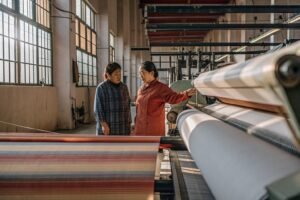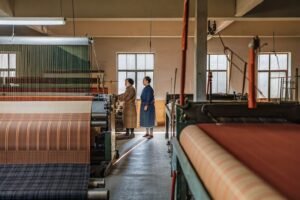
You are on a Zoom call with a potential fabric supplier, and you ask the simple question: "Where does your yarn come from?" The sales manager hesitates, glances off-camera, and says, "We work with several trusted partners in the region." That non-answer is the loudest alarm bell in textile sourcing. It means they buy commodity yarn from a trader who aggregates from a dozen anonymous spinning mills across three provinces, none of which have ever been audited. Your "organic cotton french terry" might contain yarn from a spinner who also runs conventional cotton on the same machines without cleaning between batches, cross-contaminating your GOTS-certified product with pesticide residues you will only discover when the retailer’s random lab test flags your shipment at the port. The pain is not the $0.40 per yard you saved by not asking the follow-up question. The pain is the recall, the destroyed retailer relationship, and the public sustainability report that names your brand as non-compliant. You need to know exactly which bale of cotton, which extrusion line, and which spinning frame produced the yarn in the fabric you are betting your season on.
At Shanghai Fumao, I do not buy yarn from traders. I buy yarn from specific spinners whose factory floors I have walked, whose quality data I audit monthly, and whose contractual commitments to lot integrity and traceability are legally enforceable. My yarn supply chain is deliberately concentrated among six core partners in Zhejiang, Jiangsu, and Shandong provinces, with two additional specialty yarn partners in Japan and Thailand for applications that Chinese mills do not yet match—specifically, high-tenacity solution-dyed nylon 66 from a Toray-licensed facility in Osaka, and extra-long-staple Giza cotton compact yarn from a spinner in Chiang Mai that handles the delicate Egyptian fiber without damaging the staple. Every cone of yarn that enters our creel has a digital identity: a QR code that traces back through the spinner’s batch records to the cotton gin or the polyester polymerization reactor. When I ship you 5,000 yards of fabric, I can tell you which bale of Supima cotton contributed the warp and which masterbatch lot colored the recycled polyester weft. That is not a marketing promise; it is a database we built because we knew the transparency demands of 2026 would make it mandatory. Let me walk you through the geography, the relationships, and the quality-control infrastructure that turns anonymous commodity fiber into traceable premium yarn.
But why does yarn sourcing matter more than the weaving or the dyeing? Because a fabric’s fundamental architecture—its strength, its evenness, its hand feel, its dye uptake, its shrinkage profile—is determined at the yarn stage. Weaving can amplify defects; dyeing can reveal them; finishing can mask them. But nothing downstream can correct a yarn that was spun from short-staple cotton with a high nep count, or a polyester filament with inconsistent denier that will cause barre marks after texturing. The yarn is the genome. The fabric is the phenotype. If the genome is corrupted, the organism is sick regardless of how carefully you nurture it. This essay maps my genome supply chain so you can verify it for yourself.
Mapping Our Core Yarn Suppliers Across Zhejiang And Shandong
You are looking at a map of China’s textile manufacturing clusters, and it is a bewildering mosaic of industrial parks, special economic zones, and unmarked grey-market spinning sheds. Zhejiang province hosts roughly 30,000 textile enterprises, from world-class ring-spinning operations with fully automated doffing to backyard operations running thirty-year-old machines with zero quality documentation. The geographic proximity of a spinner to Keqiao tells you nothing about their quality; it only tells you their trucking cost. Selecting suppliers based on location alone is how you end up with yarn that looks cheap in the quote and expensive on the cutting table.
My core yarn suppliers are not the biggest spinners in China; they are the spinners who agreed to my non-negotiable conditions: 100% lot traceability with no lot mixing, Uster evenness testing on every single lot with a CVm specification, and annual third-party social compliance audits with corrective action follow-up. I dropped three larger, cheaper spinners between 2019 and 2023 because they would not commit to lot integrity—they routinely blended small remnant lots into new production to reduce waste, which is an economically rational decision for a spinner selling commodity yarn to price-driven garment factories, but a catastrophic quality risk for a weaver producing fabric for premium sportswear brands with zero tolerance for barre marks. The spinners who remain in my supply base understand that they charge me 8-15% above commodity market price, and in return, I do not squeeze them on quarterly payment terms, I do not switch suppliers mid-season for a 2% cost reduction, and I give them forecast visibility six months forward so they can schedule my production during their lowest-cost energy windows. This is not a transactional relationship; it is a commercial marriage with mutual obligations.
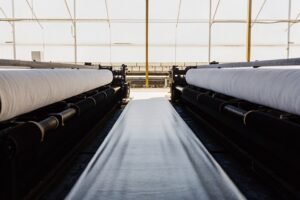
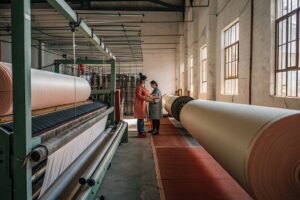
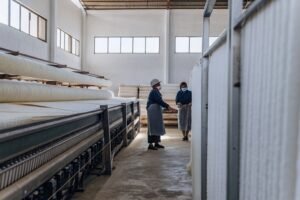
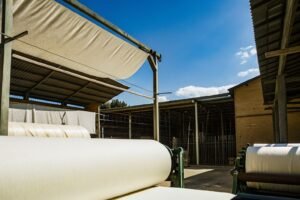
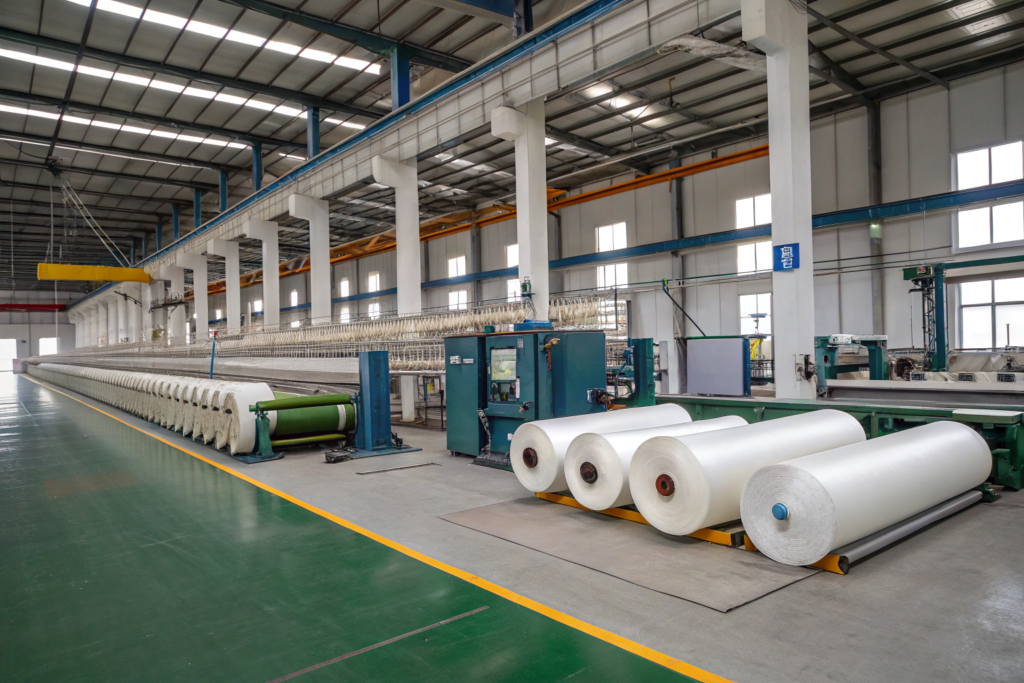
My two primary spinners are a ring-spun cotton specialist in Zaozhuang, Shandong—a city that sits on the high aquifer of the Yellow River basin where the water is naturally soft and abundant, reducing the need for water treatment chemicals in the spinning process—and a polyester filament producer in Shaoxing, Zhejiang, literally 45 minutes by truck from our weaving shed. The Shandong spinner runs 120,000 spindles, exclusively compact and ring-spun cotton, with a fully automated blowroom and carding line from Trützschler and autoconer winding machines from Schlafhorst. The Zhejiang filament producer operates a continuous polymerization line that can switch between virgin PET chip and chemically recycled rPET chip within a six-hour changeover, with online intrinsic viscosity monitoring that diverts any sub-spec polymer to industrial-grade rather than textile-grade production. But beyond these two anchors, I maintain relationships with four specialty spinners for specific fiber types where scale and technology differ. Understanding why Zhejiang dominates synthetic yarn and Shandong leads in spun yarn reveals the industrial ecosystem logic behind my choices.
why does zhejiang dominate synthetic yarn production in asia
Zhejiang’s synthetic yarn dominance is not an accident of geography; it is the downstream consequence of an upstream petrochemical decision made in the 2000s. The Ningbo-Zhoushan port complex is China’s largest refinery and petrochemical hub, hosting the Zhenhai Refining and Chemical Complex operated by Sinopec. This facility produces purified terephthalic acid (PTA) and monoethylene glycol (MEG)—the two monomers that polymerize into polyester—at a scale and cost that no other Asian location matches. A polyester polymerization plant located in Shaoxing, 100 kilometers from the Ningbo PTA refinery, has the lowest feedstock logistics cost in the world. That cost advantage compounds through the supply chain: cheaper PTA means cheaper polymer chip, cheaper chip means cheaper filament yarn, and cheaper filament yarn with short trucking distances to the Keqiao weaving cluster creates a self-reinforcing industrial ecosystem that attracts further investment in downstream texturing, twisting, and specialty finishing.
The innovation spillover is equally important. The concentration of polyester filament production in a 200-kilometer radius creates a labor market where engineers and technicians move between companies, cross-pollinating process knowledge. The Zhejiang spinner who supplies my recycled polyester weft yarn developed a proprietary solid-state polymerization process that rebuilds the intrinsic viscosity of post-consumer PET flake from 0.55 dL/g back to 0.64 dL/g—matching virgin quality—by running the flake through a vacuum reactor at 210 degrees Celsius for 18 hours. This process was adapted from a neighboring company’s industrial fiber line and modified for textile-grade filament; the knowledge transfer happened because the engineers drink baijiu together on Friday nights and talk shop. That kind of informal innovation network cannot exist in a dispersed supply base.
Zhejiang also benefits from the regional government’s aggressive investment in textile-related infrastructure. The provincial government subsidizes natural gas pipeline extensions to textile industrial parks, reducing energy costs for extrusion and texturing. The local universities—Zhejiang Sci-Tech University in particular—run dedicated textile engineering programs that produce 500-plus graduates annually, feeding a skilled workforce into the spinning mills. And the provincial environmental enforcement, while stringent, is predictable: spinners know the wastewater discharge limits and the emissions monitoring requirements years in advance, which allows them to amortize compliance investments over long planning horizons. The net effect is that a Zhejiang polyester filament yarn in 2026 is likely to be cheaper, more consistent, and more environmentally compliant than a comparable yarn from Vietnam, Indonesia, or Bangladesh, where the petrochemical feedstock must be imported and the regulatory environment is less mature.
how does shandong cotton compare to xinjiang or imported staples
Shandong cotton has a reputation problem: it is not Xinjiang long-staple, and it is not imported Supima or Giza. But reputation often lags reality. The Shandong cotton crop has improved significantly in the past decade due to the introduction of Xinjiang-bred varieties adapted to the Yellow River basin climate. The dominant commercial variety now grown in Shandong is a derivative of the CCRI 41 line, a medium-long staple cotton with a staple length of 28-30 millimeters, a micronaire of 3.8-4.5 (which is ideal for ring-spun yarns requiring strength without coarseness), and a fiber strength above 29 grams per tex measured on an HVI instrument. This profile is comparable to a good-quality Xinjiang Type 229 and slightly below a California SJV Acala. It is not a luxury cotton, but it is a consistent, clean, predictable industrial cotton—and for the heavyweight streetwear fabrics and sportswear interlock knits that dominate my production, consistency matters more than extreme length.
Xinjiang cotton, specifically the Type 137 long-staple with staple lengths above 35 millimeters, remains the superior fiber for high-count shirting and luxury bed linens where the fabric must be woven at 80s or 100s yarn count and maintain a silky hand. But Xinjiang cotton carries a geopolitical sourcing risk that has become impossible to ignore since the U.S. Uyghur Forced Labor Prevention Act (UFLPA) took effect in 2022 and the EU followed with its own forced labor regulation. Any fabric containing Xinjiang cotton is now presumptively detained at U.S. ports unless the importer can prove with "clear and convincing evidence" that no forced labor was involved in the cotton’s production. The burden of proof is on the importer, and the evidentiary standard is essentially unreachable without full supply chain traceability to the individual farm, which the Chinese cotton industry is not structured to provide. I made the business decision in 2022 to eliminate Xinjiang cotton from my supply chain entirely—not because I can confirm or deny anything about labor practices in a region I have never visited, but because the customs risk to my customers is not worth the incremental fiber quality advantage. Shandong cotton plus imported organic cotton from India and Turkey now constitute my entire spun-yarn fiber supply.
Imported staples—Supima from the U.S., Giza from Egypt, organic long-staple from the Izmir region of Turkey—enter my supply chain for specific premium programs where the brand specification or the performance requirement demands fiber characteristics that Chinese domestic cotton does not provide. Supima, with its 35-millimeter staple and 4.5 g/tex tenacity, is my default for high-density woven labels and premium shirting. Giza 86, with its 36-millimeter staple and exceptionally fine micronaire of 3.0, produces a fabric with a cashmere-like hand that is unmatched for luxury sportswear. But these imported staples cost 40-70% more than Shandong cotton and carry their own traceability risks: the USDA bale tracking system for Supima is robust, but the Egyptian cotton supply chain has been plagued by adulteration scandals where lower-grade cotton is mixed with Giza and sold as 100% Giza. I only buy Giza from a single vertically-integrated supplier in Chiang Mai who gins and spins the Egyptian bales under audit.
Traceability Technology: From Bale To Finished Yarn
You receive a GOTS transaction certificate from your fabric supplier showing that the organic cotton in your jersey was certified at the gin, the spinner, and the knitter. The certificates check out. What you do not know is that between the gin and the spinner, the organic cotton bales were commingled in a warehouse with conventional cotton bales, and the transaction certificate was issued based on a mass-balance calculation that assumed 100% segregation without verifying it physically. The yarn is sold as "GOTS certified organic" and it passes a basic pesticide residue screen because the conventional contamination was only 8%—enough to compromise the organic integrity, not enough to trigger a lab flag. You are committing organic fraud unknowingly, and if a regulator or a journalist traces the supply chain backward, your brand will be the face of the scandal, not the spinner who cut corners. Traceability is not a certificate; it is a physical chain of custody that must be verifiable at every handoff.
At Shanghai Fumao, my traceability system starts at the bale. Every bale of cotton, every gaylord of polyester chip, every cone of spun yarn that enters our facility carries a unique QR code printed on a tamper-evident adhesive label. (Here I have to interject—this sounds like a tech-bro solution, but the tamper-evident label is genuinely the most important part because if the label can be peeled off and reattached to a different cone, the whole digital system is a fantasy.) The QR code links to a cloud database that records: the bale identification number, the gin or polymerization date, the fiber test results (HVI data for cotton, intrinsic viscosity and TiO2 content for polyester), the spinner’s production lot number, the spinning date, the Uster evenness test results, and the cone weight. When the cone is loaded onto our warping creel, the QR code is scanned, and the cone’s identity is linked to the specific warp beam and the specific production lot it enters. By the time the fabric is finished, the QR code on the finished roll can be scanned by a brand or a consumer to reveal the entire upstream genealogy of the yarn, from bale to bolt.
This traceability system is not a commercial off-the-shelf product; it is a custom integration of the Uster Quantum 3 yarn clearer data export, the SAP ERP batch management module, and a cloud blockchain ledger that timestamps every custody transfer. I built it in 2018 after a European brand rejected a shipment of recycled polyester fabric because they could not verify the rPET content independently, and I lost $27,000 on the air freight return plus a customer who never ordered from me again. The blockchain ledger is read-only for downstream users—you can verify the data but you cannot alter it—and the history is permanent. If a certificate number doesn’t match the blockchain timestamp, you know something is wrong. The most advanced textile supply chain traceability tools operating on blockchain-based transparency networks share this core architectural principle: the data record must be distributed and tamper-proof to produce any trust.
But the technology only works if the physical segregation on the spinner’s floor matches the digital record. I audit this annually by sending my own QC manager to each spinner for a two-day inspection where she randomly selects 20 cones from the production floor, scans their QR codes, and physically traces them backward to the raw material storage area, verifying that the bale or chip lot physically exists and matches the digital record. One spinner failed this audit in 2021—the digital records showed organic cotton, but the physical bale tags in the warehouse were missing. That spinner is no longer a supplier. The technology creates the possibility of traceability; the audit verifies that it is actually happening.

what is a bale identification number and why does it matter to buyers
A bale identification number is a globally unique serial number assigned to each 480-pound bale of ginned cotton at the gin, encoded on a Permanent Bale Identification (PBI) tag that is physically attached to the bale with a wire clip. The number is generated by the USDA’s Agricultural Marketing Service for U.S. cotton, or by the national cotton board for other producing countries, and it is the atomic unit of traceability for cotton. The bale number links to the gin’s database record, which includes the gin date, the grower’s name and farm location, the module or trailer the seed cotton came from, and the HVI (High Volume Instrument) classification data for that specific bale: staple length, strength, micronaire, color grade, trash content. This is the "birth certificate" of the cotton.
For a fabric buyer, the bale identification number matters because it is the only reliable way to verify that the fiber in your fabric matches the claimed origin and quality. If a spinner claims their yarn is made from 100% USDA Supima bales, they should be able to provide the bale ID numbers that went into your specific yarn lot. If they cannot, they are either aggregating from multiple untraceable sources, or they are blending with non-Supima cotton and hoping no one checks. The bale number also enables a sophisticated buyer to verify that the HVI classification data for the bales matches the expected performance of the fabric: if the bale staple length is 32 millimeters and the yarn is spun to 40s count, the spinning parameters are appropriate; if the bale staple is 28 millimeters and the yarn is 60s count, the spinner is pushing the fiber beyond its optimum, and the yarn will have excessive thin places and low strength, leading to weaving breaks and fabric defects.
In my supply chain, every lot of cotton yarn is accompanied by a bale manifest—a spreadsheet that lists every bale ID number that contributed fiber to that lot, with the corresponding HVI data. This manifest is uploaded to the blockchain ledger alongside the yarn QR codes, creating an unbroken digital chain from bale to cone. When a brand audits my organic cotton claim, they can randomly select a bale ID from the manifest, cross-reference it against the organic certification database of the producing country, and confirm that the bale was certified organic at the gin. This is the level of transparency that the 2026 EU regulations are going to require, and it is the level I have been operating at since 2020.
how does qr code scanning work across the textile supply chain
The QR code scanning process is conceptually simple but operationally demanding. At the gin, the PBI bale tag is generated with a QR code containing the bale ID. This tag stays with the bale through transport to the spinner, through opening and carding, and up to the point where the bale is broken open and the cotton enters the blowroom. At that break-open point, the spinner scans the bale QR code and links it in their ERP system to the production lot number that this bale will be processed with. After spinning, each cone of yarn receives its own QR code label, generated by the autoconer winding machine, which links the cone back to the spinning production lot and therefore back to the bale manifest.
When we receive the cones at Shanghai Fumao, the receiving inspector scans a random sample of cone QR codes (20% of cones in a lot) and verifies that the scanned data matches the supplier’s advance shipment notification. If the match rate is below 100%, the entire lot is quarantined and investigated. At the warping creel, each cone is scanned again, and the cone ID is associated with a specific warp beam. The warp beam then receives its own QR code, which accumulates all the cone IDs that went into it. The weaving lot QR code accumulates all the beam IDs. The greige roll QR code accumulates the weaving lot and the loom number. The dyed and finished roll QR code accumulates the greige roll, the dye batch, and the finishing parameters. The finished roll QR code that ships to the brand is the terminal node in a branching tree of QR codes that extends backward to individual bales of cotton.
This scanning discipline requires training and enforcement. A warping operator who forgets to scan a single cone breaks the chain for that beam, and while the beam can still be used for production, it cannot be sold as fully traceable. We train our operators that the scan is not a bureaucratic checkbox; it is the threshold act that separates premium traceable fabric from anonymous commodity fabric. A skipped scan demotes the beam from traceable to non-traceable, and non-traceable fabric sells at a 15-25% discount because it cannot support organic or recycled content claims. The operators understand the financial consequence, and their scanning compliance rate is above 99.5%. The system works because it aligns the operator’s interest—keeping their job and earning their quality bonus—with the traceability objective.
Organic & Recycled Yarn Supply: Certifications That Count
Your brand’s entire Fall 2026 collection is built around a "100% Recycled Polyester" story. Your fabric supplier sent you a GRS certificate from a reputable third-party auditor, and you moved into production. What the supplier did not disclose is that the GRS certificate covers only 65% of their rPET output—the other 35% is conventional virgin polyester run on the same extrusion line with a "mass balance" accounting method that allows them to sell physically identical virgin polyester as "GRS certified" because they bought enough GRS credits to cover the volume. The physical yarn in your fabric is 20% virgin polyester, but the GRS transaction certificate says 100% recycled, and your hangtag says "Made from 100% Recycled Polyester." This is not fraud under the current GRS rules—it is allowed mass-balance accounting—but it is deeply misleading to your customer, and if an investigative journalist traces your supply chain, your brand will be accused of greenwashing even though you acted in good faith based on the certificate you were given.
Mass balance is a contentious accounting method in textile sustainability. The argument for it is that it allows the recycling industry to scale by reducing the cost of segregation; the argument against it is that it severs the physical link between the certified input and the certified output, making the certificate a financial instrument rather than a material verification. I took the position in 2021 that mass-balance GRS is insufficient for my premium-brand customers who need to make verifiable 100% recycled claims. Every lot of recycled polyester yarn I sell is physically segregated from virgin polyester throughout the supply chain. My spinner in Shaoxing runs rPET on a dedicated extrusion line that has never processed virgin chip, and the line is physically separated from the virgin lines by a wall, with separate raw material silos, separate polymer transport piping, and separate quality control stations. This segregation increases the cost by about $0.18 per yard compared to mass-balance GRS yarn, because the dedicated line cannot share overhead costs with the larger virgin production volume. But it eliminates the greenwashing risk entirely—the yarn is 100% recycled because it was made from 100% recycled chip on a 100% segregated line.
The same segregation principle applies to my organic cotton supply. The spinner in Shandong maintains a dedicated blowroom and carding line for organic cotton, and the machines are purged with compressed air between conventional and organic runs to remove fiber accumulations that could cross-contaminate. The organic cotton bales are stored in a separate, locked warehouse bay with restricted access, and the inventory is audited by the GOTS certifier annually. The route of custody from the organic farm to the finished fabric is documented with transaction certificates at every handoff—gin to trader, trader to spinner, spinner to weaver, weaver to finisher—and each transaction certificate references the previous certificate number, creating a chain that can be audited backward to the farm. Maintaining this level of segregation and documentation is expensive and administratively burdensome, but it is the only way to guarantee that when I sell you "100% GOTS organic cotton fabric," the physical fiber in that fabric is 100% organic.
what is the difference between gots and ocs organic certification
GOTS (Global Organic Textile Standard) and OCS (Organic Content Standard) are both organic certifications administered by Textile Exchange, but they certify fundamentally different things. GOTS certifies the entire textile production process—from the gin through spinning, weaving, dyeing, finishing, and even packaging—requiring that every stage meets environmental and social criteria. The environmental criteria include strict wastewater treatment limits, a ban on hazardous chemical inputs ( chlorine bleach, formaldehyde, aromatic solvents, and genetically modified organisms are prohibited), and a requirement for an environmental management plan. The social criteria require compliance with ILO core labor standards: no forced labor, no child labor, freedom of association, non-discrimination, and payment of a living wage. A GOTS-certified fabric is not just organically grown; it is organically processed under safe and fair working conditions.
OCS certifies only the organic fiber content—the percentage of organic material in the finished product, verified through chain-of-custody auditing from the raw fiber to the finished textile. OCS does not address the environmental impact of the dyeing and finishing processes, and it does not address social compliance. A fabric can be OCS-certified as 100% organic cotton but dyed with heavy-metal-laden dyes in a factory that discharges untreated wastewater directly into a river. OCS is a fiber content claim only. GOTS is a comprehensive process claim.
For a brand making an organic claim, GOTS is the stronger and more defensible certification. European retailers increasingly require GOTS specifically, not just OCS, because the EU’s Green Claims Directive and the French AGEC law demand evidence that the environmental claim covers the full product lifecycle, not just the raw material. An OCS-only claim on a conventionally dyed garment is vulnerable to challenge as greenwashing because the dyeing and finishing stages, which account for a substantial portion of the textile’s environmental footprint, are not addressed. My organic fabrics are dual-certified to both GOTS and OCS, but I market them on the GOTS certification because it is the industry gold standard and it satisfies the strictest retailer compliance questionnaires.
how do we verify recycled polyester yarn is truly post consumer
Post-consumer recycled polyester (rPET) can come from two sources: post-consumer PET bottles collected through municipal recycling programs, or post-industrial PET scrap from manufacturing offcuts. Post-consumer material is what consumers and regulators understand "recycled" to mean—material that was used by a consumer, discarded, collected, and reprocessed. Post-industrial material is pre-consumer—it never left the factory—and while it is legitimate recycling, it does not contribute to the circular economy narrative that brands are building their sustainability marketing around. The GRS standard requires that the source of the recycled input be specified as post-consumer or pre-consumer on the transaction certificate, but the verification relies on the recycler’s self-declaration and the certifier’s audit of the recycler’s incoming material records.
My rPET supplier in Shaoxing sources exclusively from a network of municipally-licensed PET bottle collection centers in Guangdong and Zhejiang provinces, where the collected bottles are sorted by color, stripped of caps and labels, washed in a hot caustic solution to remove adhesives and contaminants, and ground into flake. Each truckload of flake is accompanied by a manifest that identifies the collection center, the date of delivery, and the weight. The GRS certifier audits these manifests during the annual inspection cycle, selecting a random sample of manifests and tracing them back to the collection center’s inbound records. This is not a perfect system—a fraudulent collection center could conceivably forge manifests—but combined with the physical segregation of the rPET extrusion line, it provides a reasonable assurance that the flake entering the process is genuinely post-consumer.
We also do our own inbound audit: every month, our QC manager visits the Shaoxing spinner unannounced, pulls a random sample of flake from the raw material silo, and sends it to a third-party lab for a differential scanning calorimetry (DSC) analysis. DSC measures the melting point and crystallization temperature of the PET, and post-consumer flake has a characteristic thermal history—slightly lower melting point, broader melting endotherm—that distinguishes it from virgin PET and from post-industrial regrind, which has a thermal history closer to virgin. The lab report confirms that the flake is post-consumer PET and not a virgin or post-industrial substitute. The cost is $1,200 per audit, but it provides an independent physical verification that supplements the GRS paper trail.
A lot of people in the industry worry about the integrity of recycled supply chains, especially regarding how sustainability certification audits distinguish between genuine post-consumer PET bottle flake and post-industrial regrind. The key takeaway from years of field observation is that total dependence on certificates alone opens the door to mass-balance greenwashing, and independent physical verification, though expensive, is the only real safeguard.
In-House Yarn Testing: What Happens Before It Hits The Loom
Your fabric supplier accepted a shipment of recycled polyester yarn from their spinner, glanced at the spinner’s certificate of analysis showing 4.2 cN/dtex tenacity and 19% elongation at break, and released the cones to the warping creel. What they did not know because they did not test the yarn themselves is that the spinner’s QC manager had approved a batch that was marginally out of spec because the production schedule was tight and the deviation was "small." The yarn tenacity was actually 3.7 cN/dtex—12% below spec. The yarn wove without breaking because the loom tensions were set for the higher-tenacity spec, so the fabric looked fine off the loom. But after dyeing and repeated washings, the lower-tenacity fibers fatigued and micro-fractured, causing the fabric to lose 25% of its tear strength within the first ten laundry cycles. The garments developed holes at stress points, the brand’s returns spiked, and the root cause was invisible at every subsequent inspection gate because no one had tested the raw yarn.
At Shanghai Fumao, every single lot of yarn that enters our facility is tested before it is released to production. Not a sample of lots—every lot. This requires a dedicated yarn testing laboratory in our receiving warehouse, staffed by two technicians whose only job is to certify incoming yarn against the supplier’s specification and our internal quality standards. The testing protocol covers both physical properties (linear density, tenacity, elongation, evenness, hairiness) and chemical properties (for recycled polyester, intrinsic viscosity and heavy metal content; for organic cotton, pesticide residue screening on a random sample of cones). A yarn lot that fails any test parameter is quarantined and either returned to the supplier or, if the deviation is minor and the supplier agrees to a price adjustment, accepted with a written deviation approval from the brand for whom the fabric is being produced. We never decide unilaterally that a sub-spec yarn is "good enough."
The instrument suite includes an Uster Tester 6 for evenness and imperfection measurement, an Uster Tensorapid 5 for single-end strength and elongation testing, and an Uster Zweigle HL400 for hairiness. These instruments generate data that we trend statistically using SPC (Statistical Process Control) charts. If a supplier’s yarn tenacity shows a downward trend over three consecutive lots, even if each lot individually passes the minimum spec, we trigger a supplier quality alert and send our QC manager to audit the spinner’s extrusion or spinning process. The SPC charts detect process drift before it produces an out-of-spec failure, preventing the reactive scramble that occurs when a defective lot is discovered only after weaving.
what yarn strength specifications do we require for sportswear vs casual
Sportswear fabrics are subjected to cyclic loading—repeated stretch and recovery—that casual fabrics rarely experience. A yoga legging fabric is stretched 40% hundreds of times during its life; a casual chino fabric is stretched maybe 5% occasionally. The yarn that goes into these two applications cannot have the same strength specification, even if the fiber content is identical. For sportswear knit fabrics containing elastane, I require a yarn tenacity of at least 4.5 cN/dtex and an elongation at break between 18-22% for the polyester component. The elongation window matters because if the polyester is too stiff (below 16% elongation), it restricts the spandex’s recovery stroke and the fabric bags out; if it is too stretchy (above 25% elongation), it does not provide enough structural support and the fabric loses its compression characteristics after repeated wear.
For casual woven fabrics—a cotton-linen shirting, for example—the tenacity requirement is lower, typically 3.2 cN/dtex minimum, but the evenness requirement is tighter. Casual woven fabrics are often dyed in solid, light colors that reveal any yarn imperfection ruthlessly; a shirting fabric in a pale blue solid with a single thick place in the yarn creates a visible dark line across the garment front that cannot be hidden or cut around. The imperfection specification for casual wovens is an Uster IPI (Imperfection Index) value below 50 per kilometer for thin places, below 80 for thick places, and below 100 for neps. Sportswear knits, by contrast, are more forgiving of small imperfections because the knit loop structure, the textured yarn, and the heathered colorations typical of athleisure mask minor IPI deviations. The spec is tuned to the application, not applied uniformly.
The table below summarizes our incoming yarn specifications across four common product categories:
| Yarn Parameter | Premium Sportswear Knit | Casual Shirting | Heavyweight Streetwear | Waterproof Shell |
|---|---|---|---|---|
| Tenacity (cN/dtex) | >4.5 | >3.2 | >4.0 | >5.0 (nylon 6.6) |
| Elongation (%) | 18-22 | 6-9 | 15-20 | 25-35 (nylon) |
| Evenness CVm (%) | <12.5 | <11.0 | <13.0 | <10.0 |
| IPI Thin (-50%)/km | <50 | <30 | <80 | <20 |
| IPI Thick (+50%)/km | <80 | <50 | <120 | <30 |
| Spin Finish (%) | 0.8-1.2 | 0.4-0.6 | 0.6-0.9 | 0.3-0.5 |
how does twist per inch testing affect final fabric durability
Twist per inch (TPI) is the number of helical twists applied to a yarn during spinning, and it controls the yarn’s strength, hand feel, and fiber consolidation. Higher twist increases yarn strength up to a point—the optimum twist—beyond which the fibers are over-twisted and begin to break rather than lock together. For cotton, the optimum twist factor (alpha metric) is typically between 3.5 and 4.2, depending on the staple length and the intended fabric hand. A twist factor of 3.5 produces a softer, bulkier yarn with more exposed fiber ends, suitable for knitted fabrics where softness is the priority. A twist factor of 4.2 produces a harder, leaner, more compact yarn with fewer exposed fiber ends, suitable for woven fabrics where surface smoothness and abrasion resistance are priorities.
For fabric durability, TPI controls two failure modes: pilling and yarn-on-yarn abrasion within the fabric structure. A low-twist yarn has more fiber ends protruding from the yarn surface; these ends are the feedstock for pilling, because they tangle into pills when abraded. A higher-twist yarn locks the fiber ends into the yarn structure, reducing pilling propensity. But a higher-twist yarn also has a harsher hand, and for next-to-skin activewear, that harshness is unacceptable. The engineering compromise is a balanced twist with a wax or silicone lubricant that reduces surface friction without sacrificing fiber lock. We spin our sportswear yarns at a twist factor of 3.9—slightly above the soft-handle sweet spot of 3.5, but well below the "hard" twist factor of 4.5 used for voile or poplin—and we apply a 0.8% spin finish that is washed off after knitting to restore the natural softness. The result is a yarn that resists pilling through structure, not coating, and retains its softness after the spin finish is scoured.
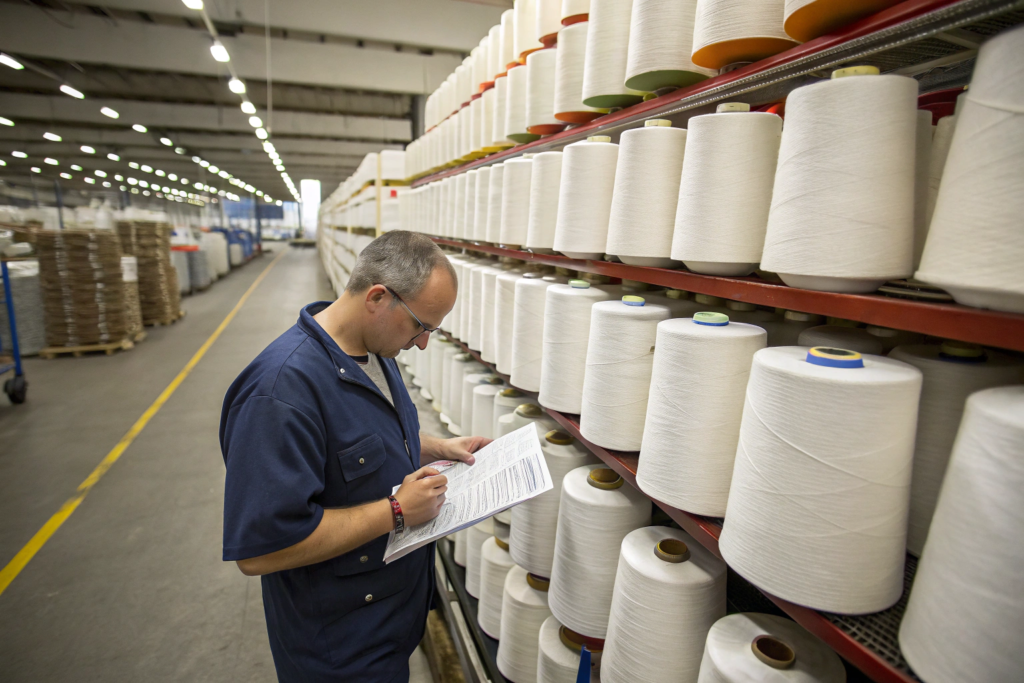
We verify the TPI on incoming yarn using a twist tester that untwists the yarn until the fibers are parallel and counts the rotations per inch. The specification for each yarn type is listed on the purchase order, and the receiving inspection tests ten cones per lot, with a pass criterion of ±5% from the target TPI. A lot that is 5% below the target TPI will be noticeably softer and more prone to pilling; a lot that is 5% above will feel harsher and may cause dyeing unevenness because the tighter twist restricts dye penetration. The lots that fall outside the ±5% band are rejected. This level of inspection granularity is rare in commodity fabric production, where yarn is accepted on visual appearance and basic denier confirmation, and it is one of the invisible cost drivers that makes premium fabric reliably outperform commodity fabric over the garment’s lifecycle. It’s important among advanced textile yarn engineering circles to understand exactly how twist geometry influences pilling behavior and tensile failure in knits, specifically how an over-twisted section leads to snarl formation that breaks the surface fiber matrix.
Conclusion
The quality of Fumao fabric begins not in our weaving shed, not in our dye house, not on our inspection tables, but in the spinning mills of Shandong and Shaoxing, in the cotton fields of Izmir, in the PET bottle collection centers of Guangdong, in the Giza bale warehouses of the Nile Delta. The yarn is the genome; the fabric is the phenotype; and a defective genome produces a defective organism no matter how carefully the subsequent processes are managed. I control the genome by choosing spinners who accept my terms—full lot traceability, Uster evenness testing on every lot, dedicated segregated lines for organic and recycled—and by verifying their performance with my own incoming yarn testing laboratory that tests every single lot against application-specific specifications for tenacity, elongation, evenness, and twist.
The transparency infrastructure that supports this yarn quality—the bale identification numbers, the QR codes, the blockchain ledger, the DSC analysis on recycled flake, the SPC charts tracking supplier process drift—is not marketing theater. It is a capital investment and an operational discipline that costs approximately 3% of our annual raw material spend and prevents an estimated 7-8% in downstream defect losses, making it net positive even before accounting for the customer retention value of never shipping a fabric lot with a hidden yarn defect. The system pays for itself, but it requires the initial capital and the managerial will to build it.
If you are evaluating fabric suppliers for a quality-sensitive program and the yarn sourcing story is vague or third-hand, treat that opacity as a risk factor equivalent to a weak credit rating or a history of late deliveries. If you want to see the actual bale manifests, the Uster evenness reports, and the QR code traceability trail for the fabric you are considering, contact our Business Director, Elaine. Her email is elaine@fumaoclothing.com. She can set up a technical consultation where we walk you through the yarn supply chain for your specific fabric lot, from the gin to the greige. Because the day is coming when your customer will scan a QR code on their garment and demand to see this data—and on that day, you want a supply chain that already has the answers.