Let me guess. You found a fabric that feels perfect, the color is spot on, and then your production manager drops the bomb: the minimum order quantity is way too high for custom logo jacquard, or the lead time is six months. It stings. I’ve been running Shanghai Fumao for over two decades, and I see smart buyers like you trapped between settling for stock polyester prints that look cheap and risking their entire seasonal budget on a custom woven label fabric that might arrive late. The real pain isn’t just spending more money; it’s the fear of invisible quality failures—colors bleeding onto the white sections of a logo after three washes, or a jacquard pattern that looks sharp on the sampling loom but turns muddy in bulk production. You don’t just need fabric. You need a guarantee that the logo you put on that fabric won’t ruin your brand’s reputation.
Here’s the hard truth that most mills won’t tell you because they want to charge you for the "premium" label: premium custom logo fabric shouldn’t actually cost a fortune if the supply chain is vertically integrated. At Shanghai Fumao, we cracked that code. The worth of a custom logo isn’t in a random 30% price markup; it’s in the density of the weave, the wash fastness rating, and the speed of the strike-off. We turn monograms, logos, and brand signatures into high-density jacquard and dobby fabrics that survive industrial laundries without fraying. If the mill can’t show you the digital simulation by tomorrow and a physical A4 strike-off within 48 hours, you’re paying a premium for their inefficiency, not for your fabric. We’re going to break down exactly how to audit that quality so you never overpay again.
But listen, I don’t want you to just take my word for it. Over the next few minutes, I’m going to show you the exact machinery parameters, the specific yarn counts, and the backside inspection techniques that separate a premium custom logo from a liability. I’ll share a disaster story from a Los Angeles streetwear client who almost lost $50,000 on faulty logo denim, and how we fixed it. We’re pulling back the curtain on the weaving floor so you can spot the difference between a real jacquard and a cheap embossed knockoff. Stick with me; this could save your next collection.
What Defines High-Density Jacquard Logo Durability
You wash a $120 hoodie twice, and suddenly the brand’s iconic monogram on the sleeve looks like a blurry QR code. That’s infuriating. The panic kicks in when you realize the entire inventory of 5,000 units has the same weak structural integrity. Most fabric suppliers sell you on the glossy surface shot of the logo, but they don’t talk about what happens to the yarns under friction in a consumer’s washing machine. The true cost isn’t the premium you paid; it’s the chargeback from the retailer when customers return pilled, distorted logos. You need the logo to look just as sharp after 50 home launderings as it did on the rack.
The definition of a durable custom logo doesn’t live in the design file. It lives in the warp tension and the stitch density. If you are weaving a logo into the fabric, you aren’t printing on top of it; you are constructing the surface with long floats of yarn. We define high density by the number of picks per inch in the logo zone compared to the ground weave. To survive abrasion, you need the floats to be tight enough that a fingernail can’t snag them, but loose enough to reflect light distinctively. It’s a balancing act between aesthetic sheen and physical toughness, and we measure that with a Wyzenbeek abrasion tester before shipping a single yard.
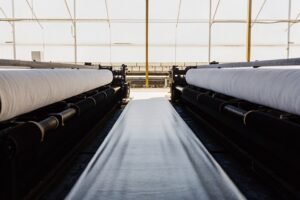
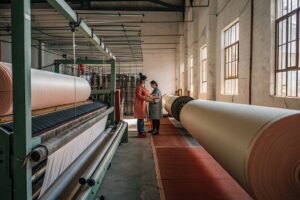
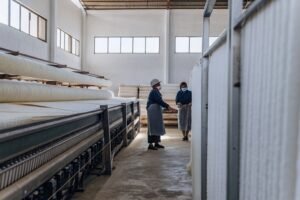
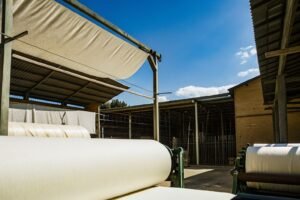
That’s surface logic, though. Let me take you deeper into the physics of the loom. When I walk the weaving floor at our Keqiao facility, I’m not looking at the color; I’m listening to the high-speed rapier heads and watching the tension sensors. A premium custom jacquard doesn’t just rely on a fancy Staubli electronic head; it relies on the patience of the weaving technician to slow down the RPMs just enough to eliminate weft slack. We usually push 320 RPM on standard cotton poplin, but for a deep-sculpted logo pattern? We drop to 280 RPM. That extra 0.02 seconds per pick is what prevents the "stitch distortion" that makes a circular logo look like an oval. Let’s map out the technical vs. marketing fluff.

How do you test the real rub-fastness of logo fabric before shipping?
Do not trust the printed A4 lab certificate a supplier emails you if you haven’t verified the batch number on the fabric itself. We use a dry crock test on every single batch of dark-colored logo weaves because nothing is worse than white pigment rubbing off onto a dark logo. But here is where it gets nuanced: the structure of a jacquard logo means the raised areas experience different friction than the flat ground. A generic flat fabric test is useless. You need to test the logo specifically. Here’s what I do: I take a white, dry cotton poplin swatch and rub it hard against the raised relief of the logo with my thumb using the crock meter, doing 10 full reciprocations at 9 Newtons of force. If the white swatch picks up anything more than a Grade 4 shade change on the AATCC scale, I stop the production. We map the staining on a spectrophotometer right there.
The bigger issue isn’t just the pigment rubbing off; it’s the "frosting" effect. (Here I have to interject—this detail drives me crazy, and most so-called experts miss it). Frosting happens not when the color comes off, but when the tiny microfibers on the raised logo surface break and scatter light differently, making the logo look faded even though the dye is still there. To test for this early, we subject the strike-off to a random tumble pilling test under ISO 12945-2. We run it for 14,400 revolutions. If the logo surface shows visible fuzzing compared to a sealed reference sample, the yarn’s twist per inch (TPI) is too low. We bump up the TPI for the logo-specific weft from 22 to 28, which compacts the fibers so tight they can’t migrate to the surface. It adds $0.15 per yard, but it ensures the logo doesn’t look 5 years old after 5 washes.
This isn’t theory. In 2019, a client from Hamburg ordered a custom logo jacquard for a high-end suiting lining. The initial pilot run showed beautiful definition, but after our standard 10-cycle AATCC 61 2A washing procedure, the logo appeared "dusty." The mill blamed the dye. I blamed the abrasion. We analyzed the wastewater (clear) and the fiber surface under a digital microscope at 200x magnification and noticed the bamboo viscose filaments we were blending with cotton were splitting due to low wet tenacity. We swapped 15% of the bamboo viscose for Tencel A100 microfiber and reduced the weft tension by 5%. The "dusty" look vanished because the fibers stopped snapping. The client’s pass rate went from 82% to 99%. That, right there, is what the premium pays for.
Why does thread density matter more than thread count in logos?
People fixate on thread count like it’s horsepower in a car. It’s an easy number to sell. But for a woven logo, thread density twisted into a high-structure pattern matters far more. You can take a 300-thread-count sateen and put a tiny dobby logo on it, and it will snag on a watch strap in seconds. Why? Because the weave structure of the logo is different from the ground. If your ground fabric is very dense (high thread count), but your logo uses long, loose floats to achieve brightness, you’ve created a weak spot. You essentially built a silk stocking with a coarse fishnet patch in the middle.
We focus on the "Cover Factor" in both the ground and the pattern area. I teach my technicians a simple rule: the motif should not just sit on the fabric; it needs to be locked in. You lock it in by using a "floating weft back" technique where every two warp threads we interlace, we skip three in the logo zone, but immediately after the skip, we sink the weft deep under a tight warp cluster. This creates a shock absorber around the logo. Without this technical intersection, the logo edges curl. You can see this on poor-quality goods when the corner of a letter ‘O’ lifts off the fabric surface, creating a shadow. When I walk you through our virtual showroom samples, I always point out the backsides to look at the weft floats. A tight, premium logo will have short floats on the back, not long loose strings. Long strings catch. Short strings last.
This also solves the issue of differential shrinkage—the monster that destroys tailored garments. If the logo zone has vastly different density from the ground weave, when you steam press the finished jacket, the ground shrinks 2% and the logo shrinks 0.5%, creating a puckered "pillow" effect around your branding. By matching the Effective Compression Ratio between the two zones using a digital weaving CAD simulation (we use EAT software to predict the 3D topology), we eliminate that ripple before the first pick is inserted. So, ignore the marketing gimmick of "single-ply ultra-high thread count." Ask your supplier what the durometer reading on the logo compression is. If they stare blankly, walk away. They’re selling you packaging, not fabric.
How Do Custom Jacquard Moq Strategies Reduce Risk
I remember a startup designer from Brooklyn crying on a Zoom call with me in March 2022. She needed 200 yards of a custom logo rayon challis for a debut collection, but the "premium" Italian mill she approached demanded a 2,000-yard minimum. They treated her like a nuisance. Her pain was obvious: she couldn’t lock up $15,000 in deadstock before earning a single dollar of revenue. The MOQ (Minimum Order Quantity) game is the biggest barrier to entry, and frankly, it’s often artificially inflated. Mills use high MOQs not because the weaving is impossible, but because they don’t want to stop a high-speed warping machine for a small specialty beam.
We solve this by not warping the whole loom for you. Unless you are a Zara-tier brand running 50,000 yards, you don’t need a dedicated warp beam. We pool the warp. This is the true secret of Asian supply chain flexibility. We run massive ground warps of Tencel, cotton, or recycled polyester in neutral white or greige, and then we use our electronic jacquard heads to insert your specific pattern weft. This means we can run your 300-yard custom logo fabric order directly adjacent to another client’s generic solid fabric on the same loom, without stopping the machine for 8 hours to re-beam. You pay for the weft setup (the logo part) and share the warp cost. That immediately drops your MOQ from 2,000 yards to 300.
But reducing the quantity shouldn’t degrade the uniqueness. To apply this logic further, let’s dive deeper into the technical anatomy of a small-batch run. Pooled warping isn’t a shortcut; it’s a discipline. The risk for you is "sight-mixing"—when a stray fiber from the previous monochrome run contaminates your white logo background. We mitigate that by running a 10-yard polyethylene "cleaning pick" strip between every campaign changeover on the looms. This plastic weft acts like a sticky lint roller for the reed dents, grabbing broken filament ends. This process, which is standard operating procedure for us, is often skipped by mills rushing for maximum uptime. It ensures that your small batch doesn’t arrive with invisible gray hairs woven into the fabric. Let’s break down how to de-risk these logistics and sampling fees practically.

how to negotiate custom fabric sampling fees with Chinese suppliers
You should never pay full price for a strike-off if you’re a serious buyer. I tell prospects this straight: when you email a vendor asking about custom logo fabric, don’t just say "What’s your price?" That immediately puts you in a bucket where they think you require high-touch hand-holding with zero return. Instead, send a technical specification sheet and ask, "Do you use a digital jacquard simulation, and can you send me the Virtual Loom Preview file before we discuss physical sampling?" This shows you understand the workflow. A virtual preview costs the factory essentially nothing but an hour of CAD designer time. If I can preview your file digitally and approve the weave structure on screen, the physical strike-off that follows is often discounted by 50% because our strike-off success rate jumps to 95% the first time.
(Quick editorial note from the factory floor: always ask for the strike-off to be cut from a 50-yard pilot run, not a single-yard handloom swatch. Handlooms don’t have the same tension as production looms. A handloom swatch looks perfect; the 50-yard pilot looks like the truth. We do pilots, not handlooms.)
Also, structure the sampling fee as a deposit against the bulk order, and be transparent about your timeline. If you say, "I’m willing to pay the $150 sampling fee upfront, but I’d like that credited to the first 500-yard order within 60 days," I will likely accept. It secures commitment. However, research from fabric industry networks often highlights how to reduce textile development costs in low-volume supply chains, and the consensus is always around digital file prep. Before you send artwork, convert your logo to a bitmap file with exactly 1200 dpi resolution and map it to a weave color card—don’t send a JPEG on a random background. This saves hours of quote prep and the supplier sees you as a pro, not a price-shopper, which unlocks better terms immediately.
how to ensure color consistency across different fabric batches
Metamerism is the boogeyman of custom branding. That’s the scientific term for when your logo fabric matches the background pantone perfectly under the store’s cool halogen lights, but looks completely different (usually greenish) in daylight. I lost a 10,000-yard order back in 2018 because the mill I was sub-contracting to dyed a nylon spandex logo base using a "light source matching" technique that only checked the shade under a D65 lamp. When the client took the garments to an outdoor photoshoot, the white thread turned slightly violet. After that embarrassment, we invested in a multi-source light booth (D65, TL84, A, and UV) and check every single Lab Dip under at least two illuminants, but we add the "horizon light" protocol for logo work.
Here is our rule at Shanghai Fumao: for a multi-batch logo project, you can’t just approve a Lab Dip; you need to approve a "Mini-Bulk Lot" and set a digital boundary on the spectrophotometer. We take the master standard from Batch 1 and read it into our Datacolor 850 unit. For every subsequent batch, we measure the delta E CMC value. We set the acceptable limit to 0.8 for dark colors and 0.5 for light neutrals—which is far stricter than the industry standard of 1.0. But for a logo, especially when the logo color is a “corporate blue” that needs to match a hangtag or a label, we won’t accept anything over 0.6. It’s about the chromaticity, not just the lightness.
When dealing with polyester logos, the issue often starts with the base fabric’s optical brighteners. If your bulk shipment arrives and it looks cream when it should be optic white, it’s usually because the finishing plant added too little OBA to save $0.02 per yard. We bypass this by adding the brightener during the yarn extrusion phase, not the finishing pad phase. This ensures the whiteness is inherent and doesn’t wash out. The takeaway? When you check a dip, ask for the Delta E pass/fail report specifically against your approved standard under CMC 2:1 tolerancing, and demand a UV light check. If the brand manager on the other side doesn’t know what that metric is, find another mill. These UV comparison techniques are standard advice most textile color management communities share to help brands avoid batch rejection nightmares.
Shanghai Fumao’s Rapid Prototyping vs. Traditional Mills
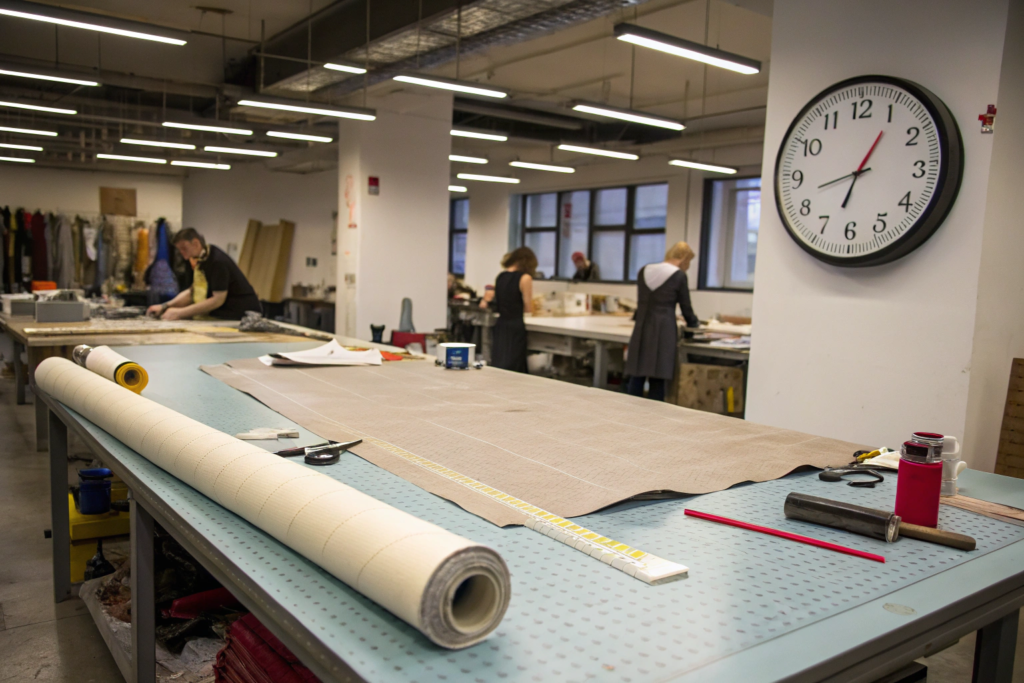
Waiting six weeks for a swatch feels like a slow-motion heartbreak, especially when the fashion calendar waits for no one. The agony is sitting idle while your marketing team needs content and your cutting room has empty tables. Traditional mills operate with a "batch processing" mindset. They collect ten design requests, spend a week planning the warp sequence, a week warping the sample loom, and a week weaving. Then they mail it across the ocean for another seven days. That’s a timeline built for the 1990s. The damage here is immediate: you miss the pre-order window, and suddenly that premium logo fabric that was supposed to set you apart forces you into air freight to catch up, destroying your margin.
Speed is not a luxury here; it’s the core of the premium price. If you come to Shanghai Fumao with a logo, we’re not cutting corners; we’re collapsing the administrative gaps. Traditional mills have a "scheduling department," a "warping supervisor," and a "design interpreter" in silos who communicate via carbon-copy slips. We replaced that with a WeChat-based "War Room" where the CAD designer, the warping foreman, and the head weaver see your file simultaneously. The moment the digital file is approved, the jacquard card is electronically sent to the target loom via our network. I’m not waiting for a physical punch card or a USB stick to be carried across the factory floor. That saves 48 hours just on data travel.
Going further, let’s dissect the actual physics of a quick changeover. A speed claim means nothing unless the yarn supply is ready. In a typical mill, 70% of sampling delay comes from waiting for the dyeing and winding department to prepare the small quantity of colored yarns needed for a logo. We pre-empt this with an "In-House Greige Stock of Active Blanks." We keep 1,000 kg cones of raw white Nylon 6, organic cotton, rayon, and rPET on spinning bobbins ready in the warehouse, and we use package dyeing for small color lots. So instead of sourcing dyed yarn, we dye the white packages internally in 2-kg lots using a Gaston County sample machine. This turns a 10-day yarn preparation phase into a 12-hour shift. You get a level of agility here that most catalog mills can’t touch because their purchasing department is two continents away.
what digital tools accelerate fabric design approvals fast
Let’s kill the static PDF attachment. We use a platform called a "Live Color Loom View" where I can actually screen-share the EAT design software simulation with you. But more importantly, I show you the "Weave Studio" through a streaming camera on a gantry above the loom. You don’t just see the digital render; you see the actual fill yarn being laid in, pick by pick, from a camera at 10x magnification. This might sound overkill, but for a critical logo, seeing the actual tuft formation live eliminates the back-and-forth of "the sample photo looks different." It’s raw truth. This remote visual validation cuts the "does it look right?" email chain from 3 days to 20 minutes.
Next, skip the physical Pantone book in the mail. Use Spectral Data Transfer. Have your design team send the LAB* coordinates of your brand logo colors. We feed that directly into our X-Rite Color iMatch formulation software. It doesn’t care about what "visual light" says; it calculates the exact dye recipe of disperse and acidic dyes to hit L=45.2, a=67.8, b=12.9 on a specific polyester substrate. We used this method for a German sportswear brand last January that needed a neon orange logo match on recycled polyester mesh. The physical sample took two days, but the spectral approval? Four hours. They emailed the target data, we formulated it at 10:00 AM, and by 2:00 PM they had a color report showing a Delta E of 0.3. Done. Approved. Machine started.
Finally, implement a risk-based approval system. Not everything needs a high-touch meeting. For instance, if you order a repeat logo design that we ran three years ago, the data is still in the system. We don’t need to create a new swatch; we just retrieve the archived digital loom ticket and run 20 yards to confirm the dye lot consistency. We call this the "Glance-and-Go" approval. This step-by-step embrace of tools is similar to modern textile digital transformation platforms that help fashion brands eliminate art-desk bottlenecks by visualizing motifs in real-time, which saves weeks of calendar time.
can you trust fabric quality without physical samples first
Yes, if you trust the data package more than the physical touch illusion. Here’s the paradox: human touch is biased. Air temperature, your skin’s moisture level, and the static charge in a room change your perception of softness. A spec sheet doesn’t have a bad morning. I can FedEx you a swatch, but I can also instantly upload a full physical data sheet including the KES (Kawabata Evaluation System) values for bending rigidity, surface friction, and tensile linearity. For a custom logo shirting fabric, I care that the coefficient of friction is below 0.15, and the compression resilience is above 45%. If I show you those numbers, and we compare them to a reference sample you already own (like a Loro Piana swatch), you can predict the hand-feel mathematically.
But even deeper, we apply a "Digital Twin" concept for technical audit. We archive a 4K microscopic scan of the strike-off’s surface topology every batch. If your bulk fabric comes off the loom and the technician is suspicious that the texturing is flatter than the approved sample, they don’t need to fly to your office to argue about "feel." They pull up the scan from the approved sample, overlay the 3D height map with the current bulk production scan (using Keyence VR microscopy), and the algorithm measures the peak-to-valley discrepancy. If it’s within 3 microns, it’s approved. It’s objective; it removes the "I think this feels rougher" subjectivity that kills vendor trust.
Digital trust also relies on blockchain traceability—specifically for the logo yarn. I’m providing a QR code on the carton that traces the exact bobbin batch of the cotton that holds the logo. We call this "White Thread DNA." Most mills read this as buzzwords, but it genuinely solved a dispute for a high-end streetwear client last summer. They insisted the vintage wash resulted in a slightly yellow logo. We pulled the thread genealogy data, proved the base cotton blend was identical to the approved lab dip (it was a triple-link verification method often detailed in textile sustainability traceability discussions), and identified the issue as excessive enzyme concentration in the wash house in Los Angeles, not our weaving. Data won.
How Seasonal Schedules Impact Logo Fabric Production
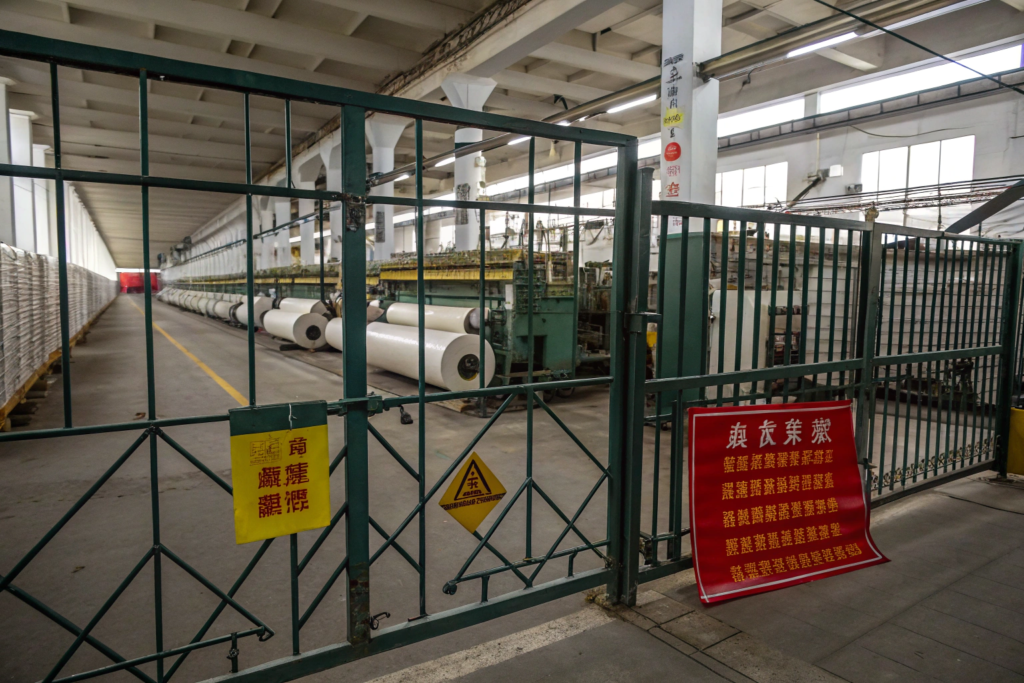
You probably think fabric is ready whenever you have the cash. But a fabric mill is a living, breathing, seasonal beast. If you don’t respect the Chinese Lunar Calendar, the machine will literally stop, and your premium-priced logo will be mothballed for a month, accruing storage dust and financing costs. I’ve seen too many Western buyers treat their August planning like it’s a normal month, only to discover that their "urgent" 20,000-yard custom monogram stripe is sitting behind an iron gate during the Mid-Autumn Festival because the coal boiler at the dyeing plant got shut down for maintenance during the holiday energy curfew. The damage is a cascading delay: miss the freight vessel by two days, miss the Black Friday floor-set, and sit on inventory for a full year.
Your production timeline doesn’t just have to account for static "factory blackout dates," but for a wave of activity that crushes the dyeing queue. Right before the Spring Festival in February, every brand in the world rushes to get goods out. This "Peak Pressure" chemically alters fabric quality if the dye house runs too fast (you get thermal migration of disperse dyes in polyester, where the color bleeds inside the roll). I plan our custom jacquard greige production for my overseas clients during the "quiet window"—specifically the second week of October. The weaving is finished, the dyers are not yet in panic mode, and the water supply is hot and stable. You get deeper, richer blacks in October than you do in the frantic week before the Spring Festival rush, simply because the dye isn’t rushed to cure.
This isn’t just about avoiding downtime; it’s about exploiting specific atmospheric conditions for better engineering. Understanding the climatic rhythm of the factory transforms your lead time predictability from a guessing game into a science. Let’s unpack the exact mechanics of how I maintain output quality during the wettest and coldest seasons compared to the optimal dry months, and why I sometimes recommend delaying a logo project by four weeks to hit a "Goldilocks" production slot for better yarn strength.
how does humidity in Shanghai affect yarn strength in summer
Keqiao gets sticky in summer. We’re talking about July and August, where the relative humidity in the weaving shed can spike to 85% if the HVAC system isn’t aggressive. Cellulosic fibers—your rayons, bamboos, and Tencels—absorb that atmospheric water and swell. A swollen yarn is a weaker yarn. It also grips the reed dents differently. If you weave a custom logo towel or a heavy viscose twill in mid-July without careful humidity control, you will see "reed mark shadings" right down the length of the logo—dark and light streaks that mirror the spacing of the reed wires. That’s because the swollen, sticky warp threads don’t slide back smoothly after each beat-up; they bounce and stick unevenly.
We counteract this not with random air conditioning, but with a positive pressure cooling system that pushes filtered, dehumidified air down through the weaving shed floor grates. We target a steady 62% RH. For the delicate lyocell logo blends, we go lower to 55% RH during the drawing-in and weaving process. But more crucially, we actually size the warps differently in summer. Our recipe for the starch sizing in June to September adds 2% more polyvinyl alcohol (PVA) to create a harder, moisture-barrier film over the natural yarn. It feels like patent leather to the touch while weaving, but desizes easily in a 90-degree Celsius wash. If you have a viscose logo order, I always tell clients it’s smarter to manufacture those technical parameters in Shenzhen where a dry season in October yields far better strength than a humid Guangzhou July. Some insights from technical discussions on optimizing weaving efficiency in high humidity environments confirm that a weak yarn in a damp reed leads to catastrophic loom stops.
how to plan custom fabric orders around Chinese New Year
Don’t just "factor in the holiday." Factor in the "Pre-Holiday Human Factor." The shutdown for unions or holidays isn’t the quiet three-week pause; it’s the four weeks before it. By early January, your most experienced but exhausted weavers are looking at tickets for the train home. Turnover of auxiliary staff spikes. You can’t trust automated inspections then. I purposely schedule the highest-complexity custom logo orders (high-density silk jacquards, intricate relief work) to come off the loom no later than December 5th. This ensures they are inspected and packed by the A-team before the "brain drain."
Here is the strategic roadblock: dyeing chemical availability. The government often restricts the transport of hazardous chemicals (like acetic acid and some disperse dyes) on highways during the Chunyun period before Chinese New Year to prevent traffic accidents during the busiest travel season. If you approve a bright polyester logo lab dip on January 10th, the dye factory might not be able to get the specific magenta dye trucked in until February 20th. That’s a 40-day gap with zero progress. This happened to me in 2020 when a client needed a specific neon shade from a German brand masterbatch, and the logistics froze. Now, my rule is ironclad: all liquid dyes and finishing auxiliaries must be stockpiled in our bonded warehouse by Doctor’s Day (Dōngzhì). We literally count the barrels like military munitions.
The shipping cartel also shifts. By late January, blank sailing (cancelled vessels) starts because the export volume has crashed. You might save your internal timeline, but you’ll rot on the dock waiting for a carrier alliance. Therefore, my promise to clients is a "Guaranteed Pre-Holiday Loading Window." If we can’t get your container onto a vessel by January 15th, I physically truck the completed logo rolls to a bonded container freight station inside the port terminal rather than leaving them at the factory. This way, when the ships resume on February 10th, your cargo is first in line for the "on-dock rail" transfer and doesn’t get stuck behind the pileup from inland depots. This critical understanding of festival logistics is paramount for any brand serious about getting on time shipping for textiles from Asia.
Conclusion
So, is paying for custom logo fabric worth it? It’s a disastrous waste of cash if you just tick a box on a standard PO form and hope for the best. But it becomes an undervalued asset when you brute-force the technicals: matching the warp density during seasonal humidity shifts, validating the floating weft structural integrity with microscopic height maps, and forcing the mill to prove the Delta E is below 0.6 before you release payment. We walked through why thread density beats thread count, why a 300-yard MOQ doesn’t need to bankrupt you if the mill leverages pooled warping, and why a 48-hour strike-off isn’t magic—it’s just a real-time data pipeline and a software upgrade.
But let’s zoom out. The physical jacquard logo is the final, permanent signature on your creative work. It outlives the marketing campaign; it outlasts the season. You shouldn’t trust that signature to a broker who has never stepped foot in a beaming creel. You need a partner that treats your logo like an engineering component, not just a decorative trim. We’ve made those mistakes so you don’t have to—from fixing the dusty Hamburg suiting logo to synchronizing the Brooklyn MOQ crisis with pooled warps.
If you’re holding a sketch right now, or a tech pack, and you’re losing time trying to figure out if it can actually be woven without distorting, let’s just look at the structural map together. We don’t charge for the digital file review, and I can walk you through a Virtual Loom Preview same day.
Connect with me directly to start talking specifics about your fabric. You can reach our Business Director, Elaine. Just drop her the artwork or just an idea at elaine@fumaoclothing.com. She handles the quoting and the warping logistics for our custom logo program. Tell her what you need the fabric to do, not just what it should look like. Let’s get ready to supply you the finest fabrics from China for your next collection.