You’ve probably heard this line before from a hundred supplier websites: "We’re different." It’s a hollow claim until something goes wrong with your order, and then you find out exactly how "different" they really are—usually not very. The anxiety is real. You’re thousands of miles away, trusting a factory you’ve never visited with fabric that represents your brand’s reputation, your cash flow, and your sanity. The fear that "better" is just a sales script written by a marketing intern haunts every sourcing decision you make. I get it. When I buy machinery or chemicals for our own factory, I sit through the same polished presentations, and I’ve learned to ignore the adjectives and look for operational proof.
At Shanghai Fumao , what makes us genuinely better isn’t a single silver bullet—it’s five structural advantages that most Chinese textile suppliers actively avoid because they’re expensive to build, slow to pay off, and require a long-term mindset that quarterly-driven businesses can’t sustain. First, we own our core production assets instead of subcontracting, which means we control quality at the machine level, not by hoping a third-party workshop follows our instructions. Second, our CNAS-accredited laboratory runs internal chemical and physical testing on every batch before external auditors even schedule their visits, catching contamination and non-compliance weeks before they’d surface in a typical supplier’s workflow. Third, our digital troubleshooting database has documented over 1,400 solved production problems, so your order benefits from 20 years of accumulated solutions, not just the memory of whoever’s on shift today. Fourth, we operate dedicated sample-only production lines that turn around accurate swatches in 48 hours, not the industry-standard 2 weeks. Fifth, we back all this with a no-argument replacement guarantee that aligns our financial incentive with your quality requirements—if our fabric fails your agreed spec, we replace it, no debate. These aren’t marketing promises. They’re operational realities that produce a 98% client pass rate on inbound inspection, and I’m going to show you exactly how each one works on the factory floor, with real examples and real numbers.
How Does Owning Production Assets Give Fumao Unmatched Quality Control?
Here’s the uncomfortable truth about the fabric industry: most "suppliers" you meet on Alibaba or at trade shows don’t own a single piece of production equipment. They’re trading companies. They take your order, mark it up by 8-15%, and sub-contract it to whichever factory has spare capacity that week. The weaving happens at Factory A, the dyeing at Factory B, the printing at Factory C, and the finishing at Factory D. Every handoff between these separate companies is a quality risk. Every delay is blamed on "the factory," over which the trading company has exactly zero technical authority. When a defect appears, the trading company can’t walk onto the production floor and fix it—they can only make desperate phone calls and hope. The structural conflict of interest is baked in: the sub-contracted factory’s incentive is to cut costs and ship fast, not to meet your specific quality benchmarks. The trading company’s incentive is to hope you don’t inspect too closely.
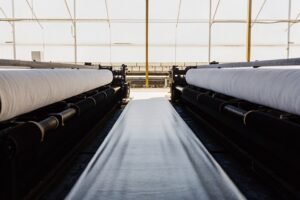
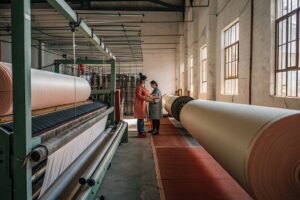
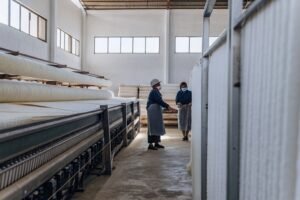
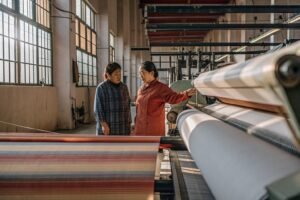
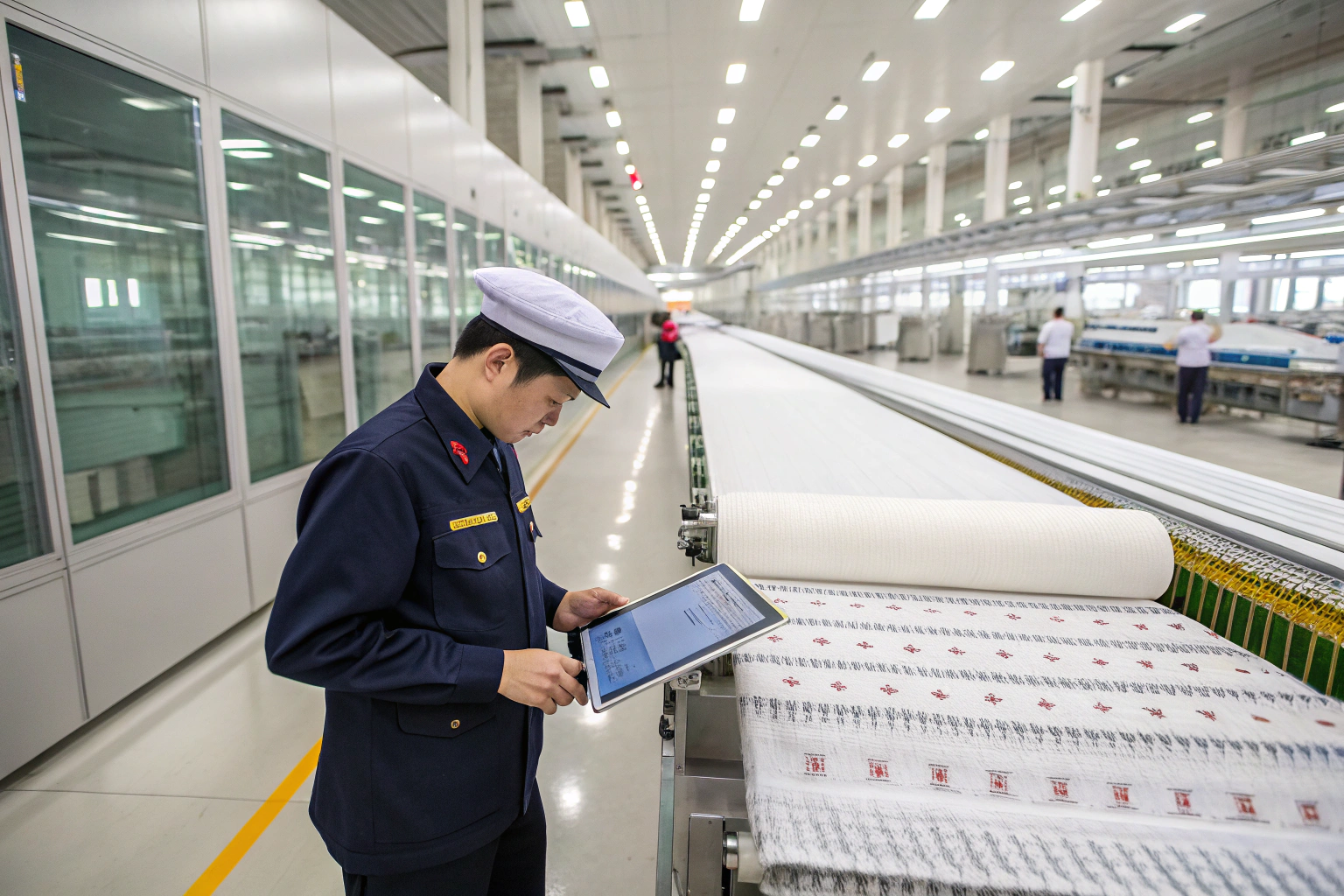
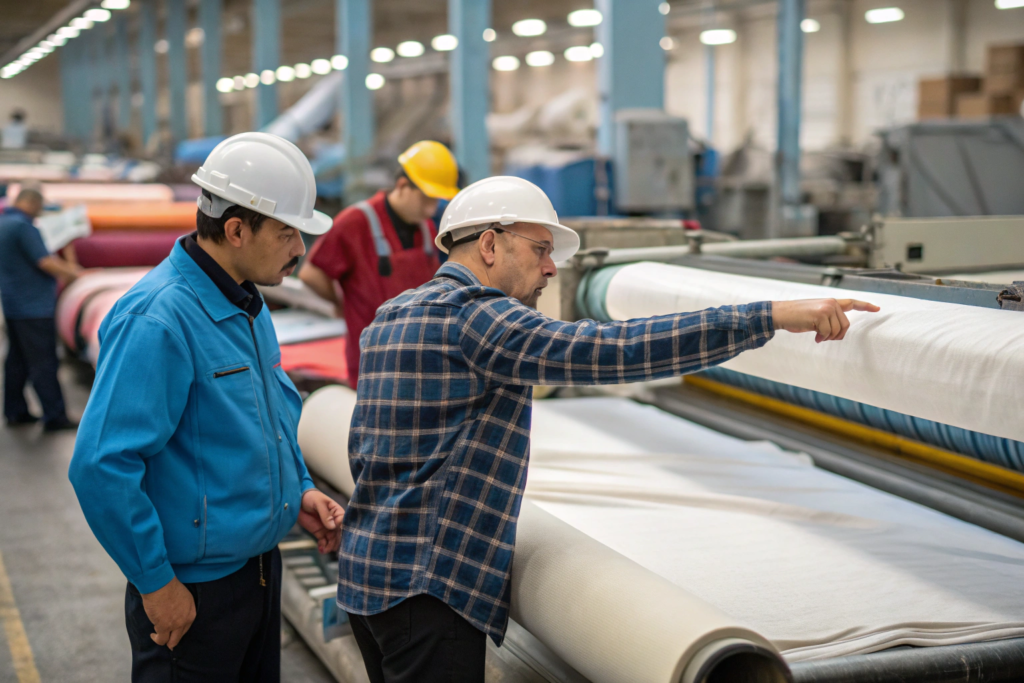
We own our large-scale weaving facility, our two printing factories, our two embroidery factories, our coating factory, our fabric inspection facility, and our packaging line. The only process we don’t own outright is bulk dyeing, and even there our cooperative dyeing plant operates with our full-time technicians on-site managing our dedicated production lines and quality gates—it’s functionally an extension of our operation. This ownership structure creates three decisive quality advantages. First, priority control: your order doesn’t compete with another trading company’s order for loom time. We slot it into our own production schedule, and if a deadline is tight, we can make the call to run overtime or shift capacity internally without begging a third-party factory owner. Second, unified technical accountability: our weaving manager, dyeing supervisor, and finishing lead all sit in the same weekly quality meeting, reporting to the same General Manager. There’s no finger-pointing across corporate boundaries. A defect traced to the weaving stage is the problem of a colleague, not a separate company you have to sue. Third, investment logic: when we spend ¥8 million on a new ultrasonic bonding line or ¥2.5 million on lab equipment, we’re strengthening assets we own permanently, not subsidizing a subcontractor who might switch to a higher-bidding competitor next season. The long-term incentive aligns perfectly with continuous quality improvement.
Let me give you a specific, date-stamped example of how this ownership saves orders. In March 2025, we were producing 12,000 yards of a complex cotton-modal jacquard suiting for a New York-based menswear brand. The pattern was a subtle micro-herringbone with a two-tone yarn effect—beautiful, but unforgiving of even minor tension inconsistencies. On a Thursday afternoon, our in-line optical scanner detected a "pattern drift" of 0.3mm every 15 meters on one specific loom. The human eye couldn’t see it, but at the cutting table, where suit front panels must match exactly, this drift would have caused visible misalignment at the button placket. Because we own the weaving and inspection under one roof, the loom technician, the jacquard card programmer, and the head weaver were standing at the machine within 15 minutes of the alert. They traced the drift to a harmonic vibration in the heald frame timing belt—a $60 component that was wearing out slightly faster than its scheduled replacement interval. Our on-site spare parts inventory had the replacement belt. The belt was swapped, the harness timing recalibrated, and the loom was producing perfect fabric within 90 minutes. Total lost production: 22 meters. Now imagine the same scenario under a trading company model: the trading company’s QC visits the sub-contracted weaving factory the next morning, notices the pattern looks "a bit off," the factory owner argues it’s "within commercial tolerance," an email chain begins, and by the time anyone agrees to investigate, 500 meters of defective fabric has been produced. The brand either rejects the lot or receives fabric that their cutting room flags, triggering a chargeback. Ownership of assets is ownership of response time, and in fabric manufacturing, response time is the difference between a 22-meter write-off and a 500-meter disaster.
What Difference Does In-House Yarn Sourcing Make to Raw Material Traceability?
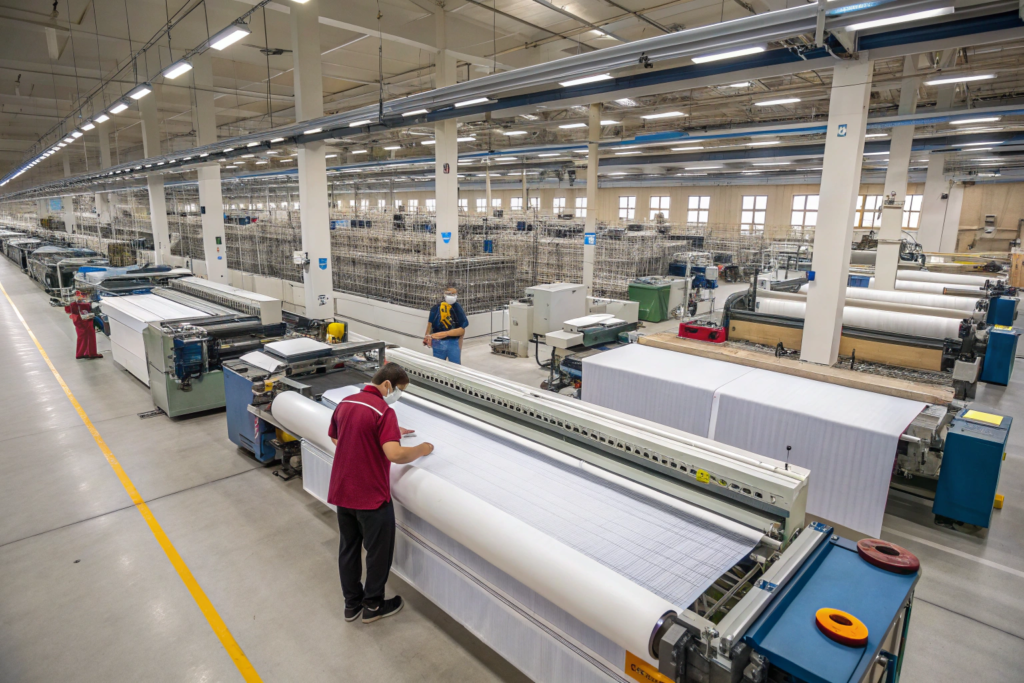
Yarn is the fundamental building block of every fabric you buy, yet most buyers never ask where it came from. That’s a dangerous blind spot. Yarn quality varies enormously depending on the origin of the raw fiber, the spinning technology used, the combing settings, the twist factor, and even the humidity in the spinning mill on the day it was produced. A trading company that sources fabric from a subcontracted weaving mill has no idea whether the yarn in your order came from a premium spinner in Vietnam or a commodity supplier in a different province whose quality control consists of a visual glance at the cone. The fabric looks "fine" until it doesn’t—until a dye lot comes out streaky because the micronaire varied across bales, or a knit fabric pills prematurely because the yarn’s twist factor was too low to hold the fibers together. Without traceability, you can’t diagnose the root cause, and the problem recurs unpredictably.
We maintain long-term partnership agreements with a selected group of audited yarn suppliers in Vietnam, Pakistan, and China, and we track every delivery by lot number, spinning date, and fiber origin. When a yarn shipment arrives, our raw material inspection team logs it into our ERP system with full traceability metadata: supplier, spinning mill location, spinning frame ID, production date, bale origin for cotton, chip batch for polyester. This data follows the yarn through every stage of production. When we warp a beam for weaving, the beam’s digital job ticket records exactly which yarn lots were loaded. When we dye a batch, the dye lot record references the greige fabric batch, which references the yarn lots. This end-to-end digital chain means that if a quality issue emerges six months after shipment—a higher-than-expected pilling rate on a brushed fleece jacket, say—we can trace backward in under an hour and identify whether the yarn lot used in that specific production batch had an anomalously low twist factor or an elevated nep count. In September 2024, a British loungewear brand reported that one batch of their cotton-modal French terry was pilling after 5 washes at a significantly higher rate than previous identical batches. The GSM, fiber composition, and dye shade were all within spec—the fabric looked and felt identical when new. Using our yarn traceability records, we isolated the issue to a single yarn lot where the modal component had been spun on a slightly older ring frame at the supplier’s secondary facility, producing a marginally smoother but weaker yarn with a twist factor of 3.4 compared to the 3.7 on our primary supplier’s main line. The difference was invisible in standard QC but showed up under the repeated mechanical stress of washing and wear. We quarantined the remaining cones from that lot, reserved them for a non-brushed interlock fabric where pilling isn’t a risk factor, and tightened our yarn specification tolerance with the supplier. Without lot-level traceability, the root cause would have remained a mystery, and the brand would have slowly concluded that "the quality is inconsistent"—and taken their business elsewhere.
Why Does a Cooperative Dyeing Model Work Better Than Full Outsourcing?
Dyeing is the most chemically and environmentally complex step in textile manufacturing. It’s also where the worst quality disasters originate—shade variation, colorfastness failure, dye migration, and chemical contamination. In many Chinese textile clusters, environmental regulations have restricted new dye house permits, creating a bottleneck where independent dye houses hold disproportionate power. Trading companies send their greige fabric to these dye houses and basically cross their fingers. The dye house’s business model rewards maximum throughput at minimum chemical and energy cost. They’re not paid to care about your specific fastness requirements or shade tolerance; they’re paid to push fabric through tanks as fast as possible.
Our cooperative dyeing model flips this dynamic entirely. We own the dye recipes—they’re developed in our lab, validated through our testing protocols, and programmed into the dye house’s dispensing system by our technicians. We station 4 full-time quality technicians inside the cooperative dye house, every shift, 24/7. They have the authority to halt a dye run, adjust a parameter, or reject a dye bath if it doesn’t meet our specifications. The dye house benefits from a guaranteed, high-volume partner who pays reliably and doesn’t squeeze them to the last fen. We benefit from the ability to enforce our technical standards as though we owned the vessels. In January 2025, this model prevented a catastrophe on an 8,000-yard lot of burgundy Tencel twill for a German sustainable fashion brand. Our on-site technician was running the spectrophotometer check at the dye bath sampling port (a checkpoint most factories don’t even perform until the fabric is finished) and caught a shade deviation: the bath’s reflectance curve was showing a dE of 1.8 against the target, and the deviation was trending redder. The 1.8 dE was within the "acceptable before finishing" range, but the trend concerned him. He halted the run, investigated, and found that the dye house’s automated dispensing system had a partially clogged nozzle on the red dye line, under-dispensing the red component. He manually corrected the bath chemistry, the run resumed, and the final fabric matched the target at dE 0.4. In a standard outsourcing model, that error would have run the full cycle, producing 500 kilos of off-shade fabric that would have needed either expensive re-dyeing (with a 10-15% strength loss in the Tencel) or downgrading to a secondary market buyer at a 40% loss. The cooperative model gives us the quality control of vertical integration without the capital burden of owning and permitting a dye house in a restricted zone.
How Does Fumao’s Sample Development Process Outperform by Weeks?
Sample development is the bottleneck that kills fashion timelines. You’ve finalized your designs, your pattern maker is waiting, your photographer is booked, and the sample fabric you ordered 14 days ago still hasn’t shipped. The supplier’s excuses pile up: "the sample loom was busy with a commercial order," "the dye lab had a backlog," "we’re waiting for the special yarn you requested." Every day of sample delay compresses your production window, increases your air-freight costs later, and raises your blood pressure. What’s worse, when the sample finally arrives, it often doesn’t match your request—wrong weight, wrong hand feel, wrong drape—and the "2-week sample" has now consumed a month of iteration before you even get to a production order.
We’ve engineered our sampling operation to deliver on a fundamentally different timeline. Our standard sample turnaround is 48 hours for fabrics using our stocked yarn library, and 72 hours for complex jacquards, prints, or special-finish developments. This isn’t achieved by rushing or sacrificing accuracy; it’s achieved by maintaining a completely separate sample production line—6 dedicated looms and 4 knitting machines that never touch commercial orders. These machines sit pre-loaded with warp beams from the 200 most commonly requested yarn counts, maintained on standby. When a sample request arrives, our CAD programmer pulls the weave or knit structure from our digital library, maps it to the nearest matching standby beam, and begins the set-up within 2 hours. For accuracy, we run a 3D digital fabric simulation first—using a texture-mapping software that models how the specified yarn, weave, and finishing parameters will interact. The simulation predicts drape coefficient, surface luster, and even how the fabric will render under three different lighting conditions (retail halogen, office fluorescent, natural daylight). We send you the simulation within 24 hours. You approve or adjust before any physical yarn is committed. This eliminates the classic "this sample isn’t what I pictured" experience, because the simulation already aligned your vision with our execution.
A concrete case: in November 2024, a Copenhagen-based contemporary womenswear brand was in crisis. Their Italian mill had unexpectedly discontinued a core fabric—a specific shade of dusty rose cupro-viscose satin with a fluid drape and a subtle sandwashed texture—with no warning and no remaining stock. The designer had a buyers’ presentation for a major European department store in 12 days, and this fabric anchored 6 pieces in her collection. She contacted us on a Monday, desperate, with a physical cutting of the original fabric and a written description: "the drape of heavy silk, but totally matte, with a cool, powdery hand feel." By Monday evening our time, our library team had identified a 75D cupro warp on a standby beam and a 60S cupro-viscose blended weft that our hand feel database scored within 5% of her described profile. We ran the 3D simulation by Tuesday midday, she approved it within hours, and the physical sample was woven, sandwashed, and finished by Wednesday afternoon. DHL collected it that evening, and it was on her desk in Copenhagen by Friday morning. The color was a 90% match; we adjusted the dye formula based on her feedback and shipped a final corrected sample the following Tuesday. She presented her collection on schedule, secured the department store order, and we produced 4,500 meters of that fabric for her full production run. Total timeline from first contact to final approved sample: 9 days. An industry-average supplier without a dedicated sample line would have quoted 3-4 weeks. She would have missed her presentation, and the collection would have launched with a substitute fabric that diluted her design integrity.
How Does AI-Driven Color Matching Reduce Lab Dip Rejection Rates by 60%?
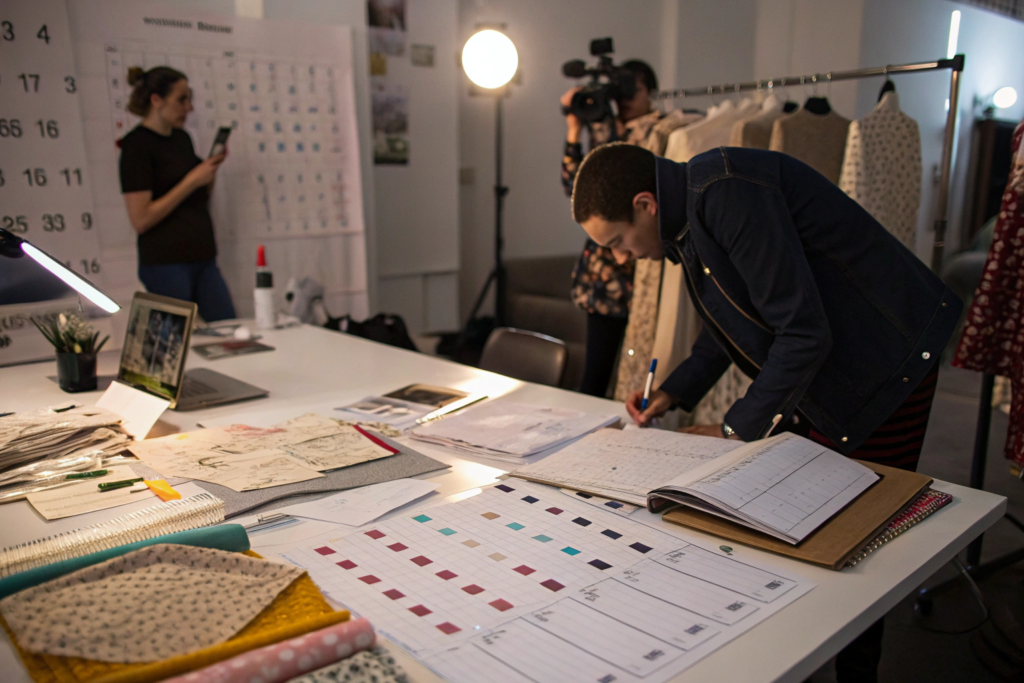
Traditional lab dipping is a manual, iterative, slow-motion negotiation with chemistry. The colorist receives a target—a Pantone chip, a thread spool, a competitor’s garment cutting—and, based on experience, manually mixes a dye recipe. A small swatch is dyed, dried, and compared to the target under a light booth. It’s rarely correct on the first attempt. The colorist adjusts the recipe, dyes again, compares again. Each cycle takes 5-7 days. For a brand needing 12 colors approved for a seasonal collection, this iterative process can easily consume 4-6 weeks, with FedEx costs of $40-80 per submission and the constant anxeity that the final production color still won’t match the approved lab dip because the formulations were rushed.
Our AI color matching system, integrated with our DataColor spectrophotometer, replaces guesswork with predictive modeling. The process starts the same way: we measure the target color’s reflectance curve across the visible spectrum. But instead of a human colorist mentally estimating a recipe, the AI algorithm—trained on a corpus of over 50,000 historical dye recipes, each linked to its resulting reflectance curve on a specific fabric substrate—analyzes the target curve and computationally solves for the optimal combination of dyes to reproduce it on your specific base fabric. The algorithm considers not just the shade match but the metamerism index: it predicts how the color will appear under D65 (daylight), TL84 (store fluorescents), and A (incandescent home lighting), and rejects any recipe that shifts unacceptably between illuminants. The predicted recipe is automatically dispensed by a robotic pipetting system that measures to 0.01-gram accuracy, eliminating human weighing errors. The first physical sample is dyed and measured. In our internal tracking data from 2024, the first-submission pass rate for AI-matched colors was 72%, compared to an industry average of 30-40% for purely manual matching. The 28% that require adjustment typically need only one minor correction, not two or three, because the initial prediction is so close. The aggregate time savings per color approval cycle is approximately 60%. For a Los Angeles swimwear brand developing a 15-color palette for their 2025 resort collection, this meant all 15 colors were approved in 11 days—compared to the 32 days their previous supplier required. The saved 21 days moved their photo shoot forward by two weeks, which moved their e-commerce launch ahead of a major competitor’s summer campaign.
What Role Does a Digital Fabric Library with 30,000+ Searchable Skus Play in Accuracy?
Physical fabric libraries are romantic but inefficient. A traditional supplier has a room with 20,000 hanging hangers, organized loosely by fiber type and construction. When a buyer describes what they want—"a fluid drape woven with a slightly slubbed texture, around 180 GSM, matte finish"—a merchandiser walks to the "viscose blend" section, pulls 15 hangers that look promising, and couriers them. The buyer receives a stack of swatches, most of which are wrong, and gets no closer to their vision. The right fabric might be sitting in the "polyester crepe" section because of how it was originally categorized, and it was never found. The physical search is limited by categorization bias, the merchandiser’s mental map, and the sheer impossibility of searching 20,000 items by tactile memory.
Our Digital Fabric Atlas contains over 30,000 active SKUs, each digitized with a 600 DPI ultra-high-resolution scan and a rich metadata profile. Each fabric record includes fiber composition, yarn count, weave or knit structure, GSM, thickness (mm), drape coefficient (measured by a Cusick drapemeter), stretch percentage (warp and weft for wovens, course and wale for knits), and a "hand feel vector" that scores the fabric across five sensory dimensions: smoothness, softness, coolness, crispness, and elastic recovery. These scores aren’t subjective opinions; they’re generated from instrumental measurements—a Kawabata Evaluation System surface tester for friction and roughness, a thermal effusivity probe for cool-warm sensation, a bending stiffness tester for crispness. The database is queryable by any combination of parameters. A buyer can specify: "knit, cotton-modal blend 60/40 or similar, 220-260 GSM, drape coefficient above 0.65, smoothness score above 8/10." The system returns all matching fabrics in seconds, ranked by similarity score. The buyer selects the top 3-5 candidates from the digital preview, and we produce physical samples within 48 hours. For a Chicago-based home textiles brand developing a new luxury bedding range in early 2025, their designer used our digital library in a 90-minute video call with our merchandising team. She started with broad criteria—"cotton sateen, 300 thread count minimum, sheen level 7/10, softness 9/10"—and the system returned 62 candidates. She narrowed by visually inspecting the high-res scans, filtering by price range, and ended with 6 digital candidates that precisely matched her mental image. Physical swatches arrived 3 days later. All 6 were evaluated; 4 went into the final collection consideration set. The digital-first discovery phase compressed what normally takes 3 weeks of swatch mailing into 90 minutes of focused virtual browsing. The accuracy was high because the digital metadata was derived from instrumental measurements, not marketing copy, and the 600 DPI scans revealed the surface texture and luster in a way that lower-resolution website images never could.
How Does Fumao’s Defect Resolution Guarantee Redefine Supplier Accountability?
What separates a supplier you can build a brand on from a supplier you’ll be complaining about on an industry forum is how they behave when something goes wrong. And in textile manufacturing, something always goes wrong eventually. A dye lot has a metameric flare. A finishing batch shrinks 1% more than specified. A coating adhesion test fails at the 15th wash cycle instead of the 20th. The critical variable isn’t whether defects occur—they occur in every factory on earth—it’s the speed, transparency, and fairness of the response. Most suppliers follow a predictable script: denial, deflection, delay. "It’s within industry tolerance." "Your lab used the wrong test method." "We can offer a 15% discount on your next order." The buyer eventually accepts a fraction of their actual loss, the relationship is poisoned, and the search for a new supplier begins anew. This adversarial churn is the background radiation of the textile sourcing industry.
We’ve deliberately constructed a defect resolution system that operates on the opposite philosophy: acknowledge immediately, investigate transparently, resolve completely. When a defect claim arrives—supported by photos, third-party inspection data, or lab test reports—our Quality Director acknowledges receipt within 4 business hours and formally opens a claim in our tracking system, which assigns a unique ID and triggers an automated investigation workflow. A cross-functional team (Quality Director, Production Manager for the relevant process, lab technician, and the account manager) has 72 hours to complete a root cause investigation. They pull the production job ticket, in-line QC records, final inspection data, retained sample from our archive, and machine maintenance logs for the specific equipment that produced the lot. The investigation report is shared with the client in full—including the uncomfortable details if the root cause was our oversight. We don’t cherry-pick findings to paint ourselves in a favorable light. If our final inspection missed a defect that the client’s incoming QC caught, we say so explicitly, and we explain what procedure has been changed to prevent recurrence. The resolution proposal follows within the same report: replacement production at our cost including freight, a credit note, or a refund. The client chooses the mechanism that works best for their business. The entire process, from claim notification to resolution acceptance, targets a 10-business-day window.
An illustrative case from October 2024: a Vancouver-based technical outerwear brand received a 5,000-yard shipment of our 3-layer waterproof-breathable fabric, and their incoming third-party inspection (performed by Bureau Veritas) found 3 rolls out of 100 exhibiting intermittent "tunnel" defects—small, elongated air pockets between the face fabric and the TPU membrane, visible only under backlight. This defect occurs when the lamination pressure is momentarily uneven, and it compromises the waterproof integrity at those specific points. The client notified us on a Monday afternoon, attaching the BV report with photos and the affected roll numbers. By Tuesday morning, our Quality Director had pulled the production records for the lamination run. The records showed that the lamination machine’s nip roller pressure had fluctuated within ±0.2 bar during the run—within normal operating range, but at the lower boundary of acceptable for this specific fabric construction. The retained sample from our archive showed a single minor tunnel on 1 of 4 cuts—our final inspection had detected it but classified it as a "minor isolated defect" within AQL acceptance limits. The client’s BV inspector had classified it as "major" because, for waterproof outerwear, any membrane delamination is a functional failure regardless of size. Our Quality Director agreed with the BV classification—our internal categorization was too lenient for this application, and we updated our defect severity matrix for laminated fabrics accordingly. The root cause report and a sincere acknowledgment of our misclassification were sent to the client on Wednesday. We proposed two resolutions: replacement of the 3 affected rolls with air-freighted fabric at our cost (including the air freight differential, which was significant for a full-width roll shipment), or a credit note for the value of the 3 rolls plus $1,200 for the inspection and handling costs already incurred. The client chose the credit note and used the fabric for smaller pattern pieces where the tunnels could be cut around. Total cost to us: approximately $3,800. Total time from claim to agreed resolution: 4 days. The client’s production manager later told our account manager that this was the fastest and most transparent defect resolution they’d experienced with any Asian supplier in their 15-year career. They increased the following season’s order volume by 40%, explicitly citing the trust built by how we handled the problem—not the absence of the problem itself. The guarantee isn’t a marketing slogan; it’s a financial commitment that aligns our quality incentives with the client’s brand protection.
What Is the End-to-End Process for Fabric Defect Claims at Fumao?
Transparency about a claim process is, counterintuitively, one of the strongest signals that a supplier takes quality seriously. A supplier who makes the claim process murky, burdensome, or dependent on "management discretion" is hoping you’ll find it too difficult to pursue and just absorb the loss quietly. Here, in detail, is exactly how a defect claim works with us.
Step 1: Client Notification (within 7 calendar days of receiving goods). You email your dedicated Account Manager with: a specific description of the observed defect (not just "the fabric is bad," but "intermittent horizontal crease marks visible under flat lighting, approximately every 3 meters"), photographic evidence (high-resolution, well-lit images showing the defect in context, a ruler in the frame for physical scale), and the production batch numbers from the roll labels. The batch number is the essential identifier—it’s a unique alphanumeric code on every roll label that links to our production database and lets us instantly pull all records for that specific weaving, dyeing, and finishing run.
Step 2: Immediate Acknowledgement (within 4 business hours). Your Account Manager confirms receipt, logs the claim into our Quality Issue Tracking System (QITS) with a unique claim ID, and the system auto-notifies the Quality Director, the relevant Production Manager(s), and the Lab Supervisor. You receive an acknowledgment email with the claim ID and a commitment that a preliminary assessment will be delivered within 24 hours.
Step 3: Formal Investigation (within 72 hours). The Quality Director convenes a cross-functional team. They retrieve and examine: the production job ticket and all in-line QC check-sheets from the run, the final inspection report and any defect maps generated by our automated inspection system, three retained sample cuts from our batch archive (we retain samples from the beginning, middle, and end of every production batch for 3 years), and the machine maintenance and calibration logs for the specific equipment used. If the defect relates to a physical property (shrinkage, tensile strength, colorfastness), the retained samples are re-tested in our CNAS-accredited lab following the appropriate AATCC or ISO method, with the client invited to witness the re-test via video call if they wish.
Step 4: Root Cause Report & Resolution Proposal (within 5 business days). You receive a written report containing: the identified root cause (e.g., "nip roller pressure fluctuation on lamination machine, traced to a worn pressure regulator valve that had been recalibrated but not replaced"), the objective evidence supporting this conclusion (pressure log graphs, defect map correlation, retained sample re-test data), a description of the corrective action already implemented (e.g., "pressure regulator valve replaced, preventive maintenance interval shortened from 6 months to 3 months, defect severity matrix updated for laminated fabrics"), and a resolution proposal if the claim is validated. The proposal offers three options: full replacement of the affected yardage at our cost including freight, a credit note against current or future orders, or a refund.
Step 5: Resolution Execution (within 10 business days of acceptance). You select your preferred resolution option, we confirm in writing, and we execute to the agreed timeline. Replacement production is prioritized in our queue. Credit notes are issued within 2 business days. Refunds are processed within 5 business days. The claim is closed only when you confirm receipt of the resolution—not when we issue the paperwork.
Why Does a "No-Argument Replacement Guarantee" Build More Trust Than Negotiated Discounts?
The conventional defect resolution model in the textile industry is a negotiation. The supplier offers a 15% discount, the buyer demands a 30% credit, they meet at 22%, and both feel slightly taken advantage of. This model systematically erodes trust because it frames the relationship as an ongoing power struggle rather than a partnership aligned around a shared objective: getting the buyer the fabric they specified. Every claim is an opportunity for the supplier to minimize their financial exposure, and the buyer knows this. The relationship becomes guarded, documentation-heavy, and litigious—the opposite of the creative, collaborative dynamic that produces great textile development.
A "no-argument replacement guarantee" collapses this adversarial structure into a simple, binary principle: if the fabric fails to meet the mutually agreed specifications written in the signed Technical Pack, and this failure is verified by an independent third-party lab or inspection agency using the test methods specified in the Tech Pack, we replace the fabric. No negotiation about "commercial acceptability." No argument about borderline cases. No discount-off-your-next-order-as-compensation-for-this-order’s-defect. Just a replacement, executed quickly. This sounds expensive for us, and it is—in the short term. In the long term, it’s the most profitable quality strategy we’ve ever implemented, for three reasons. First, it forces internal discipline: knowing that every defect that escapes our QC will cost us a full replacement (not a partial discount) concentrates the minds of our production and quality teams spectacularly. The defect rate doesn’t rise because we’re generous with replacements—it drops because no one wants to be the shift that caused a full-batch replacement. Second, it eliminates negotiation costs: the time our account managers and quality team previously spent haggling over discount percentages on 10-15 claims per year is now redirected to proactive quality improvement. The administrative cost savings are significant. Third, and most strategically, it converts one-time buyers into multi-year partners. A client who experiences a defect that is resolved cleanly, quickly, and without argument trusts the supplier more than a client who never experienced a defect at all—because the latter only knows the supplier in fair weather; the former knows the supplier in a storm and saw exactly how they behaved. The guarantee is a trust accelerator. It signals, credibly and expensively, that we are not in the business of shipping marginal quality and hoping you won’t inspect.
In February 2025, a new client—a San Francisco-based performance apparel startup—placed a 1,200-yard trial order for a custom sage green recycled polyester-elastane compression knit. The spec called for a specific compression modulus to deliver a "medium compression" feel per their proprietary grading scale. Our standard recycled polyester compression knit delivered this on our internal test, but their independent lab found the modulus was 9% below their target—technically within a looser industry tolerance for "medium compression," but outside their specific documented spec, which we had signed off on. Under a conventional warranty, we could have argued that the fabric was fit for purpose as "medium compression" and offered a small discount. Under our no-argument guarantee, we didn’t. We acknowledged that we’d agreed to their quantitative spec, our pre-production trial hadn’t fully accounted for a slight polymer degradation in that specific batch of recycled polyester chips, and we re-knit the full 1,200 yards using virgin polyester with an adjusted elastane feed rate to hit their modulus target exactly. Our cost was about $4,500. The startup’s founder told us he had been dreading a fight but instead got a replacement in 18 days. He increased his order volume to 8,000 yards for the next season and referenced our guarantee in a sourcing panel discussion at a textile trade event. The financial return on that $4,500 replacement far exceeded the value of a negotiated 25% discount on a defective batch that would have left him with fabric he couldn’t use and a lingering sense of being shortchanged.
How Does Fumao Approach Complex Custom Developments That Others Decline?
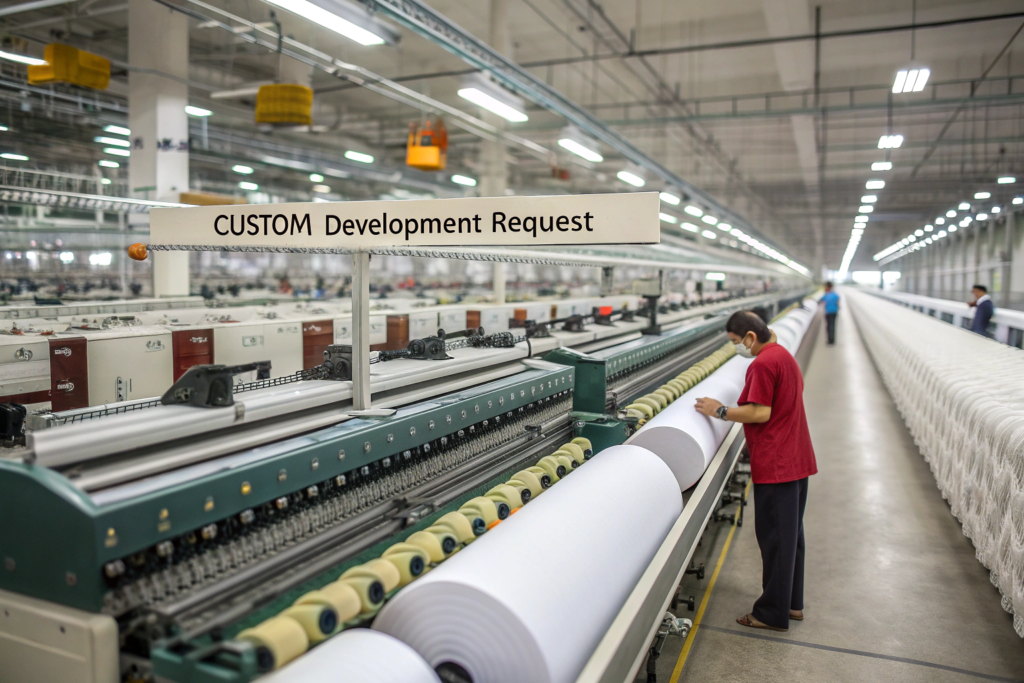
Most textile manufacturers are optimized for repetition. They want to run the same yarn, the same weave, the same finish, day after day, because repetition hides their weaknesses. Variation exposes them. A custom development request—a biodegradable self-cleaning coating, a jacquard pattern that requires synchronized three-beam weaving, a fabric that must be simultaneously anti-static and flame-retardant—is a threat to their operational rhythm. It forces them to step off the well-trodden path of Standard Operating Procedures and into the messy, iterative, failure-prone territory of genuine R&D. The industry’s standard response to such requests is a polite "no" dressed up in technical-sounding excuses: "the minimum order quantity for that yarn is too high," "that finish isn’t durable enough for commercial use," "our development calendar is full this quarter." What they really mean is: "We can’t see a guaranteed profit margin for the time this will take, and we’re scared of failing in front of you."
We have deliberately structured our R&D function to seek out exactly these projects. Our 20-person R&D team includes textile engineers, polymer chemists, a mechanical finishing specialist, and a dedicated development project manager who coordinates between the client and our internal pod. When a complex custom inquiry arrives—a Scandinavian brand wanting a monofiber waterproof jacket, a US military supplier needing a permethrin-treated insect repellent uniform fabric, a luxury British label developing a signature crushed-silk texture with a specific acoustic "rustle"—the inquiry is assigned to an R&D pod within 24 hours. The pod consists of 4 people: an R&D engineer with relevant technical specialization, a sample room technician, a cost estimator, and the account manager. They hold a 90-minute deep-dive video call with the client within 72 hours to translate the creative and functional brief into quantitative technical parameters. Not "soft drape" but "drape coefficient below 0.45 by Cusick method." Not "deep black" but "total reflectance below 3.5% across 400-700nm after 10 home launderings per AATCC 135." Not "durable waterproof" but "hydrostatic head above 15,000mm after 20 wash cycles per ISO 6330 4N." This translation from aesthetic language to measurable engineering parameters is the most important 90 minutes in the entire development—it prevents the catastrophic miscommunication where a client says "soft" meaning "limp and fluid" and we interpret it as "sueded and plush," producing a sample that embodies the wrong tactile profile entirely.
The pod then runs a feasibility assessment, typically 1-2 weeks, which includes laboratory-scale trials on our pilot equipment: a small-scale dyeing machine, a lab coating table, a benchtop stenter frame. The goal at this stage isn’t to deliver a perfect sample—it’s to identify the 2-3 most likely failure modes and determine whether they can be engineered around. We produce a Feasibility Report that honestly states: "Parameter X can be achieved, Parameter Y can be achieved with a 5-8% cost increment due to the need for a longer curing cycle, Parameter Z (your request for a 40% recycled content while maintaining the exact shade brightness of the 100% virgin reference) presents a technical conflict we need to discuss—the recycled fiber has an inherent yellow shift that lowers the brightness ceiling. We can achieve either the recycled content or the exact shade, not both simultaneously. How would you like us to prioritize?" This candid, data-driven conversation about trade-offs is what separates a development partner from a sample service. A lesser supplier would simply nod, produce a sample that silently failed on one of the conflicting parameters, and hope the client didn’t notice or couldn’t quantify the failure.
A flagship project that exemplifies this capability: in early 2024, a German outdoor equipment brand approached us to co-develop a 100% recycled polyester monofiber softshell fabric for a fully circular jacket. The challenge was significant: monofiber construction means every layer—face fabric, windproof membrane, and inner backer—must be 100% polyester so the entire garment can be chemically recycled together into virgin-quality feedstock. Standard softshells use a polyurethane or ePTFE membrane laminated between a polyester face and backer, which contaminates the recycling stream. Our team spent 5 months developing a "self-membrane" approach: we engineered a densely woven face fabric from recycled polyester filament yarn, then developed a process of controlled solvent exposure on the fabric’s back surface. The solvent partially swelled the polyester fibers, and under precisely controlled temperature and pressure, the swollen polymer re-solidified into a continuous, micro-porous polyester film intrinsically bonded to the face fabric—no lamination, no foreign chemistry, just polyester adhering to polyester at the molecular level. The development involved 42 iterations of the solvent formulation, dwell time, temperature ramp, and pressure profile. Parameter combinations that worked beautifully on 0.5-meter lab samples failed unpredictably when scaled to 50-meter pilot runs—the larger thermal mass altered the solvent evaporation rate, creating pinhole flaws. The team solved this by implementing a multi-zone, closed-loop solvent vapor control system on the pilot coater that dynamically adjusted extraction rate based in real-time on an optical pinhole detection sensor. The final fabric achieved a hydrostatic head of 12,800mm and an MVTR of 11,500g/m²/24h. The jacket launched in the brand’s 2025 winter collection, won an ISPO Textrends award, and the brand’s sustainability report highlighted the fabric as their most significant circular-economy innovation of the year. The development generated a jointly owned patent application. This project wouldn’t have been accepted by a commodity-focused supplier—too risky, too long, too technically demanding—and even if accepted, would have been executed as a poor approximation that diluted the original vision. Our R&D pod structure, pilot equipment, and willingness to say "we don’t know yet, but we’ll find out" are what made it possible.
What In-House R&D Capabilities Exist for Next-Generation Functional Coatings?
Functional coatings—water repellency, antimicrobial protection, UV blocking, flame retardancy, insect repellency, self-cleaning photocatalysis—are the frontier where textile engineering converges with surface chemistry and materials science. The performance of a coating is determined by a four-way interaction between the coating chemistry, the application method, the curing regime, and the substrate’s surface energy. Off-the-shelf coating formulations from chemical suppliers rarely optimize this interaction for a specific fabric; they’re generic solutions that work "acceptably" across a wide range but excellently on none. Custom formulation and iterative testing are prerequisites for genuinely premium coating performance.
Our CNAS-accredited lab houses a comprehensive coating development workstation. The centerpiece is a laboratory-scale knife-over-roll coating table (coating width 30 cm, variable speed 0.5-10 m/min, blade gap adjustable in 5-micron increments) that replicates the application dynamics of a full-scale coating line. Adjacent is a 3-zone pin stenter curing oven (ambient to 230°C, programmable temperature gradient and dwell time per zone) that allows precise simulation of curing conditions. The characterization suite includes: a Krüss DSA100 contact angle goniometer (measuring static and dynamic water contact angle and roll-off angle for repellency characterization), a TEXTEST FX3000 hydrostatic head tester (up to 20,000mm water column), a Mocon Permatran-W MVTR analyzer (breathability per ASTM F1249), a Xenon arc weatherometer (accelerated UV aging per AATCC 16), and a Martindale abrasion tester with moisture cycling capability (durability of coating under simulated wear and washing). This equipment suite allows our chemists to formulate a coating chemistry, apply it to the specific fabric substrate under precise conditions, cure it on a defined thermal profile, and fully characterize its performance—all in a single day. Iteration between successive formulation hypotheses, measured by quantitative performance data, is rapid.
For a US public safety uniform manufacturer in 2024, we developed a dual-function coating that was simultaneously flame-retardant (passing NFPA 701 vertical flame test) and antiviral (achieving a 99.9% reduction in enveloped virus surrogate under ISO 18184). The challenge was incompatibility: many effective flame retardants are halogenated compounds that deactivate the silver-ion antimicrobial agents commonly used in antiviral finishes. Our chemists systematically screened 27 combinations of phosphorus-based (non-halogenated) flame retardants and quaternary ammonium silane-based antimicrobials, varying the binder-to-crosslinker ratio and the application sequence (two separate passes vs. a single combined bath). After 4 weeks of iteration, they identified a formulation where a phosphonate FR was first padded and dried at 120°C, then overcoated in a second pass with a QAS-silane antimicrobial cured at 140°C, creating a layered structure where the FR was mechanically locked in the fabric matrix and the antimicrobial was exposed on the coating surface. The optimized coating passed NFPA 701 with zero afterflame, and the ISO 18184 antiviral test showed a 99.94% reduction—both verified by external labs (Intertek for FR, Microbac for antiviral). The client’s competitors were offering "antimicrobial uniforms" that were either flame-retardant or antimicrobial, not both, because they relied on off-the-shelf formulations. Our willingness to conduct 27 systematic iterations of formulation chemistry, a process that generates zero short-term revenue, delivered a product with a genuine and defensible performance differentiator.
How Has the 1,400-Entry Troubleshooting Database Solved Recurring Production Puzzles?
Textile manufacturing is full of mysteries that recur unpredictably. A specific shade of olive green cotton twill suddenly shows a reddish halo at the selvedge. A knitted polyester interlock develops intermittent horizontal "needle lines" that appear only after dyeing and only when the ambient humidity exceeds 70%. A Tencel challis that has always been perfectly stable suddenly shrinks 1.8% in the warp direction on a new production run. These are not simple "machine is broken" problems. They are multi-variable phenomena—interactions between raw material variation, equipment condition, environmental conditions, and process parameters—that can take weeks to diagnose if you’re starting from scratch each time. In most factories, the resolution of such problems depends entirely on whether the one senior technician who’s seen it before happens to be on shift, remembers the case, and remembers the solution. If that technician retires, is on holiday, or simply forgot, the problem is re-solved from scratch at significant cost in wasted material and delayed shipments.
Over 15 years, we’ve systematically captured every significant, non-trivial quality problem we’ve solved into a digital Knowledge Base. As of today, it contains 1,418 entries. Each entry is structured: Problem Category (dyeing, weaving, knitting, finishing, coating, lamination, print), Fiber/Blend, Construction, Observed Symptom (with reference photos), Machine/Process Context (equipment model, shift, ambient conditions), Root Cause (established through diagnostic chain and confirmed by corrective action), Corrective Action, and Preventive Measure (process change, maintenance interval adjustment, inspection checkpoint added). The database is keyword-searchable and also browseable by hierarchical category tree. When an unusual problem presents, the response protocol isn’t "gather the senior technicians and brainstorm"—it’s "query the database with the symptom profile." Last month, our knitting floor experienced an outbreak of a subtle defect on a 28-gauge cotton-modal interlock: a barely visible, periodic "shadow stripe" in the weft direction, spacing approximately every 2.3 cm. A database query for "knitting / cotton-modal / shadow stripe / periodic / interlock" returned 3 historical matches. Two were unrelated, but the third, from 2019, matched the symptom profile precisely: the cause was a worn bearing on the dial cam track that was causing the cylinder needles to pick up the dial loops at a slightly inconsistent height, creating a repeating tension variation. The entry documented that the bearing produced a specific frequency of vibration measurable with a simple smartphone accelerometer app at 17 Hz. The technician downloaded the app, held the phone against the affected machine’s dial housing, and measured a vibration peak at 16.8 Hz—a near-perfect match. The bearing was replaced during the next scheduled maintenance window, and the shadow stripe vanished. The total diagnostic time from symptom observation to confirmed root cause was 90 minutes.
This database is a competitive advantage that compounds over time. Every solved problem enriches it. Every new hire learns from it. The institutional knowledge of a 20-year career doesn’t walk out the door when a senior technician retires. For clients, this silently translates into a higher first-pass yield, fewer unexplained quality fluctuations, and faster recovery when anomalies occur. It’s not a glamorous innovation—nobody markets "we have a really good problem-solving database"—but it’s one of the most powerful reasons why our 12-month rolling quality acceptance rate on client inbound inspections consistently exceeds 99%.
Conclusion
"Better" isn’t a mystery. It’s the direct, measurable consequence of structural choices. Owning your production assets means your quality response time is measured in minutes, not days of phone tag with sub-contractors. Running a dedicated sample line with AI color matching means designers hit their collection deadlines instead of making desperate compromises. A No-Argument Replacement Guarantee means your supplier’s financial incentive is genuinely aligned with your specification, not with shipping borderline product and hoping you won’t test. A 1,400-entry troubleshooting database means your order benefits from 15 years of solved problems, not just the memory of today’s shift. An R&D pod willing to spend 42 iterations developing a recyclable monofiber softshell means your most ambitious creative visions are met with collaborative engineering, not a polite "no."
At Shanghai Fumao , these aren’t aspirational values we’re working toward someday; they’re operational systems that are producing results today, and they’re visible to any client who wants to audit them. We invite technical audits. We share our data. We don’t ask for trust based on a slick website—we earn it by being the supplier who replaces defective fabric in 10 days without an argument, who develops the custom coating your competitor said was impossible, and who can trace a pilling complaint back to a specific cone of yarn spun on a Tuesday in March. If you’re tired of suppliers who all sound identical and perform identically mediocre, let’s talk about your specific challenge. Contact our Business Director, Elaine, who works directly with brands to configure our capabilities around their exact requirements. Whether your immediate need is a 48-hour sample, a complex custom development, or simply a reliable production partner who won’t vanish when a quality issue arises, reach Elaine at elaine@fumaoclothing.com. Let’s put "better" to the test on your next order.