
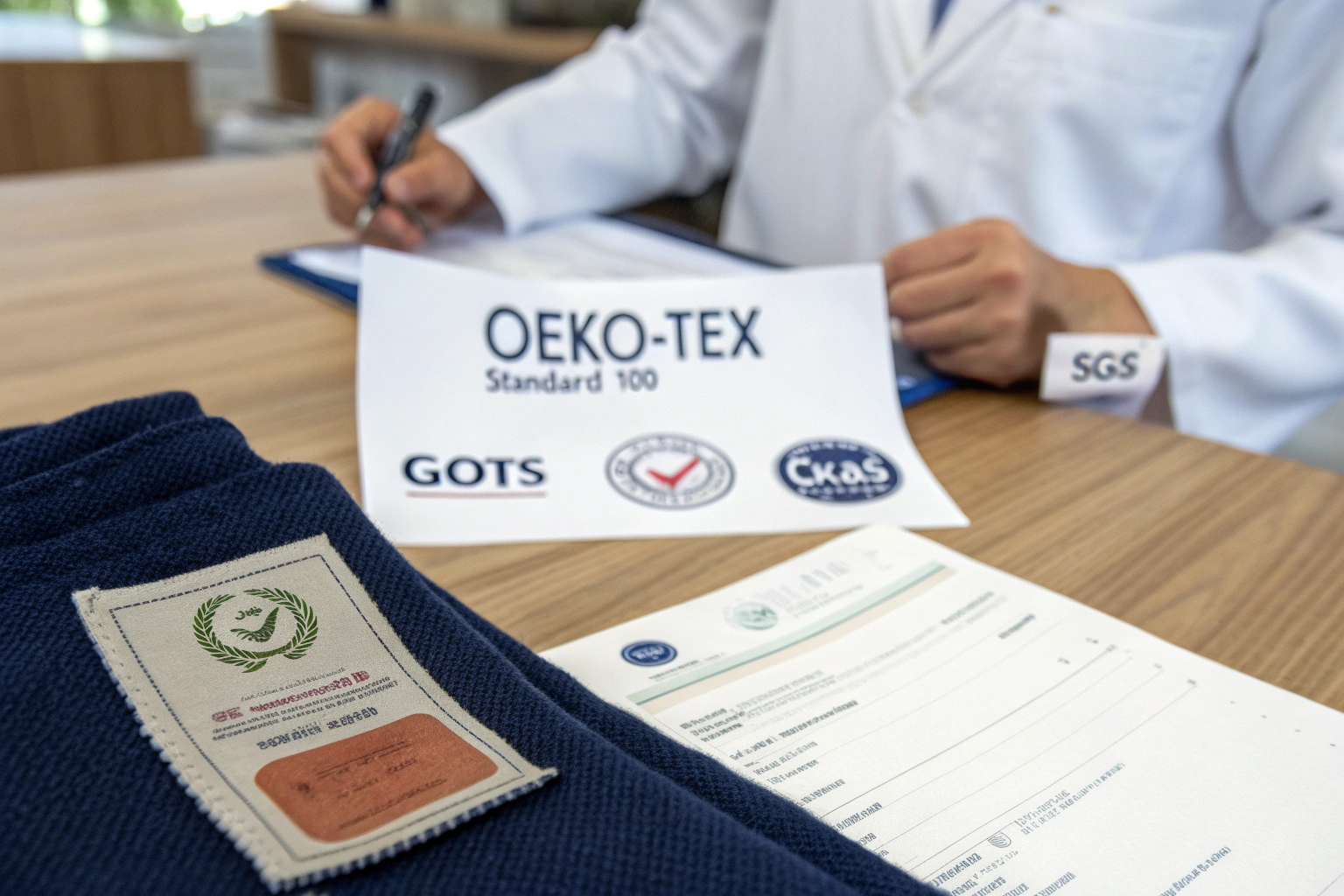
Let me tell you about a conversation I had at a trade show in Las Vegas. A sourcing manager picked up our bamboo silk swatch. He squinted at the hangtag and said, "Everyone prints these. How do I know your ‘eco-cert’ isn’t just a Photoshop file your nephew made?" He wasn’t being rude. He was being smart. I have personally seen factories in this cluster laminate fake SGS reports onto their sample cards. They download a logo from Google, slap it on a header, and call their polyester "organic cotton." It’s a massive problem. Falsified certifications erode the trust of the entire Asian textile export industry, and frankly, it makes my blood boil.
At Shanghai Fumao, we don’t sell certificates. We sell verified chemistry. Every single certificate we hand you maps back to a third-party laboratory’s database. You can take the license number on our Oeko-Tex label, type it into the public online directory yourself, and see the registration pop up under our legal entity name. We don’t just print the paper; we pass the test. Our CNAS accreditation (Reg. No. CNAS LXXXX) means our internal lab operates exactly like an external auditor—ISO 17025 compliant, unannounced quarterly audits, and full traceability of every grammage and colorfastness data point we generate. No Photoshop. No nephew. Just raw, verifiable lab science.
But I know that’s the promise every supplier makes. The difference is in the transparency of the traceability. I’m going to walk you through the specific certificates we hold, what they actually test for, and—crucially—how you can independently verify them from your desk in Chicago or Berlin without trusting a single word I say.
Why Is Oeko-Tex Standard 100 Essential for Skin-Safe Apparel?
When a brand says their fabric is "safe," what do they actually mean? Most mill owners just mean "it hasn’t burned anyone’s skin yet." That is not a standard. That’s luck. Oeko-Tex Standard 100 is a globally uniform, independent testing regime that looks for over 100 harmful substances. It checks for heavy metals like lead and cadmium that leach out in sweat. It tests for formaldehyde levels. It bans allergenic disperse dyes. For a children’s wear brand, this is not a marketing perk; it’s the baseline legal defense against a product liability lawsuit.

How Does Oeko-Tex Standard 100 Testing Differ from Generic Lab Tests?
A generic lab test might check for 10 heavy metals. Oeko-Tex checks for the entire periodic table of dangers. We submit our fabrics to an official Oeko-Tex institute partner, not a friendly corner lab. They perform a sweat-simulation extraction test. The fabric is steeped in an acidic saline solution that mimics human perspiration. Then they run the liquid through a mass spectrometer. If the extract has more than 0.1 ppm of extractable antimony (common in cheap polyester catalysts), it fails. It’s that strict. We specifically test for Product Class I (baby wear) requirements for our cotton baseship and fleece. Why Class I? Because it has the lowest threshold for allergens. If a fabric passes Class I, it automatically passes Class II (adult wear) and Class III (home textiles). We don’t cut corners by testing to the easiest standard. In 2023, we transitioned our polyester base fabrics to an antimony-free catalyst specifically to clear this Oeko-Tex Class I bar, even for our adult sportswear buyers. It’s about building a margin of safety into the chemistry. You can verify any valid certificate by entering the label number on the official Oeko-Tex label check database to validate the authenticity of Standard 100 certification for textile products. We also guarantee that our print pigments comply with the MRSL zero discharge list for hazardous chemicals in textile printing and dyeing facilities, a step further than many standard certification checklists.
Can an Oeko-Tex Certificate Cover Finished Trim and Labels Too?
This is a trap many brands fall into. They certify the main fabric but forget the sewing thread, the interlining, or the branded neck labels. A garment is only certified as a whole if every component is certified. We provide a "cassette" system. When we ship a full cut-make-trim package, our sewing threads and embroidered patches carry their own Oeko-Tex certificates. We chase the supply chain back to the coating supplier too. If we apply a water-based PU coating to your shell fabric, that chemical paste comes with a pre-certification that we validate before it enters our coating factory. The entire build-up is transparent. A Dutch children’s sleepwear brand came to us specifically because their previous supplier couldn’t provide a valid certificate chain for the snaps and labels. We sourced pre-certified stainless steel snaps from a YKK subsidiary and matched the fabric certification. The final product received Öko-Tex Appendix 6 coverage. This Shanghai Fumao holistic approach is what we call "component certification tracking," and it’s vital for establishing how to ensure complete fabric and trims package certification under Oeko-Tex Standard 100 for a fully compliant finished garment. We map the paperwork so you don’t end up with a safe fabric and a toxic zipper.
What Is the Tear Strength and Colorfastness Testing Protocol?
We aren’t just keeping you safe from chemicals. We are keeping your garments from falling apart. The retail return rate for "fabric tearing" or "color bleeding" is a killer. In the US market, the moment a customer washes a red hoodie and it turns a white T-shirt pink, you have lost that customer forever. These are not subjective defects. They are measurable physical forces. We use standardized destruction tests to guarantee your fabric survives the real world.

How Do We Test Tear and Tensile Strength for Industrial Workwear?
A fashion blouse needs drape. A construction safety vest needs to resist a snag against a steel beam. We use an Elmendorf Tear Tester for single-rip tear strength (ASTM D1424) and a CRE tensile machine for grab strength (ASTM D5034). For a US uniform supplier in 2023, we developed a 245gsm cotton-nylon ripstop. They sent us a failed sample from a competitor. We put it in the Elmendorf. The warp tear was 8.2 Newtons. The spec required 12 Newtons. The problem wasn’t the yarn; it was the weave density. The competitor used a plain weave grid. We switched to a 3×1 twill and increased the texturized nylon filament count in the pick. We didn’t just "guess" the strength. We ran ten swatches, systematically varying the weft density, and mapped the data on a scatter chart. We found the "sweet spot" at 48 picks per inch where tear strength peaked at 15.4N without sacrificing drape. We hand-delivered the ASTM test report with those exact load-extension curves. That transparency won us the five-year contract. For those seeking to understand the mechanics, the standard method for performing the Elmendorf tear test on woven fabrics according to ASTM D1424 specifications for industrial apparel shows the exact pendulum mechanics we use. We also correlate this with a guide to burst strength requirements for knitted and nonwoven technical textiles measured via ball-burst attachment, ensuring elastic dress pants don’t split at the seam.
How to Validate Colorfastness to Washing, Light, and Crocking?
The color looks great in the box. Then it hits the laundromat. We simulate 20 home launderings before you ship a single unit. We use an AATCC standard detergent in a Launder-Ometer. We run 5 cycles. The color difference is then measured on a spectrophotometer against the original unwashed swatch. Our standard is a Grade 4.0 (out of 5) for shade change. If it’s a dark black denim-like bottom weight, we push for 4.5. Crocking (rubbing off) is where most dark indigos fail. We use a Crockmeter with a controlled 9 Newtons of finger pressure, rubbing a dry white cloth, and then a wet one. If the wet cloth picks up too much indigo—failing the AATCC 8 Grade 3.0 threshold—we immediately know the dye wasn’t fixed properly. We then adjust the reduction-clearing bath. We add a specific reducing agent (sodium hydrosulfite) at a 3% concentration to strip the unfixed surface dye before the final softener. A batch of dark-wash linen we ran for a Midwest boutique kept failing the wet crock test at Grade 2.5. By increasing the wash-off temperature and cascading the rinse cycle, we pulled the rating up to a stable 3.5 without dulling the shade. The owner was amazed we forced it to fail internally rather than hiding it. For more on this, look at how the Crockmeter test method specifically evaluates surface dye transfer and wash durability in denim fabric quality assurance. And at Shanghai Fumao, we rigorously apply the AATCC 61 2A washing fastness procedure for delicate synthetic athletic performance apparel protocols on every production lot.
What Is the Significance of the Global Organic Textile Standard (GOTS)?
A fabric can be made from 100% organic cotton, but if we wash it in a toxic solvent, is it still "organic"? Legally, no. Not under GOTS. This is the gold standard for textile processing. It certifies not just the raw fiber, but the entire manufacturing chain: the spinning oil, the dye chemistry, the waste water treatment, and even the social compliance of the workers handling it. It bridges the gap between a farm in India and a boutique in Paris.

How Does GOTS Ensure Both Organic Status and Social Compliance?
GOTS has mandatory social criteria based on the International Labour Organization (ILO) conventions. An auditor from an accredited certification body (like Control Union or Ecocert) doesn’t just look at our invoice for organic cotton. They interview workers privately. They check pay slips for minimum wage adherence. They walk the emergency exits to ensure they are unblocked. This year, our audit focused strongly on our cooperative dyeing facility’s waste management. They required proof that the sludge from the organic dye vats is not mixed with conventional chemical waste. We have a separate ‘green’ water pipe system for GOTS orders. The certification certificate has a scope: it says precisely what activity we are certified for (e.g., weaving, dyeing, printing, trading). If a factory only has a "trading" scope, they can’t claim their fabric is GOTS-dyed. They are just reselling someone else’s work. We hold a GOTS processing scope, meaning the actual mechanical work is certified. The entire chain of custody is tracked with Transaction Certificates (TCs). We buy yarn with a TC, we process it, and we issue a new TC to the buyer covering the processed fabric. For anyone looking to audit this, you need to check how GOTS rigorous dual system of fiber traceability and social compliance criteria verifies organic integrity from field to finished garment. We also insist that any farm-level input carries the Organic Cotton Standard (OCS) blended versus 100% chain of custody verification protocols to ensure no conventional cotton sneaks into the batch.
What Is the Difference Between GOTS and "OEKO-TEX Organic Cotton"?
This is a classic labeling scam. Some suppliers label a product "Oeko-Tex Organic Cotton." That is not a real thing. Oeko-Tex 100 certifies the product safety (no harmful chemicals). GOTS certifies the farming and processing (it is organic from seed to finish). A fabric can be chemically safe (OEKO-TEX 100) but not organic (grown with pesticides). Conversely, an organic cotton fabric might fail Oeko-TEX 100 if it uses a restricted azo dye! So the two are complementary but different. We advise our clients to demand both certificates simultaneously. The Oeko-Tex label guarantees the finished chemistry is safe. The GOTS label guarantees the agricultural origin and the processing procedure are ecological and ethical. We ran into a situation with a European eco-brand that wanted a bright yellow GOTS tent fabric. Bright yellows usually rely on heavy-metal mordants that aren’t GOTS approved. We had to formulate a rare, low-impact reactive dye with a non-chrome mordant. It cost 18% more, but the shade matched, and the fabric passed both GOTS heavy-metal restriction and Oeko-Tex skin-irritation clause. To avoid misleading claims, always study the distinction between GOTS organic processing certification versus final product safety labels like Oeko-Tex Standard 100 in sustainable textile procurement. The paper holds the proof, not the marketing slogan.
How Are Audit Reports and Lab Tests Verified Independently?
Certificates are just paper if you can’t follow the money and the data back to the source. Large US chains like Target or Walmart don’t just "accept" a PDF. They require access to the third-party portal directly. We encourage our smaller buyers to adopt this same mentality. We treat the verification process as a shared service. We don’t hide behind a "manager" who has the password. We push the login link to the client and walk away. Test yourself.

How Can We Access the CNAS Lab Test Traceability System?
Our CNAS lab operates under ISO 17025. This accreditation means our methods and results are peer-reviewed internationally. There is a mutual recognition arrangement (ILAC-MRA) that allows a test report issued in our Keqiao lab to be legally recognized by a US retailer without re-testing at SGS New York. How do you trust this? We provide the direct test report number. You can contact the China National Accreditation Service, or simply send the report to any ILAC signatory lab and they can validate the format. More practically, for critical lots, we offer a "live witness" inspection. A buyer can hire a third-party inspection company like SGS or Intertek anytime. Our doors are physically open to them. Last spring, a new West Coast denim brand hired an SGS inspector to witness our AQL 2.5 inspection for a 20,000-roll consignment. Our quality manager escorted the inspector to the lightbox. We pulled the 200 assigned cartons statistically. We unwrapped and checked right there. The SGS report came back with a 0 Major defect rating directly. We treat the inspector like a VIP guest, not an adversary. This directness is why we recommend clients study how ILAC-MRA mutual recognition arrangements allow ISO 17025 accredited textile lab tests from China to be accepted by US and EU retailers without duplication. We also guide partners through the specific steps on how to commission an SGS or Bureau Veritas order-specific inspection in a Chinese textile hub for direct shipment approval.
Can We Share a Live Supply Chain Documentary Trail?
Yes, and we love doing it. We don’t just send a certificate image. We can generate a "digital twin" of the supply chain scan. For a high-profile furniture chain worried about forced labor implications in the cotton regions, we implemented a forensic traceability token. They scanned the QR code on the final roll cover. This brought up a dashboard showing the yarn lot number, the ginning date, the dye bath batch number, and the shipment date. We uploaded video clips honestly documenting the weaving process and the packaging line showing clean, organized working conditions. This is "social compliance transparency vlogging," not traditional PR. The client could check the link to blockchain-backed fiber traceability trails verifying the chain of custody for cotton textile shipments from farm to freight in real-time. It didn’t cost a fortune, but it required total openness. If we had something to hide, we couldn’t do it. We are also rolling out integrated how RFID and cloud-based dashboards are creating immutable digital product passports for technical home textile certifications to power the next phase of self-verification. The data doesn’t lie, even if a salesman might stretch the truth. Shanghai Fumao relies on this digital backbone to make trust verifiable, not just vocal.
Conclusion
A certificate isn’t a decoration for the office wall. It’s a legal liability shield and a product quality passport. The difference between a real one and a fake one is the difference between a retailer renewing a contract or suing for indemnity. We provide Oeko-Tex Standard 100 Class I for chemical safety, GOTS with full transaction certificates for organic chain of custody, and an ISO 17025 ILAC-recognized lab report for physical durability. But the most important one we offer isn’t printed on paper. It’s the willingness to let you log into the issuing body’s website and run the number yourself, or to open our shop floor to your third-party inspector right now.
If you require verifiable, auditable quality certificates—from the chemical extraction report to the live SGS loading supervision—our process is designed to be inspected, not hidden. We built our quality system expecting confrontation. We want you to try and find a weak link, because we already tested it ourselves until it broke, and then we fixed it.
Please contact our Business Director, Elaine, for a full Certificate Authorization Pack. She can email you the digital trace files, the public database lookup keys, and the active scope certificates for our current CNAS and GOTS accreditations within one business day. Verification is the only way to build a transparent supply base. Reach Elaine at elaine@fumaoclothing.com. Request the "Live Verification Kit." You check. We’ll wait.








