Let me guess. You’ve sat through a hundred supplier pitches. You’ve heard "best quality," "fast delivery," and "we’re a family here." And yet, three months later, you’re staring at a shipment of rayon slub jersey that feels like cardboard, and your supplier isn’t answering WeChat. The problem isn’t your gut instinct; it’s the question you’re asking. Most CEOs ask, “What’s your MOQ?” or “What’s your price on this Tencel denim?” These are transactional questions that any broker can lie about. If you’re serious about building a brand that still exists in 2035, you need to ask a question that makes a factory tremble—or light up with excitement.
That one question is: "If a critical quality deviation destroys my sell-in margin, what is the exact mechanical and financial buffer you have in place right now that prevents me from taking the hit alone?" This isn’t about "if" a problem happens—in textiles, problems happen daily. It’s about whether the factory has built an ecosystem that absorbs the shock before it reaches your warehouse in New Jersey. If they stumble here, you’re just a customer, not a partner.
This one simple question cuts through the sales theater. It forces us to show you our CNAS lab calibration logs, not just the certificate. It forces us to explain our re-dye contingency protocol and our open-book approach to cost. When a CEO asks me this, I know they’ve been burned before, and I know they are exactly the kind of person I want to do business with for the next decade. The curtain drops, and the real work begins. That’s the playground we thrive in here in Keqiao.
Why Do Most Fabric Quality Guarantees Fail Under Pressure?
Here’s the ugly truth nobody tells you at trade shows: A "Quality Guarantee" is usually just a sales promise backed by zero operational budget. The supplier says, "Sure, we guarantee it!" but what they mean is, "We guarantee we’ll argue with you for six months if you reject the goods." The problem is physics. Textiles are unstable organic materials. Cotton shrinks in dry climates, viscose stretches in steam, and pigment prints crack in sub-zero temperatures. A guarantee that doesn’t include an independent, traceable data chain isn’t worth the email it was written in.
A real guarantee isn’t an insurance policy; it’s a pre-agreed clinical procedure. At Shanghai Fumao, we kill the "blame game" before it starts. Because we hold CNAS certification that mirrors the big boys like ITS and SGS, our internal "fail" is legally recognized by your third-party auditor. That means there’s no scenario where we claim a fabric has "good color," and the independent lab flags it. We use the exact same spectrophotometer calibration blocks. When we say a garment passes, we provide the full digital map, accessible via a quick scan of the QR code, showing the Delta E values for every dye dip in that specific lot. You see what we see. If the deviation crosses the line, the guarantee triggers automatically—it’s not up for "subjective debate." That’s the difference between a marketing guarantee and an engineering guarantee.
If you dig deeper into the psychology of sourcing, you realize most CEOs aren’t actually afraid of bad fabric; they are afraid of a late response to bad fabric. A delayed reaction kills a season. If your pre-sold summer dresses arrive in June with a chronic seam slippage problem, you don’t have time for a "faulty batch investigation" that lasts three weeks. You need the factory to instantly activate a re-cut buffer without waiting for the insurance paperwork to clear. This is where the structural advantage of a vertically integrated cluster comes in. We don’t need to ask a separate finisher for permission to fix a handfeel issue. We can pivot the moment the lab tech notes a deviation, not the moment the CEO finally approves a credit note.
What Financial Buffers Protect Your Bulk Payment from Defects?
You need to think of a fabric shipment like a building project; you don’t release the contractor’s final retention payment until the building passes inspection. Yet, in textiles, importers often pay 100% of the balance before the goods leave the port, surrendering all leverage. The hidden buffer is in the payment structure itself. Ask your supplier: "Do your banking facilities allow for a pre-shipment quality-linked drawdown?"
Here’s what that means in plain English. When you deal with a company that has strong banking partnerships like ours, the financial transaction is tied to the physical release. We often structure big orders with a portion of the Letter of Credit tied to "off-site lab release approval." You don’t have to beg for a discount after the disaster; the discounted amount was never at risk in the first place. It sits in a neutral banking channel until an AQL 2.5 audit comes back clean. For a deeper look into how essential these protections are, you might want to check out how trade finance acts as a safety net for importers, as explained in a general overview of payment terms in Global Trade. That is the sort of thing that keeps your CFO sleeping at night.
We also maintain a buffer of mill-certified greige inventory that is specifically for corrective overruns. Most factories plan to weave exactly the meters you ordered with zero margin for cutting loss or defect cutting. We build in a "buffer cut" percentage that doesn’t bill to you if the defect rate stays above a defined threshold. It costs us a bit of raw material, but it saves your entire production run. That’s a financial buffer, but it’s invisible on a standard P/O.
How Do Independent Lab Standards Prevent Subjective Disputes?
Color is a nightmare of human biology. Men and women perceive it differently; lighting in Milan differs from lighting in Shanghai. If you rely on "expert eye-balling," you’re deciding a $50,000 shipment based on how much coffee the inspector drank that morning. The cure is to remove the human optic nerve from the equation. That’s the objective beauty of the spectrophotometer.
I can’t tell you how many arguments we’ve avoided simply by shifting the conversation from "it looks too yellow" to "the reflectance at 580 nm is outside the agreed CMC tolerance." When a CEO asks about the buffer against disputes, I walk them to our lab. I show them that our machines undergo daily calibration using a set of green tiles that don’t fade. There’s a specific reading procedure for testing how to avoid common lab dip failures that turns a subjective art project into an industrial science. If the initial lab dip approval took place on a specific spectrophotometer model, the bulk acceptance must happen on the same model with the same geometry, usually a sphere-based d/8° instrument, not a cheaper 45/0° one. Ignore this, and the guarantees collapse because the tools were never agreed upon.
We standardize this upfront. You pick the "referee" standard illuminant (usually D65 daylight), and the contract defines the rejection pass/fail metric. This ensures that when the guarantee kicks in, we aren’t emotionally arguing about beauty; we are calmly reading machine data. It saves the relationship because we’re fighting the problem together, not each other.
How Can a Factory Absorb Supply Chain Disasters for You?
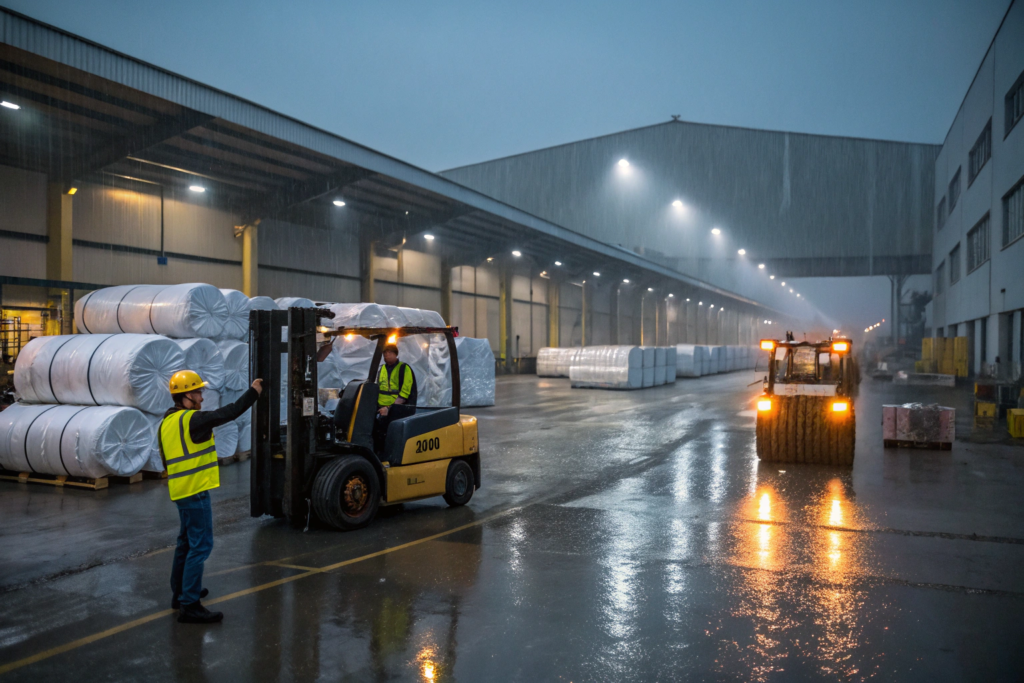
A supply chain disaster isn’t a "what if"; it’s a "when." Look at the chaos of the Red Sea diversions or the port strikes that cripple the West Coast. When that happens, a standard vendor will email you a force majeure notice and basically say, "Tough luck, it’s out of our hands." That’s not a partner; that’s a fair-weather supplier. The unique value of being embedded in the Keqiao cluster for twenty years isn’t that we don’t have disasters; it’s that we have the local depth to simply buy our way out of them for you.
Absorbing disaster means rerouting physical flow instantly. If your designated yarn supplier has a power cut and freezes a rotary spinning frame, we don’t tell you to wait six weeks. We pull in favors. We deploy our in-house warp-knitting flexibility, using stocks of raw filament that are traceable and compatible, so the fabric construction holds. The "buffer" here isn’t money sitting in a bank; it’s spare capacity and trusting relationships with five other mills within walking distance who will hand over their high-quality viscose yarn without scalping us on price. You pay the agreed price; we eat the "rush premium" because protecting your sell-through matters.
But what really separates a firefighter from an arsonist is pre-production "catastrophe clauses." We sit down with CEOs and map the vulnerable points. Is the fabric dependent on a single imported Italian finishing enzyme? If so, we don’t just order it; we stock a frozen safety buffer at the coating plant. A real disaster buffer is invisible inventory. This is where digital integration matters. By tracking real-time dyeing tank temperatures and chemical dosing pumps, our automation predicts a heater failure before we ruin the delicate shade of a cashmere blend. You must include mandatory "how to implement vendor-managed inventory" discussions if you want to bypass stockouts. It shifts the burden of predicting chaos from you to us. I want you calling me about new designs, not tracking a container stuck in customs because we failed to double-check the fumigation paperwork.
Why Is Regional Cluster Depth a Stronger Buffer Than Standard Insurance?
Commercial insurance pays out in money, months later, after lawyers haggle. A cluster pays out immediately in physical goods. Imagine a flooding incident that damages a finishing plant’s electrical grid. You have a 20,000-yard order of anti-static polar fleece mid-way through drying. If the fabric sits wet for three days, it mildews, and the entire lot is garbage. Insurance will spend weeks trying to determine if "mildew exclusion clause 4B" applies.
Because we are in Keqiao, we don’t wait for the insurance adjuster. We know every machine in town. By 4:00 PM on the day of the flood, we’ve already loaded the soggy rolls onto our transport fleet and routed them to a dryer in a plant three miles away that we know has open capacity. The fabric is saved, the insurable incident is minimized, and your production timeline slips by hours, not months. This is a physical capability you can’t buy; it’s earned through geography and twenty years of lunches with your neighbors. For anyone still relying solely on a paper policy, reading about why geographic cluster resilience matters more than policy fine print is eye-opening. I’d take a scooter and a good reputation in the Dyeing Quarter over a million-dollar insurance claim any day.
Can a Mill’s Internal QC Actually Prevent a Global Logistics Crisis?
Absolutely. A logistics crisis often starts three weeks earlier as a quality variance that spirals into a re-ship nightmare. If a container of denim jackets gets flagged at the port of Los Angeles for a heavy metal buckle exceeding California Prop 65, you are now in a detention and demurrage hell. Your brand reputation takes a hit, and the cost of destroying the goods is astronomical.
The actual way we "absorb" that logistics crisis is by snuffing it out in our CNAS lab before the trim is even sewn. Our metal detection scanners don’t just look for needles; we screen for molecular heavy metals in the plating of the shanks. We audit the upstream casting houses for lead content. The "disaster" was avoided silently, three supply chain nodes away from the port. That’s true absorption. It’s preventive.
I once had a project for skateboard apparel where the graphic print supplier quietly switched to a cheaper plastisol ink containing a non-compliant phthalate binder. Our standard chemical screening flagged the elevated phthalate levels on a random batch test before the bulk-cut panels were sewn. We deep-freeze the shipment hold. We quarantined 15,000 units. By catching it, we saved the client a potential forced recall in the EU market. That’s not just logistics; it’s legal protection wrapped in a lab coat.
Does Vertical Integration Really Mean Lower Long-Run Costs?
Let’s kill a myth right now: Vertical integration doesn’t automatically equal cheap fabric. If you want a $0.50 polyester pongee, go to a giant that operates its own oil refinery-to-hemming monopoly. That’s not us. But for mid-to-high-end, complex, branded textiles requiring innovation, our "virtual verticality" in the Keqiao cluster crushes long-run costs in a way that a standalone isolated mill simply cannot. The math of "cheap" changes when you account for the cost of miscommunication. That’s the hidden tax you pay when dealing with disconnected sources.
The real cost savings come from the "handshake effect." When you deal with a disconnected vendor chain—one weaver, one dyer, one coater—every person adds a 20% "CYA" margin to absorb the mistakes of the previous guy. The dyer blames the weaver for bad prep, the coater blames the dyer for residual surfactants, and you pay for all three rounds of "margin stacking." By integrating the process flow right here in Zhejiang, we eliminate those blame silos. I own the problem from loom to lamination. That means the total profit margin added to the garment is singular, rational, and honest. When we quote you a premium Japanese mechanical stretch denim, the price includes seamless color fixation that a separate finisher would charge extra for.
When you look at the total cost of ownership, you also have to calculate the "creativity penalty." If your fabric development process requires separate MOQs for yarn spinning, for the dye lot, and for the printing screen, you pay for 5,000 yards of a fabric you only needed 1,000 yards of, just to test. Vertical integration—especially the way we’ve structured our agile small-batch dynamic—kills that penalty. We can warp a small loom for a 300-yard sample run using custom greige, send the roll down the road for an experimental coating, and back to our inspection bench, all without triggering commercial minimums. Your cost to innovate is zero except for the physical materials. That’s how you build a fast-fashion brand on a sensible budget.

How Does Removing Middlemen Impact Your Fabric Innovation Speed?
Middlemen don’t just add margin; they add time and a terrible game of telephone. The worst words in this industry are: "Let me check with the mill." When you buy from a trading company, your design idea—say, a specific burnout velvet effect—has to travel from you, to the agent, to the agent’s production manager, to the printing foreman. By the time the message gets through, that "sharp vintage look" has become a "muddy brown stain."
When the CEO asks me about speed, I explain that integration cuts out the perceptual filter. You talk directly to the technician who controls the sulfuric acid paste for the burnout. We shoot a 30-second WeChat video of the first trial, and you adjust the pile height verbally in real time. There is no re-quoting delay. This collapse of communication time leads directly to better fabric engineering. Instead of three failed prototypes spread over six weeks, we nail the design in two trials over ten days. That acceleration is the biggest cost saving in fashion, because time-to-market is a leading indicator of gross margin. I still review basic principles of how removing textile intermediaries accelerates design occasionally, but honestly, the proof is in the speed of the sample rack.
Why Does Keqiao Logic Lower the Cost of Complex Composites?
Complex composites are essentially a B2B negotiation between chemistry, heat, and pressure. If those functions are under one roof, the line is seamless. A 3-layer waterproof-breathable jacket is a sandwich: a face fabric, a membrane, and a tricot backer. If the bond between the membrane and the outer shell fails (delamination), a standalone laminator will tell you the curing temperature of your face fabric coating is the culprit. The face fabric finisher will blame the laminator’s belt pressure. You are stuck with 10,000 meters of a rubbery, bubbling mess and a bill.
In a Keqiao-integrated logic, the same technical director oversees both the fabric prep and the lamination. They know that a non-ionic softening agent on the woven face is fatal to adhesive bonding. So, they don’t allow it. They specify a reactive softener right at the finish stenter. This avoids the cost of re-washing the fabric before lamination. It’s a detail that saves $0.80 a yard and prevents a 10% delamination failure rate.
I vividly recall a hunting apparel project where a competitor quoted a lower face price but a higher lamination cost due to incompatible chemistry. Our Keqiao-based compound line used a synchronized kiss-roll coating machine to apply the adhesive with a gram-per-square-meter precision of ±2 grams. You get perfect waterproofing (often exceeding 15,000 mm hydrostatic head) without wasting expensive glue. That’s how we always seem to win on complex soft-shell fleece tenders—not by cutting corners, but by eliminating chemical conflicts.
What Data Should a CEO Demand for a True Strategic Partnership?
Forget the glossy PDF catalog. If you want a ten-year partnership, demand the digital heartbeat. Most factories still run on Excel sheets that a manager updates on Friday—meaning your data is always four days old. A CEO who asks me, "What real-time data do I get?" is a CEO I take seriously, because it means they manage their business scientifically. A strategic partner doesn’t hide behind a sales rep; they open a live dashboard window into your specific production flow. That is the new standard.
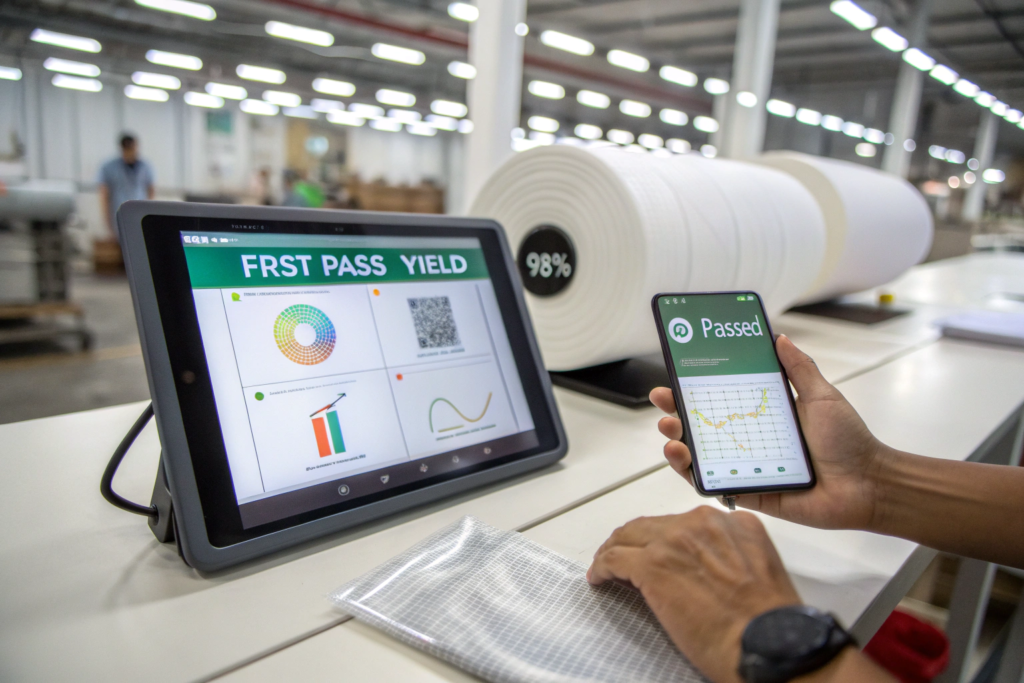
The data that actually matters isn’t vanity metrics like "tons shipped." It’s predictive data. You should demand: the "First-Pass Yield" (FPY) of your specific dye lot—meaning how many yards were perfect before needing expensive re-processing; the exact moisture content of the fabric as it enters the packing facility, because excess moisture rots fabric in containers; and the live inventory position of your custom greige inside our warehouse. These three data points tell you more about the financial health of your supply chain than any balance sheet. When we onboard a serious brand, we give them a tailored view of our Enterprise Resource Planning system. You see the racks, the beakers, and the needles. It’s not that we have nothing to hide; it’s that what we have to show is genuinely impressive.
This transparency shifts the partnership from "buying a product" to "synchronizing a pipeline." When your data shows we’ve hit the 95% weave point on your order, your logistics manager can book the container two weeks earlier with confidence, securing the best spot rates instead of last-minute panic pricing. You start to see that our interests are mathematically aligned. If our FPY drops below a target threshold (say, 92%), our system pings our engineering chief immediately, but it also sends you an automated note, "Notice: Density variance detected in Lot #2045; Remediation Plan Initiated." No hiding. No slow-rolling bad news.
How Can Real-Time Defect Tracking Prevent a Brand Crisis?
A brand crisis doesn’t happen in the lab; it happens on Instagram. One influencer posts a video of a dress seam splitting, and suddenly your DTC site is flooded with returns. That crisis was born three months earlier, on lane 4 of an inspection table, as a subtle "seam slippage" trend that nobody caught. Real-time defect tracking software, like the digital AQL we use here, spots that trend before the container even sails.
We map every defect not just by "major/minor" but by location tendency. If the data shows that cutting size inconsistencies are frequently happening at the back rise of joggers, we don’t just re-train the cutter; we check the marker layout and fabric shrinkage compensation tables. It’s root cause corrected in 24 hours. The data package we send you is your insurance policy against social media shame. Our online system is similar to how you can read about principles of textile QA management for brand protection from various industry sources, but we take it further by linking the physical map to the financial order. We want the data to be so clear that your in-house corporate quality manager feels like they were standing right here in the Keqiao inspection room.
Why Should Your Factory Share Predictive Logistics Intelligence?
Look, the ocean is a mess. The standard notice you get from a supplier is, "Here is the Bill of Lading; good luck." Predictive logistics is about sharing the port-to-door probability, not just the sailing schedule. A strategic partner acts like an assistant traffic controller for your financial planning.
We use a combination of ERP tracking, historical port congestion data, and direct relationships with the "Silk Road Keqiao" freight railway to give you a "confidence score" on delivery. If the Shanghai port shows a 3-day waiting time for berths, we don’t just hope you notice; we proactively calculate the impact on your warehouse re-stock date. For a client launching a back-to-school line with a hard deadline of July 25th, we ran a pre-mortem in June.
The data model predicted a 92% probability of arrival by July 20th using standard ocean freight, but a 100% probability using multimodal through a less congested secondary port. The switch cost an extra $0.15 per unit, which we split. It secured a $500,000 retail placement. A factory just trying to "ship cheap" would have saved that $0.15 and stranded the inventory. Sharing predictive logistics data—especially how future maintenance on Asian mainports may affect lead-times—allows you to do dynamic route costing. It turns logistics from a mystery cost into a strategic lever.
Conclusion
Let’s stop looking for the cheapest needle in the haystack and start building a mechanism that prints money for both of us. That mechanism activates the moment you ask the right question. Not "What is the price?", but "How is your entire facility, from the financial ledger to the stenter frame, buffered to protect my margin when things inevitably go wrong?" We’ve torn down the mechanics of true quality control, the cluster physics that neutralize disaster, the economic gymnastics of vertical integration, and the raw transparency of real-time data.
And we didn’t just theorize. We walked past the spectrophotometer that ends color arguments, the backup dye house three miles away that rescues flooded fleece, and the digital dashboards that tell you the moisture content of your fabric before it hits the container. This depth comes from roots sunk deep into the Keqiao soil, a place where I can settle a technical dispute with a scooter ride and a shared noodle bowl, not a twelve-week email chain.
Knowing the right question is the key that separates transactional buyers from generational brand builders. If that question hits a nerve, or if you have a stubborn technical problem that the spreadsheet-jockeys can’t seem to fix, let’s have a real, unfiltered conversation. You don’t bring a purchase order; you bring your specific headaches, your tightest deadlines, and your most demanding performance standard. I’ll bring the engineers. You can find me through our Business Director, Elaine, who coordinates these deep-dive technical sessions and can give you frank, rapid answers on capacity and chemistry. Drop us a line at elaine@fumaoclothing.com and let’s stress-test your next collection before you even sketch it.