I once stood in a returns processing center in Birmingham, UK, watching a warehouse worker sort through a gaylord box of defective polo shirts. I asked him, "What is the number one reason these come back?" He did not even look up. "The collar goes wavy. Looks like a lasagna noodle after ten washes. Customers hate it." He pulled out a shirt from a well-known mid-market brand, and the collar had completely lost its memory. Instead of lying flat and crisp against the neck, it rippled outward in a series of soft waves, the inner edge permanently stretched, the whole thing looking limp and exhausted. The body of the shirt was fine. The fabric was still vibrant. The seams were intact. But the collar was dead, and the shirt was unwearable. That moment crystallized something I already knew from the mill side: the collar is the first component to announce that a polo shirt is cheap, and the rib knit collar fabric itself—not the sewing, not the care label—is the root cause of 90% of collar failures.
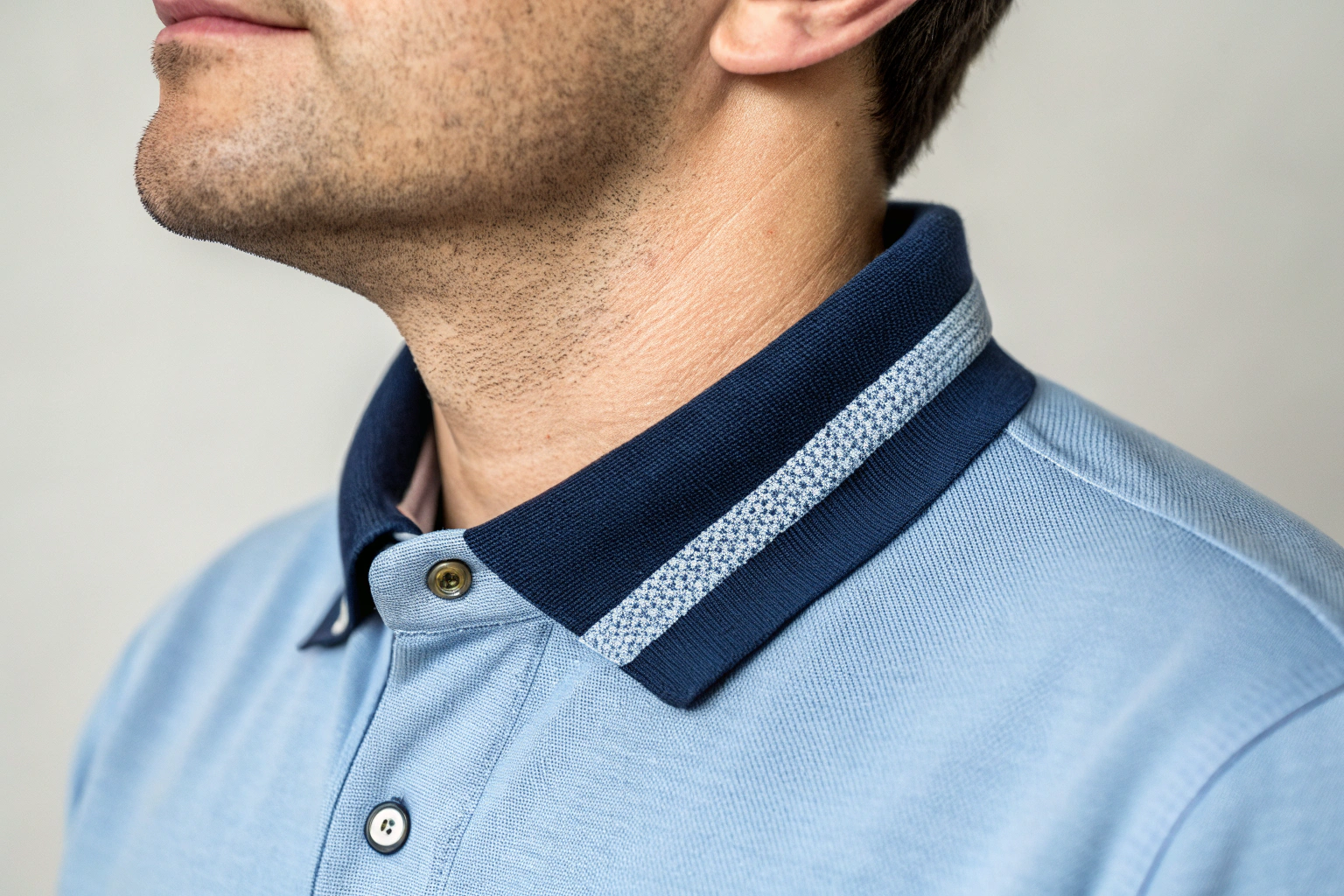
A polo shirt collar is a deceptively simple piece of textile engineering. It is a folded strip of rib knit fabric, typically 4 to 5 centimeters wide in its finished form, that must perform a brutally contradictory set of functions. It must grip the neck snugly without constricting. It must stretch repeatedly as the head passes through the neck opening, and then instantly recover to its original dimensions. It must survive industrial laundering, the alkaline chemistry of sweat, the friction of a stubbly chin, and the distorting pressure of an iron or a dryer. And it must do all of this for years while looking crisp, flat, and structured. A cheap rib knit collar fabric, the kind you find on a $12 fast-fashion polo, will fail within six months. A premium rib knit, properly engineered with the right fiber blend, the right yarn twist, and the right finishing, will outlast the garment body it is attached to.
At Shanghai Fumao, I supply rib knit collar fabric to polo shirt manufacturers across Europe, the US, and Australia, and I treat collar fabric as a distinct, high-performance product category. It is not just any rib knit; it is a specifically engineered textile with its own fiber specifications, construction parameters, and testing protocols. I want to explain exactly why the collar matters so disproportionately, how the fiber blend and knitting gauge determine its lifespan, the specific failure modes that good collar fabric prevents, and the testing methods I use to guarantee that a collar will still be lying flat long after the polo shirt has earned its keep.
Why Does the Collar Fail Before the Body in Most Polo Shirts?
The collar fails first because it operates in a fundamentally more hostile mechanical and chemical environment than the body fabric. The body of a polo shirt experiences relatively gentle stresses: it drapes, it stretches slightly across the shoulders and chest, it rubs against chair backs. The collar experience is violent by comparison. Every time the wearer pulls the shirt on or off, the collar is stretched from its resting circumference of roughly 40 to 45 centimeters to the full circumference of the wearer’s head—about 56 to 60 centimeters for an adult. That is a 30 to 40 percent dynamic stretch, repeated daily, for the life of the garment. The collar intercepts sweat, sebum, and skin cells directly from the back of the neck, a high-perspiration zone. It is rubbed by the chin and jaw stubble, which acts like fine sandpaper on the crown of the collar fold. It is subjected to the highest concentration of laundry chemicals because the neckline is the most aggressively scrubbed area during washing. All of these forces attack the molecular structure of the fibers, the geometry of the knit loops, and the integrity of the yarns themselves.
The failure cascade usually follows a predictable sequence. Stage one: the fiber begins to fatigue. The repeated stretch-and-release cycles break the intermolecular bonds in the polymer chains, especially in cotton and viscose. The fiber loses its elastic memory. Stage two: the knit loop structure deforms. Individual loops in the rib knit become permanently elongated, losing their tight, alternating wale structure. The fabric begins to grow in width and lose its thickness. Stage three: the collar "waves" or "crimps." The folded edge, which was once crisp and straight, develops a sinusoidal distortion because the inner and outer plies of the folded rib are no longer under equal tension. The inner ply, which sits against the neck, has been stretched more than the outer ply, creating a length differential that manifests as ripples. Stage four: the collar becomes unsalvageable. Ironing temporarily flattens it, but the first time the shirt is worn, body heat and moisture reactivate the deformation, and the waves return within minutes. The shirt is now a "house shirt" or a rag. Understanding this failure cascade is essential because it tells you exactly which material properties must be engineered into the collar fabric from day one: elastic recovery, fatigue resistance, and dimensional stability.

Is Collar Deformation Caused by Poor Elastic Recovery or Stitch Breakdown?
Elastic recovery is the primary culprit. Stitch breakdown—where the sewing thread snaps or the seam unravels—is a visible, dramatic failure, but it accounts for less than 10% of collar failures observed in returns. The vast majority of collars that consumers reject are still structurally intact in terms of their sewing; the collar has not come detached from the body, and the coverstitching has not unravelled. What has failed is the fabric itself. Elastic recovery is a material property of the yarn and the knit structure. It is the percentage by which a fabric returns to its original dimension after being stretched to a specified extension and held for a specified time. The industry-standard test is "elastic recovery after 30 minutes relaxation following 30% extension," and a premium rib knit collar fabric should achieve a recovery of at least 90%. Below 85%, and the customer will notice the collar losing its grip after a few months of wear.
The knitting structure plays a supporting role. A standard 1×1 rib knit, where one wale of knit stitches alternates with one wale of purl stitches, is the classic collar construction because the alternating knit-purl structure naturally contracts face-to-face, creating a fabric with high inherent stretch and recovery in the width direction. But this structure only works if the yarn itself is sufficiently resilient. A 1×1 rib knitted from 100% ring-spun cotton with no elastane will have limited stretch recovery because the cotton fibers themselves have low elastic elongation, typically 3 to 7%. The rib structure amplifies the fabric’s stretch but cannot compensate for the fiber’s lack of recovery. That cotton collar will inevitably grow and wave. This is why virtually all premium collar fabrics incorporate a filament elastane or polyester core that provides the mechanical "spring" that the cotton or viscose alone cannot supply.
Why Do Washing Machine Alkalinity and Heat Specifically Attack the Collar Structure?
Home laundry detergent is chemically hostile to cellulosic fibers like cotton and viscose. Most standard detergents create an alkaline wash bath with a pH between 9 and 11. This alkalinity is great for saponifying body oils and removing soil, but it is also the exact condition that degrades cellulose polymer chains over repeated exposure. The glycosidic bonds that link the glucose units in cellulose hydrolyze slowly under alkaline conditions, especially at elevated temperatures. A 60°C wash is chemically aggressive to cotton; a 90°C wash, which some consumers still use for "whites," is destructive. Each hot alkaline wash clips the cellulose polymer chains, reducing the average degree of polymerization and lowering the fiber’s tensile strength and elastic resistance.
The collar is particularly vulnerable because it is a folded, double-layer structure. Detergent solution becomes trapped between the inner and outer plies of the collar during the wash and rinse cycles. The fabric dries from the outside in, so the trapped alkaline residue concentrates in the interior of the collar fold as the water evaporates. Over multiple wash cycles, this results in a higher effective chemical exposure on the collar’s internal structure than on the single-layer body fabric. The collar also experiences the most mechanical action in the washing machine because it is a raised structure that catches on other garments and the machine drum. The combination of trapped alkaline chemistry and amplified mechanical abrasion creates a micro-environment that accelerates fiber degradation. This is why a collar can look ten years older than the body of the same shirt after sixty wash cycles.
What Fiber Blends Actually Extend the Life of a Rib Knit Collar?
The fiber blend is the single most important specification decision you make for a rib knit collar, and the difference between a collar that lasts and a collar that dies is usually 3% to 5% of spandex elastane filament. A 100% cotton collar has a natural, soft hand feel and a classic, matte appearance, and for a luxury garment that will be hand-washed and worn gently, it can be acceptable. But for any polo shirt that will be machine-washed, tumble-dried, and worn for sport or daily activity, cotton alone is insufficient. The cotton fibers will fatigue, the rib structure will relax, and the collar will wave. The addition of a filament elastane, typically a 20 or 30 denier spandex core wrapped in cotton or polyester, provides a built-in, permanent elastic skeleton that the cotton fibers cannot lose. The elastane filament is a polyurethane polymer that can stretch 400 to 600% and recover to near its original length with minimal permanent set. This filament, knitted into every second or third course of the rib knit, anchors the fabric’s dimensions and forces the cotton loops back to their original geometry after every stretch cycle.
The classic workhorse blend for premium polo collars is 96% cotton, 4% elastane, or 97% cotton, 3% elastane. The elastane content seems small, but because the elastane filament is fed under tension during knitting and then relaxes, it exerts a continuous, gentle compressive force on the cotton loops. This internal compression keeps the rib structure tight and prevents the loop elongation that leads to waviness. For performance polos destined for gym use, hospitality uniforms, or golf wear, I often recommend adding polyester to the blend—typically 60% cotton, 35% polyester, 5% elastane. The polyester fibers, which are inherently resilient and hydrophobic, reduce the amount of water the collar absorbs, limiting the swelling stress on the knit loops during washing. They also add a heat-set dimensional stability that cotton cannot achieve without chemical cross-linking. The trade-off is a slightly less natural hand feel and a risk of pilling if the polyester staple length is too short. I specify a minimum 38mm staple length for polyester used in collar blends to avoid that pilling issue.

Why Is 3 Percent Elastane the Magic Number for Collar Memory and Recovery?
The 3% elastane content is not a magic number in the mystical sense; it is the empirically derived minimum effective dose of elastic filament required to provide meaningful dimensional recovery in a rib knit structure without negatively affecting the fabric’s hand feel, dyeability, or cost. At 2% elastane, the spacing between elastane courses in the knit is too wide, and the restorative compressive force is unevenly distributed. Some sections of the collar recover well; others, between the elastane courses, do not. The collar can develop a subtle "striped" waviness corresponding to the elastane feed pattern. At 4% or 5% elastane, the collar becomes noticeably rubbery to the touch. The elastane starts to dominate the hand feel rather than supporting it. The rib also becomes more difficult to dye uniformly because the elastane filament takes up dye differently than the cotton wrapping, and at higher elastane content, this differential becomes visible as a subtle grin-through effect.
At 3%, the elastane is present at a high enough density to provide a uniform, fabric-wide recovery force but at a low enough density to remain invisible and intangible to the consumer. The elastane filament, typically 20 denier, is buried inside a cotton or cotton-polyester wrap yarn, so it never touches the skin directly. The consumer feels cotton; the engineer knows elastane is in there. The 3% level also balances cost. Elastane filament is significantly more expensive per kilo than cotton or polyester. Each additional percentage point of elastane content adds roughly 8% to 10% to the yarn cost. At 3%, the cost premium over a pure cotton yarn is around 25% to 30%, which is acceptable for a premium product. At 5% elastane, the yarn cost premium exceeds 50%, which becomes difficult to absorb without raising the garment price into a different bracket.
Does Polyester Core-Spun Thread Beat 100% Cotton Thread for Collar Seaming?
Yes, absolutely, and this is a specification detail that many brands overlook entirely. The collar is attached to the body of the polo shirt with a coverstitch or a flatlock seam, using a sewing thread that runs continuously around the neck circumference. If that sewing thread is 100% spun cotton, it will shrink at a different rate than the collar fabric when washed and dried. The differential shrinkage between the cotton sewing thread and the collar fabric, which contains elastane and possibly polyester, creates a tension imbalance that pulls the collar into waves. The cotton thread shrinks; the elastane-containing collar fabric resists that shrinkage; the result is a rippled collar seam.
Core-spun polyester thread eliminates this differential shrinkage. A core-spun thread has a high-tenacity continuous filament polyester core wrapped with a cotton sheath. The polyester core provides the dimensional stability and tensile strength—it does not shrink in water. The cotton sheath provides the sewability and the natural matte appearance. The thread’s residual shrinkage is typically less than 0.5%, compared to 2% to 3% for a 100% cotton thread. When you attach a collar with this thread, the collar seam remains flat after repeated washing because the thread and the fabric shrink in concert, not in conflict. I specify core-spun poly-cotton thread on all collar-seaming operations, and I recommend it even for brands producing 100% cotton polo shirts. A garment can still be labeled "100% Cotton" if the sewing thread is an exception under the fiber composition labeling rules—most labeling regulations allow a de minimis exception for sewing thread and trims. The poly-core thread is invisible to the consumer but essential to the collar’s longevity.
How Does Knitting Gauge and Yarn Twist Factor Into Collar Resilience?
Knitting gauge and yarn twist are the hidden structural parameters that distinguish a crisp, resilient collar from a soft, floppy one before the consumer ever touches it. Knitting gauge refers to the number of needles per inch on the circular knitting machine used to produce the rib fabric. A fine-gauge rib, typically 14 to 18 needles per inch, produces a dense, compact fabric with small, tight loops. A coarse-gauge rib, typically 10 to 12 needles per inch, produces a more open, textured fabric with larger, more widely spaced loops. For a polo collar that must hold a crisp folded edge and resist deformation, a finer gauge is better. The tighter loop density provides more yarn-to-yarn contact points, which creates internal friction that resists loop elongation. A fine-gauge collar has a smoother surface, a cleaner edge definition, and a higher dimensional stability. It looks more premium and it performs better over time.
Yarn twist is the second critical parameter. Twist is the number of turns per inch inserted into the yarn during spinning. A higher twist level—for example, 22 to 24 turns per inch for a 40/1 Ne cotton yarn—produces a harder, more compact yarn with less surface hairiness and higher tensile strength. This high-twist yarn resists abrasion better and holds its shape under repeated stretch. However, twist is a trade-off with hand feel. Too much twist makes the yarn harsh and stiff, unpleasant against the neck. Too little twist makes the yarn soft and fuzzy but weak and prone to pill. For collar fabric, I target a twist multiplier of 3.8 to 4.0, which is on the higher side of normal apparel yarns. This creates a yarn that is crisp and resilient but still acceptable in next-to-skin comfort. The higher twist also contributes to the collar’s ability to "snap back" after stretching because the torsional energy stored in the twisted fibers acts like a micro-spring, urging the yarn back toward its original configuration.

What Is the Ideal GSM and Stitch Density for a Long-Lasting Polo Collar?
The ideal weight and density for a rib knit polo collar is a narrow band that balances structure with comfort. A collar that is too light and open—say, below 220 GSM with fewer than 16 wales per inch—will lack the internal mass and fiber density to resist mechanical deformation. It will be flimsy on the fold line, and it will wave after relatively few wash cycles because there simply are not enough yarns packed into the structure to hold the geometry. The collar feels insubstantial in the hand, and the consumer perceives it as cheap before they even wash it. A collar that is too heavy—above 350 GSM—will be stiff, uncomfortable against the neck, and difficult to sew cleanly on standard coverstitch machines. It will also add unnecessary cost to the garment.
For a classic men’s polo shirt collar, I recommend a finished fabric weight between 270 and 310 GSM, with a wale density of 18 to 22 wales per inch and a course density of 24 to 28 courses per inch. This weight and density range produces a collar that feels substantial in the hand, folds cleanly without a press, and has enough fiber mass to absorb the mechanical stress of daily donning and doffing without permanent deformation. For women’s polo shirts, where the collar is typically narrower and the aesthetic demands a slightly lighter, more fluid hand feel, I reduce the target to 240 to 270 GSM while maintaining the wale density, achieved by using a slightly finer yarn count. The density numbers are more important than the weight because density determines the mechanical structure; weight is just a consequence of density and yarn size.
Should the Collar Rib Be Heat-Set or Resin-Treated to Lock in the Structure?
Heat-setting is a thermal process used to stabilize synthetic fibers—polyester and nylon—by heating the fabric to near its glass transition temperature under controlled tension, relaxing the internal stresses in the polymer chains, and then cooling it rapidly to lock in the new molecular configuration. For a collar fabric containing polyester, heat-setting is essential. Without it, the polyester component remains in an unstable, stressed state from the yarn spinning and knitting processes, and when the garment is washed in hot water, the polyester relaxes and the collar shrinks unpredictably.
For a cotton-rich collar blend, heat-setting alone is insufficient because cotton does not have a thermoplastic response. Cotton fibers relax through water and mechanical action, not dry heat. Resin treatment is a chemical alternative, but I use it with extreme caution on collar fabric. A cross-linking resin, typically a DMDHEU or a formaldehyde-free glyoxal-based chemistry, forms covalent bonds between the cellulose chains in the cotton fibers. This cross-linking locks the fibers in their current configuration and imparts excellent wrinkle resistance and dimensional stability. However, it also embrittles the fibers, reducing their tensile strength and abrasion resistance by 20% to 40%. On a collar, which experiences high mechanical abrasion at the fold line, a heavy resin treatment can cause the fibers to crack and break, creating a visibly worn fold after relatively few wash cycles. I prefer a mechanical stabilization approach for collars: a combination of controlled relaxation during wet finishing, followed by a light heat-set if polyester is present, and a minimal or zero-resin finish. The longevity of the collar comes from the fiber blend and the knit structure, not from a chemical stiffener.
What Testing Methods Guarantee a Collar Will Survive Repeated Washing and Stretching?
A collar that looks perfect on the pre-production sample has not proved anything. The proof comes from standardized mechanical testing that simulates years of wear and washing in a compressed timeframe. At Shanghai Fumao, I subject every new collar fabric development to a three-part testing protocol designed to expose the exact failure modes that cause returns. The three tests are elastic recovery testing, dimensional stability after multiple wash cycles, and fatigue cycle testing. Together, these three tests predict with high accuracy whether a collar will survive the life of the garment or fail prematurely.
Elastic recovery testing measures the collar’s ability to snap back after being stretched. A 10 cm wide specimen of the collar fabric is clamped in a tensile testing machine fitted with a constant-rate-of-extension mechanism. The specimen is stretched to 30% extension at a rate of 100 mm per minute and held at that extension for 30 minutes. The extension is then released, and the specimen is allowed to relax for 30 minutes. The length is re-measured, and the recovery percentage is calculated as (1 minus permanent set divided by original length) times 100. A premium collar fabric must achieve a recovery of 90% or higher. Below 85%, and the collar will develop permanent growth within a few months of wear. I record the recovery after the first cycle, the fifth cycle, and the tenth cycle to capture any progressive degradation in the elastane’s performance.
Dimensional stability testing is the wash-and-dry simulation. The collar fabric is subjected to five complete wash-and-dry cycles per ISO 6330, using a Type A washing machine at 60°C and tumble drying. The dimensions before and after are measured, and the shrinkage or growth is calculated. For a rib knit collar, the critical measurement is width-wise growth—collar fabrics tend to grow wider rather than shrink because the mechanical action of washing relaxes the knit loops and the elastane experiences some fatigue. A premium collar fabric should show less than 2% width-wise growth after five cycles. The fatigue cycle test is the most aggressive. A single specimen is repeatedly stretched to 30% extension and released for 500 cycles using the tensile testing machine in cyclic mode, then re-measured for permanent set. This simulates roughly the number of don-and-doff stretch cycles a polo shirt experiences over two years of weekly wear. The permanent set after 500 cycles must be less than 5%.

How Is a Cyclic Stretch and Recovery Test Performed on Rib Knit Fabric?
The cyclic stretch and recovery test is a dynamic, repetitive version of the static elastic recovery test. The specimen is mounted in the tensile testing machine with a gauge length of 100 mm. The machine is programmed with a cyclic loading profile: stretch to 30% extension at 500 mm per minute, hold at extension for 5 seconds, return to zero extension at 500 mm per minute, hold at zero for 5 seconds. This cycle is repeated 500 times automatically. The machine’s software records the load-extension curve for every cycle, which allows me to see not only the final permanent set but also the progressive loss of recovery force over the 500 cycles.
The key data points from a cyclic test are the stress retention percentage and the permanent set. Stress retention is the amount of elastic retractive force the fabric still exerts at 30% extension after 500 cycles, compared to the force it exerted on the first cycle. A high-quality 3% elastane rib collar fabric should retain 70% or more of its initial retractive force after 500 cycles. If the stress retention drops below 60%, the collar will feel loose and un-grippy on the neck, even if it has not visibly waved. The permanent set is measured by marking the specimen’s length after the final cycle, allowing it to relax for 24 hours in a standard conditioned atmosphere, and re-measuring. The permanent set, as a percentage of the original gauge length, must be less than 5%. This test is aggressive and it is the best predictor I have found for long-term collar performance. I have tested cheap competitor collar fabrics that showed a permanent set of 12% to 15% after 500 cycles; those collars will wave badly within a year.
What Is the Wash-and-Dry Cycle Protocol for Simulating Years of Consumer Use?
The standard protocol I use is a modified ISO 6330-1N procedure with five complete cycles. The fabric specimen, cut to a 50 cm by 50 cm square with reference marks at 35 cm intervals in both warp and weft directions, is placed in a Wascator front-loading washing machine with a 2 kg make-weight ballast load of 100% polyester knitted squares. The wash cycle is set to a delicate or normal cotton cycle with a water temperature of 60°C, using an ISO 6330 specified reference detergent without optical brighteners. After the wash cycle completes, the specimen is tumble-dried in a calibrated tumble dryer at an exhaust temperature of 70°C until dry. The specimen is then conditioned for a minimum of four hours at 21°C and 65% relative humidity. The reference marks are re-measured, and the cycle is repeated for a total of five times.
Five cycles represents approximately one to two years of consumer use for a garment washed weekly, depending on the consumer’s care habits. A collar that shows no significant dimensional change after five cycles is well-stabilized. I also perform a more aggressive "abusive consumer" protocol on request for specific clients: a 10-cycle test with a 90°C wash temperature, which simulates a consumer who ignores care labels and washes everything on the hottest setting. A collar fabric that survives this protocol with less than 5% growth is essentially bulletproof. This data package—cyclic stretch, elastic recovery, and multi-cycle dimensional stability—provides a complete picture of the collar’s expected lifespan. I include all three test reports in the pre-production approval package for any client ordering rib knit collar fabric, along with a retained physical specimen from the tested lot.
Conclusion
The rib knit collar is the canary in the coal mine for a polo shirt’s quality. When it fails, it announces to everyone who sees the garment that corners were cut. The failure is not usually a sewing defect; it is a material engineering failure rooted in inadequate elastic recovery, poor fiber blend selection, or insufficient knitting density. A collar that waves, sags, or loses its grip after twenty washes is a collar that was never designed to survive the real-world conditions it would face. The body of the shirt may have years of life left, but without a functional collar, the garment is worthless.
I engineer collar fabric at Shanghai Fumao as a separate, high-specification product line because I know it performs a disproportionate share of the garment’s structural work. The fiber blend is specified with a minimum 3% elastane for recovery, the knitting gauge is fine enough to create a dense, stable loop structure, the yarn twist is high enough to provide resilience without harshness, and the finishing process is designed to deliver dimensional stability without the fiber embrittlement caused by heavy resin treatments. Every development batch passes through a battery of cyclic stretch tests, elastic recovery measurements, and multi-cycle wash protocols before I sign off on it.
If you are a polo shirt manufacturer or a brand experiencing collar quality issues, or you are launching a premium polo line and you want the collar to be a competitive advantage rather than a liability, I can provide you with the technical specifications and test data to prove the performance before you commit to production. Contact our Business Director, Elaine, at elaine@fumaoclothing.com. Send her your target blend, your desired hand feel and weight, and the wash conditions your customer will put the garment through. She will send you a collar fabric sample and the full test package—elastic recovery, cyclic stretch, and five-cycle dimensional stability. Let us make sure the last part of your polo shirt to fail is the collar it stands on.