
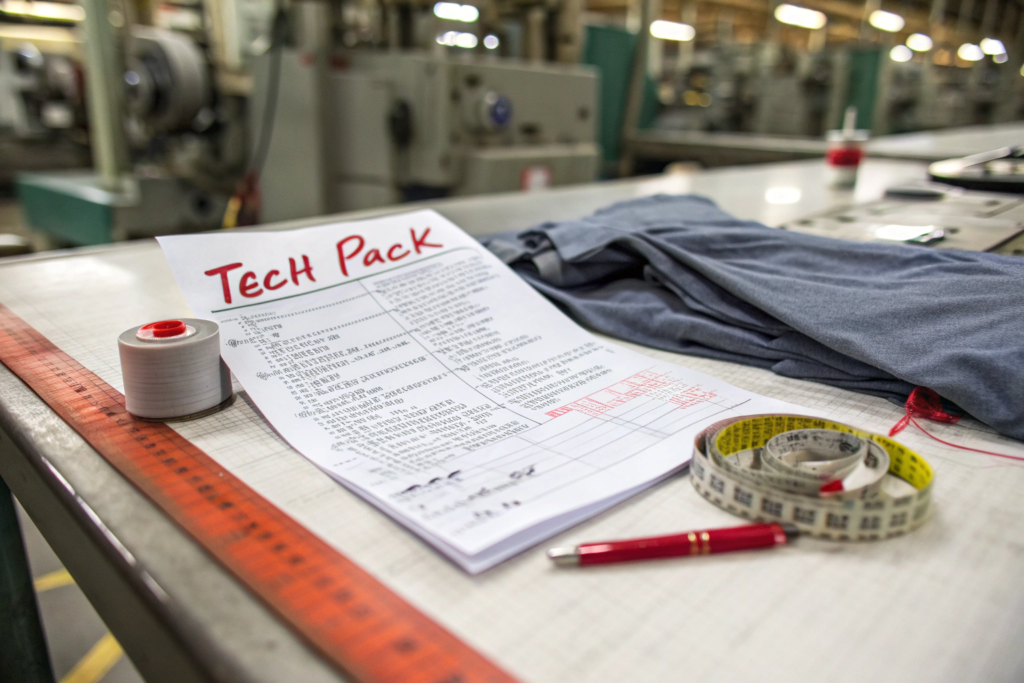
I have a memory that still makes my jaw clench. It was 2017, and a small luxury streetwear brand from New York sent us a tech pack for a cropped workwear jacket. The spec sheet was beautiful—every seam type, every stitch per inch, every measurement tolerance charted out in clean vector lines. I approved the pre-production sample. I signed off on the bulk fabric. The shipment landed, and the brand owner called me. Not to thank me. The sleeve cuff rib was 2mm narrower than the spec, visually throwing off the proportion of the jacket on-body. The bar-tack on the pocket stress point was 1mm shorter than specified, and it ripped on the third wear. The thread color on the contrast topstitching was one shade lighter than the Pantone callout. "The tech pack was perfect," he said, "but nobody in your supply chain actually followed it." He was right. And that failure cost us the reorder.
Here is the uncomfortable truth I have learned from twenty years in Chinese textile manufacturing: a tech pack is not a legally binding spell that compels compliance. It is a communication tool that only works if you build a verification system around it. Sending a PDF to a supplier and assuming they will execute every detail is like handing a recipe to a restaurant kitchen and walking away without ever tasting the dish. The supplier’s internal pressures—speed, cost, machine availability, shift worker fatigue—are constantly pushing against your spec. Without a structured process that makes compliance easier than deviation, your tech pack is just a wish list.
At Shanghai Fumao, I have built my entire production workflow around tech pack fidelity because I have been burned from both sides: as a buyer early in my career, and as a supplier who disappointed a client. I now treat every tech pack as a binding production contract that flows through a gated system: digital translation, pre-production sample cross-checking, in-line checkpoint inspections, and final measurement audits tied directly to the original spec sheet. I am going to share that exact gated system with you, explain the specific critical control points that fail most often, and tell you how to build an objective, measurement-based acceptance protocol that protects your design intent from the chaos of the factory floor.
Why Do Even Detailed Tech Packs Get Ignored in Production?
The tech pack gets ignored not because your supplier is malicious or lazy, but because your supplier is running a high-pressure, low-margin production environment where speed and volume are the loudest voices in the room. A typical cut-and-sew line manager in China is managing 40 sewing operators, 15 machine types, a daily output target of 800 units, and a defect rate that must stay below 3%. When your 25-page tech pack lands on their desk, they don’t read it cover to cover. They scan it for the critical callouts—base fabric, main seams, key measurements—and they trust their experienced operators to "fill in the blanks" based on muscle memory and habit. The elastic casing that you spec’d at 25mm? The factory has a drum of 22mm elastic left over from another order, and the line manager makes a split-second decision: 22mm is close enough, nobody will notice, and it saves a trip to the trim store. That is how deviations happen. Not from conspiracy, but from a thousand micro-decisions made under time pressure, each one seemingly rational in isolation but cumulatively destroying the integrity of your design.
Another reason is the communication gap between the tech pack creator and the production floor. Tech packs are written by designers and pattern makers who think in millimeters, seam types, and material codes. The production floor thinks in machine settings, needle sizes, and operator muscle memory. If a tech pack says "single-needle lockstitch, 12 SPI," but the operator’s machine is currently set up for a 10 SPI stitch and adjusting it requires stopping the line for 20 minutes to re-time the feed dogs, that 12 SPI callout is silently ignored. The operator feeds the fabric through at the existing 10 SPI setting, and the finished garment misses the spec. I learned this on a heartbreaker order for a US denim brand in 2019. They spec’d a specific stitch density on the waistband topstitch. Our sample room hit it perfectly. Our bulk factory didn’t. Why? The sample room used a new, precisely calibrated Juki machine. The bulk line used older machines with worn feed mechanisms that couldn’t hold the exact stitch length under speed. The spec was the same on paper. The machine reality was different. After that, I mandated that every production machine in our lines be calibrated to the specific stitch callouts of each order before cutting begins.
Are Language Barriers the Real Reason Suppliers Deviate From Specs?
Language is a contributing factor, but I have come to believe it is not the root cause. It is a convenient excuse that masks a deeper problem: the absence of numerical, visual, and physical reference standards in the production flow. I have seen tech packs written in perfect Chinese, by Chinese pattern makers working in our Keqiao office, with zero language ambiguity, and the bulk production still deviated from the sample. Why? Because the sewing operator was not referencing the tech pack at all. They were referencing the approved pre-production sample hanging on their station. And that sample had been handled, stretched, and altered during the fitting process, and no longer matched the original tech pack measurements. The operator was faithfully copying a corrupted reference.
The real solution is to make the tech pack the single source of truth by converting it into physical tools that speak the operator’s language. A measurement tolerance chart translated into a physical "go/no-go" jig that the operator uses to check their own work at the station. A stitch density spec translated into a sticker on the machine that says "This Order: 12 SPI" in large red numbers. A thread color Pantone number translated into a physical thread wrap card taped to the thread stand. These physical, visual, idiot-proof references bypass language entirely. An operator who speaks zero English and reads zero technical drawings can still hold a jig against a cuff and see instantly whether it passes or fails. At Shanghai Fumao, I have standardized these physical reference tools for every major contract. The tech pack is the master document; the jigs, stickers, and thread cards are the shop-floor translations. When those two things align, the language barrier becomes irrelevant. The operator doesn’t need to read English; they need to trust the physical gauge in their hand.
How Does Production Time Pressure Cause Deliberate Specification Short-Cutting?
Time pressure does not cause deliberate sabotage. It causes rationalized corner-cutting that the cutter genuinely believes is harmless. The thought process is: "If I use the 22mm elastic instead of the 25mm elastic, I save 45 minutes on this order, I hit my daily target, my line supervisor doesn’t yell at me, and the buyer in Europe will never see the difference." Multiply that thought process by 15 operators on a line, across 20 different trim and construction decisions per unit, and you get a finished garment that is a shadow of the tech pack’s intent. The shortcut is always rational from the perspective of the person taking it, even if it is disastrous for the brand.
I combat this with two specific tactics. First, I make the cost of the shortcut visible and personal to the person taking it. Every production line has a large, laminated "Critical Control Points" poster taped to the nearest pillar, showing the top ten spec callouts with a red highlighter marking the consequence of deviation: "Elastic narrower than spec = Full Line Re-work, No Piece-Rate Pay." When an operator knows that using the wrong elastic won’t just slide by but will cost them their wages for the afternoon, the calculus changes immediately. The shortcut is no longer harmless; it has a direct personal cost. This accountability structure is tied to our inspection gate system. If the in-line QC checker finds a repeat deviation, the entire line stops until the deviation is resolved. That 2mm elastic decision now costs not just one operator but the entire team, and peer pressure to follow the spec becomes a powerful enforcement force. The second tactic is to build specification compliance into the production engineering itself, making the deviation physically impossible. If your tech pack calls for a 12mm seam allowance, and the fabric cutting die is engineered to exactly that tolerance, the operator cannot physically sew a 10mm seam because the cut edge won’t align to the needle plate guide.
How Do Pre-Production Samples and Approval Gates Lock in Compliance?
The pre-production sample is the single most powerful compliance tool you have, and most brands misuse it. They treat it as a design approval—"Does it look like my sketch?"—when they should be treating it as a manufacturing contract. The approved pre-production sample, often called the PP sample or gold seal sample, is the physical manifestation of your tech pack. It is the item against which every subsequent bulk unit will be measured. If that sample is not absolutely identical to the tech pack’s final revision, you have just approved a corrupted version of your own design, and the factory will faithfully reproduce that corruption 5,000 times.
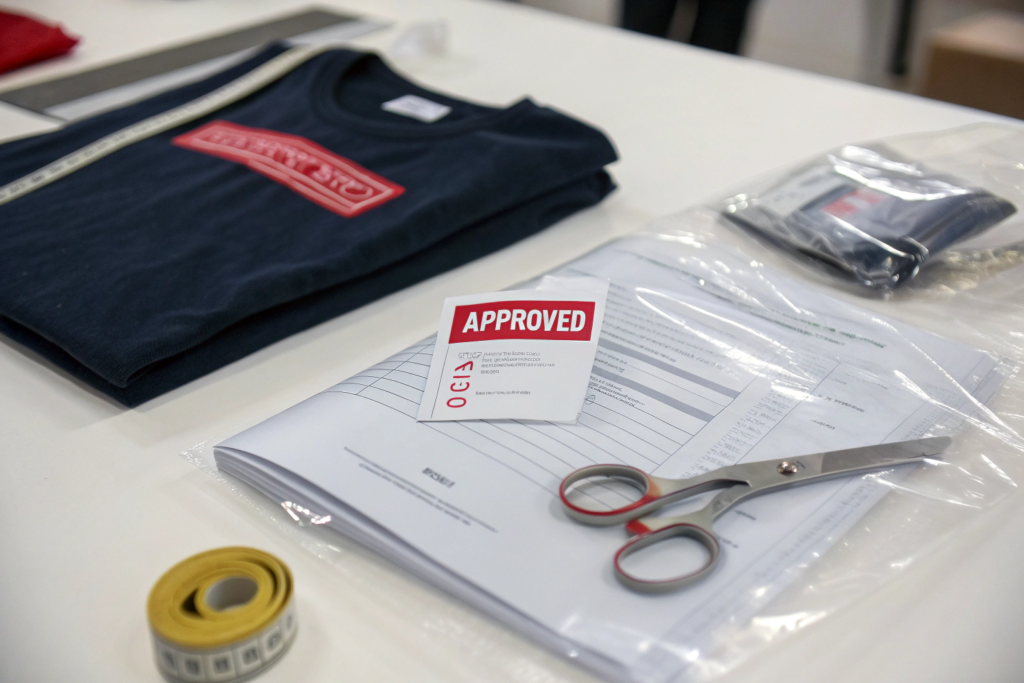
The approval gate process must be formal and irreversible. At Shanghai Fumao, we do not move from sample approval to bulk cutting until the client has physically signed a "Pre-Production Sample Approval Form." This form lists the top 20 critical measurements from the tech pack, with a column for the spec value, a column for the actual measured value on the sample, and a column for the deviation. The client must initial every line, or sign a single declaration that "deviations noted in items 3, 7, and 15 are accepted." No verbal approval. No WeChat message saying "looks good." No sample bag opened, glanced at, and set aside. A signed, dated approval form with explicit acknowledgment of deviations creates a binding reference. If a bulk shipment later arrives with those same deviations, there is no dispute. If the deviation was approved on the sample, it becomes the new spec and cannot be rejected at the bulk stage. If the deviation was not approved and appears in bulk, the contract is broken, and the liability is clear. This formality seems bureaucratic, but it saves relationships. It replaces "I didn’t notice that on the sample" with "I signed off on that exact cuff width on March 12th, and here is my signature."
What Is the Difference Between a Fit Sample, a PP Sample, and a TOP Sample?
These three sample types are distinct gates in the development-to-production pipeline, and confusing them is a recipe for disaster. A fit sample is a prototype made to verify the pattern and the silhouette on a live model or a dress form. It may be made from a similar but not identical fabric, with substitute trims, and the construction methods may be rough—the focus is purely dimensional and aesthetic. The fit sample answers the question: "Does this design look right on a body?" A pre-production sample is entirely different. It is made in the actual bulk fabric, with the actual bulk trims, on the actual bulk production line by the actual operators who will sew the bulk order. Every seam type, every stitch density, every needle type, every pressing method is production-accurate. This sample answers the question: "Is this design executable at scale with the exact materials specified?" A TOP sample, or Top of Production sample, is pulled from the very first units off the bulk production line. It is not made in a sample room by a master sewer. It is a finished garment plucked from the conveyor belt on day one of bulk cutting. It answers the question: "Is the bulk production actually reproducing the approved PP sample?"
The failure mode I see most often is a brand approving a fit sample as if it were a PP sample, and then being shocked when the bulk production doesn’t match the fit sample. The fit sample was sewn by a single skilled sample maker who spent two hours on a single garment, using a domestic iron and hand-guided stitching. The bulk was sewn by 20 operators working at 5 minutes per unit on industrial machines. Those are fundamentally different production realities. Another failure mode is the "golden sample trap." The factory sends a gorgeous PP sample, the brand approves it, and then the factory deliberately produces a lower-quality bulk and claims, "The sample was made in the sample room; bulk production naturally has more variation." This is not acceptable. A properly defined PP sample must come from the same production environment as the bulk. This is why I insist that the PP sample be sewn by the same line operators, not the sample room, for any contract above 5,000 units. It costs more and takes longer, but it produces a realistic, reproducible standard.
Should You Seal and Sign a Production Sample to Prevent Later Specification Drift?
Yes, absolutely, without exception. The "sealed sample" is a physical evidence lock. Two identical PP samples should be produced. One is signed, dated, and sealed in a tamper-evident plastic bag by the buyer, and returned to the factory. This sealed sample is the legal reference. It is kept in the QC office, unopened, until the final bulk inspection. The second sealed sample is retained by the buyer at their office. When the third-party inspector arrives to examine the bulk lot, the first thing they do is break the seal on the reference sample and compare it side-by-side with randomly pulled bulk units. If there is any dispute about whether the bulk fabric weight, trim color, or construction detail matches what was approved, the sealed sample resolves it instantly. It prevents the "specification drift" that happens over weeks of production, where small adjustments creep in and accumulate into a garment that no longer matches what the buyer signed off on.
The sealing process itself must be documented. The seal should have a unique serial number recorded on the approval form. The seal should be a tamper-evident security tape that fractures if someone tries to open the bag. The bag should be transparent so the garment inside can be visually compared without breaking the seal. I have had a case where a European client challenged a bulk lot for using a slightly lighter shade of thread on the buttonholes. Our QC office broke the seal on our reference sample, and the thread color on the sample exactly matched the bulk production. The client had misremembered the shade they approved. The sealed sample saved us a costly rework order and a damaged relationship. This is the kind of insurance a sealed sample provides. It is not distrust; it is a shared memory device. Human memory is fallible, especially across a 90-day production cycle with dozens of other garments passing through the design team’s review. The sealed sample remembers. The trims card, a physical card with every trim component stapled to it and signed, serves the same function for buttons, zippers, labels, and hang tags.
What In-Line and Final Inspection Checkpoints Verify Tech Pack Adherence?
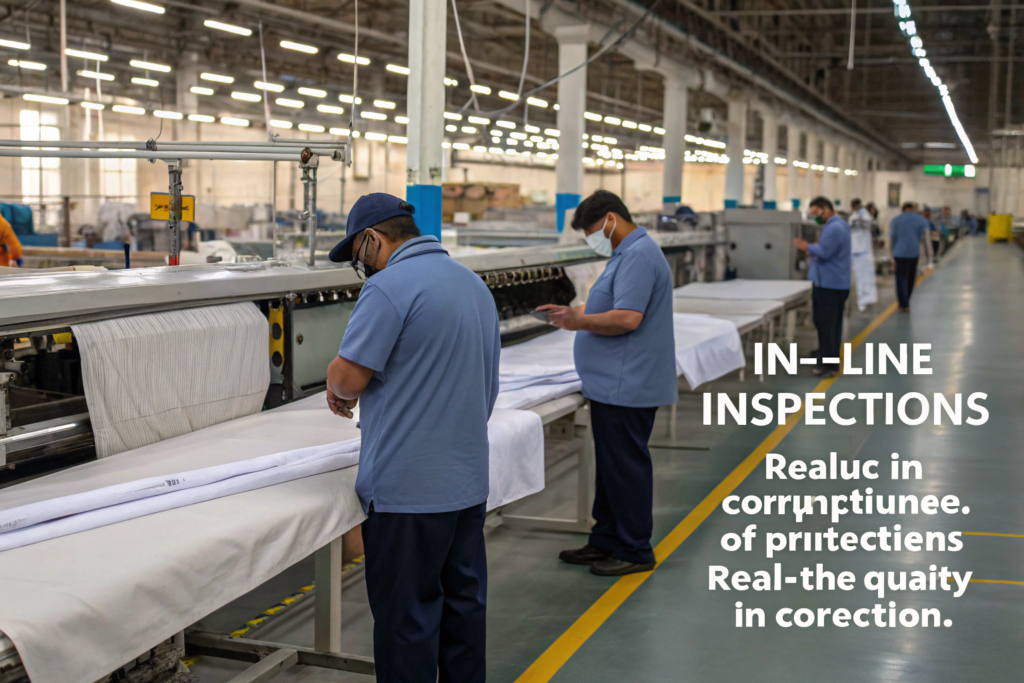
The final inspection is a funeral. You are inspecting a dead body—the production is already finished, the fabric is cut, the labor is spent. Discovering a measurement deviation at the final inspection is discovering a terminal illness at the autopsy. The only inspections that genuinely protect your order are the in-line inspections that happen while the patient is still alive—while fabric is still on the roll, while operators are still at their stations, while corrections are still possible and affordable. I have shifted our entire quality philosophy at Shanghai Fumao from "inspect and reject" to "measure and correct in real time."
We run a four-gate inspection system. Gate 1 is the incoming fabric inspection, where we measure the base fabric against the spec’s GSM, shrinkage, and color fastness tolerances before a single cut is made. If the fabric fails here, we do not cut it. Gate 2 is the cutting room checkpoint, where the first cut panels are measured against the pattern card dimensions. If the pattern spread has drifted due to fabric relaxation, we adjust. Gate 3 is the in-line sewing checkpoint, where a roving QC checker patrols the production line every hour, pulling three units from each operator and measuring the top five critical dimensions from the tech pack. Any operator found drifting gets an immediate corrective instruction and re-training. Gate 4 is the final AQL statistical inspection before packing. If the in-line checks have been done properly, Gate 4 should be a formality, a confirmation of what we already know. If Gate 4 reveals a systemic failure, the system has already failed at Gates 1, 2, or 3, and we trace the failure backward to find the root cause.
How Should You Conduct a Measurement Audit Using Your Tech Pack Specs?
A measurement audit is a systematic, side-by-side comparison of the garment’s physical dimensions against the tech pack’s specified dimensions, with the garment laid flat on a smooth, hard table under proper lighting. The key principle is that the measuring method must exactly replicate the method specified in the tech pack, or the numbers are meaningless. If your tech pack says "chest width measured 2.5cm below armhole, edge to edge, relaxed," and the inspector measures 3cm below the armhole with the fabric slightly stretched, the resulting number will differ even if the garment is identical. This discrepancy generates a false failure or a false pass, both of which damage trust.
I specify the measuring method in the tech pack itself with a small diagram for each critical measurement point. The diagram shows exactly where the tape measure goes, how the garment is positioned, and whether the measurement is taken relaxed or under a specified tension. The inspector uses a calibrated steel tape measure, not a fabric tailor’s tape that has stretched over years of use. The measurements are recorded on a pre-printed audit form that mirrors the tech pack’s spec table, with the spec tolerance range pre-filled. The inspector records the actual measurement, calculates the deviation, and marks a simple PASS or FAIL. A critical measurement outside tolerance triggers an immediate "red card." The garment is rejected, the line is stopped if the issue is systemic, and the factory’s QC manager is summoned to the inspection table. This sounds aggressive, but it is actually protective of the factory. Catching a systemic measurement drift on the first 50 units of a 5,000-unit order is a gift. It limits the damage to 1% of production. Catching it at the final inspection is a catastrophe.
What Is the AQL Sampling Method and How Does It Apply to Tech Pack Verification?
The AQL, or Acceptable Quality Level, sampling method is a statistical tool defined by the ISO 2859 standard that determines how many units from a batch you must inspect to make a statistically valid decision about the whole batch’s quality. It is not a guarantee of zero defects. It is a risk-management agreement: "We accept that X% of units may have defects, and we inspect Y units to verify the defect rate is within that X% limit." For garment construction and measurement adherence, the industry standard AQL is typically 2.5 for major defects and 4.0 for minor defects, using a Level II inspection severity.
The sampling works by lot size. If your order is 3,200 units, the AQL table tells you to pull 125 units at random from throughout the shipment. You inspect those 125 units against the tech pack’s full specification. If you find 7 or fewer units with major defects, the lot passes. If you find 8 or more, the lot fails. The key point here is that a "pass" does not mean the lot is perfect. It means you are 95% confident that the true defect rate in the whole lot is below your agreed AQL limit. Zero defects in the sample is rare and inefficient to demand—it requires 100% inspection at enormous cost. A functional AQL system defines what "good enough" looks like in hard numbers and ensures both buyer and supplier are operating from the same statistical reality. I recommend specifying the AQL and the inspection level directly in the tech pack’s quality section. For example: "Final random inspection per ISO 2859-1, Level II, AQL 2.5 Major, AQL 4.0 Minor." This line in the tech pack gives the inspector a clear procedural mandate and removes any ambiguity about how strictly the order will be judged.
How Do You Build a Binding Supplier Agreement Around the Tech Pack?
The tech pack must be legally and commercially embedded into the purchase contract, not treated as a separate, informal design document. If your purchase order references "garment per buyer’s design" without explicitly attaching the tech pack revision number and date, the supplier can argue that the tech pack was a "guideline" rather than a binding specification. The fix is simple and contractual. The purchase order or manufacturing agreement must include a clause that states: "The attached Tech Pack, Revision 3, dated 15 March 2026, forms an integral part of this agreement. All bulk production must conform to the specifications therein unless a written deviation has been approved and signed by the Buyer." This clause transforms the tech pack from a creative brief into a contractual performance standard.
The agreement must also define the consequences of non-compliance. A penalty for late delivery is standard in most contracts. A penalty for specification deviation is equally important but often missing. The clause should stipulate that goods not conforming to the tech pack’s critical specifications are subject to rejection and a full refund of the deposit and all payments made, or alternatively, a price reduction agreed upon in writing. This consequence must be credible and enforceable. If your supplier knows that a rejected lot will mean a wire transfer reversal and a container sitting unclaimed at the destination port, they will take the tech pack seriously. If they believe you will grudgingly accept the goods with a small discount and sell them anyway, there is no enforcement mechanism. The agreement should also specify the measurement tolerance band—the permissible deviation from the spec measurement. A waist measurement spec’d at 80cm with a tolerance of ±1cm defines a clear pass-fail envelope. Without documented tolerances, every measurement is a subjective argument.

What Clauses Should Protect You if Bulk Production Doesn’t Match the Approved Sample?
The core protective clause is the "Conformity to Approved Sample and Tech Pack" clause. It should read something like: "The Supplier warrants that all goods delivered under this Agreement will conform in all material respects to (a) the Pre-Production Sample approved in writing by the Buyer, reference number [XXX], and (b) the Tech Pack version [X] dated [Date]." This clause creates a dual standard—both the physical sample and the digital tech pack—and the goods must match both. If there is a conflict between the approved sample and the tech pack, the clause should specify which one governs. My recommendation: the tech pack governs, because the sample might have been approved with an unnoticed deviation. The clause should read: "In the event of any conflict between the approved PP sample and the Tech Pack, the Tech Pack shall prevail unless the Buyer has explicitly acknowledged the specific deviation in writing."
A "Right to Reject and Recover" clause is the enforcement mechanism. It should state that non-conforming goods may be rejected upon inspection, and the Supplier is responsible for the full refund of payments made, plus any air-freight differential or liquidated damages if the buyer incurs downstream costs due to the non-conformance. A "Third-Party Inspection" clause should allow the buyer to appoint an independent inspection company at their own cost, with the supplier required to provide full access and samples. This removes the possibility of the supplier blocking or manipulating the inspection. Finally, a "Non-Waiver" clause prevents the supplier from arguing that the buyer’s acceptance of a previous order with the same deviation constitutes acceptance of the deviation in the current order. Each order stands independently. These clauses seem legalistic, but they create a framework within which the factory’s natural pressure toward specification drift is counterbalanced by genuine commercial risk. The goal is not litigation; the goal is to make compliance the path of least resistance.
How Can a Factory’s Internal QC Documentation Become Part of the Contract?
By requiring the supplier to submit their internal QC documentation as part of the shipment package, and specifying this requirement in the purchase agreement as a condition of payment. This turns the supplier’s own quality system into a contractual deliverable. The clause reads: "Prior to shipment, Supplier shall provide the following documentation: (a) In-line inspection reports for cutting, sewing, and finishing stages, (b) Final AQL inspection report with detailed measurement audit against Tech Pack specifications, (c) Fabric and trim test certificates from a CNAS-accredited or ISO 17025 laboratory." If these documents are not provided, the buyer has the right to delay payment or reject the shipment.
This approach has a powerful psychological effect. Knowing that their internal QC records will be read by the buyer forces the factory QC team to actually do their job. It closes the gap between the "show QC" done for the buyer’s visit and the "real QC" done on the factory floor. The in-line inspection reports are particularly valuable. They should show a time-stamped log of hourly quality checks, with the operator’s name, the measurement taken, and the corrective action if a deviation was found. Seeing blank spots in this log, or measurements that never vary, is a red flag that the documentation is falsified. An honest log shows natural measurement variation and occasional corrective actions. I build this documentation requirement into our standard contract template at Shanghai Fumao, and I encourage clients to audit these documents, not just the final shipment. The documents are a diary of the production’s health. A healthy diary predicts a healthy shipment.
Conclusion
Ensuring your supplier follows your tech pack is not a matter of trust or good intentions. It is a system of physical tools, sequential approval gates, in-line measurements, and contractual obligations that make compliance visible, verifiable, and enforceable. The tech pack is the master blueprint, but the blueprint only protects you if the factory floor is built around it—with go/no-go jigs at every sewing station, with sealed reference samples in the QC office, with calibrated tape measures in the inspector’s hand, and with payment terms that make deviation more expensive than compliance.
I have spent two decades building that system at Shanghai Fumao. I have learned that the factories that deliver consistent, tech-pack-perfect production are not the ones with the fanciest sample rooms or the smoothest sales pitches. They are the ones with slightly obsessive QC managers, laminated critical control point posters on every pillar, and a genuine belief that a 2mm deviation on a cuff width actually matters. Because it does. That 2mm is the difference between a garment that looks designed and a garment that looks cheap. Between a brand that can charge full price and a brand that ends up on a discount rack.
If you are tired of receiving bulk shipments that feel like a different product than the sample you approved, or if you are launching a new collection and want to build a compliance framework from the start, I would like to work with you. At Shanghai Fumao, I have the gated production system, the CNAS lab, and the vertical control over fabric and finishing to execute your tech pack with the precision it deserves. Contact our Business Director, Elaine, at elaine@fumaoclothing.com. Send her your latest tech pack—even if it is still in draft form—and tell her what compliance problems you have faced with previous suppliers. She will walk you through our approval gate process and show you how our system catches deviations before they become shipments. Let us make sure your next order arrives exactly the way you drew it.