
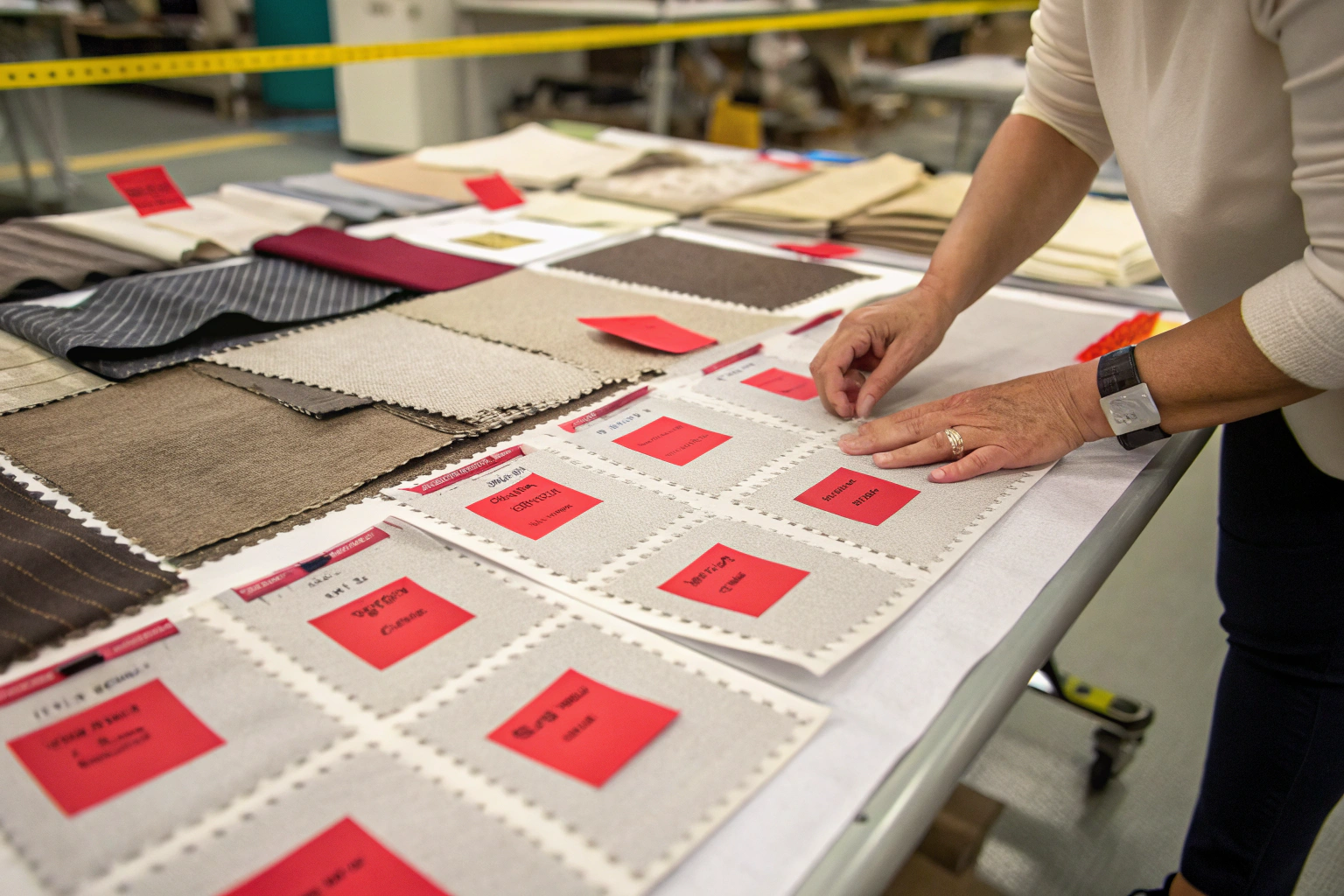
Let me start with a hard truth that most fabric suppliers will not tell you. Every single roll of fabric has defects. Every. Single. One. The question is not "Is this fabric perfect?" The question is "Are the defects acceptable for my end use?" That is the difference between a professional buyer and an amateur. An amateur sees a 4-Point Inspection Report with a score of "12 points per 100 yards" and panics. A professional sees that same report and says, "Okay, that is within the AQL 2.5 standard for fashion apparel. Ship it."
At Shanghai Fumao, we inspect millions of yards of fabric every year. We have a dedicated Fabric Inspection Factory with 12 backlit tables running 10 hours a day. We see every possible way that a piece of cloth can go wrong. And over 20 years, patterns have emerged. 80% of all wholesale fabric rejections come from the same 5 defect categories. If you understand these five categories—and the difference between a "Major" and "Minor" defect—you can stop losing money on bad shipments and stop rejecting good fabric that is actually usable.
In this article, I am going to pull back the curtain on the Fumao QC Floor. I will show you the actual inspection reports and the most common red flags. I will explain the 4-Point System in plain English. And I will give you the exact language to use on your purchase orders to protect yourself. If you are sourcing fabric from Asia—or anywhere, really—this is the playbook for quality assurance.
How Does the 4-Point Fabric Inspection System Actually Work?
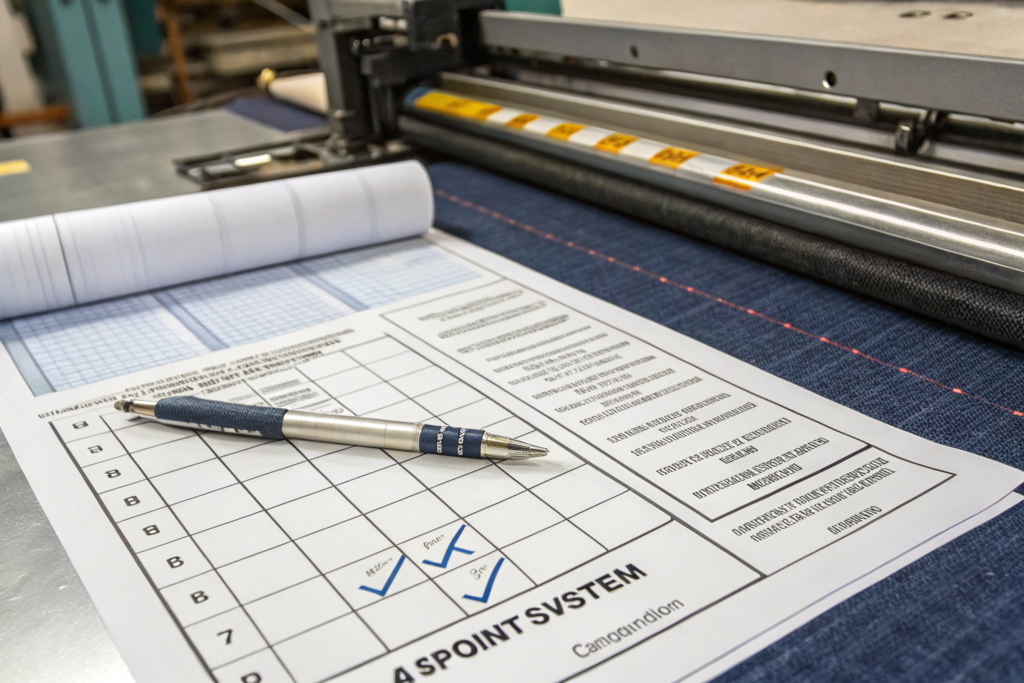
Before we talk about the specific fails, you need to understand the scoring system. The global standard for fabric inspection is the 4-Point System (ASTM D5430). It is simple, objective, and brutal. It assigns penalty points to defects based on their length.
- 1 Point: Defect is 0 to 3 inches long. (A small oil spot, a single missing yarn).
- 2 Points: Defect is 3 to 6 inches long. (A thicker slub, a small hole).
- 3 Points: Defect is 6 to 9 inches long. (A noticeable barre mark, a group of holes).
- 4 Points: Defect is over 9 inches long OR a running defect (like a crease mark that goes the whole roll).
Here is the critical part: No matter how bad the defect is, the maximum penalty per linear yard of fabric is 4 points. So, if you have a 3-foot long stain, it gets 4 points. If the entire roll is the wrong color, it gets… still 4 points per yard? No. That is a Critical Defect, which we handle separately. The 4-Point System is for random, sporadic defects.
After inspecting a roll, we calculate the Points per 100 Square Yards.
Formula: (Total Points Scored x 3,600) / (Yards Inspected x Fabric Width in Inches)
Most US retailers and brands accept a score of 20 to 30 points per 100 square yards for fashion apparel. For premium goods, the limit might be 15 points. For industrial/utility fabric, it might be 40 points.
I had a new buyer call me in a panic in January 2026. "The report says 28 points! That sounds terrible!" I had to explain: "28 points per 100 square yards is a B+ grade. That is good fabric. Relax." He was comparing it to a school test where 28/100 is an F. The scale is different. 30 points is the industry pass line. Understanding this math is the first step to not getting taken advantage of by a mill that claims "zero defects." Zero defects does not exist. Anyone who claims it is lying or they are not inspecting.
What Is the Difference Between a "Major" and "Minor" Defect Classification?
The 4-Point System measures quantity of defects. The Defect Classification measures severity. This is where the human judgment of the QC inspector comes in. And this is where most disputes between buyer and seller happen.
- Minor Defect: A deviation from the standard that does not affect the usability or appearance of the garment in a significant way. Example: A single, tiny slub on the inside of a sleeve, or a slight shade variation that is only visible under a lightbox. The fabric can be used.
- Major Defect: A deviation that makes the garment unsellable or significantly reduces its life. Example: A hole, a continuous dye streak, a noticeable color mismatch between rolls, or a tear. The fabric cannot be used in first-quality garments.
- Critical Defect: A defect that could injure the user or violate the law. Example: A needle fragment in the fabric, or a chemical PH level that causes skin burns. The fabric is hazardous.
At Shanghai Fumao, we have a zero-tolerance policy for Critical Defects. We have metal detectors on all our finishing lines. For Major Defects, we use the AQL (Acceptable Quality Level) sampling tables. AQL 2.5 means we can accept up to 2.5% of the garments having a major defect (in fabric terms, we map this to the 4-point score).
I have seen buyers reject an entire 5,000-yard shipment because of one Minor defect per roll. That is like totaling your car because of a scratch on the bumper. It is not commercially reasonable. On the flip side, I have seen mills ship fabric with Major running defects and claim it is "within tolerance." That is fraud. Knowing the difference protects you.
How Does ASTM D5430 Differ from the 10-Point System for Knits?
This is a technical nuance, but it matters if you are buying Jersey or Rib Knits. The 4-Point System was originally designed for Woven Fabrics. Wovens are stable. Knits are stretchy and delicate. A small hole in a knit can "run" and become a ladder, ruining the whole garment. A small hole in a woven just sits there.
Because of this, some buyers prefer the 10-Point System (or the Graniteville System) for knits. It assigns higher penalties for holes and defects in the "critical zone" (the center of the fabric width). The scoring goes up to 10 points per defect.
However, the industry is largely standardizing on the 4-Point System for everything because it is simpler. We just adjust the Acceptable Point Threshold. For a Cotton Poplin Woven, we might accept 25 points. For a Viscose Jersey Knit, we might accept 40 points because knits just naturally have more slubs and variations.
If you are a knitwear brand, you should ask your supplier: "Are you inspecting to ASTM D5430, and what is your AQL threshold for knits?" If they look confused, they are not a knit specialist. At Fumao, we inspect all knits on a relaxed, tension-free table because stretching the fabric hides defects. We map the 4-point score to a visual standard that accounts for the "laddering" risk of holes in knits.
Why Is "Shade Variation" the Most Common Rejection in Piece-Dyed Orders?
If I had a dollar for every time a client rejected fabric for "Shade Variation," I would own a second factory. This is, without question, the #1 cause of wholesale fabric disputes. And 90% of the time, it is due to a misunderstanding of textile dyeing physics, not actual negligence.
Shade Variation means the color on Roll #5 does not exactly match the color on Roll #1. It happens because piece dyeing is a batch process. Each dye machine holds 500 to 1,500 yards of fabric. The water temperature, the steam pressure, the cooling rate, and even the humidity in the air affect how the dye molecules penetrate the fiber. No two dye batches are 100% identical. They are commercially acceptable.
The standard for "acceptable" is the AATCC Gray Scale for Color Change. It is a physical card with pairs of gray chips showing increasing degrees of contrast.
- Grade 5: No difference (Impossible in bulk production).
- Grade 4: Slight difference. Only visible to trained eye under light box. This is the commercial standard for piece-dyed fabric.
- Grade 3: Noticeable difference. Visible on the cutting table. Reject.
- Grade 2: Obvious difference. Disaster.
At Shanghai Fumao, we cut a swatch from the first roll of every dye lot and attach it to the Lot Ticket. This is the "Lot Standard." Every subsequent roll in that lot is compared to the Lot Standard under a D65 Light Box (simulated daylight). If a roll falls below Gray Scale Grade 4, it is quarantined. It does not ship with the main lot.
I had a client in the uniform business reject a shipment of Navy Blue Poly-Cotton for "shade variation" in October 2025. We pulled the shipment back. We re-inspected it in our lab. Every single roll was Grade 4.5 against the Lot Standard. The client was comparing Roll #10 to a Pantone Chip, not to the Lot Standard. That is the mistake. Fabric will never match a paper Pantone chip exactly. It must match the approved Lab Dip and the Lot Standard. Once I explained this and sent photos of the Gray Scale assessment, the client accepted the shipment. They were just looking at it under warehouse fluorescent lights, which distort navy blue.
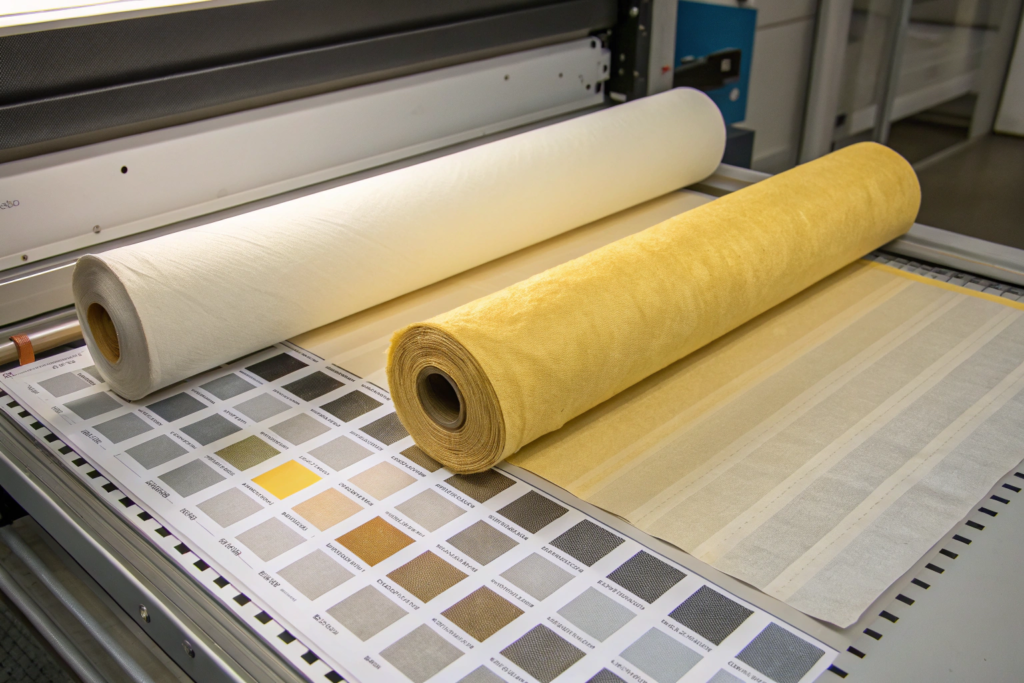
How Do Roll-to-Roll and Within-Roll Shading Occur in Viscose Dyeing?
Viscose is particularly prone to shading issues. Remember that skin-core structure I talked about in the durability article? Viscose has a skin that is denser than the core. When you dye it, the dye has to penetrate that skin. The rate of dye uptake is highly sensitive to temperature and PH.
Roll-to-Roll Shading (Batch-to-Batch): This happens when Dye Machine #1 runs at 132 degrees Celsius, but Dye Machine #2 (which is older) only hits 131 degrees. That 1-degree difference means the dye molecules move slightly slower. The fabric absorbs slightly less dye. It comes out a hair lighter. You cannot see it unless you put the two rolls side by side under a light box. This is why we blend batches in the cutting room. You always cut garment panels from a single roll for color-critical pieces (like a dress front). You never cut one sleeve from Roll #1 and the other sleeve from Roll #10.
Within-Roll Shading (Listing or Center-to-Selvedge): This happens when the fabric is not uniformly exposed to the dye liquor. The edges of the roll might get more flow than the center. This creates a "List" —a darker or lighter stripe down the length of the roll. This is a Major Defect. It is almost always caused by a malfunctioning circulation pump in the dye machine. If we find Listing during inspection, the entire roll is graded as Seconds.
I always tell my clients: "Shade variation is a feature of piece-dyeing, not a bug. Manage it with lot control, not rejection hysteria." If you need absolute color consistency across 10,000 garments, you must use Solution-Dyed fabric (where the color is in the plastic pellet before the fiber is made) or Garment Dye (where you dye the finished shirt). Piece-dyed fabric will always have minor shade variation.
What Is the AATCC Gray Scale Standard for Acceptable Color Matching?
Let’s make this practical. When you are in a dispute, the AATCC Gray Scale is the referee. You should own one. They cost about $150. It is the best investment you will make.
Here is how to use it:
- Take the Lot Standard swatch (the one we sent you with the lab dip approval).
- Take the suspect swatch from the bulk shipment.
- Place them side by side on a table. Overlap the edges. No gap between them.
- Hold the Gray Scale next to them.
- Compare the contrast between the two swatches to the contrast between the gray chips.
If the contrast is less than or equal to Grade 4, the fabric is within tolerance. Period. It does not matter if your "eye" sees a difference. The instrument standard says it is acceptable.
I had a client who was a former graphic designer. She had "perfect color eyes." She rejected everything. She was a nightmare. I flew to New York and sat with her and a Gray Scale and her Pantone book. I showed her that fabric is subtractive color (dye on fiber) and Pantone is additive color (ink on paper). They will never match exactly. We agreed on a Grade 4 tolerance in the purchase order. After that, no more rejections. She just needed to understand the industrial standard.
How Does "Barre Mark" Occur in Knitted Fabrics and Can It Be Fixed?
Let’s move from color to texture. If you buy Jersey, Rib, or Interlock knits, you will eventually run into Barre (pronounced "bar-ray"). It is a horizontal streak or stripe in the fabric. It looks like a subtle shadow or a change in stitch density. It is most visible after dyeing, especially in solid, dark colors.
Barre is the heartbreak of knitwear. Because here is the truth: Once barre is in the greige fabric, you cannot fix it in finishing. You can hide it a little bit with a heavy enzyme wash or a print, but the structural variation is locked into the knit loops.
Barre is caused by uneven yarn tension during knitting. A circular knitting machine has 80 to 120 "feeders" (cones of yarn) arranged around the machine. If Feeder #23 has slightly higher tension than Feeder #47, the stitch it forms will be tighter and smaller. This creates a denser line of fabric. When you dye it, that denser line reflects light differently. It looks like a stripe.
Common causes of barre:
- Yarn Mix-Up: Using two different lots of yarn on the same machine. Even if the yarn is the "same spec," different spinning lots have different hairiness and twist.
- Bad Cone Winding: If the yarn cone is wound too tight or has a "slough-off" (a tangle), the tension spikes.
- Machine Vibration: A worn bearing on the knitting machine causes micro-vibrations that change the stitch length.
At Shanghai Fumao, we have a "Barre Check" protocol for all greige knits. We knit a sample tube from every yarn lot before bulk knitting. We dye it in a dark, sensitive color (like Navy or Black). We stretch it on a backlit table. If we see barre, we reject the yarn lot before it ever goes to bulk production. That is the only way to prevent it. Catching it after the fabric is made is too late.
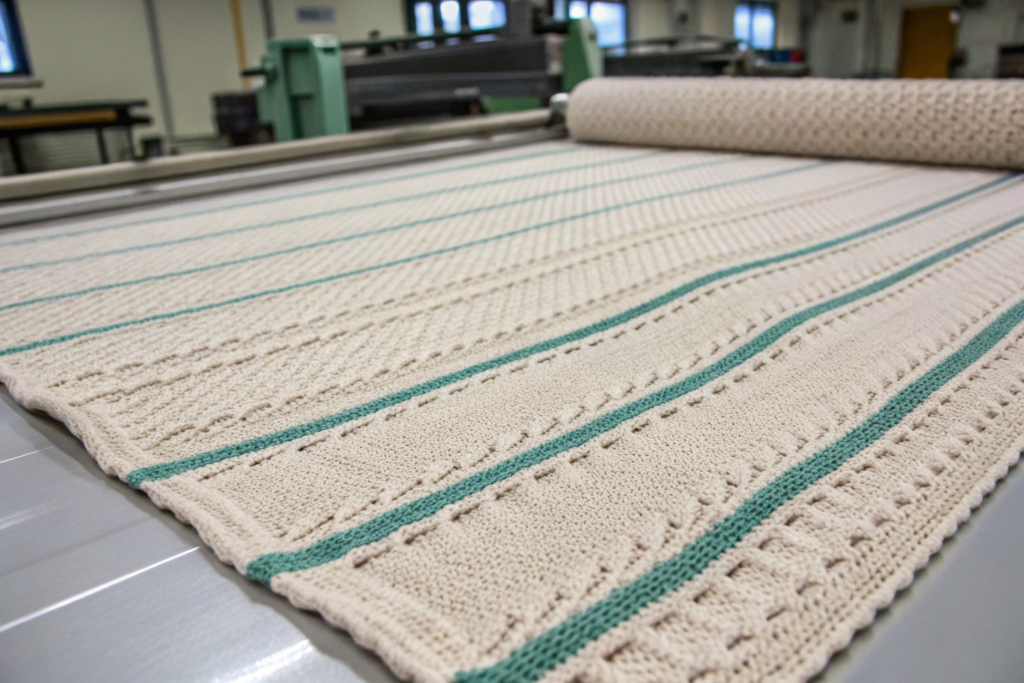
Can Tension Variations in Circular Knitting Be Corrected in Finishing?
I get this question a lot: "Can you just stretch it out in the stenter?" The answer is no, not really. You can mask barre, but you cannot eliminate it.
The stenter frame pulls the fabric width-wise. Barre runs length-wise. Stretching the fabric sideways does not change the density of the horizontal knit loops; it just pulls the wales apart. In fact, over-stretching in the stenter can actually make barre more visible because it flattens the surface and makes the light reflect more uniformly off the tight vs. loose stitches.
There is a process called "Heat Setting with Overfeed" that can help slightly. By overfeeding the fabric lengthwise into the stenter, we allow the knit loops to relax and "bunch up." This can equalize some of the stitch density variation. But if the barre is severe—caused by a mixed yarn lot —no amount of heat setting will fix it. The yarns themselves are physically different. They will always reflect light differently.
I had a client with a beautiful Modal Spandex Jersey that had a faint barre. We tried everything: Heat setting, enzyme wash, even a light pigment spray. It was still visible. We ended up selling it as "Second Quality" for a print base. The print hid the barre perfectly. The client learned a valuable lesson: Specify "Anti-Barre Yarn Mixing Protocol" on your PO. It costs a few cents more per yard, but it saves the fabric.
Why Does Yarn Lot Mixing Cause Invisible Streaks After Dyeing?
This is the silent killer. The yarn cones look identical. The yarn count is the same. The twist is the same. But they were spun on Tuesday morning (cool, humid air) vs. Thursday afternoon (hot, dry air). The difference in spinning conditions changes the fiber alignment and hairiness by 2-3%. That is enough.
When you mix these two "identical" yarns on the knitting machine, the dye uptake is different. The yarn spun in humid air has slightly more moisture regain. It absorbs dye faster. The yarn spun in dry air absorbs dye slower. When you piece-dye the fabric, the fast-absorbing feeders create darker stripes. The slow-absorbing feeders create lighter stripes. You have barre.
This is why we are so strict about Yarn Lot Traceability at Fumao. Every cone of yarn that enters our knitting mill has a Lot Number and a Spin Date. Our ERP system will not allow the knitting room to mix Lot A and Lot B on the same machine for a solid-dye order. If they try to scan a cone from a different lot, the system locks out the feeder assignment. It forces them to use a single, uniform lot.
This level of control is rare. Most contract knitters just grab whatever cone is on the shelf. That is why cheap knits have barre and expensive knits do not. It is not the machine. It is the inventory discipline.
Which Woven Defects Are Considered "Structural" vs. "Cosmetic"?
Now let’s move to Wovens. Woven defects fall into two broad camps: Structural and Cosmetic. The distinction is critical because it determines if the fabric is usable or scrap.
Structural Defects: These affect the physical integrity of the cloth. The yarns are broken or missing. The fabric is weaker. It will tear or fail in use.
- Examples: Missing End (a warp yarn broke and the weaver didn’t stop to fix it, leaving a gap), Broken Pick (a missing weft yarn), Float (a yarn skipped over several others, leaving a loose loop on the surface), Hole/Cut.
- Verdict: Almost always a Major Defect. If it is longer than 3 inches, the roll is rejected or graded as seconds.
Cosmetic Defects: These affect the appearance but not the strength. They are visual distractions.
- Examples: Slub (a thick, lumpy place in the yarn), Nep (a tiny knot of tangled fiber), Thick Place, Thin Place, Reed Mark (a slight line between warp yarns from the loom reed).
- Verdict: Depends on the end use. A slub is a defect in a dress shirt. The same slub is a design feature in a linen look or homespun fabric.
I had a client making silk charmeuse blouses. They rejected a roll for a "slub." The slub was 2mm long. I asked them, "Is this a $200 blouse or a $40 blouse?" They said $200. I said, "Then you are right to reject it. At that price, the customer expects perfection." On the flip side, I had a client making workwear aprons. They saw a slub and said, "Who cares? It’s an apron." They bought the fabric at a discount.
How Many "Neps" Per Square Inch Are Acceptable in Premium Shirting?
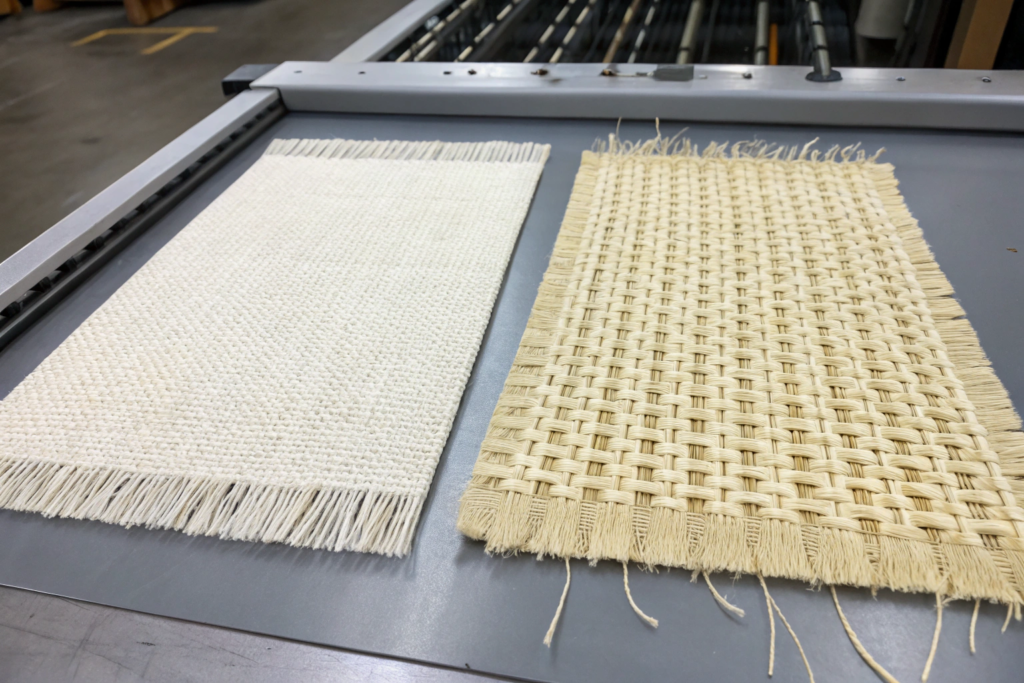
Let’s get quantitative about Neps. A nep is a tiny, tangled knot of immature or dead cotton fibers. It looks like a speck of pepper on the fabric surface. Under a microscope, it is a little bird’s nest of fibers.
For Premium Shirting (think $100+ retail dress shirt), the standard is incredibly strict. We use a Nep Count Template (a 1-inch square cutout) and a backlit table. The inspector counts the neps in 10 random squares.
- Premium Grade A: < 5 Neps per sq inch. (This requires Combed Compact Yarn made from Long-Staple Cotton like Supima or Giza).
- Standard Grade B: 5 – 15 Neps per sq inch. (This is standard Combed Cotton).
- Utility Grade C: > 15 Neps per sq inch. (This is Carded Cotton or Open-End Yarn. It is for sheets or workwear).
Why do neps matter? Because in a dyed fabric, neps do not absorb dye. They stay white. So a navy blue shirt with high neps looks like it is covered in white lint or dandruff. It looks dirty even when it is clean. This is a major issue for dark, solid colors.
At Fumao, we map the Nep Count to the Yarn Specification. We do not even attempt to make a Grade A shirting with Grade C yarn. We know it will fail inspection. If you are sourcing shirting and you see white specks, ask for the Nep Count report. It will tell you if the mill used the right yarn.
What Is "Reed Mark" and Does It Weaken the Fabric Structure?
Reed Mark is a very specific woven defect. The Reed is a comb-like device on the loom that pushes the weft yarn into place. It looks like a metal fence with hundreds of slots. Over time, the metal wires (dents) can wear down or get bent. This creates uneven spacing between the warp yarns. The fabric ends up with faint, permanent lines running lengthwise.
Does it weaken the fabric? Technically, no. The yarns are still there. The tensile strength is unchanged. It is a cosmetic defect.
BUT—and this is a big but—it can cause optical issues in certain weaves. In a Satin Weave or a Charmeuse, where the surface is smooth and lustrous, a reed mark breaks up the reflection of light. It looks like a scratch or a crack in the sheen. This is unacceptable for premium satins.
For a Plain Weave Poplin or a Twill, a faint reed mark is often invisible to the consumer. It gets lost in the natural texture of the weave. I always tell my clients: "Reed mark is a reject for Satin and Charmeuse. It is a ‘note to file’ for Poplin and Oxford." You have to judge it against the aesthetic of the cloth.
When Should a Buyer "Fail" a Roll vs. "Grade Out" the Defect?
Alright, you have the inspection report. There is a 4-point score. There is a map of defects. Now comes the economic decision. Do you Reject the Roll (send it back to the mill for a refund/replacement) or do you Grade It Out (keep the roll but plan to cut around the defects)?
This decision depends on three factors:
- Defect Type: Is it Running or Isolated? A single hole is isolated. A continuous crease mark is running. Running defects = Reject.
- Marker Efficiency: How many garment pieces can you get from one yard of fabric? If you are making scarves (1 piece per yard), a single hole kills one scarf. That is a 100% loss for that yard. If you are making bikinis (10 pieces per yard), a single hole kills 1 bikini bottom. That is a 10% loss.
- Fabric Cost and Availability: If the fabric is a custom yarn-dye that took 8 weeks to make, and you have a production deadline, you might accept a Grade 2 roll and just cut around the flaws. If it is a stock greige that can be replaced in 3 days, you reject it.
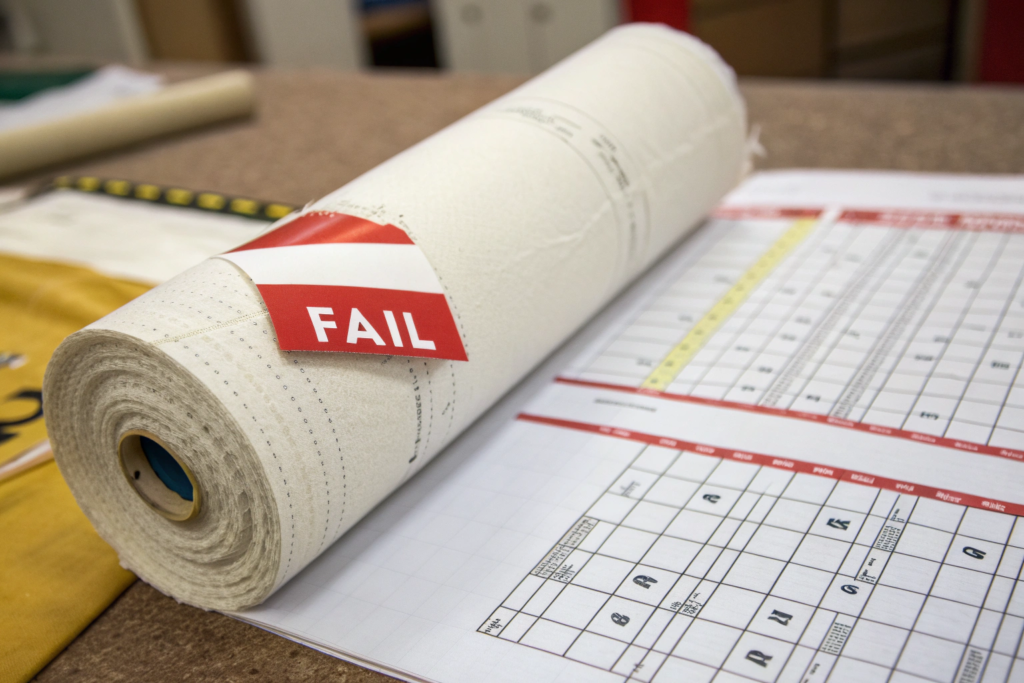
At Shanghai Fumao, we provide a Defect Map for every roll that scores over the AQL threshold. The map shows exactly where the defect is (e.g., "3 yards from end, 20 inches from left selvedge"). This allows your cutting room to lay up the marker strategically.
I had a client in the home textile business (making duvet covers). A roll had a 4-point defect (a 10-inch oil stain). The roll was 100 yards. The client was going to reject the whole roll. I said, "Wait. You are making king duvets. You need 3.5 yards per duvet. The stain is at yard 12. You can cut Duvet #1, skip the stain, and cut Duvet #2 from yard 14. You only lose 2 yards of fabric, not 100 yards." He did the math. Rejecting the roll would cost him $500 in fabric and 2 weeks of lead time. Grading out the defect cost him $10 in lost yardage. That is smart sourcing.
How Does "Marker Making" Strategy Influence Defect Acceptance Levels?
This is a conversation you should have with your pattern maker before you buy the fabric. The Marker is the layout of the pattern pieces on the fabric. A tight marker (pieces nested closely) has high efficiency but zero tolerance for defects. A loose marker has lower efficiency but allows you to shift pieces around a flaw.
If you are buying First Quality Fabric, you expect to use a Tight Marker (85-90% efficiency). Therefore, you have a low tolerance for defects. You should demand an AQL 2.5 or better with a 25 Point max on the 4-point scale.
If you are buying Seconds or Off-Price Fabric, you know you will use a Loose Marker (75-80% efficiency) and your cutters will "work around" the flaws. You accept a higher defect rate (40-50 points) because you paid 40% less for the fabric.
I always ask my clients: "What is your cut table strategy?" If you are a small brand with a single cutter who can "shade and shift," you can buy slightly flawed goods and save money. If you are a large brand with automated spreaders and laser cutters, you need near-perfect fabric because the machine cannot "see" the flaw to avoid it. It will cut right through the hole.
What Is the Protocol for Disputing a Fumao 4-Point Inspection Report?
We are not perfect. We inspect millions of yards. We sometimes make mistakes. We sometimes miss a defect. We sometimes classify a defect differently than you would. If you receive a shipment from Shanghai Fumao and you believe the fabric does not meet the agreed AQL standard, there is a formal dispute process.
Step 1: Do Not Cut the Fabric.
This is the golden rule. The minute you put a knife to the cloth, you own it. The dispute is over. If you think there is a problem, stop. Leave the rolls intact.
Step 2: Third-Party Re-Inspection.
You must hire an independent, accredited inspection agency (like SGS, Bureau Veritas, or Intertek) to re-inspect the fabric in your warehouse. They must inspect a statistically valid sample using the same ASTM D5430 standard.
Step 3: Compare Reports.
If the third-party report shows a score that is significantly higher than our internal report (e.g., we scored 22, they scored 45), we have a case.
Step 4: Credit or Replacement.
If the third-party confirms the defect level is out of spec, Fumao will issue a credit memo for the defective yardage or replace the fabric (subject to production lead time). We do not refund shipping or cutting costs unless it is a Critical Defect.
I have had this happen maybe 3 times in the last 5 years. Each time, it was a shade variation issue where the client was using a different light source than our D65 lab standard. We flew our QC manager to the US to view the fabric under their warehouse lights. We calibrated our standards. We resolved the dispute. The key is transparency and a documented process.
Conclusion
Fabric inspection is not about finding a "perfect" roll. It is about managing risk and setting realistic expectations. The 4-Point System gives us a common language to quantify defects. The AQL tables give us a statistical framework for acceptance. And the defect classification (Minor, Major, Critical) gives us a practical guide for use.
We have covered the #1 reject reason—Shade Variation —and how the AATCC Gray Scale is the only true referee. We have exposed the hidden enemy of knits—Barre —and why yarn lot control is the only cure. We have distinguished between Structural and Cosmetic defects so you know when a slub is a flaw and when it is a feature. And we have looked at the economics of grading out a roll versus rejecting it outright.
At Shanghai Fumao, our goal is to ship fabric that you can cut with confidence. We have the CNAS-certified lab, the 12 backlit inspection tables, and the trained QC team to ensure that the fabric meets the spec we agreed upon. We are not afraid of third-party inspections. We welcome them. They keep us sharp.
If you are tired of receiving "surprise" defects in your shipments, if you want a mill that speaks the language of ASTM and AATCC, then it is time to change your sourcing strategy. Let’s agree on the AQL standards upfront. Let’s put it in the purchase order. Let’s inspect it before it ships. Reach out to our Business Director, Elaine. She can provide our Standard Quality Manual and coordinate a Pre-Shipment Inspection (PSI) for your next order. Email her at elaine@fumaoclothing.com. Stop gambling on quality. Start inspecting it.








