
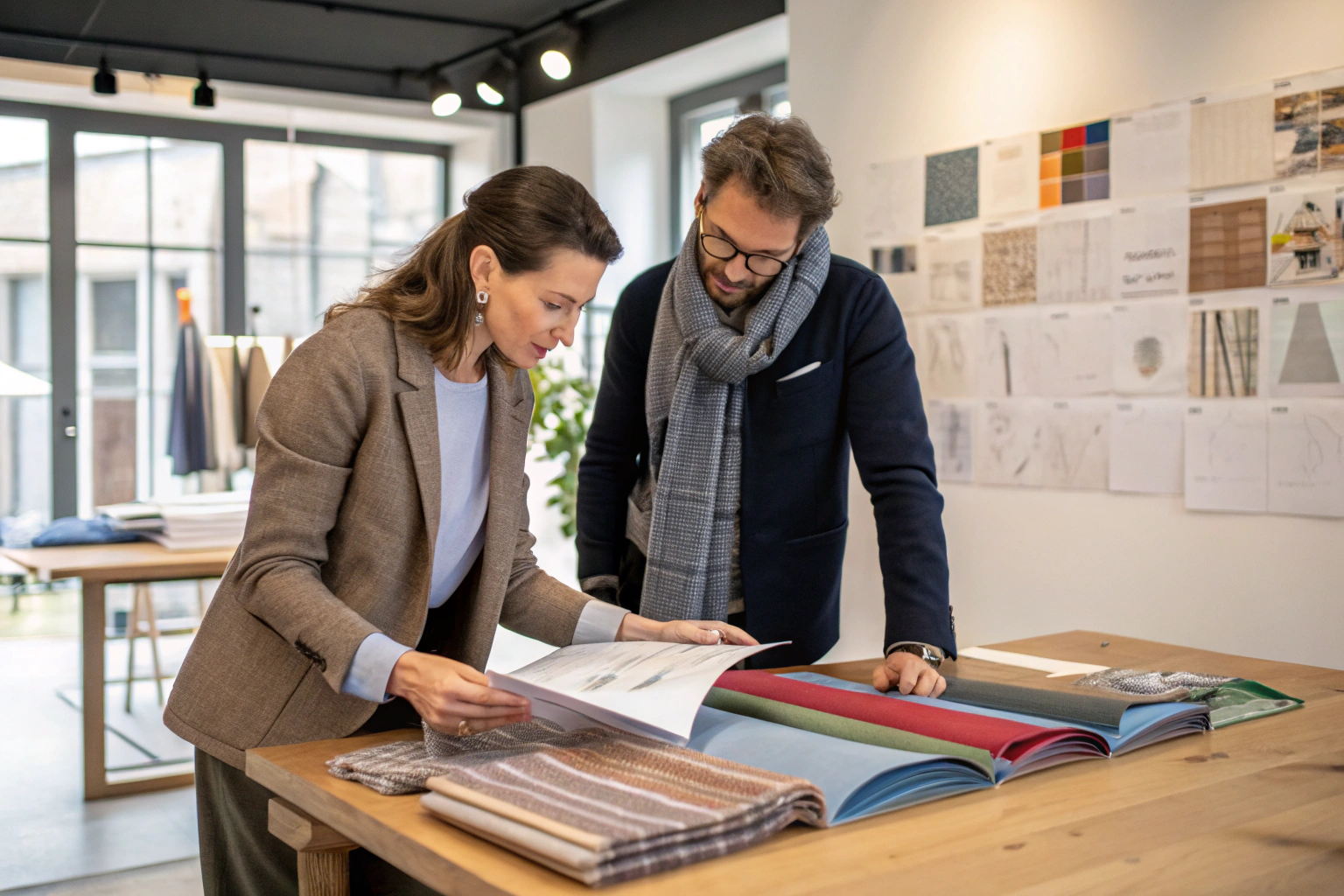
Let me ask you a blunt question. Are you tired of competing on price? Are you sick of seeing your unique dress design being undercut by ten other Amazon sellers two weeks after you launch because you are all buying the same generic rayon challis from the same five trading companies? That is the trap of off-the-shelf fabric. You build a brand on quicksand. You have no moat. No protection. The only way to build a real, sustainable apparel brand—a brand with margin and loyalty—is to control the supply chain. And the first step to controlling the supply chain is private label fabric development.
Now, when most people hear "Private Label Fabric," they think of huge minimums. They think they need to order a container of 50,000 yards and spend six months in development. That is old school. That is the past. At Shanghai Fumao, we have flipped that model on its head. We have a library of over 30,000 base fabric qualities sitting in our greige inventory. These are the "blank canvases." They are the proven, stable, production-ready constructions that we run every day for brands like ZARA and H&M. What we offer to private label clients is the ability to customize the finish, the color, the print, and the hand feel on top of these proven bases. You get the uniqueness of a custom mill without the risk and time of a full warp-knit development.
In this article, I am going to walk you through exactly how this works. I will show you how we take a standard cotton poplin from our inventory and turn it into your exclusive enzyme-washed, garment-dyed, logo-printed masterpiece. We will talk about MOQs, timelines, and the specific finishing tricks that make a fabric look expensive. If you have ever dreamed of launching a line of blouses that nobody else can copy, you are in the right place.
What Is the Difference Between Stock Service and Fumao’s Private Label Program?
This is the most common point of confusion for new buyers. They email me and say, "I want to private label your viscose." And I ask, "Do you want me to just sew your neck label into a finished dress, or do you want to own the recipe for the fabric itself?" There is a massive difference between garment private label and fabric private label.
Garment Private Label (Cut and Sew): You pick a fabric we already have in stock. We cut it and sew it into a shirt. We put your label on it. Done. Fast. Low MOQ. But guess what? The fabric is still available to anyone else who walks through my door. Your competitor can buy the same floral printed crepe and make a similar dress. You are still competing on design speed, not fabric uniqueness.
Fumao Fabric Private Label: You work with us to modify one of our base greige fabrics. You own the color standard. You own the print screen. You own the finish. If you want a "Peach Skin Finish" on a 60s Cotton Lawn, we develop that hand feel just for you. We sign a Non-Disclosure Agreement (NDA) . We do not sell that specific combination to anyone else without your permission. That is a moat. That is a barrier to entry.
I had a client from Australia—a womenswear brand focused on workwear—who came to us in February 2025. She was buying polyester crepe from stock. It was fine. But every time she found success with a style, the market flooded with knockoffs. We moved her into a private label base fabric development. We took our standard Fumao Eco-Viscose Twill and modified the finishing process to give it a cool, dry hand with a micro-sanded face. It looked like a $40/yard Italian fabric but cost her a fraction of that. We hold the finish specs exclusively for her. Now, even if someone finds a similar print, they cannot match the hand feel and drape of her garments. That is the power of private label textile sourcing.

How Does "Greige Inventory" Allow for Custom Finishing Without Full Mill Production?
Let me let you in on a secret about how we keep MOQs (Minimum Order Quantities) low for private label. Greige Goods. Greige (pronounced "gray") is the raw, unfinished fabric straight off the loom or knitting machine. It is beige, stiff, and full of natural waxes and oils. It is ugly. But it is a blank slate.
At Shanghai Fumao, we keep a strategic greige inventory of our best-selling constructions. We have shelves of 40s Cotton Poplin, 30s Viscose Twill, 20s Linen Blend, and Tencel Jersey just sitting there, waiting. This is our war chest. Because we have the greige in stock, we do not need to spin yarn and weave a full 5,000-yard minimum just to get started. We can pull 500 yards of greige off the shelf and run it through our dyeing, printing, or coating line.
This is the magic. The fabric construction (the weave, the weight, the yarn count) is fixed and tested. It is stable. You do not need to worry about the tensile strength or the shrinkage of the base cloth; we already know it inside and out. You focus purely on the aesthetics: color, surface texture, and drape.
I remember a client who wanted a very specific "Vintage Indigo" color on a cotton slub jersey. Normally, to develop a new jersey from scratch, you are looking at 3,000 yards minimum and 45 days. But because we had the greige jersey in stock, we ran a 500-yard garment dye trial for her. We nailed the color in two tries. She had exclusive fabric in 30 days. That is how a small brand acts like a big brand.
Can Small Brands Achieve "Exclusivity" Without 10,000 Yard MOQs?
Yes. And this is the part of my job I love the most. I love telling a young designer, "You can have your own fabric." They look at me like I have three heads. "But I only need 800 yards for my first run!" They think exclusivity requires a 40-foot container.
Exclusivity in textiles is not about volume. It is about combination. Think of it like a menu. We have Base A (Weave) , Base B (Yarn) , Color C (Dye Recipe) , and Finish D (Surface Treatment) . We mix and match. The combination of A + B + C + D becomes your private label SKU.
For example:
- Base A: 60/40 Cotton/Linen Plain Weave (From Greige Stock)
- Color C: Custom "Faded Terracotta" Pigment Dye
- Finish D: Heavy Enzyme Wash for Softness
That combination is yours. We will not sell that exact terracotta color on that exact washed linen base to another brand in your market. The MOQ? 500 yards. Because we are just coloring and washing existing greige cloth.
I had a client in California do this in October 2025. She launched a small line of boxy linen tops. She needed 600 yards. We did a custom reactive dye on our stock linen. The color was a muted sage green. It sold out. She reordered another 600 yards. Then another 1,000. She built her entire brand aesthetic around that one custom color on a Fumao base. And she never had to buy a full mill run. This is the new model for agile, low-inventory brand building.
How Do I Navigate Fumao’s Minimum Order Quantity for Custom Finishes?
Alright, let’s talk about the numbers. Let’s talk about the elephant in the room: MOQ (Minimum Order Quantity) . I know you are looking at our website or maybe a competitor’s site and seeing "MOQ: 3,000 yards" for custom color. Your heart sinks. You only need 800. You think the conversation is over. It is not.
The MOQ depends entirely on where the customization happens in the supply chain.
- Yarn Dye (Highest MOQ): To custom spin and dye yarn, we need 3,000 – 5,000 yards. That is a full mill run.
- Piece Dye (Medium MOQ): To dye a roll of existing greige fabric, we need 800 – 1,500 yards. This is the sweet spot for most private label startups.
- Printing (Lower MOQ): For digital printing on a base cloth, we can go as low as 300 – 500 yards. The ink is expensive, but the setup is minimal.
- Garment Dye/Wash (Lowest MOQ): This is the hack. We cut and sew the garment in Prepared For Dye (PFD) white fabric, then dye the finished shirt. MOQ can be 200 pieces per color.
At Shanghai Fumao, we try to steer small brands toward Piece Dye or Garment Dye strategies. It gives you the custom color exclusivity without the heavy upfront mill commitment. I always tell my clients: "Let the greige inventory be your bank. You withdraw the fabric you need and pay for the color service."

What Are the Price Breaks for 500-Yard vs. 1,500-Yard Piece Dye Orders?
Here is the reality of textile costing. The dye machine does not care if it is dyeing 500 yards or 1,500 yards. It takes the same amount of time to fill the machine, heat the water, and cool it down. You are paying for machine occupancy.
Let me give you a rough, realistic example based on our current Fumao Viscose Twill pricing structure (as of April 2026, just for illustration):
- Greige Fabric Cost: $2.10 per yard (This is the fixed base cost).
- Dyeing Cost (500 yards): $0.95 per yard. (The dye house charges a premium because they could have fit 1,500 yards in that machine. You pay for the "lost" capacity).
- Dyeing Cost (1,500 yards): $0.55 per yard. (Efficient. The machine is full.)
| Order Size (Yards) | Greige Cost/Yd | Dye Cost/Yd | Total Cost/Yd | Cost Premium |
|---|---|---|---|---|
| 500 Yds | $2.10 | $0.95 | $3.05 | +16% |
| 1,500 Yds | $2.10 | $0.55 | $2.65 | Baseline |
You look at this and say, "Wow, 500 yards is 16% more expensive." Yes. But let’s do the cash flow math. 500 yards @ $3.05 = $1,525 total fabric investment. 1,500 yards @ $2.65 = $3,975 total investment. If you are a startup, tying up $4,000 in one fabric is risky. What if the color is wrong? What if the style does not sell? Paying the 16% premium on 500 yards saves you $2,450 in cash . That cash can go into marketing, photography, or developing a second fabric.
(Here is a pro tip: If you think you will reorder, we can dye a "Master Batch" of 1,500 yards but only finish and ship 500 yards now. We hold the remaining 1,000 yards of dyed fabric in our warehouse as "Greige Stock – Reserved." You only pay for it when you call it off. This locks in the lower dye price for the whole batch. It is the best of both worlds.)
How Does Digital Printing Reduce Setup Fees for Private Label Designs?
If piece dyeing feels too limited (one color per roll), then Digital Printing is your private label superpower. Ten years ago, printing custom fabric required rotary screens. A set of screens for a 6-color design cost $600-$800 per color just in engraving fees. That is a $4,000 setup fee before you printed a single yard. It killed small brands.
Digital Textile Printing changed everything. There is zero setup fee for the design file. We just load the TIFF file, calibrate the color profile, and hit print. The cost per yard is higher than rotary screen (because ink is expensive), but there is no amortized setup fee.
Let’s compare a 500-yard order of a custom floral print:
- Rotary Screen (Old Way): $3,000 Setup + (500 yds x $2.50) = $4,250 Total.
- Fumao Digital Print (New Way): $0 Setup + (500 yds x $4.25) = $2,125 Total.
You save 50% on the total invoice. And you can change the design every single season without paying another setup fee. This is why we see so many new brands using digital print on demand for their private label collections. It allows for micro-collections and rapid trend response. I had a client print 8 different colorways of the same geometric design, 150 yards each. That is impossible with screen printing. With digital, it was a breeze.
Which Fumao Base Fabrics Are Best for Custom Garment Dye Programs?
Garment Dyeing is the ultimate private label hack for small brands. You do not buy colored fabric. You buy PFD (Prepared For Dye) Garments or PFD Fabric cut-and-sewn into a simple garment. Then we dye the finished shirt or dress in a big washing machine-like vessel. This gives you a vintage, washed-in color and incredibly soft hand feel. And because the dyeing happens at the very end, you can hold white inventory and dye-to-order based on which colors are selling.
But here is the catch. Not every fabric can survive garment dyeing. You cannot just throw a delicate silk charmeuse dress in a 200-pound dye machine with 100 other garments and expect it to come out in one piece. The fabric needs dimensional stability and high wet strength.
At Shanghai Fumao, we have a specific collection of base fabrics we call the "Garment Dye Ready (GDR) Series." These are fabrics we have tested to withstand 60 to 90 minutes of high-temperature tumbling in water. They have low residual shrinkage and high seam strength.
Here is my cheat sheet for best-selling GDR bases:
- 100% Cotton Slub Jersey: The king of garment dye. Slub yarns take the dye unevenly, creating a beautiful vintage, heathered look.
- Cotton/Modal Spandex Rib: Perfect for tank tops and bodysuits. The Modal gives softness; the Cotton gives structure.
- Tencel™ Twill: This is a premium option. Tencel garment dyes to a silky, lustrous finish that looks like a $200 shirt.
- Heavy Viscose Linen Blend: Great for a "beach to bar" button-down. The linen gives texture; the viscose holds the color.

Why Does 100% Cotton Slub Jersey React Better to Pigment Dye Than Rayon?
This is a chemistry lesson that translates directly to your bottom line. Pigment Dye is not like reactive dye. Reactive dye bonds inside the fiber. Pigment dye sits on top of the fiber, like paint on a wall. It is glued there with a binder.
Cotton has a rough, scaly surface (like a pine cone). The pigment binder loves this. It grabs on tight. When you wash the garment, the pigment wears off gradually on the high points of the yarn (the "slubs"). This creates that desirable "worn-in, vintage fade" at the seams and edges.
Rayon (Viscose) has a smooth, round surface (like a glass rod). The pigment binder struggles to stick. When you garment dye rayon with pigment, the color looks chalky and flat. Worse, when you wash it, the color cracks and peels off in large patches rather than fading gracefully. It looks like a mistake, not a vintage aesthetic.
I had a client who insisted on pigment dyeing a viscose challis dress. I warned her. She did it anyway. The first wash test came back looking like a shedding snake. We switched her to a cotton slub jersey with a similar drape. The result was perfect. The lesson? Trust the base fabric’s chemistry. If you want that vintage pigment fade, stick with Cotton or Cotton/Linen blends. If you want solid, rich color on Rayon, use Reactive Dye.
How Do Enzyme Washes Enhance Hand Feel on Private Label Cotton Twills?
This is where the "Private Label" magic really happens. Two brands can buy the exact same Cotton Twill greige goods from Shanghai Fumao. But one feels like sandpaper, and the other feels like a 10-year-old favorite chino. The difference? Enzyme Wash.
An enzyme is a protein that eats cellulose. When we put cotton fabric in a bath with Cellulase enzymes, the enzyme nibbles away at the tiny, loose micro-fibrils sticking up from the surface of the yarn. These are the hairs that cause pilling and surface friction. The enzyme shaves them off. It smooths the surface at a microscopic level.
| We offer three standard enzyme wash levels for private label clients: | Wash Level | Process Name | Resulting Hand Feel |
|---|---|---|---|
| Light | Bio-Polish | Clean, crisp. Removes fuzz, keeps structure. Good for dress shirts. | |
| Medium | Peach Skin | Soft, velvety surface. Slight drape improvement. Good for casual pants. | |
| Heavy | Sueded Finish | Extremely soft, almost brushed. Matte appearance. Good for overshirts. |
I developed a "Heavy Sueded" finish for a client doing workwear jackets in April 2025. We used a high-concentration enzyme and then ran it through a mechanical emerizing machine (which rubs the fabric with sandpaper rollers). The resulting fabric felt like a $300 Japanese twill. The cost added was about $0.60 per yard. The jacket retailed for $245 and sold out. That is the power of custom finishing on a standard base.
When Should I Consider Yarn-Dye Development for My Brand Identity?
Let’s level up. Piece dyeing and printing are great. But if you want to build a heritage brand—a brand like Ralph Lauren or Pendleton—you need Yarn-Dyed fabrics. This is where the yarn is dyed before it is woven or knitted. Think gingham, plaid, stripe, oxford, chambray.
Why is yarn-dye so powerful? Because the color is in the DNA of the fabric. It is not just on the surface. When you wash a yarn-dyed shirt 100 times, the colors soften and blend, but the pattern never fades away. It has depth. Piece-dyed fabric is flat by comparison. Yarn-dye also gives you crisp, clean edges on patterns. You cannot print a true, bleed-proof gingham. You have to weave it with colored yarns.
But here is the reality check: Yarn-dye requires volume. To dye a batch of yarn, you need to run a minimum of 500 kg of yarn per color. That yarn then needs to be warped on a beam, which takes up machine space. For a custom plaid with three colors, you are looking at a minimum of 3,000 to 5,000 yards of fabric just to make the math work.
I am honest with my clients about this. I tell them: "Start with Print. Prove the concept. Graduate to Yarn-Dye." Do not drop $15,000 on custom yarn-dye development for your first collection. Use digital printing to simulate a yarn-dye stripe. It will look 90% as good on the hanger. Only move to true yarn-dye when you have sell-through data and a re-order history that justifies the volume.

How Does Fumao Protect Custom Plaid Layouts for Exclusive Use?
When you take the leap to custom yarn-dye, you are investing in Intellectual Property (IP) . A custom plaid pattern is not just a design; it is a weave draft and a color blanket. It takes our design team and our weaving master hours to set up the loom. We take protecting that investment very seriously.
Here is the standard Shanghai Fumao Yarn-Dye Exclusivity Agreement:
- Pattern Lock: We register the weave structure and color sequence in our internal ERP system under your account code. The mill floor manager cannot release that loom ticket to another customer.
- Inventory Hold: Any leftover yarn or greige fabric from your production run is either shipped to you, destroyed (with your permission), or held in a bonded warehouse accessible only by your PO number.
- Sell-Through Clause: We agree on a time period (usually 12-18 months). If you do not reorder within that period, the exclusivity expires, and we reserve the right to sell the design as stock. This prevents dead inventory from sitting forever.
I had a client from the UK who did a custom lambswool check with us for a winter coat. It was a beautiful, muted olive and burgundy plaid. It became their signature. They reorder it every year. Because of our pattern lock protocol, no other brand has access to that exact check. It is their DNA. That is the pinnacle of private label.
What Are the Lead Time Implications of Custom Yarn Dye vs. Piece Dye?
This is where you need to plan your calendar like a general planning a battle. Time is the hidden cost of yarn-dye.
- Piece Dye Lead Time: 2-3 weeks (Dye greige, finish, ship).
- Print Lead Time: 3-4 weeks (Prep greige, print, steam, wash).
- Yarn Dye Lead Time: 8-12 weeks.
Why so long? Here is the critical path:
- Lab Dip on Yarn (2 weeks): You approve the color on a tiny hank of yarn.
- Bulk Yarn Dye (2 weeks): The yarn is dyed and dried.
- Weaving Preparation (1 week): Warping the loom beam.
- Weaving & Finishing (3 weeks): The fabric is woven and stabilized.
- Sampling & Approval (1 week): You see the final fabric.
If you need fabric for Fall 2027, you should be finalizing yarn-dye colors by March 2027. If you wait until June, you will be air freighting, or you will miss the season. I cannot stress this enough. Yarn-dye is not a "just in time" strategy. It is a "planned in advance" strategy.
Conclusion
Building a private label fabric program with Shanghai Fumao is not about being the biggest brand on the block. It is about being the smartest. It is about leveraging our 30,000+ greige inventory and our vertical manufacturing capabilities to create a fabric story that is uniquely yours, without the risk of a full mill commitment.
We talked about the difference between stock service and true private label—owning the recipe, not just the label. We navigated the MOQ maze, showing how piece dye, digital print, and garment dye can give you exclusivity at 500 yards. We explored the specific base fabrics that thrive in garment dye programs and the magic of enzyme washes. And we looked at the long game—yarn-dye development—and how to protect that investment.
The path is clear. Start with a base cloth from our library. Add a custom color. Add a custom finish. Control your supply. Protect your margin. Whether you are a startup with a sketchbook or an established brand looking to cut out the middleman, we have the infrastructure to make it happen.
If you are ready to stop fighting for scraps on Alibaba and start building a brand with a real textile foundation, let’s talk specifics. Reach out to our Business Director, Elaine. Tell her what you are trying to build. She can send you our Private Label Base Fabric Deck and help you find the perfect blank canvas. Email her at elaine@fumaoclothing.com. Let’s make something exclusive.








